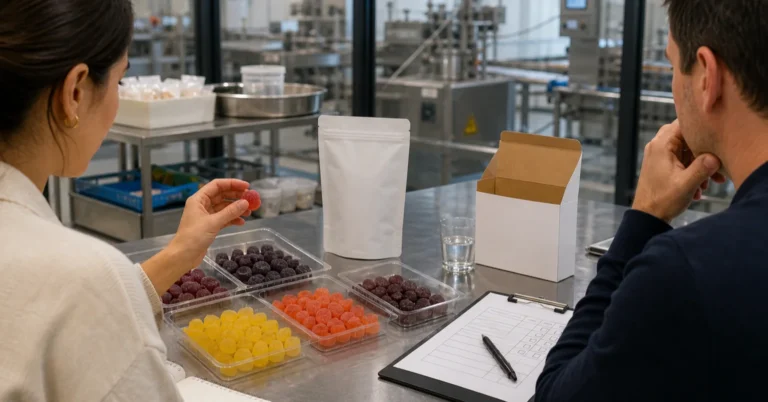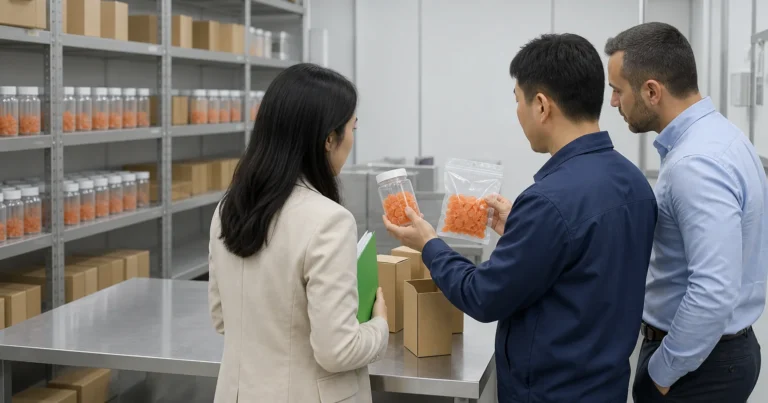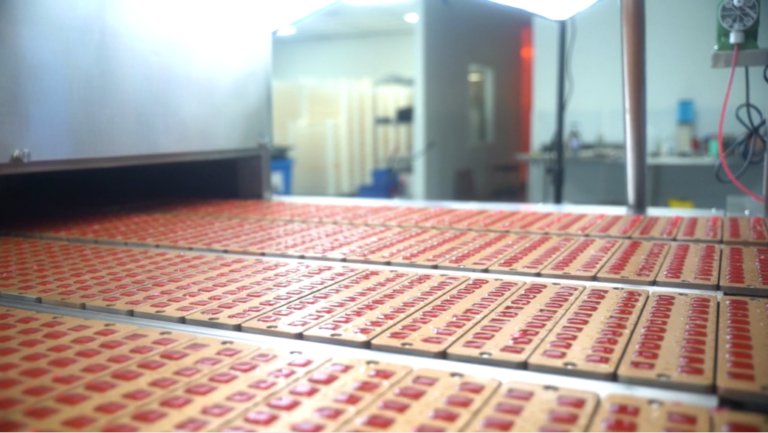
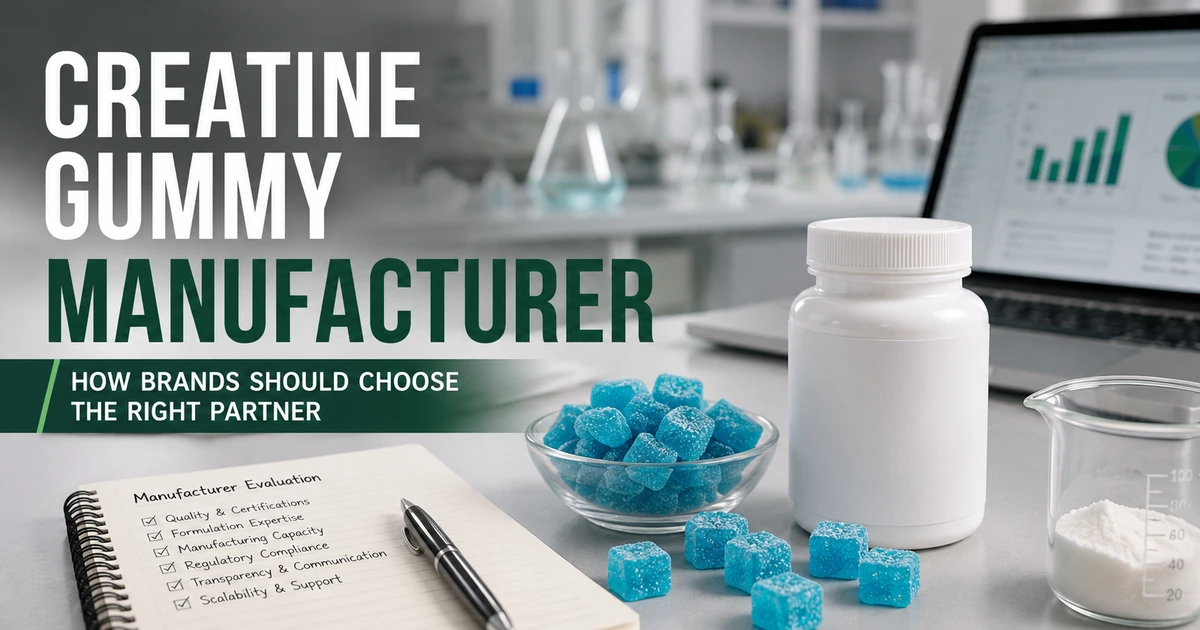

You found a production partner who shows a great sample and a low MOQ. That feels like progress. But creatine gummies are not a sample problem - they are a production problem.
The right creatine gummy manufacturer helps fit the target creatine dose into a chewable format. It protects that dose through production and packaging. It also verifies the finished product against the label claim. The real test is formula skill, process control, and scale-up discipline, not sample quality alone.

I would not judge a creatine gummy manufacturer by who says yes the fastest. Creatine has to be dosed accurately. It also has to sit inside a gummy that holds texture under active load.
The strongest production partner explains those tradeoffs before the first batch. This guide shows how a supplement brand can review a creatine gummy manufacturer before sample approval, quote comparison, or pilot production. For serving math and label planning, review creatine gummy dosage before locking the product brief.
What Should Brands Verify Before Choosing a Creatine Gummy Manufacturer?
The first manufacturer conversation should not start with price alone. Start with whether the supplier understands why creatine gummies are different from standard vitamin gummies.
Before choosing a creatine gummy manufacturer, brand teams should verify creatine-specific formula experience, sample-to-batch repeatability, finished-batch testing, packaging review, and a clear MOQ-to-scale-up path. These checks reduce the risk of approving a good sample that becomes a weak full-batch product.
Talvenda can support this early review before sample approval or quote comparison. The practical review covers target dose, serving count, formula direction, packaging format, document needs, MOQ route, and scale-up assumptions.
Creatine-Specific Formula Experience
A creatine gummy manufacturer should be able to explain how the target dose affects gummy size, serving count, sweetness, acidity, texture, and active spread. If the answer is only "we can make it," the brand has not learned enough.
When the product brief is still comparing creatine forms, review creatine monohydrate vs HCL gummies before turning that choice into a manufacturing specification.
The useful answer is more practical:
- what creatine dose can fit in each gummy without hurting texture;
- whether the serving count will still make sense for consumers;
- which gelling system fits vegan, sugar-free, or clean label goals;
- what tradeoffs may appear before a pilot batch is approved.
Sample-to-Commercial Batch Repeatability
A polished sample does not show that a full batch will behave the same way. Brand teams should ask how the manufacturer controls fill weight, cooling, moisture, coating, and packaging as the formula scales.
Strong suppliers explain what may change during scale-up. They also explain which checks catch drift before finished goods are released.
Testing, COA, and Batch Documentation
For a creatine gummy, the records should connect the ingredient input, the batch, and the finished product. Brand teams should ask which COAs, batch records, in-process checks, and finished-product potency tests are available.
Not every project needs the same testing package. The point is clarity. The manufacturer should state which records support the label claim, retailer review, and target-market rules. If the team wants a practical proof-chain reference, third-party tested creatine gummies shows what a stronger finished-batch file should prove, while is all creatine made in China is the better check when origin and supplier paperwork become part of the buying decision.
Packaging and MOQ Planning
Packaging and MOQ are connected. A bottle, pouch, blister, desiccant, custom label, or export carton can change the real project scope. The manufacturer should explain three points:
- whether a pilot run is possible;
- how packaging choices affect minimums;
- what changes when the project scales.
That conversation is more useful than asking for one MOQ number before the formula and packaging scope are clear.
Why Do Brands Move Creatine Into Gummy and Private Label Formats?
Creatine powder has served athletes for decades. But the creatine buyer has changed. The format that reaches that buyer has changed too.
For brands, the market shift creates a manufacturing question. Can the intended creatine dose be delivered in a gummy that consumers will use consistently?
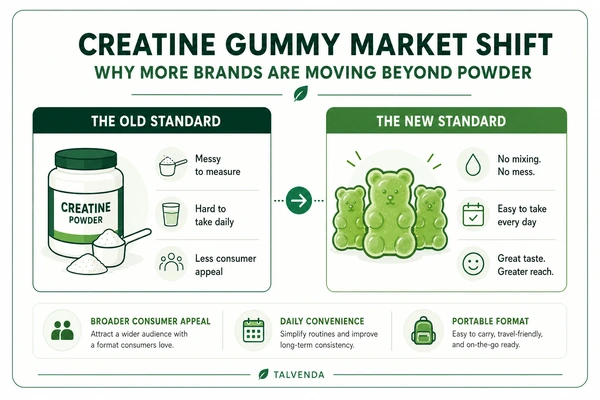
Creatine gummies are growing because they reach consumers who will not use powder. The format removes mixing and fits daily routines. It can also open the product to a broader wellness audience. Still, the gummy format needs formula review, active-load review, packaging review, and clear records.
The Shift from Powders to Gummy Supplements
Powder requires a scoop, a shaker, and the right moment in a workout routine.[^1] Many mainstream fitness consumers find that too much effort. Gummies remove that friction. They are portable, need no preparation, and fit into a daily routine. This tradeoff is also covered in creatine gummies vs powder. If the launch team is evaluating routine-fit messaging instead of manufacturing alone, when to take creatine gummies is the more direct user-behavior companion.
The gummy format also moves creatine out of the sports nutrition section and into the general health aisle. That changes the buyer profile entirely. A product placed in general health can reach people who may not walk into the sports nutrition section.[^2]
Creatine Benefit vs. Gummy Delivery
Creatine monohydrate is one of the most studied active ingredients in sports nutrition.[^3] The evidence for muscle performance and strength support is strong when the user takes an appropriate daily amount.
A gummy format does not create a new benefit by itself. It changes the delivery format. The manufacturing job is to keep the intended dose, texture, and label claim consistent.
Sugar-Free and Clean Label Options
Brands may assess sugar-free and vegan directions as formulation constraints, not stand-alone performance claims. The sweetener and gelling systems should be reviewed for texture, serving design, label fit, packaging, and finished-product testing. For consumer-facing label and dosage considerations, see Sugar-Free Creatine Gummies: Dosage and Label Checks.
What Are the Key Considerations in Creatine Gummy Manufacturing?
Creatine looks like a simple active ingredient. In a gummy, it creates production problems that may not appear until the formula runs at scale.
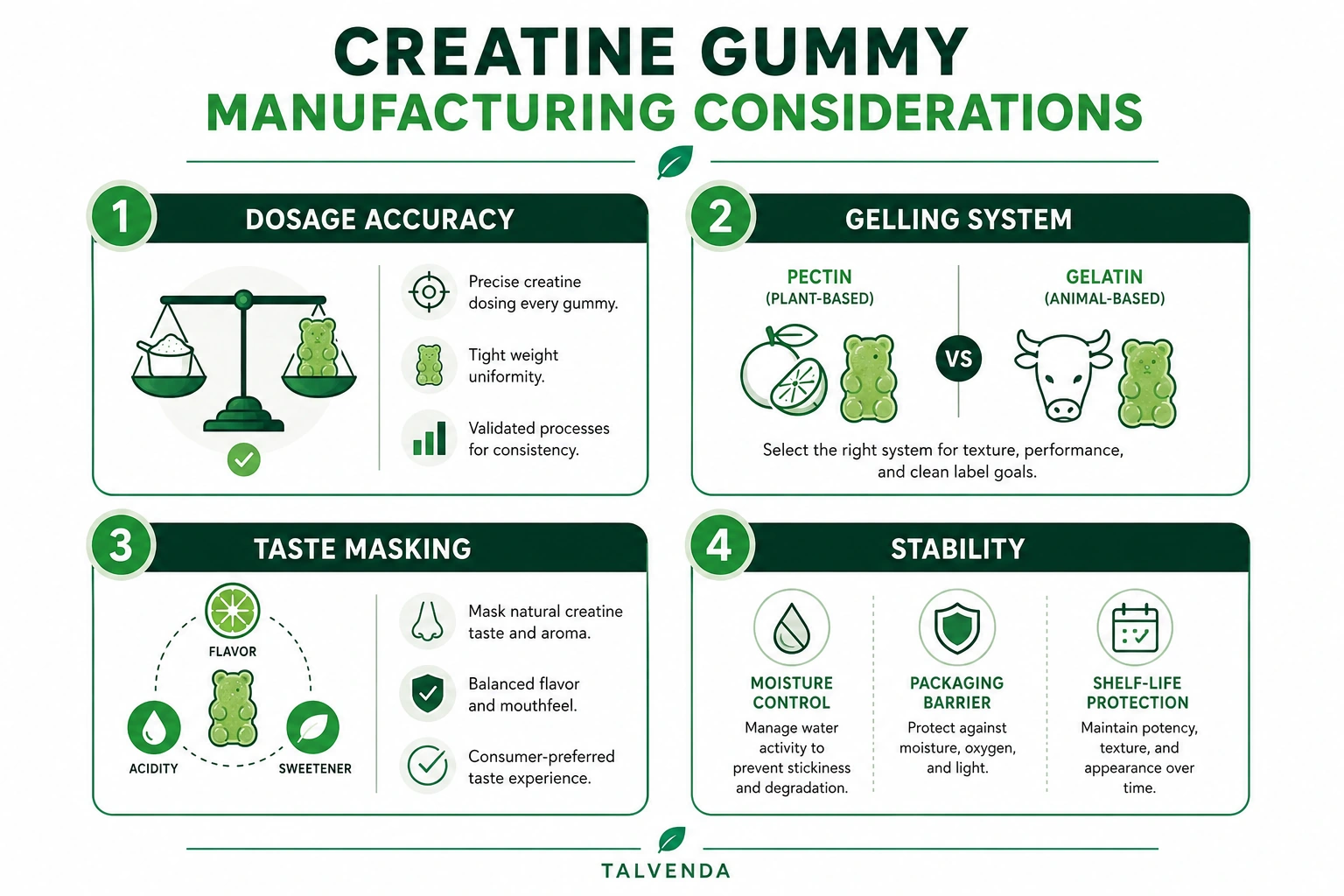
The key manufacturing considerations for creatine gummies are dosage accuracy per piece, gelling agent fit, flavor masking, and ingredient stability. Each one affects production, packaging, and shelf life. None of them works well without clear process decisions.
These are also the questions a brand should ask before accepting a low quote. Each issue affects the real cost of producing a stable creatine gummy.
Formulation and Dosage Accuracy
Many adult creatine protocols use 3g to 5g per day[^5] as a maintenance reference. In gummy form, that amount is often split across several pieces. Even then, each gummy may carry a higher active load than a standard vitamin gummy.
The serving math should be checked against a practical creatine gummy dosage plan before the label is locked.
That creates two production checks:
- blend uniformity before molding, because inconsistent blending can create dose variation across units[^6];
- fill-weight consistency at the depositor, because each cavity affects the delivered dose.
Both problems can appear in finished-product testing and label-claim review.
Gelling Agents: Pectin vs. Gelatin
| Gelling Agent | Strengths | Challenges with Creatine |
|---|---|---|
| Gelatin | Strong structure, handles high active load well | Moisture sensitive, not vegan |
| Pectin | Vegan, clean label, good mouthfeel | pH and sugar balance sensitive[^7]; requires formula tuning |
| Carrageenan blend | Firm texture, stable at room temperature | May affect mouthfeel at high active dose |
The gelling system choice affects more than texture. It affects the whole process:
- cook temperature;
- depositing behavior;
- cooling time;
- final moisture content.
This decision should be made early and tested before a pilot batch is approved. It also belongs inside a broader gummy vitamin manufacturing review, not a flavor-only sample review.
If the brand is still treating pectin and gelatin as a simple vegan checkbox, the more useful follow-on is pectin vs gelatin gummies, because that decision changes label fit, texture expectations, and production control at the same time.
Flavor Masking and Taste Optimization
Creatine monohydrate has a mild but detectable taste. The challenge becomes more obvious as the active load increases.
A manufacturer with high-load gummy experience should understand how flavor systems, acids, sweeteners, and texture work together. If that learning happens during the brand's first project, the timeline usually carries the cost.
Shelf Life and Ingredient Stability
Creatine monohydrate is more straightforward in dry formats. Gummies carry moisture as part of their structure.
Stability testing under relevant storage conditions helps the brand support a shelf-life claim and protect the label.
What Do Private Label, OEM, ODM, and Custom Creatine Gummy Services Include?
Not every manufacturer offers the same level of service. Some produce to your formula. Others develop the formula for you. The scope affects cost, timeline, and risk.
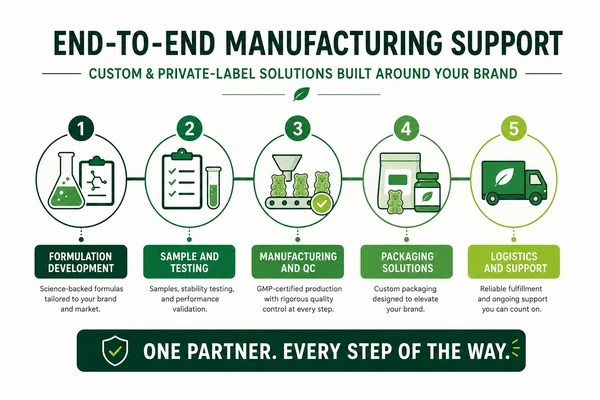
Creatine gummy manufacturing services may include private label, white label, OEM, ODM, custom formula development, equipment support, and document support. The scope varies by manufacturer. Confirming what is included before signing protects the launch timeline. It also makes quote comparisons more useful.
Custom Formula Development and R&D
A manufacturer with in-house R&D capability can develop a formula from a brief:
- target dose;
- texture;
- flavor;
- gelling system;
- label direction.
This matters for brands without formula staff. One point to confirm early is formula ownership. Some programs keep the formula with the manufacturer. Others use a work-for-hire or formula ownership agreement. Brand teams should settle that point before sample work begins.
Private Label, White Label, OEM, and ODM Paths
| Service Type | What It Includes | Best For |
|---|---|---|
| White label | Existing formula, your branding | Fast launch, lower development cost |
| Private label | Existing or semi-custom formula with your label, packaging, and brand requirements | Brand launch with moderate customization |
| OEM / Custom | New formula to your specification | Differentiated product, longer timeline |
| ODM | Manufacturer-designed product with your label | Midpoint between speed and customization |
White label is usually the simplest path when speed matters. Private label can add packaging, flavor, serving, or claim-direction adjustments. OEM or custom development is stronger when the brand needs a formula that is not copied from a catalog.
The right choice depends on two questions:
- how much product differentiation your market position requires;
- how much lead time your launch plan allows.
Advanced Manufacturing Equipment and Capacity
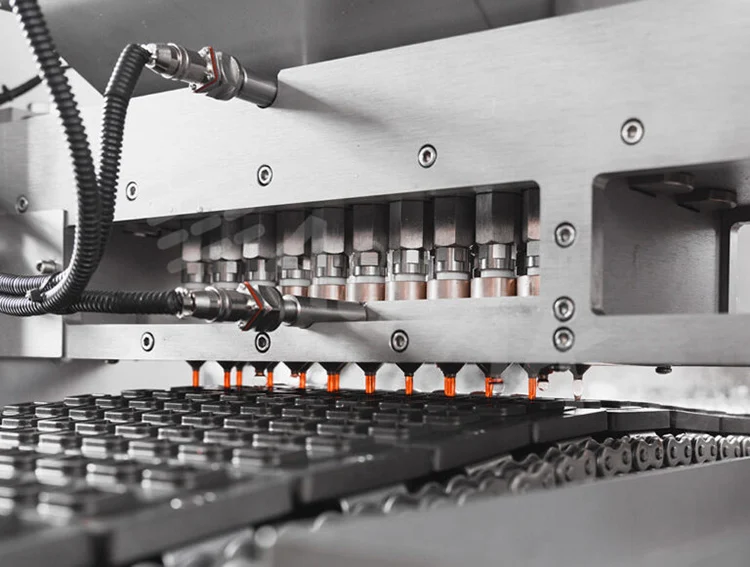
Creatine gummy production at scale needs depositing equipment that can handle a dense gummy mass. Fill weight must stay consistent from cavity to cavity.
Two details matter during scale-up.
- Continuous cooking systems can reduce batch-to-batch variation[^9] compared with smaller batch cooking, depending on the formula and process.
- In-process fill-weight monitoring helps catch dosing drift[^10] before it becomes a quality issue.
Brand teams should confirm equipment setup and realistic capacity before committing to scale-up volumes.
What Should a Creatine Gummy Manufacturer Control from Start to Finished Product?
A creatine gummy looks straightforward to make. The individual steps are not complex. The hard part is controlling all of them together at scale.
A creatine gummy is produced through four main stages: ingredient sourcing and blending, cooking the gummy base with actives, depositing into molds, and cooling before packaging. Quality control and potency testing should support each stage, not only the end. That helps protect dosage accuracy and texture consistency.
A brand does not need to manage every process detail, but it should know which controls the manufacturer can document.
Ingredient Sourcing and Formulation
Creatine monohydrate quality can vary by source, records, particle size, and supplier controls.
For a product making an active-content claim, the production team should use documented creatine input. It should also keep certificate-of-analysis records for incoming lots.
Brand teams should confirm source records, purity specs, and any branded or third-party-verified creatine grade in the formula.
Cooking, Molding, and Coating
| Production Step | Key Control Variable | Risk If Not Controlled |
|---|---|---|
| Cooking the gummy base | Temperature and hold time | Texture degradation, gelling failure |
| Blending in creatine | Mixing time and shear rate | Uneven distribution, dose variation across units |
| Depositing into molds | Fill weight per cavity | Dose inconsistency within a batch |
| Cooling and demolding | Temperature and timing | Surface stickiness, structural defects |
| Coating (if applied) | Coat weight and drying time | Moisture ingress, texture problems at shelf |
Quality Control and Potency Testing
In-process checks should cover:
- fill weight at the depositor;
- visual inspection after demolding;
- moisture content before packaging.
Finished-product potency testing can help verify actual creatine content against the label claim. A COA and batch records give brand teams the files they need for quality review, retailer requests, and market checks.
What Should You Know About Packaging and Branding Customization for Creatine Gummies?
Late packaging decisions add cost and slow launch timing. For creatine gummies, packaging also affects whether the product reaches shelf in the intended condition.
Creatine gummy packaging should control moisture and oxygen exposure to protect texture and potency over shelf life. Common options include HDPE bottles, aluminum pouches, and blister packs. Each option needs a different barrier review. Label rules and brand artwork should be checked before final artwork is approved.
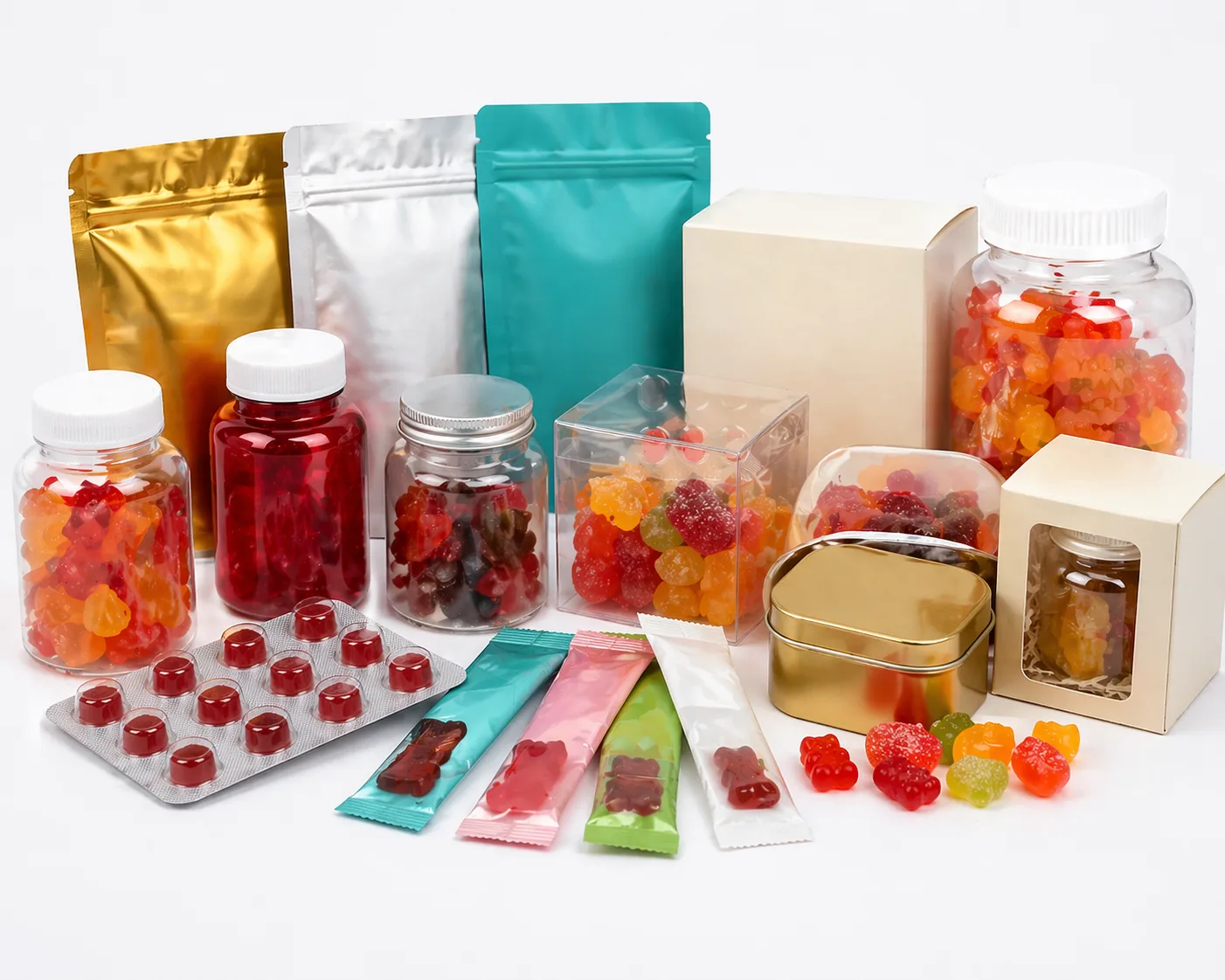
Custom Packaging Options and Bottles
| Packaging Type | Typical Barrier Role | Best Use Case to Confirm |
|---|---|---|
| Standard PET bottle | Limited moisture-barrier role | Lower-risk projects after packaging review |
| HDPE bottle with desiccant | Stronger moisture-control option | Bottle launches that need desiccant planning |
| Aluminum foil pouch | Strong barrier option | Export routes, humid markets, or stronger barrier needs |
| Blister pack | Unit-level protection option | Unit-dose retail or premium positioning |
This is not a last-minute artwork decision. Choose the packaging during formula development. That reduces rework, label reprints, and avoidable shelf-life risk.
Label Design and Compliance Support
Label requirements for creatine supplements differ by market.[^12] The US, EU, Australia, and other target markets can have different rules for:
- supplement facts;
- ingredient lists;
- allergens;
- claims;
- directions;
- warnings.
A production partner with export experience can flag common record and artwork gaps before labels go to print. That can reduce revision cycles and shipment delays.
Bulk and Flexible Order Quantities
MOQ directly affects cash flow for early-stage brands. Some programs allow a smaller pilot or trial run before a full batch. Others need a larger first order because of ingredients, packaging, or setup cost.
Brand teams should confirm two points before launch planning:
- whether pilot pricing is separate from commercial-run pricing;
- how order quantities change as volume increases.
For quote comparison, include packaging format in the first inquiry. Bottle, pouch, blister, desiccant, label, and carton needs can all change the real manufacturing scope.
Final Checklist for Choosing the Right Creatine Gummy Manufacturer
A manufacturer who says yes to everything is not a qualified partner. They are a sales contact. The right partner tells you what will not work before you discover it through a failed batch.
A final creatine gummy manufacturer checklist should confirm the core production risks first: active-load feasibility, label-claim testing, packaging review, batch records, and scale-up repeatability. Certifications, lead times, and logistics support matter. But they should not replace the checks that protect the product itself. Public proof signals also matter. Retail comparisons such as best creatine gummies show why buyers look for that proof. Teams that need a broader supplier-vetting flow can also borrow the question structure from gummy supplement manufacturer checklist.
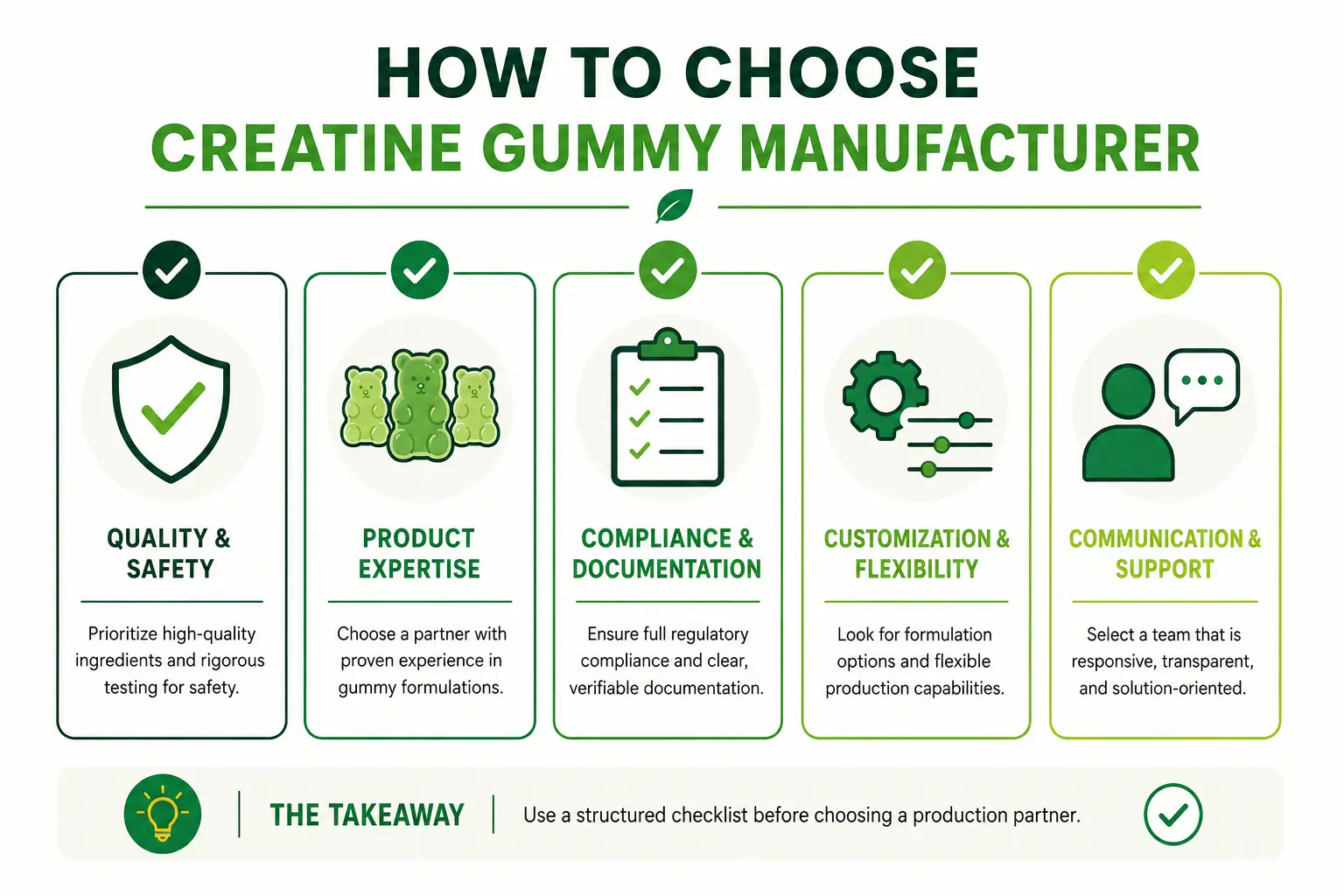
Core Questions to Ask Before Approval
Before approving a manufacturer, brand teams should be able to answer these questions:
| Question | Why It Matters |
|---|---|
| Has the manufacturer handled high-load gummy formulas before? | Creatine changes gummy size, texture, taste, and serving math. |
| How is label-claim accuracy reviewed? | Finished-product testing and batch documentation support product confidence. |
| What changes between sample, pilot, and commercial batch? | A good sample does not show full-batch repeatability. |
| Which packaging format is being quoted? | Packaging affects moisture control, label work, MOQ, and real project scope. |
| What documentation will be available? | COAs, batch records, and testing files support retailer and market review. |
Certifications, Quality Assurance, and Transparency
| Certification | What It Covers | Why It Matters |
|---|---|---|
| cGMP / ISO 22000 | Facility and process standards | Baseline for regulated supplement markets |
| NSF / Informed Sport or similar programs | Third-party testing expectations | May be required by some retailers, sports brands, or tested-athlete programs |
| HACCP | Food safety hazard controls | Standard for food-grade gummy production |
| Halal / Kosher | Religious dietary compliance | Required for specific markets and distribution |
A certified facility is a starting point, not the final answer.
Brand teams should confirm whether the relevant certification or quality system applies to:
- the specific production line;
- the product type;
- the target market requirement.
A certificate is useful only when it connects to the actual process.
Compare Pilot, MOQ, and Scale-Up Support
A production partner that can run a pilot batch is not automatically ready for a large run. Brand teams should confirm:
- how capacity scales;
- what lead-time differences exist between pilot and commercial volume;
- whether similar creatine gummy orders have already run at commercial scale.
If those answers are vague, the brand may be funding the learning curve.
End-to-End Logistics and Supply Chain Support
For brands importing from overseas production partners, supply chain visibility matters as much as production quality.
Lead-time reliability, complete records, export rules, and freight coordination all affect whether product lands on time. Brand teams should clarify who handles export records, freight coordination, and shipment updates before launch timing is locked.
What Do Brands Most Often Ask About Creatine Gummy Manufacturing?
Most brands come to the first manufacturer conversation with the same practical questions. These answers help prepare the first inquiry.
The most common questions about creatine gummy manufacturing cover MOQ, quote preparation, private label vs. custom scope, vegan and allergen-free options, COA review, and creatine stability. Clear answers reduce misaligned expectations and wasted development time.

What Is the Minimum Order Quantity?
MOQ depends on the manufacturer and the product configuration. White label products often carry lower MOQs because the formula is already developed and validated.
Custom formulas, specialized packaging, high active loading, and imported ingredients can raise the minimum. For startup brands, the question is not only the MOQ. The better question is whether a pilot batch or controlled first run is available before a larger order.
What Should I Send Before Requesting a Creatine Gummy Manufacturing Quote?
A useful first inquiry should include:
- target creatine dose per serving;
- desired number of gummies per serving;
- preferred format, such as vegan, sugar-free, low sugar, or standard gummy;
- packaging direction, such as bottle, pouch, blister, or bulk pack;
- launch market and label language;
- expected order route, such as sample, pilot, or commercial batch;
- testing, COA, or documentation requirements.
A specific brief helps the manufacturer identify formula, packaging, MOQ, and testing limits before quoting.
What Is the Difference Between Private Label and Custom Creatine Gummies?
Private label usually starts from an existing or semi-custom formula. The manufacturer then adapts it to the brand's packaging, flavor, serving, or label needs. Custom creatine gummies start from a more specific brief, such as a target dose, gelling system, sweetener system, claim direction, or texture goal.
Private label is useful when speed and launch simplicity matter. Custom development is stronger when the brand needs differentiation, specific active loading, or a formula that cannot be copied from a catalog.
Can You Manufacture Vegan and Allergen-Free Creatine Gummies?
| Attribute | Requirement | Manufacturing Consideration |
|---|---|---|
| Vegan | Pectin-based gelling system | Requires formula rebalancing vs. gelatin base |
| Allergen-free | Dedicated line or documented allergen controls | Confirm with facility audit documentation |
| Sugar-free | Alternative sweetener system | Requires taste and texture retesting |
| Non-GMO | Certified ingredient sourcing | Needs certificate-of-analysis documentation per incoming ingredient |
Many capable gummy manufacturers can produce vegan creatine gummies when the formula uses a suitable pectin-based system. Allergen-free positioning requires more than an ingredient list. It depends on facility controls, production scheduling, records, and the specific claim the brand wants to make.
How Should a Brand Review a COA for Creatine Gummies?
A COA should be reviewed as part of a record chain, not as a standalone promise. Brand teams should check what the COA covers. They should also confirm whether it applies to incoming creatine, the finished gummy batch, or both. The tested items should match the product label and target-market requirements.
For creatine gummies, the key point is finished-product review. The brand needs to know whether the label claim still holds after processing, packaging, and storage conditions are considered.
How Do You Ensure the Stability of Creatine Monohydrate in Gummies?
Creatine stability in a gummy depends on three factors:
- the quality and documentation of the creatine input;
- the moisture activity of the finished gummy formula;
- the barrier performance of the selected packaging.
A strong stability plan starts with moisture control at the end of production. It then matches desiccant and packaging choices to the target shelf life. Before the label uses a shelf-life number, the brand should review suitable stability testing.
Conclusion
A creatine gummy manufacturer should be judged less by its sample and more by how clearly it explains dose delivery, texture limits, testing records, MOQ risk, and scale-up tradeoffs.
Before a creatine gummy project moves from sample approval to production planning, the useful question is whether dose delivery, texture, testing, packaging, and scale-up expectations are already clear. As a contract gummy supplement manufacturer, Talvenda can help brands review low-MOQ market-tested in-stock gummies, stock formula modification, and custom gummy development as three practical paths. That review connects sample development, packaging and label support, documentation and testing expectations, and scale-up support, so your team can choose a route with fewer hidden production assumptions. Send the project brief through the project inquiry form.
[^1]: "The influence of consumers' preferences and perceptions of oral ...", https://pubmed.ncbi.nlm.nih.gov/22744843/. Research on oral supplement and drug dosage forms indicates that palatability, ease of administration, and convenience can affect user preference and adherence, supporting the article’s contrast between prepared powders and ready-to-consume gummies. Evidence role: general_support; source type: paper. Supports: Creatine powder involves more preparation than gummy supplements, and that added preparation can create friction for mainstream consumers.. Scope note: This would support the convenience mechanism generally, but not prove that mainstream fitness consumers specifically reject creatine powder for this reason. [^2]: "BRAND PLACEMENT AND CONSUMER CHOICE: AN IN-STORE ...", https://pmc.ncbi.nlm.nih.gov/articles/PMC2741065/. Retailing and consumer-behavior research shows that store layout, product location, and shelf placement influence product visibility, consideration, and purchase decisions, supporting the general claim that moving a product into a different aisle can broaden shopper exposure. Evidence role: mechanism; source type: paper. Supports: Placement in a general health aisle can expose creatine gummies to a broader buyer profile than placement only in a sports nutrition section.. Scope note: This evidence would support the retail-placement mechanism, but not directly measure creatine gummies or prove that specific shoppers avoid sports-nutrition aisles. [^3]: "International Society of Sports Nutrition position stand: creatine ...", https://pmc.ncbi.nlm.nih.gov/articles/PMC2048496/. The International Society of Sports Nutrition position stand reviews controlled studies on creatine monohydrate and concludes that supplementation can improve high-intensity exercise capacity, lean mass, and strength outcomes when used at established dosing levels. Evidence role: expert_consensus; source type: paper. Supports: Creatine monohydrate is extensively studied and has strong evidence for supporting muscle performance and strength when taken at an appropriate daily amount.. Scope note: This supports creatine monohydrate as an ingredient, not any added benefit from a gummy delivery format. [^4]: "Gelatin - Wikipedia", https://en.wikipedia.org/wiki/Gelatin. Reference sources describe gelatin as an animal-derived collagen product and pectin as a plant-derived polysaccharide, which supports the formulation rationale that replacing gelatin with pectin can make gummies suitable for consumers avoiding animal ingredients. Evidence role: mechanism; source type: encyclopedia. Supports: Using pectin instead of gelatin can make creatine gummies more compatible with vegan consumers and thereby broaden the potential customer base.. Scope note: This supports the vegan-formulation logic but does not quantify the size of the additional addressable market. [^5]: "International Society of Sports Nutrition position stand - PMC", https://pmc.ncbi.nlm.nih.gov/articles/PMC5469049/. Position statements and reviews on creatine supplementation commonly describe maintenance intakes of approximately 3–5 g/day for adults after loading or as a daily regimen, supporting this dosage range as a conventional reference point. Evidence role: expert_consensus; source type: paper. Supports: Many adult creatine protocols use 3g to 5g per day as a maintenance reference.. Scope note: Dosage needs can vary by body size, diet, training status, and clinical context; the source would support a general adult reference range rather than a product-specific dose. [^6]: "Risk-Based Blend and Content Uniformity Assessment: A Case Study", https://www.fda.gov/science-research/fda-science-forum/risk-based-blend-and-content-uniformity-assessment-case-study. Pharmaceutical manufacturing guidance on powder or ingredient blend uniformity describes inadequate mixing as a source of content non-uniformity among finished dosage units, which is directly relevant to active distribution before molding. Evidence role: mechanism; source type: government. Supports: Inconsistent blending before molding can create dose variation across gummy units.. Scope note: Most guidance is written for pharmaceutical solid dosage forms; it supports the manufacturing principle but may not address creatine gummies specifically. [^7]: "Pectin Hydrogels: Gel-Forming Behaviors, Mechanisms, and Food ...", https://pmc.ncbi.nlm.nih.gov/articles/PMC10530747/. Food science references on pectin gels explain that pectin gelation depends on pH, soluble solids or sugar concentration, and pectin type, supporting the claim that pectin gummy systems require pH and sugar control. Evidence role: mechanism; source type: education. Supports: Pectin gummy systems are sensitive to pH and sugar balance and require formula tuning.. Scope note: The evidence would describe pectin gelation generally, not necessarily a creatine-specific gummy formulation. [^8]: "Expiration Dating and Stability Testing for Human Drug Products - FDA", https://www.fda.gov/inspections-compliance-enforcement-and-criminal-investigations/inspection-technical-guides/expiration-dating-and-stability-testing-human-drug-products. Stability literature and regulatory guidance describe water activity, pH, temperature, and packaging as factors influencing chemical degradation and physical quality of food or supplement products during storage, providing contextual support for their relevance to gummy shelf life. Evidence role: general_support; source type: government. Supports: Water activity, acidity, heat exposure, and packaging affect gummy texture and confidence in active content over time.. Scope note: A general stability source would not prove the shelf life of a specific creatine gummy; product-specific stability testing would still be required. [^9]: "Hard Candy", https://encyclopedia.che.engin.umich.edu/hard-candy/. Food engineering literature describes continuous confectionery cooking as providing more stable control of time, temperature, and solids than discrete batch operations, supporting the general claim that continuous systems can reduce process variation. Evidence role: mechanism; source type: paper. Supports: Continuous cooking systems can reduce batch-to-batch variation compared with smaller batch cooking.. Scope note: The support is contextual to confectionery processing generally; actual variation reduction depends on the gummy formulation, equipment design, and process controls. [^10]: "[PDF] FDA Guidance for Industry PAT – A Framework for Innovative ...", https://www.fda.gov/media/71012/download. FDA guidance on process analytical technology and quality systems recognizes in-process monitoring as a means to measure and control critical process and quality attributes during manufacturing, supporting the use of fill-weight checks to detect drift before release testing. Evidence role: expert_consensus; source type: government. Supports: In-process fill-weight monitoring helps catch dosing drift before it becomes a quality issue.. Scope note: The guidance is not specific to creatine gummies; it provides a general manufacturing quality-control rationale. [^11]: "[PDF] How stable are medicines moved from original packs into ...", https://www.ub.edu/farmaciaclinica/projectes/webquest/WQ0/docs/church.pdf. Pharmaceutical and food-packaging literature describes package selection as a stability-control decision, because water-vapor transmission, desiccant use, and barrier materials influence moisture uptake and therefore product shelf life under different storage climates. Evidence role: mechanism; source type: paper. Supports: Packaging format should be selected according to shelf-life goals, market climate, and channel requirements because moisture-barrier performance affects product stability.. Scope note: This support is contextual unless the source specifically tests creatine products in the listed package formats. [^12]: "Dietary Supplement Labeling Guide - FDA", https://www.fda.gov/food/dietary-supplements-guidance-documents-regulatory-information/dietary-supplement-labeling-guide. Regulatory guidance from authorities such as the FDA, European Commission, and Australian government sets jurisdiction-specific requirements for supplement or complementary-medicine labels, including mandatory information, ingredient declarations, claims, warnings, and directions for use. Evidence role: general_support; source type: government. Supports: Creatine supplement label requirements differ across markets such as the US, EU, and Australia.. Scope note: The cited regulations establish that labeling rules vary by jurisdiction; they may not address creatine-specific requirements in every export market.