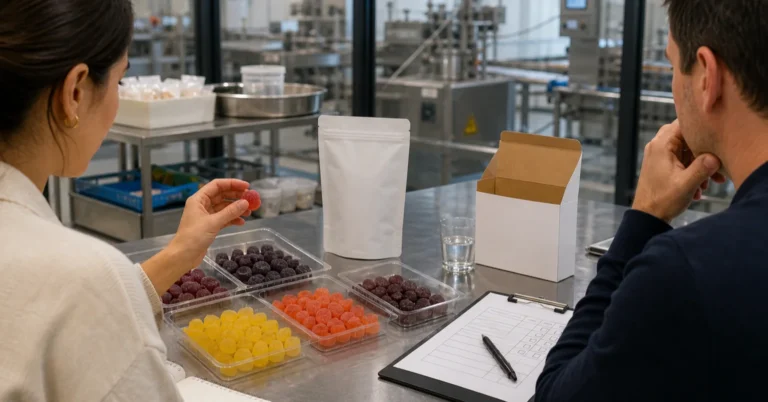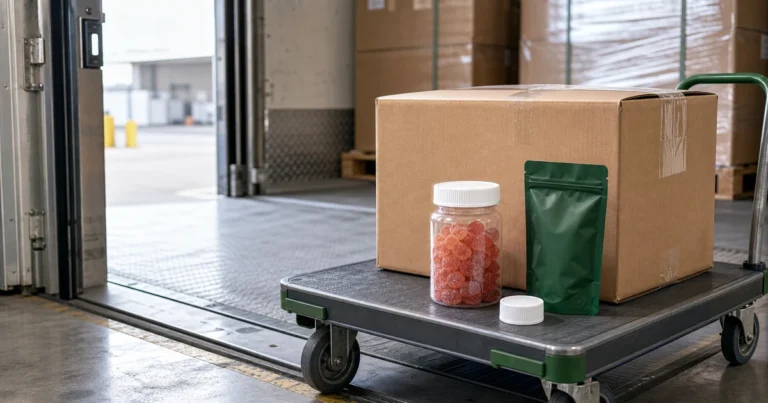


Creatine is easy to sell as a clean label claim. The risk starts when a brand cannot prove where the ingredient actually came from.
No, not all creatine is made in China. Some creatine is made, processed, packed, or marketed through other countries. For supplement brands, the real question is whether the supplier can prove raw material origin, batch quality, and the meaning of any country claim.
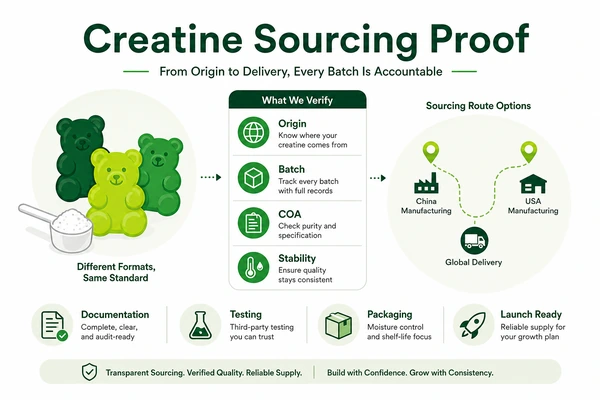
I would not judge a creatine source by country alone. Country matters, but the proof chain matters more. A brand needs to know where the raw material came from, how it was made, which batch was tested, and whether the label language can be supported if a customer, retailer, or compliance reviewer asks for evidence.
Is All Creatine Made in China? Understanding USA vs. China Sourcing
Most brands I talk to have already chosen a creatine source. Fewer have checked what that choice means for label claims, import documents, and quality risk.
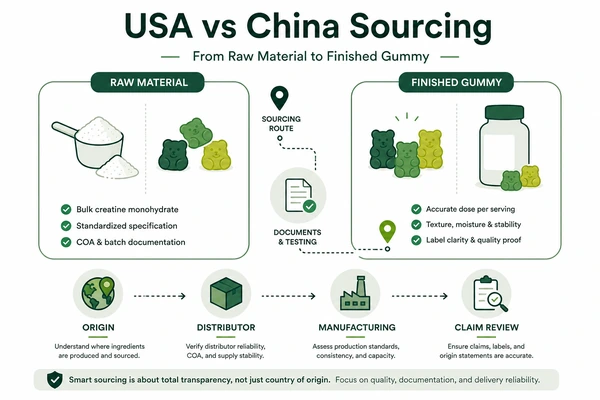
Creatine sourcing should compare origin, production control, testing, documents, and claim support. USA vs. China is useful only when the supplier can show what was manufactured, processed, packed, and certified at each step.
The Global Creatine Supply Chain
Creatine supply is not necessarily a straight line from one factory to one finished bottle.[^1] A raw material supplier may produce creatine monohydrate in one country. A distributor may hold inventory in another country. A gummy manufacturer may use that ingredient in a finished product in a third country. Packaging, labeling, and export may happen somewhere else.
That is why I do not like simple answers when a buyer asks, "is all creatine made in china?" The better question is, "which part of this product's supply chain happened where?" A finished creatine gummy can be made in the United States, Canada, Europe, or Asia while still using imported creatine raw material. A brand can also buy creatine made in USA, but it still needs proof that the specific batch used in production matches the claim.
How Creatine Monohydrate Is Made and Documented
For a supplement brand, creatine monohydrate should be handled like a controlled raw material, not just a commodity powder. The supplier should provide a specification sheet, certificate of analysis, batch number, production date, expiry or retest date, and test results[^2] that match the ingredient standard used in the finished product.
In practical gummy production, I also look at how the ingredient behaves during processing. Creatine has to fit the formula, the target serving size, the flavor system, the texture, and the moisture profile[^3]. A clean COA is important, but it is not the whole story. The ingredient also has to work in a real gummy line without creating unnecessary texture or dosing problems.
Why Country-of-Origin Claims Need Careful Reading
Country-of-origin language can be easy to misunderstand. "Made in USA" may refer to finished-product manufacturing, packaging, or a broader claim that needs stronger support. "Creatine gummies made in USA" may not mean the creatine raw material was made in the United States. It may mean the gummy product was manufactured there using imported or domestic ingredients.
I would ask the supplier to separate these points in writing:
| Claim Area | What a Brand Should Verify | Common Gap |
|---|---|---|
| Raw material origin | Where the creatine was produced | A domestic seller may resell imported creatine |
| Finished product manufacturing | Where the gummy was made | Finished-product location may not prove active-ingredient origin[^4] |
| Packing and labeling | Where final packaging was completed | Packing language can sound stronger than it is |
| Marketing claim | What the brand can safely say | Claim wording may not match the document trail |
| Batch evidence | Whether documents connect to the exact lot | Generic PDFs may not match the production lot |
This is the first place where good suppliers and weak suppliers start to look very different. The same language can be true, unclear, or risky depending on which part of the chain it describes.
The Landscape of Chinese Creatine Manufacturing
Ruling out Chinese creatine without reviewing a specific supplier is not risk management. It is a preference dressed up as a decision.
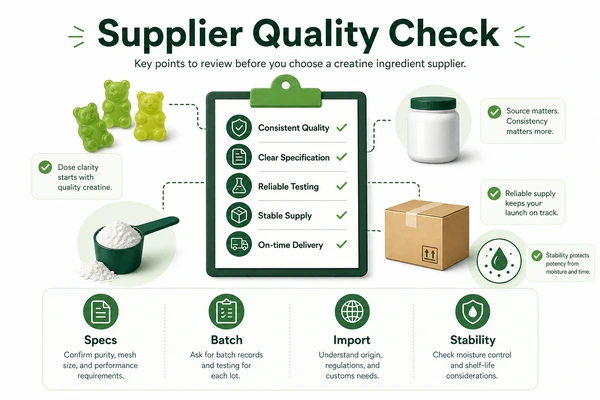
Chinese creatine sourcing can be low-cost and workable, but brands should verify quality systems, batch testing, import documents, and supplier communication before using any origin claim or long-term procurement plan.
Why China Is Often Discussed in Creatine Sourcing
China is often part of supplement sourcing discussions because many ingredient categories have mature industrial supply chains there[^5]. That does not mean every creatine source is Chinese. It also does not mean every China source is weak. The problem is that buyers sometimes turn a sourcing trend into an absolute statement.
When a brand asks where is creatine made, I would answer with documents, not opinion. If a Chinese supplier provides clear origin proof, matching COA, stable specs, and reliable logistics, it may be a practical source. If any supplier, from any country, cannot explain the batch trail, that source can become risky.
Cost Efficiency and Scale of China Sourcing
Cost is one reason Chinese creatine sourcing is discussed. Many buyers expect China sourcing to offer stronger price flexibility, especially at larger order volumes[^6]. This can matter when a brand is building a formula that has a tight retail price target. It can also matter when the finished gummy already has added costs from pectin systems, flavors, active loading, bottle packaging, and testing.
Lower cost does not automatically mean lower quality. It also does not remove the need for control. I would compare total landed cost, MOQ, lead time, batch consistency, communication speed, and document quality together. A cheaper ingredient can become expensive if it delays production or forces the brand to revise a claim after launch.
Quality Control, Testing, and Import Documentation
For any imported creatine raw material, the documentation chain needs to be organized before production starts. The brand should ask for the COA, specification sheet, allergen statement if needed, heavy metal and microbiology testing where relevant, batch record support[^7], and import or export documents that help prove the supply route.
The documents should connect to the actual lot used in the finished product. I have seen buyers collect a clean supplier PDF, then later learn that the production batch used a different lot or a different warehouse shipment. That is a process problem. It can happen in any country when purchasing, formulation, and production teams do not work from the same batch data.
When China Sourcing Can Still Be a Reliable Option
A China source can still be a reliable option when the supplier is transparent, the test results are consistent, and the brand's claim strategy is realistic. The brand should not use country language that the supplier cannot support[^8]. It should also avoid marketing copy that turns a cost decision into a quality promise.
For me, the practical test is simple. Can the supplier support the formula, the production schedule, the label language, and the buyer's documentation needs at the same time? If yes, the source deserves serious review. If no, the country name alone does not solve the problem.
The Rise of USA-Manufactured Creatine
A "Made in USA" phrase sounds simple on a label. In a real supply chain, it can mean several different things.
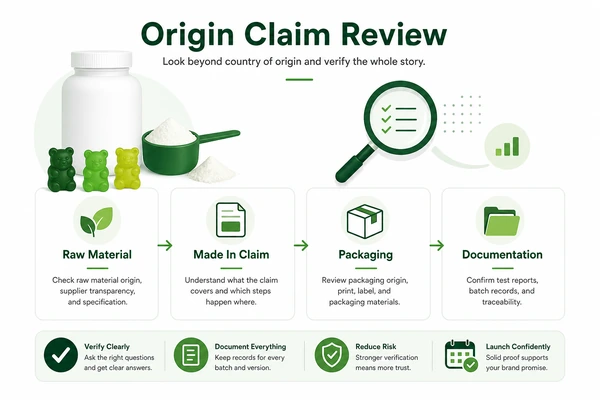
USA-manufactured creatine may support stronger consumer trust and supply security, but brands still need to verify whether the claim applies to raw material production, finished gummy manufacturing, packaging, or marketing location.
Domestic Production Claims and What Brands Should Verify
When a supplier says creatine made in usa, I would first ask what that means in the exact supply chain. Was the creatine raw material synthesized or produced in the United States? Was imported creatine processed or packaged there? Was the finished supplement made there? These are different claims.[^9]
For creatine gummies made in USA, the finished gummy plant may be domestic, but the active ingredient may still come from an overseas source. That can still be acceptable if the claim is written correctly and the documents are clear. The risk starts when the marketing team uses simple language while the supply chain is more complex.
Why USA-Made Claims May Carry a Premium
USA-made claims may carry a premium because buyers often connect them with shorter domestic communication loops, local manufacturing oversight, faster replenishment, and stronger consumer trust[^10]. A domestic source may also reduce some import timing concerns[^11]. These benefits can matter when a brand sells through retailers, marketplaces, or performance-focused communities where origin questions come up quickly.
That premium still needs business logic. If a brand pays more for USA-made positioning, the supplier should help protect that position with documents. The claim should not rest on a sales message. It should rest on batch records, origin statements, production records, and packaging records[^12] that match the final product.
Supply Chain Security and “Made in USA” Claim Clarity
Supply chain security is not only about being domestic. It is about whether the brand can keep product moving with stable quality. A domestic production step may help with lead time and communication. It may also make it easier to visit facilities or align on documentation. But a brand still needs backup plans, raw material availability checks, and clear change-control rules.
I would also separate "Made in USA" from "USA-origin creatine." If the raw material origin is the main selling point, the supplier should prove raw material origin. If the finished gummy manufacturing location is the claim, the brand should write the claim around finished product manufacturing. This distinction protects the brand from overpromising.
Key Differences: Sourcing Creatine from USA vs. China
Country debates can distract from the real buying decision. A brand still has to compare documents, costs, timing, testing, and claim support.
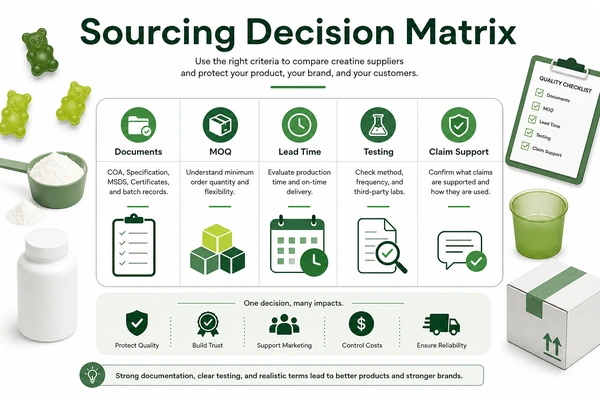
The key differences are not just country labels. Brands should compare regulatory oversight, MOQ, lead time, purity testing, transparency, and whether documents support the exact origin and marketing claims.
Manufacturing Standards and Regulatory Oversight
Different countries and facilities can work under different quality systems, audit habits, and customer requirements. I would not assume a country name proves a standard. I would ask for supplier certifications, facility information, testing scope, and production controls. I would also ask who owns responsibility if a document does not match the batch used in production.
For gummy brands, the finished product manufacturer also matters. Even if the creatine raw material is strong, the gummy plant must control dosing, mixing, cooking or depositing conditions, drying, coating, packing, and shelf-life behavior. Raw material sourcing and gummy manufacturing are connected. One weak step can affect the product.
Pricing, Minimum Order Quantities (MOQ), and Lead Times
China sourcing may offer attractive pricing at scale, but the full cost depends on MOQ, freight, customs, testing, payment terms, and buffer inventory. USA sourcing may reduce some timing friction, but it may cost more or have different capacity limits. Neither path is automatically better.
I usually compare sourcing options with a basic commercial table:
| Factor | USA Source Questions | China Source Questions |
|---|---|---|
| MOQ | Can the supplier support launch volume? | Does price require large volume? |
| Lead time | How fast can repeat orders ship? | How much buffer is needed for import timing? |
| Cost | Is the premium tied to a real claim? | Is landed cost still lower after testing and freight? |
| Documentation | Is origin clearly defined? | Are export and batch documents complete? |
| Claim support | Can the label language be defended? | Does the claim avoid overstatement? |
For market testing, this matters a lot. A startup brand may not need a massive creatine order first. It may need a controlled launch, stable documents, and a fast path to feedback.
Purity, Testing, and Transparency Profiles
Purity should be judged by test results, not by country reputation alone. A supplier should provide a COA that matches the specification. If the brand needs additional testing, the supplier should cooperate with third-party lab review. For a creatine gummy, I would also check how the active ingredient performs in the formula after processing, because a powder spec does not necessarily tell the whole finished-product story.
Transparency is the real difference. Some suppliers answer origin and batch questions clearly. Some answer only with general claims. I trust the first group more, even when the price is not the lowest.
Documentation Risk: COA, Spec Sheet, Batch Records, and Origin Proof
The highest risk often sits in the gap between sales claims and production evidence. A COA may look clean, but the brand still needs to connect it to the lot used in the product. A spec sheet may look professional, but the brand still needs to confirm whether it matches the buyer's quality standard. An origin statement may sound clear, but the brand still needs to know if it covers raw material production, final processing, or packaging.
I would keep these documents organized before approving label copy:
| Document | Why It Matters | What I Check First |
|---|---|---|
| COA | Shows batch test results | Batch number, test date, and whether it matches the lot used |
| Spec sheet | Defines expected ingredient quality | Purity, moisture, particle size, and any application limits |
| Batch record | Connects material to production | Whether the finished product uses the same ingredient lot |
| Origin proof | Supports country-related claims | Whether it covers synthesis, processing, packing, or resale |
| Import/export documents | Shows movement through the supply chain | Whether shipment documents match supplier claims |
| Third-party testing | Adds independent review when needed | Whether the test is batch-specific, not only a sample report |
If the supplier cannot provide this proof chain, I would slow down the project before the brand builds the claim into packaging.
Is All Creatine Made in China? How Brands Should Choose a Creatine Source
A first sample can make almost any supplier look ready. Repeat orders show whether the sourcing system is actually controlled.
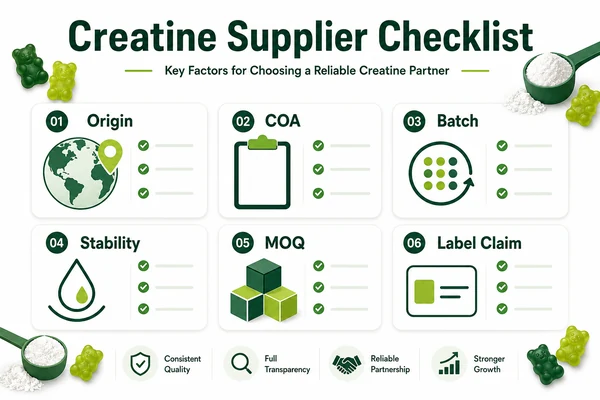
Choose a creatine supplier by sourcing control, document clarity, batch consistency, lead time reliability, and claim support. Country is one factor, but the supplier's proof chain should decide the final choice.
Evaluating Supplier Certifications and Third-Party Lab Results
Before I would use a creatine source in a commercial gummy product, I would ask for current certifications, testing documents, and the supplier's process for batch traceability. I would also check whether the supplier can support additional third-party testing if the brand, retailer, or market requires it. For teams turning that review into a broader supplier screen, the gummy supplement manufacturer checklist is the next practical document.
Certifications are useful, but they are not a substitute for batch-level review.[^13] A certificate can describe a facility or system. A COA describes a batch.[^14] A third-party lab result can add more confidence.[^15] These pieces should work together. If they do not match, the brand should ask questions before production.
Balancing Production Cost, Consumer Claims, and Brand Risk
Creatine sourcing is a commercial decision as much as a quality decision. A lower-cost China source may be workable when the testing and documentation chain is strong. A USA-made claim may still create risk when the brand cannot explain what was made, processed, packed, or only marketed in the United States.[^16]
I would not pay a premium only for a simple country phrase. I would pay for a supply system that helps the brand defend its label, keep batches consistent, and avoid launch delays. For a gummy brand, I would also check whether the creatine source fits the target dosage, serving size, flavor profile, and texture requirements. A source that looks good on paper can still be difficult in production if the formula is not balanced.
Navigating Logistics, Import Documents, and Supplier Communication
Supplier communication becomes very important when raw material origin, production timing, and documents all need to align. The brand should know who provides the COA, who confirms the batch number, who manages shipment documents, and who answers questions from the finished product manufacturer.
I prefer suppliers that answer in specific terms. A good answer sounds like this: "This batch number matches this COA, this origin statement, this shipment record, and this production date." A weak answer sounds like this: "Our creatine is high quality, and many brands use it." The second answer may be true, but it does not help a brand protect its label.
Questions to Ask Before Using a Creatine Source in a Gummy Product
Before a brand uses a creatine source in a gummy, I would ask direct questions:
| Question | Why I Ask |
|---|---|
| Where is the creatine raw material made? | To clarify raw material origin |
| Is the supplier a producer, distributor, or trading company? | To understand how close the answer is to the real source |
| Where is the gummy manufactured? | To separate ingredient origin from finished product claims |
| Can the COA be tied to the production lot?[^17] | To protect batch traceability |
| What testing is available for each batch? | To judge purity and quality review without relying on old sample reports |
| What claim language can the supplier support? | To reduce marketing risk |
| What is the repeat-order lead time? | To plan inventory and launch timing |
| What particle size, moisture profile, or application notes[^18] are available? | To check whether the ingredient can work in a gummy matrix |
| Has the ingredient been tested in a gummy formula? | To reduce texture and dosage problems |
For me, the best supplier is not simply the cheapest or the closest. The best supplier gives a brand a workable formula, clear documents, stable batches, and honest claim boundaries. That is the practical answer behind the question is all creatine made in china.
Conclusion
Creatine origin is only one sourcing signal. For a gummy brand, the stronger question is whether the batch file can support the formula, label claim, finished product, and repeat production.
For a creatine sourcing-led project, Talvenda can support the production side as an OEM/ODM gummy manufacturer by connecting ingredient-source review with the right gummy route: low-MOQ market-tested in-stock gummies, stock formula modification, or custom gummy development. If the target market, creatine form, serving goal, source preference, and claim position are already clear, share the project file so the first review can cover COA expectations, batch traceability, packaging and label support, documentation and testing expectations, and quality-controlled production through GMP-certified and FDA-registered manufacturing facilities. Start with a sourcing and production review.
[^1]: "21 CFR Part 111 -- Current Good Manufacturing Practice in ... - eCFR", https://www.ecfr.gov/current/title-21/chapter-I/subchapter-B/part-111. FDA dietary supplement current good manufacturing practice rules distinguish system-level controls from batch-specific production records and specifications, supporting the point that facility or quality certifications do not replace review of individual batch documentation. Evidence role: expert_consensus; source type: government. Supports: Certifications are useful, but they are not a substitute for reviewing batch-level documents.. Scope note: This supports the quality-control principle in the U.S. dietary supplement context rather than proving requirements in every market. [^2]: "Q7A Good Manufacturing Practice Guidance for Active ... - FDA", https://www.fda.gov/regulatory-information/search-fda-guidance-documents/q7a-good-manufacturing-practice-guidance-active-pharmaceutical-ingredients. USP and other pharmacopeial guidance describe a certificate of analysis as a document reporting test results and specifications for a defined material or lot, supporting its use as batch-specific evidence. Evidence role: definition; source type: institution. Supports: A certificate of analysis describes the test results and specifications for a specific batch or lot.. Scope note: Terminology and document format can vary by industry and jurisdiction. [^3]: "Guidance on CPSC Acceptance of Third Party Laboratory ...", https://www.cpsc.gov/Business--Manufacturing/Testing-Certification/Lab-Accreditation/Guidance-on-CPSC-Acceptance-of-Third-Party-Laboratory-Accreditation. ISO/IEC 17025 and laboratory-accreditation guidance set competence requirements for testing laboratories, providing contextual support that independent laboratory testing can strengthen confidence in analytical results when the lab is appropriately accredited. Evidence role: expert_consensus; source type: institution. Supports: A third-party lab result can increase confidence in ingredient quality review.. Scope note: Accreditation supports laboratory competence but does not prove that any particular sample is representative or that the tested batch will perform in formulation. [^4]: "Complying with the Made in USA Standard", https://www.ftc.gov/business-guidance/resources/complying-made-usa-standard. The U.S. Federal Trade Commission states that unqualified Made in USA claims require that a product be “all or virtually all” made in the United States, supporting the concern that vague domestic-origin language can create substantiation risk. Evidence role: historical_context; source type: government. Supports: A USA-made claim can create risk if the brand cannot substantiate what production steps occurred in the United States.. Scope note: This directly applies to U.S. advertising law; origin-claim standards may differ in other countries. [^5]: "21 CFR Part 111 Subpart I -- Production and Process Control System", https://www.ecfr.gov/current/title-21/chapter-I/subchapter-B/part-111/subpart-I. FDA dietary supplement cGMP regulations require manufacturers to establish and follow batch production records, component specifications, and identity-related controls, supporting the importance of linking quality documents to the relevant production lot. Evidence role: mechanism; source type: government. Supports: A COA should be traceable to the relevant production lot to support batch traceability.. Scope note: The rule establishes manufacturing recordkeeping expectations but does not prescribe one universal COA format. [^6]: "A Comprehensive Review of the Rehydration of Instant Powders", https://pmc.ncbi.nlm.nih.gov/articles/PMC12385211/. Food and pharmaceutical formulation literature reports that powder particle size, moisture content, and material properties can affect mixing, dissolution, stability, and texture, providing contextual support for checking these parameters before using an ingredient in a gummy matrix. Evidence role: mechanism; source type: paper. Supports: Particle size, moisture profile, and application information can affect whether a creatine ingredient works in a gummy formulation.. Scope note: This is general formulation support and may not directly evaluate creatine monohydrate in a specific gummy recipe. [^7]: "Full Report: Global value chain repositioning - OECD", https://www.oecd.org/en/publications/2026/04/global-value-chain-repositioning_e4938a03/full-report.html. Institutional literature on global value chains describes how production commonly spans multiple firms and countries, with inputs, processing, logistics, and final assembly occurring at different stages. Evidence role: general_support; source type: institution. Supports: Creatine products can involve multiple supply-chain stages rather than a single factory-to-bottle path.. Scope note: This would support the supply-chain concept generally rather than proving the structure of any specific creatine product supply chain. [^8]: "21 CFR Part 111 -- Current Good Manufacturing Practice in ... - eCFR", https://www.ecfr.gov/current/title-21/chapter-I/subchapter-B/part-111. FDA dietary supplement current good manufacturing practice regulations require manufacturers to establish component specifications and maintain production and quality-control records, providing regulatory context for batch-level documentation of supplement ingredients. Evidence role: expert_consensus; source type: government. Supports: Supplement brands should verify controlled raw-material documentation such as specifications, COAs, batch identifiers, dates, and test results.. Scope note: The regulations support the need for documented specifications and batch records but may not require every listed document name in exactly the same terminology. [^9]: "Analysis of the efficacy, safety, and regulatory status of novel ...", https://pmc.ncbi.nlm.nih.gov/articles/PMC3080578/. Peer-reviewed studies on creatine stability report that creatine can convert to creatinine in aqueous systems, with degradation influenced by factors such as pH, temperature, and time, supporting the relevance of moisture and processing conditions in formulation. Evidence role: mechanism; source type: paper. Supports: Creatine formulation in gummies should account for moisture and processing conditions, not only a clean certificate of analysis.. Scope note: Such studies generally examine creatine stability in solution or model systems and may not directly measure stability in a specific gummy formulation. [^10]: "Rules of Origin: Substantial Transformation", https://www.trade.gov/rules-origin-substantial-transformation. U.S. country-of-origin guidance distinguishes between the origin of a finished article and the origins of its components, with origin determinations often depending on manufacturing facts such as substantial transformation. Evidence role: historical_context; source type: government. Supports: The place where a finished gummy is made does not automatically establish where its active creatine ingredient was produced.. Scope note: Country-of-origin determinations are fact-specific and can vary by jurisdiction and claim type, so this supports the distinction rather than deciding any particular creatine gummy claim. [^11]: "US drug supply chain exposure to China - Brookings Institution", https://www.brookings.edu/articles/us-drug-supply-chain-exposure-to-china/. Government and institutional analyses of global supply chains identify China as a major manufacturing base for chemical, pharmaceutical, and related input categories, supporting the article’s contextual claim that ingredient sourcing discussions often include China. Evidence role: historical_context; source type: government. Supports: China is often included in supplement ingredient sourcing discussions because many ingredient categories have mature industrial supply chains there.. Scope note: This would support China’s broader industrial role, not prove that a specific creatine lot or supplier is Chinese or reliable. [^12]: "English Text (93.47 KB) - Open Knowledge Repository", https://openknowledge.worldbank.org/bitstreams/ab4c2eab-4e40-5b26-b777-2de2f6c67140/download. Research on manufacturing scale economies and China’s export-oriented industrial production can contextualize why buyers may associate large-volume sourcing from China with lower unit costs or pricing flexibility. Evidence role: general_support; source type: paper. Supports: Many buyers expect China sourcing to offer stronger price flexibility, especially at larger order volumes.. Scope note: Such evidence would be contextual and would not establish current creatine-specific pricing or prove savings for any individual buyer. [^13]: "21 CFR Part 111 -- Current Good Manufacturing Practice in ... - eCFR", https://www.ecfr.gov/current/title-21/chapter-I/subchapter-B/part-111. FDA dietary supplement current good manufacturing practice rules require manufacturers to establish specifications and maintain production and testing records for components and finished batches, which supports the need for organized COAs, specifications, relevant contaminant testing, and batch documentation. Evidence role: expert_consensus; source type: government. Supports: Imported creatine raw materials should be supported by organized documentation such as COAs, specifications, relevant contaminant testing, and batch records before production.. Scope note: FDA rules define U.S. compliance expectations for dietary supplements; exact documentation requirements may differ in other jurisdictions or for non-U.S. products. [^14]: "Complying with the Made in USA Standard", https://www.ftc.gov/business-guidance/resources/complying-made-usa-standard. The FTC’s country-of-origin guidance states that marketers need a reasonable basis for origin claims, supporting the article’s point that country-related marketing language should be substantiated by supplier and production evidence. Evidence role: expert_consensus; source type: government. Supports: A brand should not use country-of-origin language that the supplier cannot substantiate.. Scope note: FTC guidance is specific to U.S. advertising and labeling enforcement and does not address every jurisdiction’s country-of-origin rules. [^15]: "[PDF] Complying with the Made In USA Standard", https://www.ftc.gov/system/files/documents/plain-language/bus03-complying-made-usa-standard.pdf. FTC guidance on U.S.-origin marketing distinguishes unqualified and qualified 'Made in USA' claims and requires marketers to consider where significant processing occurs and where components are sourced. Evidence role: definition; source type: government. Supports: Claims about U.S. synthesis, U.S. processing or packaging, and U.S. finished-product manufacturing are legally and evidentially distinct.. [^16]: "Meta‐Analysis of Consumer Willingness to Pay for Short Food ...", https://pmc.ncbi.nlm.nih.gov/articles/PMC11891576/. Research on country-of-origin effects finds that origin information can influence consumer perceptions of product quality, credibility, and purchase intention, providing contextual support for the claim that U.S.-made positioning may affect trust. Evidence role: expert_consensus; source type: paper. Supports: Buyers may associate USA-made claims with stronger consumer trust.. Scope note: Country-of-origin research is product- and audience-dependent and does not directly prove that creatine gummies receive a price premium. [^17]: "The Impact of the COVID-19 Pandemic on Freight Transportation ...", https://www.usitc.gov/research_and_analysis/tradeshifts/2020/special_topic.html. Government and institutional analyses of supply chains describe how imports can be affected by port congestion, customs procedures, transportation capacity, and international shipping disruptions, supporting the general point that domestic sourcing may reduce some timing exposures. Evidence role: general_support; source type: institution. Supports: A domestic source may reduce some import timing concerns.. Scope note: This supports the mechanism at a general supply-chain level and does not show that every domestic creatine source has shorter or more reliable lead times. [^18]: "Small Entity Compliance Guide: Current Good Manufacturing ... - FDA", https://www.fda.gov/regulatory-information/search-fda-guidance-documents/small-entity-compliance-guide-current-good-manufacturing-practice-manufacturing-packaging-labeling. FDA dietary supplement current good manufacturing practice regulations require manufacturers to maintain records such as batch production records and packaging or labeling records, supporting the need for documentary substantiation of finished-product claims. Evidence role: mechanism; source type: government. Supports: USA-made positioning should be supported by production, origin, batch, and packaging documentation rather than by sales statements alone.. Scope note: FDA GMP rules support recordkeeping for quality and manufacturing control; separate FTC guidance is still needed for the advertising substantiation standard for U.S.-origin claims.