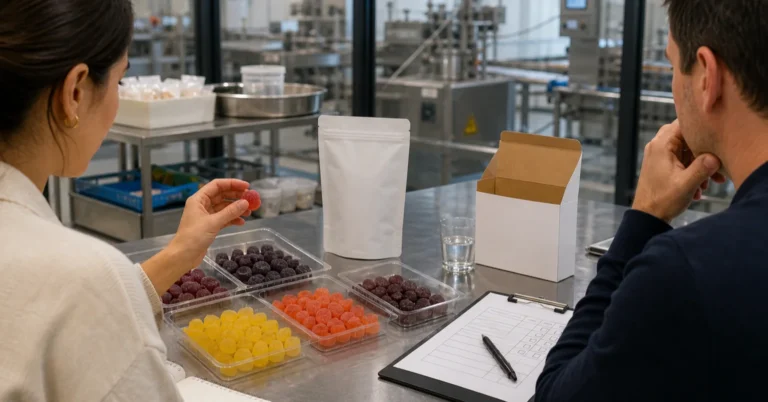

Third party tested creatine gummies should prove a finished product claim, not just display a quality phrase.
A strong file for third party tested creatine gummies should connect batch-specific finished-product testing to the product name, lot number, test date, active content, safety checks, moisture control, and label claim. A raw creatine COA alone does not prove the finished gummy sold to buyers.
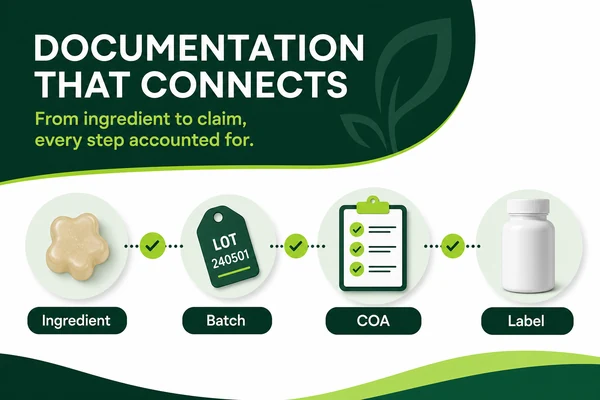
I treat third-party testing as a documentation chain, not a marketing badge. A testing label can help sell the product, but without the test object, test date, and batch link, the phrase does not prove what buyers often assume. I have also seen strong raw material documentation without finished-product verification, and that gap is where many quality questions begin.
What Third-Party Tested Should Mean for Creatine Gummies
Testing language is easy to print on a product page. It becomes weak when nobody can show the test object, batch, or supported result.
A strong third-party testing claim for creatine gummies should connect the finished gummy batch to the label claim, not only to raw ingredient paperwork. The claim should show the test object, lab, lot number, test date, and result scope.
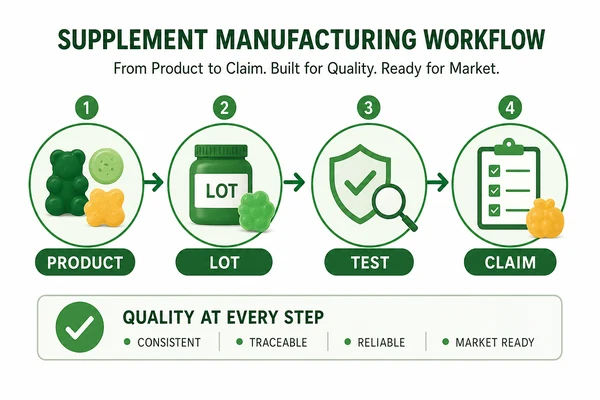
Creatine gummies are not just creatine powder in a different container. The gummy manufacturing format adds active loading, moisture control, texture, flavor, packaging, and shelf-life limits.
Also, third-party tested only describes who ran the test.[^1] It does not define what the test covered. That is why a useful testing claim needs to follow the product through manufacturing, not stop at the ingredient.
Testing Claim vs. Marketing Phrase
"Third-party tested" becomes a marketing phrase when it does not answer basic quality questions.
A serious testing claim should answer these questions:
| Question | Why It Matters |
|---|---|
| What product was tested? | It separates the finished gummy from a raw ingredient or development sample. |
| Which batch or lot was tested? | It connects the report to the bottle or shipment being sold. |
| What was tested for? | It shows whether the report supports active content, contaminants, moisture, or another claim. |
| Does the result match the label claim? | It confirms whether the test supports the consumer-facing promise. |
If a brand cannot answer those questions, the claim may still sound strong on a product page. It is not strong enough as a quality file.
Finished-Gummy Proof
For creatine gummies, finished-gummy proof is the center of the claim.
A finished-product test should confirm that the gummy after manufacturing still supports the intended specification. Depending on the product and market, that may include active creatine content, microbial limits, heavy metals or other contaminants, moisture-related checks, and shelf-life support.[^2]
The most useful report ties back to the actual production lot. If a brand sells bottles from Lot A, the strongest proof should connect to Lot A or to a clearly traceable production batch.
I would not treat a pilot sample or generic raw material report as proof for a commercial bottle. Finished-gummy proof should mean the gummy as sold: cooked, dried, packed, labeled, and connected to the lot in distribution.
Raw Powder vs. Finished Product
A raw creatine COA still matters. It can help confirm supplier quality, ingredient identity, purity, and incoming material specifications.
But a raw powder COA does not prove the finished gummy delivers the labeled creatine amount.
| What Was Tested | What It Proves | What It Does Not Prove |
|---|---|---|
| Raw creatine monohydrate COA | Incoming ingredient identity and purity | Finished gummy dose, stability, texture, or lot match |
| Development sample | Early formula feasibility | Commercial production consistency |
| Finished-batch COA | Result from a manufactured gummy batch | Future batches unless each batch is linked |
| Lot-matched finished batch | The strongest support for the sold product | Performance, medical benefit, or guaranteed user result |
Between raw material intake and final sale, the product may go through blending, heating, depositing, cooling, drying, coating, packing, and storage. The final serving may also depend on gummy weight control and active distribution across pieces.
That is why I treat raw COA and finished-product testing as two separate layers in the same documentation chain.
Why Finished-Batch Testing Matters More Than a Raw Creatine COA
A raw creatine COA supports the ingredient. Finished-batch testing supports the product on sale. Mixing those two ideas can create weak claims.
For third party tested creatine gummies, finished-batch testing matters because it links the actual gummy lot to active content, contaminant checks, moisture control, and label-claim support. A raw COA cannot capture what happens during cooking, drying, packing, and storage.
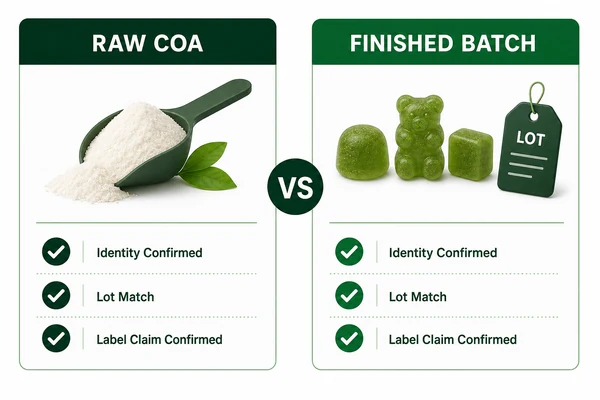
This distinction matters in gummy development because formula feasibility and label credibility have to work together. A formula can look workable on paper and still need finished-batch proof before the brand should lean on a testing claim. If the brand is still comparing active-form choices before it locks the test plan, creatine monohydrate vs hcl gummies is the cleaner formulation follow-on.
Raw COA Limits
A raw material COA usually describes the ingredient before manufacturing. It may show identity, purity, assay, heavy metals, microbial limits, or other supplier-specific parameters.
That information is useful, but it has limits:
- It may not reflect the final gummy.
- It may not match the sold lot.
- It may not test active content per gummy or per serving.
- It may not account for manufacturing conditions.
- It may not support the exact label claim on the bottle.
The mistake is not using a raw COA. The mistake is treating it as finished-product proof. If the supplier also wants to make an origin story part of the sales claim, is all creatine made in China is the better companion check because the COA still has to match the source and batch trail.
In real production work, I see the raw COA as the starting condition. It documents the ingredient as received, not the ingredient after gummy processing. It is not the delivery confirmation.
Processing and Storage Risk
Creatine gummies are processed dosage forms. During production, variables such as temperature, water activity, pH, drying time, piece weight, packaging, and storage environment can affect the finished product profile.
That does not mean every batch is unstable or unsuitable. It means the testing plan should match the format.
| Production Variable | Why It Matters For Creatine Gummies |
|---|---|
| Cooking temperature | It can affect active content if the process is not controlled. |
| Water activity | It connects to texture, microbial risk, and shelf-life planning. |
| pH and acidic coatings | They can affect creatine stability and claim confidence. |
| Drying time | It affects moisture, gummy weight, and serving consistency. |
| Packaging barrier | It affects moisture control during storage and shipping. |
If a brand claims a defined amount of creatine per serving, the finished-batch test should help confirm that the actual serving supports that claim. If the product needs to remain acceptable through shelf life, the brand should have a moisture and shelf-life plan instead of relying only on launch-day assumptions.
Batch-Matched Label Claims
The strongest label claim is batch-matched.
That means the COA or test report connects to the specific production batch, lot number, or shipment on sale. If the label says the product provides a defined amount of creatine per serving, the test should support that serving claim.
For buyers and distributors, this is one of the simplest checks. Ask whether the report matches the product name, lot number, and label claim. If the answer is unclear, the testing language is probably too broad. On the manufacturer side, I would fold those same questions into a broader supplier-vetting review such as the gummy supplement manufacturer checklist before approving the commercial launch path.
| Document | Useful Role | Limit |
|---|---|---|
| Raw material COA | Confirms ingredient input quality | Does not prove finished gummy serving content |
| GMP record | Shows process control and documentation discipline | Does not replace finished-batch testing |
| Finished-batch COA | Supports the actual manufactured product | Must match the product and lot being sold |
| Shelf-life or stability record | Supports claim confidence over time | Needs to connect to packaging and storage assumptions |
How to Read Third-Party Testing Claims for Creatine Gummies on a COA
A COA can look official and still fail to support the commercial claim. The first job is to match the document to the product.
To review a creatine gummy COA, check whether the product name, lot number, test date, method, active content, and quality checks match the batch being sold. Then check whether the active result connects clearly to the labeled serving size.
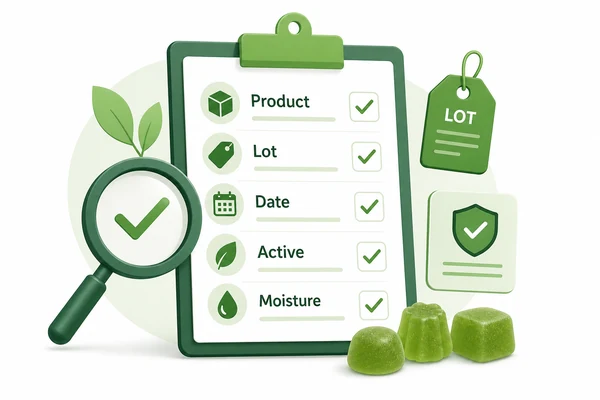
Do not stop at the lab logo. Start with the matching details, then review whether the test result connects to the label and product specification.
Product and Lot Match
First, check the basics:[^3]
- Product name
- Batch number
- Lot number
- Sample description
- Test date
- Report date
- Manufacturer or client name where applicable
If those fields do not match the bottle, shipment, or finished batch, the report may still be useful background documentation. Do not treat it as direct proof for the sold product.
This is where many testing claims become vague. A brand may have a valid document, but the document may support a raw material, pilot batch, or earlier production run rather than the current finished product.
Active Content Per Serving
For creatine gummies, review active content in a way that connects to the serving claim.
A test result per gummy can be useful if the label serving is based on a defined number of gummies. A test result per serving can be useful if it clearly defines the serving size. What matters is that the math is traceable.
| COA Expression | Practical Question |
|---|---|
| Creatine per 100g | Can this be converted into the labeled serving size? |
| Creatine per gummy | Does the label define how many gummies make one serving? |
| Creatine per serving | Does the report define the serving clearly? |
| Assay of raw creatine | Does this only describe the ingredient before production? |
If the report only lists a bulk result without clear serving logic, it may not be enough for confident claim support. A result per 100g can look credible on a COA, but it still needs serving-weight math before it can support the Supplement Facts panel. This is a common gap when a product moves from formula development into commercial packaging.
Contaminant and Moisture Checks
Depending on the product, market, and brand requirements, a finished-product COA may include checks such as:
- Heavy metals
- Microbial limits
- Yeast and mold
- Pathogens where required
- Moisture or water activity
- Relevant shelf-life indicators
Not every report will look identical. Requirements can vary by market, customer, channel, and specification.
For gummies, moisture-related controls deserve special attention because texture, shelf life, microbial risk, and packaging performance can connect. A COA that only checks active content can still be a partial document when the product, market, or channel also expects contaminant and moisture checks. A brand should understand how the plan manages moisture and shelf-life expectations.
Sold Batch Verification
The final question is simple: does this document support the batch being sold?
A useful verification chain connects:
- Raw material COA
- Production batch record
- Finished-product COA
- Lot number
- Packaging record
- Label claim
- Retain sample
- Shelf-life plan
When those pieces connect, third-party testing becomes more than a badge. It becomes a defensible quality story. When one piece is missing, the brand may still have useful paperwork, but the claim becomes harder to defend.
Lab Names, Certification Programs, and GMP Claims Are Signals, Not Proof
Recognized labs, certification programs, and GMP claims can support trust. They do not replace batch-specific proof.
Lab names and certification signals are helpful only when the report clearly shows what was tested, which batch was tested, and what the result proves. A logo or facility claim is a signal, not a substitute for finished-product documentation.
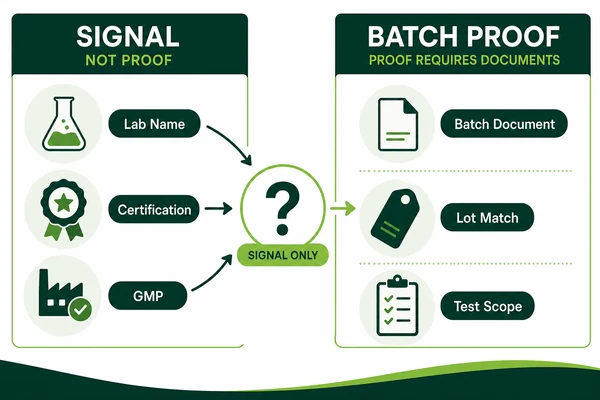
Names like NSF, Informed Choice, Labdoor, Eurofins, ISO 17025, and GMP may indicate stronger quality and certification systems or testing discipline.[^4] The document still has to prove the right thing.
Recognized Lab Signals
A recognized lab or certification program can help buyers feel more confident that a qualified team handled the testing.
ISO 17025 accreditation, for example, can signal that a lab follows recognized competence standards for testing and calibration activities within its accredited scope.[^5] Other programs and lab names can help brands communicate quality expectations to retailers, distributors, or consumers.
But the value depends on the actual report. A familiar name does not automatically tell you whether the test covered active creatine content, contaminants, microbes, or a finished commercial batch.
What Lab Names Do Not Prove
A lab name does not prove:
- The finished gummy was tested.
- The current lot was tested.
- The label claim was verified.
- The serving-size math is accurate.
- The product is more effective.
- The product has medical benefits.
- The claim applies to every future batch.
This is why brands should avoid logo-driven trust language. A lab name can support credibility when it is tied to a specific document, but it is weaker as a standalone trust signal. The underlying documentation still needs to answer practical questions.
The practical questions matter more than the visual weight of the logo: what was tested, who tested it, when it was tested, which batch it came from, and which specification it was tested against.
GMP vs. Finished-Product Testing
GMP and finished-product testing are related, but they are not the same.
A GMP facility claim speaks to manufacturing systems, procedures, documentation, and quality controls.[^6] It helps show that the production team manages work under structured standards.
Finished-product testing speaks to the actual batch result.
| Claim Or Record | What It Supports | What It Does Not Prove Alone |
|---|---|---|
| GMP facility claim | Process control, procedures, documentation habits | Specific finished batch active content |
| ISO 17025 lab report | Lab competence within the tested scope | That the sold batch was the sample tested |
| NSF or similar certification signal | Stronger testing or audit expectations when applicable[^7] | Any claim not covered by that program or batch |
| Finished-batch COA | Product-specific result for a defined batch | Future batches or performance outcomes |
A brand should not use GMP language as a replacement for finished-batch verification. Good manufacturing systems reduce risk, but they do not remove the need to confirm that a creatine gummy batch supports its label claim.
A Practical Proof Chain Brands Should Prepare Before Launch
Brands should plan the proof chain before launch, not add testing language after production. Build the file before writing the marketing claim.
A launch-ready proof chain should connect raw material records, finished-batch testing, lot traceability, label claims, packaging records, retain samples, and shelf-life support. Each record should point back to the same product and batch.
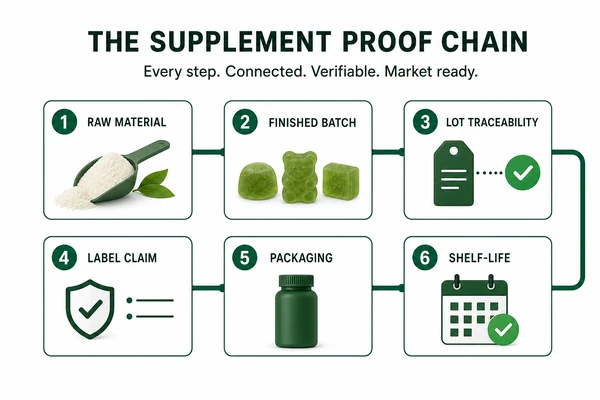
This is where testing becomes part of product development. The earlier the documentation plan is built, the easier it is to keep claims realistic and defensible.
Raw Material Documentation
Start with the ingredient layer.
For creatine, brands should collect and review supplier documentation such as raw material COA, ingredient specification, identity information, allergen or contaminant statements where relevant, and supplier qualification records.
If the creatine source changes between batches, add the new supplier's documentation separately. Do not treat a COA from one supplier as proof for a different supplier's material, even when the ingredient name looks the same.
This layer helps confirm that the input material is appropriate. It also gives the manufacturer a baseline for formulation and quality control.
But it remains the first layer. Raw material documentation should feed into the finished-product proof chain, not replace it.
Finished-Batch Testing
Plan finished-batch testing around the product claim.
If the label promises a certain amount of creatine per serving, the test plan should support active content verification. If the market, customer, or channel expects contaminant testing, microbial testing, or other quality checks, include those checks in the specification.
Pilot batch testing can help during development, but commercial batch testing is what supports the product being sold.
For private label and custom gummy projects, discuss this early because it affects timeline, cost, sampling, release decisions, and claim confidence. I would rather plan the test at the beginning than discover after packaging that the file cannot support the claim cleanly.
Lot-Level Traceability
Lot-level traceability connects the product to the proof.
A brand should be able to trace from raw material lot to production batch to finished bottles. If there is a quality question later, traceability helps identify what the team made, when they made it, which materials they used, and which test records apply.
| Record Type | What It Should Capture |
|---|---|
| Raw material intake record | Supplier, ingredient lot, COA, receiving date |
| Batch production record | Formula, quantities, processing dates, line details |
| In-process checks | Weight, texture, moisture, and process observations where applicable |
| Finished-batch COA | Active content and quality panel connected to the batch |
| Packaging record | Bottle, label, lot code, retain sample, and release status |
| Distribution record | Which lots moved to which channels or customers |
Without lot-level traceability, even a good COA becomes less useful because the brand may not be able to connect it to the product in the market.
This also matters for distributors and retail buyers. They may not want a long technical explanation. They want confidence that the paperwork matches the goods.
Label, Packaging, and Shelf-Life Records
The final proof chain should connect the test result to the consumer-facing product.
That includes:
- Label claim
- Supplement facts panel
- Serving size
- Batch or lot coding
- Packaging format
- Retain sample
- Shelf-life or stability plan
- Finished-product COA
For gummies, packaging and shelf life are especially important because moisture, texture, and storage conditions can influence product quality. A launch-ready product should have a plan for how the claim remains supported over the intended shelf-life period.
What Third-Party Testing Claims for Creatine Gummies Should Not Imply
Testing language should support quality verification, not stretch into claims it cannot prove. Overclaiming makes a strong quality file weaker.
Third-party testing can support active content and quality checks, but brands should not use it as an effectiveness, dosage, medical, safety, or performance guarantee. Testing documentation proves what is in the batch. It does not prove what the product will do for every user.
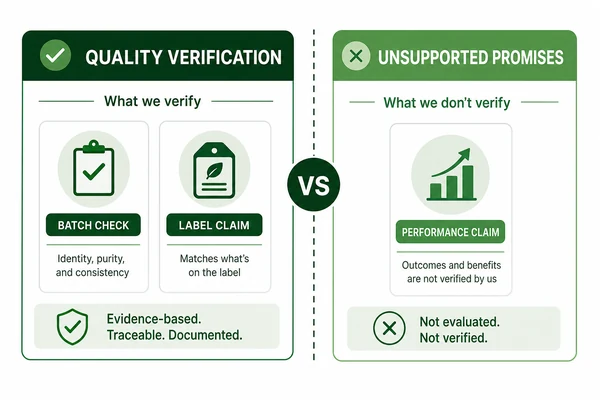
This is a practical compliance boundary. Clear testing language is stronger than inflated promise language.
Not an Effectiveness Guarantee
Third-party testing does not automatically prove that a creatine gummy produces better results than another format or another product.
Testing can support what is in the product. It can help confirm active content and certain quality parameters. It does not, by itself, prove performance outcomes.
Brands should avoid turning testing language into a results promise. If a brand uses performance language, that claim needs its own substantiation route. Do not borrow it from a COA.
Not a Replacement for Dosage Clarity
Testing also does not replace clear dosage communication.
If a product uses multiple gummies per serving, the label should make that clear. If the test reports active content per serving, the report should define that serving. If the product uses a lower-dose positioning strategy, the brand should be careful not to imply more than the formula supports.
A tested product can still confuse buyers if serving-size math is unclear.
| Claim Type | What Testing Can Support | What It Cannot Support Alone |
|---|---|---|
| Contains a defined amount per serving | Active content result tied to the serving | Whether the serving is ideal for every buyer |
| Batch tested for listed quality checks | Results for the tested batch | All future batches without matching records |
| Manufactured under controlled systems | Process documentation and GMP records | The active content of the finished batch |
| Supports performance positioning | Only if separate evidence supports the claim | Medical or guaranteed performance outcomes |
Not a Medical or Performance Promise
Third-party testing should not become a medical claim, disease claim, or guaranteed performance claim.
For supplement brands, the safer and stronger position is to use testing language to support quality verification: what was tested, which batch was tested, and how the result connects to the label.
That is enough. A clear documentation chain is more defensible than inflated promise language.
Frequently Asked Questions
Testing questions usually come down to whether the paperwork matches the finished gummy batch. Broad testing language is not enough.
The most reliable answers depend on batch-specific documentation, not broad testing language or a familiar lab name. The strongest proof connects the COA, lot number, serving size, label claim, and sold product.
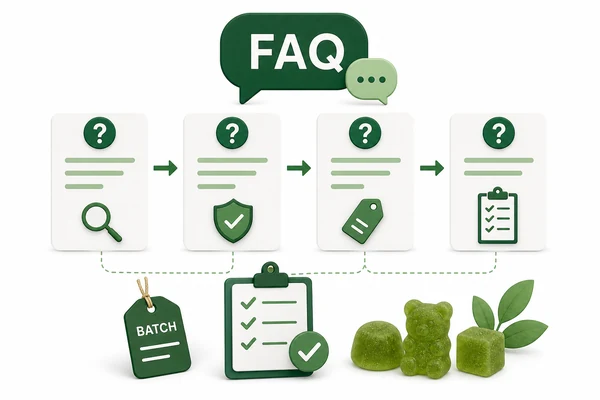
Use these questions to check whether a testing claim is specific enough to support the product being sold.
Is a raw material COA enough for creatine gummies?
No. A raw material COA is useful, but it does not prove the finished gummy delivers the labeled creatine amount after manufacturing, packing, and storage.
Stronger proof includes finished-batch testing tied to the product name, lot number, test date, and label claim.
What should a creatine gummy COA show?
A useful creatine gummy COA should show the product name, batch or lot number, sample details, test date, method, active creatine content, and relevant safety or quality checks.
For gummies, moisture, microbial, contaminant, and shelf-life support may also be important depending on the product specification and market.
How can you check whether a dose claim matches the tested batch?
Check whether the COA or test report matches the finished product lot and whether the active content result connects to the labeled serving size.
If multiple gummies make one serving, the test result should support that serving math clearly.
Are all lab-tested creatine gummy claims equally reliable?
No. A lab-tested claim is only as reliable as the documentation behind it.
A recognized lab name can be a good signal, but buyers still need to know the test object, batch, result, and link to the actual product on sale.
Conclusion
Third-party testing is persuasive only when the report follows the finished batch. A raw ingredient COA or generic lab claim cannot carry the finished creatine gummy by itself.
For a creatine gummy claim, the risk is not only whether testing exists, but whether the proof file can support the label story when retail partners, marketplaces, or internal quality teams ask for details. As a contract gummy supplement manufacturer, Talvenda can help brands review low-MOQ market-tested in-stock gummies, stock formula modification, and custom gummy development before claims, packaging, and testing scope are locked. That route review connects documentation and testing expectations, packaging and label support, quality-controlled production, and GMP-certified and FDA-registered manufacturing facilities, giving the project a clearer proof and production path. Start with the project inquiry form.
[^1]: "BSCG's overview of third-party supplement testing", https://www.bscg.org/blogs/single/third-party-supplement-testing-what-it-is-and-why-it-counts. This is an elink-returned industry source used here for general testing-language context. It does not verify any specific creatine gummy product. [^2]: "CTLA Testing's dietary supplement testing overview", https://ctlatesting.com/blogs/articles/testing-requirements-for-dietary-supplements. This is an elink-returned lab-industry source used here for broad finished-product testing context. Actual test scope still depends on the product, market, and specification. [^3]: "CTLA Testing's COA overview", https://ctlatesting.com/blogs/articles/certificate-analysis-for-food-dietary-supplements. This is an elink-returned lab-industry source used here for general COA reading context. This article still requires product and lot matching before a COA supports a sold batch. [^4]: "NSF supplement certification", https://www.nsf.org/consumer-resources/articles/supplement-vitamin-certification, and "Informed Sport certification process", https://sport.wetestyoutrust.com/about/certification-process. These are useful references for certification-program context. This article treats those names as quality signals, not proof that any specific creatine gummy is certified. [^5]: "ISO/IEC 17025", https://www.iso.org/standard/66912.html. This is the international standard for the competence of testing and calibration laboratories. NIST also lists "ISO/IEC 17025:2017", https://www.nist.gov/standard/706, as a standards reference. [^6]: The FDA explains dietary supplement current good manufacturing practice requirements on its "Dietary Supplement CGMPs" page, https://www.fda.gov/food/guidance-regulation-food-and-dietary-supplements/current-good-manufacturing-practices-cgmps-food-and-dietary-supplements. elink also returned "21 CFR Part 111 on eCFR", https://www.ecfr.gov/current/title-21/chapter-I/subchapter-B/part-111, which is useful legal-context support for GMP discussion. This article uses GMP language only as a process-control signal. [^7]: "NSF Certified for Sport", https://www.nsf.org/consumer-resources/articles/certified-for-sport-program. This is a sports-supplement certification program reference. A certification signal should still be checked against the actual product, batch, and claim scope.