
A gummy idea can sound ready before it is ready for production. The gap usually appears when the brand asks for a quote.
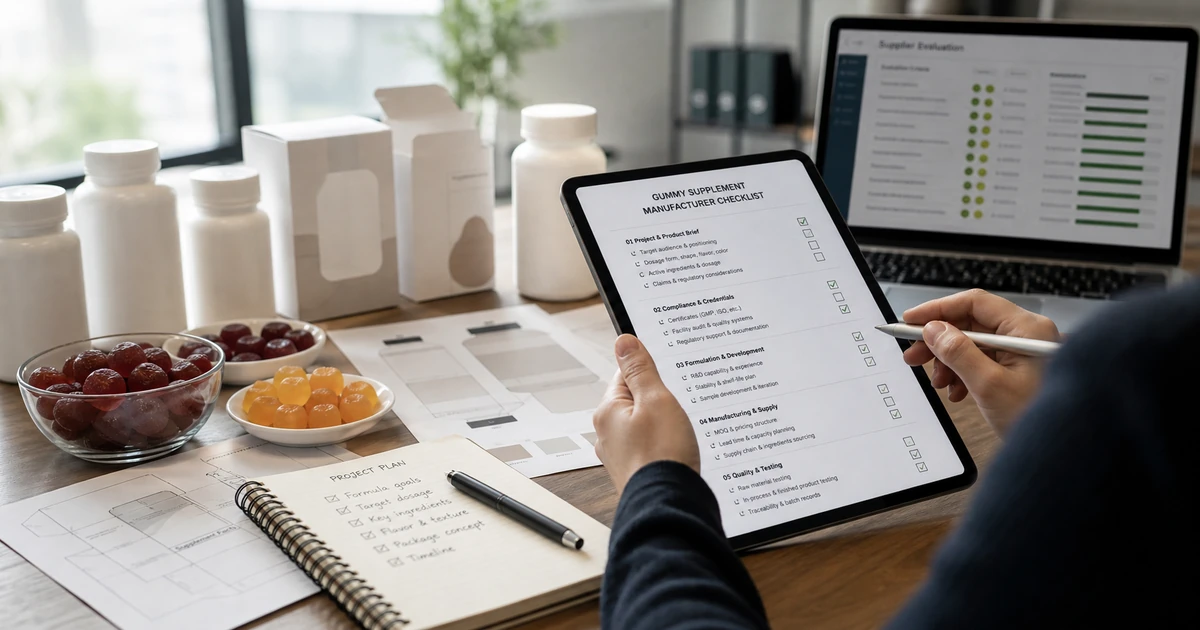
A useful gummy supplement manufacturer checklist helps a brand prepare formula route, dose target, gummy base, packaging plan, testing needs, MOQ, sample expectations, and launch timeline before speaking with suppliers. The goal is not only choosing a factory. The goal is making the project quote-ready.
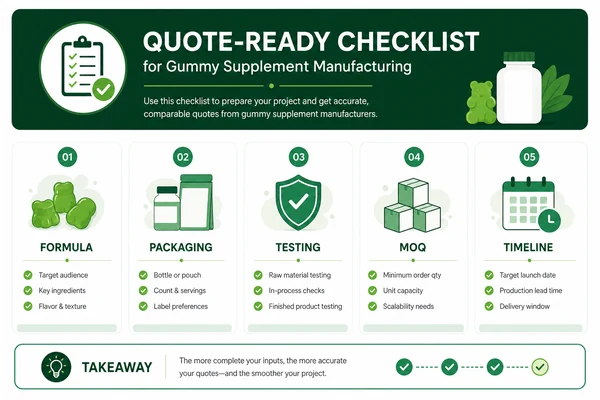
I would not start a manufacturer search with the question, "Can you make gummies?" Most suppliers will say yes. The better question is, "Can you review this product brief and tell us where the production risks are?"
That difference matters. A vague inquiry creates vague pricing, weak sample planning, and late-stage surprises. A clear brief helps the manufacturer evaluate active loading, texture, base system, packaging, documentation, and timeline before money is spent on the wrong sample path.
This checklist is for startup supplement founders, product managers, ecommerce teams, and wellness brands that want a stronger first conversation with a gummy supplement manufacturer. It helps compare suppliers more fairly because each manufacturer is answering the same project scope.
If the broader business plan is still being defined, start with Talvenda's guide on how to start a supplement brand before narrowing the manufacturer checklist.
Why Brands Need a Gummy Supplement Manufacturer Checklist
Many gummy projects fail early because the first conversation is too broad. The brand asks for private label gummies before the factory knows what must be built.
Brands need a gummy supplement manufacturer checklist because gummy production connects formula, serving size, texture, packaging, testing, MOQ, and claims. If those details are missing, the supplier has to guess. That makes quotes less useful and samples less reliable.

Why a vague gummy idea leads to quote, sample, and scale-up problems
A vague brief may sound simple. It may say, "We want a vegan sleep gummy," "We want a beauty gummy," or "We need private label gummies with low MOQ."
That gives a product category. It does not give the manufacturer enough detail to price, sample, or scale the project.
The manufacturer still needs to understand target user, active ingredients, dose per serving, gummy count, gelling system, sweetener preference, flavor direction, shape, bottle or pouch format, sales channel, label direction, and expected launch date.
When those details are missing, each stage carries assumptions.
| Stage | Common assumption | What can go wrong |
|---|---|---|
| Quote | Standard base and standard package will fit | Price changes when formula, package, or testing scope becomes real |
| Sample | A pleasant sample is enough | Sample may not match the active dose, serving size, or commercial package |
| Packaging | Bottle or pouch can be chosen later | Moisture, count size, desiccant, and label space may force changes |
| Scale-up | The approved sample will behave the same in production | Texture, piece weight, drying, or coating can drift at batch scale |
This is why I prefer to approach the first inquiry as a product-readiness conversation, not a price request. The first manufacturer meeting should expose risks. It should not hide them behind a fast sample.
How manufacturer selection affects quality, timing, and brand reputation
Choosing a gummy supplement manufacturer is not only a purchasing decision. It affects whether the product can support its label, whether the commercial batch matches the approved sample, and whether the launch timeline survives real production.
The wrong partner may still deliver a sample. The problem is what happens after that. A weak manufacturer may not explain dose limitations, label-claim risk, pectin versus gelatin tradeoffs, packaging requirements, or finished-product testing early enough.
A stronger partner asks more questions before saying yes. That can feel slower at first, but it usually protects the brand later.
| Manufacturer behavior | What it may mean for the brand |
|---|---|
| Says yes before reviewing formula details | Hidden feasibility problems may appear after sample work starts |
| Quotes before packaging and testing scope is clear | Later cost changes become more likely |
| Cannot explain sample-to-batch controls | Production consistency risk is higher |
| Avoids documentation questions | Retailer, marketplace, or compliance review may become harder |
| Explains tradeoffs early | The brand can plan cost, timeline, and proof needs more honestly |
For a new brand, reputation is fragile. One weak batch, delayed launch, label issue, or texture complaint can damage trust before the product has time to grow.
Start With a Quote-Ready Private Label Gummy Supplement Manufacturer Brief
The most common mistake I see from new brands is requesting a gummy manufacturing quote before defining the product. The quote is not the starting point. The brief is.
A quote-ready private label gummy supplement manufacturer brief should define target user, sales channel, product promise, active ingredients, serving size, gummy base, packaging format, quality documents, MOQ expectation, sample needs, and launch timing. Without this, a manufacturer cannot quote the project with confidence.

Target user, sales channel, product promise, and launch goal
A gummy sold on Amazon, in clinics, through TikTok Shop, in retail, or through a practitioner channel may need different planning. The sales channel affects packaging, label review, claim language, documentation, price target, and timeline.
The brand should also define the product promise in plain language. Is the gummy for sleep routine, beauty support, kids' vitamins, energy, stress support, sports nutrition, fiber, hair support, or daily wellness? The manufacturer does not need final marketing copy first. It needs the practical product direction.
Prepare these points before requesting a quote:
| Brief item | Why the manufacturer needs it |
|---|---|
| Target consumer and age group | Affects serving size, flavor, warnings, and package count |
| Sales country or region | Affects label, documentation, and market-specific review |
| Sales channel | Affects packaging, carton, testing, and timeline needs |
| Main benefit direction | Helps evaluate actives, claims, and formula route |
| Desired serving size | Connects dose math to gummy size and count |
| First order size | Helps the supplier discuss MOQ and production planning |
| Target launch date | Shows whether the timeline is realistic |
This gives the manufacturer a commercial frame. A formula that works for a premium clinical channel may not fit a low-cost marketplace launch. A fast stock launch may not support a differentiated brand platform. The brief should make those tradeoffs visible.
Stock formula, private label, semi-custom, or custom formulation
Not every brand needs full custom formulation. Some brands need a fast stock route. Others need private label packaging around a proven formula.
Some need semi-custom changes such as flavor, color, shape, packaging, or selected active adjustments. A smaller group needs full custom gummy formulation.
If the launch goal is speed, check whether the manufacturer has ready-to-market gummy formula options that can be reviewed before moving into deeper customization.
The checklist should force this route decision early.
| Route | Best fit | What to confirm |
|---|---|---|
| Stock formula | Fast launch and market testing | Available documents, label flexibility, exclusivity limits |
| Private label | Brand launch with familiar formula base | Packaging, MOQ, label review, lead time |
| Semi-custom | More differentiation without full R&D | Which changes affect cost, MOQ, and timeline |
| Custom formulation | Ownable formula or special active system | R&D cost, sample rounds, formula ownership, scale-up plan |
For brands comparing route options, Talvenda's gummy vitamin manufacturing partner resource can help connect formulation choices with production planning.
Private label gummies vs white label gummies
Private label gummies and white label gummies are often used as if they mean the same thing. For a brand preparing a manufacturer inquiry, I would separate them because the project scope changes quickly.
White label gummies usually start from an existing stock product that can move faster with limited changes. The brand may mainly adjust label, packaging, count size, carton, and channel preparation. Private label gummies can still start from a stock or proven formula, but the brand usually expects more control over packaging presentation, label direction, market positioning, documentation needs, and sometimes limited formula or sensory adjustments.
That difference affects the quote. A white label route may be mostly about available SKU, MOQ, label files, packaging fit, lead time, and documents. A private label route should also define the brand promise, formula route, packaging system, claim boundary, quality file, and scale-up plan. If the project needs broader formulation, packaging, compliance, and coordination support beyond one stock SKU, Talvenda's custom services for private label gummy projects page is the better service-page follow-on.
| Route question | Why it matters before quoting |
|---|---|
| Is the formula fixed, semi-custom, or fully custom? | Changes sample work, ownership, MOQ, and lead time |
| What can be changed at low MOQ? | Separates label-only work from real product changes |
| Which packaging formats are available now? | Prevents a private label plan from depending on unavailable components |
| What documents come with the route? | Clarifies COA, batch records, testing scope, and market support |
| Can the project scale after the first order? | Prevents a fast launch from becoming a reorder problem |
First order size, target price, sample expectations, and timeline
A manufacturer cannot give a serious quote without order-size and timeline context. A 1,000-bottle test, a 10,000-bottle first launch, and a larger annual plan are different projects.
The brand should also define what it expects from samples. Does the team need flavor samples only, formula-active samples, packaging mockups, pilot samples, or production-prepared samples? Each option means a different level of work.
The same is true for price. A brand does not need to reveal every margin detail, but it should know its target cost range. If the target cost is unrealistic for the formula, packaging, and testing scope, it is better to learn that before development begins.
Use a simple quote-prep table:
| Project variable | Brand answer |
|---|---|
| First order target | |
| Reorder expectation | |
| Target launch date | |
| Target bottle or pouch count | |
| Target cost range | |
| Sample type needed | |
| Market / sales region | |
| Required documents |
This turns the inquiry into a real project conversation.
Check Regulatory Compliance and Manufacturer Credentials
Certificates look impressive, but they are not the whole compliance story. A buyer still needs to know what those credentials cover.
When checking a gummy supplement manufacturer, brands should verify facility registration context, cGMP alignment, quality-system documents, market-specific certifications, label-review support, and the difference between a real credential and a marketing claim.
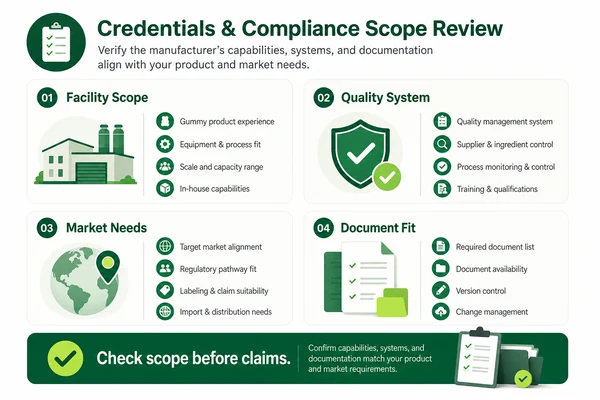
FDA registration, cGMP, and facility quality systems
For U.S.-market dietary supplements, brands often ask whether a facility is FDA registered or cGMP compliant. That question is useful, but it must be understood correctly.
FDA registration is not the same as FDA approval of a product, formula, or manufacturer. It is a facility registration signal, not proof of quality by itself.[^1] A responsible manufacturer should be able to explain the registration scope and the quality systems behind its production.
cGMP review should be practical. Ask how the manufacturer handles written procedures, personnel training, sanitation, component control, specifications, quality control operations, batch production records, packaging and labeling control, product complaints, and recordkeeping.[^2]
The brand does not need to audit every line item in the first call. It should ask whether the supplier can provide a clear quality-document package before production.[^3]
Organic, Non-GMO, Halal, Kosher, allergen, and market-specific needs
Some projects need extra certifications or controls. Vegan gummies may need pectin and broader material review. Halal or Kosher projects may need certification alignment across gelatin, pectin, flavors, colors, processing aids, and facility controls. Organic, Non-GMO, allergen-free, sugar-free, or clean-label projects may also need documented ingredient support.
The key point is scope. A manufacturer may have one certification, but that does not mean every formula, ingredient, line, or packaging option automatically fits it.
Before using any certification as a selling point, ask:
- Does this certificate apply to the facility, product category, ingredient, or finished product?
- Does it cover the exact formula route we want?
- Does it apply to the market where we plan to sell?
- Can we use the logo or claim on packaging?
- What documents will be available before label printing?
This protects the brand from using compliance language that sounds stronger than the documentation behind it.
What documentation to request before moving forward
A strong supplier should be comfortable discussing documents. The exact package depends on the project, but the early checklist can include:
| Document or record | Why the brand asks for it |
|---|---|
| Facility registration or quality-system summary | Confirms basic manufacturing context |
| cGMP or audit documentation | Shows quality-system maturity |
| Ingredient specifications | Defines what goes into the formula |
| Supplier COAs | Supports raw-material review |
| Formula or master manufacturing record summary | Shows production control logic |
| Batch production record availability | Supports traceability |
| Finished-product COA | Supports label-claim and release review |
| Micro and heavy metals testing scope | Supports safety and retailer review |
| Label and packaging review process | Reduces mislabeling risk |
Do not wait until after the first batch to ask about these records. Document expectations should be part of the quote conversation.
Evaluate Formulation and Customization Capabilities
A good gummy manufacturer is not only a plant with equipment. It also needs formulation judgment.
Brands should evaluate whether the gummy supplement manufacturer can review active ingredients, dose targets, serving size, gelatin or pectin base, flavor masking, sweetener system, texture, shape, color, and coating before sample approval.
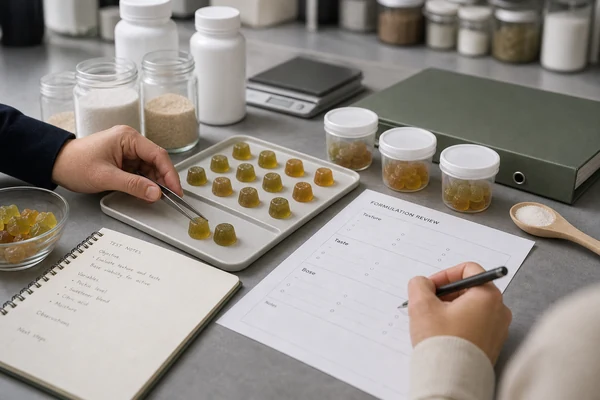
Active ingredients, target dose, and serving-size feasibility
Gummies have less room than capsules or powders. Every active ingredient competes with the gummy base, sweeteners, acids, flavors, colors, water content, and gelling system. A formula that works on paper may become too large, too bitter, too sticky, or too unstable in gummy form.
If the formula may be better served by another dosage form, make the gummies vs capsules decision before requesting final samples or quotes.
The manufacturer should be able to discuss dose feasibility before sampling. A high-load mineral, creatine formula, fiber formula, botanical blend, or multi-ingredient sleep gummy may need a larger serving, different texture target, stronger flavor system, or a different product route.
Ask these questions:
- What dose can fit per gummy without hurting texture?
- How many gummies per serving would the formula require?
- Will the active ingredient affect taste, color, pH, or stability?
- Does the formula need a stock, semi-custom, or custom route?
- What finished-product test should confirm the label claim?
For active-loaded projects, creatine gummy manufacturer planning can help frame dose and proof-chain questions.
Gelatin vs pectin, vegan, sugar-free, and low-sugar options
The base system affects more than the label. Gelatin, pectin, sugar-free systems, low-sugar systems, and clean-label sweetener choices all change production behavior.
Gelatin can give a familiar chew and strong structure, but it does not fit vegan positioning. Pectin can support plant-based positioning, but it needs careful control of pH, solids, texture, and process conditions. Sugar-free or low-sugar directions can create different texture, sweetness, aftertaste, and shelf-life questions. If the team is still deciding between the two base systems, pectin vs gelatin gummies is the better formulation-specific follow-on.
The manufacturer should not present these choices as simple menu options. They are formulation decisions.
| Requirement | What to ask the manufacturer |
|---|---|
| Vegan or vegetarian | Which gelling system is used, and what other ingredients must be checked? |
| Sugar-free | Which sweetener system is used, and how does it affect texture and digestion tolerance? |
| Low sugar | How much sugar can be reduced before texture changes? |
| Clean label | Which colors, flavors, acids, and processing aids are acceptable? |
| Heat-sensitive actives | How will the process protect the ingredient? |
If the manufacturer cannot explain the tradeoffs, the brand may be approving a sample without understanding production risk.
Flavor masking, color, texture, shape, and coating expectations
Consumers judge gummies by taste and texture first. The brand may judge the product by the ingredient story. The manufacturer has to make both sides work together.
Bitter botanicals, mineral notes, high active loads, acids, and some sweeteners can all affect flavor. Color can shift during production or storage. Shape can affect drying, demolding, coating, packaging fit, and piece weight. Coating can reduce stickiness or improve appearance, but it may also affect the sensory experience and label.
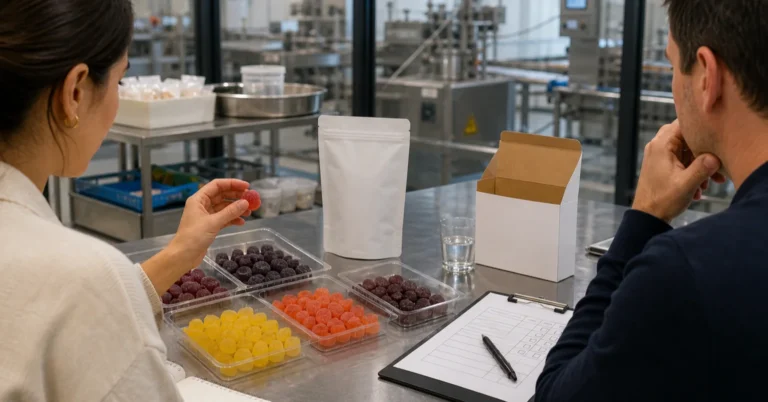
I would ask for a sample review form instead of casual tasting feedback. The form should cover:
- flavor strength;
- aftertaste;
- chew and hardness;
- stickiness;
- shape and size;
- color;
- smell;
- serving experience;
- packaging fit;
- concerns before pilot or commercial production.
Sample approval should be a controlled decision. It should not be only "the team liked the taste."
Review Production Capacity, MOQ, and Lead Time
MOQ is one of the first questions brands ask. It is also one of the easiest questions to misunderstand.
MOQ and lead time depend on formula route, ingredient purchasing, packaging format, sample rounds, testing scope, line scheduling, and reorder planning. A useful gummy supplement manufacturer checklist separates first-order MOQ from the real commercial path.
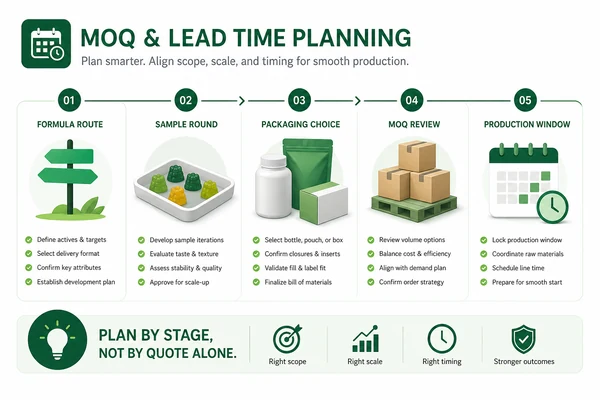
MOQ differences for stock, semi-custom, and custom gummy projects
A stock formula may have a lower or more flexible MOQ because the base formula and process are already familiar. A semi-custom project can still be efficient if the changes are limited. A full custom project may need higher MOQ because of ingredient purchasing, R&D work, line setup, testing, or packaging minimums.
The brand should not ask only, "What is your MOQ?" Ask by route:
| MOQ question | Why it matters |
|---|---|
| What is the MOQ for a stock formula? | Shows the fastest launch baseline |
| What is the MOQ if we change flavor, color, or shape? | Separates simple customization from deeper changes |
| What is the MOQ for custom formulation? | Shows real development commitment |
| Are packaging minimums separate? | Prevents bottle, cap, pouch, label, or carton surprises |
| Are ingredient minimums separate? | Prevents raw-material purchase surprises |
| Does reorder MOQ differ from first-order MOQ? | Helps plan scale and cash flow |
This makes quote comparison more honest. A low MOQ is not useful if it excludes the packaging, testing, or customization the brand actually needs.
Production capacity, sample rounds, turnaround time, and reorder planning
Lead time should be broken into stages. A manufacturer may quote production time, but the brand also needs to plan formulation review, sample development, sample shipping, feedback, label review, packaging artwork, material procurement, testing, production scheduling, and final release.
For a practical timeline, ask for three estimates:
- sample development and approval time;
- commercial production lead time after all materials are ready;
- reorder lead time after the first production run.
Also ask what can delay the project. Common delays include late label artwork, packaging changes, ingredient substitutions, failed sample rounds, claim review problems, testing scope changes, and unclear payment or deposit timing.
I would rather receive a cautious timeline than an optimistic one. Launch teams can plan around a realistic schedule. They cannot plan around a date that only works if nothing changes.
When 3PL, warehousing, or fulfillment support matters
Some gummy supplement manufacturers only produce finished goods. Others can help with packaging coordination, warehousing, export documents, or fulfillment partners. The right scope depends on the brand's channel.
An ecommerce startup may care about carton size, Amazon preparation, 3PL labeling, pallet configuration, and shipping protection. A retail brand may care about shelf-ready packaging, master cartons, lot coding, case packs, and reorder stability. An export brand may care about documents, destination-market requirements, and customs paperwork.
Ask:
- Can the manufacturer coordinate packaging suppliers?
- Can finished goods be shipped to a 3PL?
- What carton and pallet details are provided?
- Can lot codes and expiration dates support retailer needs?
- What export documents are available?
This prevents the brand from discovering after production that the goods are not ready for the actual sales channel.
Ask About Manufacturing Process Controls Without Turning It Into a Machine Audit
Brand teams do not need to audit every machine detail in the first conversation. They do need to understand which process controls protect the gummy.
A brand should ask a gummy supplement manufacturer how it controls mixing, cooking, depositing, drying, demolding, coating, packaging, and in-process checks. The goal is not to become a process engineer. The goal is to know how the supplier protects dose, texture, and shelf life.
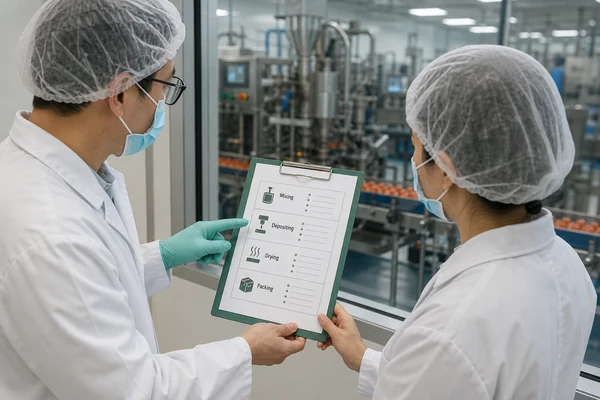
Mixing, heating, depositing, drying, demolding, and packaging control points
Gummy production has several points where quality can drift. Ingredients must be weighed and mixed correctly. The base must be cooked or prepared within the right process window. Active ingredients need a suitable addition point.
Depositing must control piece weight. Drying or setting must support texture. Demolding and coating must avoid damage or stickiness. Packaging must protect the product after release.
A brand can ask simple control questions:
- How do you control piece weight?
- How do you confirm batch uniformity?
- How do you decide when gummies are ready for packaging?
- How do you manage stickiness or moisture risk?
- How do you handle deviations during production?
- What in-process checks are recorded?
These questions are more useful than asking for a tour of every machine. The brand wants proof that the manufacturer controls the points that affect the finished product.
Where production-line details should be reviewed separately
Some process questions belong in a separate manufacturing-process review. If the brand is evaluating equipment, production-line setup, or machine-level process design, that belongs in a different review than this checklist.
The checklist should stay focused on manufacturer selection and quote readiness. The process-control section exists because a brand needs to know whether the supplier has enough discipline to protect the product.
If a supplier gives only vague answers, the brand can ask for a higher-level process summary, quality flow, or batch record example. It does not need proprietary machine settings. It does need confidence that the supplier understands gummy production as a controlled process.
How process control affects dose consistency, texture, and shelf life
Process control shows up in the final gummy. If mixing is weak, dose consistency can drift.
If depositing varies, piece weight can drift. If drying is not controlled, texture and water activity can drift. If packaging is not matched to the formula, gummies may become sticky, hard, wet, or unstable.
This is why process control is a commercial issue, not only a technical issue. A poor texture complaint becomes a customer-service problem. A label-claim failure becomes a trust problem.
A sticky product becomes a refund problem. A short shelf-life problem becomes an inventory problem.
For Talvenda, this is where production-line thinking becomes useful in gummy manufacturing. The brand does not need every process parameter, but it should understand how the supplier connects formula, process, packaging, and finished-batch checks.
Confirm Ingredient Sourcing, Testing, and Quality Standards
Ingredient quality is not proven by a nice sample. It is proven through traceability, specifications, testing, and release decisions.
Before choosing a gummy supplement manufacturer, brands should ask how ingredients are sourced, how suppliers are qualified, what COAs are reviewed, what finished-product tests are available, and how the manufacturer supports label-claim confidence.
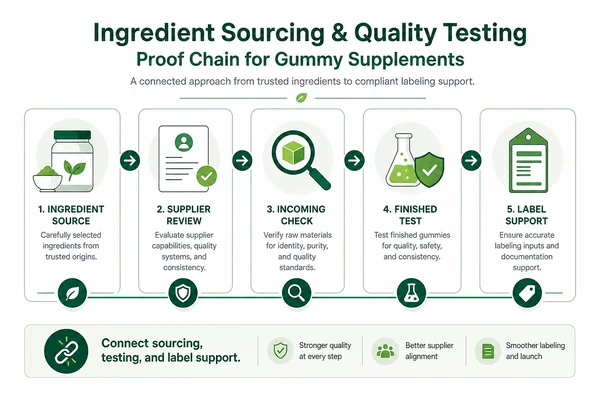
Raw material traceability and supplier verification
A manufacturer should be able to explain how it qualifies suppliers and traces raw materials into production. The brand does not need every internal record during the first call, but it should understand the system.
Ask whether the supplier can provide ingredient specifications, supplier COAs, allergen statements, country-of-origin information where needed, and lot traceability. For botanical or specialty ingredients, ask about identity, active markers, extraction ratio, carrier materials, and market-specific concerns.
This is especially important when the brand wants a strong product story. A beauty gummy, stress-support gummy, kids' gummy, or sports gummy may rely on ingredient claims. Those claims should be backed by real material records.
Finished-product testing, active assay, micro, heavy metals, and label claims
Raw-material COAs are not enough for every project. A finished gummy can behave differently from the raw ingredient. The brand should ask which finished-product tests are available and which are recommended.
Common testing discussions include:[^4]
| Test or check | Why it may matter |
|---|---|
| Active assay | Supports label-claim confidence |
| Microbiology | Supports safety and release review |
| Heavy metals | Supports safety and retailer review |
| Water activity or moisture | Supports texture and shelf-life planning |
| Stability study | Supports shelf-life and packaging decisions |
| Allergen or contaminant review | Supports market and channel requirements |
The exact testing plan depends on formula, market, claims, channel, and risk level. A responsible manufacturer should not pretend every project needs the same package. It should help the brand choose the right proof level.
For proof-oriented positioning, third-party tested creatine gummies show why finished-batch evidence can matter in consumer trust.
When to use a separate gummy supplement quality control checklist
The manufacturer-selection checklist cannot replace a full quality-control checklist. If the project is moving toward production, the brand should create a separate QC checklist for raw materials, in-process controls, finished-product specs, release tests, retained samples, complaints, and stability.
The manufacturer-selection checklist answers: "Can this supplier support the project?"
The quality-control checklist answers: "How will this product be controlled from material intake to finished-batch release?"
Both are useful. They should not be merged into one vague document. A merged checklist often becomes too broad to act on.
Review Packaging, Labeling, and Cost Structure
Packaging is often treated as a design task. In gummy supplements, it is also a stability, cost, and compliance task.
A gummy supplement manufacturer checklist should include bottle or pouch format, desiccant needs, child-resistant options, Supplement Facts space, label claims, packaging MOQ, tooling, setup fees, shipping, warehousing, and document costs.
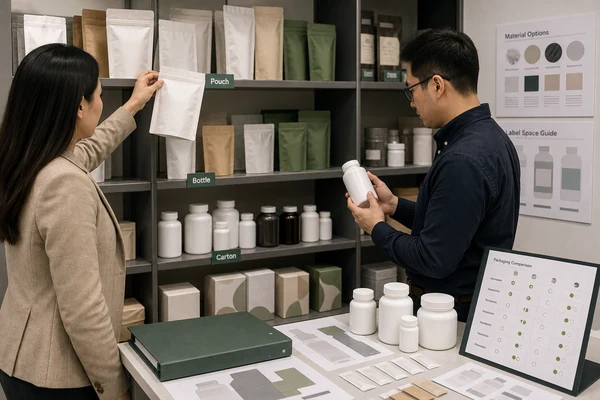
Bottle, pouch, desiccant, child-resistant, and storage requirements
Gummies are sensitive to heat, moisture, pressure, and storage conditions. Packaging should be reviewed with the formula, not after the formula is approved.
Bottles may need the right cap, liner, desiccant, induction seal, and label area. Pouches may need barrier review, seal strength, and retail presentation checks. Child-resistant packaging may be needed for certain product categories or market rules. Shipping cartons may need to protect the gummies from heat and compression.
Ask the manufacturer:
- Which packaging formats are already compatible with this gummy type?
- Does the formula need a desiccant?
- What storage conditions should appear on the label?
- Can the package protect texture during shipping?
- Does packaging have its own MOQ and lead time?
Packaging is not a final decoration step. It is part of the product system.
Supplement Facts, allergen statements, and limited label space
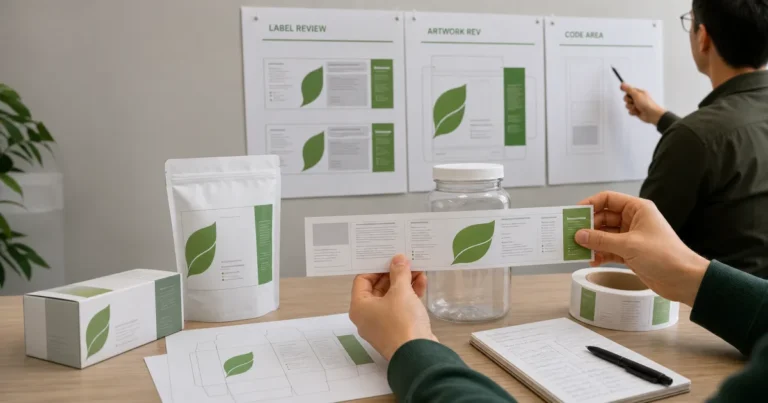
Gummy labels can become crowded quickly. Supplement Facts, serving size, ingredient list, warnings, allergen statements, claim disclaimer, usage instructions, net quantity, distributor information, storage notes, certifications, and barcode all compete for space.[^5]
A brand should not approve a small bottle or pouch before checking label space. This is especially true for multi-ingredient formulas, kids' products, products with warnings, and export projects.
The manufacturer may not be the brand's legal label reviewer, but it should be able to coordinate label information, formula data, serving size, ingredient names, and packaging dimensions. The brand should still use qualified regulatory review for final label claims and market-specific requirements.[^6]
I would ask for the label-review workflow before printing. Reprinting labels after a compliance or formula correction is expensive and slow.
Tooling, molds, setup fees, shipping, warehousing, and document costs
The lowest per-bottle price is not necessarily the lowest project cost. A useful cost review includes:
| Cost item | Why it can change the budget |
|---|---|
| Formula development | Custom work may require R&D and sample rounds |
| Mold or shape tooling | Custom shapes can add setup time and cost |
| Packaging materials | Bottles, caps, labels, pouches, cartons, and inserts may each have minimums |
| Testing | Finished-product testing can be separate from production cost |
| Documentation | Export, retailer, or certification documents may require added work |
| Shipping | Heat protection, cartons, pallets, and destination affect cost |
| Warehousing / 3PL | Storage and fulfillment may sit outside manufacturing quote |
Ask the manufacturer to separate one-time costs from repeat costs. A setup fee may hurt the first order but matter less after scale. A low first-order quote may look better than it is if it excludes packaging or testing.
How to Vet and Partner With a Private Label Gummy Supplement Manufacturer
The final checklist step is supplier behavior. A good partner should make the project clearer after every conversation.
To vet a private label gummy supplement manufacturer, ask practical questions about formula feasibility, sample process, documentation, MOQ, testing, packaging, timelines, communication, and red flags. The strongest partner is usually the one that explains tradeoffs before production begins.
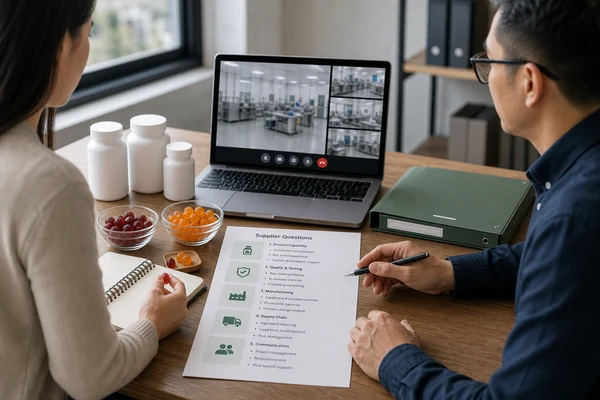
Questions to ask before paying for samples or production
Before paying for samples, I would ask a manufacturer these questions:
| Question | What the answer should reveal |
|---|---|
| Which product route fits this brief: stock, private label, semi-custom, or custom? | Whether the supplier understands project scope |
| What are the main formula risks? | Whether the supplier can identify feasibility issues |
| What sample type will we receive? | Whether the sample matches the real formula goal |
| What documents are available before production? | Whether the supplier supports quality review |
| What testing is recommended? | Whether label-claim and safety checks are considered |
| What affects MOQ and lead time? | Whether quote assumptions are clear |
| What packaging options fit this gummy? | Whether packaging is connected to formula needs |
| What happens if the sample fails review? | Whether revision process is defined |
| What are the payment and production milestones? | Whether commercial risk is clear |
These questions also help compare manufacturers. If one supplier answers clearly and another avoids detail, the difference matters.
How to request samples and review virtual or on-site facility evidence
A sample request should define what the brand is testing. If the sample is only a flavor sample, say that. If it should contain the active ingredients, say that. If it is a texture reference rather than final formula, say that too.
The sample review should include taste, texture, stickiness, smell, appearance, serving size, packaging fit, and any claim-related concerns. If the brand team is scattered across locations, use one shared scoring sheet. Otherwise, feedback becomes subjective and hard to act on.
Facility evidence can also be reviewed in stages. Some brands may request a virtual facility review, quality-system summary, audit documents, sample batch record, or on-site visit before production. The level of review should match the project risk and order size.
Do not ask for proprietary details that a manufacturer cannot reasonably share. Ask for enough evidence to judge whether the supplier can control the product.
Red flags in communication, promises, documentation, and pricing
Red flags often appear before production. The brand just has to notice them.
Watch for:
- instant yes answers to every formula request;
- no questions about dosage, market, or packaging;
- vague claims that imply FDA approval of the factory;
- no clear explanation of cGMP or documentation;
- no written sample-revision process;
- quote that excludes testing, packaging, or label review;
- unrealistic lead times;
- refusal to discuss batch records or finished-product COA;
- pressure to pay before feasibility is reviewed;
- pricing that changes whenever a basic detail is clarified.
One red flag does not necessarily mean the supplier is unusable. It does mean the brand should slow down and ask for written clarification.
The best gummy supplement manufacturer relationship feels practical. The supplier should help the brand define what is possible, what is risky, what costs more, what takes longer, and what must be documented before launch.
FAQ About Private Label Gummy Manufacturers
What is the difference between private label gummies and white label gummies?
White label gummies usually start from a ready or stock product that can be branded quickly. Private label gummies may also use a proven formula, but the project often includes more brand control over packaging, label direction, market positioning, documentation, and limited customization.
What should I ask a private label gummy manufacturer before requesting samples?
Ask which product route fits the brief, what can be changed at the target MOQ, what sample type will be provided, which packaging formats are available, what documents come with the order, what testing is recommended, and what would move the project into custom formulation.
Can a brand start with stock gummies and customize later?
Yes, if the route is planned that way from the start. A stock or white label gummy can help test demand, but the brand should ask whether formula, flavor, packaging, documents, and reorder terms can support a later move into semi-custom or custom gummy development.
What affects MOQ for private label gummy supplements?
MOQ can depend on the formula route, active ingredients, flavor or color changes, packaging components, bottle or pouch count, label work, testing scope, document needs, and reorder plan. A useful quote should separate product MOQ from packaging and testing assumptions.
Should private label gummy manufacturer intent go to a blog or a service page?
The checklist fits early supplier-vetting and quote-readiness questions. A service page should handle direct project support, available formula routes, packaging coordination, and inquiry conversion. Use this checklist to prepare the brief, then move to Talvenda's gummy vitamin manufacturing or private label project support pages when the project scope is clear.
Conclusion
A gummy supplement manufacturer checklist is useful only when it turns a broad private label gummy idea into a production-ready brief, with route, formula, packaging, testing, documents, MOQ, and reorder expectations clear enough for a real quote.
A manufacturer shortlist is more useful when the brand first knows what kind of project it is asking suppliers to quote. As an OEM/ODM gummy manufacturer, Talvenda can help compare low-MOQ market-tested in-stock gummies, stock formula modification, and custom gummy development so different quotes are judged against the right route, not treated as equivalent. That gives the brand a clearer discussion around documentation and testing expectations, packaging and label support, quality-controlled production, and production through GMP-certified and FDA-registered manufacturing facilities before deeper supplier conversations begin. Start with a manufacturer review.
[^1]: U.S. Food and Drug Administration, "FDA consumer update on approval language". Evidence role: FDA approval boundary; source type: regulator guidance. Supports: FDA registration or oversight language should not be treated as product or manufacturer approval. [^2]: Electronic Code of Federal Regulations, "21 CFR Part 111: Current Good Manufacturing Practice in Manufacturing, Packaging, Labeling, or Holding Operations for Dietary Supplements". Evidence role: dietary supplement cGMP scope; source type: federal regulation. Supports: quality-system, production-control, batch-record, packaging, labeling, and recordkeeping review points. [^3]: NSF, "GMPs for Dietary Supplements: 21 CFR 111 Comprehensive Overview Bundle". Evidence role: professional third-party cGMP context; source type: recognized standards / testing / training organization. Supports: quality-system, documentation, batch-record, personnel training, and packaging / labeling control as practical review topics; does not replace FDA or eCFR as the regulatory source. [^4]: U.S. Food and Drug Administration, "Small Entity Compliance Guide: Current Good Manufacturing Practice in Manufacturing, Packaging, Labeling, or Holding Operations for Dietary Supplements". Evidence role: dietary supplement quality specifications; source type: FDA guidance. Supports: identity, purity, strength, composition, and contaminant-limit discussions for finished product quality review. [^5]: U.S. Food and Drug Administration, "Dietary Supplement Labeling Guide: Chapter IV. Nutrition Labeling". Evidence role: Supplement Facts labeling; source type: FDA guidance. Supports: Supplement Facts panel and label-space planning for dietary supplement packaging. [^6]: Federal Trade Commission, "Health Products Compliance Guidance". Evidence role: health-product claim substantiation; source type: regulator guidance. Supports: the recommendation to review label and advertising claims before finalizing market-facing language.