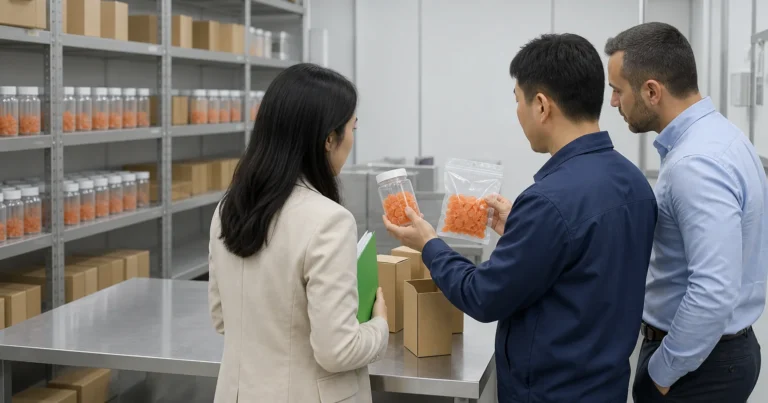
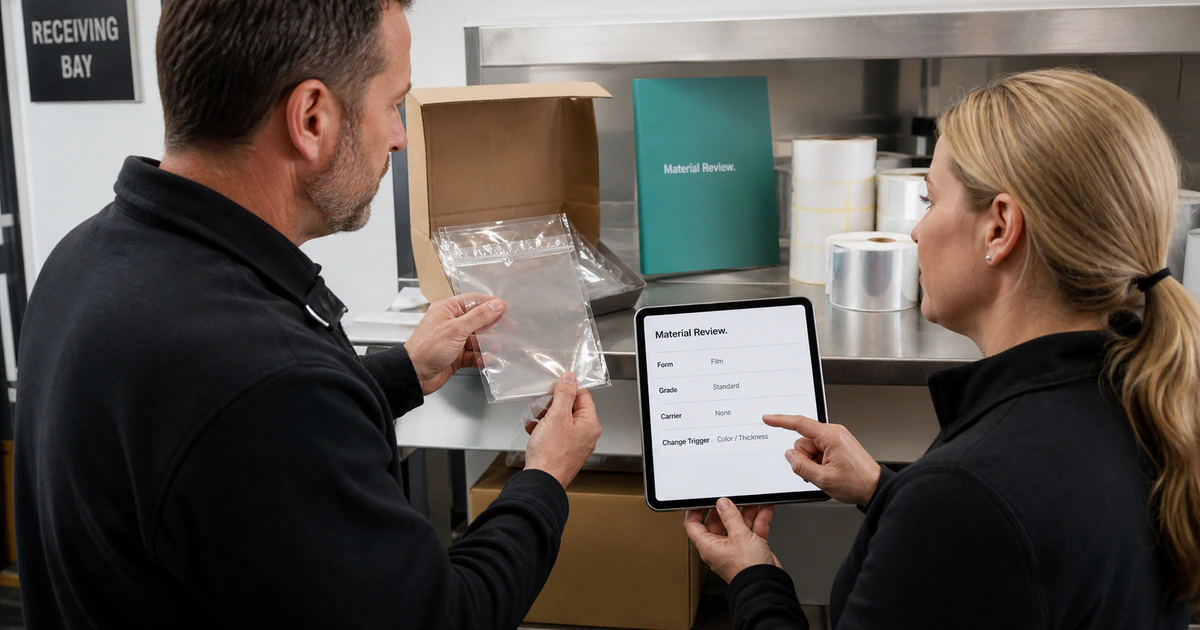

A raw material can look acceptable on paper and still create avoidable problems during sampling, gummy production, packaging, or commercial planning.
Supplement ingredient sourcing should connect the exact raw-material specification and batch documents to the intended gummy route. Approval should then remain traceable through sampling, substitutions, packaging decisions, commercial production, finished-product checks, and batch records.
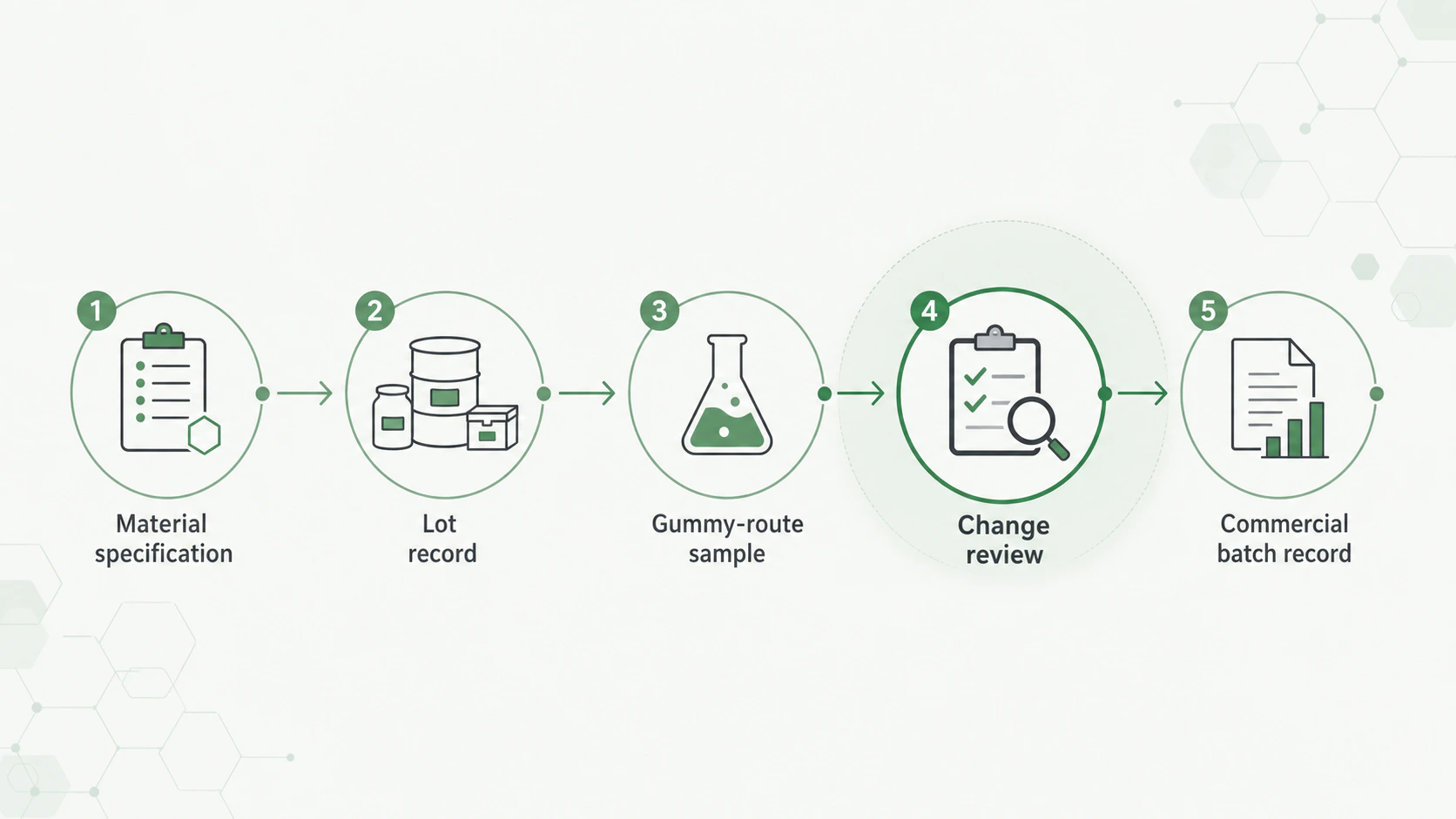
The ingredient name is only the starting point. A useful approval decision identifies which material was reviewed, why it may fit, what remains uncertain, and what would trigger another review.
Supplement Ingredient Sourcing: Start With an Approval Specification, Not an Ingredient Name
Ingredient names create categories, but they rarely define everything a product team needs to approve.
A raw-material approval specification should define the exact material, intended use, product constraints, required documents, and change triggers. It gives the brand and production team one controlled basis for comparing samples, quotes, supplier documents, and later commercial lots.
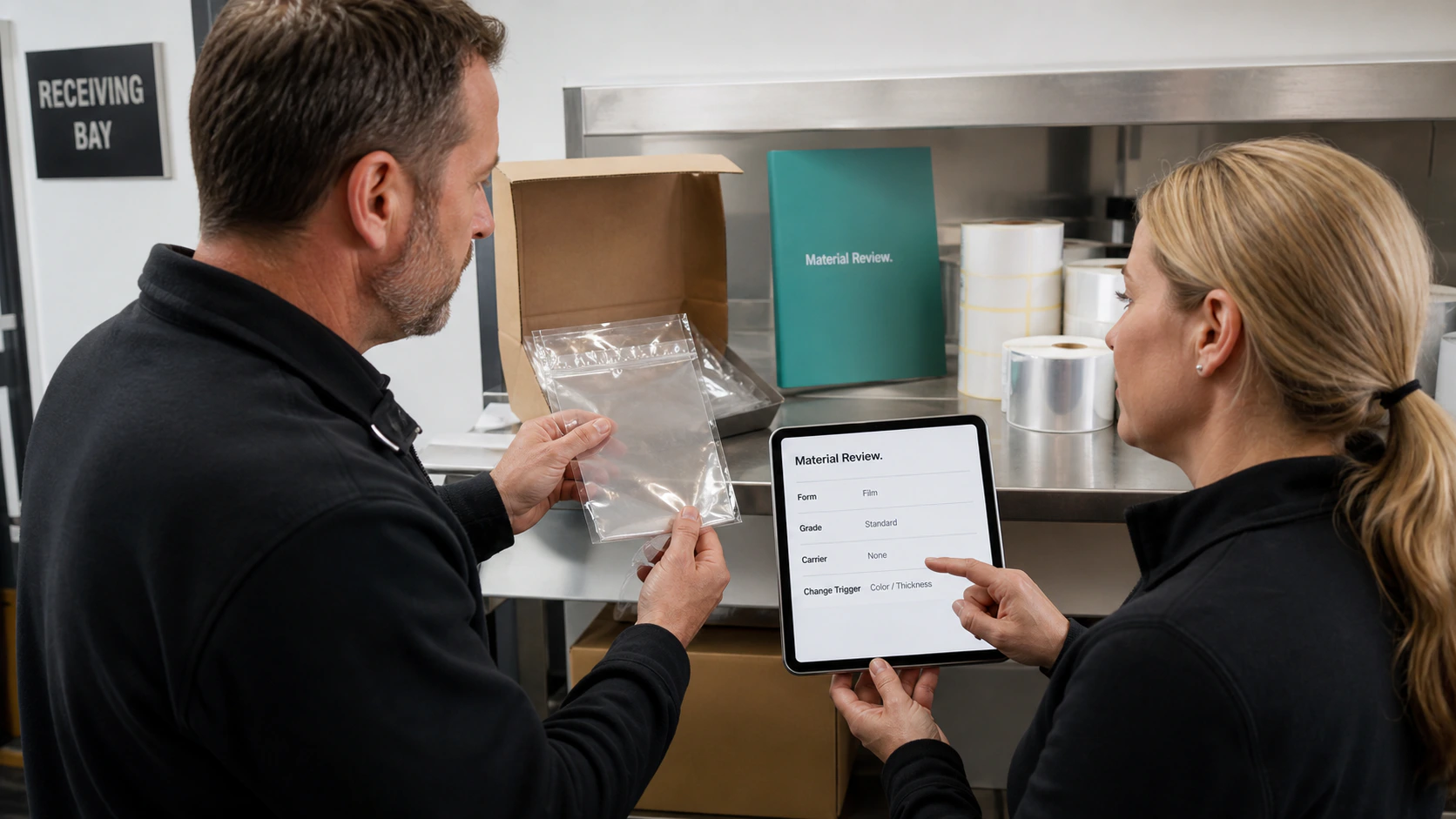
Define the material form, intended use, and product constraints
Two materials sold under the same general ingredient name may not be interchangeable. They may differ in physical form, concentration basis, carrier system, flavor impact, color, odor, moisture behavior, particle characteristics, or supporting ingredients. Those differences may influence how the material behaves in a gummy concept.
The approval specification should describe the candidate material precisely enough that the parties can recognize what has—and has not—been reviewed. Useful fields may include:
- Ingredient and material form
- Intended active or functional role
- Supplier product or specification identifier
- Manufacturer or source identity when relevant
- Concentration, assay basis, or standardization description
- Carriers, processing aids, or other declared components
- Relevant sensory and physical characteristics
- Storage and handling expectations supplied with the material
- Intended gummy serving concept
- Packaging and target-market constraints
- Documents required before sample or commercial use
- Conditions that require clarification or reapproval
The intended use matters as much as the description. The brand should state whether the material is for an early feasibility sample, a stock-formula modification, or a custom project because each route creates different review questions.
This functions as a decision record, not merely a purchasing description. A purchasing description may be broad enough to request a quote. An approval specification must be narrow enough to flag a different grade, concentration, carrier, or source for review before it enters the project.
The specification should capture known constraints such as serving design, active-load direction, dietary positioning, sensory limits, packaging, shelf-life discussion, and label restrictions. These inputs reveal which questions remain for document review and sampling.
The record does not need to pretend every variable is settled. It can separate requirements into four states:
| Status | Meaning | Practical action |
|---|---|---|
| Confirmed | The brand and production team have aligned on the requirement | Use it as a controlled project input |
| Target | The preferred direction is known but needs sample or document review | Test or clarify before final approval |
| Open | The decision cannot yet be made | Assign an owner and required evidence |
| Change trigger | A later change could affect the approval | Require documented review before use |
This distinction prevents a preferred target from being mistaken for a confirmed requirement. It also makes later changes visible.
Confirm market, label, allergen, MOQ, and timing inputs before comparing quotes
A low ingredient price does not make two quotes comparable when the underlying assumptions differ.
The target market should be identified before the product team compares candidate materials. Market expectations can affect the requested document package, label review, ingredient naming, allergen questions, and claim boundaries. A material that appears suitable for one project may require more clarification for another market or sales channel.
The brand should give the production team its current label direction. Supplier documents and the formula brief should not describe the material differently, and any carrier or supporting component should enter formula and label review before sample approval.
Allergen information needs a defined source and scope. Confirm which statement applies to the exact material, who issued it, and whether it covers the relevant manufacturing or distribution activity.
MOQ should be divided into separate questions. The raw-material supplier may have a purchase minimum. The production route may have its own planning threshold. Packaging suppliers may introduce additional minimums. A low material MOQ does not automatically create a low commercial-production route, while a high material MOQ may create inventory exposure when the formula uses only a small amount.
Timing needs the same separation. The product team should distinguish among document review, material availability, sample preparation, packaging procurement, commercial scheduling, and release-related records. These activities are connected, but they are not one guaranteed lead time.
Before comparing quotes, use one shared brief that names the exact candidate material, intended gummy and serving direction, target market, label and allergen assumptions, sample purpose, expected commercial volume, packaging direction, required documents, and open questions.
Raw-material approval is one input to a wider gummy supplement manufacturer checklist. A quote becomes more useful when material, formula, packaging, quantity, documentation, and launch assumptions are visible together.
What the Supplier Document Package Must Establish
A thick document folder can create confidence without answering the project’s most important questions.
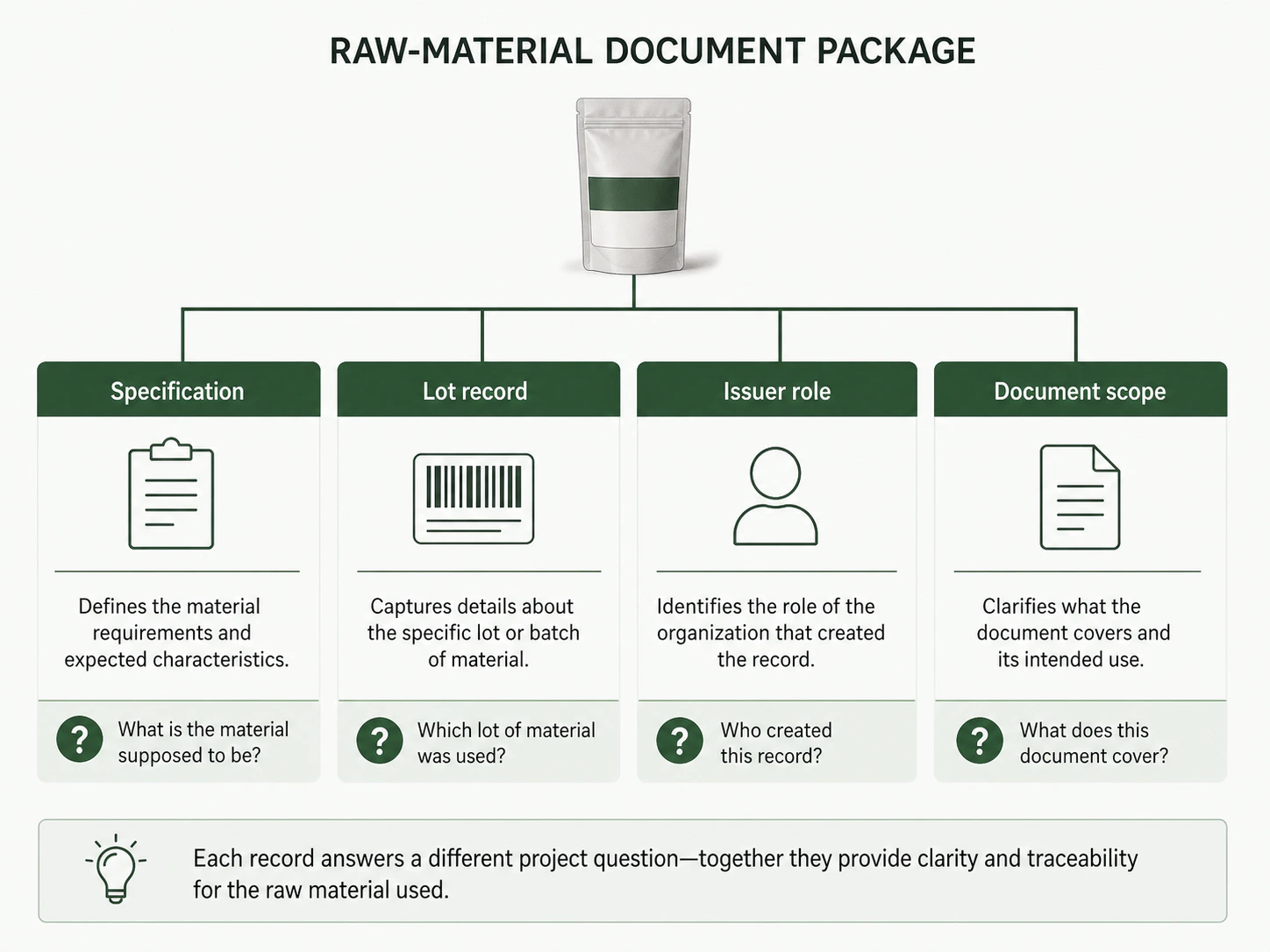
The supplier document package should establish what the material is, which batch is being offered or used, who made and supplied it, how the records connect, and what each quality statement actually covers. Document identity, scope, consistency, and traceability matter more than document volume.
Match the material specification and batch-specific COA
The material specification and certificate of analysis serve different purposes. The specification describes the defined requirements or characteristics for the material. The batch-specific COA reports information for a particular lot. The product team should review them together.
Start with identity matching. The material name, product code, grade, concentration, or other defining description should align across the specification, COA, quote, sample label, and project record. Minor naming differences may have a valid explanation, but unexplained differences should be clarified before approval.
Next, confirm that the COA is tied to an identifiable lot. The lot or batch identifier should be available for comparison with the container label, receiving record, or later production record. A generic or sample COA may support an early discussion, but it should not be treated as evidence for a different commercial lot.
The review should then ask whether the reported items correspond to the specification being approved. A result without a clear specification reference can be hard to interpret. A document may also appear complete while omitting a characteristic that matters to the intended product route.
A compact review can use five questions:
- Is this the exact material described in the approval specification?
- Does the COA apply to the exact lot being sampled or supplied?
- Do the reported items correspond to the agreed specification?
- Are the document issuer, test basis, and revision clear enough for the current decision?
- Can the material label and project records be connected to the same identity?
A COA is an important input, but it is not a complete approval decision. It does not by itself establish gummy-route feasibility, label fit, commercial availability, or finished-product performance. Those questions require separate review. In the U.S. dietary-supplement CGMP context—not as legal advice—FDA guidance on dietary-supplement CGMP[^1] treats specifications, master manufacturing records, and batch production records as distinct controls with different roles. FDA’s June 2026 warning letter to Mineral BioSciences[^2] states that reliance on a supplier COA does not replace applicable dietary-ingredient identity verification; this point should not be read as a broader supplier-qualification conclusion.
Clarify supplier, manufacturer, distributor, origin, and traceability records
The company issuing the quote may not be the company manufacturing the material. That distinction is not automatically a problem, but the roles should be clear.
The document package should identify the supplier of record and, when relevant to the project, clarify whether that organization is the manufacturer, distributor, importer, agent, or another commercial party. The team should understand which party issued each document and who is responsible for answering specification, lot, and change questions.
Origin information also needs precise wording. A sales-office address, shipping location, distributor address, and manufacturing origin are different facts. The brand should avoid filling gaps with assumptions. If origin matters to market positioning, documentation, internal policy, or supply planning, the required record should be defined before approval.
Traceability is the connection among records, not the presence of the word “traceable.” The team should be able to follow a practical chain:
Approved specification → supplier item → material lot → receiving record → sample or production batch → finished-product record
Each handoff should preserve a stable identifier. If a distributor changes an internal code, the record should still show which manufacturer material and lot were supplied. If a sample container uses a shortened label, the project file should retain the full connection.
Direct questions should identify who manufactured, sold, shipped, and documented the material; whether it was repacked; how identifiers changed; and which lot entered the project. Procurement confirms commercial details, the brand confirms market and label requirements, the production team coordinates project records, and the supplier explains its documentation.
Check what a quality or certification statement actually covers
A quality statement can refer to a company, site, system, process, product family, or specific material. These scopes should not be treated as interchangeable.
When a supplier provides a certification or quality statement, ask:
- Which legal entity or facility does the statement name?
- What activity or scope does it cover?
- Is it current for the relevant review period?
- Does it apply to the manufacturer, distributor, or another party?
- Does it address the exact material or only the broader organization?
- Is an important limitation or exclusion stated?
- What project decision is the document expected to support?
The goal is not to collect impressive logos. It is to understand the document’s relevance. A statement about a general quality system does not automatically establish the identity of a particular lot. A material-specific document does not establish finished-gummy performance. A distributor’s statement does not necessarily describe the manufacturing site.
Do not turn a document into a stronger public claim than its wording supports. Quality or certification language may require separate market-appropriate review.
A practical document register should name the document, issuer, applicable material or entity, project purpose, current version, and review status. It does not decide approval by itself; it shows what each record can and cannot establish.
Check Whether the Material Fits the Intended Gummy Route
A clean document package may describe the material accurately while leaving the production questions unanswered.
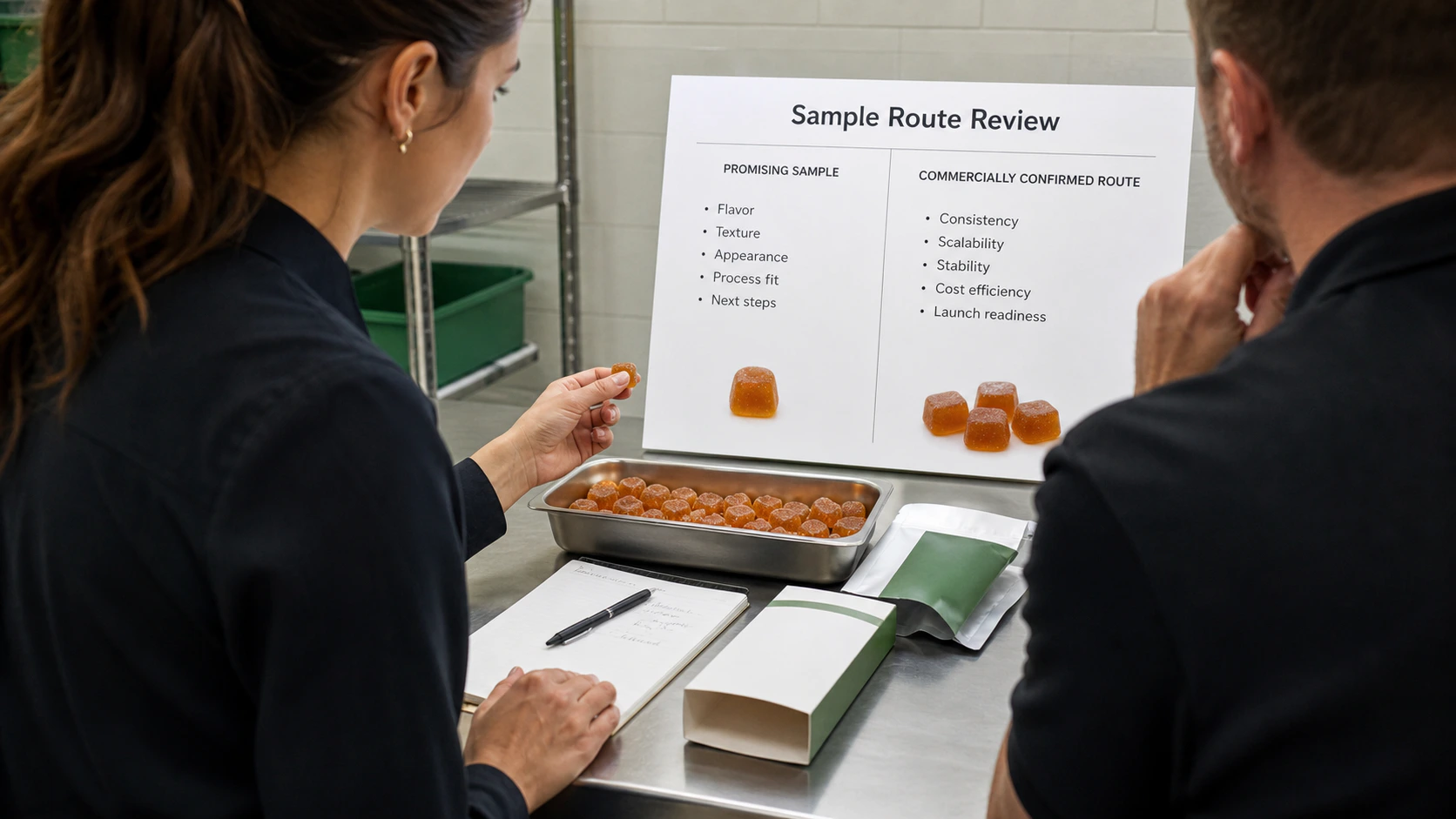
Gummy-route fit requires a separate feasibility review of active load, sensory impact, texture risk, process exposure, packaging needs, and sample behavior. Supplier paperwork can support identity and traceability, but it does not prove that the intended gummy can be produced as planned.
Why identity and supplier paperwork do not prove production fit
Identity answers, “What material is this?” Production fit asks, “Can this documented material work in the intended gummy route under the project’s constraints?” The first question supports the second, but it cannot replace it.
A material may present challenges because of its required load, taste, color, odor, solubility or dispersion behavior, moisture interaction, acidity, or sensitivity to proposed production and storage conditions. The importance of each factor depends on the complete formula and product route.
The approval process should therefore separate three decisions:
- Document acceptance: The material identity and records are sufficiently clear for the current stage.
- Sample authorization: The material may enter a controlled feasibility or development sample.
- Commercial approval: The documented material may enter the agreed commercial route, subject to the project’s production, testing, and release controls.
Keep these decisions separate. A complete supplier package may support sampling while commercial approval remains open, and a promising sample does not close document gaps.
This is where production-team input becomes important. Talvenda may support formula review, sample planning, packaging review, document coordination, MOQ planning, and scale-up discussion from the manufacturing side. The brand retains its supplier and market decisions, and outside documents should be considered within their stated scope.
“Approved for sampling” should not be treated as “approved for all future production.” The narrower statement is more useful because it defines what was actually decided and what evidence is still required.
Review active-load, taste, texture, packaging, and sample-route implications
The intended serving design determines how much material the gummy system may need to carry. That amount can affect the number or size of gummies, sensory profile, texture direction, and space available for other formula components.
The brand and production team should review several connected questions:
- What is the intended active direction per serving?
- How many gummies are expected per serving?
- Which material concentration or form is being evaluated?
- Does the proposed load leave a workable route for the gummy base?
- What taste, odor, or color contribution may need to be managed?
- Could the material affect texture, moisture behavior, or appearance?
- What packaging barrier and storage discussion may be needed?
- Is the sample intended to test flavor, texture, active-load feasibility, packaging, or a combination?
- Which results can be judged from the sample, and which require later checks?
A sample should have a defined job. If the team wants to evaluate taste and texture, the sample record should identify the material and assumptions used. If the team wants to assess packaging, a loose sample in a temporary container may not answer the full question. If the commercial formula or serving direction remains open, the sample should not be presented as final proof.
Packaging should enter early because the bottle, pouch, closure, count, and storage direction may interact with product size, moisture exposure, handling, and label space. Review identifies assumptions that still need testing or documentation.
A controlled sample sequence defines the material and serving direction, reviews likely production pressure, sets a focused objective, records the exact material used, evaluates the sample against that objective, and carries accepted conditions and open questions into commercial planning.
Keep sample approval tied to the documented material
A sample is informative only when the product team knows what went into it.
The sample record should identify the raw material by supplier, product code or specification, lot when available, and relevant revision. It should also record the formula version, sample date or identifier, packaging used for review, and the questions the sample was meant to answer.
When the brand approves a sample, the approval should state the scope. The brand may accept the flavor direction and texture at the time of review while commercial documentation, packaging, or finished-product checks remain open. This is more precise than a broad “sample approved” message.
Changes after sample approval need visibility. A supplier may propose a different grade, concentration, carrier, manufacturer, or source. Procurement may find an alternative with better availability. The production team may need to change the material because the original route is impractical. Any of these changes may be reasonable, but they should not inherit the first sample’s approval automatically.
A useful sample approval record names the sample identifier, supplier item, grade, specification, lot when available, formula version, review scope, accepted points, open points, change triggers, decision owner, and date. Recording open points prevents enthusiasm about a sample from erasing unresolved commercial questions.
Carry Approval From Sample to Commercial Batch
A project can lose control between a successful sample and the first commercial batch when changes are handled through scattered messages.
Sample-to-commercial approval should preserve the material identity, accepted specification, formula version, change history, lot records, production batch, finished-product checks, and release documents. Any material or specification change should trigger a review proportionate to its possible effect on the product route.
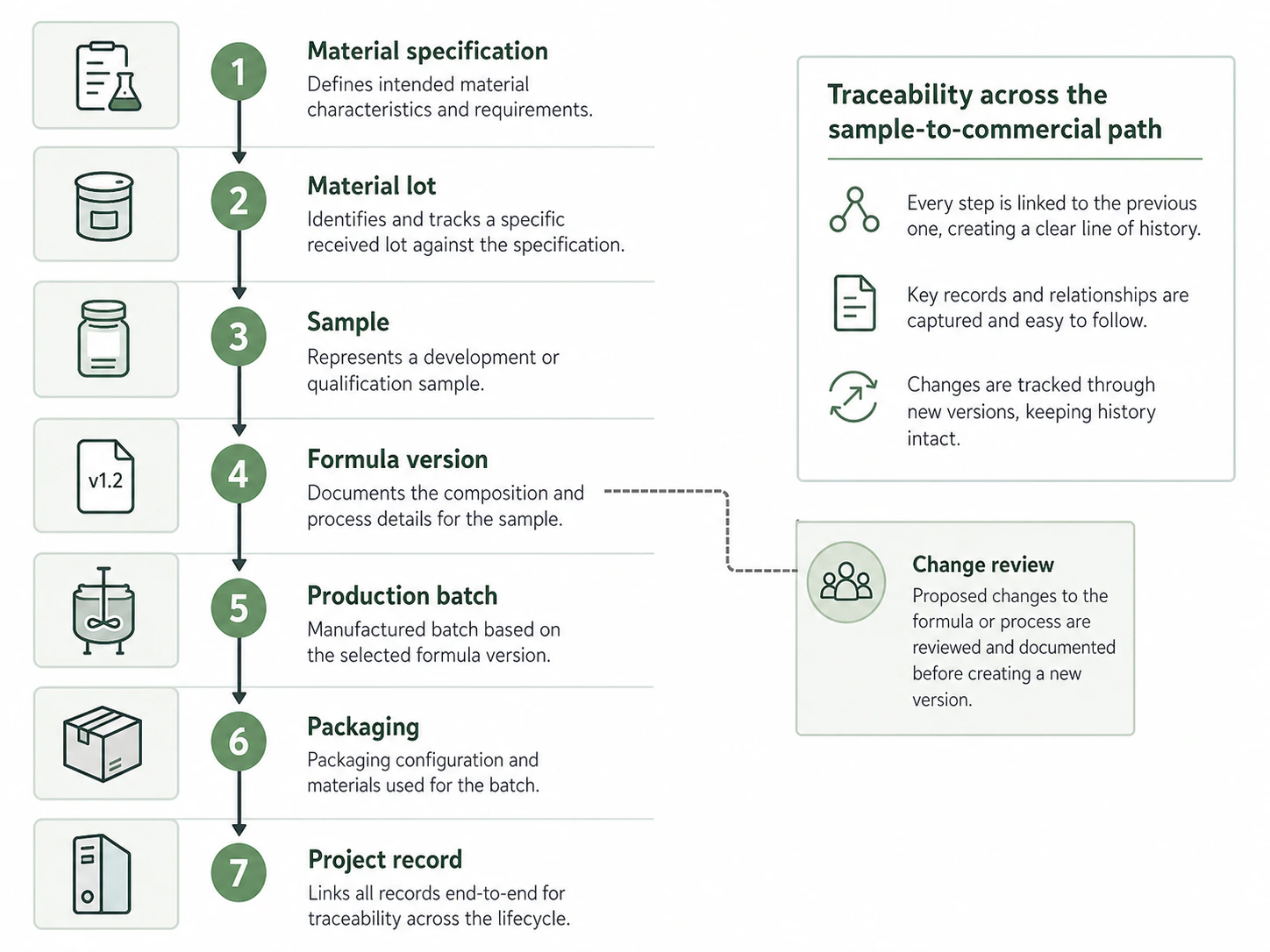
Record substitutions, specification changes, and change-control triggers
A substitution should be treated as a new decision, not an administrative update. Even when two materials share the same ingredient name, differences in concentration, carrier, physical properties, sensory profile, or source may affect the intended gummy route.
The project record should define changes that require notification and review. Common triggers may include:
- Manufacturer or manufacturing-site change
- Supplier or distributor change
- Product code, grade, or material-form change
- Specification or test-method revision
- Concentration or standardization change
- Carrier or supporting-component change
- Origin change when relevant to the project
- Material appearance, taste, odor, or handling change
- Document-scope or quality-statement change
- Storage, packaging, or shelf-life information change
- Commercial lot that does not match the sampled material
Not every change requires the same response. The team can record the reason, responsible owner, next action, and decision state, then select a review proportionate to the possible effect:
| Change level | Example decision | Possible response |
|---|---|---|
| Administrative | A corrected address with no material change | Record and confirm document continuity |
| Documentary | A specification revision with unclear impact | Compare versions and request clarification |
| Material | A new grade, concentration, carrier, or manufacturer | Reassess documents and gummy-route fit |
| Product-route | A change affecting load, taste, texture, packaging, or process assumptions | Consider formula review and another sample |
| Unresolved | The effect cannot be established | Hold until sufficient information is available |
The brand and production team should agree on who can authorize each level. Procurement should not have to make formulation judgments alone. The production team should not make the brand’s market or label decision. A controlled change record keeps those responsibilities connected.
Connect material lot, production batch, finished-product checks, and release records
Commercial traceability should allow the team to move in both directions. Starting with a production batch, the record should identify the raw-material lot used. Starting with a material lot, the record should show which production batch received it.
The practical chain may include:
Material approval → purchase record → receiving record → raw-material lot → formula version → production batch → finished-product checks → packaging run → release record
The exact record names may vary. The connection matters more than the terminology.
Finished-product checks should reflect the agreed product and claim boundaries. A supplier COA describes the supplied raw-material lot within the document’s scope. It does not replace the project’s finished-product testing expectations or release process. Likewise, a finished-product result does not correct an unclear raw-material identity record.
If a lot is held, rechecked, returned, or accepted after clarification, keep that decision with the batch history. Informal message-thread approval is difficult to recover later.
For the first commercial batch, use a short reconciliation before release-related decisions:
- Does the raw-material identity match the approved specification?
- Is the received lot connected to its COA and receiving record?
- Does the commercial formula match the accepted version?
- Were approved substitutions or changes recorded?
- Do packaging records match the intended format?
- Are required finished-product checks and documents accounted for?
- Are deviations or open items assigned and resolved at the proper level?
This reconciliation does not establish a production outcome. It creates a visible proof chain for the brand and production team to review.
Supplement Ingredient Sourcing Red Flags: When to Pause Rather Than Approve
Speed becomes expensive when an unclear material enters sampling or production and the team must reconstruct the decision later.
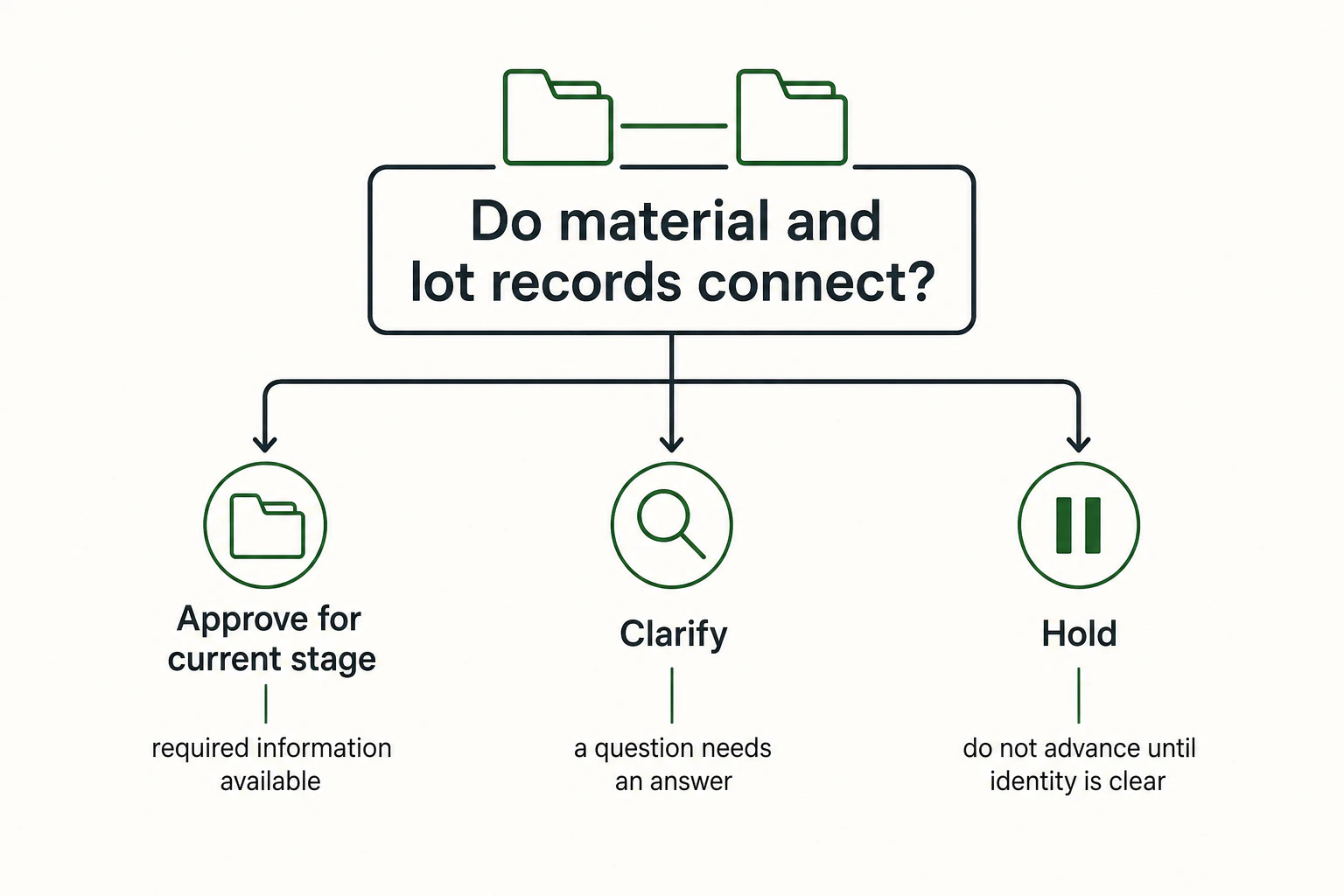
Raw-material approval should pause when identity, lot, document scope, intended use, gummy-route fit, or change history cannot be connected. A hold is not a rejection; it is a controlled state that defines the missing information, responsible party, and next decision.
Documents that do not match the material, batch, or intended use
The most important red flags are usually mismatches, missing connections, and unsupported assumptions.
Pause when the material name, code, grade, concentration, manufacturer, or lot cannot be reconciled across the quote, specification, COA, sample label, and project record. A formatting difference may be harmless, but it still needs an explanation when it obscures identity.
Other reasons to hold or clarify include a generic COA for another lot; conflicting material descriptions; unclear issuer, manufacturer, distributor, or origin roles; a statement used outside its scope; an undeclared carrier; a sampled material that cannot be connected to the commercial item; an undocumented substitution or specification change; an unreviewed gummy load; a vague sample approval; conflicting packaging or label assumptions; and unexplained physical differences in the commercial lot.
Match the response to the issue: correct a missing record, compare unclear revisions, reassess a new material form, and hold an unresolved lot mismatch until identity is established.
Urgent scheduling is not evidence. A planned launch date does not make an unclear material acceptable; it only increases the cost of a late decision.
A brand–manufacturer decision table for approve, clarify, or hold
The approval decision should be simple enough to use and specific enough to surface assumptions before approval.
Approve means the required information for the current stage is available, the material matches the defined specification, and the brand and production team understand the remaining controls. It does not mean every future lot, change, or finished product is automatically approved.
Clarify means the issue appears resolvable without allowing the material to advance unconditionally. The record should name the missing answer, document owner, and next decision.
Hold means the material should not enter the next stage because a material-identity, document, feasibility, change-control, or project-risk question remains unresolved.
| Decision area | Approve for current stage | Clarify before decision | Hold |
|---|---|---|---|
| Material identity | Exact specification and item are matched | Minor naming or code difference needs explanation | Material, grade, concentration, or source cannot be established |
| Lot documentation | COA and lot identifiers connect | Correct lot record is pending | COA applies to another or unidentified lot |
| Party roles | Supplier, manufacturer, and distributor roles are clear | One role or issuer needs confirmation | Document responsibility cannot be established |
| Document scope | Statements are current and used within scope | Scope wording needs explanation | A claim relies on a document outside its stated scope |
| Label and allergen inputs | Current project inputs are aligned for review | Supporting statement or naming needs confirmation | Material composition conflicts with the intended brief |
| Gummy-route fit | Feasibility questions are addressed for the current stage | Sample assumptions remain open | Material concerns have no workable review path |
| Sample continuity | Sample and proposed commercial material match | A controlled difference requires assessment | Commercial material differs without reapproval |
| Change control | Triggers and decision owners are defined | Notification or version history is incomplete | A material change occurred without review |
| Commercial records | Material lot and production batch can be connected | A record needs correction before release review | Traceability between material and batch is missing |
A practical approval record can be brief: decision, stage, exact material and lot, basis, open items, change triggers, owners, date, and controlled version.
The three-state table also improves coordination with the supplier. Questions become tied to a project requirement rather than a vague request for “better quality.” The supplier can see which identifier, document, or scope needs clarification. The production team can see whether the material is cleared for discussion, sampling, or commercial use.
The strongest supplement ingredient sourcing process is not the one that approves every material quickly. It is the one that makes each approval narrow, traceable, and appropriate to the current stage.
Conclusion
Reliable supplement ingredient sourcing keeps the specification, lot evidence, production-fit decision, sample approval, change history, and commercial-batch records connected. When one link is unclear, clarify or hold the material before it advances.
As a contract gummy supplement manufacturer, Talvenda can outline in-stock, stock-formula-modification, and custom-development routes through sample planning, documentation expectations, packaging fit, and scale-up support. Share your target market, intended active direction, and packaging concept through the project contact route. The useful outcome is a clearer sample and quote discussion in which raw-material questions, production assumptions, approval boundaries, and the records needed for commercial planning are visible to both the brand and production team.
[^1]: U.S. Food and Drug Administration, Small Entity Compliance Guide: Current Good Manufacturing Practice in Manufacturing, Packaging, Labeling, or Holding Operations for Dietary Supplements. [^2]: U.S. Food and Drug Administration, Mineral BioSciences, LLC - 724745 - 06/05/2026.