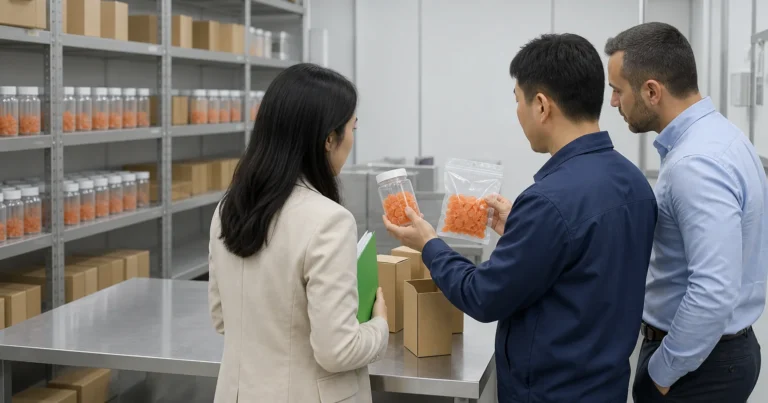


Sugar-free creatine gummies are chewable creatine supplements made with low-sugar or sugar-free sweetener systems. They can be a useful option for people who dislike powder mixing or want a lower-sugar routine, but effectiveness depends on delivered creatine dose, consistent daily use, ingredient quality, and finished-product proof.
Sugar free creatine gummies look easy from the front label. They promise creatine in a chewable format without the sugar that often comes with regular gummy supplements.
The real question is more practical: does the serving deliver enough creatine, use a sweetener system you can tolerate, and give enough label proof to trust what you are taking?
Start with the consumer checks: what they are, how to read the label, what dose to check, and whether they can work. The same questions also matter for brands because a sugar-free creatine gummy has to support the promised serving, texture, and label claim before it reaches the shelf.
What Are Sugar-Free Creatine Gummies?
Sugar-free creatine gummies are creatine supplements made in a chewable gummy form while replacing traditional added sugar with alternative sweeteners or sugar-free systems.
They are not automatically better than powder or regular creatine gummies. They are a different delivery format. Their value depends on whether the product makes daily creatine intake easier while still giving a clear, realistic serving.
How creatine gummies fit into daily supplement routines
Creatine is usually taken consistently over time. That is why format matters. A supplement that is easy to take every day can be more practical than one that keeps getting skipped.
Powder is still simple for many users: one scoop, water, mix, drink. But it can be inconvenient for people who dislike grittiness, carry supplements to work or the gym, or do not want to clean a shaker bottle.
Gummies reduce that friction. They are pre-portioned, portable, and easy to fit into a routine with other daily supplements. The tradeoff is serving size. A gummy can only carry so much creatine before taste, texture, and chew quality become harder to manage.
This is why the label matters more than the format name. A product may be convenient, but the user still needs to know how much creatine is in one gummy and how many gummies make a full serving.
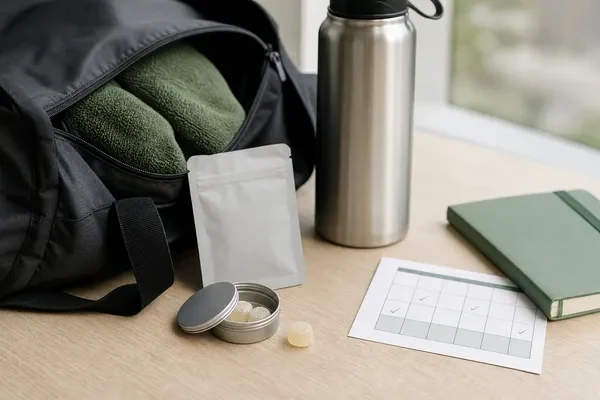
What "sugar-free" usually means on the label
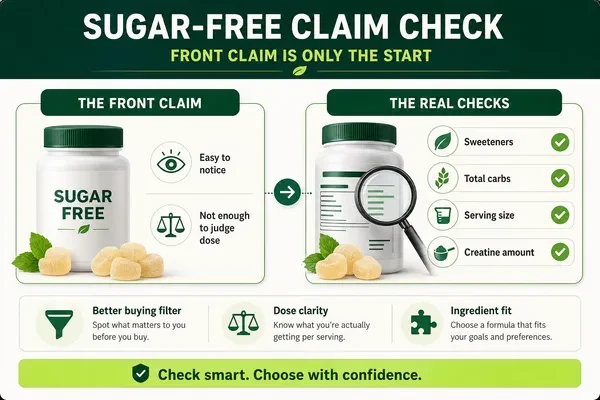
"Sugar-free" does not mean sweetener-free. For U.S. food labeling, the claim generally turns on a very low sugar threshold, not the absence of all sweeteners or carbohydrates.[^1] In practical supplement shopping, it usually means the formula avoids traditional sugars and uses other sweetening systems such as sugar alcohols, high-intensity sweeteners, plant-derived sweeteners, soluble fibers, or blends.
That can change more than taste. Sugar contributes to gummy body, chew, moisture behavior, and texture. When a formula removes sugar, the product has to replace those functions in another way.
For consumers, the label checks are straightforward:
| Label Area | What To Check | Why It Matters |
|---|---|---|
| Sweetener list | Erythritol, stevia, monk fruit, sucralose, allulose, maltitol, or blends | Affects taste, aftertaste, texture, and tolerance |
| Total carbohydrates | Carbs and sugar alcohols per serving | Important for low-carb or keto-style tracking |
| Serving size | Number of gummies per serving | Determines the real daily routine |
| Creatine amount | Per gummy and per serving when available | Determines whether the product can meet the user's intake goal |
The front claim tells only part of the story. The back panel tells whether the product fits the user's actual routine.
Creatine monohydrate vs other creatine forms in gummies
Many creatine gummies use creatine monohydrate because it is familiar, widely studied, and easy for consumers to compare with powder.[^2] Some products use other forms such as creatine HCl or buffered creatine for positioning, taste, or formula reasons.
The creatine form matters, but it should not distract from the serving. A product can use a familiar form and still underdeliver if the serving is too small or unclear. A product can use a more marketable form and still need proof that the finished gummy contains what the label says.
The cleanest label gives the creatine form, the creatine amount per serving, and a serving size that is realistic for daily use. If a label only says "creatine" without a clear amount, the product is hard to evaluate.
Benefits of Sugar-Free Creatine Gummies
The main benefits of sugar-free creatine gummies are convenience and lower-sugar positioning. Those benefits are real, but they do not override dose, quality, or label clarity.
A sugar-free creatine gummy can be useful when it helps someone take creatine consistently, fits their sugar or carbohydrate goals, and delivers a meaningful creatine serving. The gummy format supports the habit; it does not replace the need for a clear dose.
Convenience for people who dislike powder mixing
Powder can be a small daily hassle. It needs a scoop, water, a bottle, and cleanup. That is not difficult, but it is enough friction for some people to miss doses.
Gummies are easier in that moment. Open the bottle or pouch, count the serving, chew, and move on. For travel, work bags, gym lockers, or a morning supplement routine, that convenience can be valuable.
The convenience advantage depends on how many gummies are required. Two or three gummies may feel easy. Six or eight gummies may feel less convenient than powder. A product with a small creatine amount per gummy can lose the very benefit it is trying to sell.
This is why convenience should be judged together with creatine per serving. A gummy that is easy to take but too lightly dosed is not a strong creatine product. A gummy that delivers a clear serving in a practical number of pieces has a stronger reason to exist.
Lower-sugar positioning for low-carb or calorie-conscious users
Regular gummy supplements often rely on sugar for taste and texture. For users who track sugar, carbohydrates, or calories, that can make regular gummies less attractive.
Sugar-free creatine gummies solve a specific problem: they allow a chewable creatine format without the added sugar profile of a traditional gummy. That can matter for people following low-carb routines, calorie-conscious plans, or personal sugar-reduction goals.
Still, sugar-free is not the same as automatically keto-friendly, calorie-free, or better for every user. Some sugar-free sweeteners may affect digestion. Some formulas still contain carbohydrates from fibers, bulking agents, or other ingredients. Users should read total carbohydrates, sugar alcohols, sweetener type, and serving size instead of relying only on the front claim.
Why consistency matters more than the gummy format itself
Creatine format is not the result. Consistent intake is the result.
A powder someone takes every day is more useful than a gummy they take only when they remember. A gummy someone takes consistently may be more practical than powder they keep skipping. The best choice is the format that delivers a realistic dose in a routine the user can maintain.
This point is especially important with sugar-free gummies because taste and tolerance can change the routine. A product may taste fine on day one but become tiring after a week. A serving may look simple until the user realizes how many gummies they need each day.
The better question is not "Are gummies better than powder?" It is: "Can this product deliver the dose I want in a format I will actually take?"
Ingredients and Sweeteners to Check Before Buying
Sugar-free creatine gummies depend heavily on the sweetener and gummy base. A small change in sweetener choice can affect flavor, aftertaste, chew texture, digestive tolerance, and shelf behavior.
Before buying, check the creatine amount, the sweetener system, total carbohydrates, serving size, flavor/texture reviews, and any testing or label-proof statements.
Common sugar-free sweetener systems
Most sugar-free gummy products use a blend rather than one sweetener alone. A bulk sweetener may provide body and sweetness, while a high-intensity sweetener adjusts flavor.
| Sweetener / System | Common Role | Possible Consumer Consideration |
|---|---|---|
| Erythritol | Sugar alcohol used for bulk sweetness | Can create a cooling sensation for some users |
| Stevia | Plant-derived high-intensity sweetener | Can taste bitter or herbal at higher levels |
| Monk fruit | Plant-derived high-intensity sweetener | Often blended for a cleaner sweetness profile |
| Sucralose | High-intensity sweetener | Very sweet at low use levels; some users notice aftertaste |
| Allulose | Sugar alternative with sugar-like taste | Can help flavor and body, depending on formula |
| Maltitol / sorbitol / xylitol | Sugar alcohols used for sweetness and body | May affect digestion for some users, especially at higher intake[^3] |
This table is not a ranking. The right system depends on taste target, carb target, gummy texture, cost, and consumer tolerance.
For a consumer, the most useful step is to read the ingredient list and ask whether that sweetener system fits their personal routine. For a brand, the same list becomes a formulation decision: sweetness, body, water activity, aftertaste masking, and stability need to work together.
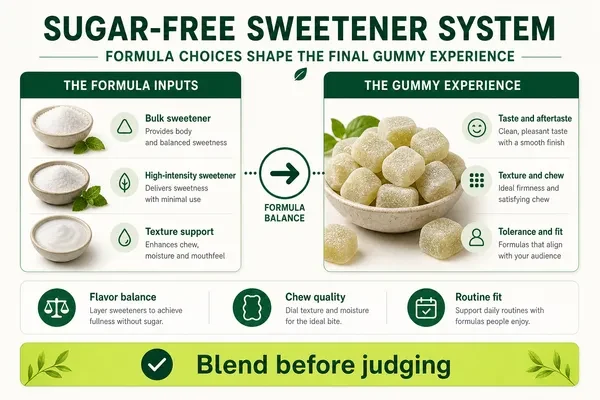
Flavor, aftertaste, and texture differences
Sugar-free gummies often taste different from regular gummies because sugar does more than sweeten. It also helps shape the chew and how flavor releases in the mouth.
Erythritol can feel cool. Stevia can create a bitter or herbal finish. Some sugar alcohols can affect digestive comfort when the serving is large. A formula may taste good in one gummy but less pleasant when the serving requires several pieces.
Texture is just as important. A gummy that is too sticky, too hard, too wet, grainy, or crumbly can reduce repeat use even if the label looks attractive. With creatine, texture can be harder to manage because the active ingredient adds solids to the gummy matrix.
The best buying signal is not only a pleasant first taste. It is whether the serving remains pleasant enough for daily use.
Why "sugar-free" does not automatically mean better
Sugar-free is a positioning choice. It is not a quality standard by itself.
A regular gummy can be well made. A sugar-free gummy can be poorly balanced. A sugar-free claim does not prove the product has a meaningful creatine dose, clean texture, strong testing support, or better results.
Use this simple buying check:
| Question | What A Strong Product Shows |
|---|---|
| How much creatine do I get? | Clear creatine amount per serving, and ideally per gummy |
| What sweeteners are used? | Sweetener system that fits the user's taste and tolerance |
| How many gummies do I need? | Serving size that is realistic for daily use |
| Is there quality proof? | Finished-product testing, COA, or transparent quality information when available |
| Does the product overpromise? | No weight-loss claims or absolute body-result language |
If the product passes those checks, the sugar-free label becomes useful. If it fails them, "sugar-free" is not enough.
Dosage: How Many Sugar-Free Creatine Gummies Should You Take?
There is no universal number of sugar-free creatine gummies to take. The right number depends on creatine per gummy, creatine per serving, the user's goals, and any guidance from a qualified professional.
The label should make the serving easy to calculate. If it does not, the product is harder to trust.
Check creatine amount per gummy and per serving
Start with the Supplement Facts panel. Look for three numbers:
| Number | Why It Matters |
|---|---|
| Gummies per serving | Shows how many pieces the label expects the user to take |
| Creatine per serving | Shows the total active amount in that labeled serving |
| Creatine per gummy | Helps users compare products and adjust the routine when needed |
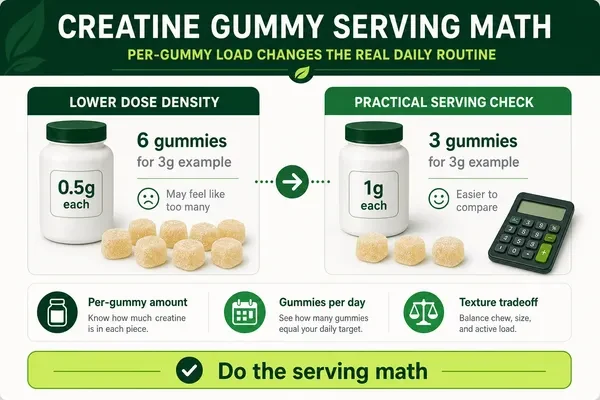
If the label gives creatine per serving but not per gummy, divide the serving amount by the number of gummies. For example, if three gummies provide 3 grams of creatine, each gummy provides about 1 gram.
This math matters because the bottle count can be misleading. A bottle with many gummies may still deliver fewer true servings if the user needs several pieces per day. Compare cost and convenience by creatine per serving, not only by gummies per bottle.
Compare the serving with common creatine intake ranges
Many creatine users compare products against common daily maintenance ranges, often around 3 to 5 grams per day.[^2] Individual needs can vary, and users with health conditions or specific performance goals should ask a qualified professional.
The gummy serving should make sense next to that range. A product that provides 3 grams in three gummies is easier to understand than one that provides 1.5 grams in three gummies while implying a full-dose routine.
| Creatine Per Gummy | Gummies For 3g | Gummies For 5g | Practical Meaning |
|---|---|---|---|
| 0.5g | 6 | 10 | May feel like too many gummies for daily use |
| 0.75g | 4 | 7 | More manageable, but still a larger serving |
| 1g | 3 | 5 | Commonly practical for many gummy users |
| 1.5g | 2 | 4 | More dose-dense, but harder to formulate well |
The highest creatine amount per gummy is not automatically best. Higher loading can affect chew, taste, and stability. A realistic serving with good texture may be better than an aggressive label claim that creates a poor eating experience.
When powder may still be easier for higher-dose users
Powder still has a practical advantage for users who want larger or more flexible doses. It is easier to deliver several grams in one scoop than in a small gummy.
Sugar-free creatine gummies may fit users who want convenience, a lower-sugar chewable format, and a consistent maintenance routine. Powder may fit users who want maximum dose flexibility, lower cost per gram, or higher-dose phases.
The two formats can also work in different situations. Some users may prefer powder at home and gummies for travel. Others may use gummies because the easier habit matters more than the cost difference.
The important thing is to match the format to the job. If the job is dose density, powder often wins. If the job is daily convenience with lower sugar, a well-made gummy can make sense.
Are Sugar-Free Creatine Gummies Effective?
Sugar-free creatine gummies can be effective when they deliver a meaningful creatine serving and are taken consistently.
The sugar-free claim does not determine effectiveness. The gummy format does not determine effectiveness. The delivered dose, routine consistency, and label proof matter more.
Effectiveness depends on delivered creatine dose
Creatine is the active ingredient. The body does not give extra credit because the format is a gummy, and it does not reject creatine simply because it is in a gummy.
If the product delivers the amount of creatine the user expects, and the user takes it consistently, the format can do its job. If the product delivers too little, or the user takes fewer gummies than the label serving, the daily intake may fall short.
This is why the same product can be useful for one person and a poor fit for another. A user who wants a modest, easy routine may be satisfied with a gummy serving. A user who wants more flexible dosing may prefer powder, especially after comparing the practical tradeoffs in a fuller creatine gummies vs powder breakdown.
The label math should decide the comparison, not the format debate.
Why third-party testing and label-claim proof matter
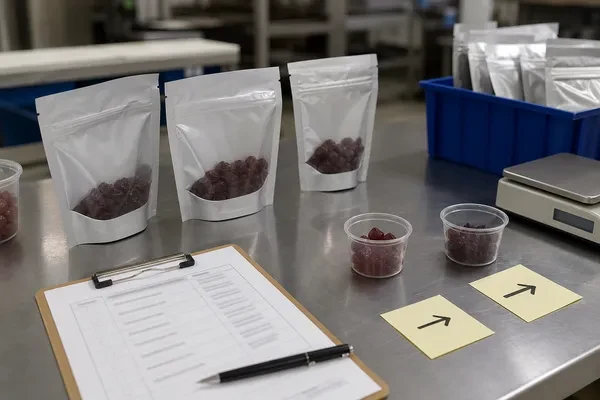
Finished-product proof matters because the consumer buys the gummy, not the raw ingredient.
A formula may be designed to contain a certain amount of creatine. The finished gummy still needs to show that the amount is present in the final product. This is especially important when the formula uses a sugar-free base, carries a meaningful creatine load, and needs to remain stable through storage.
Useful proof may include third-party testing, a certificate of analysis, batch documentation, or transparent quality information from the brand. A single logo or claim should not be viewed as magic, but third-party quality programs can still help consumers evaluate supplement quality signals more carefully.[^4] Finished-product verification is also a stronger trust signal than a label promise alone. The proof chain matters enough that it deserves its own deeper review in third-party tested creatine gummies.
For consumers, this proof reduces uncertainty. For brands, it protects the label claim and supports long-term trust.
What consumers should look for beyond taste and convenience
Taste and convenience get attention first. They should not be the only decision points.
A stronger consumer checklist looks like this:
| Check | Good Sign |
|---|---|
| Creatine per serving | Clearly stated and realistic for the user's goal |
| Creatine per gummy | Easy to calculate or stated directly |
| Sweetener system | Fits taste, diet, and tolerance needs |
| Serving size | Practical enough for daily use |
| Label language | Avoids weight-loss or absolute-result claims |
| Quality proof | Finished-product testing or transparent batch-quality support when available |
| Price comparison | Cost per gram of creatine is acceptable for the convenience premium |
A pleasant gummy with unclear dose is still uncertain. A sugar-free gummy with strong label proof, clear dose, and good texture is easier to trust.
What Brands Should Understand Before Developing Sugar-Free Creatine Gummies
This is where the consumer checks become product-development requirements.
If consumers care about dose, taste, sweeteners, texture, and proof, brands need to solve those issues before launch. A sugar-free creatine gummy is not only a flavor project. It is a formula, process, packaging, and documentation project.
Sugar-free formulas can be harder to stabilize than regular gummies
Sugar does several jobs in a gummy. It supports sweetness, body, texture, and moisture behavior. Removing or reducing sugar means those jobs need to be handled by other ingredients and process controls.
Sugar-free systems can be more sensitive to crystallization, stickiness, dryness, aftertaste, and moisture movement. Creatine adds another layer because it contributes solids and may affect mouthfeel. A formula that tastes acceptable in a small sample can behave differently after storage or scale-up.
For a brand, the key question is not only "Can we make a sugar-free sample?" It is: "Can this formula keep its texture, taste, creatine content, and label promise through production and normal storage?"
That requires more than a first tasting. It requires formulation review, pilot checks, packaging alignment, and finished-product verification.
Creatine loading affects texture, serving size, and shelf life
Creatine loading is the central tradeoff in this format.
A lower creatine amount per gummy may be easier to formulate, but it increases the number of gummies needed per serving. A higher amount per gummy improves dose density but can make texture, flavor masking, uniformity, and stability more difficult.
| Brand Decision | Consumer Impact | Development Risk |
|---|---|---|
| Lower creatine per gummy | More gummies per day | Easier texture and process control |
| Higher creatine per gummy | Fewer gummies per day | More pressure on chew, mouthfeel, and uniformity |
| Aggressive sugar-free claim | Stronger front-label appeal | More sweetener and texture balancing work |
| Finished-batch proof | More trust in label claim | Requires testing plan and documentation discipline |
Brands should decide the serving strategy early. The creatine target, gummy size, sweetener system, flavor masking, and packaging route are connected decisions. Treating them separately often creates rework.
Packaging and moisture control can affect the final product experience
Packaging is not only a container. For sugar-free gummies, it can be part of the stability strategy.
If the product gains moisture, gummies may become sticky, soft, or clumped. If it loses moisture, they may become hard or unpleasant to chew. Sugar-free systems can be especially sensitive because the formula no longer behaves like a conventional sugar-based gummy.
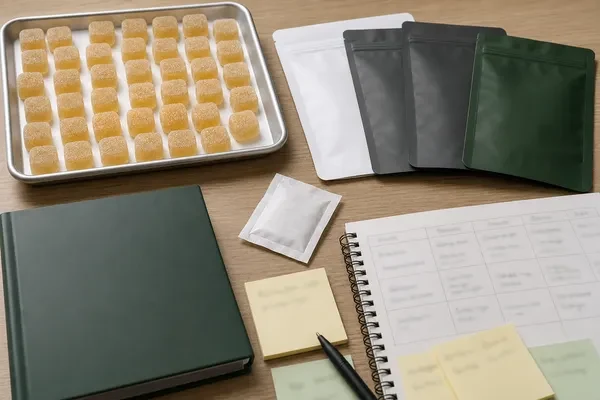
Brands should test the real formula in the real package. Bottle choice, pouch barrier, seal quality, desiccant use, fill count, and storage instructions can all affect the consumer experience.
The best packaging decision is made alongside formulation, not after the formula is finished. A gummy that works only in the sample room is not ready for market.
Finished-batch testing helps protect the label claim
Finished-batch testing checks the product after it becomes the product consumers will actually receive.
For sugar-free creatine gummies, this can help confirm creatine content, batch consistency, microbial quality, and other relevant finished-product specifications. The exact test plan depends on the formula, claim, target market, and sales channel.
This is not paperwork for decoration. FDA dietary supplement CGMP rules require manufacturers to establish and follow specifications and quality-control procedures for dietary supplements, including finished product requirements.[^5] If a brand says the product delivers a certain amount of creatine per serving, the finished batch should support that statement.
For Talvenda projects, I would review finished-batch testing, packaging, and serving strategy as part of the same proof chain. The formula should taste acceptable, carry the intended dose, remain stable through normal storage, and support the label language the brand wants to use.
FAQ About Sugar-Free Creatine Gummies
Are sugar-free creatine gummies as effective as powder?
They can be, if the daily serving delivers a comparable creatine amount and the user takes it consistently. Powder is often easier for larger or more flexible doses. Gummies may be easier for daily convenience. The format matters less than the total creatine intake and the reliability of the label claim.
Are sugar-free creatine gummies suitable for keto or low-carb diets?
They may be suitable for some keto or low-carb routines, but the label still needs to be checked. Look at total carbohydrates, sugar alcohols, sweetener type, and serving size. "Sugar-free" does not automatically mean that every product fits every low-carb plan.
Can sugar-free creatine gummies help with weight loss?
Sugar-free creatine gummies are not weight-loss supplements. Creatine is used to support training and performance routines, not to directly burn fat. The sugar-free format may reduce added sugar compared with regular gummies, but weight management depends on diet, activity, total calories, and professional guidance when needed.
What should supplement brands check before launching this format?
Brands should check delivered creatine dose, sweetener system, flavor masking, chew texture, water activity, packaging, stability, and finished-batch testing. They should also review whether the label claim is specific, supportable, and aligned with the actual serving.
Talvenda can help brand teams think through these questions before launch: whether the target creatine load is realistic, whether the sugar-free system can produce an acceptable chew, whether packaging protects the product experience, and whether finished-batch testing supports the label claim. For brands still deciding the daily serving strategy, a dedicated creatine gummy dosage review can also help separate consumer serving expectations from production feasibility.
Conclusion
Sugar free creatine gummies can make sense when the serving is realistic, the sweetener system fits, and finished-product proof supports the label.
For brands considering sugar-free creatine gummies, Talvenda works as a contract gummy supplement manufacturer that can help turn the sweetener, dose, texture, and proof requirements into a clearer sample path. Brands can compare low-MOQ market-tested in-stock gummies, stock formula modification, and custom gummy development before overbuilding a formula from scratch, while Talvenda supports sample development, packaging and label support, documentation and testing expectations, and quality-controlled production. To check which route fits your launch plan, contact Talvenda through the project inquiry form.
[^1]: U.S. FDA, Dear Manufacturer Letter Regarding Sugar Free Claims, and eCFR, 21 CFR 101.60 nutrient content claims. [^2]: Kreider et al., International Society of Sports Nutrition position stand: safety and efficacy of creatine supplementation in exercise, sport, and medicine, Journal of the International Society of Sports Nutrition, 2017. [^3]: Lenhart and Chey, A Systematic Review of the Effects of Polyols on Gastrointestinal Health and Irritable Bowel Syndrome, Advances in Nutrition, 2017. [^4]: NIH Office of Dietary Supplements, Dietary Supplements: What You Need to Know. [^5]: U.S. FDA, Small Entity Compliance Guide: Current Good Manufacturing Practice in Manufacturing, Packaging, Labeling, or Holding Operations for Dietary Supplements, and eCFR, 21 CFR Part 111.