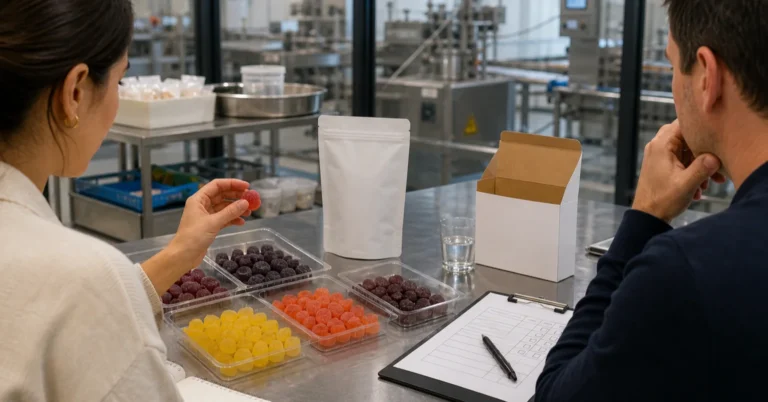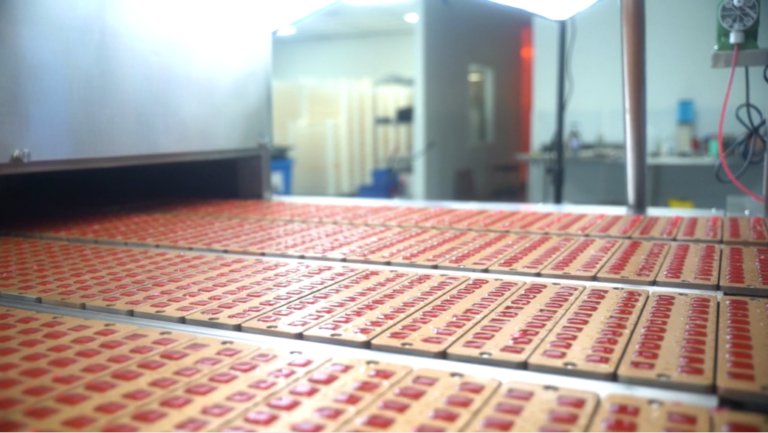
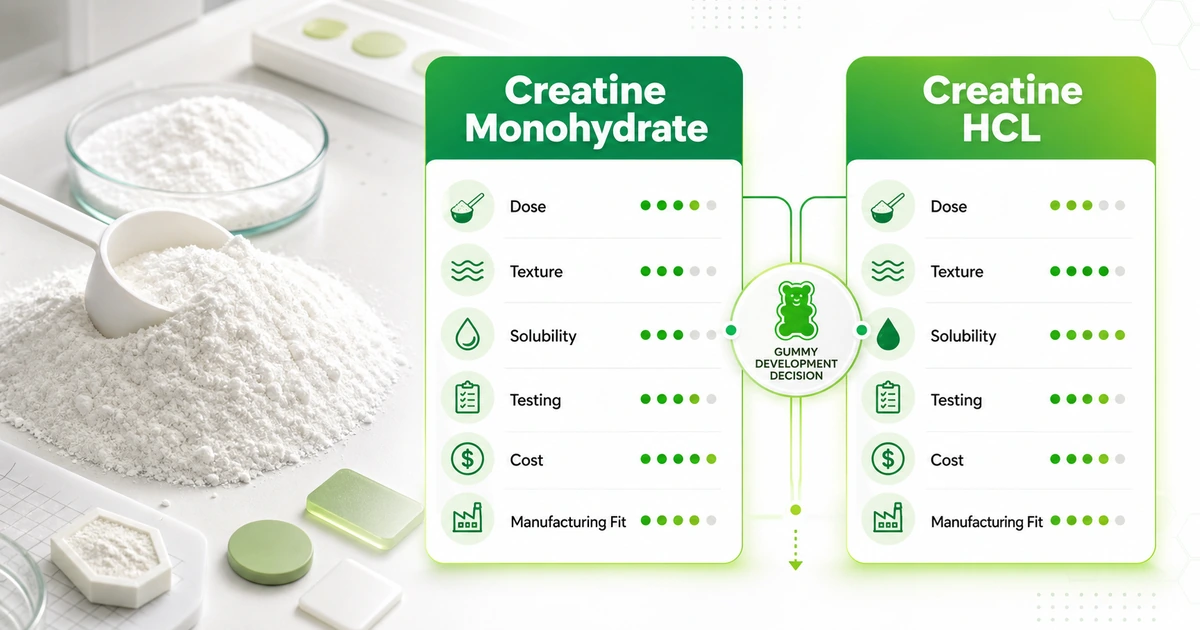

Most brands frame this as a performance question. They compare ingredient forms first, then discover the gummy format changes the decision.
Creatine monohydrate vs HCL gummies is not a universal winner question. Monohydrate has stronger evidence familiarity and lower ingredient cost. HCL may support solubility and smaller-serving positioning. The better choice depends on delivered dose, texture, shelf life, label clarity, testing, and cost.
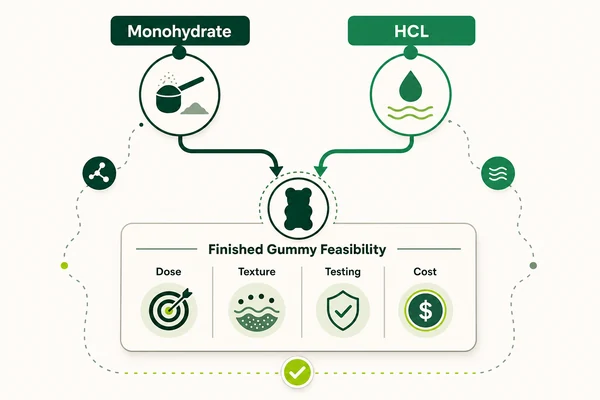
A powder comparison can stop at ingredient form. A gummy comparison cannot. In gummy development, the creatine form has to survive active loading, flavor masking, moisture control, serving-size design, finished-batch testing, and real channel pricing.
This is why I do not read creatine monohydrate vs HCL gummies as a simple sports nutrition ranking. For brands, the better question is more practical: which form can become a credible finished gummy product?
Creatine Monohydrate vs HCL Gummies: The Short Answer
The short answer is that monohydrate is the safer baseline, while HCL is a more specific positioning choice.
Monohydrate is usually easier to explain and price. HCL may help a solubility or comfort story, but both forms need finished-gummy proof before the label claim becomes credible.
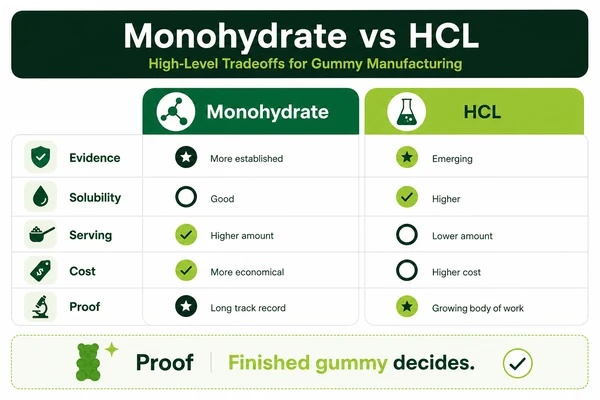
The decision should start with the product brief, not the ingredient trend. A gummy has to deliver a believable serving, taste good, stay stable, and make commercial sense after testing and packaging are included.
Evidence Base
Creatine monohydrate is usually the stronger starting point because the market already understands it. Consumers recognize the name, buyers know how to compare it, and brands can explain it without building the entire ingredient education from zero.[^1]
That matters because a gummy already asks the customer to accept a different format. If the brand also uses a less familiar creatine form, the product may need more education, tighter claim control, and stronger proof.
Monohydrate gives many brands a cleaner baseline:
- Strong consumer familiarity
- Easier comparison against powder and capsules
- More familiar buyer language
- More straightforward price positioning
- Lower risk of overexplaining the ingredient form
This does not mean monohydrate automatically creates the best gummy. It means the ingredient story starts from a more familiar place.
HCL has a smaller evidence base. Its main product argument is usually solubility, serving size, and comfort-oriented positioning. Those can be useful, but they should not be inflated into unsupported performance claims.[^2]
Solubility Claims
Creatine HCL is often positioned around solubility. That can be useful when a brand wants a premium, modern, or comfort-focused product story.
But solubility should not be treated as proof of better results. A more soluble ingredient form does not automatically prove that the finished gummy works better, tastes better, tests better, or delivers a more reliable label claim.[^3]
| Factor | Creatine Monohydrate | Creatine HCL |
|---|---|---|
| Evidence familiarity | Stronger | More limited |
| Typical dose story | 3-5 g is familiar in sports nutrition | Often positioned at lower gram dose |
| Solubility | Lower | Higher |
| Gummy development pressure | Higher active-load pressure | Lower active-load pressure, different taste and claim risks |
| Claim discipline | Stronger research familiarity, still needs finished-product testing | Solubility must not be overstated as better results |
A responsible HCL position is more disciplined:
- HCL may support a different formulation route.
- HCL may support a solubility or comfort story.
- The finished gummy still needs testing.
- Dose language still needs to be clear.
- Marketing should not imply certain performance outcomes.
HCL can be part of a product strategy, but it should not become a shortcut around proof.
Gummy Development Fit
The real question is not which creatine form sounds better. The real question is which form fits the gummy that can actually be manufactured, tested, packaged, priced, and sold.
For a creatine gummy, I would check five points before approving either form:
- Can the formula deliver a credible creatine amount per serving?
- Can the gummy texture stay acceptable with that active load?
- Can the flavor system manage taste and aftertaste?
- Can the label claim be supported by finished-batch testing?
- Can the cost structure survive real channel pricing?
That is where creatine monohydrate vs HCL gummies becomes a product development decision instead of an ingredient debate.
Why Monohydrate Is Still the Baseline for Creatine Gummies
Monohydrate remains the baseline because it is familiar, cost-aware, and easier to explain.
For gummies, monohydrate's advantage is not only evidence. Its practical advantage is that brands can build a clearer product story, as long as active loading and texture are handled well.
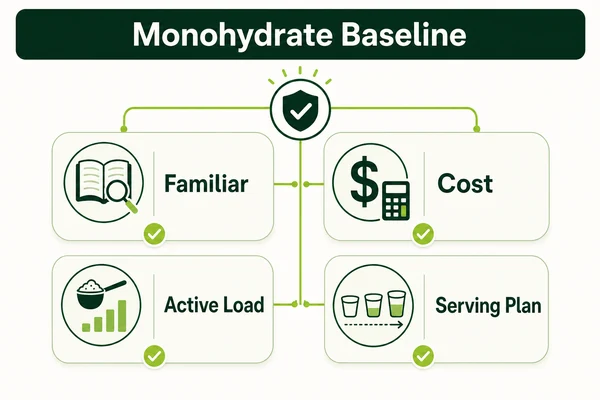
The challenge is that monohydrate can put real pressure on the gummy system. A formula that looks simple on a supplement facts panel may become difficult in texture, serving size, and shelf life.
Research Familiarity
Monohydrate benefits from a simple advantage: people know what it is. That helps when a brand is asking consumers to accept creatine in a gummy format.
A monohydrate gummy can tell a direct story:
"We are putting a familiar creatine form into a more convenient delivery format."
That is easier than asking the buyer to learn both a new format and a less familiar creatine form at the same time.
For B2B development, familiarity also helps with buyer conversations. Retailers, distributors, and private label clients usually ask practical questions first:
- What form of creatine is used?
- How much is in each serving?
- How many gummies make one serving?
- Does the finished product test to the label claim?
- Is the cost realistic?
Monohydrate does not solve every issue, but it gives the conversation a familiar starting point.
Active Loading Pressure
The main challenge with monohydrate gummies is active loading. Creatine is not a tiny flavor, color, or botanical accent. It is a functional active that can take meaningful formula space.
In a gummy, every gram matters. The formula has to balance:
- Creatine load
- Gel system
- Sweetener system
- Acid system
- Flavor
- Moisture control
- Coating or anti-stick process
- Piece weight
- Serving size
If the creatine load is too high, the gummy may become too large, too firm, too gritty, too costly, or too difficult to eat in a normal serving. If the creatine load is too low, the product may feel convenient but weak from a label-claim perspective.
This is why I would not approve a monohydrate gummy concept from a spreadsheet alone. The key question is whether the final gummy can carry the active in a way that still feels like a real consumer product.
Mouthfeel and Serving Size
Monohydrate can create mouthfeel challenges if the formula is not handled carefully. A gummy is judged quickly by texture. If it feels gritty, chalky, oversized, dry, or hard to chew, the consumer may not repeat.
Serving size also matters. A brand may want a stronger creatine claim, but if that claim requires too many gummies per serving, the convenience story becomes weaker.
The right serving design depends on the product position:
- A mass-market gummy may prioritize taste, texture, and price.
- A performance-focused gummy may accept a larger serving for a clearer claim.
- A premium product may use packaging, flavor, and testing to support a higher price.
- A starter product may choose a more moderate claim to protect texture and cost.
The active load, serving size, label language, taste profile, and price point need to tell the same story.
Best-Fit Product Briefs
Monohydrate usually fits best when the brand wants a practical, recognizable, cost-aware creatine gummy.
It is especially suitable when the product brief says:
- The brand wants a familiar creatine form.
- The target consumer already knows creatine monohydrate.
- The pricing needs to stay competitive.
- The channel expects simple claims.
- The brand can accept formulation work around texture and serving size.
- Finished-batch testing will support the label claim.
| Product Brief Fit | Monohydrate Suitability |
|---|---|
| Familiar creatine story | Strong |
| Cost-aware formulation | Strong |
| 3-5 g serving target | Possible, but serving size must be realistic[^4] |
| Compact 1-2 gummy serving | Difficult at high active load |
| Premium advanced-form story | Less direct |
I would be careful when the brief demands a very small gummy, a very high creatine claim, a very low cost, and a perfect candy-like texture at the same time. That combination can create unrealistic expectations before formulation begins.
A good production partner should push back at this stage, not just say yes.
Where Creatine HCL Gummies Can Make Sense
HCL can make sense when the brand has a specific positioning reason.
Creatine HCL may help a solubility or premium comfort story, but the brand still needs careful dose language, sensory validation, finished-batch testing, and commercial discipline.
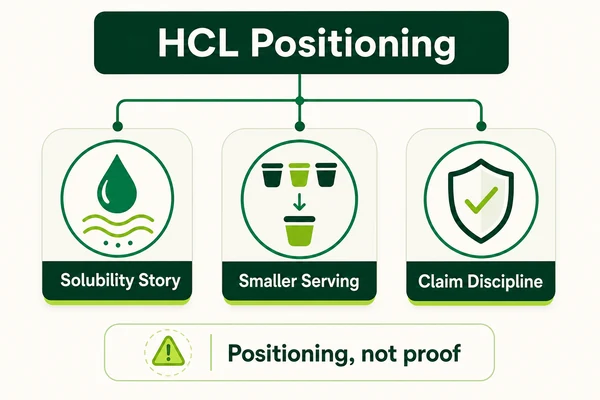
HCL is not automatically better than monohydrate in gummies. It is a different form with a different story, different cost expectations, and different claim risks.
Solubility Positioning
Creatine HCL may fit when solubility is part of the product story. For some brands, that can support a premium, modern, or comfort-focused positioning.
But the positioning has to stay disciplined. "More soluble" should not become "automatically better." "Different form" should not become "certainly better results."
A more responsible HCL position sounds like this:
- HCL is selected for a specific formulation or positioning reason.
- The finished gummy still needs to be tested.
- Dose language must be clear.
- Consumer expectations should stay realistic.
- The claim should not imply medical outcomes or certain performance results.
That type of language protects the brand and makes the product easier to defend.
Lower-Dose Claim Discipline
One reason brands look at HCL is lower-dose positioning. This can be attractive in gummies because lower active loading may reduce pressure on texture, serving size, and taste.
But this is also where claim discipline matters most.
A lower-dose HCL gummy cannot rely on vague wording. The label, product page, and sales material should make the serving size and creatine amount easy to understand.
Brands should be careful with claims that imply:
- A lower HCL dose is automatically equivalent to a higher monohydrate dose.
- Better solubility proves better results.
- HCL removes the need for label-claim verification.
- The ingredient form alone proves the product will work for every user.
A good HCL gummy brief should separate formulation convenience from consumer outcome claims.
Taste and Acidity
HCL may bring different taste and acidity considerations than monohydrate. That does not make it better or worse in every gummy. It means the finished product needs sensory work.
In a gummy, taste is not only the first bite. The product team should check:
- Sourness balance
- Aftertaste
- Sweetener interaction
- Flavor masking
- Chew texture
- Coating stability
- Heat and storage behavior
- Repeat-use acceptability
This is especially important for premium products. A premium claim with a harsh aftertaste can weaken the whole experience.
Premium Product Positioning
HCL may fit a premium or differentiated product when the brand has a clear reason for using it. That reason should be more specific than "HCL sounds better."
Better reasons might include:
- A comfort-oriented concept
- A smaller serving-size target
- A premium ingredient story
- A specialized retail channel
- A product line built around advanced formulas
- A formula where HCL makes sense beside other actives
Even then, the brand should validate the finished gummy before building the launch story. The creatine form is only one part of the product. The final gummy still has to taste good, test properly, survive shelf life, and make sense at the target margin.
Creatine Monohydrate vs HCL Gummies in Finished-Product Formulation
The ingredient choice becomes clearer when it is tested against real gummy constraints.
In gummy formulation, creatine form affects serving size, texture, flavor, testing, shelf life, and cost. The best choice is the one that fits the finished product system.
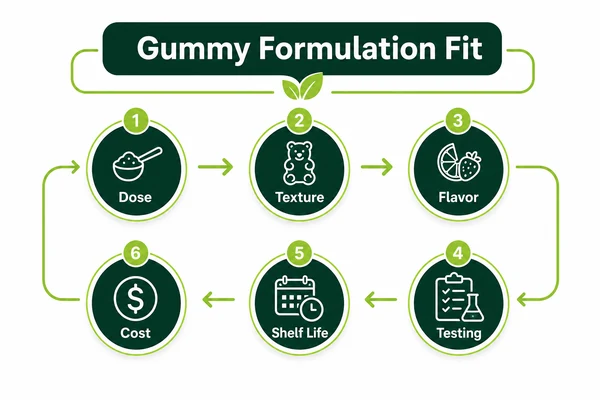
This is where many concepts become more realistic. A formula can look strong in a brief and still fail once active loading, sensory quality, and scale-up are considered.
Dose Per Serving
Dose per serving is the first practical checkpoint. Not because this is a dosage guide, but because formula reality starts with how much active the gummy must carry.
If the target creatine amount is high, the gummy has to make room for that active. That can affect piece weight, chew, flavor, cost, and packaging count.
If the target amount is lower, the gummy may be easier to formulate, but the brand must avoid overselling the claim.
For monohydrate, the challenge is usually active-loading pressure. For HCL, the challenge is often claim clarity. In both cases, the serving design should be honest enough that a consumer can understand it without complicated math.
As a planning example, a 2-gummy serving that targets 3 grams of creatine monohydrate asks each gummy to carry about 1.5 grams of active. If each gummy weighs 4 to 6 grams, that is a heavy active load for the format. The production team needs to test whether the base can still deliver acceptable texture, drying behavior, and shelf-life stability at that level.
Texture and Moisture Control
Texture is one of the biggest differences between a powder concept and a gummy concept. In powder, the consumer expects mixing. In gummies, the consumer expects a finished chew.
The manufacturer has to manage:
- Gel strength
- Water activity
- Drying time
- Active dispersion
- Stickiness
- Coating
- Packaging compatibility
- Shelf-life texture change
A gummy that feels good during a pilot run still needs to hold up after production, storage, and shipment. That is why brands should not judge the formula only from the first sample.
| Formulation Parameter | Creatine Monohydrate | Creatine HCL |
|---|---|---|
| Active-load pressure | Higher at familiar gram targets | Lower when positioned at smaller serving weight |
| Mouthfeel risk | Gritty or chalky if particle behavior is not managed | Sourness, acidity, or aftertaste may need control |
| Moisture and shelf-life focus | Active load, drying, coating, and packaging | Acid balance, texture stability, and packaging |
| Testing priority | Potency, uniformity, shelf-life retention | Potency, claim support, sensory stability |
Flavor Masking
Creatine gummies need serious flavor work. A formula can look strong on paper and still fail if the taste is not repeatable.
Flavor masking should be evaluated in the actual gummy base, not only in a lab blend. The final taste depends on creatine form, acid system, sweetener system, flavor type, coating, and storage conditions.
For monohydrate, brands may need to watch texture and mouthfeel. For HCL, brands may need to watch acidity and aftertaste. In both cases, the solution is not simply louder flavor. The active, base, and flavor system need to work together.
Finished-Batch Testing
Finished-batch testing is where the formulation decision becomes a proof decision.
A raw material document is useful, but it does not prove that the finished gummy delivers the label claim after mixing, cooking, depositing, drying, packing, and storage.[^5]
For creatine monohydrate vs HCL gummies, finished-batch testing helps answer practical questions:[^6]
- Does the active content match the label claim?
- Does the tested batch match the product being sold?
- Is the serving size supported by the finished product?
- Are the documents aligned with the formula and packaging?
- Is the shelf-life plan realistic?
If a product is marketed around proof, the brand needs proof at the batch level.
Cost and Scale-Up Feasibility
Cost can decide whether a product survives beyond the first sample.
Monohydrate is often more cost-friendly, but it may require more work around active load, serving size, and texture. HCL may support differentiation, but it can create a different cost structure and a different claim burden.
Brands should compare full product economics, not only ingredient price. Real cost includes:
- Active cost
- Formula complexity
- Sample rounds
- Testing
- Packaging
- Production yield
- Minimum order planning
- Freight and storage
- Retail or marketplace margin
| Scale-Up Question | Why It Matters |
|---|---|
| Can the active load stay uniform at commercial batch size? | Prevents label-claim and piece-to-piece variation risk |
| Can the texture survive drying, packing, and shipment? | Protects repeat purchase and channel acceptance |
| Can the claim be supported by finished-batch data? | Reduces unsupported performance or dosage-language risk |
| Can the price work after testing and packaging? | Prevents a good sample from becoming a weak commercial product |
A formula that looks attractive in a small pilot may become difficult when scaled. The goal is not just to make a sample. The goal is to build a product that can be produced consistently.
How Brands Should Choose Between Monohydrate and HCL Gummies
Brands should choose the creatine form after the product promise is clear.
Brands choosing between creatine monohydrate and HCL gummies should compare the consumer promise, serving size, price point, testing plan, and manufacturing feasibility. The creatine form should support the product brief rather than replace it.
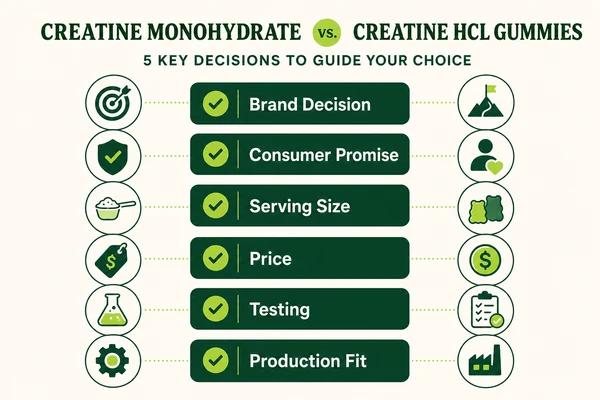
A strong product brief makes the decision easier. It connects the ingredient form to the consumer, the claim, the channel, and the production plan.
Consumer Promise
Start with the consumer promise before choosing the creatine form.
If the promise is familiar, practical, and cost-aware, monohydrate may fit better. If the promise is premium, comfort-oriented, or built around solubility positioning, HCL may deserve a closer look.
A strong product brief should answer:
- Who is this gummy for?
- Why would they choose a gummy instead of powder?
- What claim can we support clearly?
- How many gummies per serving will feel acceptable?
- What price point does the channel require?
- What testing will support the launch?
This keeps the creatine form decision grounded in real product strategy.
Serving Size and Price Point
Serving size and price point are linked. A higher active load may require a larger serving, more gummies per bottle, or a higher product cost.
A premium ingredient position may support a higher price, but only if the product story and consumer experience justify it.
Brands should avoid choosing a creatine form in isolation from the commercial model. A formula that is technically possible may still be hard to sell if the serving count, bottle size, and retail price do not match the channel.
Marketplace consumers may compare price per bottle. Sports nutrition buyers may compare creatine amount and serving count. Retail buyers may also care about shelf presence, claims, and category fit.
The right formula has to survive all of those comparisons.
Testing and Documentation Plan
A testing and documentation plan should be built before launch, not added after marketing claims are written.
For either monohydrate or HCL, the brand should prepare:
- Raw material documentation
- Formula version control
- Finished-batch testing plan
- Label-claim verification
- Lot-level traceability
- Shelf-life support
- Packaging and specification records
This is not just a compliance habit. It also helps the brand avoid weak claims. If a statement cannot be supported by formula, testing, or documentation, it should not become the center of the sales message.
Manufacturing Feasibility Check
Manufacturer feedback should validate feasibility, not replace the product brief.
The brand brings the target consumer, claim direction, price point, and channel strategy. The production team brings formula feasibility, process limits, testing expectations, and scale-up reality.
For creatine monohydrate vs HCL gummies, the feasibility check should cover:
- Whether the target active amount is realistic
- Whether the gummy size and serving count make sense
- Whether taste and texture can meet market expectations
- Whether the label language is supportable
- Whether the cost works at the expected order scale
- Whether finished-batch testing can support the product claim
This is where a gummy project becomes concrete. The form choice becomes part of a finished product system.
| Decision Checkpoint | What to Confirm |
|---|---|
| Consumer promise | Does the form support the label story? |
| Serving size and price | Can the cost structure support the target retail price? |
| Testing plan | Is finished-batch potency and stability testing planned? |
| Manufacturing fit | Can the production plan handle active load, texture, and scale-up? |
FAQ: Creatine Monohydrate vs HCL Gummies
Is creatine HCL better than monohydrate in gummies?
Not automatically. HCL may support a solubility or comfort-focused product story, but that does not prove better results in the finished gummy.
Monohydrate usually has stronger familiarity and cost advantages. The better choice depends on the product brief, serving size, texture, label claims, testing plan, and price point.
Are creatine monohydrate gummies effective?
They can be credible when the formula delivers a clear creatine amount, the serving size is realistic, and the finished batch supports the label claim.
The key issue is not only the ingredient form. It is whether the gummy can carry the active properly while maintaining texture, taste, shelf life, and documentation.
Does better solubility mean better creatine results?
Better solubility can be useful for formulation and positioning, but it should not be treated as automatic proof of better results.
A finished gummy still needs clear label language, realistic serving design, and appropriate testing. Brands should avoid turning solubility into an unsupported performance claim.
Can a brand combine monohydrate and HCL in one gummy?
It may be technically possible, but the brand should have a clear reason for doing it.
Combining forms can make the product story more complex, and it may also affect taste, texture, cost, and testing. If the combination does not improve the product brief in a clear and supportable way, a simpler formula may be easier to explain and scale.
Conclusion
Monohydrate vs HCL is not a winner-takes-all ingredient debate. In gummies, the better choice is the form that can survive serving size, taste masking, texture, cost, and proof constraints.
As an OEM/ODM gummy manufacturer, Talvenda can help teams assess creatine form and production route together instead of treating monohydrate or HCL as a label-only choice. A clear serving target can be reviewed across low-MOQ market-tested in-stock gummies, stock formula modification, and custom gummy development, with sample development, documentation and testing expectations, quality-controlled production, and GMP-certified and FDA-registered manufacturing facilities considered before cost, taste, and packaging assumptions lock the brief. Send the formula direction through the project inquiry form.
[^1]: International Society of Sports Nutrition position stand: creatine supplementation and exercise. Source returned by elink: https://pmc.ncbi.nlm.nih.gov/articles/PMC2048496/ [^2]: Supplementing With Which Form of Creatine (Hydrochloride or Monohydrate). Source returned by elink: https://pmc.ncbi.nlm.nih.gov/articles/PMC11629957/ [^3]: Bioavailability, efficacy, safety, and regulatory status of creatine forms. Source returned by elink: https://pmc.ncbi.nlm.nih.gov/articles/PMC8912867/ [^4]: Common questions and misconceptions about creatine supplementation. Source returned by elink: https://pmc.ncbi.nlm.nih.gov/articles/PMC7871530/ [^5]: Analysis of the efficacy, safety, and regulatory status of novel forms of creatine. Source returned by elink: https://pmc.ncbi.nlm.nih.gov/articles/PMC3080578/ [^6]: FDA dietary supplement guidance documents and regulatory information. Source returned by elink: https://www.fda.gov/food/guidance-documents-regulatory-information-topic-food-and-dietary-supplements/dietary-supplements-guidance-documents-regulatory-information