
Most brands ask whether pectin or gelatin is better. A better question is which gelling system fits the gummy supplement they want to launch.
Both pectin and gelatin can build gummy structure, but they are not interchangeable. Gelatin is animal-derived and gives a familiar elastic chew. Pectin is fruit-derived and supports plant-based positioning with a cleaner bite. The best choice depends on label goals, texture, formula behavior, stability needs, and manufacturer capability.
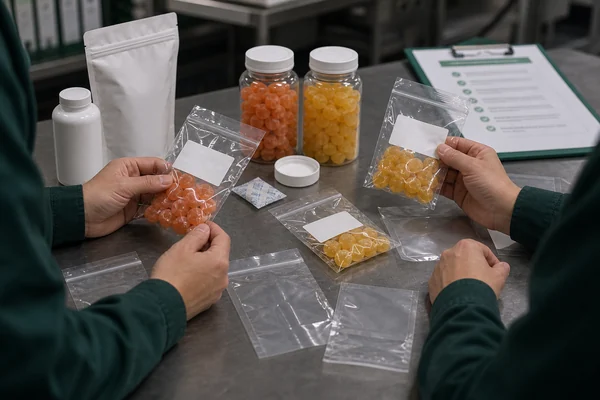
I do not recommend viewing pectin vs gelatin as only a vegan vs non-vegan choice. For supplement brands, this is first a gelling-system decision. It affects the ingredient statement, mouthfeel, sample approval standard, packaging discussion, and manufacturer questions before production.
Pectin vs Gelatin Gummies: What Is the Difference?
Both ingredients help a gummy hold its shape, but they create that structure in different ways.
Gelatin is an animal-derived collagen protein that creates a soft, elastic gummy structure. Pectin is a plant-derived polysaccharide that creates a firmer, cleaner bite. Their source, setting behavior, texture, and label implications are different, so they should not be considered interchangeable.
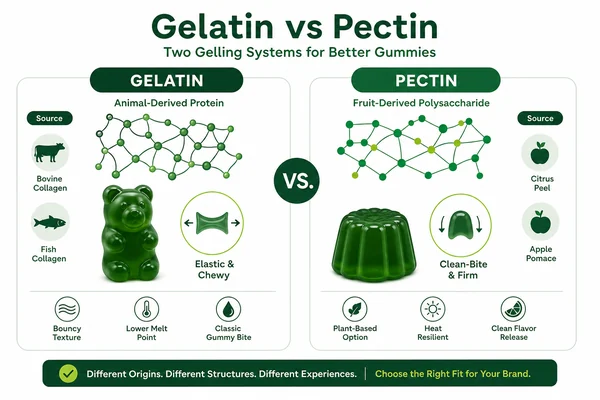
Gelatin as an animal-derived collagen protein gelling system
Gelatin is made from animal collagen, usually bovine or porcine sources.[^1] In a gummy, gelatin forms a protein network that sets as the cooked mass cools. That network gives a gummy its familiar stretch, bounce, and slow chew.
This is why gelatin remains common in supplement gummies. It is familiar to consumers and often easier for manufacturers to run because the process window is more forgiving than pectin. It can work well when the brand wants a classic gummy bite, when the formula does not need vegan positioning, and when the target consumer is comfortable with animal-derived ingredients.
Gelatin also has a natural relationship with animal-sourced collagen concepts. A brand working on collagen gummies formulation may find gelatin easier to explain because the gelling agent and collagen ingredient sit in the same animal-source family. That does not make gelatin automatically better. It only means the positioning is coherent when the SKU is already animal-derived.
Pectin as a fruit-derived plant polysaccharide gelling system
Pectin comes from plant cell walls, most commonly citrus peel or apple pomace.[^2] It is a polysaccharide, not a protein. In gummy production, pectin needs a more controlled relationship between soluble solids, acid, pH, and sometimes calcium.[^7]
The finished texture is different from gelatin. Pectin tends to create a shorter, cleaner bite with less stretch and more snap. For some brands, that feels more modern and less candy-like; for others, it can feel too firm if the consumer expects a classic gummy chew.
Pectin is also the natural route for vegan, vegetarian, plant-based, and many clean-label gummy concepts. If the product story depends on avoiding animal-derived ingredients, pectin should be reviewed first. For vegan collagen gummies, pectin helps keep the base aligned with the plant-based promise.
Why this choice affects more than vegan positioning
It is tempting to say gelatin equals non-vegan and pectin equals vegan. That shortcut misses the production and commercial reality.
| Decision area | Why it matters |
|---|---|
| Label positioning | Animal-derived vs plant-derived ingredient statement |
| Texture | Elastic chew vs clean bite |
| Formula design | Different pH, solids, sweetener, and active-load behavior |
| Stability | Different heat and storage performance |
| Sample approval | Different sensory standards during review |
| Manufacturer fit | Not every factory runs both systems equally well |
For brands, this means the choice should be made before the formula is locked. If the brand waits until after sample rejection, the change is no longer a small adjustment. It can become a new formulation route.
Pectin vs Gelatin Source, Label Fit, and Dietary Requirements
The gelling agent is visible on the label, and buyers often notice it quickly.
Gelatin signals animal-derived material. Pectin signals a plant-derived gummy base. That difference affects vegan, vegetarian, halal, kosher, and clean-label expectations, but the final claim still depends on the whole formula and the documents behind it.
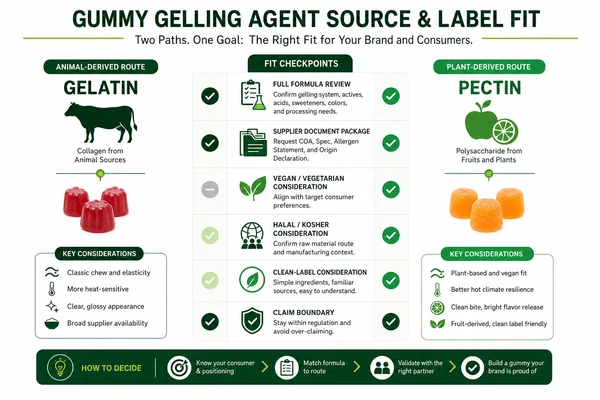
Animal-derived vs plant-based ingredient statements
A gelatin gummy will show gelatin in the ingredient statement.[^3] For some shoppers, that is normal. For others, it immediately excludes the product. This is especially important when the brand is selling into vegan, vegetarian, plant-based, or religious-diet segments.
A pectin gummy can usually support a plant-derived ingredient story more naturally. The ingredient statement may say pectin or apple pectin, depending on the source and label requirements. This can help brands that want the product to feel fruit-based, cleaner, or less confectionery-like.
The source story should match the product promise. A brand should not build a plant-based offer around a gelatin base. A brand should also not force pectin into a product if the consumer expects a traditional elastic chew and the label has no plant-based requirement.
Vegan, vegetarian, kosher, halal, and clean-label expectations
Pectin is the easier starting point for vegan and vegetarian gummies because it is plant-derived.[^4] But a pectin base alone does not make the whole product vegan.[^5] Flavors, colors, coatings, carriers, actives, and processing aids also need review.
For a vitamin-focused project, the separate vegan gummy vitamin supplements guide shows how that full-formula review connects to B12, D3, mineral taste, pectin texture, packaging, and label documentation before launch.
Gelatin can be more complex for kosher or halal positioning. The animal source and processing route matter. A manufacturer may offer bovine gelatin, porcine gelatin, fish gelatin, or certified gelatin options, but the documentation must match the target claim.
Clean-label is not a legal shortcut. It is a consumer expectation. Pectin often performs better in a clean-label story because it is commonly associated with fruit. Gelatin is also familiar, but its animal origin changes how some consumers read the label.
How brands should review labels, COAs, and supplier documents
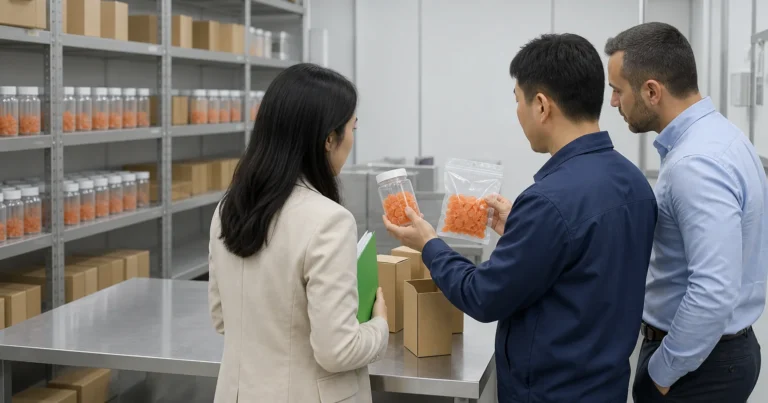
Before approving a gelling system, ask for the document package behind the ingredient. For gelatin, review source species, gel strength, and any halal, kosher, or market-specific documentation that applies to the claim. For pectin, review plant source, HM or LM type, pH range, gel behavior, and any carriers or processing aids listed in the specification.
This review should happen before production planning. A private label gummy vitamin manufacturing partner should be able to explain what documents are available, what claims they support, and what claims still need separate review.
Texture and Consumer Experience
Texture affects whether a consumer finishes the bottle and buys again.
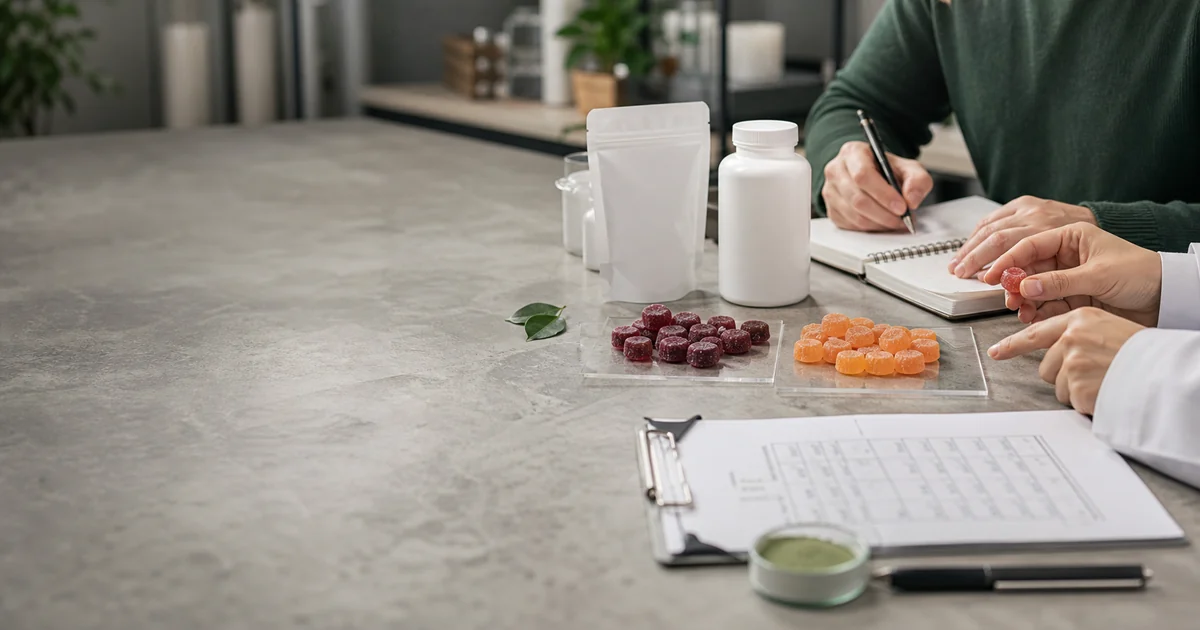
Gelatin gummies usually feel elastic, bouncy, and familiar. Pectin gummies usually feel firmer, cleaner, and less stretchy. Neither texture is universally better. The right texture depends on the supplement category, brand promise, target consumer, and flavor system.
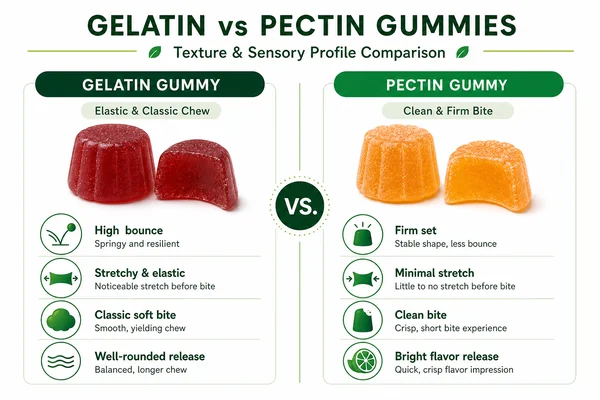
Gelatin gummies: elastic chew, bounce, and familiar bite
Gelatin delivers the texture many consumers expect when they hear the word gummy. It stretches slightly, resists the bite, and then softens as the consumer chews. This can help broad-market gummies feel familiar, especially when the product is positioned near traditional gummy candy or everyday wellness.
That familiarity can be useful. If the product is a kids gummy, a general multivitamin, or an animal-sourced collagen product, gelatin may reduce sensory risk. The consumer does not need to learn a new texture.
The tradeoff is heat sensitivity.[^6] Gelatin gummies can soften or stick together in warm storage or shipping conditions.[^6] That risk does not automatically block gelatin, but it should shape packaging and logistics discussions.
Pectin gummies: clean bite, firmer set, and flavor release
Pectin gummies break differently. They are usually less elastic and have a cleaner bite. Some brands like this because it feels more adult and less candy-like. Fruit flavors may also feel brighter because pectin can release flavor quickly.
This texture can support vegan, plant-based, beauty, and clean-label supplement positioning. It may also fit brands that want a gummy to feel more like a functional format than a candy-style confection.
The risk is expectation mismatch. A consumer used to gelatin may read a pectin gummy as too firm or less indulgent. That is why sample testing matters. A brand should not choose pectin only for the label and ignore the eating experience.
Matching mouthfeel to supplement category and target consumer
Mouthfeel should match the product role. A collagen gummy aimed at mainstream beauty consumers may benefit from a gelatin-like chew. A vegan collagen booster may need pectin because the ingredient source and target consumer demand it. A sugar-free or low-sugar gummy may require its own feasibility review because sweetener choice changes texture and moisture behavior.
This is the practical question: what should the consumer feel when they take the product daily? If the brand wants familiar, candy-like comfort, gelatin is often easier. If the brand wants a plant-based, clean, adult supplement cue, pectin may fit better.
Production and Stability Differences
The gelling system determines the process window, not just the ingredient list.
Gelatin generally sets as it cools and is more forgiving across pH and solids. Pectin requires tighter control of pH, soluble solids, acid timing, and sometimes calcium. Pectin may offer better warm-condition stability after setting, but it is usually less forgiving during formulation and production.
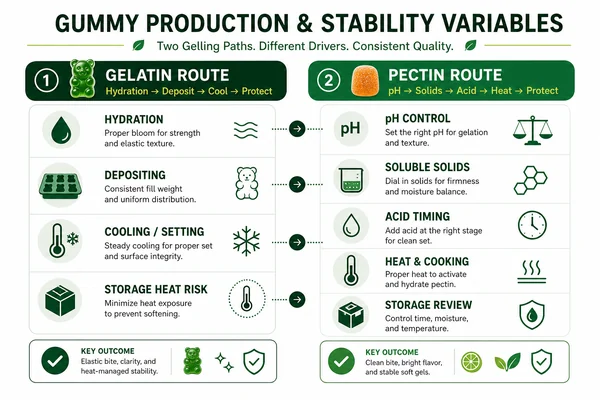
Setting behavior, temperature, pH, solids, and acid sensitivity
Gelatin is often easier to understand from a production point of view. Hydrate it, heat it, deposit it, and let it cool into a gel. The process still needs control, but the gel formation is usually more forgiving than pectin.
Pectin is more conditional. High-methoxyl pectin depends on high soluble solids and an acidic pH range. Low-methoxyl pectin uses calcium to form its gel network and can be relevant for lower-sugar systems. This means the sweetener system, acid system, active load, and processing sequence are connected.
| Production factor | Gelatin | Pectin |
|---|---|---|
| Main setting driver | Cooling | pH, solids, acid timing, and sometimes calcium |
| Formula flexibility | More forgiving | More system-dependent |
| Heat behavior after setting | More heat-sensitive | Usually more heat-resilient |
| Sugar-free route | Often more flexible | Needs careful pectin type and system review |
| Brand risk | Label limitation and heat risk | Process-control and texture-expectation risk |
For a brand, the key takeaway is simple: pectin should be designed as a system. It is not only a single ingredient line.
Heat, shipping, storage, and warm-climate stability
Gelatin can soften when exposed to heat. This matters for summer e-commerce shipments, warm warehouses, tropical climates, and retail channels without consistent temperature control. Brands using gelatin should discuss packaging, storage, moisture control, and logistics early.
Pectin generally holds shape better in warm ambient conditions.[^6] That can make it attractive for brands selling through hot-climate or direct-to-consumer channels. But better heat resilience does not remove the need for stability review. Gummies can still change in texture, moisture, flavor, color, and active content over time.
The smart approach is to discuss the target market and channel with the manufacturer before choosing. A product sold only through controlled indoor retail may have a different risk profile from one shipped through summer parcel networks.
Why switching between gelatin and pectin is not a one-for-one swap
Switching gelling systems means rebuilding the formula. The sweetener system, acid system, cooking behavior, depositing behavior, texture target, and moisture target may all change.
If a brand has already approved a gelatin sample and then wants a vegan version, the pectin version should be handled as a new development project. If a brand has already approved a pectin gummy and wants a lower-cost gelatin version, that also needs new samples and stability review.
This is why the pectin vs gelatin decision should happen before the brand locks packaging, claims, timelines, or quote expectations.
Cost, Formulation Risk, and SKU Planning
The cheapest ingredient can still be the costliest launch path once sample rounds, packaging, testing, and delays are included.
Gelatin is often lower in raw material cost and can be easier to run. Pectin may cost more and require tighter process control, but it can support plant-based positioning and warm-condition resilience. Brands should compare total SKU risk, not only ingredient price.
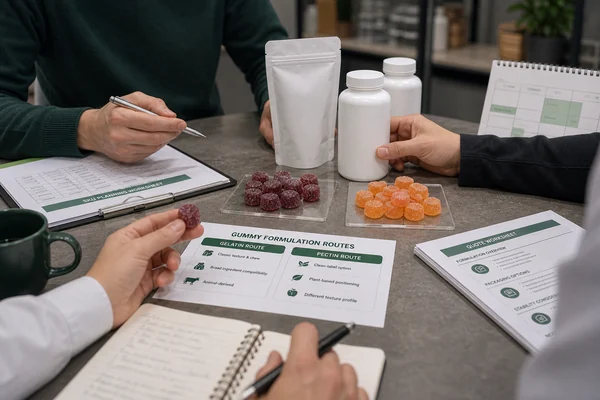
Why ingredient cost is only one part of total production cost
A raw material comparison may make gelatin look cheaper. That can be true at the ingredient level. But total cost includes sample rounds, waste, rejected batches, packaging changes, testing needs, and the opportunity cost of a delayed launch.
If pectin is the only system that fits a vegan product, gelatin is not a real cost-saving option. If gelatin is the only system that delivers the texture the consumer expects, pectin is not automatically better because it supports plant-based language.
Brands should ask for a route comparison: what changes in formula, sample timing, packaging, stability review, and production confidence when using pectin vs gelatin?
Active load, sweetener system, flavor, moisture, and waste risk
Supplement gummies carry actives, and actives can affect the gelling system. Acids, minerals, botanicals, fibers, amino acids, sweeteners, and collagen peptides can all change texture, taste, moisture, and set behavior.
When fiber is the main active system, the separate fiber gummies vs powder guide is the better place to evaluate dose room, serving count, and format proof.
For pectin, acid and soluble solids matter strongly. For sugar-free or reduced-sugar gummies, the pectin type and calcium system need careful review. For gelatin, heat sensitivity, moisture behavior, and off-note masking may be more important.
The formulation risk is not only whether the gummy sets on day one. It is whether the gummy stays acceptable through packaging, shipping, storage, and use.
How collagen, vegan, or sugar-free examples can change the decision
Collagen, vegan, and sugar-free examples show why pectin vs gelatin should stay connected to the SKU strategy.
| SKU example | Likely gelling-system direction | Why |
|---|---|---|
| Animal-sourced collagen gummies | Gelatin may fit | Source story and familiar chew can align |
| Vegan collagen booster gummies | Pectin usually fits | The full base needs plant-based positioning |
| Sugar-free collagen gummies | Requires feasibility review | Sweetener system, pectin type, and texture target change the route |
| Broad-market multivitamin gummies | Either may fit | Consumer texture expectation and label direction decide |
| Warm-climate DTC gummies | Pectin may reduce heat risk | Still needs packaging and stability review |
These examples are support cases. They should not turn this guide into a collagen formula guide. If the main topic is collagen formula design, the better destination is collagen gummies formulation. Here, collagen is only a useful example of how the gelling system changes the decision.
Pectin vs Gelatin Gummies: Pros, Cons, and Decision Table
The decision becomes easier when it is tied to the product brief.
Choose gelatin when classic chew, formula flexibility, and animal-source compatibility matter more. Choose pectin when plant-based positioning, clean-label fit, and warm-condition resilience matter more. Confirm either route with samples and manufacturer capability before production.
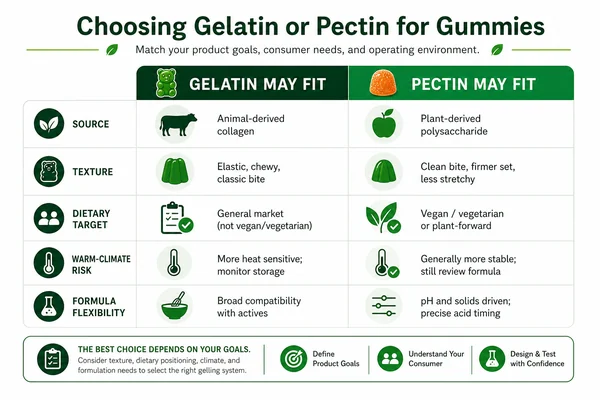
| Decision factor | Gelatin may fit when | Pectin may fit when |
|---|---|---|
| Source positioning | Animal-derived is acceptable or useful | Plant-based is required |
| Texture goal | Elastic, bouncy, familiar chew | Clean bite, firmer set, less stretch |
| Dietary target | No vegan or vegetarian requirement | Vegan or vegetarian positioning matters |
| Warm-climate risk | Controlled storage and packaging can manage heat | Heat resilience is a priority |
| Formula flexibility | Wider pH and solids tolerance is helpful | Formula can be built around pH and solids control |
| SKU examples | Animal collagen, broad wellness, kids formats | Vegan beauty, plant-based, clean-label gummies |
When gelatin fits a supplement gummy project
Gelatin fits when the brand wants a familiar gummy chew, does not need vegan positioning, and has a manufacturer with strong gelatin experience. It can also fit animal-sourced collagen concepts where the source story is coherent.
Gelatin may be a practical starting point when the formula has active ingredients that make pectin difficult, or when the brand needs a more forgiving development path. It still needs stability and packaging review, especially in warm channels.
When pectin fits a supplement gummy project
Pectin fits when plant-based positioning is central to the SKU. It is also useful when the brand wants a cleaner bite, stronger warm-condition performance, or a label story that avoids animal-derived ingredients.
Pectin should be handled as a system decision. The brand needs to discuss pH, sweetener system, active load, moisture target, and sample review before assuming the formula is simple.
Hybrid or alternative gelling systems: what to ask before assuming
Some projects use hybrid systems or alternative hydrocolloids. These may help adjust texture or solve specific formulation problems, but they also add complexity.
Before accepting a hybrid route, ask what the manufacturer has actually produced at scale. Ask whether there is batch history, stability learning, and sample evidence for a similar active load. A novel gelling system can sound attractive in a sales call and become difficult in production.
Questions to Ask a Gummy Manufacturer Before Choosing
A good manufacturer should help translate this decision into a production route.
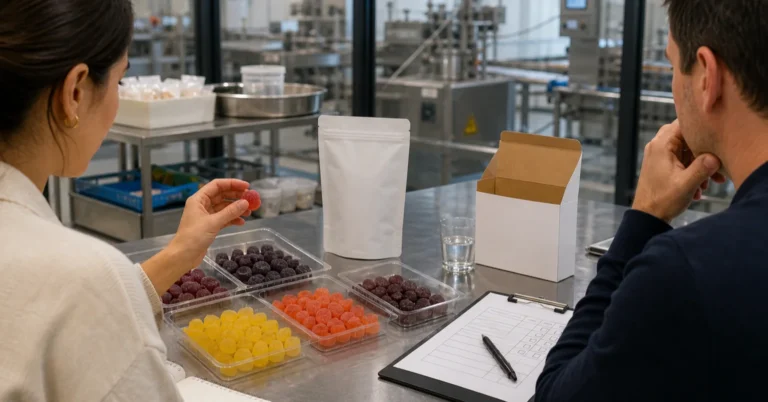
Before choosing pectin or gelatin, ask what the manufacturer runs well, what sample and stability evidence they can provide, and whether the formula should use a stock, semi-custom, or custom route. The best answer is not theoretical. It is tied to real production capability.
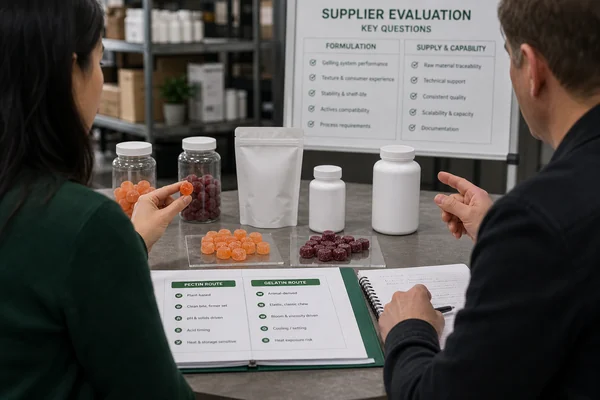
Which gelling systems the manufacturer actually runs well
Ask directly which system the manufacturer runs most often and which system has the stronger first-pass success rate. A manufacturer may say they can do both, but that does not mean both are equal strengths.
Useful questions include:
- Which gelling system do you run most often for supplement gummies?
- Do you have pectin and gelatin sample references with similar active loads?
- What are the most common failure points for each system?
- Can your line support the required pH, temperature, and setting conditions?
- What formulation route would you recommend for this SKU and why?
The goal is not to audit the factory like an engineer. The goal is to find out whether the partner can turn your product brief into repeatable production.
What sample, stability, testing, and packaging evidence to request
Request samples using the intended gelling system and a realistic active load. A blank base sample is useful for texture direction, but it does not prove the final formula will behave the same way.[^8]
Also ask how the manufacturer reviews stability, moisture behavior, packaging compatibility, quality documentation, and finished-product checks. You do not need unsupported guarantees. You do need a clear evaluation plan before launch.
If the manufacturer cannot explain how pectin or gelatin affects sample approval, packaging, and stability,[^8] the gelling system decision is not mature enough for production.
When to connect this decision to stock vs custom formulation
Some projects can start from an existing formula base. Others need custom development. The gelling system often decides which path is realistic.
If the brand wants a fast launch and the desired texture, active load, and label direction match an existing base, a stock or semi-custom route may reduce risk. If the product needs vegan positioning, unusual actives, sugar-free positioning, or a specific texture target, custom formulation may be more honest.
This is where stock formula vs custom formulation becomes part of the discussion. The gelling system is not isolated. It shapes the launch route. Brands can also review Talvenda's product options when they want a starting point before deciding whether to customize.
Frequently Asked Questions
Is pectin the same as gelatin?
No. Pectin is a plant-derived polysaccharide, usually from citrus or apple sources. Gelatin is an animal-derived collagen protein. They form gummies through different mechanisms and create different textures.
Is pectin vegan?
Pectin itself is plant-derived and is generally suitable for vegan formulas. A finished gummy is vegan only if the full formula, including flavors, colors, carriers, coatings, and actives, also meets vegan requirements.
Can pectin replace gelatin in gummies?
Not as a direct swap.[^9] Replacing gelatin with pectin requires reformulation because pectin and gelatin need different pH, solids, temperature, and process conditions. Handle this as a new formula route.
Which is better for collagen gummies?
For animal-sourced collagen gummies, gelatin often fits the product story and texture expectation. For vegan collagen booster gummies, pectin is the better fit because the product needs a plant-based base. The final choice still depends on active load, flavor, texture target, and manufacturer capability.
Conclusion
Choosing pectin vs gelatin is a strategy decision, not just an ingredient preference. It changes labeling, texture, and manufacturing; decide early, then align samples, packaging, and timelines to one route.
For pectin vs gelatin gummies, the base choice should protect the brand's label position, texture target, market channel, and production path at the same time. Talvenda can support this as a private label gummy manufacturing partner by helping brands compare low-MOQ market-tested in-stock gummies, stock formula modification, and custom gummy development before locking the brief. The value is a more practical sample route, with packaging and label support, documentation and testing expectations, quality-controlled production, and scale-up support considered early instead of after reformulation starts. Contact Talvenda through the project inquiry form.
[^1]: "Analysis of porcine gelatin in gelatin powder and gelatin-containing foods", https://pmc.ncbi.nlm.nih.gov/articles/PMC12587888/. Supports gelatin as collagen-derived protein and animal source context from article analysis. [^2]: "A Comparative Study of Pectin Green Extraction Methods from ...", https://pmc.ncbi.nlm.nih.gov/articles/PMC9792233/. Supports pectin’s plant-cell-wall source from citrus peel and apple pomace. [^3]: eCFR, "part 102—common or usual name for nonstandardized foods", https://www.ecfr.gov/current/title-21/chapter-I/subchapter-B/part-102. Supports ingredient statement naming expectations. [^4]: OK State Extension, "What is a Processing Aid?", https://extension.okstate.edu/fact-sheets/what-is-a-processing-aid. Supports the need to review non-gelling inputs for claim scope context. [^5]: Internal claim boundary context for full vegan claim logic across formula components; uses processing-aid and labeling principles from the same source set. See processing input requirements and finished-product labeling workflows. [^6]: PMCID and scholarly hydrocolloid sources on gel/texture behavior and heat-related stability differences, including pectin-gel system behavior in confectionery contexts. https://pmc.ncbi.nlm.nih.gov/articles/PMC3551143/ and https://pmc.ncbi.nlm.nih.gov/articles/PMC10530747/ [^7]: Pectin Hydrogel behavior context for pH and soluble solids control with HM/LM systems, including calcium-related gel formation, as returned by eCFR-targeted elink review. https://pmc.ncbi.nlm.nih.gov/articles/PMC10530747/ [^8]: FDA, "Small Entity Compliance Guide: Current Good Manufacturing Practice in Manufacturing, Packaging, Labeling, or Holding Operations for Dietary Supplements", https://www.fda.gov/regulatory-information/search-fda-guidance-documents/small-entity-compliance-guide-current-good-manufacturing-practice-manufacturing-packaging-labeling. Supports quality-document, packaging, and stability review process expectations. [^9]: PMCID stability evidence source for gummy formulation route differences and moisture/texture control, supporting non-direct swap formulation logic. https://pmc.ncbi.nlm.nih.gov/articles/PMC10818720/