


Gummy iron supplements look easy to launch until the formula has to carry real iron without tasting metallic.
Gummy iron supplements are chewable iron products where the formula must balance iron form, serving size, taste masking, vitamin C, label claims, and warning language before production.
Iron gummies are easy to understand at the product-format level: the format looks approachable, and the category has clear adult, women's, vegan, and vitamin C positioning routes. For brands, that market signal should become a controlled gummy iron supplement brief, not a medical promise.
The product may look simple on a shelf, but the development path is closer to a formula-risk project than a standard flavor extension.
What Brands Should Check
- Iron form and elemental iron target
- Metallic taste, color impact, and mouthfeel
- Vitamin C pairing and acidity
- Sugar, sugar-free, vegan, or gelatin-free base limits
- Label claim and warning-language review
- Finished-product testing and stability planning
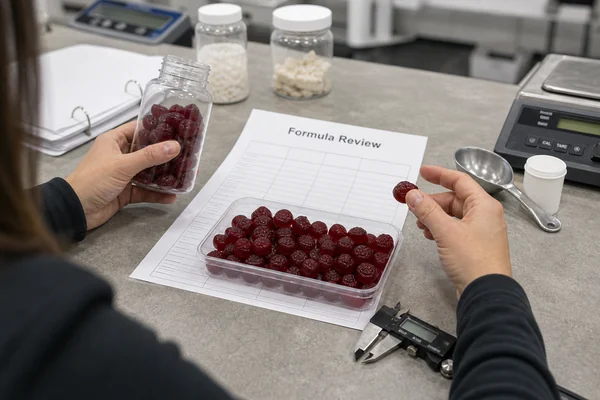
What Are Gummy Iron Supplements?
Iron gummies are a familiar consumer format, but the mineral inside makes them harder to formulate than many standard gummy vitamins.
Gummy iron supplements are chewable supplement products that deliver a declared amount of iron in a gummy base. For brands, the format creates both consumer appeal and formulation risk.
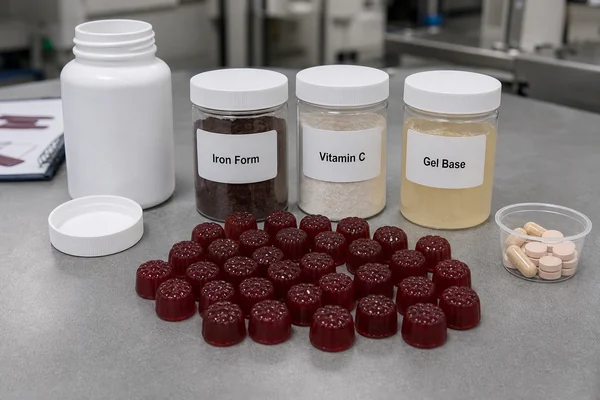
An iron gummy is not just a pill in a softer shape. The active ingredient sits inside a chewy matrix made from sweeteners, gelling agents, acids, flavors, colors, and moisture-control ingredients. Each part of that matrix can affect the finished texture, taste, appearance, and label performance.
The practical development question is whether the gummy can deliver the declared iron amount without becoming too large, too metallic, too gritty, or too difficult to keep consistent through shelf life.
Iron Gummies vs Pills
Iron tablets and capsules can hold a higher active load in a smaller unit. They also protect the end user from tasting the mineral directly. That makes them easier to formulate when the main goal is delivering a higher dose with less sensory exposure.
Iron gummies work differently. The active ingredient is exposed during chewing, so taste masking becomes part of the product design. The base also has physical limits. A gummy has to remain chewable, stable, and acceptable in serving size.
That is why a gummy cannot be judged by the same logic as a tablet. A dose that looks simple on a supplement facts panel may become difficult once the iron form, flavor system, acid level, and gummy weight are tested together.
For a wider format decision, brands can compare gummies with capsules in Talvenda's guide to gummies vs capsules. For a proof-chain view of gummies versus pills, Talvenda also explains when gummy vitamins can be as effective as pills. This page stays focused on what changes when the active ingredient is iron.
| Format | Taste exposure | Dose flexibility | Development difficulty |
|---|---|---|---|
| Tablet | Low | High | Lower |
| Capsule | Low | High | Lower to medium |
| Gummy | High | Medium | Higher |
Why Brands Use Gummies
Brands use gummies because the format is easy for end users to understand. Gummies are easy to chew, easy to package into daily routines, and easier to position visually than plain tablets.
That format advantage can matter in iron. Many consumers associate iron tablets with a more clinical experience. A gummy can make the category feel more approachable and give a brand more room for flavor, shape, color, and lifestyle positioning.
The business question is whether that format advantage is worth the added formulation work. If the iron dose is too high, the taste is hard to mask, or the label needs a more cautious warning set than expected, the product may require a custom development path instead of a quick private-label launch.
Where Market Interest Comes From
Market interest usually comes from three patterns: adult iron support, women's health positioning, and alternatives to pills. Some product listings also emphasize vegan formulas, vitamin C, sugar-free claims, or family-oriented use.
Those patterns are useful for brand planning, but they should not pull the product into medical advice. Market language around iron gummies, gummy iron supplement, iron vitamin gummies, and even awkward comparison phrases like iron pills gummies usually points to format preference, ingredient curiosity, or pill-alternative demand. The safer interpretation is that the category wants a more convenient iron format, while brands need to translate that demand into formula decisions, label decisions, and testing decisions.
What Brand Teams Should Map for Gummy Iron Supplements
Iron gummy listings often compete on audience, supporting ingredients, dietary claims, flavor, and serving style.
Market-facing iron gummy supplements often compete by adult or women's positioning, vitamin C pairing, vegan format, sugar profile, flavor, and serving size. Those signals can help brands shape the formula brief before sampling.

The useful angle is not to imitate a retail page. It is to translate visible market expectations into practical product-development decisions for an iron gummy.
Adult and Women's Positioning
Adult and women's positioning appears strongly across retail listings and category language. Phrases such as iron gummies for women and iron gummies for adults show that the format is commonly framed for daily adult use.
For a brand, this affects product design in several ways. The serving size needs to match the intended positioning. If the concept is framed as iron vitamin gummies or a daily gummy iron supplement, the label language still needs to stay away from disease claims. The flavor profile, bottle count, and packaging style should match the target audience without promising medical outcomes.
Women's health positioning is especially sensitive. It can be commercially useful, but it can also drift into anemia, fatigue, or deficiency language.<sup><a href="#fn-fda-structure-function">[2]</a></sup> The safer path is to discuss daily iron intake support, label accuracy, and formula feasibility while keeping medical claims out of the main copy.
Kids and Family Products
Kids and family searches also appear in the market, but this is a high-caution lane. Iron products can create serious safety concerns if children consume too much.<sup><a href="#fn-medlineplus-iron-overdose">[4]</a></sup> A children's iron gummy should not be handled as a simple flavor or packaging variant of an adult product.
If a brand wants to enter a children's or family segment, it should handle that as a separate formulation and label review track. Dose, warning language, package design, and market rules need to be checked before development.
In a brand-side product-development brief, kids and family positioning stays as a risk boundary rather than a full product guide.
Vegan and Vitamin C Claims
Vegan and vitamin C claims are common in iron gummy listings. They both make sense from a market perspective, but neither is a free add-on.
A vegan gummy usually means pectin or another gelatin-free base. That changes texture, setting behavior, and acid sensitivity. A vitamin C pairing may support the product's positioning, but vitamin C brings acidity and stability considerations into the gummy matrix.
The important point for brands is sequence. Decide whether vegan, vitamin C, sugar-free, or clean-label claims are part of the product brief before sampling begins. Adding those requirements late can force a formula restart.
Formulation Challenges in Iron Gummies
Putting iron into a gummy looks simple on paper, but the first sample often exposes the real constraints.
Iron gummy formulation depends on iron form, taste masking, color behavior, serving size, and base compatibility. These choices should be settled before the product moves from concept to production.
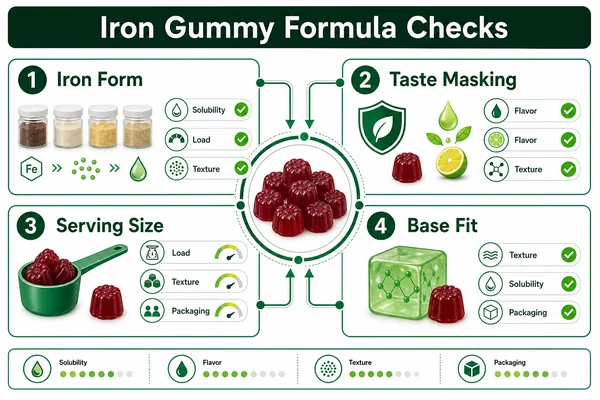
The hardest part is not writing the claim. It is making a gummy that can hold the formula, taste acceptable, and support the label statement after production.
Choosing the Iron Form
The iron form affects taste, color, dose calculation, cost, and finished-product behavior. Common forms used in supplement products may include ferrous fumarate, ferrous sulfate, ferrous bisglycinate, ferric pyrophosphate, or other chelated or specialty forms, depending on the market and supplier availability.<sup><a href="#fn-lpi-iron">[1]</a></sup>
The label usually declares elemental iron, while the raw material is an iron compound. That means the form choice affects how much raw material must be added to reach the target label amount.
From a gummy development standpoint, the first question is not only which form looks best on paper. It is which form can be sourced reliably, masked effectively, tested accurately, and kept compatible with the chosen gummy base.
| Iron form decision | Why it matters for gummies | What brands should ask |
|---|---|---|
| Taste profile | Iron can create metallic notes during chewing | Can the target dose be masked in the selected flavor? |
| Elemental iron contribution | Compound amount affects active load | How much raw material is needed for the label target? |
| Color behavior | Some forms can affect finished color | Will the gummy darken or look inconsistent? |
| Supplier availability | Reformulation risk increases if sourcing is unstable | Is the selected form available for repeat production? |
| Testing method | Finished-product verification must match the label | How will elemental iron be checked in the batch? |
Managing Metallic Taste
Metallic taste is the most obvious sensory problem in iron gummies.<sup><a href="#fn-time-gummy-vitamins">[8]</a></sup> If the mineral note comes through during chewing, the product may fail consumer acceptance even when the label looks strong.
Flavor masking usually depends on several levers: the iron form, the target dose, fruit flavor selection, sweetness, acidity, and sometimes ingredient coating or encapsulation. Strong berry or citrus profiles may help, but they can also affect clean-label or sugar goals.
The practical recommendation is to test taste at the target dose, not at a lower demonstration dose. A sample that tastes acceptable at a lower iron load may not hold up once the real serving target is added.
Balancing Dose and Serving Size
Gummies have a physical limit. The active load competes with the gummy base, sweeteners, acids, flavors, and moisture-control system. A high target dose may require more gummies per serving, a larger gummy, a different iron form, or a different product positioning.
Brands should decide early whether the label target is fixed or whether the formula can be adjusted to fit a practical gummy serving. A gummy iron supplement brief should define the intended elemental iron amount, the number of gummies per serving, and whether vitamin C or other co-ingredients are also declared. This decision affects the product brief, sample review, supplement facts panel, and cost per serving.
The strongest product-development question is simple: can the finished gummy deliver the declared iron amount without becoming too large, too metallic, too gritty, or too hard to keep stable?
Vitamin C, Sugar, and Clean-Label Choices
Many iron gummy concepts include more than iron, and every extra claim changes the formula.
Vitamin C, sugar reduction, vegan bases, and clean-label positioning can all support iron gummy supplements, but each choice affects acidity, texture, taste masking, stability, or label review.
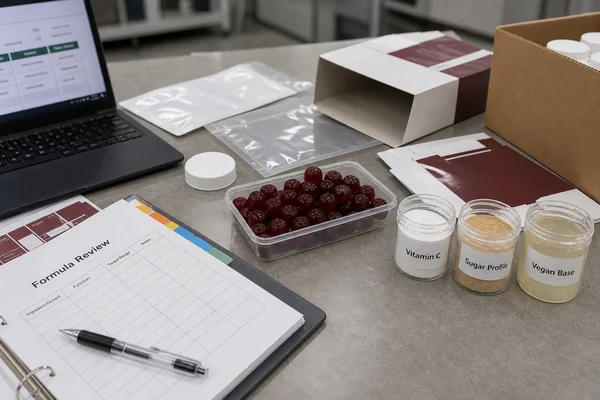
Brands often want vitamin C, vegan positioning, sugar-free claims, natural colors, or a clean-label ingredient list. Each of those choices should be handled as a specification, not a marketing decoration.
Why Vitamin C Is Common
Vitamin C commonly appears in iron supplement positioning because it is often paired with iron in consumer products.<sup><a href="#fn-lpi-iron">[1]</a></sup> In gummy development, the manufacturing question is how that pairing affects the formula.
Vitamin C is acidic and can affect pH, flavor sharpness, color, and texture. It may also require overage and stability planning if a specific label amount is declared. The finished product needs to support the claim through its intended shelf-life target.
That means vitamin C should be included in the first formula brief if it is important to the positioning. Adding it later can change the base chemistry and sample result.
Sugar and Sugar-Free Options
Sugar does more than sweeten a gummy. It supports texture, mouthfeel, solids content, and flavor masking. Removing or reducing it can change the way the gummy sets and how the mineral taste appears during chewing.
Sugar-free or reduced-sugar iron gummies may be possible, but they often need different sweetener systems and extra sensory review. Polyols, high-intensity sweeteners, fibers, or blended systems can affect taste and texture in different ways.
For iron gummies, sugar reduction should be tested against the metallic taste risk. A formula may meet a sugar target but fail as a consumer product if the taste becomes too mineral-heavy.
Vegan and Gelatin-Free Formats
Vegan iron gummies usually require a gelatin-free base such as pectin or another plant-based gelling system. That decision affects the texture, processing window, acidity tolerance, and shelf-life behavior.
Pectin-based gummies can work well, but they are not simply gelatin gummies with one ingredient swapped. The base system needs to be designed around the active ingredients and acids in the formula.
For a deeper gummy-base decision, brands can read Talvenda's guide to pectin vs gelatin gummies. Here, the key message is narrower: a vegan iron gummy needs a gummy-base decision before sample development, not after.
Label and Safety Risks to Control
Iron gummies need careful label review because the product sits close to health and safety language.
Brands should keep iron gummy claims focused on declared iron amount, formula support, label accuracy, and warning review. The copy should avoid medical-condition wording and consumer dosing advice.
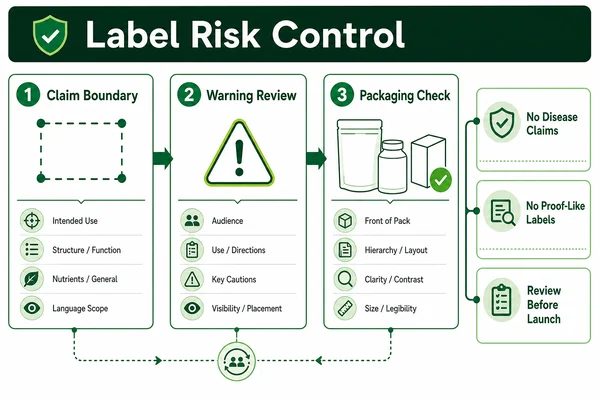
The label review should happen before the brand commits to packaging, retail copy, and ad angles. Rewriting the claim after label printing is slower and more expensive than building the boundary into the brief.
Avoiding Disease Claims
Iron gummies should not be positioned as products that address medical conditions or symptoms.<sup><a href="#fn-fda-structure-function">[2]</a></sup><sup><a href="#fn-ecfr-structure-function">[3]</a></sup> Those are disease or medical-advice directions, and they need a different level of evidence and regulatory review.
Even when market language includes anemia-facing terms, a brand should handle that demand as a claim-risk signal rather than a product promise. A brand can discuss label boundaries, warning review, and daily iron intake support without using condition- or symptom-style wording.
Safer wording focuses on product development and claim control: declared iron amount, support for daily iron intake, label accuracy, finished-product testing, and regulatory review.
Brands should also remember that claims outside the label matter. Product descriptions, marketplace copy, social ads, and website pages can create the same risk if they use medical-condition language.
Handling Sensitive User Groups
Women's, children's, prenatal, and postnatal language can all attract market interest, but these groups require caution. Brand-facing copy should not recommend who should take iron gummies or how much they should take.
For brand planning, sensitive groups should be handled as label and product-development boundaries. A standard adult iron gummy is not automatically suitable for children or prenatal positioning. Those routes may require separate formula review, different warning language, and professional regulatory guidance.
This keeps the product-development discussion useful for brands without turning the page into a consumer dosing guide.
Warning and Overdose Language
Iron products require careful warning review because accidental overconsumption can be dangerous, especially for children.<sup><a href="#fn-medlineplus-iron-overdose">[4]</a></sup><sup><a href="#fn-ecfr-iron-warning">[5]</a></sup> Exact wording and thresholds depend on the target market and current regulations, so brand guidance should not invent a universal warning statement.
The practical advice is that warning language, child-safety considerations, package format, and serving-size directions should be reviewed before production. If a brand sells in multiple markets, it should not assume one label version works everywhere.
This is one of the reasons iron gummies need a higher-control product path than a basic flavor gummy or low-risk vitamin line extension.
How Brands Should Prepare for Manufacturing
An iron gummy brief should be clear before a brand asks for samples or pricing.
Before manufacturing gummy iron supplements, brands should confirm iron form, elemental iron target, serving size, vitamin C decision, base system, flavor direction, label boundary, and testing expectations.
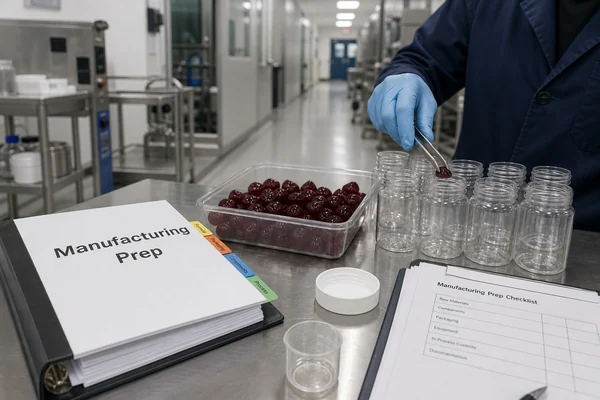
By the time a brand approaches a production partner, the concept should be more than a flavor idea. A clear brief makes sampling faster and reduces the risk of late-stage reformulation.
Confirm Formula Targets
A useful formula target should include:
- Iron form preference or acceptable options
- Target elemental iron per serving
- Gummies per serving
- Vitamin C inclusion and target amount if applicable
- Sugar, reduced-sugar, or sugar-free direction
- Gelatin, pectin, or other base preference
- Flavor and color direction
- Target market and claim boundary
- Packaging and warning-label assumptions
The more precise the brief is, the easier it is for the production team to judge feasibility. Vague briefs lead to vague samples. If the brand is still preparing its supplier inquiry, Talvenda's gummy supplement manufacturer checklist can help organize formula route, packaging, testing scope, MOQ expectation, and launch timing before sampling.
Plan Testing and Stability Checks
Testing should not be handled as a final paperwork step. For iron gummies, it is part of product development.
Brands should plan how the finished product will be checked for iron content, microbiological quality, label accuracy, and stability.<sup><a href="#fn-ecfr-cgmp">[6]</a></sup><sup><a href="#fn-nsf-supplement-cert">[7]</a></sup> If vitamin C is declared, that co-ingredient also needs stability consideration. If the gummy uses a vegan base, texture stability may need special attention.
The documentation package should match the claim and market route. A raw-material COA is useful, but it does not replace finished-product review. Brands should clarify which batch records, finished-product assay, microbiology results, stability assumptions, release documents, and product specifications will be available for the commercial order. For broader supplier qualification, Talvenda's GMP certified supplement manufacturer guide explains how brands can review certificate scope, COA process, testing, and release documentation.
The goal is not to make unsupported proof claims in marketing copy. The goal is to make sure the formula, label, and batch documentation can support the product that the brand is selling.
| Checkpoint | Purpose | Why it matters before launch |
|---|---|---|
| Finished-product assay | Confirms declared iron amount | Protects label accuracy |
| Sensory review | Checks metallic taste and mouthfeel | Prevents repeat-purchase problems |
| Microbial testing | Confirms basic finished-product quality | Supports retail and documentation review |
| Stability planning | Checks active level, texture, and appearance over time | Reduces shelf-life risk |
| COA and batch records | Connects the commercial batch to the release file | Helps brands review what the documentation actually supports |
| Label review | Screens claims, warnings, and directions | Prevents packaging rework |
Choose Stock or Custom Development
A stock formula may make sense when the brand wants to test the market quickly and can accept the existing iron form, dose, flavor, and base. It can reduce development time and simplify the first launch.
A custom formula makes more sense when the brand needs a specific iron form, a unique flavor, a vegan base, a lower-sugar direction, or a differentiated serving target. It gives more control, but it also requires more sampling, testing, and decision-making.
For a deeper development-route comparison, link to Talvenda's guide to stock formula vs custom formulation. If the brand wants to test demand before a deeper custom project, the low MOQ private label gummy supplements guide can support first-order route planning. Here, the practical decision is whether the available formula route can support the brand's claim, taste, dose, and label needs without creating avoidable launch risk.
| Decision factor | Stock formula | Custom formula |
|---|---|---|
| Speed | Faster if the existing formula fits | Slower because sampling is required |
| Differentiation | Limited | Stronger |
| Ingredient control | Lower | Higher |
| Best fit | Standard adult positioning | Specific dose, vegan, sugar-free, or premium claim direction |
| Main risk | Limited flexibility | Longer validation path |
Iron Gummies FAQ for Brands
Do iron gummies work?
For a brand, the safer question is whether the finished gummy can deliver the declared iron amount in a stable, acceptable product format. That depends on iron form, serving size, taste masking, stability planning, finished-product testing, and label review. The article should not promise a medical outcome or position iron gummies as a treatment.
Are iron gummies as effective as pills?
Iron gummies and pills should be compared by declared iron amount, ingredient form, serving size, stability, and finished-product proof. Pills often have more room for higher active loads, while gummies need extra formula space for taste, texture, acids, sweeteners, and moisture control. A gummy can be a good product route when the formula and documentation support the label claim.
What iron forms can be used in gummies?
Possible iron forms may include ferrous fumarate, ferrous sulfate, ferrous bisglycinate, ferric pyrophosphate, or other specialty forms, depending on supplier availability and market requirements. The practical decision is not only the ingredient name. Brands should review elemental iron contribution, metallic taste, color behavior, compatibility with the gummy base, sourcing reliability, and testing method.
How can brands manage metallic taste in iron gummies?
Metallic taste should be tested at the target iron level, not only in a low-dose sample. The formulation team may need to adjust iron form, flavor direction, sweetness, acidity, gummy base, serving size, and sometimes coating or encapsulation strategy. The goal is a product that can support the label while still being acceptable to chew.
What documents should brands ask for before launching iron gummies?
Brands should ask what documentation will support the commercial batch: finished-product assay, microbiology results, stability plan, batch records, COA process, product specifications, label review notes, and any market-specific compliance files. The exact file set depends on the formula, claim, target market, and sales channel.
Can iron gummies be positioned for women, adults, or children?
Adult and women's positioning can be commercially useful, but it should stay away from disease, fatigue, anemia, prenatal, or treatment-style claims unless qualified advisors approve the wording. Children's iron gummies need extra caution because warning language, package design, serving directions, and accidental overconsumption risk must be reviewed before production.
Conclusion
Gummy iron supplements need careful planning around iron form, taste, serving size, label language, and testing before launch.
Iron gummy supplements need extra discipline around iron form, taste, serving size, label language, packaging, and testing expectations. Talvenda can support brands as a contract gummy supplement manufacturer by helping them choose between low-MOQ market-tested in-stock gummies, stock formula modification, and custom gummy development before moving too far into custom sampling. That gives your team a clearer route for sample development, packaging and label support, documentation and testing expectations, and production through GMP-certified and FDA-registered manufacturing facilities. To review whether an iron gummy concept is practical, contact Talvenda through the project inquiry form.
<section class="footnotes"> <ol> <li id="fn-lpi-iron">Linus Pauling Institute, Oregon State University, <a href="https://lpi.oregonstate.edu/mic/minerals/iron">Iron</a>.</li> <li id="fn-fda-structure-function">U.S. Food and Drug Administration, <a href="https://www.fda.gov/food/food-labeling-nutrition/structurefunction-claims">Structure/Function Claims</a>.</li> <li id="fn-ecfr-structure-function">21 CFR 101.93, <a href="https://www.ecfr.gov/current/title-21/chapter-I/subchapter-B/part-101/subpart-F/section-101.93">Certain types of statements for dietary supplements</a>.</li> <li id="fn-medlineplus-iron-overdose">MedlinePlus Medical Encyclopedia, <a href="https://medlineplus.gov/ency/article/002659.htm">Iron overdose</a>.</li> <li id="fn-ecfr-iron-warning">21 CFR 101.17, <a href="https://www.ecfr.gov/current/title-21/chapter-I/subchapter-B/part-101/subpart-A/section-101.17">Food labeling warning and notice statements</a>.</li> <li id="fn-ecfr-cgmp">21 CFR 111.75, <a href="https://www.ecfr.gov/current/title-21/chapter-I/subchapter-B/part-111/subpart-E/section-111.75">Dietary supplement testing requirements</a>.</li> <li id="fn-nsf-supplement-cert">NSF, <a href="https://www.nsf.org/consumer-resources/articles/supplement-vitamin-certification">Supplement and Vitamin Certification</a>.</li> <li id="fn-time-gummy-vitamins">TIME, <a href="https://time.com/5549874/do-gummy-vitamins-work/">Do Gummy Vitamins Work? Here's What Experts Say</a>. Used only for gummy-format context, not regulatory or medical claims.</li> </ol> </section>