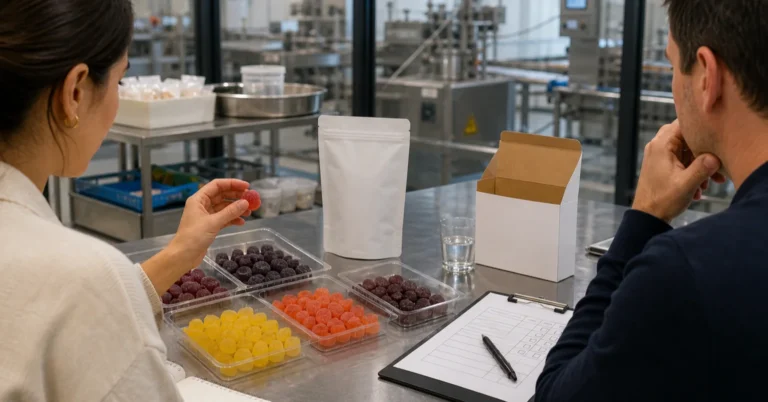


A GMP badge can reduce worry, but it can also hide weak product proof if a brand stops asking questions too early.
A GMP certified supplement manufacturer should show controlled production and documentation systems. A brand still needs to verify the certificate scope, facility match, audit body, batch records, COA process, finished-product testing plan, packaging risk, and label-claim support before production.
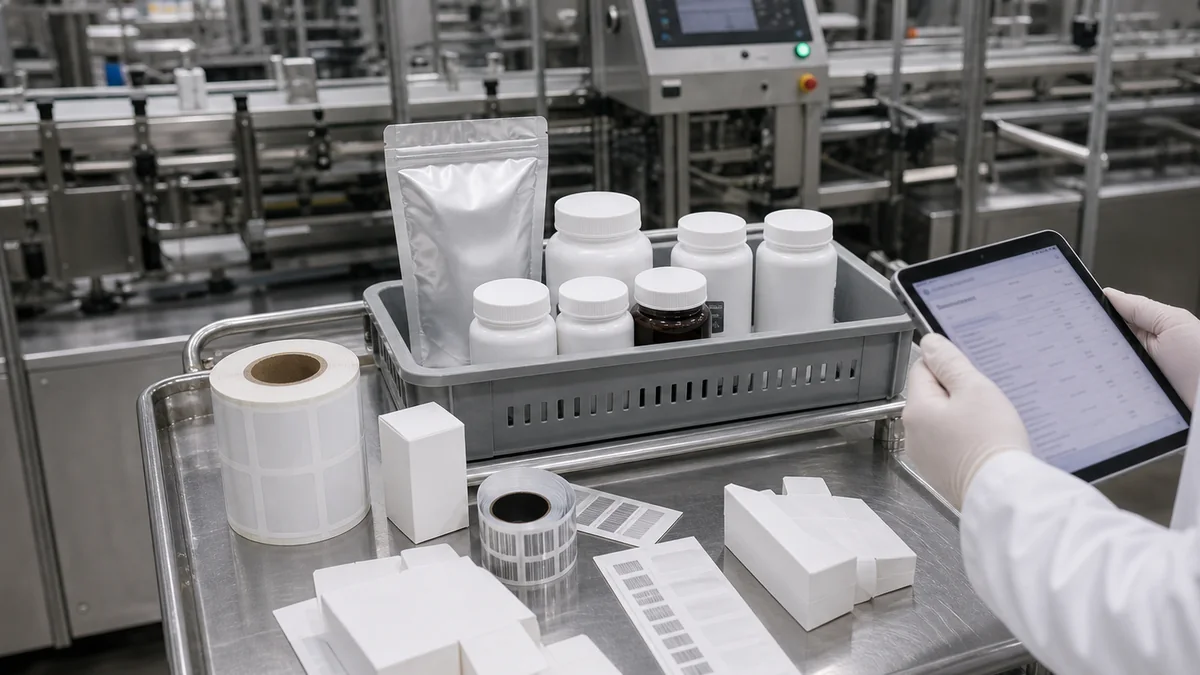
I use GMP as the start of supplier qualification, not the finish line. A certificate can help a brand screen a manufacturer, but the product still needs its own proof path before a commercial lot is released.
What Does GMP Certified Supplement Manufacturer Mean?
The phrase sounds reassuring, but it becomes risky when a brand reads it as complete product proof.
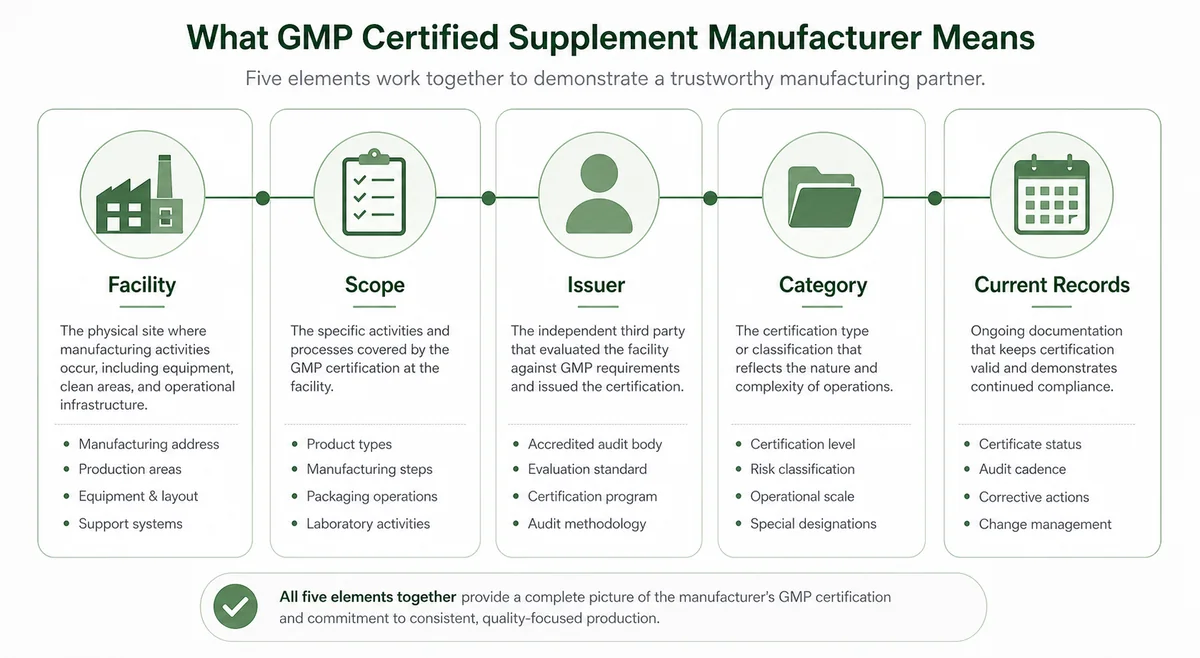
A GMP certified supplement manufacturer is a manufacturer or facility that can show good manufacturing practice controls through compliance systems, audits, or third-party certification. The exact meaning depends on the facility, certificate scope, issuing body, product category, and current quality records.
What Does GMP Stand For? GMP and cGMP in Dietary Supplement Manufacturing
GMP stands for good manufacturing practice. cGMP means current good manufacturing practice. In dietary supplement manufacturing, these terms point to controlled procedures for materials, production, sanitation, equipment, training, records, quality review, and release decisions.[^1]
For a supplement brand, the useful point is not only the definition. The useful point is whether the quality system connects to the product that will be made. A GMP claim for one facility or process does not automatically answer every question about a gummy, capsule, powder, or softgel project.
I prefer to ask how the system works in the real production path. Who checks incoming raw materials? How are batch records created? How are deviations handled? How does the quality team release a lot? These questions turn GMP from a logo into something a brand can evaluate.
Why "GMP Certified" Does Not Mean FDA Approved
This boundary needs to stay clear. A dietary supplement manufacturer may follow applicable cGMP requirements. A facility may also hold a third-party GMP certification. That is different from saying the FDA approved the supplement product or approved the manufacturer as a marketing claim.
The FDA sets and enforces regulatory expectations. Third-party certification bodies or audit programs can review a facility or quality system against their standards. A brand should avoid supplier language that blends these ideas together.[^2]
| Claim language | What it can mean | What it does not prove by itself |
|---|---|---|
| GMP compliant | The manufacturer says it follows GMP requirements | That a third party certified the facility |
| GMP certified | A third-party program may have reviewed a defined scope | FDA approval of the product or facility |
| cGMP | The system should reflect current practice expectations | Finished-product potency, stability, or label-claim match |
| Audit scope | A defined site, category, process, or system was reviewed | That every product or site is covered |
Compliance, Certification, and Audit Scope: What Brands Should Separate
Compliance, certification, and audit scope are related, but they answer different questions. Compliance asks whether the manufacturer follows the required quality system. Certification asks whether a third party reviewed the system. Audit scope asks what was actually included.
That scope can change the whole supplier decision. A certificate may apply to one facility, one dosage form, one production area, or one product category. If a brand is making gummies, it should not assume a certificate for another site or process covers the gummy project.
This is where I separate the certificate file from the product proof file. The certificate can support the facility review. The product proof file still needs raw material COA handling, batch records, finished-product testing decisions, label review, packaging checks, and release documentation.
What Proof Should a Brand Ask From a GMP Certified Supplement Manufacturer?
A supplier can answer "yes, we are GMP certified" and still leave the brand with too little proof for production.
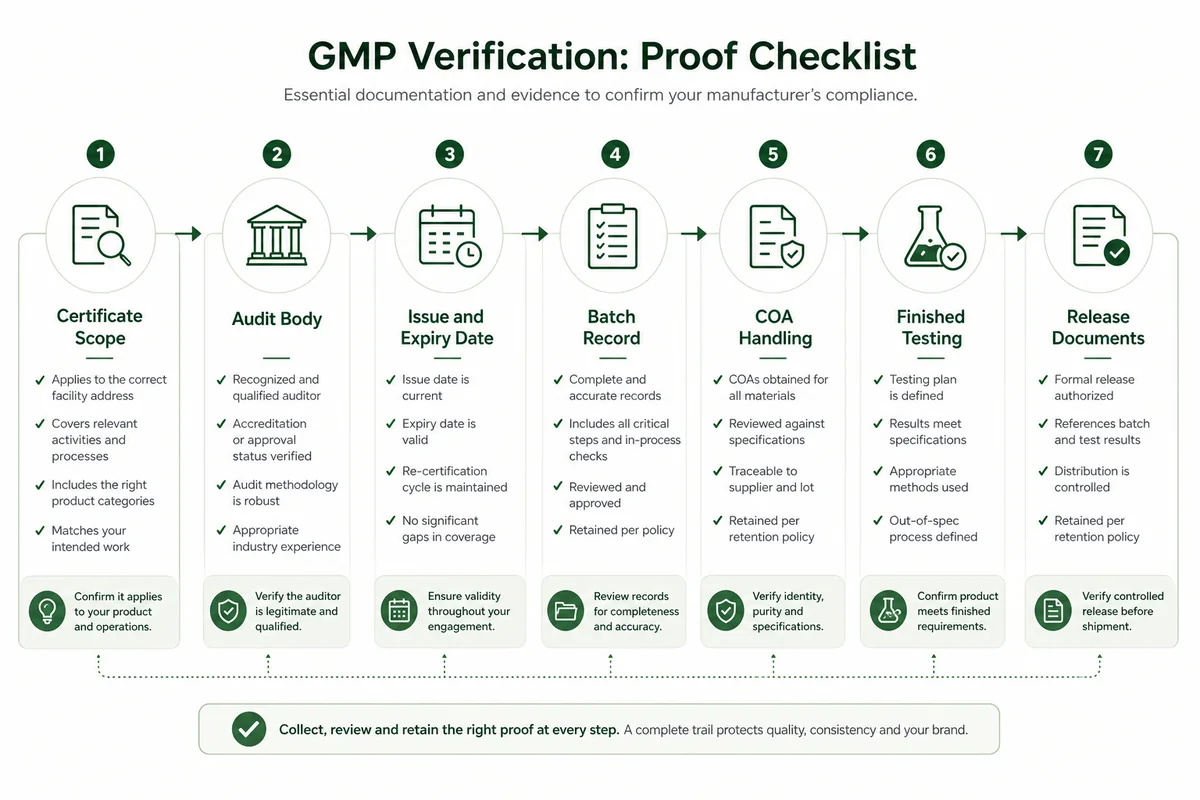
A supplement brand should ask for the facility-specific certificate, issuing body, certificate scope, product category, issue date, expiry date, quality-system summary, SOP expectations, batch-record process, COA handling, finished-product testing plan, and release documentation path.
Facility-Specific Certificates and Audit Body Details
The first check is the facility. If the manufacturer has multiple sites, the certificate should match the site that will actually produce the product. A GMP-certified facility claim is only useful when the facility address, audit scope, product category, and planned production route line up. A document from a different location may still say something positive about the company, but it may not cover the project in front of the brand.
The second check is the issuing body or audit program. A recognized outside review carries more value than a loose badge on a sales page. The brand should know who issued the document, what standard or program it refers to, and whether the manufacturer can explain the certificate without vague language.
I do not expect every sales contact to answer every quality question alone. A serious manufacturer should be able to involve its quality team when needed. If no one can explain the certificate, that is a warning sign before sampling.
Certificate Scope, Product Category, Issue Date, and Expiry Date
The certificate scope should be read closely. It may mention dietary supplements, food products, blending, encapsulation, tablet production, packaging, warehousing, or another category. The brand should check whether the scope matches the product form and process being discussed.
Issue date and expiry date matter because quality systems are not static. Facilities add lines, change staff, update procedures, qualify new materials, and revise documentation practices. A current certificate does not answer every product question, but an expired or unclear certificate should slow the decision.
For gummies, the product category matters more than many brands expect. Gummies involve water activity, texture, drying or curing decisions, packaging protection, active-load limits, and stability-aware review. A broad certificate can support the facility screen, but the gummy project still needs a product-specific quality discussion.
Quality System Summary, SOPs, and Batch Record Expectations
Many manufacturers will not share every internal SOP, and that is reasonable. But the brand should still understand the quality system at a practical level.
Useful questions include:
| Proof area | Practical question to ask |
|---|---|
| Raw material control | How are ingredients qualified, received, tested, and released? |
| Production records | What batch record is created for each lot? |
| Deviation handling | How are exceptions documented and reviewed? |
| Lot traceability | Can materials, production steps, and release records be traced by lot? |
| Packaging control | How are labels, bottles, pouches, desiccants, and cartons checked? |
| Release decision | Who reviews the file before finished goods are released? |
The batch record is central because it connects the formula, materials, process, checks, and release decision. A GMP claim without batch-record discipline does not give a brand enough confidence for a commercial order.[^3]
Where GMP Ends and Product Testing Begins
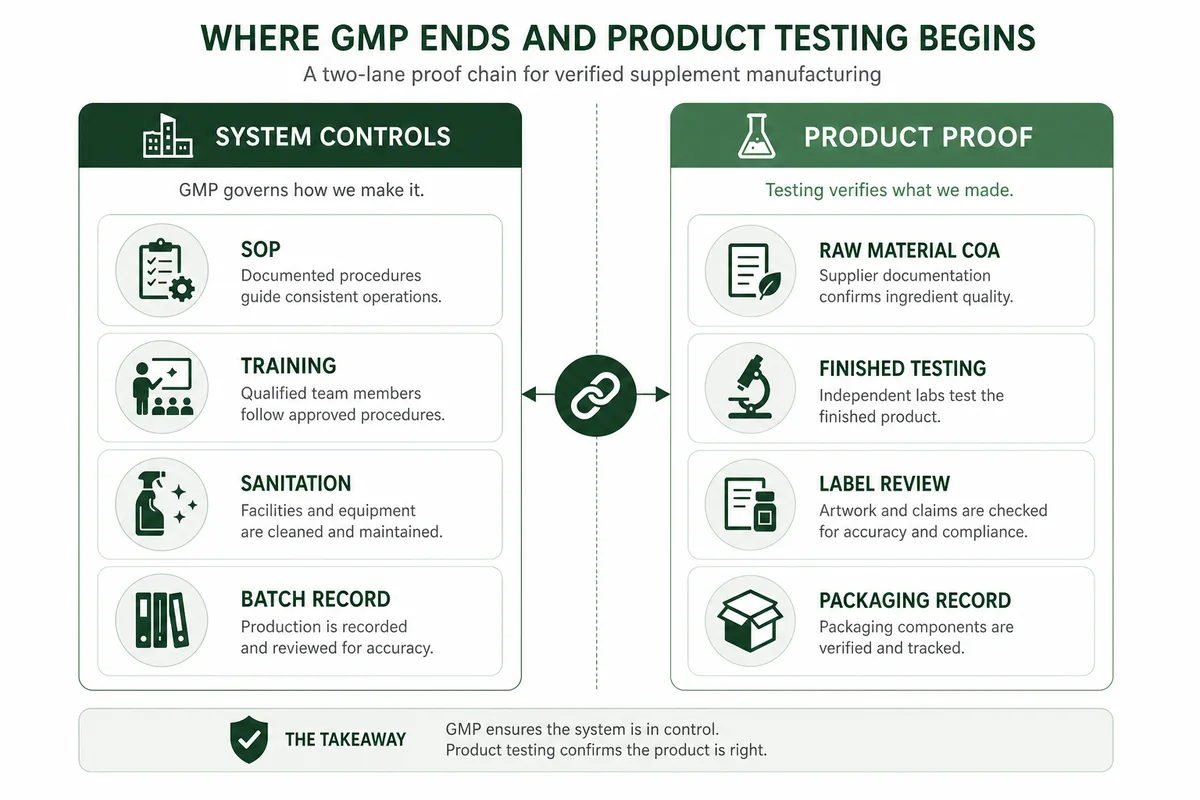
GMP controls the manufacturing system, but it does not replace proof for one finished formula and one finished lot.
GMP ends at system control, documentation, and production discipline. Product testing begins when the brand needs proof for ingredient identity, active content, contaminants, label-claim support, finished-batch release, packaging performance, or stability-related expectations.
Raw Material COA vs Finished-Product Testing
A raw material COA is an ingredient-level document. It can support identity, purity, strength, or contaminant expectations for an incoming material. It does not prove that the finished supplement meets every label or release requirement after manufacturing.
Finished-product testing answers a different question. It looks at the product after the formula, process, and packaging path have changed the material into a finished SKU. For a gummy, this distinction can be important because heat, moisture, acids, fibers, minerals, flavors, and storage conditions can affect the final product experience.
The brand and manufacturer should agree on the test plan before production. The right plan depends on the formula, claims, market, dosage form, risk level, and release requirements. The practical point is simple: do not use one raw material COA as if it answers every finished-product question.[^4]
Batch Records, Lot Traceability, and Label-Claim Support
Batch records show how a lot was made. Lot traceability shows how materials, equipment, production timing, packaging, checks, deviations, and release decisions connect. Together, they help a brand understand what happened if a quality question appears later.
Label-claim support is related, but it is not identical. If a finished product claims a certain active amount, the proof file should support that claim. If the product uses softer structure/function positioning, the brand still needs the claim language to match the evidence and the product format.
I like to review these proof layers as one chain:
| Proof layer | Main question it answers |
|---|---|
| Facility GMP proof | Is the manufacturing system controlled? |
| Raw material COA | Does the incoming ingredient file support the material? |
| Batch record | How was this specific lot made and reviewed? |
| Finished-product testing | Does the finished lot support the intended release requirements? |
| Label review | Does the label language match the evidence and product boundaries? |
| Packaging record | Does the package support the product's stability and handling needs? |
Third-Party Testing, NSF, NPA, BSCG, and What Each Signal Can Prove
Third-party names can be useful trust signals, but the brand should ask what each signal covers. One program may focus on facility GMP certification. Another may support product certification, testing, prohibited-substance review, or a company listing.[^5]
The mistake is turning a logo into blanket proof. A facility certification does not automatically prove a finished lot. A finished-product test does not replace the full quality system. A supplier listing does not answer all packaging or label-claim questions.
The stronger approach is to place each signal in the right part of the quality file. Facility certification supports the manufacturing-system review. Finished-product testing supports lot-level questions. Batch records support traceability. Label review supports claim discipline. The file becomes stronger when these pieces connect.
How GMP Affects Supplier Selection for Supplement Brands
Supplier selection becomes weak when a brand checks price and lead time before checking whether quality proof is ready.
GMP affects supplier selection by showing whether the manufacturer can support controlled production, documentation, and release discipline. Brands should still ask product-specific questions before sampling, packaging approval, purchase orders, and commercial production.
Questions to Ask Before Sampling or Production
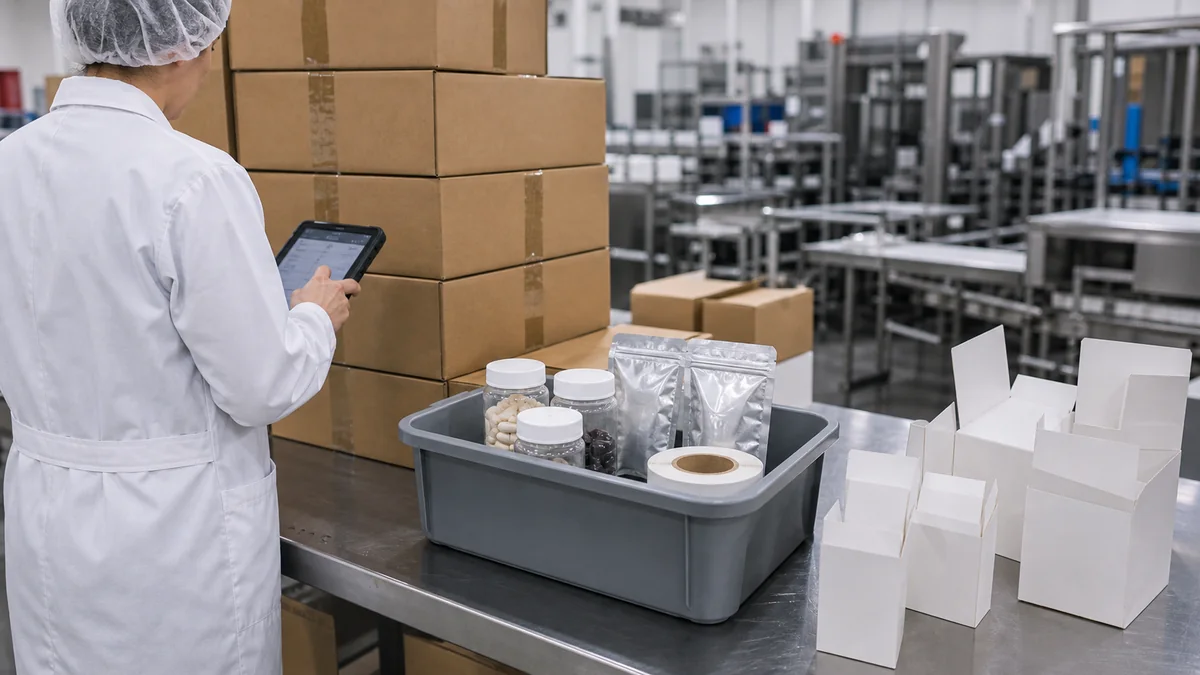
Before a brand moves into samples or production, I would use questions that connect the supplier claim to the project:
| Review area | Question before moving forward |
|---|---|
| Facility match | Which facility will produce this product? |
| Certificate scope | Does the certificate cover that facility and product category? |
| Quality contact | Can the quality team explain the proof file? |
| Raw materials | What COA and incoming-material checks are used? |
| Finished testing | What finished-product testing is recommended for this formula? |
| Label support | What label-claim review should happen before release? |
| Packaging | What package risks should be settled before commercial production? |
| Documentation | What records will the brand receive or be able to review? |
These questions are not meant to slow a good project. They reduce the chance that a weak project moves too fast. The earlier a brand asks them, the easier it is to adjust the brief, timeline, packaging plan, or testing expectation.
For a broader supplier screen beyond GMP, the gummy supplement manufacturer checklist can support a wider review.
Red Flags in GMP, cGMP, and Certification Claims
Some red flags are direct. The certificate is expired. The facility address does not match the production site. The certificate scope is unclear. The sales page says "FDA approved" in a way that the quality team cannot support.
Other red flags are more practical. The manufacturer uses raw material COA as finished-product proof. It cannot explain batch records. It pushes fast production before label and packaging questions are settled. It avoids discussing testing until after the purchase order.[^6]
I do not read every weak answer as automatic failure. Sometimes the right person has not joined the conversation yet. But if the supplier cannot connect GMP, documentation, testing, packaging, and release logic after reasonable questions, the brand should pause before production.
MOQ, Lead Time, Packaging, and Documentation Readiness
MOQ and lead time are commercial questions, but they should not be separated from quality readiness. A low MOQ can still carry quality risk if the documentation path is vague. A short lead time can still be risky if the formula, label, package, and testing plan are not ready.
Packaging is especially important. A product may look fine in a sample jar but behave differently after commercial filling, sealing, shipping, and storage. Gummies can stick, dry, absorb moisture, change texture, or create label-claim questions if the package is not chosen carefully.
Talvenda can support this kind of early planning through formulation review, packaging coordination, documentation discussion, and scale-up thinking. For certification display and company trust context, the Talvenda certifications page is the better deeper page.
GMP Checks for Gummy Supplement Manufacturing Projects
Gummies make proof review more connected because the formula, process, packaging, and label promise affect the same finished product.
For gummy supplement manufacturing, GMP checks should connect facility proof with finished-batch review, active-load feasibility, moisture and texture control, packaging decisions, label-claim support, and stability-aware documentation before commercial production.
Why Gummies Need Finished-Batch and Stability-Aware Review
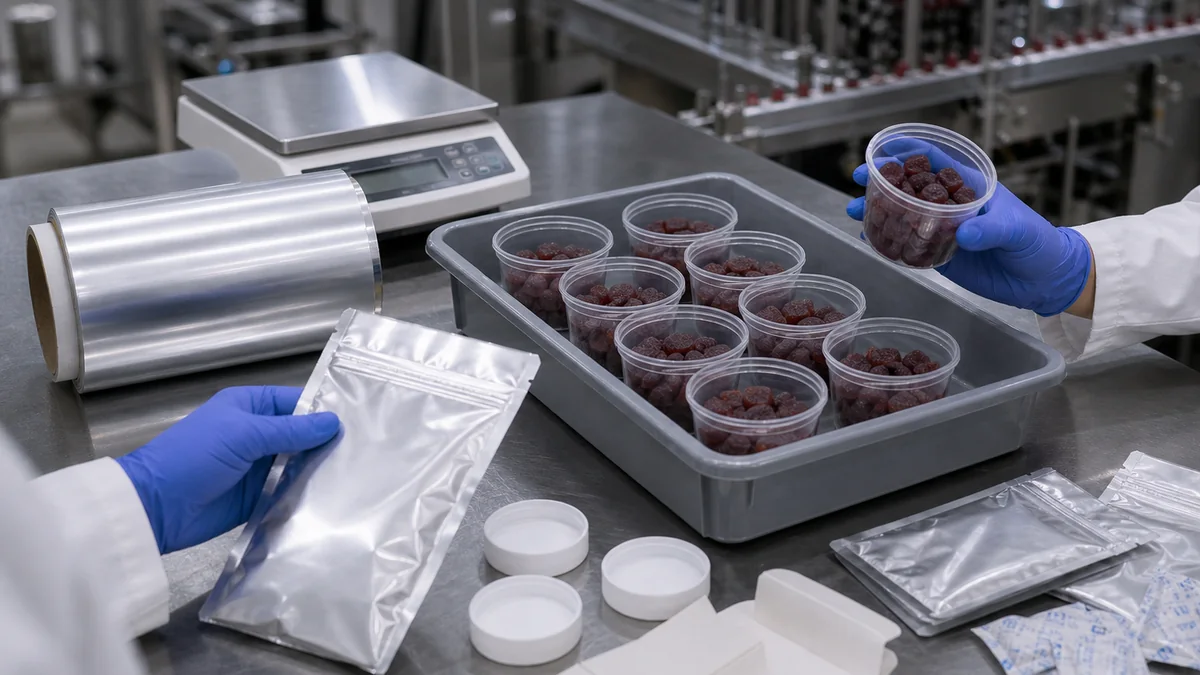
A gummy is not a dry supplement placed into a bottle. It is a matrix that may include sweeteners, acids, flavors, colors, gelling agents, oils, fibers, minerals, botanical extracts, and active ingredients. Moisture and texture are part of the product, not background details.
That is why a GMP certificate should be paired with finished-batch thinking. The brand should understand how the finished gummy will be checked, how the active claim will be supported, and how the packaging choice affects the product over time.
I would rather ask these questions before the first commercial batch. Once labels, packaging, purchase orders, and launch dates are fixed, every missing proof layer becomes harder to correct.
Packaging, Moisture, Texture, and Label-Claim Documentation
Packaging is a quality decision for gummies. It can affect moisture control, sticking risk, odor protection, texture stability, shipping tolerance, and the consumer experience. It should be discussed before production, not only after samples taste good.
The brand should connect packaging with the documentation file. What packaging format is planned? What risk is it meant to control? Does the product need desiccant discussion? Are storage conditions clear? Does the label claim require a stronger finished-product review?
This is where gummy projects often expose weak GMP thinking. The facility certificate may be valid, but the SKU can still need more specific review. Active load, moisture, texture, coating, bottle or pouch choice, and label language all need to work together.
When to Use a Manufacturer Checklist or Certification Page Instead
Use this guidance when the main question is how to interpret a GMP certified supplement manufacturer claim. Broader supplier and trust questions need different review paths.
Use a broader checklist when the brand needs to compare manufacturers across communication, MOQ, formulation support, packaging, lead time, documentation, and export readiness. Use the certification page when the brand wants Talvenda's trust and certification context. Use a product-specific testing article such as third-party tested creatine gummies when the main question is finished-batch or third-party testing proof.
The best review uses the right file for the right decision. GMP explains the manufacturing-system foundation. Supplier checklists help compare partners. Certification pages show trust signals. Testing articles explain product-specific proof. A strong launch should not collapse these into the same file.
FAQ About GMP Certified Supplement Manufacturers
Is GMP certification required for dietary supplements?
Dietary supplement manufacturers must follow applicable manufacturing requirements. Third-party GMP certification is a separate trust signal, so brands should review both regulatory expectations and any certificate claim.
What is GMP certification?
GMP certification usually means an outside audit or certification program reviewed a defined facility, quality system, or manufacturing scope. For supplement brands, the practical question is what the certificate covers and whether that scope matches the product that will be made.
What is the difference between GMP certification and FDA approval?
GMP certification usually refers to a third-party review of a facility or quality system. FDA approval is different. Brands should not read GMP certification as FDA approval.
How can I verify a supplement manufacturer's GMP claim?
Ask for the certificate, issuing body, facility address, scope, product category, issue date, expiry date, and quality-system explanation. Then connect that proof to batch records, COA handling, testing plans, packaging review, and release documentation.
Is GMP certification the same as third-party testing?
No. GMP certification supports facility or quality-system review. Third-party testing can support product-specific questions such as identity, active content, contaminants, or finished-batch release requirements.
Conclusion
A GMP certified supplement manufacturer claim is useful only when it connects to facility proof, product testing, packaging review, and release documentation.
As an OEM/ODM gummy supplement manufacturer working through GMP-certified and FDA-registered manufacturing facilities, Talvenda can help brands prepare a manufacturer review around the product route, not just a certificate request. For projects with a clear brief, the team can review whether low-MOQ market-tested in-stock gummies, stock formula modification, or custom gummy development best fits formula feasibility, packaging risk, documentation and testing expectations, and scale-up support. Send the product type, active direction, packaging plan, and quality questions through the project inquiry form.
[^1]: eCFR, 21 CFR Part 111: Current Good Manufacturing Practice in Manufacturing, Packaging, Labeling, or Holding Operations for Dietary Supplements. [^2]: FDA, Is It Really "FDA Approved"?. [^3]: eCFR, 21 CFR Part 111, including batch production record and quality control provisions. [^4]: FDA, Dietary Supplements overview. [^5]: NSF, Dietary Supplement and Vitamin Certification. [^6]: FTC, Health Products Compliance Guidance.