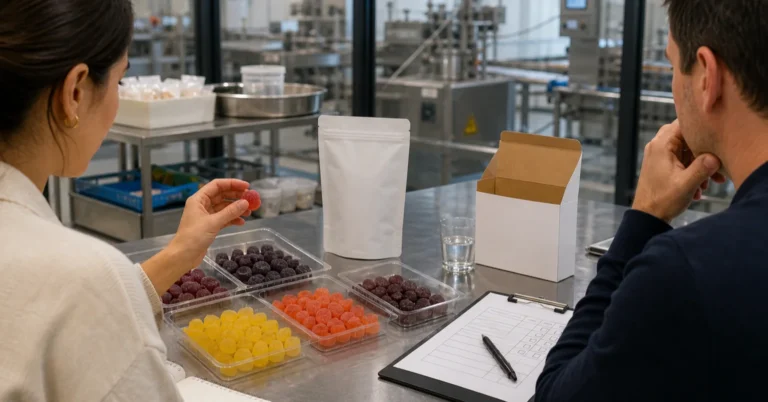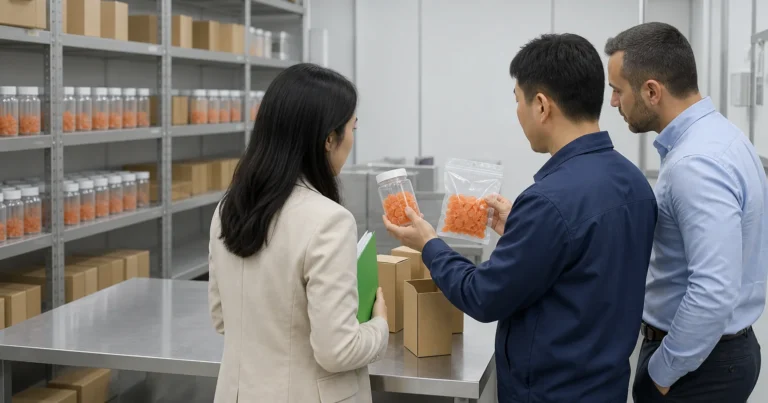


For supplement brands, the gummies vs capsules decision should start with whether the formula can work in the chosen format, not what looks popular on shelf.
Gummies are strongest when consumer experience, taste, and repeat use matter, and when the active load can realistically fit the gummy matrix. Capsules are often safer when dose density, formula simplicity, and fewer sensory constraints matter more.

The risky question is not only "Do consumers like gummies?" Many consumers do. The real question is whether the supplement still behaves like a reliable product after it becomes a gummy. Active dose, label claim, taste, texture, moisture, packaging, shelf-life plan, and finished product documentation all have to work together.
That is why the best manufacturer conversation should happen before the brand locks the Supplement Facts panel.[^1] A brand should bring its target ingredients and desired active amount per serving. It should also clarify sugar or sugar-free preference, vegan or pectin requirement, packaging channel, market, and shelf-life expectation. The manufacturer can then pressure-test whether gummies are a good fit or whether capsules are the more practical format.
Gummies vs Capsules: The Short Answer for Supplement Brands
Both formats can support a serious supplement product, but they solve different problems.
Choose gummies when the product promise depends on daily habit, consumer enjoyment, and a formula that can fit the gummy system. Choose capsules when the product promise depends on higher active load, fewer excipients, and a simpler development path.
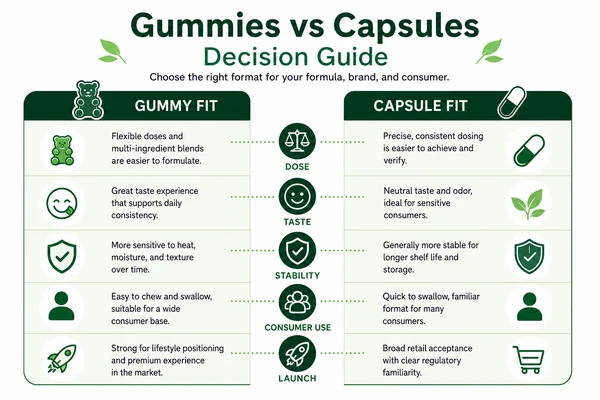
For a brand owner, the right format is the one that can support the product promise without forcing weak claims, unstable texture, oversized servings, or unrealistic costs.[^2]
Choose gummies when consumer experience drives repeat use
Gummies can make a supplement easier to take every day. They are chewable, flavored, portable, and more approachable for consumers who dislike swallowing pills.[^3]
That habit advantage can matter in categories such as beauty, hair growth, sleep, stress, children's wellness, and daily vitamin products. If repeat use is central to the product's value, a well-designed gummy can support the commercial story.
The brand still has to earn that format choice. A gummy must taste good, hold its shape, control moisture, survive storage and shipping, and deliver the declared active amount. Consumer appeal is an advantage only when the finished product can support the label.
Choose capsules when dose density and formula simplicity matter more
Capsules are often more practical when the formula needs more active material in a smaller serving. They can carry powdered ingredients with fewer flavor, color, texture, sweetener, and moisture-control constraints.
This matters for high-dose minerals, sports nutrition formulas, proteins, amino acids, some botanicals, and ingredients with strong bitter, metallic, or earthy notes. A capsule can hide taste and keep the product closer to the raw ingredient system.
Capsules may also be a lower-risk starting point for brands testing a market, working with a narrow budget, or trying to keep the first launch simple.
The real decision is formula feasibility, not format popularity
The strongest gummy project starts with feasibility, not trend imitation. A competing brand may succeed with gummies because its active system, dose, packaging, and positioning fit that format. Your formula may not behave the same way.
Use this first-pass screen before choosing a direction:
| Decision factor | Gummy-friendly signal | Capsule-friendly signal |
|---|---|---|
| Active dose per serving | Low to moderate active load | Higher active load or bulky powder |
| Taste profile | Mild or maskable ingredients | Bitter, metallic, earthy, or strong odor |
| Stability risk | Actives can tolerate gummy processing and storage plan | Actives are heat, moisture, or interaction sensitive |
| Consumer experience | Habit, taste, and lifestyle positioning are central | Function, dose, and simplicity are central |
| Commercial path | Brand can support more formulation work | Brand needs simpler early launch |
This is not a universal rule. It is a practical way to decide what the manufacturer should evaluate first.
What Changes When a Supplement Becomes a Gummy?
A gummy is not just a capsule with flavor. It is a different product system.
When a supplement becomes a gummy, its active ingredients must fit inside a chewable matrix that also controls flavor, texture, moisture, color, sweetness, and packaging protection.
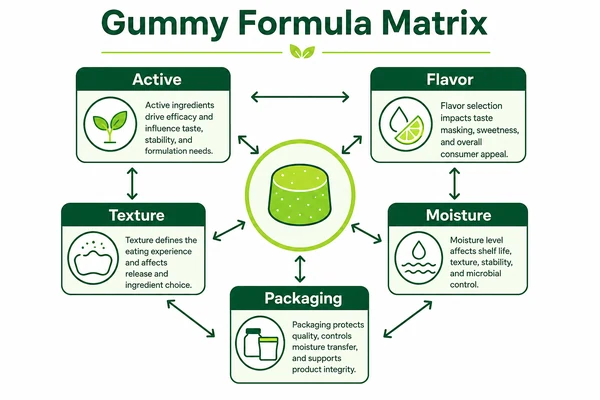
That is why a gummy concept should be reviewed as a finished-product system, not only as an ingredient list.
Gummies must balance active ingredients, flavor, texture, and moisture
In a gummy, each formulation choice affects the others. The gelling system affects texture. The sweetener system affects taste and water activity. The acid system affects flavor and sometimes ingredient compatibility. Active ingredients can also change color, bitterness, texture, and stability.
This is why gummy development can require more iteration than a brand expects. A sample may taste good but be too soft. It may hold texture but not carry enough active. It may look good at first but need a stronger packaging plan.
For many brands, this belongs in a broader formulation and ingredients review before the format is locked.
For brands, the important point is that gummies do several jobs at once. A good gummy is not only pleasant to chew. It is a controlled supplement format.
Capsules can carry more powder with fewer sensory constraints
Capsules are more direct. The consumer usually swallows the formula without tasting the active powder, so the development team does not need to solve the same level of bitterness, mouthfeel, color, or sweetness issues.
That makes capsules useful for difficult ingredients. If the active system is large, bitter, or less compatible with moisture, capsules may preserve more formula flexibility.
Capsules still require quality control, blend uniformity, ingredient documentation, capsule-shell compatibility, and label review. They are not automatically easy. But compared with gummies, they usually remove many sensory and texture variables.
Why serving size often changes between gummies and capsules
Serving size often changes because a gummy must carry both the active ingredients and the gummy structure itself. The base, sweetener, flavor, acid, color, and texture system all take up space.
A capsule can devote more of its volume to active powder. A gummy must reserve room for the matrix that makes it chewable and acceptable.
| Serving-size question | Why it matters for gummies | Why it matters for capsules |
|---|---|---|
| How much active is needed per serving? | Sets whether the gummy can carry the formula without becoming too large | Sets capsule count and fill-weight feasibility |
| How many units will consumers accept? | Too many gummies can raise cost, sugar load, and label friction | Too many capsules can hurt convenience |
| Does the active affect taste or texture? | May force more flavor masking or a larger serving | Usually less visible to the consumer |
| Can the label claim stay credible? | Needs finished-gummy potency and stability planning | Needs blend and finished product documentation |
The final serving should feel reasonable to the consumer and support the product promise without hiding a compromised formula.
Active Load and Dosage: Can the Formula Fit?
Active load is often the deciding factor in the gummies vs capsules conversation.
Gummies work best when the active amount is realistic for the matrix. Capsules work better when dose density is the main requirement.
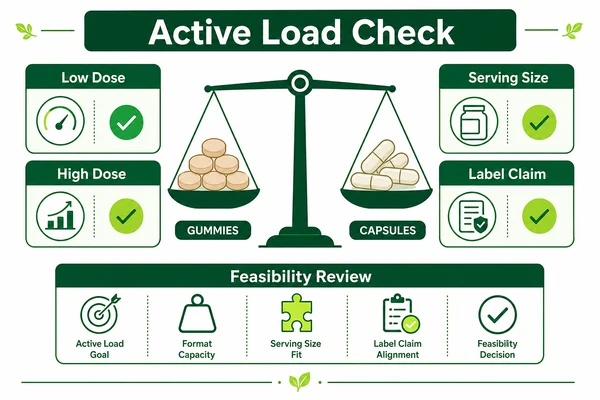
Brands should answer this before committing to packaging, claims, or a launch timeline.
Low-dose actives are usually easier to develop as gummies
Low-dose vitamins, certain minerals at modest levels, some sleep-support ingredients, and many daily wellness blends can be easier to explore as gummies. These formulas leave more room for taste, texture, and stability controls.
That does not mean the project is automatic. The manufacturer still needs to review ingredient interactions, flavor masking, active stability, finished product testing, and packaging.[^4]
But when the active system is compact, the gummy format has more room to deliver both consumer experience and supplement credibility.
High-dose minerals, proteins, creatine, and botanicals can be harder
High-dose formulas are where gummy enthusiasm often meets manufacturing reality. Minerals can taste metallic. Botanicals can be bitter or earthy. Proteins and amino acids can affect texture. Creatine and similar sports nutrition ingredients may need a larger serving. That can be hard to make practical as a gummy.
In these cases, the brand may face tradeoffs: a larger serving, a lower active claim, a different ingredient form, stronger flavor masking, higher formulation cost, or a decision to keep the product in capsules.
The important point is not that gummies cannot handle functional ingredients. It is that the active load has to be reviewed honestly before the brand commits to the format.
How label claims, overage, and finished product testing affect the decision
The label claim is a quality promise. For gummies, that promise has to survive formulation, processing, drying or setting, packaging, storage, and shipping.
If an active is sensitive, the manufacturer may need to consider overage strategy, compatibility testing, finished product potency, and shelf-life protection. Those decisions affect cost, timing, and claim confidence.
Brands should ask how the manufacturer will evaluate the finished gummy, not only the raw material input. A good formula on paper is not enough if the finished product cannot support the label at the intended shelf-life point.
Taste, Sugar, and Consumer Positioning
Gummies usually win the consumer experience conversation, but taste is not free.
The same chewable format that makes gummies appealing also exposes bitterness, metallic notes, sourness, color issues, sweetener choices, and texture tradeoffs.

This is where marketing positioning and formulation reality need to meet early.
Gummies can improve compliance but expose bitter or metallic ingredients
Consumers may take a gummy more consistently because it feels pleasant and easy. That can help brands in categories where repeat use drives perceived value and repurchase.
However, a gummy is chewed. If the active ingredient is bitter, metallic, earthy, or astringent, the consumer experiences that directly. Flavor masking can help, but it may require stronger sweetness, acidity, flavor systems, or serving-size changes.
Brands should not assume a popular flavor can solve every ingredient problem. Taste feasibility should be tested with the real active system.
Capsules avoid flavor masking but lose the sensory advantage
Capsules avoid most taste-masking work because the consumer swallows the formula. This makes capsules attractive for difficult-tasting ingredients and high-dose powders.
The tradeoff is that capsules do not create the same sensory moment. They are functional and familiar, but they do not give the consumer a flavor experience that can support habit-building.
For a brand, this becomes a positioning choice. Is the product's value built around enjoyable daily use, or around concentrated functionality and formula simplicity?
Sugar, sugar-free, vegan, and clean-label tradeoffs brands should review
Gummy positioning often adds more decisions: sugar or sugar-free, gelatin or pectin, natural colors, flavor direction, texture preference, allergen concerns, and clean-label expectations.
Each choice can affect the formula. A sugar-free gummy may need a different sweetener system. A vegan gummy may use a different gelling approach. A clean-label direction may limit color, flavor, or texture options.
Before requesting a quote, the brand should decide which positioning claims are essential and which can be adjusted after feasibility review.
Stability, Shelf Life, and Packaging Risk
Stability is one of the biggest reasons gummies and capsules should not be compared only by consumer preference.
Gummy supplement stability depends on protecting both active performance and sensory quality through shelf life. Potency, moisture control, texture, flavor, and packaging all matter, while capsules usually carry fewer sensory variables.

This makes shelf-life planning part of the format decision.
Why gummies need tighter moisture and texture control
Gummies are sensitive to moisture behavior. If moisture is not controlled, a gummy can become sticky, dry, hard, soft, clumped, or inconsistent.
Texture is not just cosmetic. A consumer may judge product quality by whether gummies remain separate, pleasant to chew, and visually consistent. Texture drift can also signal that the product system needs stronger formulation or packaging control.
For brands, gummy stability should be discussed before launch claims, channel plans, and packaging decisions are finalized.
Heat-sensitive and moisture-sensitive ingredients need early screening
Some ingredients are sensitive to heat, moisture, acids, light, or long storage in a gummy matrix. Others may interact with flavors, colors, minerals, or the gelling system.
Early screening helps the brand avoid late-stage surprises. If a key active is sensitive, the manufacturer may recommend a different ingredient form, adjusted process, modified serving size, stronger packaging, or another format.
This is especially important for formulas that contain probiotics, enzymes, delicate botanicals, certain vitamins, or hygroscopic ingredients.
Packaging choices that protect gummies during storage and shipping
Packaging is part of the formula system for gummies. Bottles, closures, liners, desiccant decisions, pouch options, count per bottle, and shipping conditions can affect texture and label-claim confidence.
Capsules may also need protective packaging, but gummies often require closer moisture and texture planning.
Brands should ask how packaging supports the specific gummy base, active system, target market, distribution channel, and storage expectation. The right package is not only a shelf design choice. It is part of quality control.
Manufacturing Complexity, MOQ, Cost, and Lead Time
Gummies usually require more development work before production than capsules.
Higher gummy development complexity does not make gummies a poor choice. Brands should compare total development risk—including MOQ, cost, and lead time—not unit price alone.

The lowest quote may not be the safest quote if it does not include the work needed to prove the format.
Why gummies often require more formulation development before production
Gummy development is a multi-variable problem. A change in active load can affect taste. A change in sweetener can affect texture. A change in gelling system can affect processing. A change in packaging can affect stability assumptions.
That means a gummy project may need sample rounds, flavor work, texture adjustments, ingredient compatibility review, packaging review, and testing planning before scale-up.
For serious brands, that development time is not wasted time. It is how the team reduces the risk of launching a product that looks good in concept but fails in production or storage.
How capsules can simplify early launches for some brands
Capsule projects can be more linear. The active ingredients are blended, filled into capsules, checked for quality, and packaged under the appropriate manufacturing controls.
This can make capsules useful for early launches, market tests, high-dose formulas, or brands that need a simpler first product before moving into a more sensory format.
The capsule route still needs documentation, label review, ingredient qualification, and batch controls. It is simply a different development path with fewer taste and texture variables.
What to ask before comparing gummy and capsule quotes
A quote is only useful when you know what it includes. A gummy quote with feasibility review, sample rounds, stability planning, packaging guidance, and finished product testing is not the same as a quote that only gives a unit price.
| Question to ask | Why it matters |
|---|---|
| What formula feasibility review is included? | Shows whether the supplier is checking the product before production |
| How are sample rounds handled? | Gummies may need taste, texture, and active-load adjustments |
| What testing or documentation supports the finished product? | Helps compare label-claim confidence across formats |
| What packaging assumptions are built into the quote? | Packaging affects gummy texture and stability risk |
| What happens if the formula needs adjustment? | Clarifies whether the supplier will pressure-test or simply execute |
| What information is needed before pricing is reliable? | Prevents comparing incomplete quotes |
The goal is not to prove gummies are more expensive or capsules are easier. The goal is to compare the real work required to launch the product responsibly.
Gummies vs Capsules by Product Type
Some supplement categories naturally fit gummies better than others.
For gummies vs capsules decisions, product-category fit is a starting hypothesis, not a final answer. The active system, serving size, and finished-product requirements still have to prove the format.
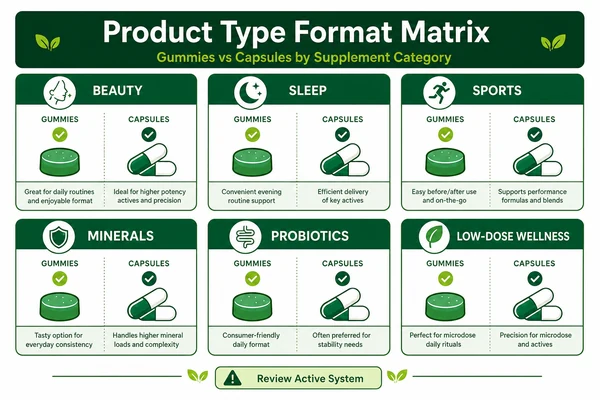
This is especially important when a category looks gummy-friendly in the market, but the actual formula contains difficult or high-load ingredients.
Beauty and hair growth supplements
Beauty and hair growth supplements often benefit from a consumer-friendly, routine-driven format. Gummies can support the habit story when the active blend fits the matrix.
However, not every beauty formula is simple. Minerals, botanicals, collagen, amino acids, or high-dose nutrient combinations can create taste, texture, stability, or serving-size issues.
Before choosing gummies, brands should review the target active amounts, serving count, finished product testing plan, and claim direction. A beautiful gummy still has to support the label.
Sleep, stress, and low-dose functional blends
Sleep, stress, and low-dose wellness blends can work well as gummies when the active amount is realistic and the product experience supports routine use.
For these categories, the gummy format can become part of the product ritual. Taste and convenience may help consumers remember the product and use it consistently.
Still, botanicals and functional actives can bring bitterness, color, or stability challenges. The brand should test the real ingredient system rather than assuming the category is easy.
Sports nutrition, minerals, probiotics, and high-dose formulas
Sports nutrition, high-dose minerals, probiotics, and bulky formulas need stricter review. These products often depend on dose, potency, or ingredient sensitivity.
| Product type | Gummy consideration | Capsule consideration |
|---|---|---|
| High-dose minerals | May create taste, texture, and serving-size challenges | Often more dose-efficient |
| Creatine or sports actives | Gram-level active load can be difficult for gummies | Usually easier to frame by dose |
| Probiotics or delicate actives | Need careful heat, moisture, and shelf-life review | May offer a lower-risk route |
| Beauty blends | Often gummy-friendly if active load is realistic | Still practical for simpler formulas |
| Low-dose wellness blends | Often a strong gummy candidate | Useful when clean-label simplicity matters |
These categories are not impossible as gummies. They simply require a more disciplined feasibility review before the brand commits.
Decision Checklist: Should Your Brand Choose Gummies or Capsules?
A practical format decision should happen before the RFQ becomes too narrow.
Use the checklist below to separate consumer preference from formula feasibility, commercial readiness, and quality documentation.

The strongest manufacturer conversations happen when the brand brings clear constraints instead of only a product idea.
Formula questions to answer before choosing the format
Start with the formula, not the package design.
| Formula question | Why it matters |
|---|---|
| What active ingredients are required? | Defines the ingredient system the format must carry |
| What active amount is needed per serving? | Determines whether the gummy matrix can fit the formula |
| Are any actives bitter, metallic, earthy, heat-sensitive, or moisture-sensitive? | Predicts flavor, texture, and stability risk |
| Is sugar-free, vegan, pectin, gelatin-free, or clean-label positioning required? | Changes the gummy base and formulation options |
| What serving size will consumers accept? | Connects formula feasibility with market reality |
| What label claims must be supported? | Sets the proof needed from finished-product testing |
If the answers make the gummy too large, unstable, expensive, or unpleasant, capsules may be the stronger commercial choice.
Commercial questions to answer before requesting a quote
Format choice also depends on the launch plan.
| Commercial question | Why it matters |
|---|---|
| What is the target market and channel? | Influences packaging, claims, and storage expectations |
| What is the target price position? | Sets limits for ingredient cost, serving size, and packaging |
| What launch volume is realistic? | Helps the supplier discuss production planning |
| What timeline is required? | Gummies may need more development before scale-up |
| Is this a first launch or a reformulation? | Affects risk tolerance and speed |
| Which requirements are fixed, and which can change? | Helps the manufacturer recommend tradeoffs |
Brands that can answer these questions usually receive better guidance from manufacturers because the supplier can evaluate both technical and commercial fit.
Quality and testing documents to request from a manufacturer
A brand should also ask what proof supports the finished product.
| Document or discussion point | Why it matters |
|---|---|
| Raw-material and supplier documentation review | Confirms input identity and quality expectations |
| Finished product testing plan | Shows how label claims will be checked in the finished product |
| Stability or shelf-life testing approach | Explains how potency, texture, and quality will be monitored |
| Water activity or moisture-control discussion | Especially important for gummies |
| Batch manufacturing records | Supports production traceability |
| Packaging recommendation | Connects format choice with storage and shipping risk |
| Supplement Facts / label-claim review | Helps keep claims aligned with the formula |
The point is not to collect paperwork for its own sake. The point is to understand whether the manufacturer has a clear proof chain from ingredient input to finished product.
How Talvenda Helps Brands Develop Gummy Supplements
Talvenda helps brands pressure-test gummy ideas before they become expensive production problems.
For gummy projects, the useful manufacturing partner is not the one that says every formula is easy. It is the one that identifies tradeoffs early and helps the brand decide whether gummies are technically and commercially appropriate.

That is especially important when a brand is comparing gummies vs capsules before the first serious quote request.
From formula feasibility to gummy manufacturing plan
Talvenda can support early gummy development conversations around ingredient fit, active-load expectations, serving-size math, sample planning, flavor direction, gummy-base choice, packaging review, documentation, and manufacturing feasibility.
For brands exploring custom or private label gummies, the next step is to connect the desired formula with a realistic production plan.
If gummies fit the brand strategy after that review, the next step is gummy vitamin manufacturing planning with formula, packaging, testing, and scale-up assumptions in the same conversation.
When Talvenda will recommend adjusting the gummy formula
Sometimes the best recommendation is to adjust the gummy formula rather than force the original specification into production.
That may happen when the active load is too high for the target serving size. It can also happen when an ingredient creates strong taste or texture problems, the stability risk needs a different approach, or clean-label requirements conflict with formula needs.
Adjustment can protect the brand. It may mean changing serving size, ingredient form, sweetener system, gelling system, packaging assumptions, claim direction, or even reconsidering whether capsules are the better launch format.
Next step: explore gummy vitamin manufacturing
If gummies still look like the right format after feasibility review, the next step is a more specific manufacturing discussion.
Bring the target ingredient list, desired active amount, market, serving-size expectation, sugar or sugar-free requirement, vegan or pectin preference, packaging plan, and launch expectations.
That gives the manufacturer enough context to discuss sampling, testing, packaging, and scale-up without pretending that gummies and capsules are interchangeable.
FAQs About Gummies vs Capsules
Are gummies as effective as capsules?
Gummies can be as effective as capsules when the finished gummy delivers the declared active amount and remains stable through its intended shelf life. The format alone does not prove effectiveness.
For vitamin-specific proof boundaries, see are gummy vitamins as effective as pills before turning a format preference into an equivalence claim.
For brands, effectiveness should be judged by formula fit, label claims, finished product testing, stability planning, and consumer use behavior.
Do gummy vitamins absorb better than capsules?
Do not assume gummies absorb better because they are chewable. Absorption depends on the ingredient, dose, form, formulation, and how the consumer uses the product.
Brands should avoid superior absorption claims unless they have ingredient-specific support for the actual formula.
Are capsules cleaner than gummies?
Capsules often have a shorter excipient list because they do not need the same flavor, sweetener, color, acid, or texture system.
Gummies can still fit a cleaner positioning, but brands need to review sugar, sweeteners, gelatin or pectin, colors, flavors, and stability needs before making that claim.
Are gummies or capsules better for hair growth supplements?
Gummies can be a strong commercial format for hair growth supplements when the active blend fits and the product depends on daily routine.
Capsules may be better when the formula contains higher-dose nutrients, strong-tasting botanicals, or ingredients that would make the gummy too large or difficult to stabilize.
Which format is better for a private label supplement launch?
Capsules may be better for a first private label launch when the brand needs a simpler formula path, lower sensory risk, or faster market test.
Gummies may be better when consumer appeal, differentiation, and repeat use are central to the business case. The formula still has to support the gummy format. The best first step is to review the formula, serving size, packaging plan, and quality documents before choosing the format.
Conclusion
For gummies vs capsules, choose the format your formula can prove before you commit to claims, serving size, packaging, or quotes.
When a brand is choosing between gummies and capsules, the useful question is not which format looks better, but which format can support the formula, serving size, taste, packaging, and proof expectations. As an OEM/ODM gummy manufacturer, Talvenda can help brands evaluate whether the gummy route should start with low-MOQ market-tested in-stock gummies, move through stock formula modification, or require custom gummy development. That gives your team a clearer path for sample development, documentation and testing expectations, packaging and label support, and scale-up support before quotation or launch planning. Start with Talvenda through the project inquiry form.
[^1]: FDA, "Dietary Supplement Labeling Guide," https://www.fda.gov/food/dietary-supplements-guidance-documents-regulatory-information/dietary-supplement-labeling-guide. Used for Supplement Facts and dietary supplement labeling context. [^2]: FDA, "Label Claims for Conventional Foods and Dietary Supplements," https://www.fda.gov/food/food-labeling-nutrition/label-claims-conventional-foods-and-dietary-supplements. Used for label-claim discipline and claim-support context. [^3]: NIH Office of Dietary Supplements, "Dietary Supplements: What You Need To Know," https://ods.od.nih.gov/factsheets/WYNTK-Consumer/. Used for general dietary supplement form and consumer-use context. [^4]: FDA, "Current Good Manufacturing Practices (CGMPs) for Food and Dietary Supplements," https://www.fda.gov/food/current-good-manufacturing-practices-cgmps-food-and-dietary-supplements/current-good-manufacturing-practices-cgmps-dietary-supplements. Used for manufacturing quality-system context.