

Vegan amino acid supplements sit at the intersection of plant-based nutrition, sports positioning, and convenient supplement formats.
Vegan amino acid supplements provide selected amino acids from non-animal sources, often as EAA blends, BCAA formulas, or single amino acids. For supplement brands, the bigger question is not only whether the ingredient is vegan, but whether the formula, serving size, taste, texture, and claim language can work in the chosen format.
That matters even more for gummies. A powder or capsule can hide volume, bitterness, and format limitations more easily. A gummy has to deliver a pleasant chew, a credible serving, and a clear plant-based story in a small piece consumers actually want to take.
What Are Vegan Amino Acid Supplements?

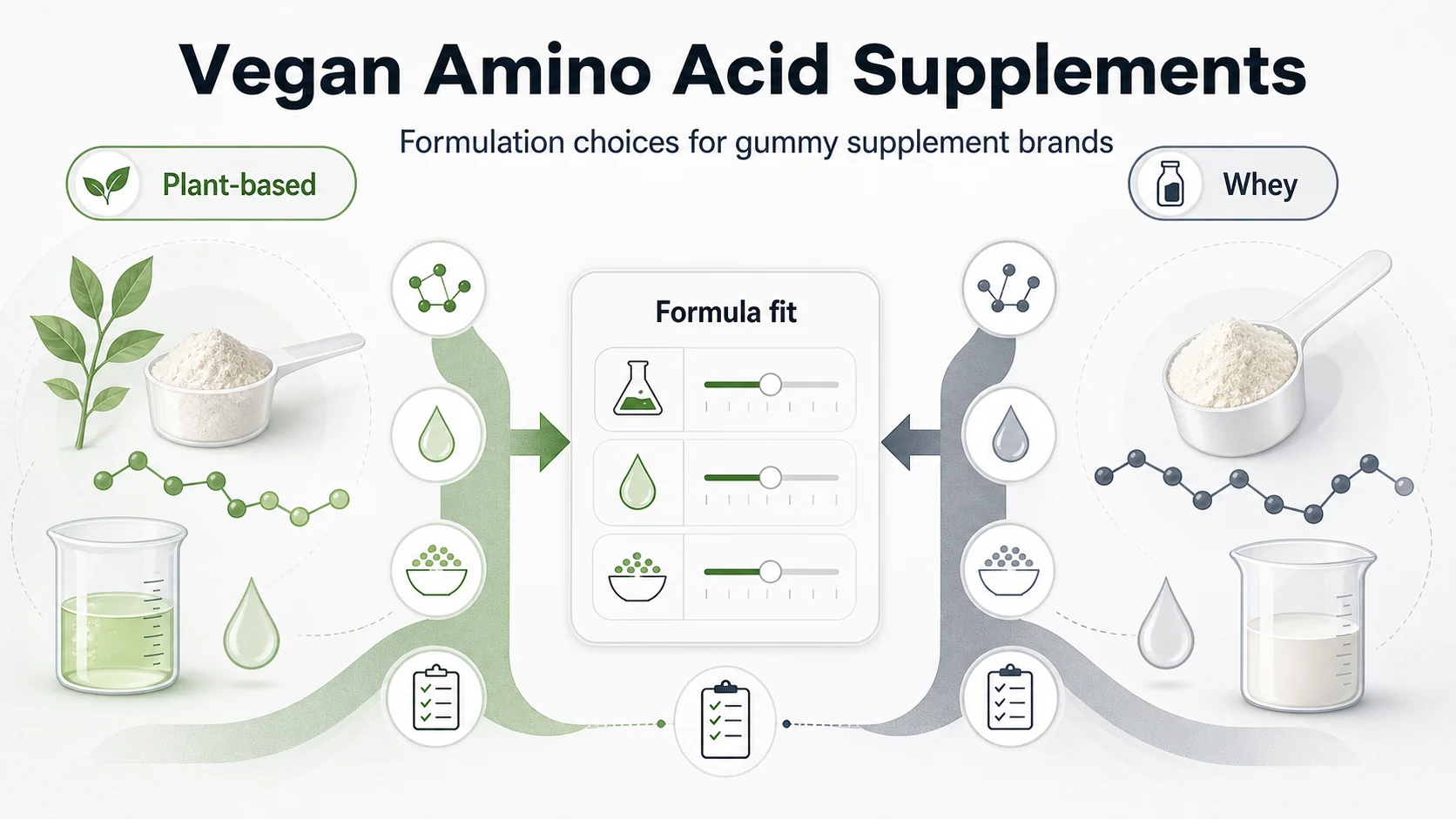
Vegan amino acid supplements are products that provide amino acids without animal-derived ingredients.
Vegan amino acid supplements use fermented, plant-derived, or otherwise non-animal amino acid sources. Products may contain EAA blends, BCAA formulas, or single amino acids for sports, daily-wellness, or plant-based positioning.
Essential vs. Non-Essential Amino Acids
Amino acids are often described as the building blocks of protein. Some can be produced by the body, while essential amino acids must come from food or supplementation[^1].
For supplement positioning, the essential group matters most because consumers often connect it with complete proteins, plant-based diets, sports nutrition, and nutritional gaps. This does not mean every vegan consumer needs an amino acid supplement. It means the search intent around vegan amino acids usually starts with a practical question: "Am I getting the amino acids I need from plant-based sources?"
For brands, that question affects product architecture. A formula built around essential amino acids has a different story than a formula focused on BCAAs or a single amino acid such as L-glutamine or L-lysine. The ingredient choice should match the product role, not just the label trend.
| Amino acid route | Typical role in supplements | Brand planning issue |
|---|---|---|
| EAA blend | Broader essential amino acid support | More complex taste, serving, and documentation planning |
| BCAA formula | Sports-positioned amino acid product | Stronger bitterness and claim-control risk |
| Single amino acid | Narrow targeted product concept | Clearer story, but narrower consumer use case |
Why Vegan Formulas Need a Clear Amino Acid Source
The word "vegan" is not enough by itself. A buyer, retailer, or consumer may still want to understand where the amino acids come from, whether the product is plant-derived, whether the claim can be documented, and how the formula differs from animal-based protein.
This is where brand planning starts. A vegan amino acid supplement can be positioned as sports nutrition, a plant-based daily supplement, a clean-label alternative to whey, or a convenience format for consumers who do not want powders. Each direction changes the formula brief.
For gummy brands, the source decision also connects to flavor, color, texture, label statements, documentation, and supplier qualification. A vegan claim should be supported by ingredient records and a formulation path that fits the finished product.
Can a Plant-Based Diet Provide Enough Amino Acids?
Many plant-based diets can provide amino acids when planned well, but consumers still search for clarity.
A well-planned plant-based diet can provide all essential amino acids when it supplies enough total protein from varied plant foods. Supplements may add convenience or targeted serving design, but they are not automatically necessary for every vegan.
Complete Protein Sources
A complete protein provides all essential amino acids in meaningful amounts. Some plant foods, such as soy-based foods and quinoa, are commonly discussed as complete or near-complete protein sources. Other plant foods may contribute useful amino acids but need dietary variety.
For consumers, the simple takeaway is that plant-based diets are not automatically amino-acid deficient[^2], but they require attention to protein quality and variety. For brands, the takeaway is different: a vegan amino acid supplement should not be framed as a fear-based deficiency solution. It should have a specific use case.
That use case may be sports positioning, convenience, low-sugar daily supplementation, clean-label vegan lifestyle support, or an alternative to larger servings of protein powder. The product concept needs to be sharper than "vegans need amino acids."
Where Supplementation May Fit
Supplementation may fit when the consumer wants a more targeted format than food alone can provide. Examples include a compact EAA blend, a BCAA-focused sports product, or a single amino acid product with a specific label role.
The safest writing angle is practical, not medical. A vegan amino acid supplement can help a brand offer a convenient plant-based format, but the product should not imply that it treats deficiency, disease, fatigue, or performance problems.
For gummy development, this distinction matters. A gummy is rarely the best format for very high active loads. It can be a strong format for a clear, moderate, enjoyable routine product, but the serving size and claim promise must stay realistic.
Whole Foods vs. Supplement Formats
Whole foods provide protein, fiber, minerals, and broader nutritional value. Supplements provide convenience, controlled serving design, and a specific label story.
This difference should be clear in the article. The goal is not to argue that gummies replace a plant-based diet. The better message is that supplements are one format within a broader nutrition landscape.
For brands, that opens a better positioning path: vegan amino acid gummies can be designed as a convenient add-on, not as a meal replacement or a substitute for protein-rich foods.
Vegan Amino Acid Supplements vs. Whey
Whey is a useful comparison because many consumers use it as a mental benchmark.
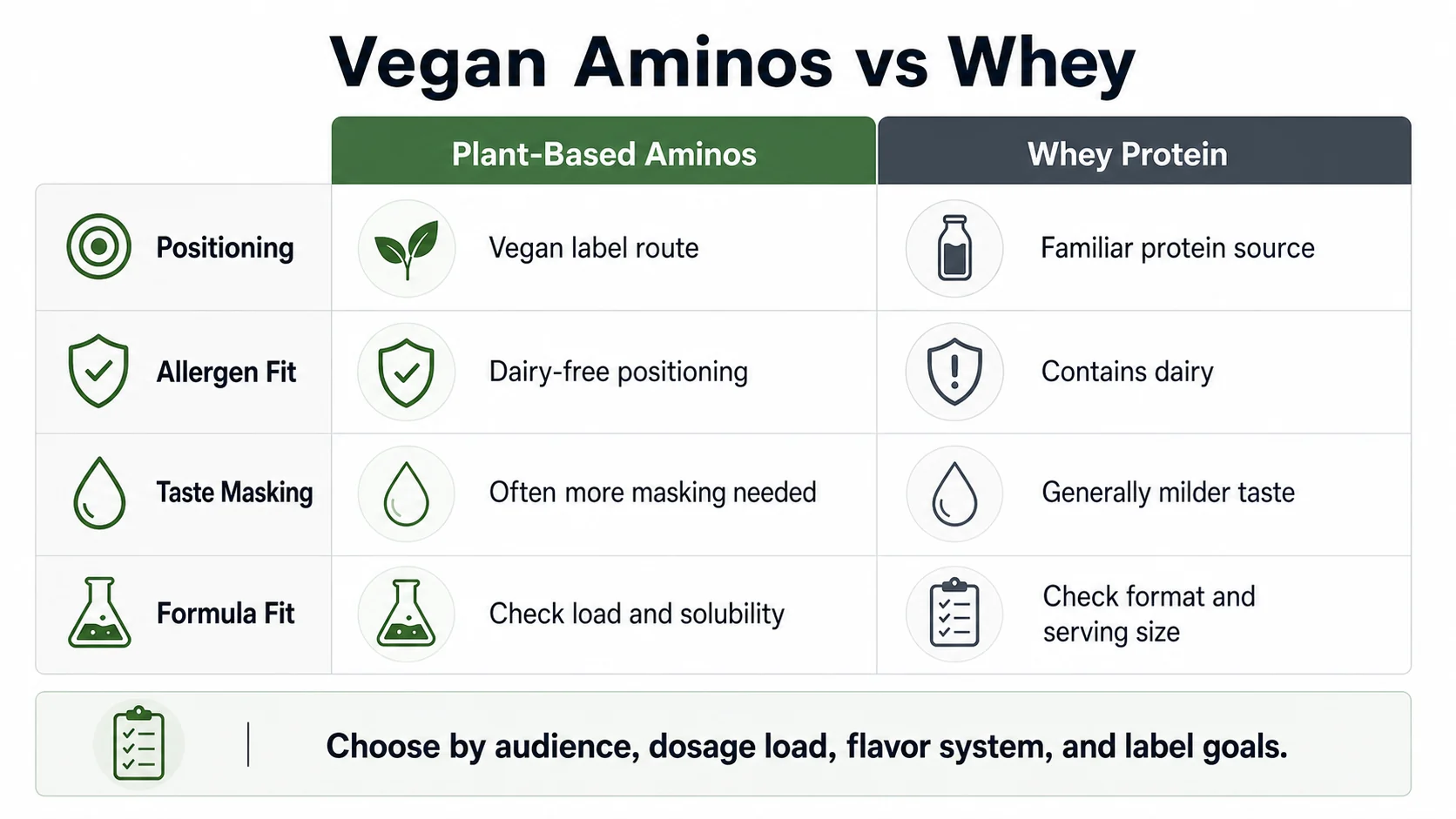
Vegan amino acid supplements and whey protein serve different purposes and formats. Whey is a complete animal-derived protein, while targeted vegan amino acid blends deliver selected amino acids in a plant-based or non-animal positioning lane.
Protein Source and Label Positioning
Whey comes from dairy. That makes it unsuitable for vegan positioning and less attractive for consumers avoiding dairy-based ingredients. Vegan amino acid supplements can support a plant-based label story, but they must still be clear about what they provide.
This is where brands should avoid lazy comparisons. A vegan amino acid gummy is not simply "whey in gummy form." It may be an EAA gummy, a BCAA gummy, or a targeted amino acid gummy. Each product has a different reason to exist.
| Product direction | Better positioning | Risk to avoid |
|---|---|---|
| Vegan EAA blend | Plant-based essential amino acid support | Claiming it replaces all dietary protein |
| Vegan BCAA formula | Sports-positioned amino acid format | Overpromising recovery or performance |
| Single amino acid gummy | Targeted ingredient story | Making medical or deficiency claims |
| Protein powder alternative | Convenience and taste angle | Suggesting equivalent protein delivery without matching dose |
Digestibility, Taste, and Format Differences
Whey powders and vegan amino acid gummies create different consumer experiences. Powders can deliver larger servings, while gummies offer convenience and a more snack-like routine.
The tradeoff is formula space. A gummy has limited room for active ingredients, sweeteners, acids, flavors, gelling agents, moisture control, and coating. Amino acids can also bring bitterness or aftertaste that needs to be managed.
This is the first place to introduce a light B2B cue: if a brand wants a vegan amino acid gummy, the comparison is not only whey vs vegan. It is also powder economics vs gummy feasibility, serving size, taste masking, and label clarity.
When Amino Acids Make More Sense Than Protein Powder
Amino acids may make more sense when the brand wants a lighter, more targeted supplement format rather than a high-protein serving. This can work for consumers who dislike mixing powders, want a portable routine, or prefer a plant-based supplement.
But the product should be honest about its role. If the gummy cannot deliver the same protein quantity as a powder, it should not pretend to be the same category. A clearer angle is often more credible: a vegan amino acid gummy for convenience, routine, or targeted formulation.
That difference helps protect both SEO intent and customer trust. The article can answer the whey comparison without turning into a full whey vs vegan protein guide. For a broader format decision, brands can compare gummies with other delivery forms in gummies vs. capsules.
Types of Vegan Amino Acids Used in Supplements
The amino acid type drives the product promise, serving design, and claim risk.
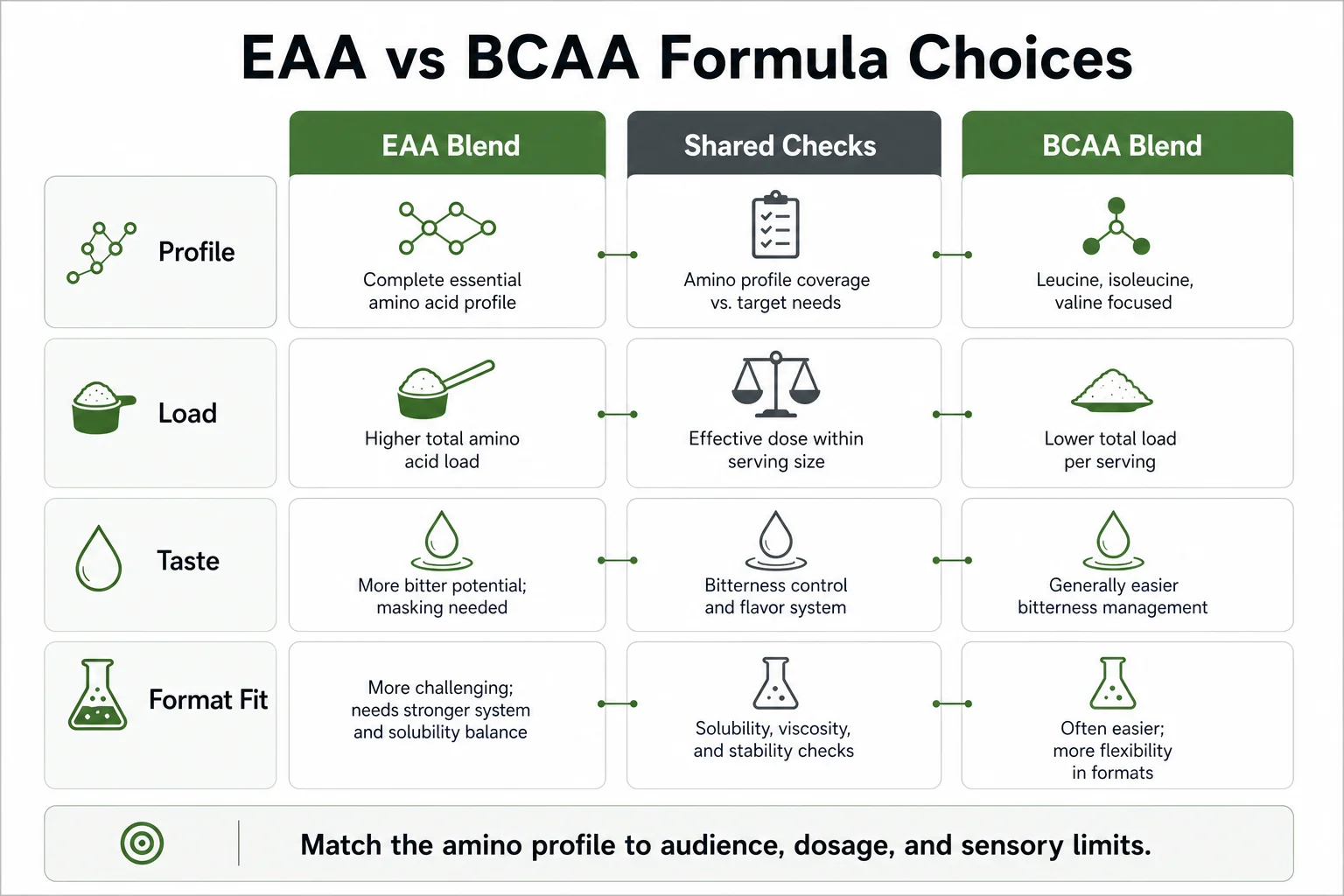
Most vegan amino acid supplement concepts fall into three practical buckets: EAA blends, BCAA formulas, and single amino acid products. Brands should choose the bucket before choosing flavor, format, or manufacturer.
EAA Blends
EAA blends include the essential amino acids that the body must obtain through diet. In consumer search behavior, EAA products are often connected with plant-based protein quality, sports nutrition, and the idea of a complete amino acid profile.
For brands, the advantage is broader positioning. An EAA gummy can speak to plant-based amino acid support without narrowing itself only to workout culture. The challenge is that the formula may need more actives than a gummy can comfortably carry.
That makes serving design important. A brand may need multiple gummies per serving, a moderate active level, or a different format if it wants a high-dose EAA product. The formula should be built around what the format can deliver, not only what the marketing team wants to claim.
BCAAs
BCAAs are a subset of essential amino acids: leucine, isoleucine, and valine[^3]. They are strongly associated with sports nutrition.
For gummy brands, BCAAs can create a focused sports supplement story. The risk is overclaiming. Many BCAA pages drift into aggressive performance, recovery, or muscle-building language. A Talvenda-style article should keep this practical: ingredient choice, positioning, taste, serving size, and documentation.
BCAA formulas may also create flavor challenges. The stronger the amino acid load, the more important taste masking and sensory screening become. This is where formulation feasibility becomes more than a technical detail; it becomes the difference between a product concept and a product consumers will repeat.
Single Amino Acids
Single amino acids can support targeted formulas, but they also require sharper claim control. Examples include L-glutamine, L-lysine, or other amino acids used in specific supplement categories.
For brands, single amino acid gummies should start with a narrow use case. Why this amino acid? Why gummy format? What claim can be supported? What serving is realistic? What documentation is available?
If those questions are not answered, the product can become confusing. A single amino acid gummy may sound simple, but it can be harder to explain than a broader EAA blend.
What Changes When Vegan Amino Acids Become Gummies?
This is where the article should fully transition from consumer education to product development.
A vegan amino acid gummy is not just a vegan supplement in a different shape. The gummy format changes delivered dose, taste masking, texture, moisture control, documentation, and the type of claim a brand can responsibly support.
Serving Size and Active Loading
Serving size is the first practical constraint. Amino acids take physical space, and gummies also need a base system, sweetener, acids, flavors, colors, and processing tolerance.
If a brand wants a high-active amino acid product, the gummy may need more than one piece per serving. If the brand wants a one-gummy serving, the active level may need to be more moderate. Neither choice is automatically wrong. The issue is whether the label, price, bottle count, and consumer routine all make sense together.
This is where brands should prepare a formula brief before asking for a quote. A manufacturer cannot make a strong recommendation from "we want vegan amino acid gummies" alone. The better brief includes target amino acid type, desired serving, number of gummies per serving, sugar or sugar-free preference, vegan claim requirements, flavor direction, packaging format, and launch market.
Taste Masking and Texture
Amino acids can be challenging in taste. Some may create bitterness, aftertaste, or a dry sensation[^4] that becomes more noticeable in a chewable format.
That means flavor is not just a branding choice. It is part of the formula strategy. Citrus, berry, tropical, sour, or functional flavor profiles may perform differently depending on the amino acid load and base system.
Texture also matters. A gummy that carries active ingredients must still chew cleanly, hold shape, resist sweating or sticking, and remain acceptable through shelf-life review. The more a brand pushes active loading, the more it needs sampling and sensory review before approving the formula.
Plant-Derived Claims and Documentation
Vegan amino acid claims should be documentable. This may involve ingredient source statements, supplier documentation, allergen review[^5], processing aid review, and finished-product label review.
Brands should separate three ideas:
| Question | Why it matters |
|---|---|
| Is the amino acid source non-animal? | Supports vegan or plant-based positioning |
| Is the finished gummy formula vegan? | Gelling system, colors, flavors, and processing aids must align |
| Can the claim be documented? | Retailers, distributors, and compliance reviewers may ask for support |
This is also why a vegan amino acid gummy should not be planned only from a consumer-facing benefit list. The commercial value depends on whether the brand can defend the formula story from ingredient sourcing through finished product.
How Brands Should Evaluate a Vegan Amino Acid Gummy Formula
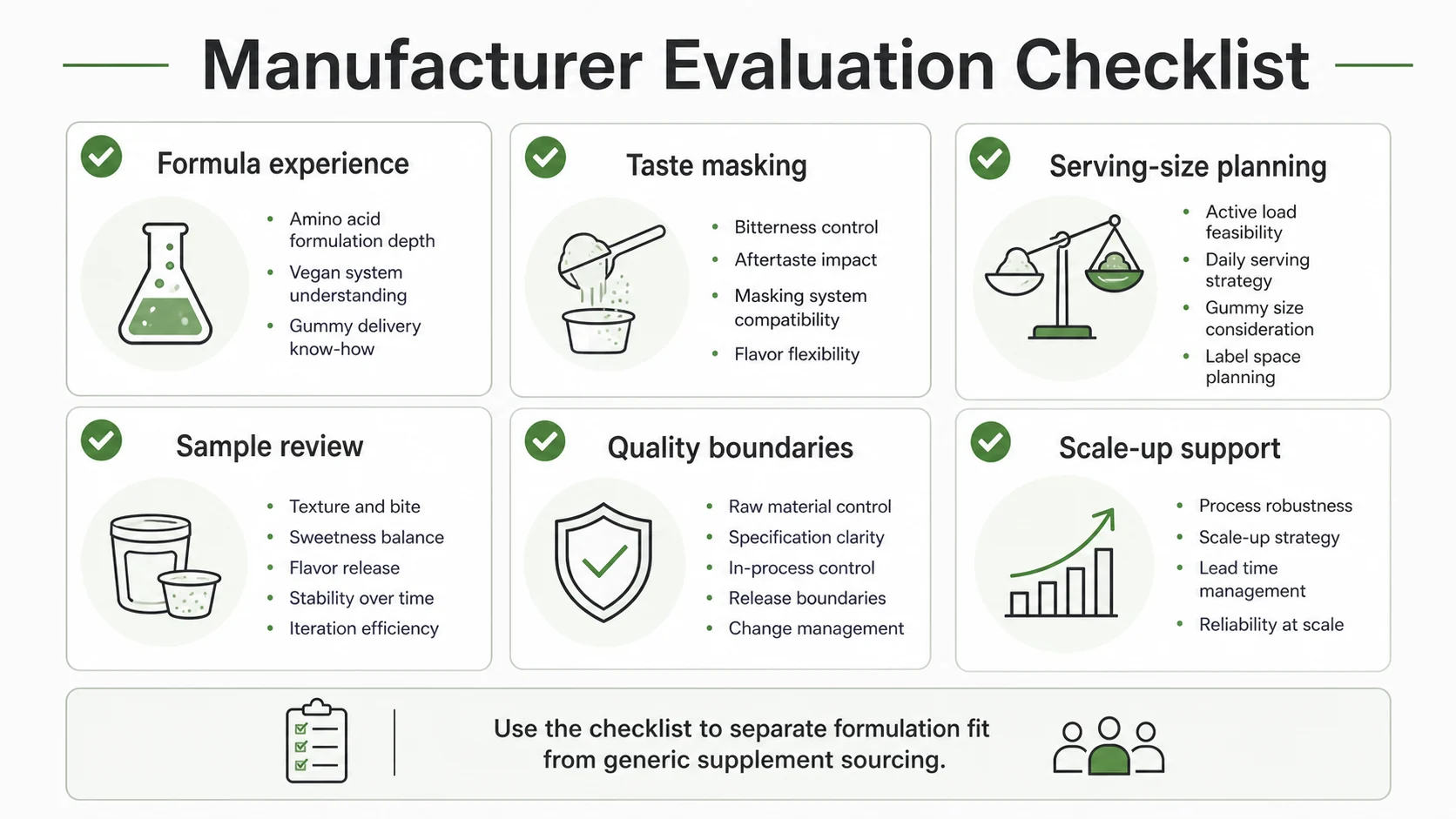
Brands should evaluate the formula before they evaluate the factory quote.
A strong vegan amino acid gummy brief defines the ingredient role, source documentation, serving size, taste strategy, claim boundary, testing expectation, and manufacturer-readiness questions before sample development begins.
Ingredient Source
Ingredient source affects more than the ingredient line on the label. It influences vegan positioning, documentation, allergen review, supplier qualification, and how the finished product is explained to buyers.
A practical brand brief should ask:
- Which amino acid type is being used: EAA, BCAA, or single amino acid?
- Is the source plant-derived, fermented, or otherwise non-animal?
- What documentation can the supplier provide?
- Does the finished formula use a vegan gelling system?
- Are flavors, colors, processing aids, and coatings aligned with the vegan claim?
These questions help prevent a common launch problem: the marketing team wants a vegan claim, but the formula review discovers gaps late in development.
Claim Boundaries
Claim boundaries should be set early. Vegan amino acid gummies can be positioned around plant-based supplement support, sports nutrition format, convenience, taste, or daily routine. They should not promise disease treatment, guaranteed performance, or medical outcomes[^6].
The safer approach is to make the article useful without sounding timid. Brands can explain what the ingredient is, why the format may fit a consumer routine, and what formulation questions must be solved. They should avoid making the gummy responsible for outcomes that depend on diet, training, health status, dosage, and individual response.
For Writer and brand teams, this means avoiding exaggerated phrases such as "builds muscle fast," "repairs tissue," "fixes deficiency," or "boosts immunity." The stronger B2B message is that claim language should follow formula reality and documentation.
Testing and Supplier Documentation
Testing and documentation are not only final-stage tasks. They should shape the formula brief from the beginning.
For a vegan amino acid gummy, brands may need to discuss raw material COA expectations, finished-product testing, label-claim support, allergen statements, vegan documentation, and packaging suitability. The exact plan depends on the market, claims, channel, and product specification.
This is where a manufacturer with formulation support can be useful. The best conversation is not "Can you make this?" but "Here is the amino acid profile, target serving, vegan claim, flavor direction, packaging format, and testing expectation. What is realistic in gummy format?"
Manufacturer Readiness
Manufacturer readiness is the point where the article can mention a vegan amino acid supplement manufacturer without making it the primary keyword.
A brand is ready for that conversation when it can provide:
- Target amino acid type and serving level
- Desired number of gummies per serving
- Vegan or plant-derived claim requirement
- Sugar, sugar-free, or low-sugar direction
- Flavor and texture preference
- Packaging format and bottle count target
- Launch market and sales channel
- Claim language to review
- Documentation and testing expectations
- Stock formula vs custom formulation preference
This keeps the B2B bridge practical. The article is still about vegan amino acid supplements, but it gives supplement brands a clear path from search intent to product-development action. If the brand is still deciding whether to use an existing base or build from scratch, the next decision is usually stock formula vs. custom formulation.
FAQ About Vegan Amino Acid Supplements
FAQ should clarify close-intent questions without opening new article directions.
The best FAQ answers are short, cautious, and useful: they should resolve confusion around amino acids, vegan protein, gummy feasibility, and manufacturer support without turning into medical advice or a sourcing guide.
Are vegan amino acid supplements the same as vegan protein?
No. Vegan protein products usually provide protein from sources such as pea, rice, soy, hemp, or blends. Vegan amino acid supplements provide selected amino acids, such as EAA blends, BCAAs, or single amino acids. They can support related positioning, but they are not automatically equivalent to a full protein serving.
Are vegan amino acids suitable for gummies?
They can be, but the formula must be checked for serving size, taste, texture, moisture control, plant-derived documentation, and claim boundaries. Gummies are convenient, but they have less active-loading room than powders or capsules, so the product role needs to be realistic.
Should brands use EAA or BCAA blends?
It depends on the product positioning. EAA blends can support a broader essential amino acid story, while BCAAs are more sports-positioned. A brand should choose based on the target consumer, serving size, taste challenge, label language, and documentation available for the ingredient source.
Do vegan amino acid gummies need a manufacturer with formulation support?
Yes, if the brand wants a credible commercial product rather than just a label concept. The manufacturer should be able to discuss amino acid type, serving size, bitterness, flavor masking, vegan gelling systems, documentation, testing expectations, packaging, and scale-up risk before production.
For Talvenda-style product development, the best vegan amino acid gummy starts with a clear use case. Once that role is defined, the formula can move through ingredient selection, sensory testing, label review, documentation, and manufacturer-readiness planning without letting the claim outrun the gummy format. For broader gummy production support, brands can also review Talvenda's gummy vitamin manufacturing capabilities.
Conclusion
Vegan amino acid gummies are not just a vegan-format idea; they are a bitterness, serving-size, and claim-boundary problem that still has to feel simple to chew, explain, and repeat.
For vegan amino acid gummies, the risk is building the brand story faster than the formula route can support, especially when bitterness, serving count, gelling preference, and claim wording all matter. As a contract gummy supplement manufacturer, Talvenda can help brands review low-MOQ market-tested in-stock gummies, stock formula modification, and custom gummy development before choosing a custom path too early. The value is a clearer sample and production route: what can be tested through sample development, what needs documentation and testing expectations, and where quality-controlled production and scale-up support become important. Start with the project inquiry form.
[^1]: "Biochemistry, Essential Amino Acids - StatPearls - NCBI Bookshelf", https://www.ncbi.nlm.nih.gov/books/NBK557845/. Used to support the basic nutrition definition that essential amino acids must be supplied from outside the body. Evidence role: nutrition definition; source type: government medical education. Supports: Essential amino acids must come from the diet or external intake.. Scope note: Definition support only; not evidence for product efficacy. [^2]: "Dietary Protein and Amino Acids in Vegetarian Diets-A Review", https://hero.epa.gov/reference/5920813/. Used to support cautious dietary-adequacy framing for vegetarian and vegan protein patterns. Evidence role: dietary adequacy background; source type: peer-reviewed review. Supports: Well-planned plant-based diets can provide amino acids, while specific patterns may need attention.. Scope note: Does not imply that all vegan diets are adequate or that supplementation is necessary. [^3]: "Branched-chain amino acids and muscle protein synthesis in humans", https://pmc.ncbi.nlm.nih.gov/articles/PMC5568273/. Used to support the ingredient-category definition of branched-chain amino acids. Evidence role: ingredient-category definition; source type: peer-reviewed biomedical source. Supports: BCAAs are leucine, isoleucine, and valine.. Scope note: Definition support only; not used for performance or recovery claims. [^4]: "Amino Acid Bitterness: Characterization and Suppression", https://pubmed.ncbi.nlm.nih.gov/39352105/. Used to support the formulation note that amino acids can create sensory and taste-masking challenges. Evidence role: formulation sensory background; source type: peer-reviewed food science source. Supports: Some amino acids can contribute bitterness or sensory challenges in formulation.. Scope note: General formulation support; not proof of a specific Talvenda formula. [^5]: "Food Allergens and Gluten-Free Guidance & Regulatory Information", https://www.fda.gov/food/guidance-documents-regulatory-information-topic-food-and-dietary-supplements/food-allergensgluten-free-guidance-documents-regulatory-information. Used to support why ingredient and finished-formula review should include allergen-label considerations. Evidence role: label and compliance boundary; source type: official regulatory source. Supports: Allergen labeling and documentation are relevant to formula review.. Scope note: Supports allergen-review relevance only; not a vegan-claim validation. [^6]: "Structure/Function Claims - FDA", https://www.fda.gov/food/nutrition-food-labeling-and-critical-foods/structurefunction-claims. Used to support conservative supplement claim-boundary language. Evidence role: claim compliance boundary; source type: official regulatory source. Supports: Supplement copy should avoid disease-treatment or unsupported medical-outcome claims.. Scope note: US regulatory framing only; not legal advice.