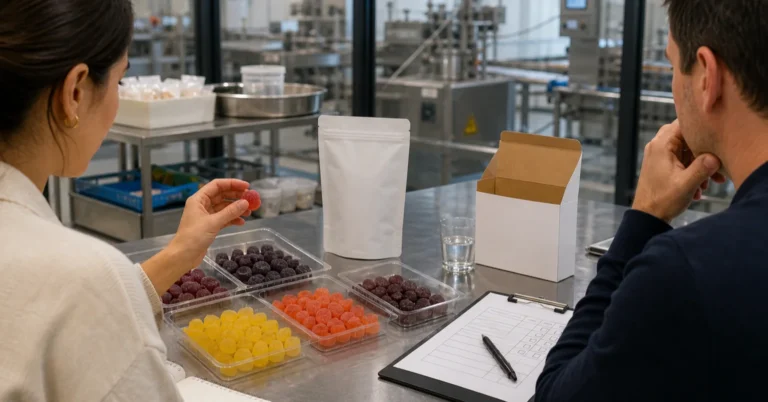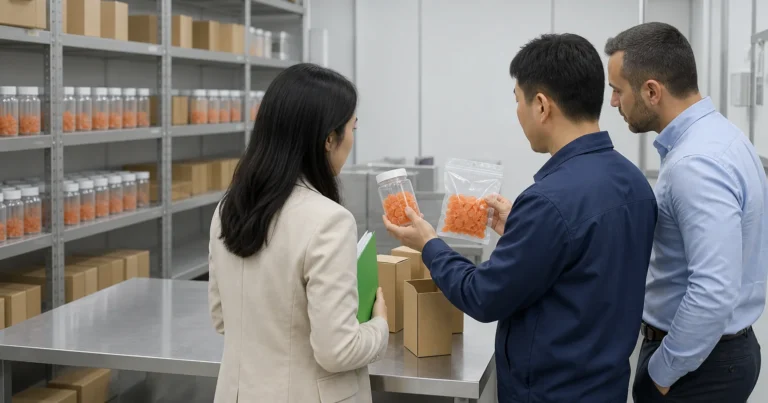


For a gummy supplement brand, the choice between a stock formula and custom formulation is not just a product-development question. It is a launch-risk decision.
A stock gummy formula helps a brand launch faster from a familiar base. A custom gummy formulation creates a more ownable product when the brand needs specific actives, sensory targets, or a long-term platform, but it requires more R&D, sampling, stability review, and commercial patience.
I would not frame this as "stock is cheap and custom is premium." That is too simple for gummy production. The better question is: which route gives your brand the right balance of speed, budget, MOQ, differentiation, formula ownership, compliance readiness, and scale-up confidence?
For many brands, the most practical answer is not one extreme. A semi-custom route can start from a proven gummy base, then adjust flavor, color, shape, sweetener system, packaging, or selected ingredients. That can protect time-to-market while still giving the product a clearer brand position.
This guide compares stock formula vs custom formulation as three real gummy launch routes: stock, semi-custom, and full custom. Use it before you request a quote, approve a sample, or commit to a production path.
If your team is still mapping the broader supplement brand launch sequence, review that first, then return here to choose the formula route.
Understanding Stock Formulas for Gummy Supplements
Stock formulas give gummy supplement brands a faster starting point for familiar categories, market testing, and launch planning.
But stock does not mean automatic fit. The formula still has to match the target market, serving size, active plan, flavor expectations, packaging format, label direction, and sales channel requirements before it is ready for your launch.

What Are Stock Gummy Formulas?
Stock gummy formulas are ready-to-use or pre-developed formulas that a gummy vitamin manufacturing partner already has available. They are usually built around common product categories, familiar active ingredients, and production routes that have already been evaluated in some form.
For example, a supplier may offer stock options for vitamin gummies, beauty gummies, sleep-support gummies, apple cider vinegar gummies, fiber gummies, or other common supplement categories. A stock option may include a standard gummy base, flavor direction, texture target, active ingredient range, and packaging assumptions.
For the brand, the value is that the starting point already exists. The conversation can move from "can you create this product from zero?" to "does this existing route fit our brand, label, packaging, and channel plan?"
That distinction matters. A stock formula is not automatically exclusive to your brand. It also does not by itself secure marketplace approval, label compliance, or channel acceptance.[^1][^2] Your team still needs to ask what can be changed, what cannot be changed, what documents are available, and whether the formula is shared with other brands.
The Pros of Choosing a Ready-to-Use Stock Formula
The biggest advantage of a stock formula is speed. Because the formula base and production route are already familiar, the brand can often move faster through sample review, quote discussion, packaging planning, and production preparation.
Stock formulas can also reduce early launch uncertainty. If a startup brand or ecommerce team is still testing whether customers want the product category, it may not make sense to spend heavily on full custom formulation before the demand signal is clear.
There is also a supplier-communication advantage. When the formula route is defined, the manufacturer can usually discuss MOQ, packaging, timeline, documentation, and production planning with less ambiguity.
| Advantage | What it means for a gummy brand | What still needs review |
|---|---|---|
| Faster launch path | Sampling and packaging can begin from an existing formula direction | Label, claims, packaging, documentation, and channel fit |
| Lower early development burden | Less need for full formula R&D before the first quote discussion | Whether the formula fits the brand's real product promise |
| More familiar production route | The supplier has more process experience with the base | Commercial batch quality and documents still need review |
| Easier first launch planning | MOQ and timeline discussions may be more straightforward | Exact MOQ and lead time depend on the supplier and project |
| Useful for market testing | Brand can validate category demand before deeper custom investment | Product differentiation may need stronger branding or packaging |
I usually see stock formulas work best when the brand wants speed, the ingredient target is not unusual, and the product story can be carried by positioning, packaging, flavor, bundle strategy, or channel execution.
The Cons of Relying on Stock Formulations
The main limitation of stock formulations is differentiation. If the same or similar base formula is available to multiple brands, your product may need stronger branding, packaging, flavor identity, content, and distribution strategy to stand apart.
Formula ownership is another concern. A stock option is usually not the same as a formula developed exclusively for your brand. Before launch, ask whether the formula is exclusive, whether exclusivity is available, and what changes would be required to create a more ownable formula later.
Ingredient flexibility can also be limited. A stock formula may not support the exact active dose, texture, flavor profile, sweetener system, gelatin or pectin preference, or clean-label direction your brand wants. Gummies are sensitive systems. Adding actives, changing sweeteners, switching gelling systems, or adjusting acids can affect taste, texture, processing, and stability.
Stock also does not remove compliance responsibility. Your team still needs to review the Supplement Facts panel, label claims, ingredient acceptability, packaging statements, documentation, and marketplace rules before launch.
Understanding Custom Formulation for Gummy Brands
Custom formulation makes sense when the product concept needs a more specific formula, ingredient story, sensory target, or ownership path.
The tradeoff is that custom gummy development is more than a creative brief. It is a production problem. The formula has to taste acceptable, hold its shape, carry the intended ingredients, fit the packaging, and move toward repeatable production.

What Is a Custom Gummy Formulation?
A custom gummy formulation is developed around a brand's specific requirements. Instead of choosing a ready-to-use base formula, the brand works with the formulation and manufacturing team to define the active ingredients, dosage direction, flavor, color, shape, texture, sweetener system, gelling system, serving format, packaging direction, and product positioning.
Custom formulation may be needed when the brand wants a specific active combination, a differentiated ingredient story, a unique sensory profile, or a formula that supports a more defensible product platform.
For example, a brand may want a gummy with a particular active dose, a pectin-based texture, a special flavor direction, a botanical combination, or a product concept that is not available in existing stock options. Those choices can create value, but each one has to be checked against gummy feasibility.
The Advantages of Bespoke Formula Development
The biggest advantage of custom formulation is strategic fit. The product can be built around the brand's target audience, claim direction, channel plan, sensory expectations, and long-term product line.
Custom work also creates more room for differentiation. A formula can support a more specific ingredient story, a clearer product reason to exist, and a stronger brand platform than a shared stock option.
There may also be a formula ownership advantage, depending on the agreement. I would clarify this before development begins. "Custom" does not automatically mean the brand owns every part of the formula or can transfer it freely to another manufacturer. Ownership, exclusivity, documentation, and future scale-up rights should be discussed in writing.
Custom formulation makes the most sense when:
- the formula is central to the brand promise;
- the product needs a specific active combination or dose direction;
- the brand wants stronger differentiation than packaging alone can provide;
- the team has time for sampling and review;
- the budget supports R&D;
- the product is part of a long-term line, not only a quick market test.
The Trade-Offs: Higher Costs and Longer Timelines
Custom gummy development usually requires more upfront work. The team may need to review ingredient compatibility, active loading, taste-masking, gelling system behavior, texture, pH, packaging fit, and stability considerations.
That work can increase development cost and extend the timeline. A formula that sounds strong in a brief may need multiple sample rounds before it becomes production-ready. If the active ingredients taste bitter, interact with the gummy base, or require a high dose per serving, the development work becomes more complex.
Custom products may also involve higher MOQs or more rigid production planning, depending on ingredient sourcing, packaging, exclusivity, and production setup. The brand should ask early which parts of the custom request affect MOQ, sampling, cost, and scheduling.
The tradeoff is clear: custom can create stronger product fit, but it requires more discipline. It is best for brands that know why the formula needs to be custom and have the commercial plan to support that investment.
The Semi-Custom Alternative: Strategic Gummy Customization
Semi-custom formulation is often the most practical route for brands that want more differentiation than a stock formula but are not ready for full custom development.
In a semi-custom route, the brand starts from an existing gummy base or proven production direction, then changes selected elements that matter commercially. This can include flavor, color, shape, sweetener direction, packaging, surface finish, or certain ingredient adjustments.
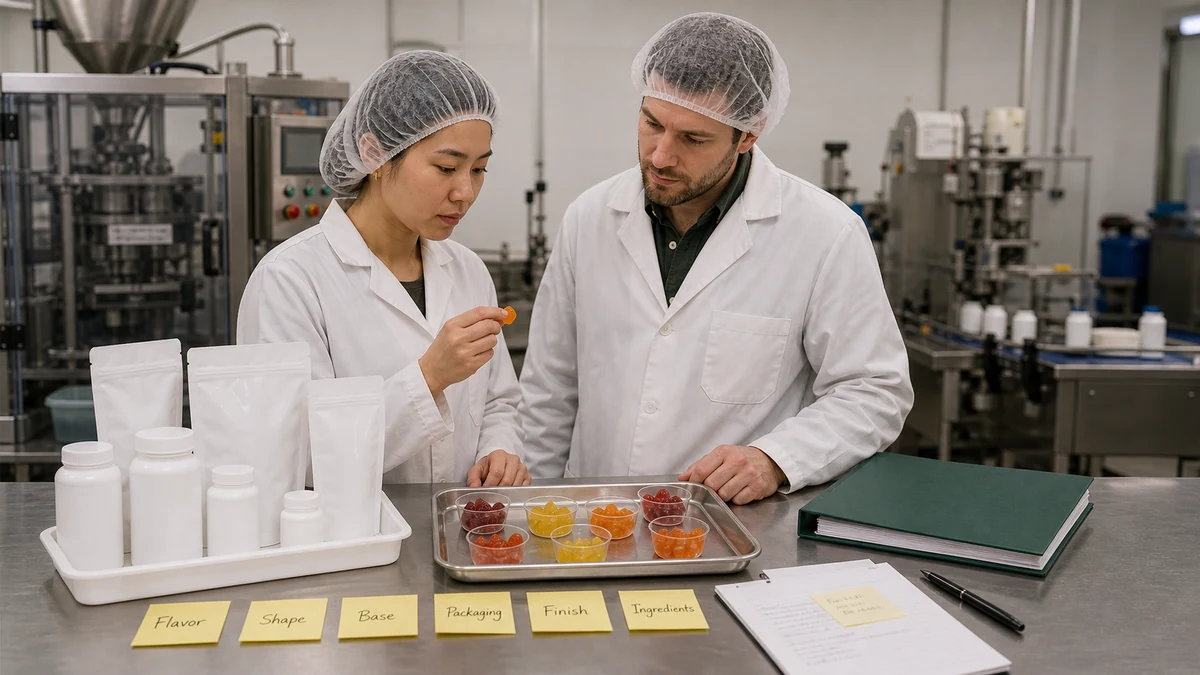
I like this route because it respects how gummy development really works. Not every part of the product needs to be new for the product to feel distinct. The skill is deciding which changes create brand value without creating unnecessary production risk.
Customizing Flavors, Colors, and Shapes
Flavor, color, and shape can strongly influence how customers understand a gummy supplement. A beauty gummy, sleep gummy, kids' gummy, or sports nutrition gummy may need a different sensory direction even if the base product category is familiar.
| Semi-custom element | What can change | Why it matters | What to check |
|---|---|---|---|
| Flavor | Fruit profile, masking direction, sweetness balance | Can improve consumer acceptance and brand feel | Active taste, aftertaste, flavor stability |
| Color | Natural or permitted color direction | Helps align product and packaging identity | Color behavior, label expectations, market rules |
| Shape | Existing mold or custom shape | Can create stronger product recognition | Demolding, drying, packaging fit |
| Surface finish | Sugar, oil, or other finishing options | Affects look, mouthfeel, and handling | Stickiness, packaging, shelf behavior |
| Packaging | Bottle, pouch, count size, outer box | Shapes retail and ecommerce presentation | MOQ, artwork, label space, shipping protection |
These changes may sound simple, but they still need review. Some colors behave differently in gummies. Some flavors do not mask actives well. Some shapes affect drying, demolding, surface finish, or packaging. A good partner should help the brand separate easy changes from changes that need added testing.
Modifying Standard Base Ingredients and Gelatin Options
Semi-custom changes can also involve the gummy base. A brand may want to discuss gelatin versus pectin, sugar level, sweetener system, acid profile, texture, surface finish, or selected excipients.
Gelatin and pectin are common discussion points. Gelatin can provide a familiar chew and texture, while pectin can support vegetarian or vegan positioning depending on the full formula and manufacturing controls. The right choice depends on the target consumer, ingredient system, cost expectations, production route, and market positioning.
Brands should not view base changes as cosmetic. Changing the gelling system, sweetener system, or active profile can affect texture, production behavior, and stability. Semi-custom works best when the brand changes the elements that matter for positioning while protecting the formula elements that already support manufacturability.
Stock Formula vs Custom Formulation: Key Differences Compared
The decision between stock and custom gummy formulas should be made through several filters: cost, MOQ, timeline, differentiation, ownership, documentation readiness, and scale-up complexity.
No route is automatically better. The right route depends on the brand's stage, budget, target market, product promise, and risk tolerance.
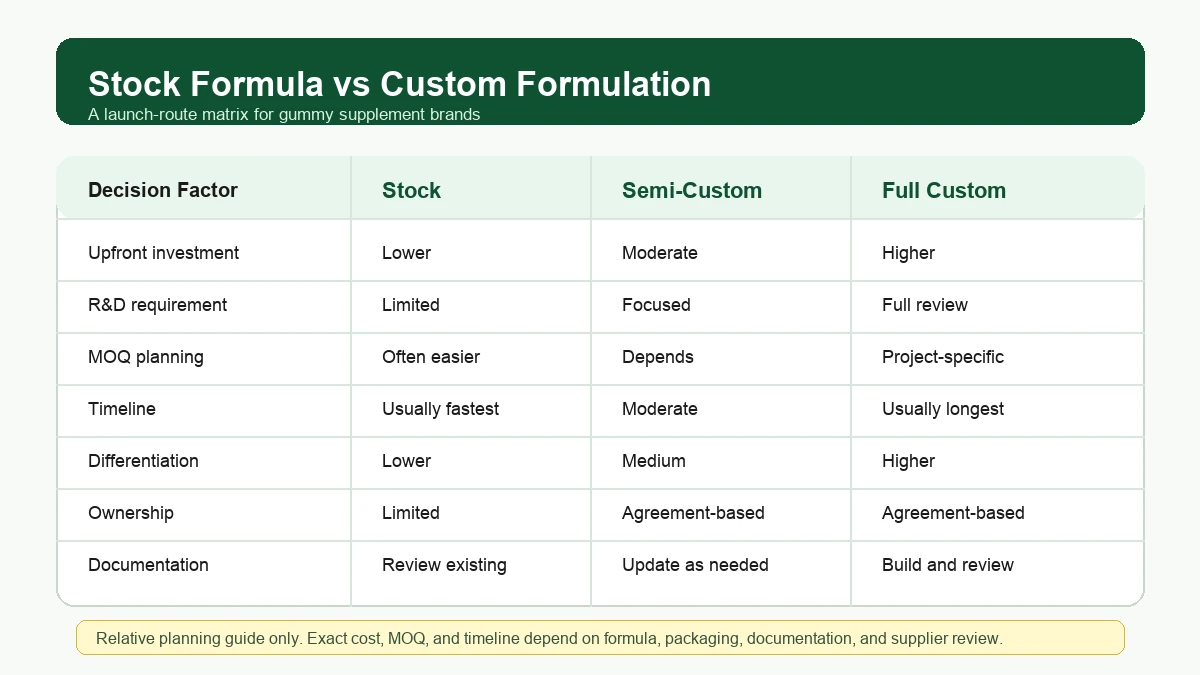
| Decision factor | Stock formula | Semi-custom | Full custom formulation |
|---|---|---|---|
| Upfront investment | Usually lower | Moderate | Usually higher |
| R&D requirement | Limited | Focused adjustments | Full development work |
| MOQ flexibility | Often easier for first launch | Depends on change depth | Often higher or more project-specific |
| Timeline | Usually fastest | Moderate | Usually longest |
| Differentiation | Lower if formula is shared | Medium, depending on changes | Higher when formula supports brand strategy |
| Ingredient control | Limited | Limited to approved changes | Highest |
| Formula ownership | Usually limited | Depends on agreement | Depends on agreement and development terms |
| Documentation readiness | Often more familiar | Often partly familiar | Must be built and reviewed |
| Scale-up risk | Lower when base is familiar | Low to moderate | Higher until process is proven |
Upfront Costs, Investment, and R&D
Stock formulas usually require less upfront R&D because the starting formula already exists. The brand may still need sampling, label review, packaging review, and documentation checks, but the development investment is usually more contained.
Custom formulation requires more work before production. The brand may need multiple sample rounds, ingredient feasibility checks, flavor adjustments, active-loading review, and production-readiness discussion. That increases cost before the first commercial run.
Semi-custom sits between the two. A flavor adjustment may be relatively simple. A gelling-system change, active addition, or sweetener-system change may move the project closer to custom development.
The best way to evaluate cost is to ask what risk the investment is reducing. If custom work prevents a weak product-market fit or supports a long-term product platform, it may be justified. If the brand is testing a category, stock or semi-custom may be the more rational first step.
Minimum Order Quantities (MOQs)
MOQ differences are often driven by production economics, not only supplier preference. A familiar stock formula may be easier to plan because ingredients, process steps, and packaging assumptions are already known. A custom formula may require dedicated ingredient purchasing, process setup, and documentation work.
That does not mean every stock formula has a low MOQ or every custom formula has a high MOQ. The actual number depends on the supplier, ingredients, packaging, production line, and commercial plan.
When discussing MOQ, ask by route:
| MOQ question | Why it matters |
|---|---|
| What is the MOQ for the stock version? | Establishes the fastest launch baseline |
| What changes would increase MOQ? | Shows whether semi-custom is still practical |
| Are ingredient minimums separate from finished-goods MOQ? | Helps avoid hidden purchasing pressure |
| Does packaging have its own MOQ? | Bottles, caps, pouches, labels, and cartons can affect the real commitment |
| What MOQ applies to reorder production? | First order and reorder planning may differ |
| Can the route scale later? | Prevents choosing a first launch path that cannot support growth |
I would ask these questions before detailed custom work begins. MOQ surprises are painful when the brand has already invested time into samples.
Time-to-Market and Development Timelines
Stock formula routes are usually faster because the formula does not start from zero. The brand can focus on sample approval, packaging, documentation, label review, and launch planning.
Custom formulation takes longer because the product has to be developed, tested, adjusted, and prepared for production. The timeline can expand if the actives are difficult to formulate, taste masking is challenging, packaging is not ready, or the brand changes requirements midstream.
Semi-custom protects time when the changes stay focused. It becomes slower when the brand keeps adding "small" changes that actually affect the formula system.
For planning, separate timeline into three stages:
- formulation and sample development;
- label, documentation, and packaging review;
- production scheduling and commercial-batch preparation.
Many launches get delayed because teams only plan for the first stage. A gummy product is not ready just because a sample tastes good. The commercial and documentation pieces also have to be ready.
Brand Differentiation, Exclusivity, and Formula Ownership
Stock formulas can support a fast launch, but differentiation may depend more on branding, packaging, flavor direction, content, bundle strategy, and channel execution. If several brands can access similar stock options, the formula alone may not protect the brand.
Custom formulation can create stronger differentiation, especially when the brand has a specific ingredient story or long-term product platform. But ownership still depends on the development agreement. A brand should clarify whether it owns the formula, whether exclusivity is available, what documentation it receives, and whether the formula can be transferred later.
Semi-custom can be a smart bridge. It may not create full formula ownership, but it can make the product feel more distinct while the brand tests demand. Later, sales data and customer feedback can support deeper custom work.
Stock Formula vs Custom Formulation: How to Choose the Right Route
Choosing the wrong route can waste time before the brand learns whether the product has real demand.
The route should support the business goal. A new brand may need speed and cash discipline, while a mature brand may need formula differentiation, documentation planning, or a stronger hero product platform.
When a Stock Formula Makes More Sense
A stock formula makes sense when speed, simplicity, and demand testing matter most. It can be a strong route for brands entering a known category or launching their first gummy supplement.
Choose stock when:
- the category is already familiar to customers;
- the product does not require a unique active dose;
- the brand story can be carried by positioning and packaging;
- the launch budget does not support deep R&D;
- the team wants to validate demand before custom investment;
- speed matters more than formula exclusivity.
The stock route is not a shortcut around quality. It still needs formula review, documentation review, label direction, packaging planning, and channel confirmation.
When to Invest in a Custom Formulation
Custom formulation makes sense when the formula itself is central to the product promise. If the brand needs a specific active combination, unique ingredient story, stronger ownership position, or differentiated product platform, custom may be worth the investment.
Choose custom when:
- the product concept cannot be met by a stock formula;
- the brand needs more control over actives and sensory profile;
- the formula story is central to the marketing strategy;
- the team can support R&D cost and sampling time;
- the brand wants a longer-term product asset;
- ownership and exclusivity are important enough to negotiate clearly.
Custom is strongest when the brand has a clear brief. A vague custom request wastes time. A focused custom brief helps the formulation team identify tradeoffs quickly.
Strategic Questions to Ask Yourself Before Deciding
Before you choose a route, work through the decision as a team.
| Question | What it reveals |
|---|---|
| What is the main goal of this launch? | Demand test, line extension, hero product, or channel entry |
| Does the formula need to be unique? | Whether stock can work or custom is needed |
| Which features are must-have? | Prevents over-customizing nice-to-have details |
| How much launch risk can we accept? | Balances speed against formula control |
| What is the real budget after packaging and marketing? | Avoids spending all capital on development |
| What MOQ can we responsibly commit to? | Keeps inventory risk realistic |
| Which claims or label statements need review? | Protects against compliance surprises |
| Could we launch stock or semi-custom first, then move to custom later? | Creates a phased growth path |
When I review a gummy launch plan, these questions usually reveal the route faster than a generic price comparison.
Regulatory Compliance and Quality Standards in Gummy Production
Gummy supplements combine formulation, food-like sensory expectations, supplement labeling, and manufacturing documentation. Compliance should be planned early, not added after the formula is chosen.
The brand remains responsible for making sure the product, label, claims, and sales channel requirements are reviewed appropriately. A partner can support documentation and production readiness, but that support should not replace legal or regulatory review.

Navigating Label Compliance and Ingredient Regulations
A gummy formula has to make sense on the label. That includes the ingredient list, Supplement Facts, serving size, warning statements when relevant, allergen considerations, and claim language.[^1][^3]
Stock formulas may already have a label direction, but the brand should still review whether that direction fits its product and market. Custom formulations need even closer review because ingredient changes can affect serving size, claim support, and required statements.
Brands should review:
- active ingredients and amount per serving;
- inactive ingredients, colors, flavors, sweeteners, and gelling system;
- Supplement Facts and ingredient naming;
- claims and support language;
- packaging space for required information;
- analysis-certificate and batch-document expectations;
- channel-specific requirements for ecommerce, retail, or cross-border sales.
Marketplace rules can change. If the brand plans to sell on Amazon, Shopify, retail, or international channels, it should confirm current requirements before launch.[^4][^5] Do not assume a stock formula automatically qualifies for a platform.
The Importance of GMP and ISO Certifications
Quality systems matter because gummies require repeatability. Brands should ask about GMP or cGMP practices, quality controls, ingredient qualification, batch records, finished-product testing approach, packaging controls, and documentation availability.[^6][^7]
If a supplier claims certifications or quality standards, ask for current documents and verify the scope.[^8][^9] The useful question is not only whether a certificate exists, but whether the process, product category, and documentation package fit your launch.
For brand teams, quality review should happen before production. A good discussion includes sample approval, formula documentation, packaging approval, analysis-certificate expectations, batch documentation, and any testing needs tied to the product category or channel.
How to Source and Manufacture Your Gummy Supplement
After the brand chooses a launch route, the next step is turning that decision into a production plan.
A practical sourcing process connects route choice, sample review, label planning, documentation, MOQ, packaging, and production scheduling before the brand commits to a commercial run.

Talvenda can support gummy brands by helping review launch-route fit, formula direction, packaging considerations, documentation needs, MOQ planning, and stock and custom gummy manufacturing routes. The goal is not to force every brand into the same route. The goal is to choose the route that fits the launch stage and commercial reality.
The Step-by-Step Formulation and Production Process
A practical gummy supplement launch often follows this sequence:
- Define the product concept, audience, active ingredients, serving format, and channel plan.
- Choose the launch route: stock, semi-custom, or full custom formulation.
- Review formula feasibility, flavor direction, texture, gelling system, packaging, and label needs.
- Request stock samples, semi-custom samples, or development samples based on the chosen route.
- Review taste, texture, appearance, serving size, and brand fit.
- Confirm label direction, claims, Supplement Facts, and documentation needs.
- Discuss MOQ, packaging, timeline, batch documents, analysis-certificate needs, and production schedule.
- Approve final sample and packaging details before production.
- Review commercial-batch documents and prepare the product for launch.
The exact process varies by project, but the principle is stable: formula decisions should not be separated from commercial and compliance planning.
How to Transition from Stock Formulas to Custom Later
Many brands do not need to start with full custom formulation. A stock or semi-custom launch can create market feedback first. After the product proves demand, the brand can decide whether deeper custom work is justified.
A practical transition path can look like this:
- launch with a stock or semi-custom gummy to test demand;
- track customer feedback, reorder rate, flavor response, packaging performance, and channel questions;
- identify what needs to become more ownable: active dose, ingredient story, flavor, shape, claims direction, or packaging;
- use sales data and customer insight to build a sharper custom formulation brief;
- move into custom development when the commercial case is stronger.
This approach keeps the first launch realistic while still leaving room for a more defensible product later.
Tips for Choosing the Right Gummy Manufacturing Partner
The right partner should help you choose a route, not push every project into the same formula type. Look for a team that can discuss stock options, semi-custom adjustments, and custom formulation with clear tradeoffs.
| Evaluation area | What to ask |
|---|---|
| Stock formula fit | Which existing gummy formulas are available for this category? |
| Customization depth | Which changes are easy, which need testing, and which change the full development route? |
| Formula feasibility | Can the active ingredients, dose, taste, and texture work in a gummy matrix? |
| MOQ planning | Which formula or packaging choices affect MOQ? |
| Documentation | What analysis certificate, batch record, label-support, and ingredient documents are available? |
| Packaging support | How do bottle, pouch, count size, label, and carton choices affect cost and timeline? |
| Quality systems | What GMP, cGMP, ISO, or other quality documents can be reviewed, if relevant? |
| Scale-up support | Can the route support future reorder and volume growth? |
| Communication quality | Does the team answer technical and commercial questions clearly? |
My usual recommendation is to ask these questions before you fall in love with a sample. A good sample is important, but it is only one part of a successful gummy launch. The route also has to work for production, documentation, packaging, budget, and reorder planning.
Frequently Asked Questions
Do I Own the Formula If I Use a Stock Option?
Usually, a stock formula is not the same as a formula developed exclusively for your brand. You may be able to sell a product based on the stock option, but the underlying formula may also be available to other brands unless exclusivity is agreed in writing.
Before launch, ask what rights you have, whether exclusivity is available, what can be modified, and what documentation will be provided. If formula ownership is central to your strategy, custom formulation may be a better long-term route.
How Long Does It Take to Launch a Custom Gummy Product?
The timeline depends on formula complexity, ingredient sourcing, sample rounds, packaging, documentation, production scheduling, and approval speed. A simple custom adjustment may move faster than a complex active ingredient system, but custom work usually takes longer than a stock formula route.
Brands should plan time for sample review, formula adjustment, label review, packaging approval, and production scheduling. The best way to shorten the timeline is to prepare a clear brief and make decisions quickly when samples and documents are ready.
Can I Sell Stock Formulation Gummies on Amazon or Shopify?
Possibly, but a stock formula does not automatically secure approval on Amazon, Shopify, retail, or any other channel.[^2][^10] Marketplace policies, supplement requirements, label rules, claim language, and documentation expectations can change.
Before listing a stock formulation gummy, review the current marketplace requirements, product label, claims, documentation, and category restrictions. A manufacturing partner can help prepare product information and batch documents, but the brand should still confirm channel-specific rules before launch.
Conclusion
Stock formula vs custom formulation is a launch-route decision, not a quality ranking. Choose the route that matches your timeline, differentiation need, MOQ comfort, and production risk.
Talvenda can help brand teams compare stock, semi-custom, and custom gummy routes through formula feasibility review, sample planning, packaging discussion, documentation expectations, MOQ planning, and scale-up support before the launch path is locked.
[^1]: eCFR, "21 CFR 101.36 -- Nutrition labeling of dietary supplements," https://www.ecfr.gov/current/title-21/chapter-I/subchapter-B/part-101/subpart-C/section-101.36/. [^2]: Amazon Seller Central, "Dietary supplements," https://sellercentral.amazon.com/help/hub/reference/external/G55N3JF2WQS7RVNE/. [^3]: U.S. Food and Drug Administration, "Label Claims for Conventional Foods and Dietary Supplements," https://www.fda.gov/food/nutrition-food-labeling-and-critical-foods/label-claims-conventional-foods-and-dietary-supplements/. [^4]: Amazon Seller Central, "Changes to dietary supplements policy," https://sellercentral.amazon.com/seller-forums/discussions/t/c23c51e6-159c-4d01-b297-9836d7d16419/. [^5]: Shopify Help Center, "Ensuring that your store complies with Shopify's policies," https://help.shopify.com/en/manual/compliance/legal/. [^6]: eCFR, "21 CFR Part 111 -- Current Good Manufacturing Practice in Manufacturing, Packaging, Labeling, or Holding Operations for Dietary Supplements," https://www.ecfr.gov/current/title-21/chapter-I/subchapter-B/part-111/. [^7]: U.S. Food and Drug Administration, "Current Good Manufacturing Practices (CGMPs) for Food and Dietary Supplements," https://www.fda.gov/food/guidance-regulation-food-and-dietary-supplements/current-good-manufacturing-practices-cgmps-food-and-dietary-supplements/. [^8]: International Organization for Standardization, "ISO 22000 -- Food safety management," https://www.iso.org/iso-22000-food-safety-management.html. [^9]: International Organization for Standardization, "ISO/IEC 17025 -- Testing and calibration laboratories," https://www.iso.org/ISO-IEC-17025-testing-and-calibration-laboratories.html. [^10]: Shopify Help Center, "Prohibited products on Shop," https://help.shopify.com/en/manual/online-sales-channels/shop/eligibility/prohibited-products/.