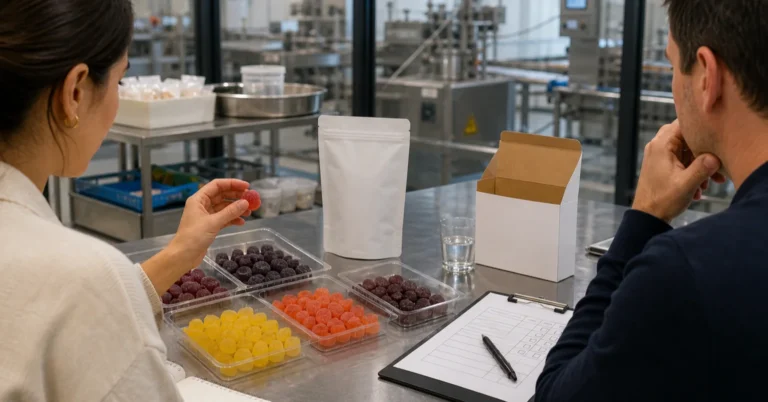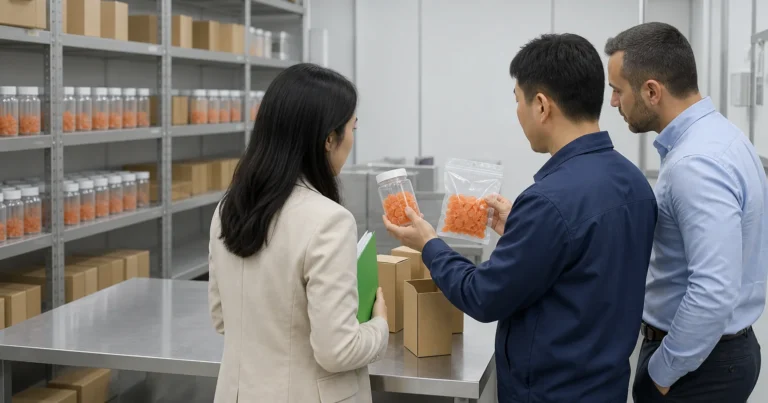


Many people compare gummies and pills by shape. That shortcut feels easy, but it can hide the real reason a supplement works or fails.
Gummy vitamins can be as effective as pills in some cases, but only when the nutrient form, dose, stability, and finished-product proof support the label claim. The format alone does not prove effectiveness.

For consumers, the first answer is simple: compare the same nutrient at the same intended dose, then ask whether the product can keep that dose through shelf life. For brand owners, product managers, and procurement teams, the better question is more practical: can this gummy formula deliver what the Supplement Facts panel says it will, from the first commercial batch to the last unit on shelf?[^1]
That is why this is not only a "gummy vitamins vs pills" article. It is a product development question. A gummy can be a smart format when the nutrient list, base system, taste, serving size, packaging, and testing plan all work together. It becomes risky when the brand treats the gummy shape as proof by itself.
Short Answer: Are Gummy Vitamins as Effective as Pills? Only If the Formula Proves It
A gummy can look more consumer-friendly than a pill. If the active dose is weak, unstable, or poorly documented, that friendly format becomes a label risk.
Gummy vitamins can be as effective as pills when they deliver the declared nutrient amount and maintain potency through shelf life. Pills may be more suitable for higher active loads, space-limited formulas, or ingredients that do not fit gummy processing well.

The same nutrient and dose matter more than the shape
The practical comparison is not "gummy vitamins vs pills" in general. It is one nutrient form and one intended dose compared with another nutrient form and another intended dose.
A vitamin D gummy and a vitamin D tablet may be designed to serve the same label purpose when the nutrient form and declared amount are comparable. A low-dose gummy and a higher-dose tablet are not the same product, even if the front label sounds similar.[^2] This is why broad claims such as "gummies are better" or "pills are stronger" are not useful. They skip the variables that actually matter.
For a brand team, the Supplement Facts panel is the starting point. The team should confirm the target nutrient list, intended amount per serving, nutrient forms, and expected serving size. Then the formulation and production team should ask whether that active load can fit inside the gummy without damaging taste, texture, moisture control, or stability.
| Effectiveness variable | What the brand needs to confirm |
|---|---|
| Nutrient form | The form used in the gummy is suitable for the intended claim and target market. |
| Declared dose | The serving can realistically carry the nutrient amount shown on the label. |
| Finished product | The active is present in the actual gummy, not only in the raw material plan. |
| Shelf life | The product can remain within the intended specification during normal storage. |
| Claim language | The marketing claim matches what the formula and documentation can support. |
Why "effective" means different things for consumers and brands
Consumers usually mean, "Will this product help me get the nutrient I am trying to take?" That question should be answered carefully. A supplement is not medical advice, and no dosage form should promise disease treatment or guaranteed results.[^3]
Brands have a different responsibility. They need to support the label claim they put into the market. That means the product should be developed around specifications, batch records, COA expectations, finished-product testing, and shelf-life planning. A good-tasting sample is not enough.
In production, "effective" should mean that the declared nutrient amount is realistic, the ingredient form is suitable, the gummy process can handle it, and the final product can be documented. If the brand wants to compare gummies with tablets or capsules, the comparison should stay inside those proof limits.
When pills still have the advantage
Pills, tablets, and capsules often have more room for active ingredients. They do not need the same level of sweetener, acid, flavor, color, gelling system, and chew texture. That makes them more practical for some high-potency formulas and complex multivitamins.
Pills may also be better when the nutrient has a strong taste, poor compatibility, high mineral load, or a sensitive stability profile. A gummy has to be pleasant enough to chew. It also has to hold water activity, texture, and potency over time.
So the short answer is balanced. Gummies can be effective for the right formula. Pills can be more practical for dense or difficult formulas. The brand's job is to decide based on dose, form, stability, packaging, and proof, not only consumer preference.
Gummy Vitamins vs Pills: The Practical Differences
The consumer sees flavor and convenience first. The production team sees active load, processing limits, texture risk, and label-claim responsibility.
The main difference between gummy vitamins and pills is not only absorption. Gummies must reserve formula space for taste, texture, moisture, and chewability, while pills can usually carry denser nutrient systems in a smaller serving.
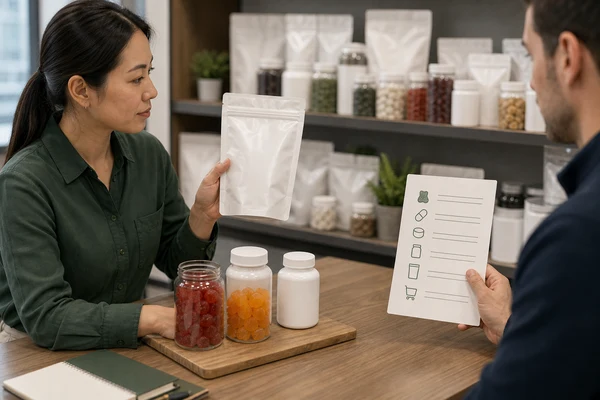
Active ingredient load
A pill can often carry a larger active load because the format is compact. A gummy has to share space with the base system.
That base may include pectin or gelatin, sweeteners, acids, flavors, colors, coating agents, and moisture-control elements. Each part has a job. The problem is that every gram used for texture or taste is a gram not available for active ingredients.
This matters most for multivitamins, minerals, and formulas with several high-dose ingredients. A simple vitamin D, vitamin C, or B12 gummy may be realistic. A broad formula with many minerals and high-potency claims needs a stricter feasibility review.[^4]
| Format | Active-load room | Common tradeoff |
|---|---|---|
| Tablet | High | Swallowability, tablet size, coating choice |
| Capsule | Medium to high | Fill weight, shell fit, moisture sensitivity |
| Softgel | Medium | Fill type, oxidation, specialized process |
| Gummy | Low to medium | Taste, texture, serving size, moisture control |
| Chewable tablet | Medium | Taste, mouthfeel, compression limits |
I usually separate the wish list from the feasible label panel early. If the first brief tries to make one gummy do every job a large tablet does, the project often becomes harder than the brand expected.
Taste masking and texture
Gummies are eaten like a chewable product, so taste is not a small detail. A bitter mineral, sour vitamin blend, or strong botanical can change the whole formula.
Taste masking can require more flavor, acid balance, sweetener adjustment, or coating work. Those changes can affect texture and stability. If the formula becomes too soft, sticky, grainy, or bitter, the consumer experience can fail even when the nutrient idea looks good on paper.
Texture is also part of manufacturing repeatability. A lab sample may feel acceptable, but a scaled batch can behave differently if temperature, solids content, depositing, drying, coating, or packaging is not controlled well. This is where a production-first review matters: the formula should be judged as a product that must run consistently, not only as a nice sample on a table.
Serving size and consumer compliance
One advantage of gummies is habit formation. Some consumers do not like swallowing pills. A gummy can feel easier to take, which may help consistency for people who would otherwise skip supplements.
But serving size can cut both ways. If a formula needs several gummies to reach the intended dose, the product may become expensive, sugary, bulky, or less convenient. A pill may deliver the same label amount in a smaller serving.
For brands, the serving-size decision should happen before flavor approval. The team should ask: can the consumer reasonably take this serving every day, and can the product still meet label claim at that serving size? If the answer is weak, the gummy may need a simpler nutrient panel or a different positioning claim.
Sugar, acids, and sugar-free systems
Traditional gummies often use sugar or syrup systems. Sugar can help taste and texture, but it may not fit every brand position. Consumers may also care about sugar intake, acids, and dental exposure.
Sugar-free systems can solve some marketing problems, but they create new formulation questions. Polyols, fibers, high-intensity sweeteners, or other systems can change mouthfeel, digestive tolerance, water activity, and processing behavior. A sugar-free gummy is not just a sugar gummy with one ingredient removed.
For a vitamin gummy, the sweetener system should be part of the proof chain. It affects flavor, texture, shelf-life behavior, and label communication. Brands should avoid treating sugar-free as only a front-label claim. It is a formulation system that has to work with the active ingredients.
Do Gummy Vitamins Absorb Better Than Pills?
Absorption is an attractive claim because it sounds scientific. It becomes risky when one result is stretched across every nutrient and every gummy formula.
Some nutrients in gummy form may show comparable absorption to pills, but brands should not claim gummies absorb better as a universal rule. Bioavailability depends on the nutrient, form, dose, matrix, and study conditions.[^5]

What bioavailability can and cannot prove
Bioavailability can help compare how much of a nutrient becomes available to the body under certain conditions. It is useful, but it is not a magic proof for every product.
A study may look at one nutrient, one dose, one population, one delivery form, and one measurement method. That does not automatically prove every gummy vitamin absorbs better than every pill. It also does not prove that a brand's finished commercial formula will perform the same way after months of storage.
For consumers, the safe takeaway is this: do gummy vitamins work as well as pills? They can, when the product is designed and controlled well. For brands, the safer claim is more specific. Discuss the nutrient form, intended dose, and product testing. Do not make broad absorption promises that the finished product cannot support.
Why one nutrient study does not prove every gummy formula
Different nutrients behave differently. Fat-soluble vitamins, water-soluble vitamins, minerals, and botanical ingredients do not all fit the same logic.
The gummy matrix also matters. Pectin, gelatin, sugar, acid, moisture, flavor oils, and processing heat can affect the finished product. A formula can be excellent for one nutrient and unsuitable for another. A gummy that works for vitamin C does not prove that iron, zinc, magnesium, or a complex botanical blend will be easy.
This is why I would not use one successful nutrient example as a blanket marketing claim. It is better to frame it as a starting point for feasibility. The brand should still review active compatibility, processing tolerance, taste masking, and stability before deciding how to present the product.
How brands should discuss absorption safely
Safe language stays close to what the brand can prove. Instead of saying "gummies absorb better than pills," a brand can say the formula is designed to deliver a declared amount of selected nutrients in a chewable format. If the brand has specific testing or substantiation, the claim can be reviewed within that boundary.
The label and marketing team should also avoid implying medical outcomes. Vitamin products can support normal nutrient intake when used as directed, but the exact wording should be checked with qualified regulatory or legal review for the target market.
For brand owners, this is not only a compliance concern. It is a trust concern. If the consumer buys a gummy because it sounds more advanced than a pill, the finished product should not depend on a vague claim. It should depend on a clear formula, a realistic dose, and a documented proof plan.
Why Some Gummy Multivitamins Are Less Complete
A complete multivitamin sounds attractive on the front label. In a gummy, too many actives can create taste, texture, and stability problems.
Some gummy multivitamins are less complete because gummies have limited active load and more taste constraints. Minerals, iron, and high-potency multi-ingredient formulas often need harder review than simple vitamin gummies.

Minerals and iron are harder to formulate
Minerals can bring strong taste, color impact, reactivity, and texture challenges. Iron is a common example because it can be difficult to include in a pleasant gummy at useful levels.
This does not mean every mineral is impossible. It means mineral choice, form, dose, taste masking, and compatibility should be reviewed before the brand promises a complete gummy multivitamin. The formulation team may need to reduce the mineral list, adjust serving size, or move certain nutrients into a different format.
A pill can often hide difficult ingredients better. A gummy has to be chewed and tasted. That single difference changes the whole development process. If the product tastes metallic, gritty, or harsh, the consumer may not keep using it, even if the label panel looks strong.
High-potency claims need careful review
High-potency claims can be useful in some dosage forms. In gummies, they can create a trap. The brand may want a strong front-label promise, while the formula has limited room to carry the active level cleanly.
Overages may also enter the discussion. Some vitamins can lose potency over time, so a formula may need a controlled overage strategy to support label claim through shelf life. But overage is not a casual fix. It needs technical review, regulatory boundaries, safety considerations, and stability logic.
When I review high-potency gummy concepts, I look for the point where marketing ambition starts to fight the product format. If the dose target forces poor taste, unstable texture, or weak documentation, the claim should be adjusted before the product reaches commercial production.
Complex formulas may need tablets, capsules, or chewables
Some products should not be forced into a gummy. A tablet, capsule, powder, or chewable may be the better format when the formula is too dense or too sensitive.
This is not anti-gummy thinking. It is good product development. A gummy should be chosen because it fits the consumer habit and formulation task, not because it looks easier to market.
Brands can also split a product line. A gummy may cover selected nutrients that fit the format, while a tablet or capsule covers a more complete or high-potency formula. This approach can protect both consumer experience and label credibility.
| Formula goal | Gummy fit | Practical concern |
|---|---|---|
| Simple vitamin D or B12 support | Often realistic | Confirm dose, flavor, and stability. |
| Vitamin C gummy | Often realistic | Manage acidity, taste, and moisture. |
| Broad multivitamin with minerals | Case by case | Active load and taste may limit completeness. |
| Iron-containing gummy | Harder | Taste, color, compatibility, and safety review. |
| High-potency multi-active formula | Often difficult | Serving size and label claim may become unrealistic. |
The Shelf-Life Question: Will the Label Claim Still Be True Later?
A vitamin gummy can pass a first taste test and still fail the bigger commercial question. The label claim must remain credible later.
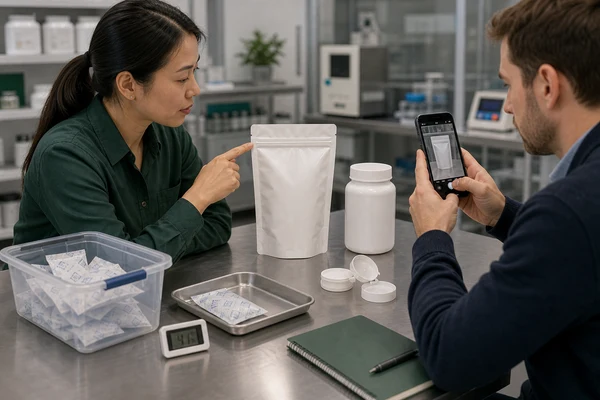
Shelf life is central to gummy vitamin effectiveness because potency, texture, moisture, and packaging conditions can change over time. Brands should plan stability before approving samples, not after launch.
Potency can change over time
Some nutrients are sensitive to heat, moisture, oxygen, light, pH, or interactions with other ingredients. Gummy vitamins add more variables because the matrix contains water and texture-building components.
The product that leaves the factory is not the only point that matters. The brand needs to think about the product after shipping, storage, warehouse time, retail display, and consumer use. If the nutrient amount falls below the declared level too early, the label claim becomes a problem.[^6]
This is where finished-batch testing and stability planning connect. A COA can help show what the batch contains at a point in time. Stability work helps judge whether the product can remain within specification over the intended shelf life. The two should not be handled as separate paperwork tasks.
Packaging and storage affect the finished gummy
Packaging is part of the formula's performance environment. A bottle, pouch, desiccant, closure, seal, and label instruction can all affect the finished gummy.
Gummies can absorb or lose moisture. They can stick, harden, soften, sweat, or change texture when exposed to poor conditions. Nutrient stability may also be affected. If the packaging is chosen only for appearance or cost, the product may look fine in a mockup but struggle in real distribution.
For brands, packaging should be reviewed with the formula. The production team should consider water activity, expected storage temperature, oxygen or moisture sensitivity, and shipping route. The goal is not only a beautiful package. The goal is a package that supports the product through shelf life.
Why stability planning belongs in the first brief
Stability planning is often delayed because teams want samples first. I understand that instinct. A brand needs to see flavor, color, shape, and texture before it feels real.
But a gummy vitamin project should include shelf-life assumptions from the first brief. If the target nutrient is sensitive, if the formula carries minerals, or if the packaging route is uncertain, those points affect the sample direction. Waiting until the end can lead to reformulation, delayed launch, or weaker claims.
The first brief should define the intended shelf life, target markets, packaging route, storage expectations, and testing plan. That does not mean every answer is final on day one. It means the sample is developed with the right questions already on the table.
Are Gummy Vitamins as Effective as Pills? What Brands Need to Prove Before Launch
The consumer sees the finished bottle. The brand must see the proof chain behind the bottle before making strong claims.
Before launch, brands should prove Supplement Facts feasibility, finished-batch quality, stability assumptions, third-party verification signals when needed, and claim boundaries. This protects both consumer trust and commercial risk.

Supplement Facts feasibility
Supplement Facts feasibility means the intended panel can be made in the gummy format without breaking the product. It is the first development gate.
The team should review each nutrient, target amount, nutrient form, serving size, flavor impact, processing tolerance, and compatibility with the base. If the formula needs a larger serving size than consumers will accept, the panel may need to change. If one mineral damages taste or texture, the formula may need a different form or a different dosage format.
This is also where brands should compare multivitamin gummies vs pills honestly. A pill can carry a more complete panel in less physical space. A gummy can offer a more enjoyable format, but only if the formula is built around realistic active load and label support.
Finished-batch testing
Finished-batch testing checks the product that will actually go to market. It is different from approving a bench sample or reviewing raw material paperwork.[^7]
The brand should define what needs to be tested and when. This may include identity, potency, microbiological quality, heavy metals where relevant, moisture-related attributes, and other specification points based on the formula and market. The exact test plan should match the product and legal requirements.
Finished-batch testing is not a decoration for a sales deck. It is one of the practical ways to connect manufacturing output with label promise. If the product claims selected vitamins at declared levels, the brand should have a reasonable way to confirm the finished batch aligns with that promise.
Third-party verification signals
Third-party testing or verification can strengthen trust, but it should be used carefully. A logo or testing phrase should not suggest more than the program actually covers.[^8]
Some brands use independent labs for finished-product assays. Some use broader certification or verification programs. Some use targeted contaminant testing depending on the product type and market. The important point is clarity. What was tested? Which batch? Which analytes? What does the result support?
For a gummy vitamin, third-party verification is most useful when it supports a specific concern. That may be potency, contaminants, label accuracy, or another defined specification. It should not become a vague shield for broad effectiveness claims.
Claim and label review
Claim review should happen before the product is locked. If the formula cannot support a claim, the wording should change.
The brand should separate structure/function-style language, general wellness positioning, dosage-format preference, and comparative claims. "Easy to take" is different from "absorbs better." "Designed to deliver declared nutrients" is different from "works better than pills." Each phrase carries a different proof burden.[^9]
I would not promise equivalence unless the product has a clear basis for that comparison. It is safer to say the gummy is formulated to deliver selected nutrients in a chewable format, with testing and stability planning used to support label accuracy. That language is less flashy, but it is more durable.
| Launch proof area | What to check before commercial release |
|---|---|
| Supplement Facts panel | Nutrient list, form, amount, serving size, and feasibility. |
| Finished batch | Potency, quality specifications, and batch documentation. |
| Stability plan | Shelf-life assumptions, packaging route, and storage conditions. |
| Packaging | Moisture, light, oxygen, heat, and distribution exposure. |
| Claims | Absorption, equivalence, wellness, and label wording boundaries. |
How to Brief a Manufacturer for an Effective Gummy Vitamin
A vague brief creates vague samples. A strong brief gives the production team enough information to test whether the gummy can earn its label.
To brief an effective gummy vitamin project, define the nutrient list, target dose, gummy base, sweetener system, packaging needs, sample review criteria, and testing plan before moving toward commercial production.

Define the target nutrient list and dose
Start with the nutrient list and intended amount per serving. Do not begin with flavor alone.
The brief should name each active, preferred nutrient form if known, target dose, serving size, and positioning limit. If the brand wants a children's gummy, adult multivitamin, beauty gummy, immune support gummy, or sugar-free vitamin gummy, those choices affect dose, taste, excipient system, and compliance wording.
The brief should also state what the product should not claim. This helps the formulation and production team avoid building toward a marketing promise that may not be supportable. In gummy vitamins, a clear "no" can save time. No unsupported absorption comparison. No medical claims. No complete multivitamin promise if the formula cannot carry it.
Choose the gummy base and sweetener system
The base system affects texture, process, consumer positioning, and stability. Pectin and gelatin are common paths, but they do not behave the same way.
Pectin may fit vegan or plant-based positioning. Gelatin may provide a familiar chew profile. Sugar-based systems may help taste and texture. Sugar-free systems may fit low-sugar positioning but can bring different processing and mouthfeel challenges. The right answer depends on the active ingredients and brand goal.
For an effective gummy vitamin, the base is not only a lifestyle choice. It is part of the delivery system. The production team should review active compatibility, pH, moisture behavior, drying, coating, packaging, and storage together.
Review samples beyond taste
Taste matters, but it should not be the only sample approval standard. A brand can love the flavor and still have a weak commercial product.
Sample review should include appearance, chew, stickiness, odor, active load feasibility, serving size, packaging assumptions, assay plan, and stability concerns. If the sample uses a simplified active blend, the team should not assume the final active-loaded product will behave the same way.
This is where a practical project checklist helps:
| Review point | What the brand should confirm |
|---|---|
| Nutrient panel | Can the target nutrients fit the serving size? |
| Taste and texture | Does active loading still taste and chew well? |
| Process fit | Can the formula move from sample to batch production? |
| Packaging | Does the package protect moisture, texture, and potency? |
| Testing | What finished-batch and stability checks are planned? |
| Claims | Does the wording match the proof available? |
Connect the project to gummy vitamin manufacturing
The final brief should connect consumer promise with production proof. That is where formula feasibility and gummy vitamin manufacturing become more than a service category. They become the process that decides whether the product can support its label in the real market.
Talvenda can help brands discuss formula feasibility, gummy base selection, sample planning, packaging review, production planning, COA expectations, and batch document needs. The useful starting point is not "make this taste good." The useful starting point is "can this gummy deliver the intended nutrients, stay stable, and support the claims we want to make?"
My usual recommendation is to brief the proof before the flavor. Flavor can be adjusted. Color can be adjusted. Shape can be adjusted. But if the dose, active compatibility, stability plan, and testing logic are wrong, the whole product position becomes fragile.
FAQ
Do gummy vitamins work as well as pills?
Gummy vitamins can work as well as pills for some nutrients when the dose, nutrient form, stability, and finished-product testing support the label claim. They should not be assumed automatically equal for every formula.
Are vitamin tablets better than gummies?
Vitamin tablets are often better for dense formulas, high-potency formulas, and complex nutrient panels. Gummies may be better for consumers who prefer a chewable format, but the formula still needs proof.
Why do some gummy vitamins not contain iron?
Iron can be difficult in gummies because of taste, color, compatibility, dose, and safety considerations. Some brands leave it out rather than weaken taste, texture, or claim credibility.
Can gummy vitamins lose potency?
Yes. Some nutrients can lose potency over time because of heat, moisture, oxygen, light, pH, or ingredient interactions. Gummy vitamin projects should include stability planning and suitable packaging.
What should brands test before selling gummy vitamins?
Brands should review Supplement Facts feasibility, active load, finished-batch potency, relevant quality specifications, packaging performance, shelf-life assumptions, and claim wording. This is how are gummy vitamins as effective as pills becomes a proof question, not a slogan.
Conclusion
Gummy vitamins can be as effective as pills when the product proves the same practical chain: nutrient form, realistic dose, active-load fit, finished-batch testing, packaging, and shelf-life stability.
For a vitamin brand, the real question is whether the gummy format can carry a believable nutrient promise without turning the first launch into an overbuilt custom project. Talvenda is an OEM/ODM gummy manufacturer that can help compare low-MOQ market-tested in-stock gummies, stock formula modification, and custom gummy development against the brand's serving goal and launch route. Through sample development, packaging and label support, documentation and testing expectations, and scale-up support, the brand can see what is realistic to sample first and what should wait until a more tailored formula path is justified. Start with a formula feasibility review.
[^1]: FDA, Dietary Supplement Labeling Guide. Used for Supplement Facts and dietary supplement label-review context.
[^2]: NIH Office of Dietary Supplements, Vitamin D Fact Sheet for Health Professionals. Used for nutrient-form and dose-specific comparison context.
[^3]: FDA, Dietary Supplement Claims. Used for structure/function and disease-claim boundary context.
[^4]: NIH Office of Dietary Supplements, Multivitamin/mineral Supplements Fact Sheet for Health Professionals. Used for multivitamin variability and formula-completeness context.
[^5]: NIH Office of Dietary Supplements, Vitamin C Fact Sheet for Health Professionals. Used for nutrient-specific bioavailability and dose-response context.
[^6]: Electronic Code of Federal Regulations, 21 CFR Part 111 - Current Good Manufacturing Practice in Manufacturing, Packaging, Labeling, or Holding Operations for Dietary Supplements. Used for specifications, quality-control, and batch-proof context.
[^7]: FDA, Dietary Supplement Current Good Manufacturing Practices (CGMPs). Used for dietary supplement manufacturing proof-chain context.
[^8]: USP, verification services for dietary supplements. Used for third-party verification scope and trust-signal wording context.
[^9]: FTC, Health Products Compliance Guidance. Used for advertising, comparative-claim, and substantiation boundary context.