

What’s the difference between prebiotic and probiotic gummies? They use different gut-health mechanisms.
Prebiotic gummies usually deliver a substrate such as fiber. Probiotic gummies focus on live cultures, strain identity, viable count, and shelf-life stability. For brands, that changes the formula, claim, testing plan, and packaging conversation.
From a brand-side formulation review perspective, the question is not only which term sounds better. The better starting point is which mechanism the finished gummy can actually support through production, packaging, and shelf life.
Decision Snapshot
- Prebiotic gummies are usually easier to stabilize, but fiber load, texture, sweetness, serving size, and digestive comfort still limit what the formula can carry.
- Probiotic gummies need a live-culture proof chain: strain identity, target count, processing conditions, packaging, storage, and finished-product testing.
- Synbiotic gummies only make sense when the prebiotic and probiotic parts both have a real role in the finished product.
- A gut-health claim should match what the finished gummy can defend at the end of shelf life, not only what sounds attractive on a label.

What’s the Difference Between Prebiotic and Probiotic Gummies?
Probiotics are live microorganisms, while prebiotics are substrates that beneficial microbes can use.[^1][^2]
Prebiotic gummies provide ingredients—often certain fibers—that are intended to support beneficial gut microbes, while probiotic gummies deliver live microorganisms. For brands, that difference changes ingredient selection, processing limits, shelf-life testing, packaging, and claim support.
For probiotic gummies, manufacturing checks should start with the actual strain and viable-count plan, not only the generic word "probiotic." Two products can both use probiotic language while having very different strain identities, stability profiles, storage needs, and claim boundaries.
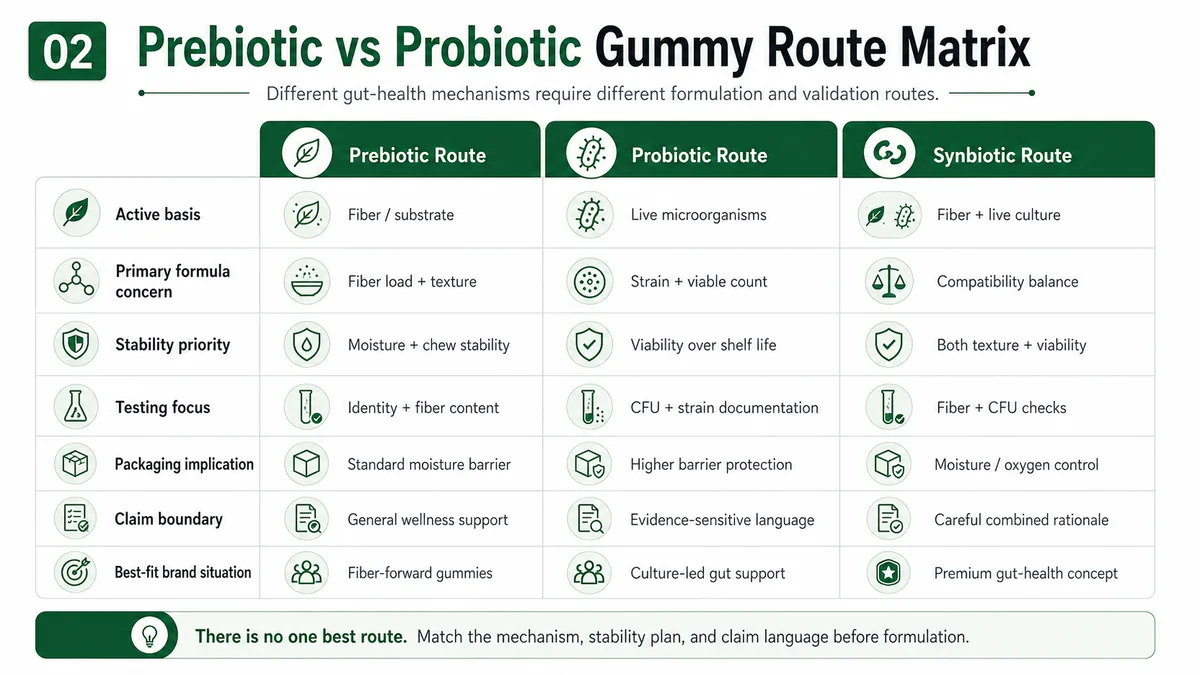
Probiotics Are Live Microorganisms
Probiotics are live microorganisms intended to provide a benefit when consumed in adequate amounts. The word “live” matters. A product cannot rely only on a probiotic name on the label if the organism does not remain viable through the product’s real life: manufacturing, packaging, warehouse storage, transport, retail display, and home storage.
This is why probiotic gummies need more than a popular ingredient name. A brand has to know which strain is being used, what viable count is expected, whether the count is measured at manufacture or at the end of shelf life, and what conditions the strain can tolerate.[^1]
I would be careful with any probiotic gummy concept that starts with “add Lactobacillus” or “add Bifidobacterium” before it answers the stability question. Different probiotic strains can behave differently, and a strain that is suitable for one format does not automatically work in a gummy matrix.
Prebiotics Feed Beneficial Microbes
Prebiotics are not live organisms. They are substrates that are selectively used by microorganisms in or on the body. In supplements, many prebiotic concepts are built around specific fibers or fiber-like ingredients, but not every fiber automatically becomes a strong prebiotic claim.
For gummies, prebiotics create a different formulation problem. The active does not need to stay alive, but the formula still has to carry a meaningful amount without damaging taste, texture, sweetness balance, or digestive comfort.
Fiber ingredients can change chew, stickiness, moisture behavior, sweetness perception, and serving size. If the dose requires too many gummies per serving, the consumer experience becomes worse. If the formula tries to hide too much fiber in a small gummy, the texture can become dense or tacky. The real question is not whether prebiotics are stable in theory. It is whether the finished gummy can deliver a practical serving.
How They Can Work Together
Prebiotics and probiotics can appear together in a synbiotic product. In concept, the prebiotic component supports the microbial side, while the probiotic component supplies the live organism. In practice, a synbiotic gummy should not be used as a shortcut to a stronger claim.
A synbiotic gummy adds complexity. The prebiotic ingredient must fit the gummy texture and serving size. The probiotic strain must survive the process and shelf life. The combination also needs a clear reason to exist. If the prebiotic is only there because it sounds good, or the probiotic is only there because the market recognizes the word, the product can become crowded without becoming more credible.
When I review a synbiotic concept, I look for a real job on both sides. The prebiotic should contribute to the product concept without making the gummy unpleasant or unstable. The probiotic should have a strain, dose, and shelf-life plan that can be defended. Without both, the word “synbiotic” can become a label upgrade instead of a formulation decision.
What’s the Difference Between Prebiotic and Probiotic Gummies for Format Decisions?
Gummies are high-sensory products, not capsules with sugar around them.
Prebiotic and probiotic gummies face different format risks: prebiotics must fit a practical serving without overwhelming texture or tolerance, while probiotics need strain, viability, processing, packaging, storage, and shelf-life controls.
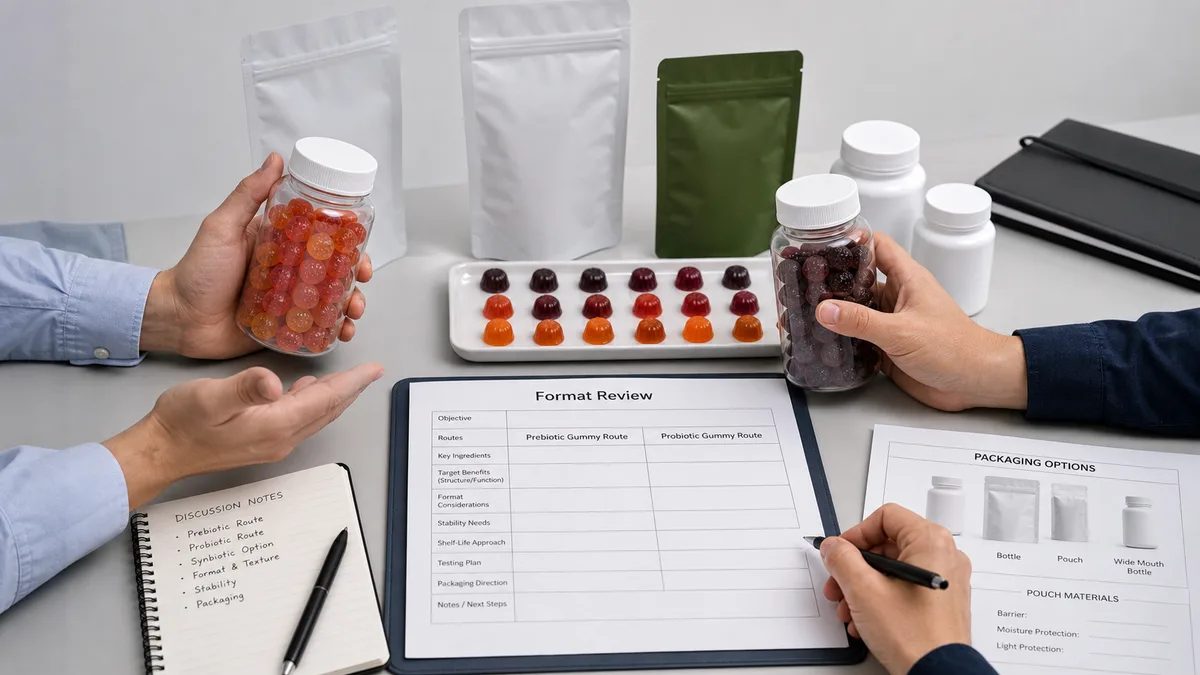
Live Culture Viability vs Fiber Stability
The main probiotic gummy challenge is viability. The live culture has to survive the product route. Heat exposure during processing, water activity, acidity, oxygen exposure, and storage conditions can all matter. A formula can contain live microorganisms at one point and still have a weaker claim later if the survival plan is not controlled.
The main prebiotic gummy challenge is practical delivery. The ingredient is usually more stable than a live culture, but the active load can affect the eating experience. Higher fiber content can influence texture, stickiness, sweetness, and digestive tolerance.
| Factor | Prebiotic Gummy | Probiotic Gummy |
|---|---|---|
| Primary active problem | Delivering a practical substrate dose | Maintaining live-culture viability |
| Strain or ingredient identity | Confirm the specific fiber or substrate | Confirm the exact strain, not only the genus or blend name |
| Count or dose target | Confirm serving amount and tolerance | Confirm target CFU and whether it is measured at manufacture or shelf life |
| Main formula risk | Texture, sweetness, moisture, serving size | Heat, water activity, acidity, oxygen, shelf life |
| Process exposure | Usually focused on texture and ingredient behavior | Must account for heat, moisture, pH, and processing route |
| Testing focus | Finished serving amount and product stability | Viable count and finished-product stability |
| Packaging concern | Moisture control and texture protection | Moisture, oxygen, temperature, and count preservation |
| Claim risk | Overstating fiber or prebiotic function | Claiming a probiotic count the finished product cannot defend |
This is why the decision should not be made only by marketing preference. “Probiotic” may sound more advanced to some consumers. “Prebiotic” may sound cleaner or easier to understand. The better question is which product route can support the claim in the finished gummy.
Why Probiotic Gummies Are Harder to Formulate
Probiotic gummies are harder because the active is alive. A live organism is not just an ingredient on a formula sheet. It reacts to conditions. The formula has to protect the strain from the stresses that can reduce viability.
The first checkpoint is strain identity. A broad “probiotic blend” claim is weaker than a clear strain-level plan. The second checkpoint is count. A brand should know whether the CFU target is based on manufacture date or end of shelf life. The third checkpoint is process. If the gummy process exposes the organism to heat or moisture conditions it cannot tolerate, the concept needs redesign before the label claim becomes a problem.
Packaging also matters. Oxygen and moisture exposure can affect product stability. Storage instructions matter too. A probiotic gummy designed for room-temperature retail has a different risk profile from one that requires tighter storage conditions. The formulation, packaging, and claim should be decided together.
I do not see probiotic gummies as impossible. I see them as technically demanding. A brand that wants one needs a strain strategy, process limits, packaging logic, and a finished-product testing plan before the claim is considered production-ready.
Before paying for samples, the brand should ask the manufacturer practical questions. Can the project use a shelf-stable probiotic strain? How will live-culture exposure be managed during gummy production? What packaging and storage assumptions are needed? What finished-product testing supports the label claim? Does the retail plan require room-temperature storage, or does the product need tighter handling instructions? These are supplier capability questions, not medical-benefit questions.
When a Synbiotic Gummy Makes Sense
A synbiotic gummy can make sense when the product has a clear reason to combine both components. The prebiotic part should support the product concept without damaging texture or tolerance. The probiotic part should have a strain, dose, and shelf-life plan that can survive the finished gummy route.
It does not make sense when the combination only adds more label claims. More actives can make a formula harder to execute. More claims can create more proof burden. More ingredients can also make taste, texture, and serving size harder to control.
My usual rule is simple: do not combine prebiotic and probiotic just because both words are popular. Combine them only when the finished gummy can carry both parts well and when each part makes the product more credible.
Food Sources, Supplements, and Gummies
Consumers often understand prebiotics and probiotics through foods first.
Prebiotic and probiotic food sources can include yogurt, fermented foods, fruits, vegetables, grains, and other fiber-rich foods. Prebiotic or probiotic gummies are formulated supplement servings, not substitutes for those ordinary food sources.

Common Probiotic Food Sources
Common probiotic-associated foods include yogurt and fermented foods that contain live cultures. These foods help consumers understand what probiotics are, but they do not automatically prove that every probiotic supplement works the same way.
For gummies, the useful lesson is not “fermented foods are good, so probiotic gummies are good.” The useful lesson is that live cultures are format-sensitive. A live-culture food has its own production, storage, and consumption context. A gummy has a different matrix and a different shelf-life route.
If a brand uses food examples in content or packaging education, the language should stay careful. Food examples can explain the idea. They should not be used to imply that the gummy has the same evidence, the same organism survival, or the same consumer outcome.
Common Prebiotic Fiber Sources
Prebiotic conversations often include foods such as onions, garlic, bananas, chicory root, and other fiber-containing foods. These examples help consumers understand the “feeding beneficial microbes” idea. But again, a gummy is a formulated product.
In a gummy, the brand chooses a specific ingredient, serving size, texture system, flavor system, and label language. Some fibers can create digestive discomfort at higher intakes. Some affect sweetness or chew. Some require more serving volume than the brand expects.
The practical question is whether the chosen prebiotic ingredient can fit the gummy format without pushing the product into an awkward serving. A gummy that needs too many pieces per day may lose the convenience advantage that made the format attractive in the first place.
When Gummies Are a Convenience Format, Not a Medical Shortcut
Gummies are a convenience format. They can make a supplement easier to take, easier to sample, and easier to position for daily routines. But convenience does not remove the need for evidence, stability, and claim discipline.
This matters for both prebiotic and probiotic gummies. A prebiotic gummy still needs a practical dose and a tolerable formula. A probiotic gummy still needs a viability plan. A consumer-friendly format should not become a reason to weaken the proof chain.
For brands comparing formats more broadly, gummies can be useful when taste, habit formation, and portability matter. Capsules, powders, and tablets may still be better for some actives or dose levels. That is why a gummy concept should be checked against the ingredient, not only against the market trend. For a wider format comparison, brands can compare gummies vs capsules and review gummy vitamin proof questions without repeating those topics in full here.
Benefits and Claims: What Brands Should Be Careful About
Gut-health language can become risky quickly.
For prebiotic vs probiotic gummies, the claim should follow the evidence and finished-product support. If the formula cannot support the claim after production and storage, the claim should be softened, changed, or removed.
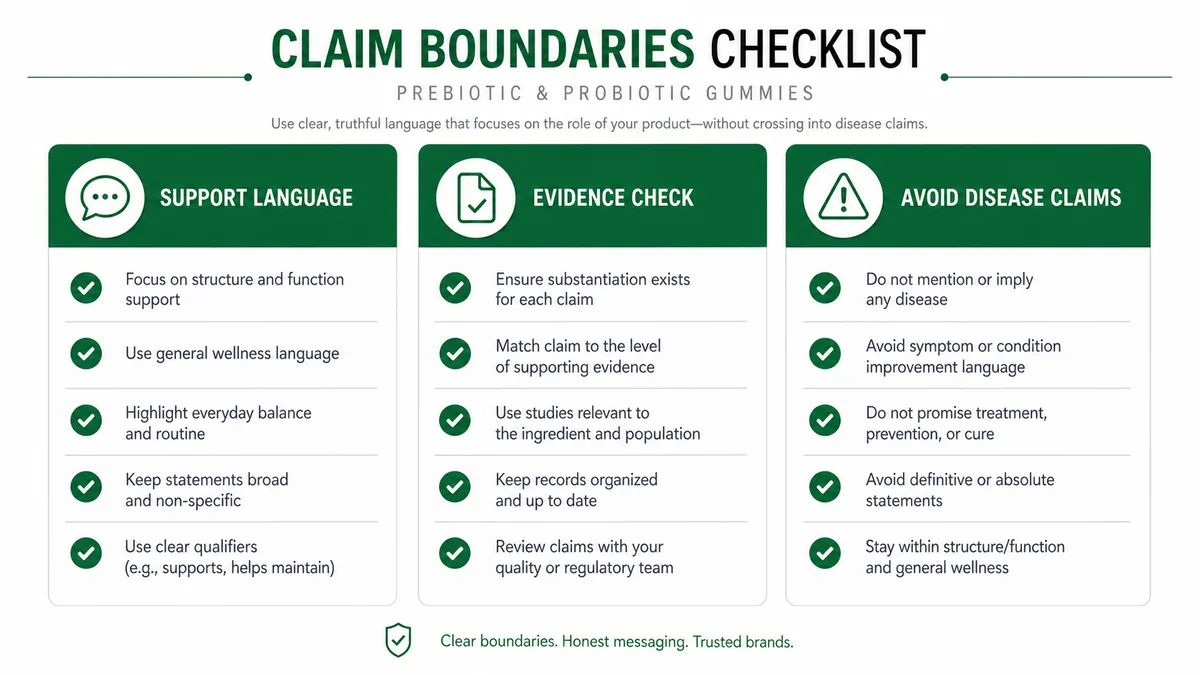
General Gut Health Language vs Disease Claims
General structure/function language is different from disease language. A supplement can usually talk about supporting normal structure or function when the claim is truthful and properly substantiated. It should avoid disease-language that implies medical management, therapeutic outcomes, disease-risk reduction, or diagnosis claims.[^4]
That boundary is important for probiotics because consumer content often talks about specific health conditions. A brand may see those discussions and want stronger claims. I would not move that language onto a gummy label or product page without a careful regulatory and evidence review.
For prebiotic gummies, the same caution applies. Fiber and gut-health language may feel familiar, but familiar does not mean unrestricted. The formula, serving size, ingredient identity, and supporting evidence should control the claim.
Why Strain, Dose, and Evidence Matter
Probiotics are not interchangeable. A Lactobacillus strain and a Bifidobacterium strain are not automatically equivalent. Even within the same broad group, different strains can have different evidence and different stability behavior.
This is why probiotic gummies need strain-level thinking. The brand should know what strain is being used, what evidence supports it, what dose is relevant, and whether the product can maintain an appropriate viable count through shelf life. A general “probiotic” claim is not enough for a serious product-development decision.
For label planning, I would separate four checks:
- Strain identity: what organism and strain is actually in the formula?
- Dose or CFU target: what count is the brand trying to support?
- Evidence scope: what does the strain evidence support, and what does it not support?
- Shelf-life boundary: can the finished gummy still defend the intended viable-count claim later?
Prebiotics need evidence discipline too. The ingredient should qualify for the intended positioning. A general fiber source should not automatically be marketed as a prebiotic if the specific ingredient and claim are not supported. In both cases, the label should not run ahead of the proof.
Why “Signs It Is Working” Should Stay Cautious
Many consumers want simple signs that a supplement is working. For gut-health products, that can lead to oversimplified promises about digestion, comfort, regularity, or visible changes. A brand should be careful here.
The same gummy can feel different to different people. Diet, baseline gut habits, serving size, other supplements, medications, and individual tolerance can all affect the experience. Some consumers may notice digestive changes. Others may not. Some may need to stop or ask a healthcare professional if they have health concerns.[^3]
I would keep “working” language cautious and practical. The product can explain what it is formulated to support, how it should be used, what the serving size is, and when consumers should seek professional advice. It should not promise a specific feeling, timeline, or health outcome.
Formulation and Manufacturing Checks for Prebiotic or Probiotic Gummies
This is where the product decision becomes concrete.
Prebiotic and probiotic gummies need different checks before a brand moves from concept to sample: active, serving, texture target, claim, packaging expectation, and proof standard.
For a broader supplier-vetting view, brands can use a gummy supplement manufacturer checklist after they define the probiotic or prebiotic concept. This guide stays focused on the gut-health active decision rather than every factory question.

Heat, Moisture, Acidity, and Shelf Life
Heat, moisture, acidity, and shelf life matter because gummies are not dry capsules. They have a chewable matrix and a moisture profile. Water activity is one of the practical food-stability variables a formulator has to consider.[^5] For probiotic gummies, that concern sits beside live-culture survival.
Acidity can help flavor, but it may not be friendly to every live organism. Moisture can help chew, but it may create stability questions. Heat can be part of processing, but live cultures need a process that respects their limits. Packaging can protect the product, but only if it is matched to the formula and storage route.
The gummy base also matters. A brand comparing pectin vs gelatin gummies should not view the base as only a vegan or texture choice. The base system can affect pH, water activity, setting behavior, chew, and how much formulation review is needed before a probiotic or prebiotic claim feels realistic.
| Checkpoint | Prebiotic gummy question | Probiotic gummy question |
|---|---|---|
| Heat exposure | Does the fiber or substrate change texture or solubility? | Can the selected strain tolerate the process, or does the process need adjustment? |
| Water activity | Will the gummy stay pleasant without sticking, drying, or clumping? | Will the water activity support the desired viable count through shelf life? |
| Acidity | Does the acid system support flavor without harming texture? | Does the pH range fit the selected strain's tolerance? |
| Shelf life | Does serving size, texture, and moisture stay stable? | Can the finished product defend the live-count claim at the relevant shelf-life point? |
For prebiotic gummies, these variables matter mainly because they shape texture, active load, moisture behavior, and consumer experience. For probiotic gummies, they also affect whether the live culture remains viable enough to support the intended claim.
Delivered Dose and Label Claim Testing
The label claim should be built around delivered reality. In a prebiotic gummy, that means the serving size should make sense for the ingredient and the claim. In a probiotic gummy, that means the viable count should be considered at the point that matters, not only at the time of manufacture.
Finished-product testing is part of this logic. Raw-material documentation is useful, but it does not automatically prove the finished gummy claim. The production process, matrix, packaging, and storage route can change what the product can defend.
I would separate three questions before launch. What does the raw material supplier say? What does the finished formula contain after production? What can the finished product still support at the end of its intended shelf life? If those answers do not match, the claim needs to be revised.
For probiotic gummies, a raw-material COA may support supplier review, but it does not by itself prove the viable count in the finished gummy. Finished-product testing supports finished-gummy reality, while shelf-life testing or a documented shelf-life plan supports whether the claim remains defensible later. That same proof-chain logic is why brands should understand finished-batch testing as a product trust issue, not only a paperwork step.
Packaging and Storage Requirements
Packaging is not only decoration for gut-health gummies. It can be part of the stability plan. Bottles, desiccants, foil packs, seals, and storage instructions can all affect how the product performs over time.
For probiotic gummies, packaging should be discussed early. If the culture is sensitive to oxygen or moisture, a weak packaging decision can undermine a strong formulation decision. If the product needs certain storage conditions, that should be clear before the brand promises a mainstream retail route.
Prebiotic gummies may have fewer live-culture concerns, but packaging still matters for stickiness, moisture pickup, texture change, and shelf appearance. A gummy that clumps, sweats, hardens, or loses chew quality can damage consumer trust even when the active ingredient is stable.
For probiotic gummies, the packaging review should cover moisture barrier, oxygen exposure, seal quality, desiccant use, bottle or pouch route, warehouse exposure, and expected storage temperature. If the product is positioned for room-temperature retail, the brand should be especially careful that the formula, package, and claim all support that route. For related shelf-life logic, brands can also review how shelf-life and packaging proof affects gummy supplement credibility.
How Supplement Brands Should Choose Between Prebiotic, Probiotic, and Synbiotic Gummies
The right choice depends on the claim, ingredient, manufacturing risk, and proof standard.
I would not choose the format only by trend. I would choose the route by what the finished gummy can honestly support after formulation, stability planning, and claim review.
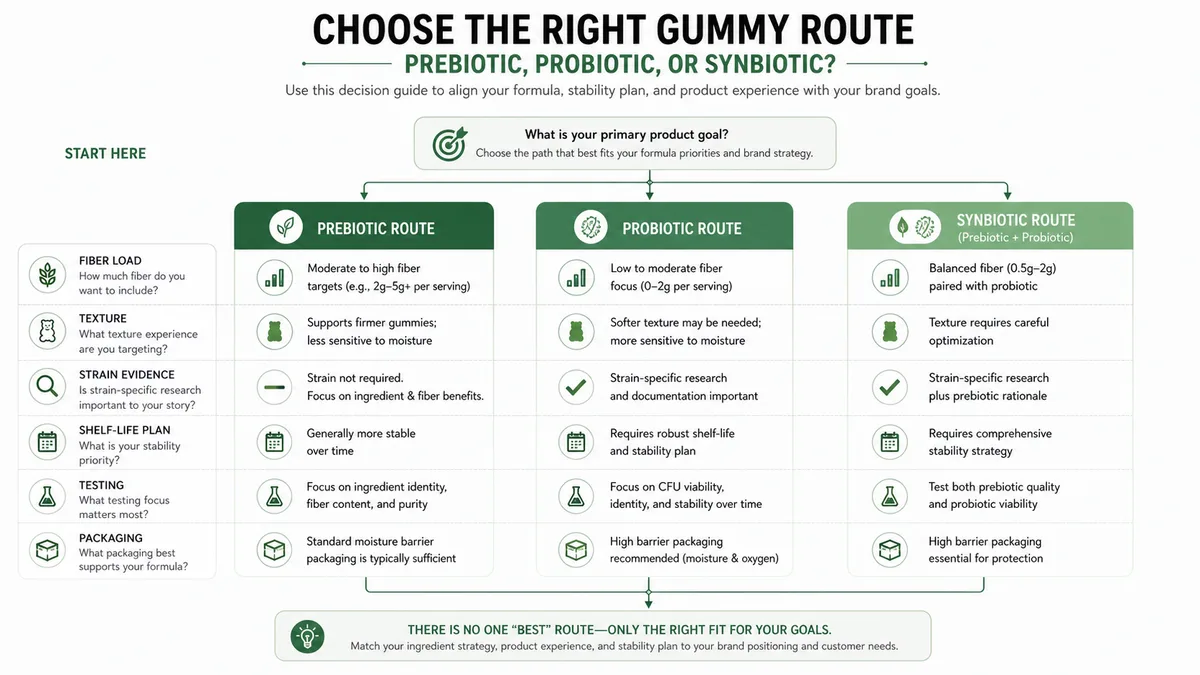
Choose Prebiotic When Stability and Fiber Positioning Matter Most
Prebiotic gummies often make sense when the brand wants a gut-health product with a simpler stability story. The product can focus on substrate delivery, fiber positioning, flavor, texture, and daily routine.
This route can be strong for brands that want a consumer-friendly gummy without the extra proof burden of live-culture survival. But the formula still needs discipline. The prebiotic ingredient should fit the serving size. The texture should remain pleasant. The digestive tolerance should be considered. The claim should not overstate what the ingredient can support.
Prebiotic is not the “easy” route. It is the route where the main difficulty usually shifts from live viability to dose, texture, tolerance, and label clarity.
Choose Probiotic When the Strain Evidence and Stability Plan Are Clear
Probiotic gummies make sense when the brand has a specific strain strategy and a credible stability plan. The product should not begin and end with “add probiotics.” It should define strain, target viable count, process tolerance, packaging, storage, and testing expectations.
This route can be commercially attractive because consumers recognize the word probiotic. But recognition is not enough. If a probiotic gummy cannot maintain a defensible viable count, the claim becomes weak. If the evidence is not strain-specific, the product may sound more scientific than it really is.
I would choose probiotic when the brand is willing to do the harder work: tighter supplier review, clearer documentation, more careful process planning, and stronger finished-product testing logic.
If the goal is a commercial gut-health product line, this decision should also connect to the finished SKU plan. Talvenda's digestive health gummy supplements category is the better commercial bridge after the brand has chosen whether the concept is prebiotic, probiotic, or synbiotic.
Choose Synbiotic Only When Both Parts Have a Real Formulation Role
Synbiotic gummies can be useful, but they should be built with restraint. The prebiotic part should not simply be a decorative fiber. The probiotic part should not simply be a recognizable word. Both should support the product concept.
The risk is overloading the gummy. More actives can mean more texture issues, more taste masking, more serving-size pressure, and more claim complexity. A brand may end up with a product that sounds rich but feels compromised.
I would choose synbiotic only when the combined concept is clearer than either route alone. If the formula becomes harder to defend, harder to chew, or harder to explain, a simpler prebiotic or probiotic concept may be stronger.
Safety and Use Boundaries
Prebiotic and probiotic gummies should be written and labeled with clear boundaries.
The difference between prebiotic and probiotic is not only technical. It also affects how the product should speak to consumers without making unsupported or medical-style claims.

Common Digestive Adjustment Issues
Some consumers may notice digestive changes when starting a prebiotic or probiotic product. With prebiotics, fiber type and serving size can matter. With probiotics, the strain, dose, and user’s own condition can matter. The experience is not identical for everyone.
A brand should keep serving instructions clear and avoid pushing consumers to overuse the product. If the formula contains a meaningful fiber load, serving size should be realistic. If the product contains probiotics, the label and supporting content should avoid implying that a higher serving is automatically better.
Digestive comfort is also a formulation issue. Taste, chew, active load, and serving size should work together. A gummy that requires an uncomfortable serving is not a strong product, even if the concept is attractive.
Who Should Ask a Healthcare Professional First
People with medical conditions, people with weakened immune systems, people taking medications, pregnant or breastfeeding consumers, children, and anyone with serious digestive concerns should ask a qualified healthcare professional before using supplements. This should be framed as a safety boundary, not as a scare message.
For brands, the important point is restraint. Do not write a gummy product page as if it is giving medical guidance. Do not target vulnerable groups with strong benefit promises unless the product, evidence, and regulatory review support the language.
The safest content explains the product type, the intended general support area, the serving instructions, and the need for professional advice when appropriate. It does not diagnose the consumer’s problem.
What Brands Should Avoid Saying on Labels
Brands should avoid disease-language, guaranteed results, timelines for effects, and broad claims that one probiotic or prebiotic ingredient will work the same way for everyone. They should also avoid implying that a gummy format makes the active automatically effective.
For probiotic gummies, I would avoid any claim that ignores strain, dose, viability, and shelf life. For prebiotic gummies, I would avoid claims that frame every fiber as a validated prebiotic or that overstate digestive outcomes from a small serving.
The stronger label is usually the more disciplined label. It matches the ingredient to the serving, the serving to the finished formula, and the finished formula to the proof the brand can defend. That is the real difference between a gut-health gummy that only sounds good and one that can survive product development.
Prebiotic and probiotic gummies are not interchangeable label options. They are different development routes. The better product is the one whose claim, formula, testing plan, and shelf-life reality all point in the same direction.
Frequently Asked Questions
Are probiotic gummies hard to manufacture?
Probiotic gummies are technically demanding because the live culture has to survive the product route. A brand should check strain identity, target CFU, process exposure, water activity, acidity, packaging, storage, and finished-product testing before considering the concept production-ready.
Can probiotic gummies keep their CFU through shelf life?
They can only support that claim when the strain, formula, process, packaging, storage route, and testing plan are aligned. The brand should clarify whether the CFU claim refers to manufacture date or the end of shelf life, because those are different proof questions.
What should brands check before launching probiotic gummies?
Brands should check the strain, target viable count, process limits, water activity, pH or acidity, oxygen and moisture exposure, packaging barrier, storage condition, finished-product testing, and label claim wording. A good launch brief connects all of those points before sampling and scale-up.
Are prebiotic gummies easier than probiotic gummies?
Prebiotic gummies are usually simpler from a live-viability standpoint because they do not need living organisms to survive the format. They still need formulation review for active load, texture, sweetness, serving size, moisture behavior, and digestive comfort.
Do probiotic gummies need special packaging?
They may need stronger packaging review than a simpler prebiotic gummy, depending on the strain and formula. Moisture barrier, oxygen exposure, seal quality, desiccant use, temperature expectations, and storage instructions can all affect whether the finished gummy can support its claim.
Conclusion
Prebiotic and probiotic gummies are not the same formulation route; the harder choice is whether the product relies on a substrate, live culture, or true synbiotic logic.
A prebiotic, probiotic, or synbiotic gummy should enter sampling only after the active route is clear. As a contract gummy supplement manufacturer, Talvenda can help your team choose whether the project fits low-MOQ market-tested in-stock gummies, stock formula modification, or custom gummy development. That route check connects sample development, packaging and label support, documentation and testing expectations, and scale-up support, so stability, claim language, and launch timing are reviewed before the formula becomes difficult to adjust. Contact Talvenda through the project inquiry form.
[^1]: International Scientific Association for Probiotics and Prebiotics (ISAPP), Probiotics. Used for the probiotic definition, live microorganism requirement, adequate level, and strain-specific caution. [^2]: International Scientific Association for Probiotics and Prebiotics (ISAPP), Prebiotics. Used for the prebiotic definition and selectively utilized substrate boundary. [^3]: National Center for Complementary and Integrative Health, Probiotics: Usefulness and Safety. Used for conservative safety and evidence-boundary language around probiotic use. [^4]: U.S. Food and Drug Administration, Questions and Answers on Dietary Supplements. Used for dietary supplement and disease-claim boundary. [^5]: U.S. Food and Drug Administration, Water Activity (aw) in Foods. Used for food-stability reasoning around water activity; not used as probiotic efficacy proof.