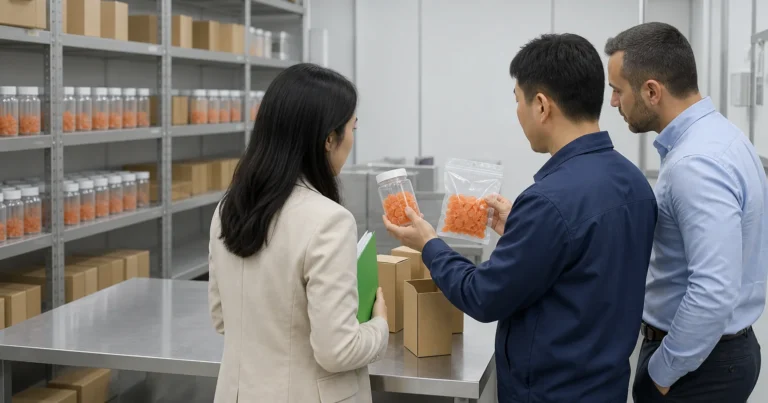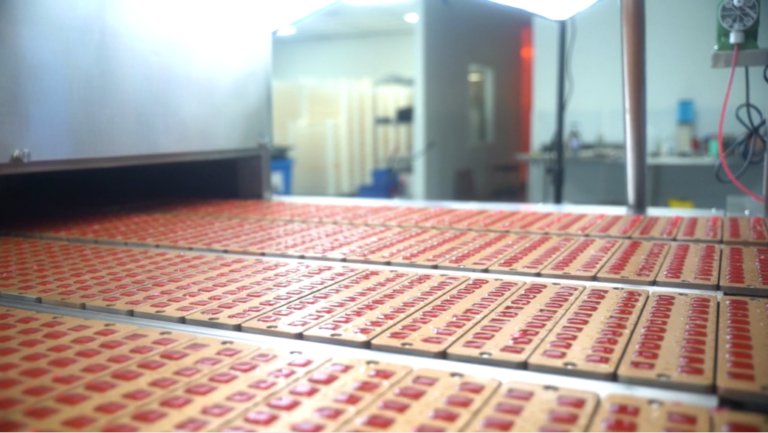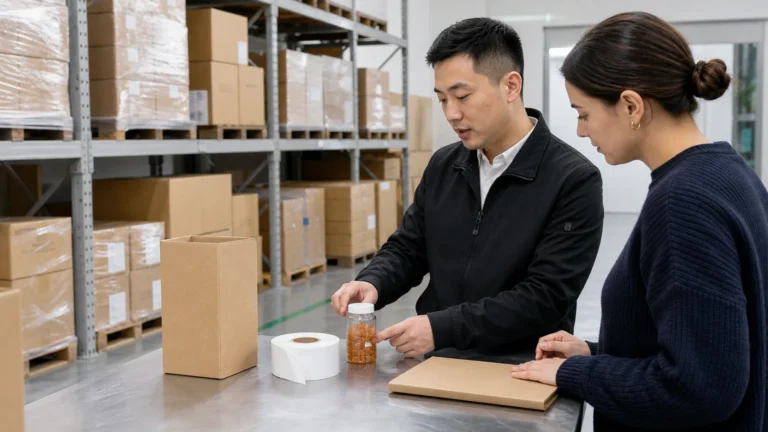
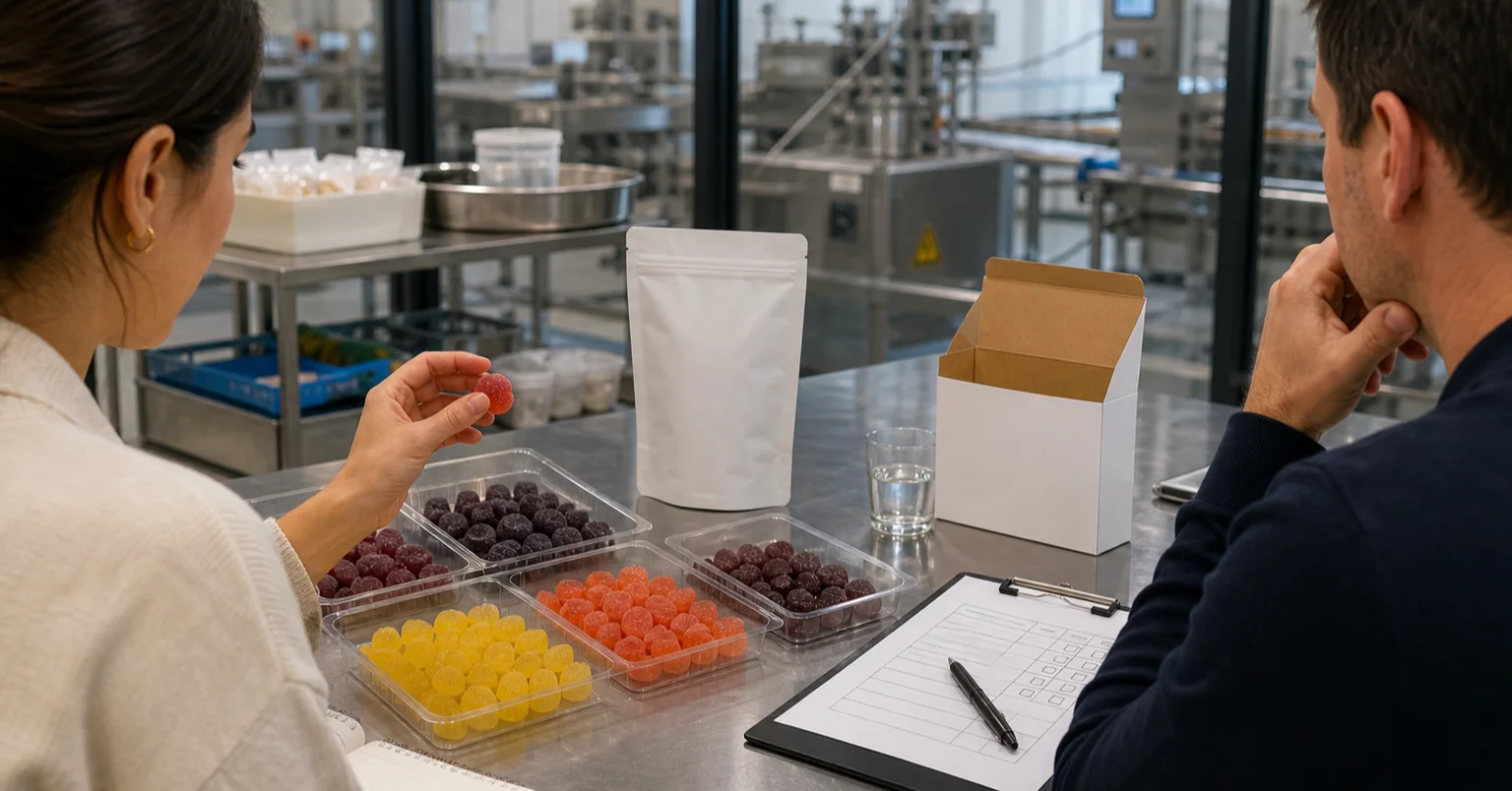

Dietary supplement R&D services should help a gummy brand decide whether a promising concept can move through sampling, documentation, packaging, and commercial production as one controlled project. Formula approval should confirm more than taste: it should show the agreed product direction, open risks, decision owners, and handoffs that connect the accepted sample to the next production stage.
Decision Snapshot
- Review the whole product brief before treating an ingredient list as a feasible gummy concept.
- Define what each sample round is meant to establish and what remains outside that decision.
- Record changes, trade-offs, owners, and open items instead of relying on message history.
- Align testing, documentation, packaging, and label expectations before commercial scheduling.
- Choose stock, semi-custom, or full custom R&D according to the differentiation the brand actually needs.
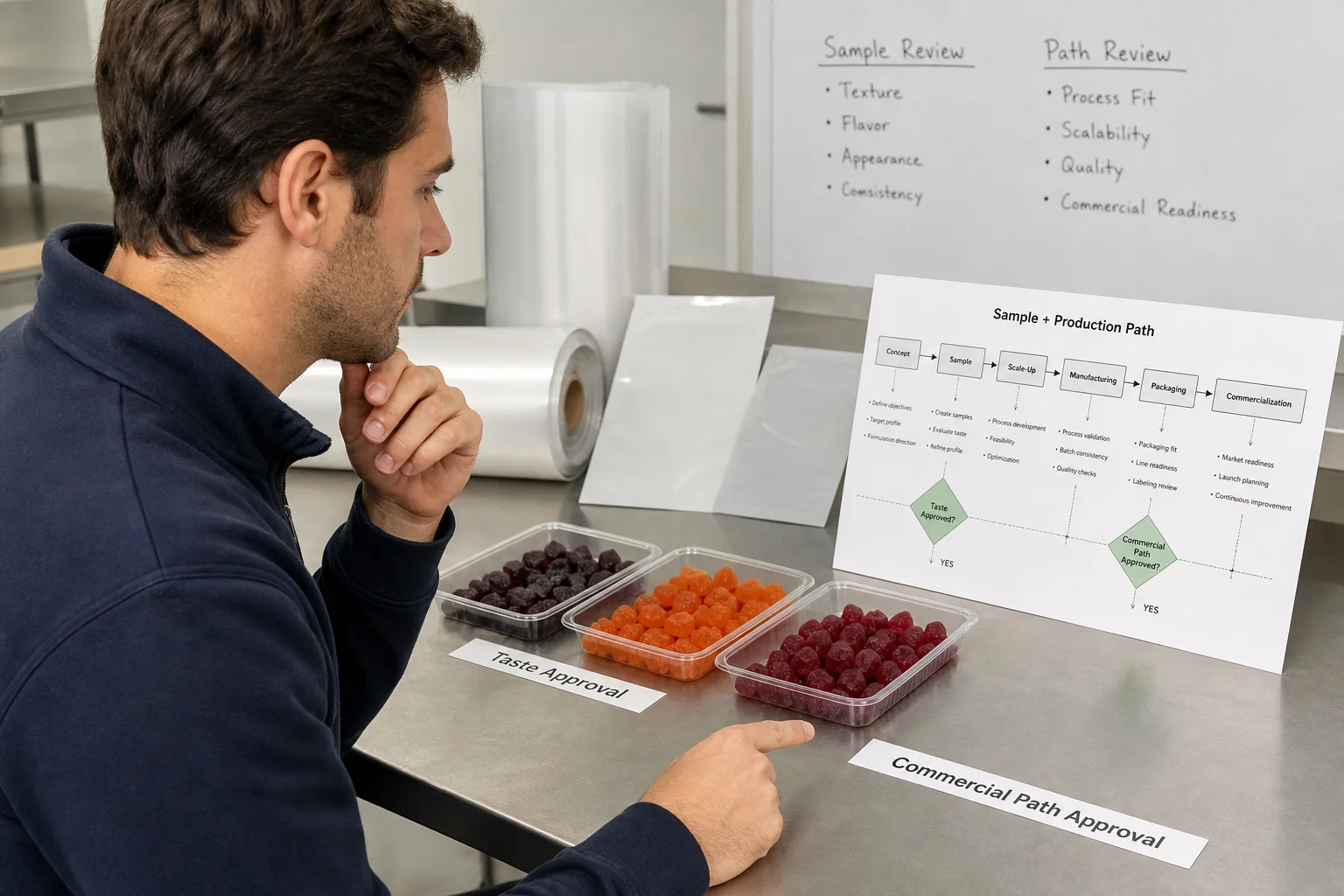
R&D Support Is More Than a Formula Quote
A formula quote can begin a commercial discussion, but it cannot replace the feasibility, sample, record, and handoff decisions needed before approval.
R&D support should connect concept to commercial readiness.
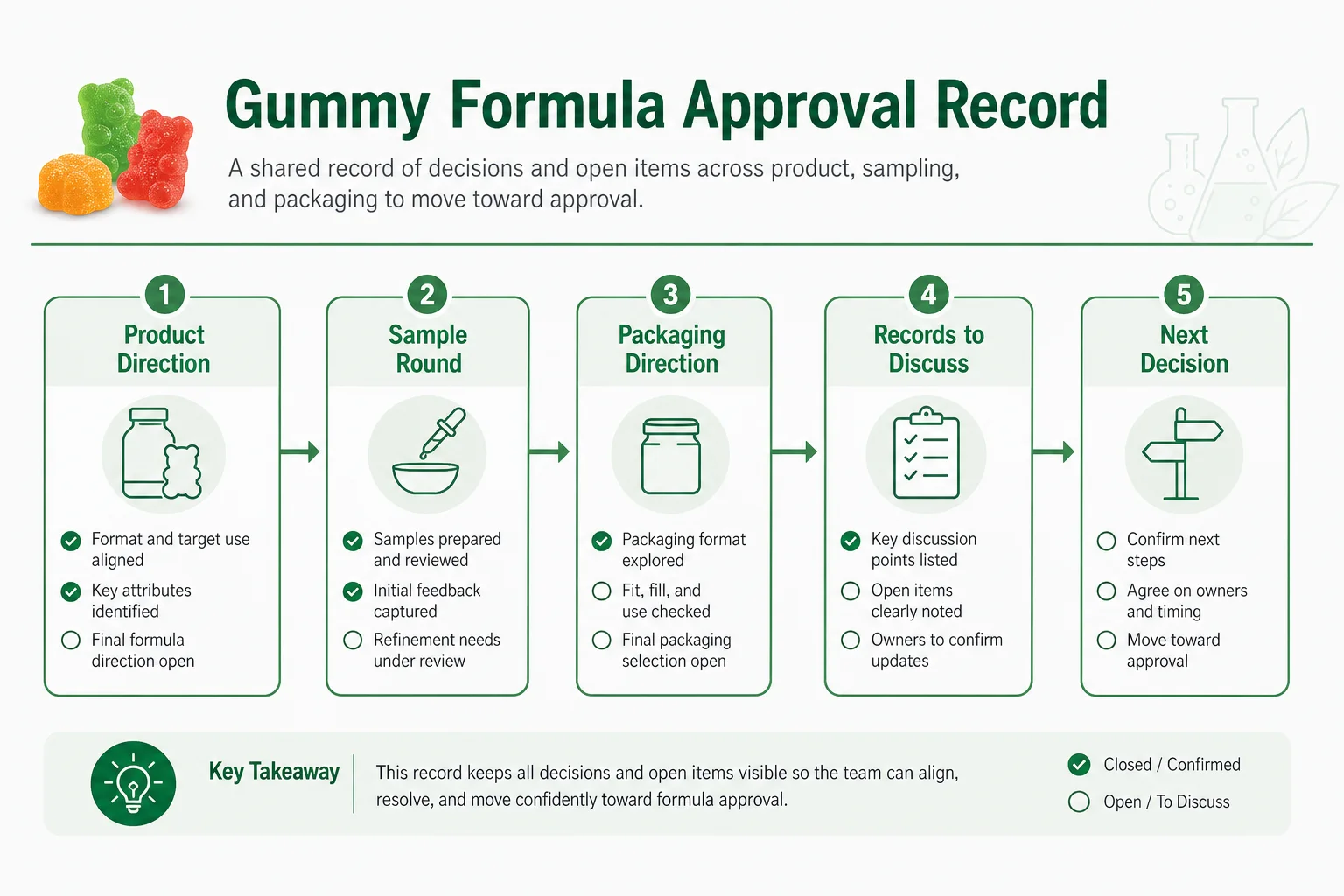
When a brand asks for dietary supplement R&D services, the visible deliverables are often a proposed formula and a sample. The more valuable deliverable is the decision path behind them. A strong development process should clarify how the brief was interpreted and which choices shaped the sample. It should also show what still needs review and which records or confirmations are expected before the project advances.
R&D collaboration should therefore organize uncertainty rather than cover it with broad assurances. For every open point, the brand should be able to see why it matters and who owns the answer. The record should also show whether it must close before another sample, formula approval, or commercial scheduling. This turns a quote into the beginning of a controlled project rather than the appearance of a finished solution.
What “approval-ready” means for a gummy formula
An approval-ready gummy formula has a controlled identity. The brand and production team can point to the same version and describe the same intended product. They understand the serving direction, gummy count, sensory target, packaging assumption, and outstanding exceptions attached to that version.
Approval-ready does not mean that a development sample guarantees a commercial result. It means the project has enough alignment to support a responsible next decision. The team is no longer relying on assumptions such as “packaging will be decided later” or “testing is included somehow.” Those questions have been raised, assigned, and placed in the project sequence.
A practical approval map separates what is confirmed from what is conditional:
| Approval area | What the brand should be able to confirm | What may remain conditional |
|---|---|---|
| Product direction | Current formula or product-version reference | Changes triggered by later review |
| Serving format | Intended gummy count and serving presentation | Final label review |
| Sensory direction | Accepted taste and texture target | Confirmation at a later production gate |
| Packaging direction | Intended component and pack concept | Final component information |
| Evidence plan | Testing and documentation expectations under discussion | Work not yet completed or received |
| Change control | Closed and open requests | Named exceptions with owners |
| Commercial handoff | Requirements before scheduling | Items assigned to a later gate |
Why a good-tasting sample is not the whole decision
A good-tasting sample is commercially encouraging, but it is only one type of evidence. It can show that the current sensory direction is worth advancing. It cannot by itself confirm that the formula direction, packaging interface, testing expectations, label handoff, and production responsibilities are aligned.
The brand should separate two questions:
- Do we accept the sensory direction represented by this sample?
- Do we have enough connected information to approve the production path attached to it?
The approved expert perspective captures that distinction:
A gummy sample is not ready for commercial approval just because it tastes acceptable. Before sign-off, the brand and production team should be able to connect the agreed serving format, active direction, texture target, packaging direction, outstanding change log, and testing/documentation expectations. If one of those handoffs is still vague, the project is usually approving a sample rather than approving a repeatable production path.
Supplier due diligence remains a separate job. A brand that also needs a broader evaluation framework can use a gummy supplement manufacturer checklist without turning this pre-approval R&D discussion into a general supplier-comparison page.
Start With a Feasibility Review of the Whole Product Brief
Formula feasibility is clearest when the product concept, serving, sensory target, market direction, packaging, and commercial priorities are reviewed together.
The whole product brief defines the feasibility question.
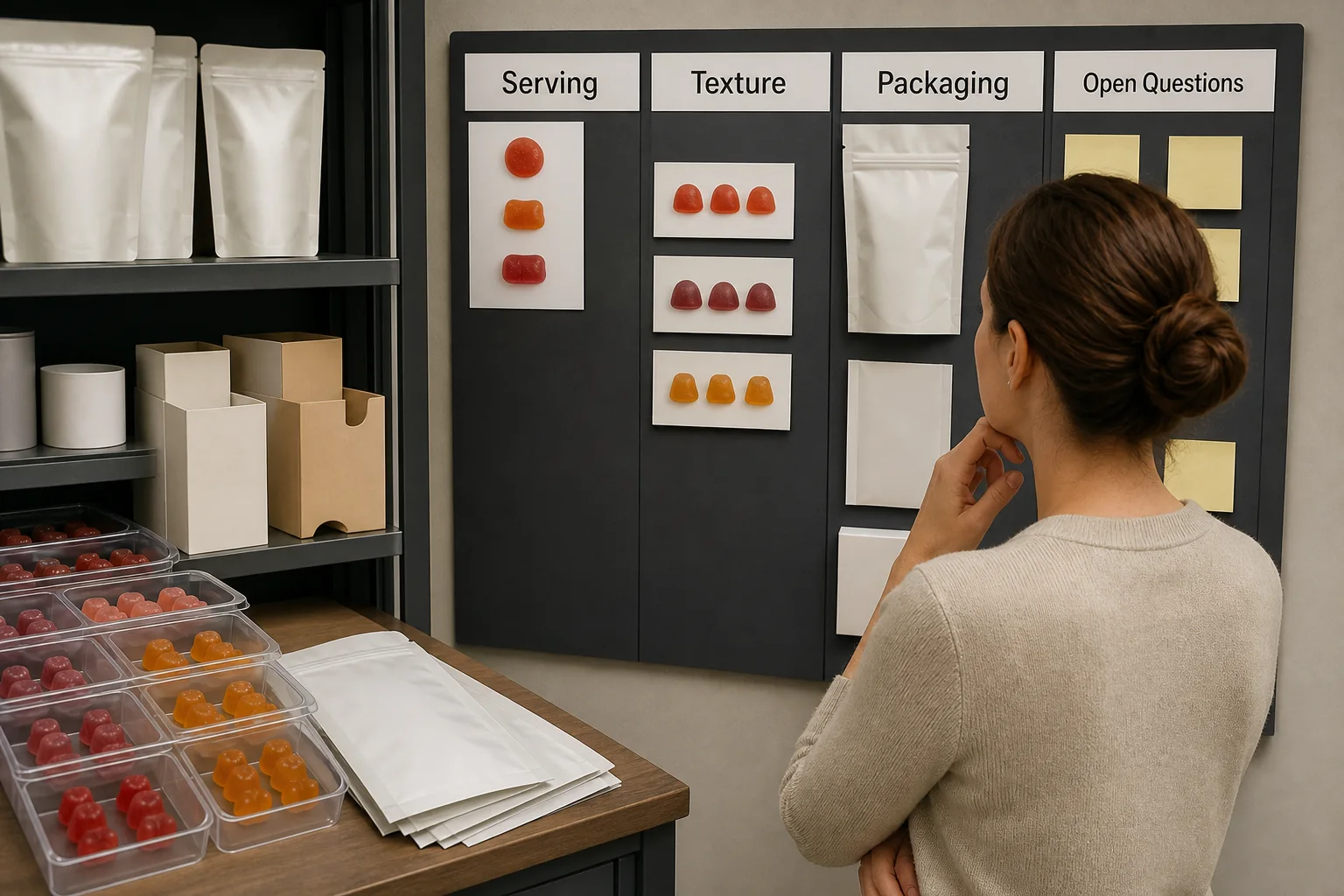
An early feasibility review should not be a quick yes-or-no response to an ingredient list. It should show how the brand’s priorities interact. The goal is to establish a workable starting route, identify the choices creating the most pressure, and expose the questions that deserve attention before sample work expands.
A useful feasibility brief distinguishes fixed requirements, strong preferences, and open options. It also names the brand-side owner who can decide when those priorities conflict.
Active direction, serving format, and gummy count
The active direction needs business and product context. The development team should understand whether the brand is protecting a particular ingredient story, serving experience, front-label concept, or broader market position. It should also know which elements are requirements and which can change if feasibility review reveals a trade-off.
Serving format and gummy count belong in the same discussion. A concept may look simple at the ingredient-list level. The product decision changes when the brand explains how it expects the finished serving to be presented. The purpose of R&D review is to expose that relationship without prescribing a dose, giving medical advice, or promising an outcome.
Useful intake questions include:
- Which active or positioning directions are essential to the concept?
- Which ingredients or features are preferred rather than fixed?
- What serving presentation is the brand currently considering?
- Does the intended gummy count align with the packaging and label concept?
- Which trade-offs need explicit brand approval?
- What change would cause the project to reconsider the route?
Taste, texture, base system, and packaging fit
Taste and texture feedback becomes useful when it is comparative and specific. “Make it better” is not a stable development target. “Less of the current flavor note,” “firmer than the previous round,” or “closer to the accepted reference” is easier to interpret. Each comment should still be tied to the correct sample version.
The base-system direction should be treated as part of the product brief rather than an invisible technical choice. The brand may have preferences linked to positioning, sensory experience, or market expectations. Those preferences should be identified early so the development team can explain when a requested change may affect another priority.
Packaging fit should enter the discussion before formula approval, even if the final component is not selected. The brand does not need to imply that compatibility has already been proven. It should identify the intended pack direction, the component information still needed, and the event that will trigger another review.
Questions can remain practical:
- What bottle, pouch, or other pack direction is assumed?
- How do pack count and serving presentation connect?
- Who will provide and approve component information?
- Which packaging choices remain provisional?
- What needs renewed review if the gummy or serving direction changes?
This avoids a common disconnect: the product team approves one direction while design or procurement continues with a different packaging assumption.
Ingredient availability, target market, and claim boundaries
Ingredient availability should be discussed cautiously. Early information can support route planning, but it should not be treated as a guarantee of future supply, price, minimum purchase, or timing. The project record should show which assumptions are current, who must confirm them, and what alternative discussion is needed if an assumption changes.
The target market influences the questions the brand must bring to the project. It may shape documentation expectations, label work, ingredient review, and the qualified specialists the brand chooses to involve. The production team can help organize those handoffs, but manufacturing coordination should not be presented as a legal or regulatory conclusion.
Claim boundaries are equally important. A desired marketing story should not become an unsupported effectiveness promise or an assumed formula requirement. Before formula approval, the brand should distinguish:
For U.S.-market planning, claims made under Section 403(r)(6) need substantiation that they are truthful and not misleading, as described in FDA’s dietary-supplement claim-substantiation guidance[^1].
- proposed positioning from reviewed wording;
- product-development information from clinical evidence;
- project documentation from substantiation owned elsewhere;
- manufacturing review from legal, regulatory, or specialist review;
- commercial goals from guaranteed consumer outcomes.
A disciplined partner should state when a question belongs outside the formulation conversation. That boundary keeps the brand from building its approval around an assumption the R&D process was not designed to verify.
What a Brand Should Receive During Sample Development
Sample development should give the brand a traceable series of decisions, not several versions surrounded by increasingly informal feedback.
Sample development should produce evidence for a defined decision.
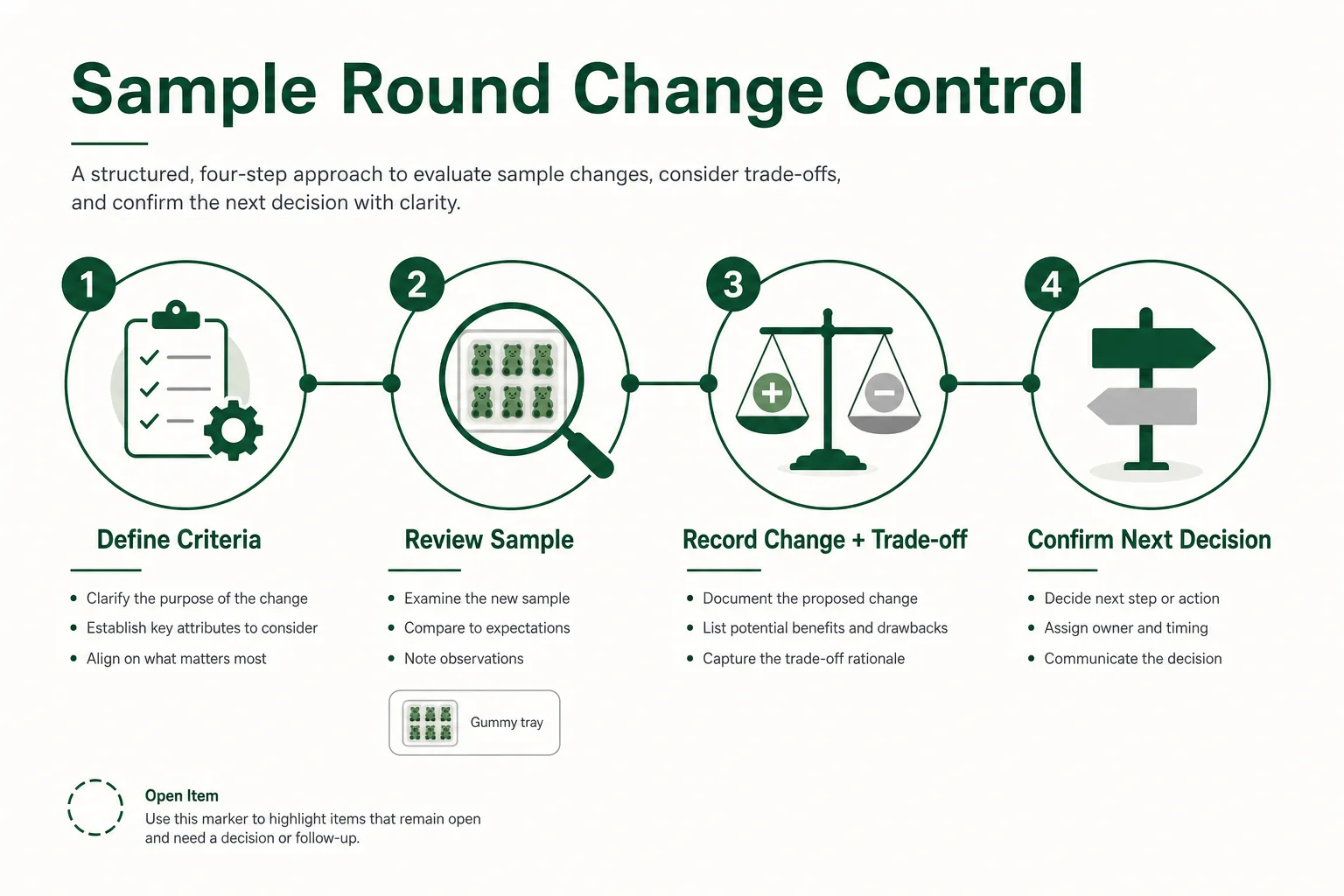
The sample stage is where a clearer brief becomes tangible, but it is also where scope can drift. Each round should answer a stated question. Its record should show what the brand accepted, what it rejected, what changed, and what it intentionally left open.
Sample purpose and acceptance criteria
Before receiving a sample, the brand should understand its purpose. An early round may explore the general route. A later round may focus on one sensory adjustment.
Another round may support a pre-approval review. The team should not judge a limited-purpose sample as though it represents every final commercial condition.
Acceptance criteria can remain concise and decision-oriented:
| Review item | Decision question |
|---|---|
| Sample identity | Are all reviewers evaluating the same dated version? |
| Round purpose | What was this sample designed to explore or confirm? |
| Taste | Is the current direction accepted, rejected, or revised? |
| Texture | What agreed comparison guides the next decision? |
| Appearance | Does it support the current product brief? |
| Serving direction | Does the sample still represent the intended format? |
| Exceptions | Which topics are not being approved in this round? |
| Authority | Who can authorize the next action for the brand? |
The brand should consolidate feedback. Separate messages from multiple stakeholders can create contradictory instructions and slow supplement product development. One response should identify the controlling decision, any concern that remains open, and the person authorized to resolve it.
An approval such as “sensory direction accepted; packaging direction remains open” is stronger than a general “looks good.” It allows the project to advance without implying that the open handoff has disappeared.
Change log and trade-offs between sample rounds
The change log should connect every meaningful request to a reason and a result. It can be simple, but it should be dated and version-specific. At minimum, it should record what changed, why it changed, the priority behind the request, the trade-off discussed, the decision owner, and the resulting status.
Trade-offs should be explained in commercial terms rather than hidden inside a new version. If the brand prioritizes one sensory characteristic, what other attribute needs review? If it changes the serving presentation, what packaging or label work could reopen? If an ingredient direction changes, which sourcing or documentation assumption is no longer current?
One responsibility map can keep the process visible:
| Item | Decision or record needed | Owner | Due before | Status |
|---|---|---|---|---|
| Sample feedback | Consolidated acceptance or revision request | Brand product owner | Next sample instruction | Open / closed |
| Formula direction | Current version and named exceptions | Development and brand teams | Formula approval | Open / closed |
| Packaging input | Component direction and required information | Named packaging owner | Packaging handoff | Open / closed |
| Label input | Current serving and product information | Brand review owner | Artwork approval | Open / closed |
| Evidence expectation | Agreed discussion of testing and records | Named quality contacts | Commercial planning gate | Open / closed |
A useful closeout for each round contains four lines. Record what the round tested, what the brand accepted, what changes next, and what remains open outside the sample decision.
When the project should change route instead of adding another sample
Another sample makes sense when the change is defined and the next decision is clear. It adds little value when the brief remains unstable or the brand is trying to resolve an internal business disagreement through repeated physical versions.
The team should pause and reconsider the route when:
- each round introduces a new concept instead of narrowing one concept;
- earlier priorities are repeatedly reversed;
- serving, gummy count, or packaging assumptions no longer align;
- an active-direction request changes the original feasibility question;
- target-market or claim direction changes;
- acceptance criteria cannot be agreed;
- the same conflict returns after multiple rounds;
- a question requires evidence or specialist review that another sample cannot provide.
A route reset may mean narrowing the custom scope, returning to a semi-custom starting point, revising a serving or sensory priority, or rewriting the brief. The production team should explain the dependency and available options without presenting one outcome as guaranteed.
This is a commercial judgment, not a failure of ambition. The goal is not to maximize the number of samples. It is to reach a product direction that the brand and production team can explain, document, and carry into the next gate.
Approve the Production Path, Not Only the Sample
Production-path approval connects the accepted product direction with testing, documentation, packaging, artwork, responsibilities, and commercial-planning conditions.
Production readiness begins with connected handoff decisions.
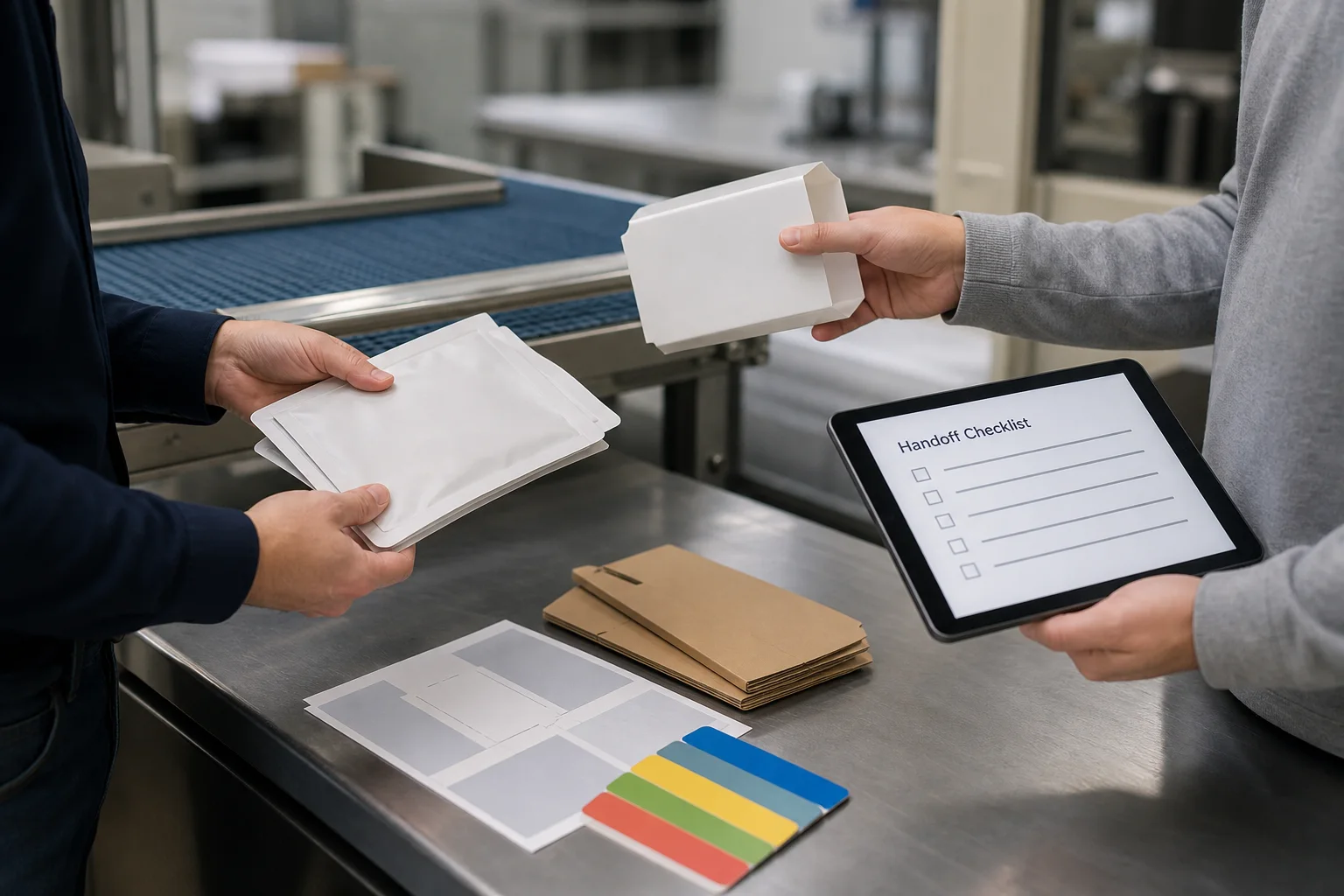
Formula sign-off should be a bridge between development and manufacturing, not a gap where assumptions change owners. A readiness review should show what is complete, what remains conditional, and what would send the project back to R&D.
The strongest review does not ask only whether tasks exist. It asks whether the current product version, responsible owner, decision use, and next gate are clear. That approach makes room for open work without allowing “planned” to be mistaken for “complete.”
Testing and documentation expectations before scheduling
The brand should discuss testing in terms of scope, responsibility, timing, and decision use. “Will it be tested?” is too broad. It does not identify the activity under consideration or who arranges it. Nor does it show when the record is expected or what happens if a result raises a question.
A productive testing discussion covers:
- the categories of testing or review being considered;
- when each activity belongs in the project sequence;
- who proposes and approves the scope;
- who coordinates the work and receives the record;
- what information must be available before scheduling;
- how changed requirements or exceptions return to review.
Documentation should be mapped in the same way. Depending on the agreed project scope, the brand may expect to discuss a current product specification, formula-version record, sample approvals, and change decisions. Packaging information, controlled artwork, test records, and batch-related documents may also be relevant. The exact package must be confirmed rather than inferred from generic “full-service R&D” language.
In a U.S. CGMP context, written master manufacturing records and batch production records are among the records addressed in FDA’s dietary-supplement CGMP guide[^2].
Packaging and label handoff
The packaging handoff should identify the intended component, current information, sourcing owner, and review needed before commercial use. The label handoff should identify the controlled artwork file, approval authority, serving information, and any open claim or market-review question.
For U.S.-market planning, required label information includes high-level categories such as identity, net quantity, nutrition information, ingredient information, and the manufacturer, packer, or distributor, as outlined in FDA’s Dietary Supplement Labeling Guide[^3].
Before formula approval, clarify:
- which component and pack count are assumed;
- who sources and approves the packaging;
- which component information is current;
- which artwork file is controlled;
- who approves label content for the brand;
- what formula or serving change reopens the handoff;
- whether any named exception blocks scheduling.
Manufacturing-side packaging review should not be presented as legal approval or a guarantee of performance. Its purpose is to connect physical and production assumptions with the current product direction and make unresolved questions visible.
A discussion of Talvenda’s custom services can be appropriate when a brand needs to coordinate formulation direction, sample planning, packaging review, and commercial handoffs. Project scope, evidence, and responsibilities still need confirmation for the specific brief.
Commercial-batch readiness questions
A commercial-readiness review should put the approved direction and open conditions on one page. It does not promise a pilot batch or commercial outcome. It shows whether the project contains enough controlled information for the next planning decision.
Ask:
- What exact product or formula version is being advanced?
- Who approved it, and which exceptions remain?
- Are serving direction, gummy count, and pack count aligned?
- Is the accepted sensory target tied to the correct sample?
- Which packaging information and artwork file are current?
- Which testing and documentation expectations have been agreed?
- What remains conditional, and who owns each item?
- Has any quote or supply assumption changed during development?
- If a pilot batch is part of the agreed route, what decision is it intended to support?
- What event returns the project to formula, packaging, or label review?
- Who gives the brand’s final authorization to proceed?
A short status table keeps those answers actionable:
| State | Meaning | Required action |
|---|---|---|
| Ready | The requirement is confirmed for this gate | Preserve the approved record |
| Conditional | A named item remains with an owner | Close it before the stated next gate |
| Blocked | The project lacks a required decision | Stop the affected handoff |
| Reopened | A later change invalidated an earlier approval | Return to the responsible review |
The controlled/conditional distinction is more useful than a vague statement that a project is “almost ready.” Everyone should understand what allows the next step and what would still block it.
Questions to Ask Before Formula Approval
The best questions reveal the process behind the promise, the evidence behind the decision, and the owner behind every open action.
Formula-approval questions should test execution, not sales language.
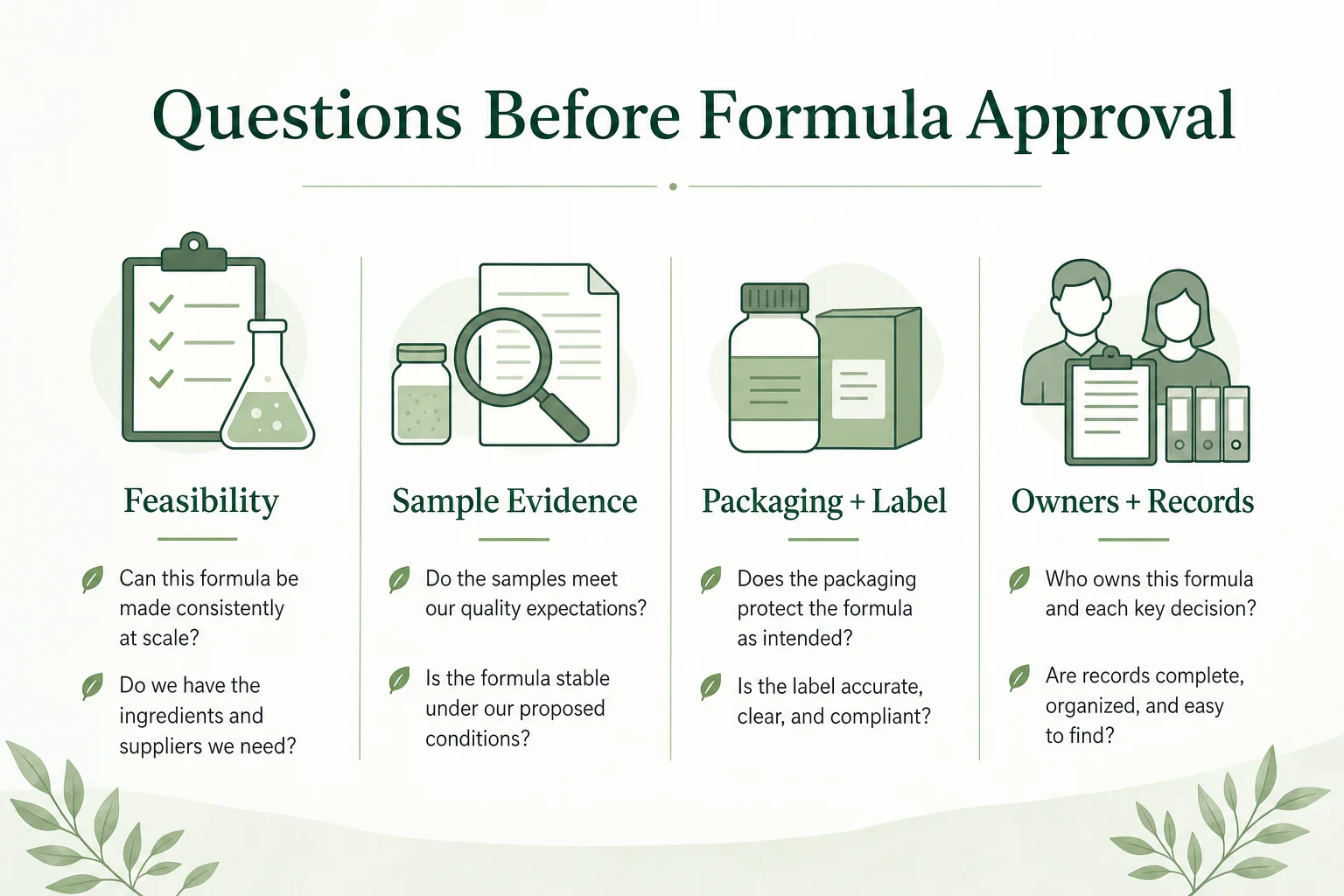
The brand does not need an excessively long questionnaire. It needs a focused conversation that distinguishes a workable collaboration from a sequence of assurances. Procurement, product, packaging, and quality stakeholders should be able to use the answers without translating vague claims into their own assumptions.
Feasibility, evidence, and responsibility questions
The following framework combines feasibility, evidence, and ownership without asking the production team to guarantee a future result:
| Topic | Approval question | Responsibility follow-up |
|---|---|---|
| Brief | Which requirements are fixed, preferred, or open? | Who controls the priority decision? |
| Feasibility | What are the main dependencies or trade-offs? | Who accepts a route change? |
| Sample | What does the accepted sample establish and not establish? | Who signs the sample decision? |
| Version | How will the approved direction be identified later? | Who maintains the current reference? |
| Change control | Where are requests, decisions, and exceptions recorded? | Who closes open changes? |
| Ingredient path | Which availability or documentation assumptions remain? | Who confirms each assumption? |
| Claims | Which questions belong to the brand or a qualified specialist? | Who coordinates that review? |
| Testing | What is being discussed and for which decision? | Who agrees scope and receives records? |
| Packaging | What must be confirmed before components or artwork advance? | Who owns the component and artwork approvals? |
| Commercial path | What must close before scheduling is considered? | Who authorizes the next gate? |
Three follow-ups are especially useful: “Where is that recorded?”, “Who owns the decision?”, and “What happens if the assumption changes?” They shift the discussion from capability language to execution.
Brands should pause when there is no controlled version, every responsibility is described as shared, or all unresolved work is deferred until after formula approval. A capable collaboration can acknowledge open questions while still assigning them.
Records the brand should expect to discuss
Record names can vary, but the brand should understand what information supports each approval. A practical development trail may include:
- the current product brief and priority hierarchy;
- formula or product-version identification;
- sample purpose and acceptance records;
- consolidated brand feedback;
- a dated change log;
- an open-item and responsibility register;
- packaging assumptions and component information;
- controlled artwork and label-review status;
- testing and documentation expectations;
- claims or specialist-review questions;
- formula-approval sign-off and exceptions;
- a commercial-readiness review.
For every record, ask who creates it, who reviews it, which decision it supports, and what change would make it outdated. These questions ensure the records support actual control instead of substituting for it.
A compact register can be enough:
| Record | Decision supported | Current owner | Reopen trigger |
|---|---|---|---|
| Product brief | Feasibility route | Brand product owner | Priority or market change |
| Sample record | Sensory or round decision | Named sample approver | New acceptance target |
| Change log | Formula-version history | Project coordinator | Any accepted change |
| Packaging information | Component handoff | Packaging owner | Serving, count, or component change |
| Evidence plan | Testing and documentation expectations | Named quality contacts | Scope or market change |
| Readiness review | Next commercial-planning gate | Authorized brand owner | Any blocked dependency |
The brand should designate one source for the current project summary. Email and chat can support collaboration, but the approved version should not depend on searching a conversation. This becomes more important when procurement, design, quality, or external reviewers enter after early R&D discussions.
When Stock, Semi-Custom, or Full Custom R&D Fits Better
The best R&D route is the least complex path that can still deliver the differentiation and control the brand genuinely needs.
Stock, semi-custom, or full custom R&D should match commercial needs.
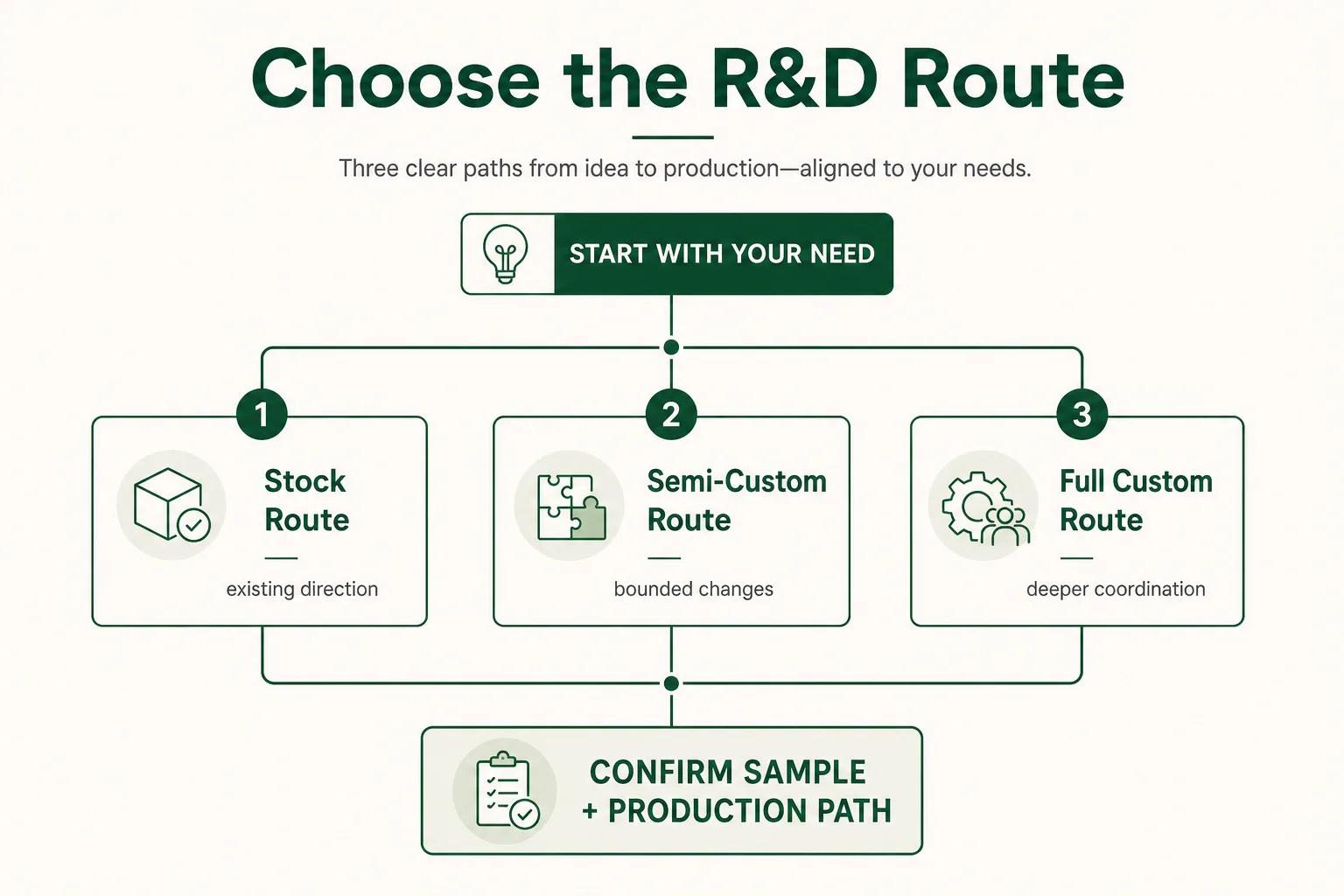
Custom development can be valuable, but greater scope is not automatically a better choice. Every additional variable creates more decisions, possible trade-offs, and handoffs to control. Route selection should therefore begin with the market and product difference the brand is trying to create.
Use existing routes without overbuilding the project
A stock route may fit when an existing product direction meets the core brief and differentiation will come mainly from positioning, packaging, or go-to-market execution. A semi-custom route may fit when a useful starting formula needs a limited set of purposeful adjustments.
Before rejecting an existing route, ask:
- Which requirement does it fail to meet?
- Would a bounded change solve that gap?
- Does the target customer value the difference enough to justify deeper R&D?
- Is the brand ready to make the additional trade-off decisions?
- Will customization create a meaningful commercial asset or only a longer brief?
- Which approval records and handoffs remain necessary on the simpler route?
Stock and semi-custom projects still need controlled approvals. The brand should know what is fixed, what can change, how the accepted product direction is identified, and which packaging and documentation questions remain. Less customization should reduce unnecessary development scope, not reduce clarity.
For a fuller route comparison, see stock formula vs. custom formulation. Once a route is selected, the next step is to apply it to the pre-approval production path.
When deeper custom development is justified
Full custom R&D is easier to justify when the intended product position cannot be achieved through a stock or bounded semi-custom route. A custom gummy formulation may then become relevant to that route. The distinction should also matter to the brand’s commercial plan.
The brand should be ready to answer:
- What specific product difference requires deeper development?
- Which priority is non-negotiable, and which can move?
- Who owns timely decisions when trade-offs appear?
- What is the purpose of each planned sample stage?
- Which packaging, evidence, or target-market questions must be coordinated?
- How will scope changes affect commercial planning?
- What condition would trigger a route reset?
Deeper customization requires stronger governance. One brand-side owner should consolidate feedback. The priority hierarchy should remain visible. New requests should be tested against the reason the project became custom in the first place.
Custom work should not be sold as inherently more innovative, compliant, stable, or commercially successful. It is a deeper development route for a brief that genuinely requires more coordinated decisions. Project-specific feasibility, evidence, scope, responsibilities, and timing still need to be confirmed.
Conclusion
Formula approval is strongest when the accepted sample, current product version, packaging direction, change history, evidence expectations, and named responsibilities form one visible production path. Any missing handoff should remain open rather than disappear behind a signature.
Talvenda, as an OEM/ODM gummy manufacturing partner, can outline low-MOQ market-tested stock gummies, stock formula modification for a semi-custom route, and custom gummy development against the brand’s actual differentiation need. To prepare a clearer sample path and a cleaner discussion of packaging, documentation, and scale-up expectations, share your active direction, serving goal, and packaging idea through the project contact. Those three inputs help frame the route without assuming that every concept requires full custom R&D.
[^1]: U.S. Food and Drug Administration, Dietary Supplement Claim Substantiation Guidance under Section 403(r)(6). [^2]: U.S. Food and Drug Administration, Dietary Supplement Current Good Manufacturing Practice Small Entity Compliance Guide. [^3]: U.S. Food and Drug Administration, Dietary Supplement Labeling Guide, Chapter I.