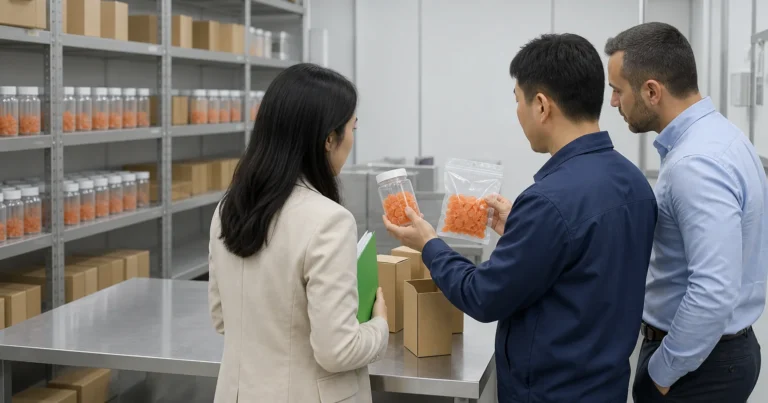
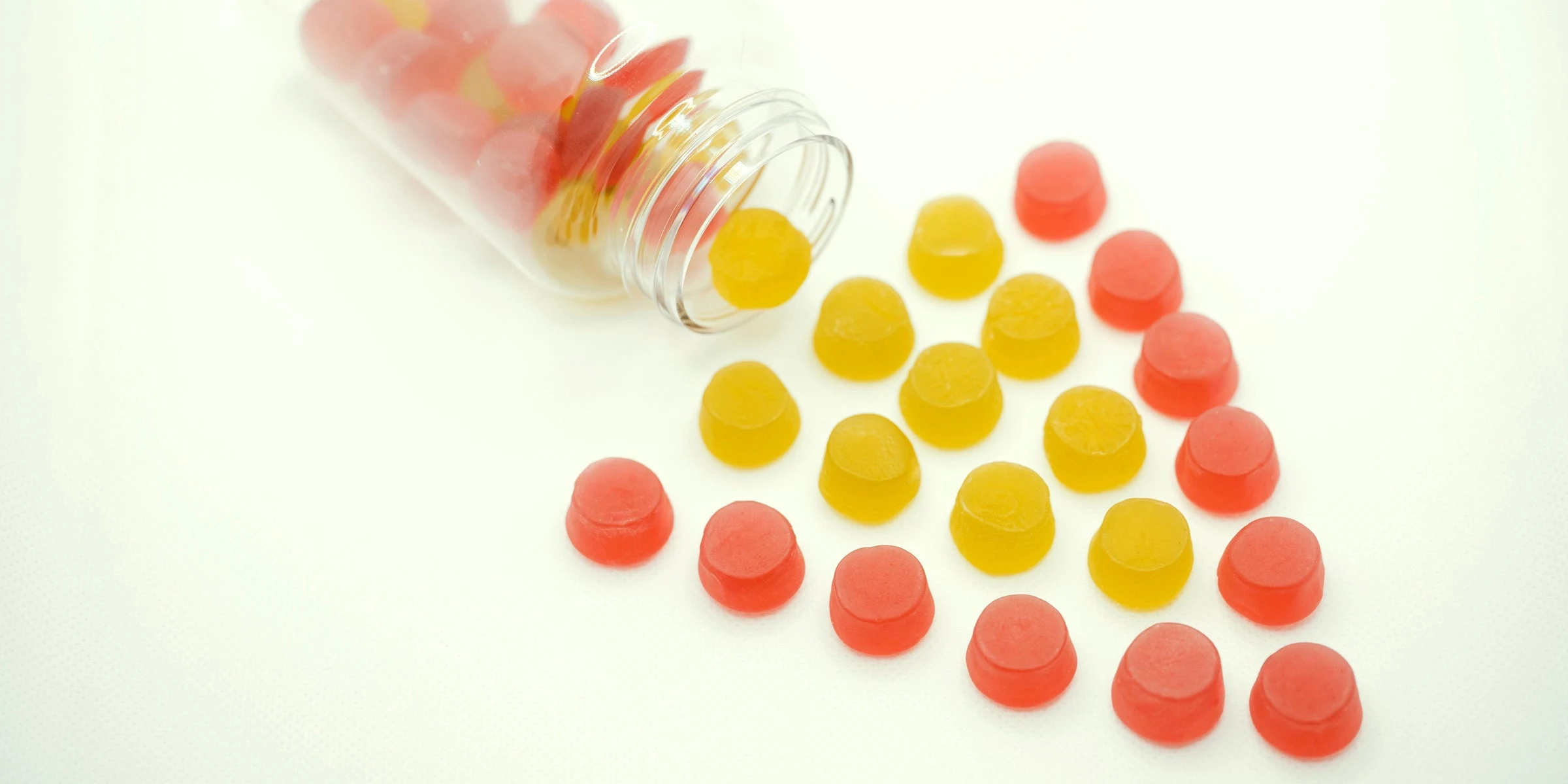

Vegan vitamin supplements look easy to launch until the gummy format adds texture, source, taste, and claim problems to the formula brief.
For brands, vegan gummy vitamin supplements are not just gelatin-free gummies. A feasible product needs a plant-based gelling system, vegan-appropriate vitamin sources, workable taste masking, stable color and flavor choices, and label claims that the formula can actually support.
Key takeaways:
- A vegan gummy vitamin formula starts with gelatin-free structure, but pectin choice affects texture, setting behavior, and commercial consistency.
- B12, D3, minerals, colors, flavors, and sweeteners should be reviewed together because one ingredient choice can affect taste, label claims, documentation, and stability.
- A short feasibility review before scale-up helps reduce the risk of sample formulas that look good once but become difficult to repeat in commercial production.
- The best development conversation is not only about which vitamins to include. It should align the claim, serving size, gummy base, flavor system, documentation, packaging, and launch route.

On the shelf, a vegan gummy vitamin looks like a simple daily supplement. In development, it is a formula system. Before a brand approves samples, the team has to check whether the vegan claim, pectin base, active blend, flavor system, and packaging plan can work together at commercial scale.
What Vegan Gummy Vitamin Supplements Mean for Brands
The word vegan can make a formula sound simple, but it changes more than one ingredient choice.
For brands, vegan gummy vitamin supplements mean building a gummy system where the gelling base, active ingredients, flavor, sweetener, color, and label language all support a vegan positioning without creating avoidable production risk.
Vegan Vitamins vs Vegan Gummy Vitamins: The Product Development Difference
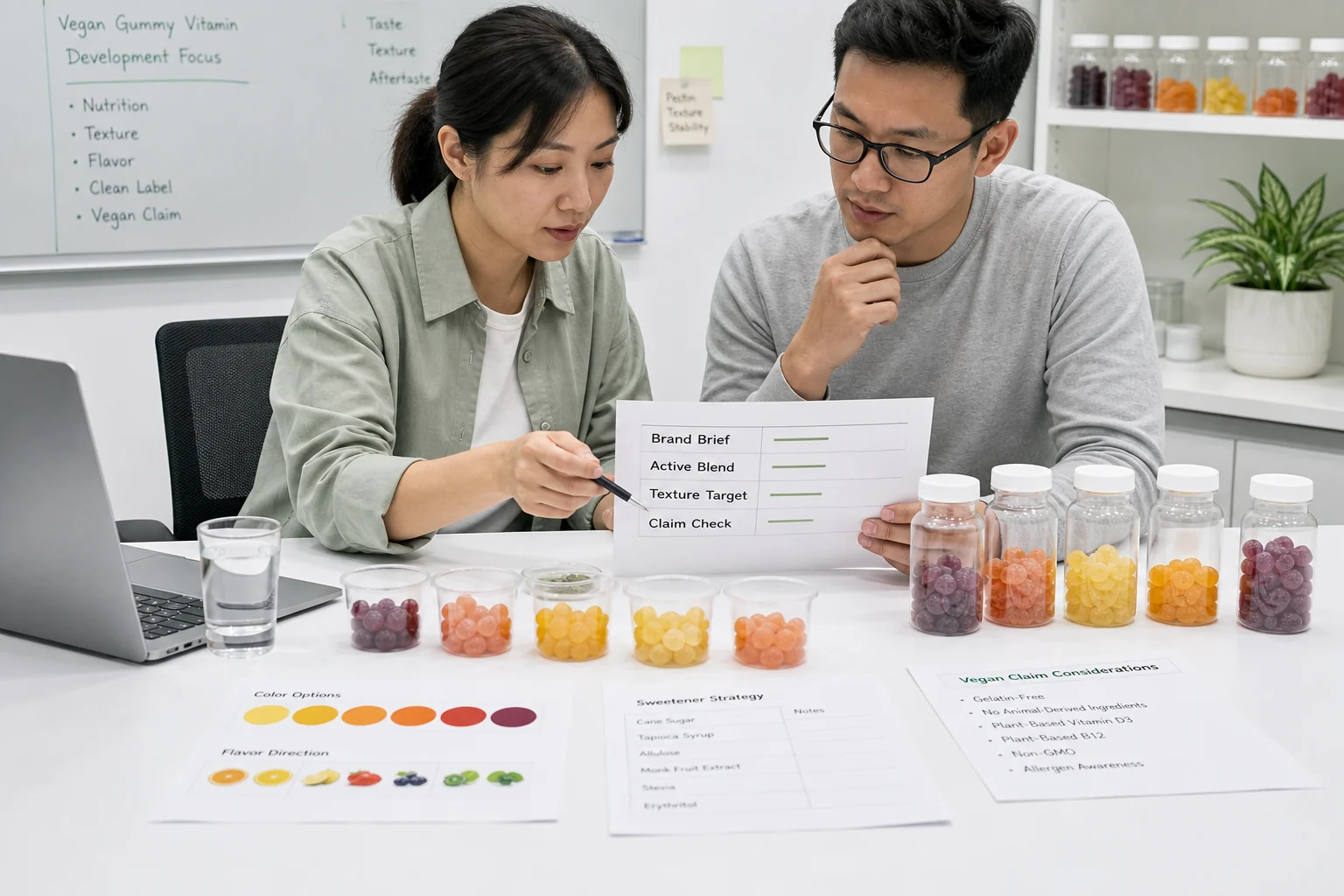
A vegan vitamin capsule or tablet can focus mainly on the active blend, excipient system, serving size, and label claims. A vegan gummy vitamin has to solve those issues while also behaving like a confectionery-style dosage form. That extra layer matters.
In gummy development, the active blend is not isolated from the eating experience. Vitamin and mineral inputs can change taste, color, aftertaste, texture, and perceived freshness. The gelling base has to carry the actives without making the gummy too sticky, too soft, too firm, or too unstable. The sweetener system has to support flavor while fitting the label strategy. Packaging has to protect the finished gummy from moisture and texture drift.
This is why I do not view "vegan" as a single checkbox. A brand may start with a clean message such as "plant-based multivitamin gummies," but the production team still has to translate that message into a formula that can be sampled, adjusted, packed, documented, and repeated. A capsule-to-gummy change is not a simple format swap. The gummy matrix rewrites many compatibility assumptions.
Why Gelatin-Free Claims Change the Formula Brief
Gelatin-free is usually the first technical signal behind a vegan gummy. Traditional gummy texture often depends on gelatin, so replacing it changes the structure of the product. The replacement is not only a label decision. It affects bite, chew, setting behavior, flavor release, and stability expectations.
For a brand brief, "gelatin-free" should not stand alone. It should connect to the target texture, target market, sugar position, flavor direction, active loading, and packaging needs. A soft fruit gummy for adults, a firmer children's multivitamin, and a sugar-free vegan gummy may all require different formula decisions even if they share the same broad vegan claim.
The practical question is not only "Can this be vegan?" It is "Can this vegan concept remain pleasant, stable, and commercially repeatable after the formula leaves the first sample bench?"
When a Vegan Vitamin Gummy Is a Better Fit Than Capsules or Tablets
A gummy can be a strong format when the brand wants a more approachable daily supplement, especially for consumers who dislike swallowing capsules or expect a more enjoyable routine. It can also support flavor-led positioning, family-friendly lines, beauty formulas, or wellness products that need stronger repeat-use appeal.
But the gummy format is not necessarily the easiest path. It may be less suitable when the active load is very high, the ingredient taste is difficult to mask, or the brand needs a very strict low-sugar profile. A capsule can sometimes carry a stronger active dose with fewer taste and texture issues. A powder can sometimes handle larger serving sizes. A gummy has to balance supplement value with sensory performance.
For brand teams, the early decision should be format fit, not only trend fit. Vegan gummy vitamin supplements can be commercially attractive, but the formula has to match the active blend, serving size, consumer expectation, and launch channel.
Gelatin-Free Gummy Base: Pectin, Texture, and Claim Fit
Pectin is often the first answer for vegan gummies, but it is not the whole answer.
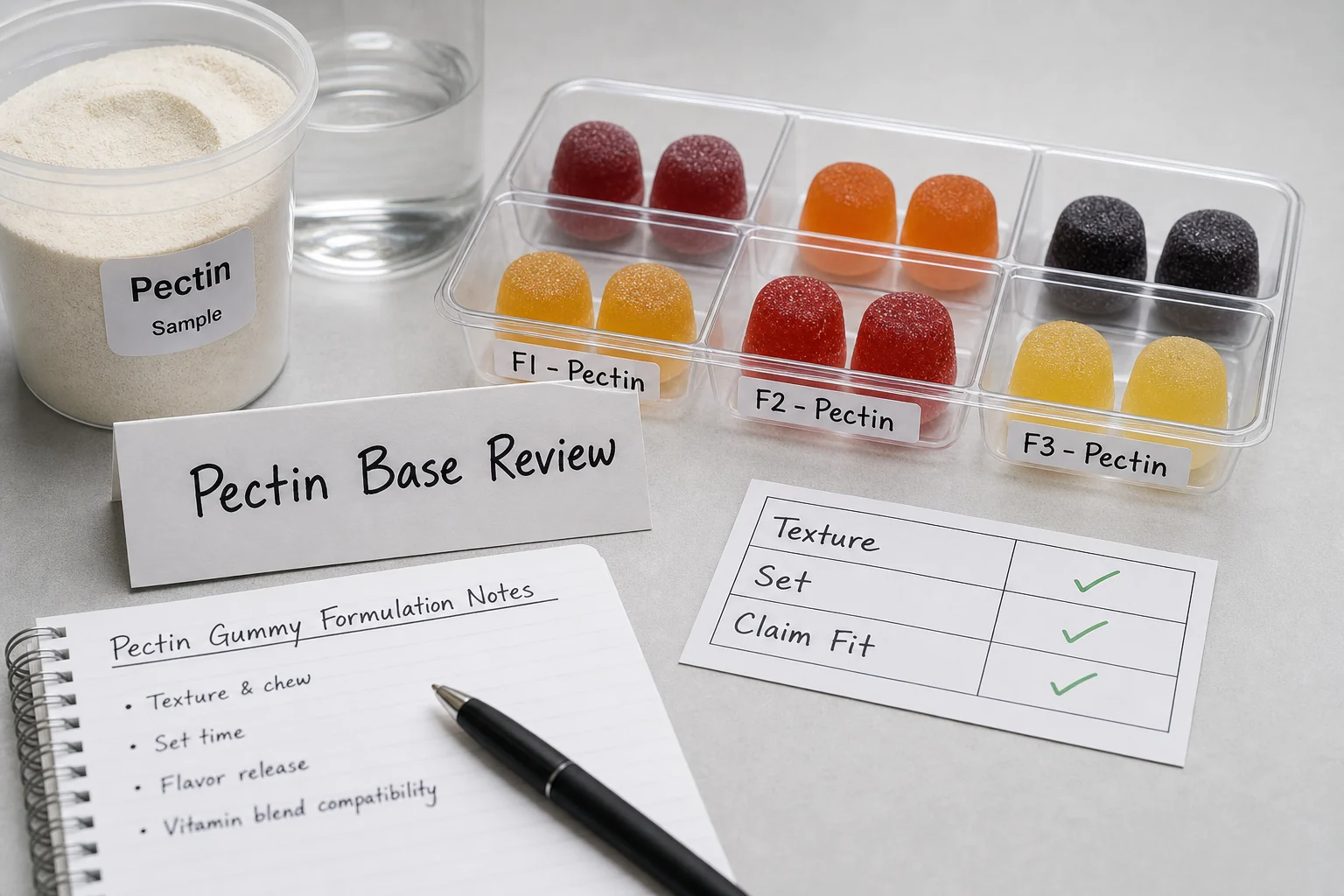
A pectin base can support vegan and gelatin-free gummy claims, but brands still need to define texture, sweetness, acid balance, active compatibility, and packaging expectations before the formula can be judged feasible.
Why Pectin Is the Default Choice for Vegan Gummies
Pectin is plant-derived[^1], widely used in fruit-based gels, and familiar to formulators working on vegan or vegetarian gummy concepts. It gives brands a cleaner route away from animal-derived gelatin while supporting a gummy format that consumers already understand.
For vegan gummy vitamin supplements, pectin can also fit a clean-label story better than some alternative gelling systems. It can deliver a different bite from gelatin: often shorter, less elastic, and more fruit-gel-like. That can be a strength if the brand wants a plant-based identity. It can become a problem if the brand expects a classic gelatin chew without adjusting the product brief.
This is one reason I prefer to define texture in plain commercial language before formulation starts. "Soft chew," "clean bite," "fruit snack texture," "not sticky," and "stable in bottle" are more useful than simply saying "make it vegan."
What Brands Should Decide Before Choosing a Pectin Gummy Base
Before choosing a pectin system, the brand team and production team should align on several practical questions:
| Decision area | Why it matters for vegan gummy vitamins |
|---|---|
| Target texture | Pectin has a different bite from gelatin, so the expected chew should be defined early. |
| Active blend | Vitamins and minerals can affect taste, color, acidity, and stability. |
| Sugar position | Sugar-free or low-sugar targets may change mouthfeel and setting behavior[^2]. |
| Flavor direction | Fruit flavors often work well, but mineral-heavy blends may need stronger masking. |
| Packaging | Moisture control and bottle closure choices can affect texture over time. |
| Claim language | Vegan, gelatin-free, non-GMO, natural flavor, and sugar-related claims need ingredient support. |
This table is not a replacement for formulation work. It is a way to reduce the risk of approving a marketing concept before the formula logic is clear.
Gelatin-Free Gummy Manufacturing Checklist for Brands
Before a vegan or gelatin-free gummy moves into sampling, brands should treat the pectin base as part of a full manufacturing checklist, not a single ingredient swap.
| Checklist item | What to confirm before sampling |
|---|---|
| Gelling system | Whether pectin, carrageenan, or another gelatin-free system fits the claim and texture target. |
| Texture target | Whether the gummy should feel soft, firm, fruit-gel-like, or closer to a traditional chew. |
| pH and heat exposure | Whether the active ingredients, colors, and flavors can tolerate the process route. |
| Active compatibility | Whether vitamins, minerals, botanicals, or amino acids affect taste, color, texture, or stability. |
| Vegan claim support | Whether gelling agents, actives, flavors, colors, carriers, coatings, and processing aids have suitable documentation. |
| Packaging route | Whether bottle, pouch, closure, desiccant, and storage assumptions protect texture and moisture behavior. |
This checklist helps prevent a common launch problem: the brand approves a vegan label concept before the formula, documentation, and production route are aligned.
When to Compare Pectin and Gelatin Gummy Bases
A vegan vitamin launch does not need to solve every pectin-versus-gelatin detail inside the same product brief. That comparison matters because it involves texture, heat behavior, setting behavior, mouthfeel, and consumer expectation.
For a vegan vitamin gummy launch, the key takeaway is narrower: pectin helps support a plant-based and gelatin-free positioning, but it also changes the product experience. If the brand is moving from a traditional gelatin gummy benchmark to a vegan formula, the team should expect formula adjustments rather than a one-for-one swap.
For a deeper comparison, pectin vs gelatin gummies can serve as the technical reference. In this discussion, the practical job is to keep the vegan launch brief realistic.
Vegan Vitamin Ingredient Choices: B12, D3, Minerals, and Multivitamin Blends
The gelling base may make the gummy vegan, but the active ingredients can still weaken the claim.
For vegan vitamin gummies, B12, D3, minerals, and multivitamin blends should be reviewed for source, dosage fit, taste, color impact, and documentation before the brand treats the formula as launch-ready.
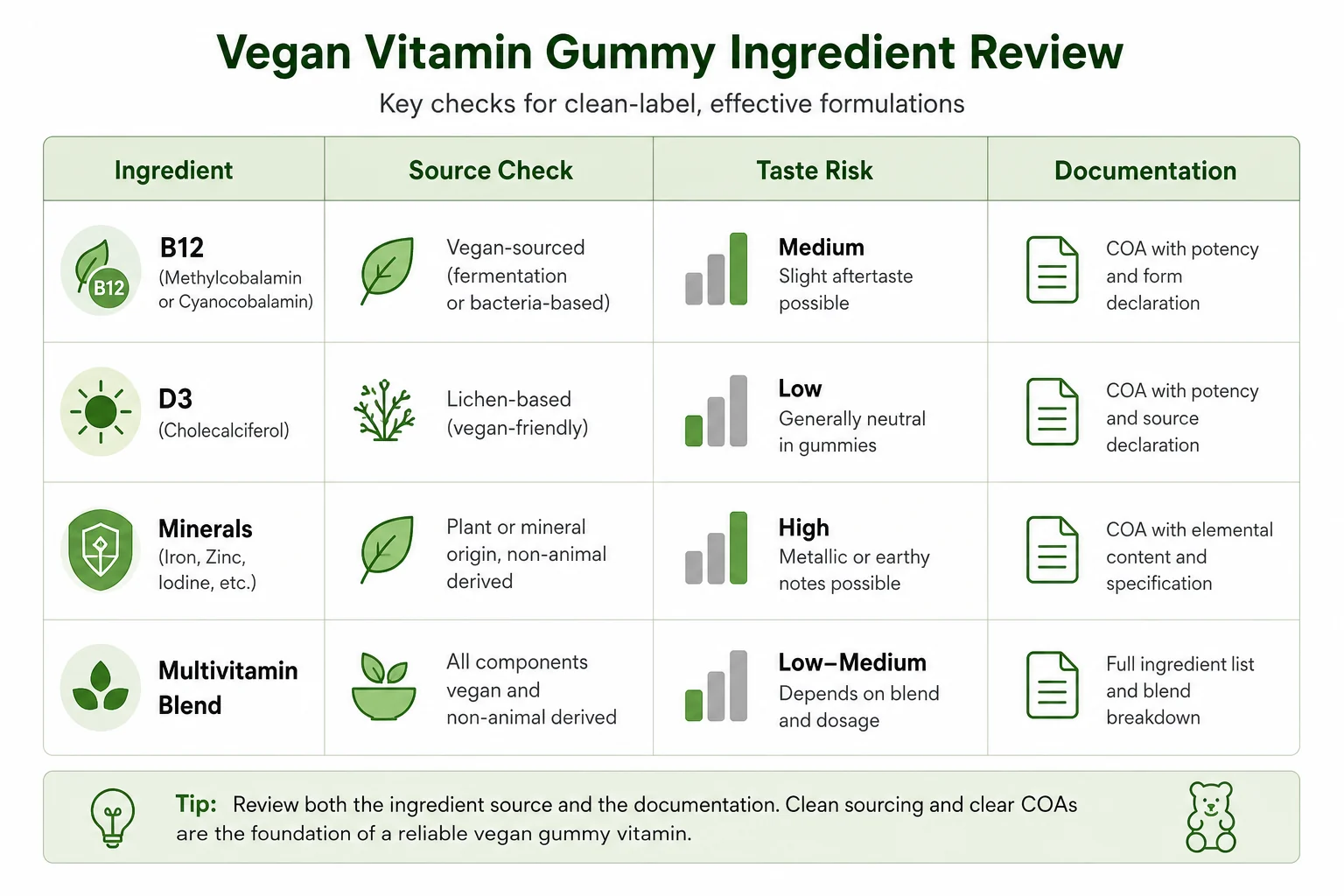
Vitamin B12 Source Considerations for Vegan Claims
B12 is common in vegan supplement positioning because plant-based diets are often associated with B12 supplementation. For a brand, the practical question is not whether B12 belongs in the idea. It is which input, dosage target, documentation, and flavor system can support the finished gummy.
B12 can appear in different forms, and the brand should confirm whether the selected input matches the intended label and market expectations. The production team also needs to understand how the active fits into the gummy base, whether the color is affected, and whether the ingredient creates any taste or stability concerns.
The documentation point matters. If a brand wants a vegan claim, the source statement and ingredient documentation should support that claim[^3] for the actual input used in the formula, not only for a generic B12 description. This is a good example of why vegan gummy vitamin supplements should not be designed from a nutrient list alone. A nutrient can look simple in a spreadsheet but still influence the formula system.
Vitamin D3 Source Considerations: Lichen-Based vs Non-Vegan Sources
Vitamin D3 deserves extra review because some D3 sources are not vegan[^4]. Lichen-based D3 is commonly discussed in vegan supplement development because it can support a plant-based positioning. Other D3 sources may not fit the same claim.
The brand should confirm source documentation before leaning on a vegan D3 message. This is especially important when the product concept says "vegan multivitamin," "plant-based vitamin D3," or "gelatin-free vitamin gummies" in the same positioning. One unsupported ingredient can create a claim problem even if the gummy base itself is gelatin-free.
I would handle D3 as a claim-control item, not only a nutrient. The formula brief should specify the expected source route and the documentation needed to support the label direction. If the final label will say vegan, the D3 source should be confirmed early enough that it does not force a late-stage formula change.
Minerals and Multivitamin Blends: Taste, Dosage, and Stability Trade-Offs
Minerals can be useful in multivitamin gummies, but they often create more formulation pressure than a simple vitamin-only blend. Zinc, iron, magnesium, and other minerals may introduce metallic, bitter, chalky, or drying taste notes. Some can affect color or interact with other formula choices. Higher active loading can also push the gummy away from the desired texture.
For brand teams, this means a vegan multivitamin gummy should be designed around realistic serving size and taste expectations. Trying to force too many actives into one gummy can create a product that looks strong on the Supplement Facts panel but performs poorly in the mouth.
The better development question is: which active blend creates enough consumer value while still allowing a pleasant, stable gummy? That is where formulation feasibility and commercial positioning have to meet.
Color, Flavor, and Sweetener Decisions in Vegan Vitamin Gummies
The cleanest claim can still fail if the gummy tastes wrong or looks unstable.
Color, flavor, and sweetener choices in vegan vitamin gummies should support the plant-based story while also masking active ingredients, protecting mouthfeel, and keeping the label language realistic.

Natural Colors and Flavor Systems for Plant-Based Positioning
Plant-based positioning often pushes brands toward natural colors and fruit-forward flavors. That can work well, but natural systems need careful selection. Some colors are sensitive to pH, heat, or light[^5]. Some fruit flavors may not cover mineral notes. Some "natural" expectations may limit the tools available for masking difficult actives.
The formula should not handle flavor as decoration added at the end. In gummy vitamin development, flavor is part of the active-delivery system. It has to carry the consumer experience while hiding the less pleasant edges of the vitamin and mineral blend.
For vegan products, color and flavor review should also include source review. A color or flavor can look compatible with a natural positioning but still require documentation before it can support a vegan label. A bright color that fades or a flavor that changes over time can make the product feel less stable. These details influence repeat purchase as much as the ingredient list does.
Sugar, Sugar-Free, and Low-Sugar Sweetener Options
Sugar strategy is one of the most important commercial decisions for vegan gummy vitamin supplements. Full-sugar gummies can provide a familiar taste and texture, but some brands want lower sugar for wellness positioning. Sugar-free gummies can support a stronger label story, but they often require more work on mouthfeel, aftertaste, digestive tolerance messaging, and texture stability.
The right choice depends on target consumer, channel, price point, and claim strategy. A children's vitamin line may need a different sweetness profile from an adult vegan multivitamin. A premium plant-based product may accept a more natural fruit profile, while a mass-market gummy may need a sweeter and more familiar taste.
Brands should decide the sugar position before sample work becomes too specific. Changing from sugar to sugar-free later can affect the whole gummy system, not just the sweetener line.
How Taste Expectations Affect Repeat Purchase
A vitamin gummy is not judged only by the label. It is judged every time the consumer opens the bottle. If the first chew is too bitter, too sticky, too medicinal, too sour, or too dry, the product may not support daily use even if the formula is technically vegan.
This matters for B2B development because a brand can spend heavily on packaging and launch promotion, then lose repeat purchase because the gummy experience was treated as secondary. For vegan products, the risk can be stronger because consumers may already expect a cleaner, more natural, or more thoughtful product experience.
The practical target is not candy. It is a supplement gummy that tastes good enough for routine use while keeping the claim, active blend, and production requirements under control.
Formula Feasibility Checks Before Scaling Vegan Vitamin Supplements in Gummy Form
Some sample gummies look acceptable once, then become difficult when the team tries to repeat them.
Before scaling vegan vitamin gummies, brands should check pectin behavior, pH range, heat sensitivity, active loading, moisture control, and packaging assumptions so the product does not fail between sample approval and commercial production.
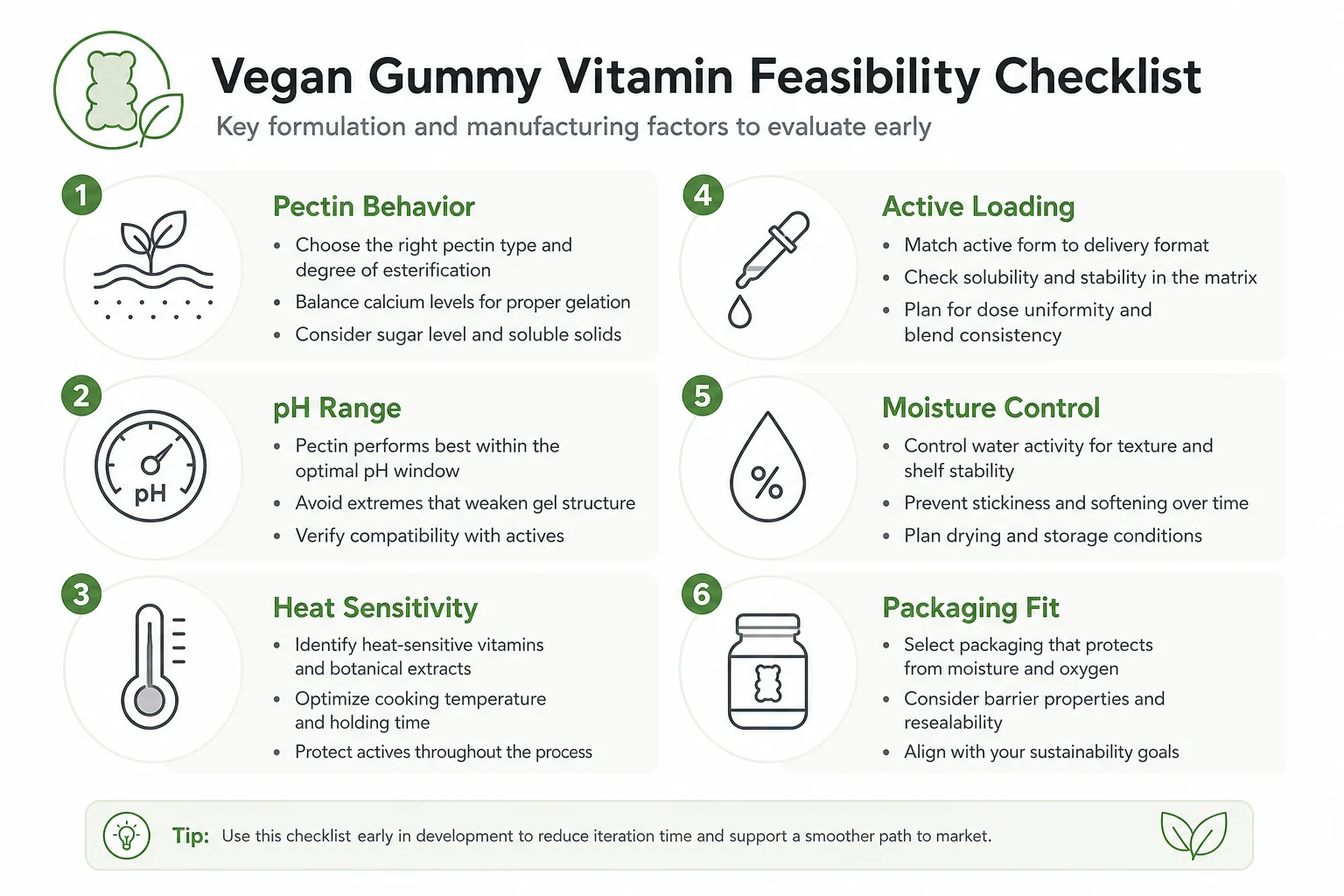
Why Pectin, pH, and Heat Sensitivity Matter for Vitamin Stability
Pectin gummies depend on formula balance. Acid level, soluble solids, setting conditions, water activity, and process handling can all influence the final texture. Vitamin ingredients can add another layer because some actives are sensitive to heat, pH, moisture, oxygen, or light[^6].
This does not mean the brand brief needs to become a process manual. The useful point for brand teams is simpler: feasibility should be checked before the product promise becomes fixed. If the concept requires vegan, sugar-free, high-potency, natural color, pleasant taste, and long shelf stability at the same time, those goals need to be reviewed together.
I often see the risk when a brand approves a concept based on the label story first. The label may sound strong, but the production team still has to make the gummy set, taste acceptable, hold shape, survive packaging, and maintain quality expectations.
What Can Go Wrong When Vegan Gummies Move from Sample to Production
The most common problems are not necessarily dramatic. They can be small issues that become expensive after packaging design, ingredient purchasing, or launch planning has already moved forward.
Common feasibility risks include:
| Risk | What it may signal |
|---|---|
| Texture drift | The gummy may be too soft, too hard, sticky, or inconsistent over time. |
| Active taste breakthrough | Minerals or vitamins may overpower the flavor system. |
| Color change | Natural colors may not fit the pH, heat, or light exposure. |
| Sugar-free mouthfeel issues | Sweetener changes may affect chew, aftertaste, or stability. |
| Claim-documentation gap | Vegan, gelatin-free, or natural claims may need stronger ingredient support. |
| Packaging mismatch | Moisture exposure can affect texture and shelf experience. |
This is why I prefer to connect formula planning, sample review, packaging expectations, and documentation early. These areas are not separate once the product becomes a real gummy.
A sample pass should not be treated as commercial proof by itself. For a gelatin-free gummy supplement, the next review should connect sample texture, active load, moisture behavior, packaging route, claim documentation, and repeatability. If any of these points changes after the label or packaging artwork is locked, the project may need another formula round before production.
Questions to Ask Your Manufacturer Before Finalizing the Formula
Before finalizing the formula, the brand team should confirm the practical details that affect commercial execution:
- Which gelling system supports the vegan and gelatin-free claim?
- Which B12 and D3 sources match the intended vegan positioning?
- How much active loading can the gummy carry without harming taste or texture?
- What sugar, low-sugar, or sugar-free system best fits the target consumer?
- Which natural colors and flavors are realistic for the active blend?
- What packaging assumptions are needed to protect texture and moisture control?
- What MOQ, pilot-run, or batch-size assumptions should be reviewed before launch planning?
- What documentation can support vegan, gelatin-free, and other label claims?
- What should be reviewed again before moving from sample to commercial production?
A good gummy contract manufacturer should help connect these questions. At Talvenda, the useful work is not only making a sample. It is helping the brand turn a marketing brief into a formula route that can support sampling, packaging, documentation, and scale-up planning. For a broader supplier-prep framework, use the gummy supplement manufacturer checklist before requesting quotes or samples.
Formula Positioning Options for Vegan Gummy Vitamin Products
Vegan vitamin gummies can support several product routes, but each route changes the formula pressure.
A vegan gummy vitamin product can be positioned as a daily multivitamin, beauty gummy, energy support concept, immune-positioned formula, or kids' product, but each direction needs its own active blend and claim boundary.
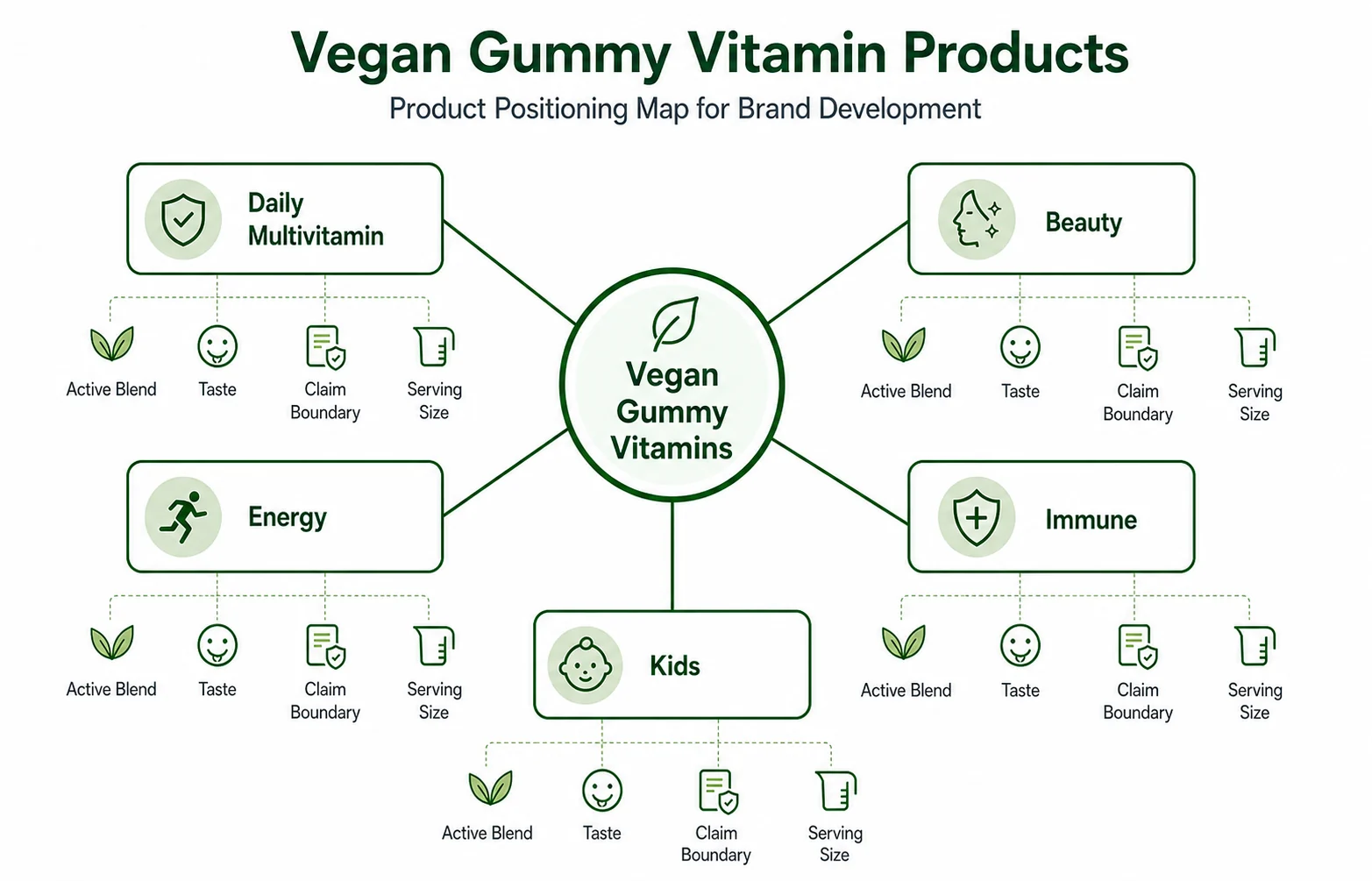
Daily Vegan Multivitamin Gummies
A daily vegan multivitamin gummy is often the broadest concept. It may include a range of vitamins and minerals, which can make it attractive from a marketing point of view. It can also be more difficult to formulate because broad active coverage increases taste, dosage, and stability pressure.
The brand should decide whether the product is meant to be a simple daily support gummy or a more complete multivitamin concept. More actives do not automatically make a better gummy. They can create serving-size issues, stronger off-notes, and more complicated label review.
For a daily vegan multivitamin, I would focus on a balanced formula that consumers can understand and use consistently. The brief should avoid overloading the gummy just to make the panel look longer.
Targeted Vegan Formulas: Beauty, Energy, Immunity, and Kids
Targeted formulas can be easier to position because the product has a clearer job. A beauty gummy might focus on biotin, vitamin C, or other beauty-related nutrients. An energy-positioned gummy may lean on B vitamins. A kids' vegan gummy needs a different taste, dosage, and safety review from an adult product.
However, targeted formulas also create claim risk. Beauty, energy, immunity, and kids' positioning must be handled carefully so the formula concept and finished product do not drift into unsupported promises. The formula can support a category direction, but the label language should remain controlled.
From a development perspective, targeted formulas are useful because they help the brand decide which active blend matters most. That makes taste masking, serving size, and packaging review more focused.
When to Use Internal Links Instead of Repeating Existing Topics
A vegan vitamin gummy brief should stay focused on the formula system instead of trying to solve every adjacent category at once. If the brand is specifically interested in vegan collagen gummies, hair-skin-nails gummies, or private label biotin gummies, the deeper decision changes from multivitamin feasibility to category-specific actives, claims, and positioning.
For beauty-specific vegan concepts, vegan collagen gummies, hair skin nails gummies, and private label biotin gummies can support those deeper decisions. For format comparison, are gummy vitamins as effective as pills addresses the broader gummy-versus-pill question.
For brand teams, this planning map shows what options exist and where the formula risks change, then lets the team evaluate a more specific resource when the product idea becomes narrower.
Label Claim and Supplier Checklist Before Launch
A strong vegan gummy concept should be checked before the label language becomes fixed.
Before launch, brands should align vegan, gelatin-free, non-GMO, sugar-free, natural, and custom formulation claims with actual ingredient sources, documentation, formula feasibility, and production planning.
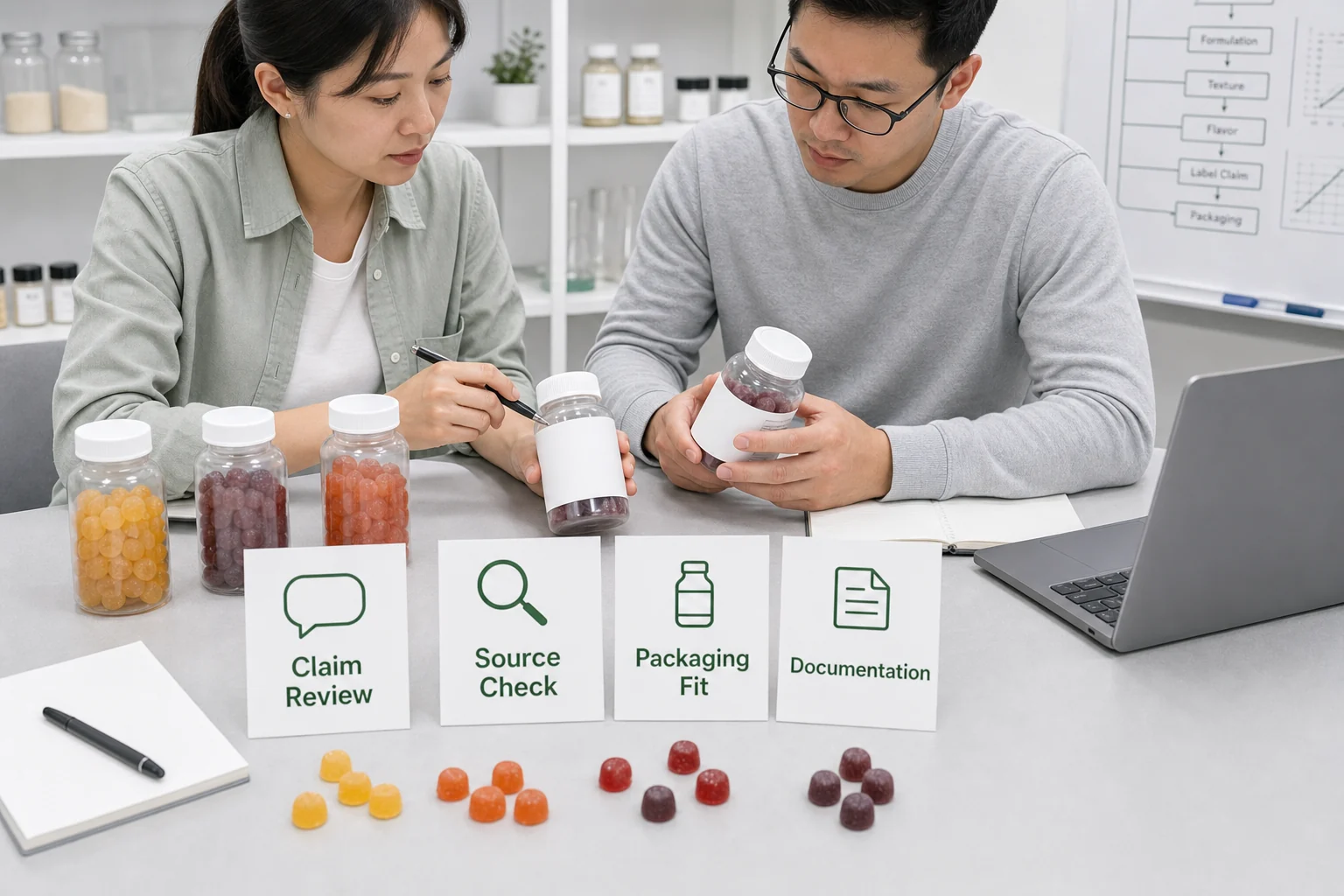
Vegan, Gelatin-Free, Non-GMO, Sugar-Free, and Natural Claim Boundaries
Claim language can be powerful, but it should be earned by the formula and documentation. "Vegan" should be supported by the gelling base and active sources. "Gelatin-free" should be clear from the gummy base. "Sugar-free" or "low sugar" should match the sweetener system and applicable labeling rules. "Natural flavor" or "natural color" should be reviewed against ingredient inputs.
The broader gummy supplement ingredients review also matters here. A pectin base can support a gelatin-free direction, but it does not prove the whole finished gummy is vegan. The full formula still needs review across active ingredients, colors, flavors, carriers, coatings, and processing aids. For brands, the safer question is not only "Is the base gelatin-free?" but "Can the finished product and its documentation support the claim we want to print on the label?"
The risk is not only regulatory. It is also commercial trust. If a product makes a clean-positioning promise, the consumer expects the ingredient list and product experience to support it. If the taste, color, texture, or label feels inconsistent, the brand loses credibility.
For brand teams, claim review should happen before packaging artwork is locked. It is easier to adjust a formula brief than to correct a finished label direction.
Questions to Ask Before Custom Vitamin Formulation
Before a custom vitamin formulation project starts, the brand team should prepare a clear brief:
| Brief item | Practical question |
|---|---|
| Target claim | Is the product vegan, gelatin-free, sugar-free, non-GMO, natural, or another positioning? |
| Active blend | Which vitamins and minerals are essential, and which are optional? |
| Serving size | How many gummies per serving are acceptable for the target consumer? |
| Taste direction | What flavor profile fits the active blend and market? |
| Sweetener system | Is the product full sugar, reduced sugar, or sugar-free? |
| Texture target | Should the bite be soft, firm, fruit-gel-like, or closer to a traditional gummy? |
| Packaging route | Does the gummy need stronger moisture protection or specific bottle closure planning? |
| Documentation | What ingredient and batch documents are needed for the intended claims? |
This kind of brief helps the production team respond with practical options instead of guessing what the brand values most.
How Talvenda Helps Brands Turn a Vegan Vitamin Brief into a Feasible Gummy Formula
Talvenda supports brands as a gummy contract manufacturer for formulation planning, private label development, packaging coordination, and scale-up. For vegan gummy vitamin supplements, the most useful support is connecting the marketing idea to production reality.
That means reviewing the active blend, pectin base, flavor and sweetener system, claim direction, packaging needs, and sample expectations together. It also means flagging trade-offs early: a stronger active blend may affect taste, a sugar-free target may affect mouthfeel, and a natural color system may need more stability review.
The goal is not to make the formula more complicated. The goal is to make the launch path clearer. When the formula brief is realistic, sample work becomes more focused, documentation is easier to organize, and commercial production has fewer avoidable surprises. For broader production and service context, gummy vitamin manufacturing explains how formula planning connects with commercial gummy production.
FAQ About Vegan Gummy Vitamin Supplements
Are all gummy vitamins vegan?
No. Many gummy vitamins use gelatin or ingredients that may not fit a vegan claim. A vegan gummy vitamin should be checked for its gelling base, active sources, colors, flavors, sweeteners, processing aids, and supporting documentation.
What makes a vitamin D3 gummy vegan?
A vitamin D3 gummy depends on the source of D3 and the rest of the formula. Lichen-based D3 is commonly used for vegan positioning, while some other D3 sources may not fit a vegan claim.
Are pectin gummies necessarily better than gelatin gummies?
Not necessarily. Pectin is usually more suitable for vegan and gelatin-free positioning, but gelatin can deliver a different elastic chew. The better choice depends on the claim, target texture, formula, and market.
Can vegan gummy vitamins be sugar-free?
Yes, vegan gummy vitamins can be developed with sugar-free or low-sugar sweetener systems, but those choices may affect mouthfeel, aftertaste, texture, and feasibility. They should be reviewed early in formulation.
What should brands check before manufacturing gelatin-free gummy supplements?
Brands should check the gelling system, target texture, active load, pH and heat exposure, flavor masking, moisture control, packaging route, and claim documentation before moving from sample approval to commercial production.
Is pectin enough to make a gummy supplement vegan?
No. Pectin can support a gelatin-free base, but the finished gummy also depends on active ingredients, flavors, colors, carriers, coatings, processing aids, and supporting documentation.
What documents support a vegan or gelatin-free gummy claim?
The document package may include ingredient specifications, source statements, supplier documents, COA or batch records where applicable, and finished-label review. The exact requirement depends on the market, claim, channel, and final formula.
Conclusion
Vegan vitamin supplements in gummy form work best when claim, formula, taste, packaging, and scale-up planning are developed as one system.
Vegan gummy vitamin supplements need source compatibility, texture, taste, label position, packaging, and production expectations to work as one system. As a contract gummy supplement manufacturer, Talvenda can help brands move from a broad vegan concept into a practical route: low-MOQ market-tested in-stock gummies, stock formula modification, or custom gummy development. Your team can use that route discussion to clarify sample development, packaging and label support, documentation and testing expectations, and quality-controlled production before the project becomes harder to adjust. Contact Talvenda through the project inquiry form.
[^1]: "21 CFR § 184.1588 - Pectins. - Law.Cornell.Edu", https://www.law.cornell.edu/cfr/text/21/184.1588. Use to support pectin as a plant-derived/food-use gelling ingredient, without overstating vegan certification. Evidence role: ingredient identity / formulation support; source type: regulatory or technical source. Supports: Pectin can support a gelatin-free gummy base and is relevant to vegan gummy formulation.. Scope note: Does not prove any specific finished product is vegan-certified. [^2]: "FDA Regulatory Requirements for Nutrient Content Claims - NCBI", https://www.ncbi.nlm.nih.gov/books/NBK209851/. Use only to support that sugar-related claims require careful label review; keep body wording qualitative. Evidence role: label boundary / formulation caution; source type: regulatory source. Supports: Sugar-free or low-sugar positioning should be reviewed against formulation and label requirements.. Scope note: Do not introduce numeric thresholds unless the source is clearly applicable. [^3]: "Structure/Function and Related Claims in Dietary Supplement ... - FDA", https://www.fda.gov/food/information-industry-dietary-supplements/notifications-structurefunction-and-related-claims-dietary-supplement-labeling. Use to support the caution that supplement label and claim language should be backed by appropriate documentation. Evidence role: claim boundary / labeling caution; source type: FDA guidance. Supports: Vegan and related positioning should be supported by source documentation and controlled label language.. Scope note: Does not replace legal review for the final label. [^4]: "Vitamin D - Health Professional Fact Sheet", https://ods.od.nih.gov/factsheets/VitaminD-HealthProfessional/. Use to support cautious vitamin D3 source review and avoid treating all D3 inputs as vegan by default. Evidence role: ingredient source caution; source type: government health information or technical source. Supports: D3 source should be checked before making a vegan D3 positioning claim.. Scope note: Supplier documentation is still needed for the actual input used. [^5]: "Anthocyanidins and anthocyanins: colored pigments as food ... - PMC", https://pmc.ncbi.nlm.nih.gov/articles/PMC5613902/. Use to support the formulation caution that natural color systems may be affected by pH, heat, or light. Evidence role: formulation stability support; source type: technical or scientific source. Supports: Color systems should be reviewed for stability in gummy vitamin development.. Scope note: Specific color behavior depends on the actual colorant and formula. [^6]: "Stability of vitamin A, E, C and thiamine during storage ... - PMC", https://pmc.ncbi.nlm.nih.gov/articles/PMC9674494/. Use to support cautious feasibility review around active stability in gummy development. Evidence role: active stability support; source type: technical or scientific source. Supports: Vitamin actives may require review for heat, pH, moisture, oxygen, and light exposure.. Scope note: Does not claim instability for every vitamin or every gummy formula.