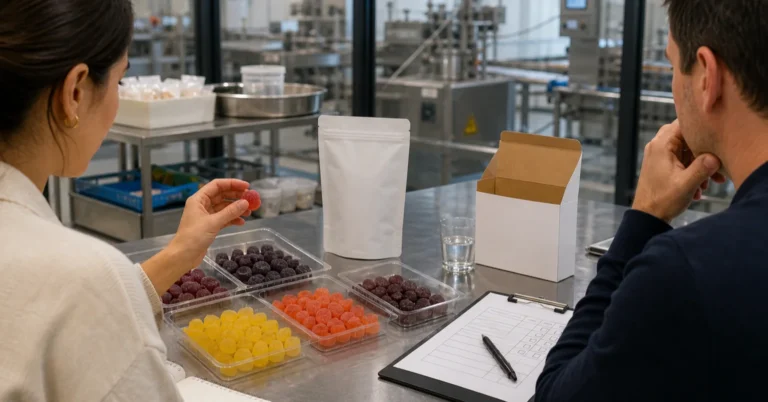

Hair, skin, and nails gummies are dietary supplements built around recognizable beauty nutrients such as biotin, vitamin C, zinc, keratin, or collagen. A credible product does more than place those names on a label. The serving design, claim language, taste, texture, testing plan, packaging, and production controls must work together.
For a supplement brand, the central decision is whether the beauty concept can become a consistent commercial gummy without making promises the evidence, formula, or finished product cannot support.

That decision is best made before the first sample. A clear brief reduces avoidable reformulation, artwork changes, packaging delays, and gaps between a successful bench sample and repeatable production.
Decision Snapshot
- Give every active a defined formula and label role instead of building the longest possible ingredient list.
- Review biotin level and laboratory-test warning language before approving artwork.
- Handle sugar-free and pectin options as distinct formulation routes, not late marketing changes.
- Define finished-product specifications, COA expectations, packaging, MOQ, and scale-up checks before production.
- Confirm that depositing, piece-weight control, in-process checks, traceability, and packaging-line fit can support repeat orders.
What Are Hair, Skin, and Nails Gummies?
Beauty gummies combine an easy consumer format with a formula that can become surprisingly difficult when too many actives and claims are added.
Hair, skin, and nails gummies are multi-ingredient beauty supplements designed to support normal hair, skin, or nail functions while offering a convenient chewable format. Their commercial quality depends on realistic serving design, cautious claims, stable texture, and repeatable manufacturing.
What Consumers Expect From Beauty Gummies
Consumers usually expect a beauty gummy to be simple: a pleasant flavor, an attractive color and shape, a convenient daily serving, and a clear explanation of what the product is intended to support. Biotin is often the category anchor because it is familiar and easy to recognize on the front label. Vitamin C, zinc, collagen, or keratin can make the concept feel more complete.
The product experience matters as much as the ingredient story. Gummies that arrive sticky, harden during storage, show inconsistent color, or require an awkward number of pieces per serving weaken trust quickly. A premium beauty position therefore needs both shelf appeal and physical stability.
The same principle applies to claims. Shoppers may associate the category with faster hair growth, glowing skin, or stronger nails, but the product must communicate a support role without promising treatment or guaranteed results.
For a brand team, this means the consumer promise should be drafted alongside the formula brief. Flavor, serving count, active levels, front-label wording, and ecommerce copy should tell the same restrained story.
Common Ingredients: Biotin, Vitamin C, Zinc, Keratin, and Collagen
The familiar beauty stack includes ingredients with very different formulation burdens. Biotin can occupy little physical space while still requiring careful dose, label, and warning review. Collagen can dominate the active load and create pressure on piece weight, serving count, flavor, mouthfeel, and texture. Zinc may bring an unpleasant mineral note. Keratin can add sourcing and documentation questions. Vitamin C can influence acidity and flavor balance.
| Ingredient | Common category role | Manufacturing-readiness question |
|---|---|---|
| Biotin | Familiar hair, skin, and nail nutrient | Is the intended level aligned with the claim and warning review? |
| Vitamin C | General antioxidant and collagen-support positioning | How will acidity interact with flavor, color, and the gelling system? |
| Zinc | Hair, skin, nail, and general nutrition positioning | Can the mineral taste be masked without making the gummy overly sweet or acidic? |
| Keratin | Hair and nail differentiation | Are source, documentation, allergen, and label implications clear? |
| Collagen | Beauty-from-within and skin-focused positioning | Can the intended amount fit the serving without compromising chew, taste, or stability? |
These ingredients should not be treated as interchangeable marketing badges. A useful formula brief states why each active is included, what amount is intended per serving, what claim it may support, and what test or document will be expected.
Brands considering a collagen-led concept can explore the separate collagen and biotin gummy manufacturing route. The rest of this guide keeps the wider hair, skin, and nails category as the primary subject.
Why Brands Should Treat This as a Formula-Readiness Category
A beauty gummy concept can look complete in a presentation while remaining incomplete for production. A list of ingredients, a flavor name, and a bottle mockup do not answer whether the active load fits, whether the gummy will deposit consistently, or whether the label can be supported.
Formula readiness starts with linked decisions:
- Define the primary beauty position and the intended consumer.
- Assign a clear role to every active.
- Check the total active load against piece weight and serving count.
- Select gelatin, pectin, standard sugar, reduced-sugar, or sugar-free direction early.
- Review taste masking, moisture behavior, texture, and packaging together.
- Set claim, warning, specification, and finished-product testing expectations.
- Confirm how the approved sample will be translated into commercial production.
This approach prevents a common failure: approving a visually attractive sample that does not contain the final active stack or cannot be repeated at production scale. A sample is useful only when it tests the formula route the brand actually intends to sell.
The approval record should name what the sample represents. It can identify the active stack, serving design, gummy base, sensory target, provisional packaging, open risks, and variables that may still change during scale-up. That makes sample approval a controlled project decision rather than a general statement that the gummies "look and taste good."
Do Hair, Skin, and Nails Gummies Work? Evidence and Claim Boundaries
Beauty positioning can easily outrun the evidence when ingredient associations are presented as certain finished-product outcomes.
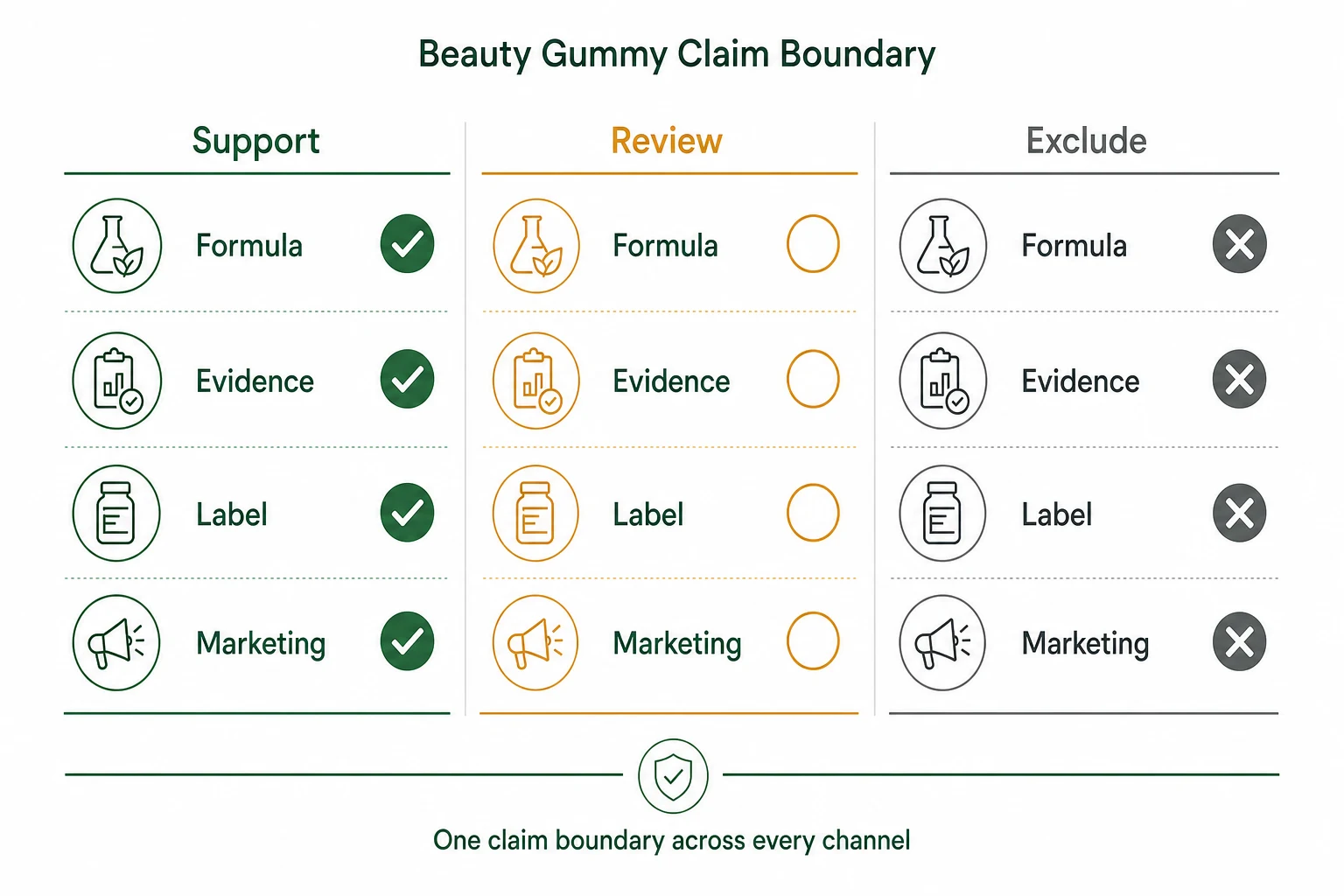
Hair, skin, and nails gummies may supply nutrients associated with normal body functions, but results depend on the ingredient, level, user, nutritional status, and finished formula. Brands should substantiate the exact claim they communicate and avoid guaranteed growth, repair, treatment, or transformation language.
What Biotin Can Support and What It Should Not Promise
Biotin is an essential nutrient involved in normal metabolism, and deficiency can include changes affecting hair, skin, or nails. That does not mean additional biotin will produce the same visible result for every person who is not deficient. The category association is stronger than the basis for an unconditional outcome promise.[^1]
For product development, biotin should be treated as a low-weight but high-attention active. It rarely creates the same physical loading pressure as collagen, yet it influences the Supplement Facts panel, front-label emphasis, claim language, warning review, and consumer information.
A restrained statement about supporting normal hair, skin, or nail health is different from saying a gummy grows hair, reverses hair loss, repairs a skin condition, or guarantees stronger nails. The full context matters. Product names, before-and-after images, testimonials, social copy, and marketplace bullets can create an implied claim even when the bottle wording appears cautious.
The practical review should cover the intended biotin level, evidence file, exact claim, target market, label context, and online marketing. A disclaimer does not repair an unsupported main message.
Skin, Nail, and Hair Claims That Need Careful Substantiation
Beauty claims sit on a spectrum. General support language may be possible when it is truthful, not misleading, and properly substantiated.[^2] Disease, treatment, or guaranteed outcome language creates a different risk.
| Claim direction | Review status | Brand-side concern |
|---|---|---|
| Supports normal hair, skin, and nail health | Review for ingredient relevance, level, market, and full label context | Do the formula and substantiation file support the statement? |
| Supports collagen formation | Review the nutrient, amount, and permitted wording | Does the claim accurately describe the ingredient's normal role? |
| Promotes healthy-looking hair or nails | Review evidence and implied consumer takeaway | Could the full presentation imply a certain visible result? |
| Makes hair grow faster or reverses hair loss | High risk | May imply a treatment or guaranteed efficacy outcome |
| Acne, dermatitis, or nail-disease claims | Do not use for a normal supplement position | Disease language changes the regulatory boundary |
| Promises a certain beauty transformation | High substantiation burden | Does evidence apply to the exact product, level, population, and outcome? |
The claim file should be built before packaging is printed. It should identify the express claim, likely implied message, supporting evidence, ingredient level, finished-product relevance, and any necessary qualification. Marketing, legal or regulatory review, product development, and manufacturing documentation should not operate as separate islands.[^3]
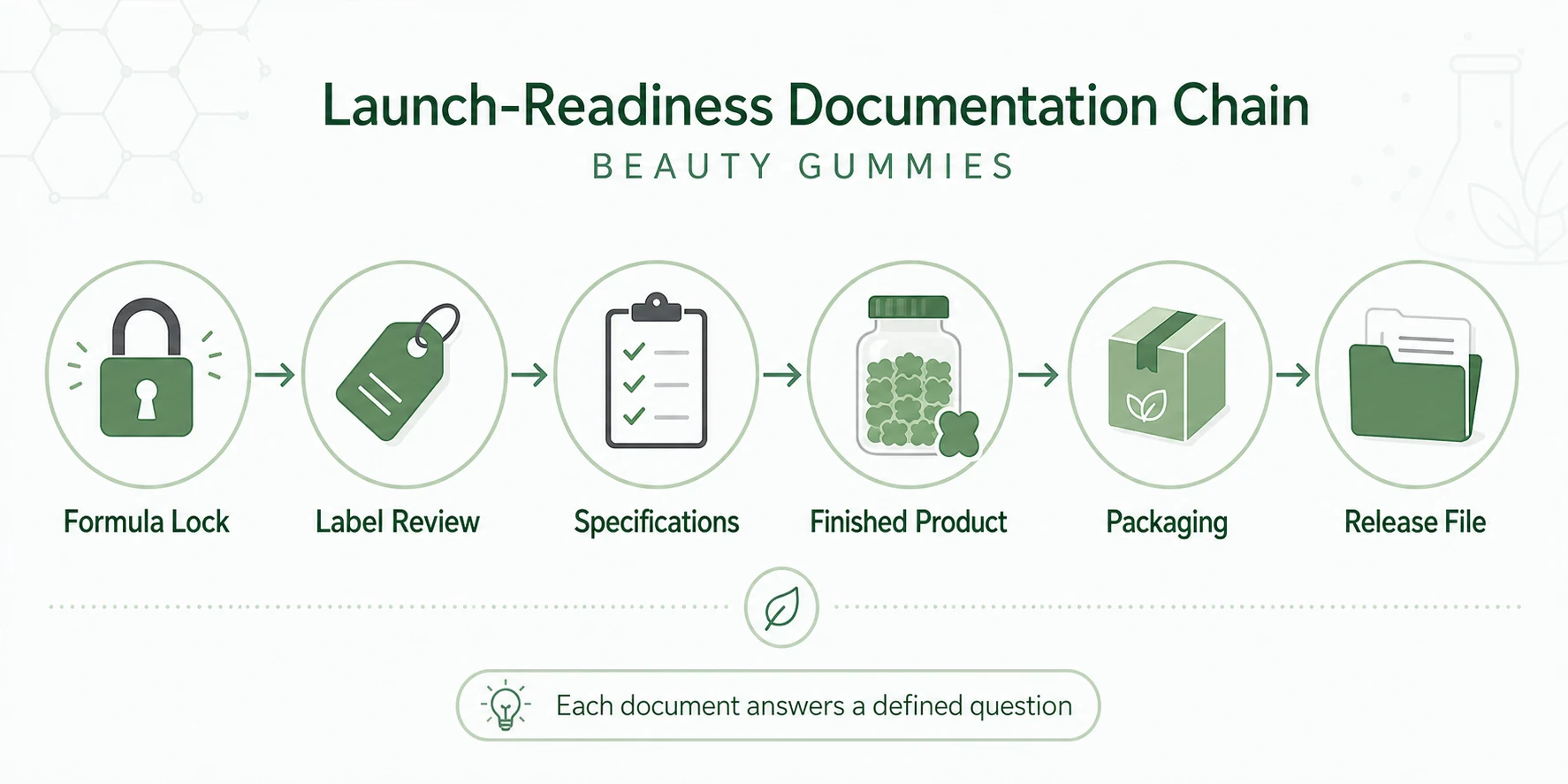
Finished-product testing does not by itself prove a beauty benefit. It can verify selected quality attributes and support label consistency, but efficacy language needs its own appropriate substantiation. The brand should know which question each document answers.
Why Lab-Test Interference Must Be Reviewed Before Label Approval
Supplemental biotin can interfere with some laboratory test methods and may contribute to inaccurate results.[^4] The issue is not limited to beauty marketing; it is a product-information and label-review responsibility.
A brand should not improvise medical instructions. Instead, the label and consumer-information review should consider the biotin level, target market, applicable guidance, warning wording, and where the information needs to appear. Healthcare questions should be directed to a qualified professional.
This review belongs early in development for three reasons. First, changing warning language after artwork approval can delay printing. Second, the front label may emphasize a high biotin amount while the side panel gives too little context. Third, ecommerce listings and promotional images must remain aligned with the physical label.
The final decision should be documented. That record can include the reviewed biotin specification, approved warning language, responsible reviewer, artwork version, and change control. It becomes part of a more reliable handoff from product development to packaging and production.
Formulation Readiness for Hair, Skin, and Nails Gummies
The longest beauty ingredient list is rarely the easiest formula to scale, test, package, or reorder consistently.
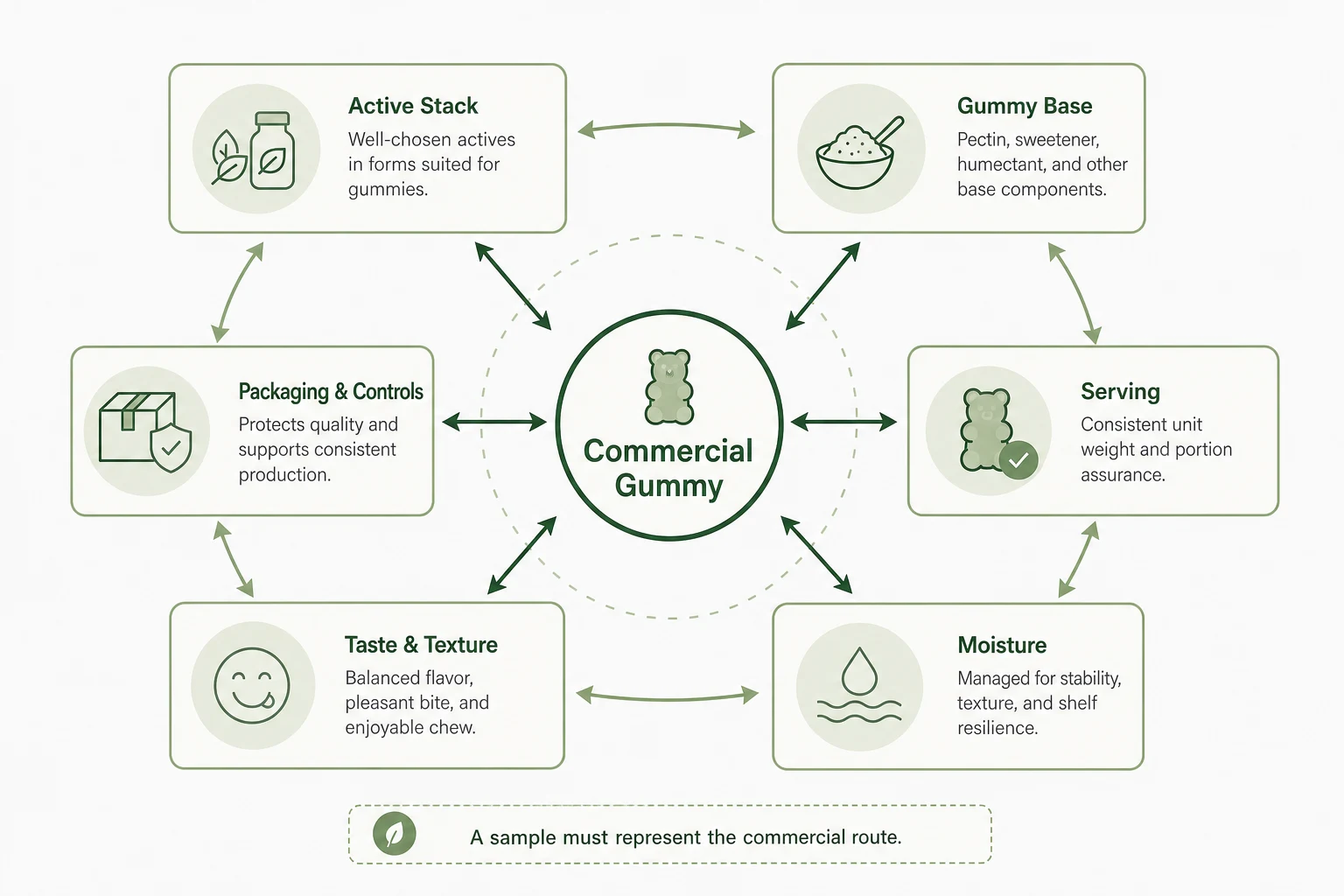
Formulation readiness means the active stack, gummy base, piece weight, serving count, flavor system, moisture target, packaging, and process controls can function as one commercial product. A successful sample should represent that complete route rather than a simplified demonstration formula.
Biotin Level, Co-Actives, and Gummy Count Pressure
Every gummy has a practical capacity. The available space is shared by the gelling system, sweetener system, flavors, acids, colors, processing aids, and active ingredients. Adding more co-actives can increase the piece weight, number of gummies per serving, taste-masking work, or risk of unstable texture.
Biotin usually contributes little mass, but the same is not true for collagen or some supporting ingredients. A formula that combines collagen, keratin, vitamin C, zinc, and several minor beauty actives can become crowded quickly. The brand then faces tradeoffs:
- Keep the active stack and increase the serving count.
- Keep the serving count and reduce one or more active targets.
- Use a larger gummy and check consumer acceptance and packaging impact.
- Narrow the formula to one clear hero-active route.
- Move a high-load concept to another dosage form.
Low-dose actives also require distribution discipline. Mixing strategy, controlled depositing, and piece-weight consistency help support repeatable delivery across the batch. The brand does not need machine settings in the commercial brief, but it should expect a clear explanation of how dosage consistency is controlled and verified.
Taste, Texture, Moisture, and Stability Considerations
Beauty actives can bring bitterness, mineral notes, protein mouthfeel, color changes, or aftertaste. Masking those effects with more sweetness or acid can change the gelling system and overall sensory profile. Flavor development should therefore use the intended active load, not an easier low-active substitute.
Texture is also dynamic. A gummy that feels right immediately after production may soften, harden, sweat, stick, or crystallize during storage. Humidity, temperature, coating, bottle headspace, closure, desiccant strategy, and shipping conditions all influence the experience.
At scale, automation supports consistency when the formula is process-ready. Controlled depositing helps manage fill weight and shape. Defined in-process checks can identify drift before it becomes a finished-lot problem. Batch and equipment records connect the approved formula, materials, processing, packaging, and release decisions. Line trials confirm that gummies feed, count, fill, cap, seal, and label reliably.
Automation cannot rescue a poorly balanced formula. If viscosity, setting behavior, moisture, or surface condition is unstable, faster equipment may reproduce the problem more consistently. The useful manufacturing question is therefore not whether a line is automated, but which product variables are controlled, checked, recorded, and reviewed when the sample moves to a commercial run.
A stability plan should match the final formula and pack. Useful review points can include appearance, odor, flavor, texture, moisture-related behavior, active-content expectations, microbiological quality, package integrity, and storage conditions. The exact specification and study design require qualified review for the product and target market.
Sugar-Free, Vegan Pectin, and Clean-Label Positioning Options
Sugar-free and vegan beauty gummies can create meaningful differentiation, but each term changes the development path. A sugar-free direction affects sweetener choice, aftertaste, texture, moisture behavior, digestive-tolerance review, coating, and labeling. It should be defined before sampling.
Pectin can support a plant-based gummy base, yet a pectin gummy is not automatically vegan. Collagen, keratin, colors, flavors, coatings, and other components still require source review. A true vegan beauty gummy may use biotin, vitamin C, zinc, or other non-collagen actives while avoiding animal-derived ingredients.
Clean-label language also needs definition. It may refer to color source, flavor direction, sweeteners, allergens, preservatives, or a shorter ingredient deck. Without a written standard, different teams can use the same phrase to mean different things.
| Positioning route | Early decisions | Common development pressure |
|---|---|---|
| Standard beauty gummy | Hero active, serving, flavor, gelatin or pectin | Differentiation and claim discipline |
| Sugar-free beauty gummy | Sweetener system, coating, tolerance and label review | Aftertaste, moisture, chew, stickiness |
| Vegan pectin gummy | Source review for every component | Setting behavior, acidity, heat and humidity sensitivity |
| Collagen-led beauty gummy | Collagen source and realistic amount | Active load, mouthfeel, serving count |
| Clean-label beauty gummy | Written ingredient and claim standard | Fewer formulation tools and more sourcing constraints |
A concrete product example such as sugar-free biotin gummies with keratin can help a brand discuss the route. Broader plant-based format decisions belong in the vegan gummy vitamin supplements guide.
Label, Testing, and Documentation Before Launch
A finished gummy can pass a taste review and still be unready because its label, specifications, testing, or packaging evidence is incomplete.
Launch readiness requires an aligned Supplement Facts panel, substantiated claim language, approved warnings, finished-product specifications, testing and COA expectations, traceable batch documentation, and packaging that protects the gummy through intended storage and distribution.
Supplement Facts, Structure-Function Claims, and Warning Language
The serving design controls the Supplement Facts panel. The brand should confirm serving size, servings per container, dietary ingredients, amounts per serving, other ingredients, allergen information, directions, and applicable warnings before final artwork.
Structure-function wording should describe an appropriate support role without implying disease treatment. The brand must have substantiation that the statement is truthful and not misleading, follow applicable notification and disclaimer requirements, and review the net impression of the full presentation.[^2]
The review extends beyond the bottle:
- Front and back label panels
- Carton or pouch copy
- Ecommerce title and bullets
- Marketplace images
- Product inserts
- Influencer or affiliate briefs
- Paid advertising and social posts
Warning language needs the same version control as the formula. A biotin caution or market-specific statement can fail if one channel uses outdated artwork.
The manufacturing handoff should use the approved label version. This reduces the risk of applying the wrong label, using an unapproved claim, or creating a mismatch between the master manufacturing record and the marketed product.
Finished-Product Testing, COA, and Stability Expectations
Raw-material documents are useful, but they do not answer every question about the finished gummy. Ingredients have been combined, exposed to the manufacturing process, deposited, set or dried, finished, and packaged. The final product needs specifications and a verification plan appropriate to its formula and risks.[^5]
The exact test panel should be qualified rather than copied from another SKU. Depending on the product, review may cover identity, selected active-content expectations, microbiological quality, relevant contaminant limits, appearance, piece weight, moisture-related measures, texture, packaging integrity, and other agreed specifications.
A COA should be understood as a document tied to defined tests, methods, specifications, and a batch. It is not a general promise that every possible claim has been proven. Before ordering, the brand team should know:
- Which documents are standard and which require added scope
- Whether results are raw-material, in-process, or finished-product based
- Which actives are included in the agreed verification plan
- How out-of-specification or deviation handling is managed
- What batch and reserve records are retained
- What the stability plan supports about storage and shelf-life decisions
Piece-weight checks and in-process controls matter because finished-product testing samples only part of a batch. Quality must be built into ingredient control, documented procedures, calibrated equipment, repeatable processing, and release review rather than depending on an end test alone.
Packaging Choices for Moisture Control and Shelf Appeal
Beauty packaging has two jobs: protect the gummy and communicate the product. A highly decorative bottle that does not manage moisture, heat, light, closure integrity, or shipping exposure is not a finished solution.
Bottle size should match gummy count, piece dimensions, headspace, desiccant strategy, and counting-line requirements. Closure and induction-seal decisions affect protection and tamper evidence. Pouches may offer different shelf and shipping advantages but need their own barrier, sealing, and handling review.
Packaging-line fit should be tested with the actual gummy. Surface oil, sanding, coating, softness, and shape can affect feeding and counting. Automated counting and filling work best when gummies separate cleanly and maintain consistent dimensions. The line trial can reveal jams, double counts, scuffing, deformation, cap issues, or label-placement problems before a larger run.
Shelf appeal should be finalized after these functional choices. Shape, color, bottle, label stock, and carton can support premium positioning, but they should not introduce avoidable instability or delay. Packaging is part of formulation readiness, not a design task left until the end.
How to Choose a Manufacturer for Hair, Skin, and Nails Gummies
Price comparisons become misleading when suppliers are quoting different formulas, testing scopes, packaging assumptions, or customization levels.
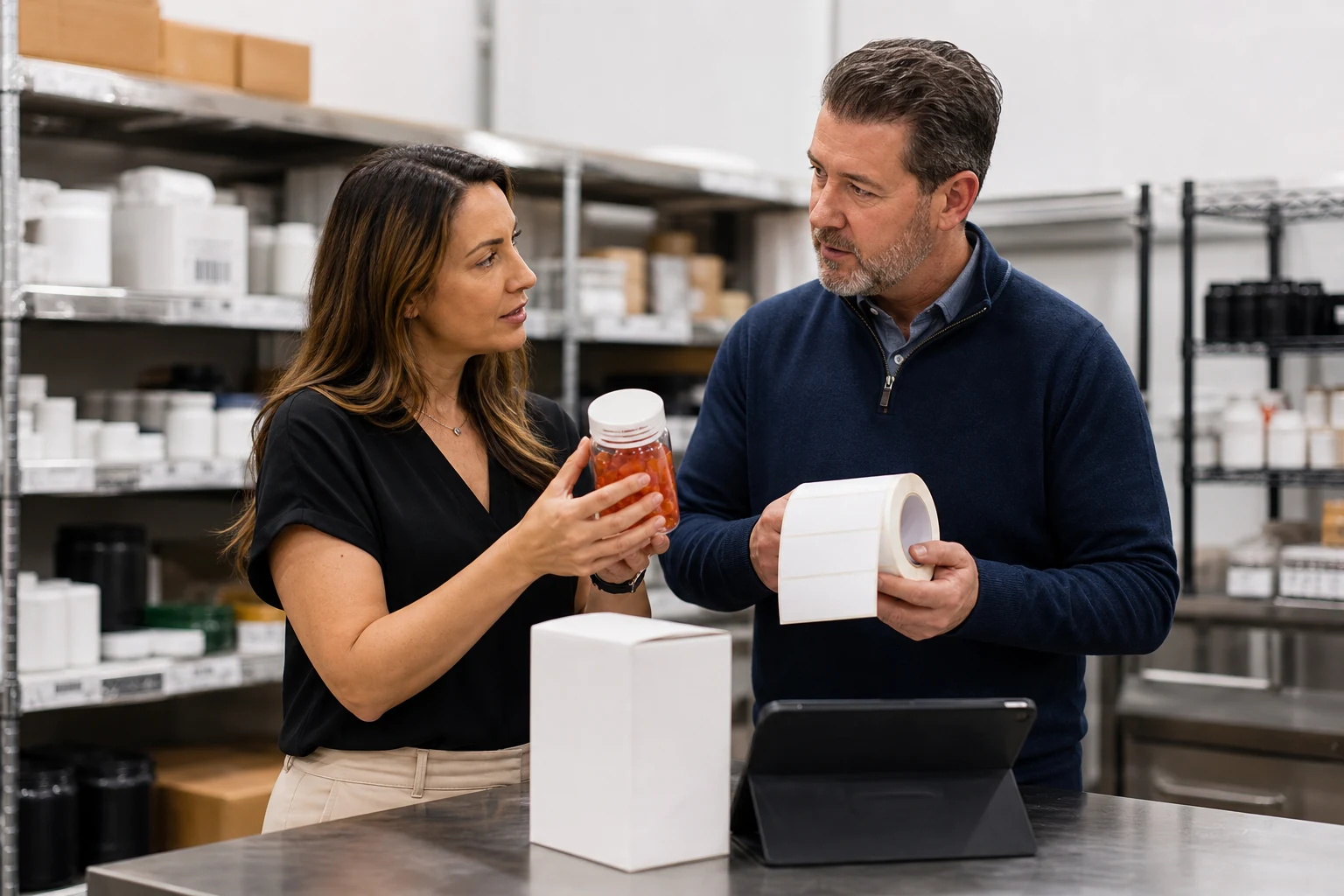
A capable hair, skin, and nails gummy manufacturing partner should define formula feasibility, sample criteria, process controls, documentation, packaging, MOQ assumptions, lead-time dependencies, and scale-up checks before commercial production. Compare the complete route, not only the unit quote.
MOQ, Sampling, Lead Time, and Scale-Up Questions
MOQ is not a standalone number. It can change with stock versus custom formula, ingredient sourcing, flavor and shape, packaging components, print quantities, test scope, and production scheduling. A low-MOQ route may use a market-tested in-stock product, while a highly differentiated formula may need a different commercial commitment.
Sampling should have written acceptance criteria. Taste is one criterion, but not the only one. The review may include appearance, piece weight, chew, aftertaste, surface condition, serving practicality, packaging compatibility, and whether the sample represents the intended active stack.
Lead time should be broken into dependencies rather than presented as one optimistic date:
- Formula and brief review
- Ingredient and packaging availability
- Sample development and feedback
- Label and claim approval
- Testing and documentation planning
- Production scheduling
- Packaging and release
- Export or delivery coordination
Scale-up questions should focus on what changes between sample and production. Ask how piece weight, appearance, moisture, texture, active distribution, and packaging-line behavior will be checked. Confirm how deviations and approved changes are documented. A repeat order should reproduce an agreed specification, not rely on memory.
For a broader view of these capabilities, the gummy vitamin manufacturing service explains how formula planning, private label routes, packaging, and commercial production connect.
Questions to Ask Before Approving a Beauty Gummy Formula
A productive approval meeting uses questions that force tradeoffs into the open. The goal is not to obtain confidential machine settings or an exact recipe. It is to understand whether the formula, evidence, process, and pack are aligned.
| Approval question | Why it matters |
|---|---|
| What is the hero active, and what role does each co-active play? | Prevents an overloaded marketing list |
| Can the target amounts fit the proposed piece weight and serving count? | Exposes active-load and consumer-use pressure |
| Does the sample contain the intended commercial active stack? | Prevents approval of an easier demonstration formula |
| What taste, texture, moisture, and stability risks need monitoring? | Connects sensory approval with shelf performance |
| How are low-dose actives and piece weight controlled in production? | Clarifies consistency and process-control expectations |
| Which in-process and finished-product specifications will be used? | Defines what production and release must meet |
| What COA, batch, traceability, and stability documents are expected? | Prevents documentation surprises after production |
| Has the label claim and biotin warning language been reviewed? | Reduces late artwork and claim changes |
| Is the final packaging compatible with the gummy and filling line? | Connects moisture protection with operational fit |
| Which variables can still change after sample approval? | Establishes change control and resampling triggers |
The answers can be captured in a short approval record:
| Approval area | Record before commercial production |
|---|---|
| Consumer acceptance | Approved flavor, chew, appearance, aftertaste, and serving practicality |
| Formula confirmation | Active stack, serving design, gummy base, and remaining formulation risks |
| Process repeatability | Piece-weight and in-process checks, scale-up variables, and change-control triggers |
| Quality documents | Agreed specifications, testing scope, COA expectations, traceability, and release responsibilities |
| Packaging fit | Final pack direction, moisture-protection assumptions, count/fill behavior, and artwork version |
Strong answers should be specific enough to guide a project but cautious about facts that depend on the final formula, market, and order. Fixed promises made before reviewing those inputs deserve scrutiny.
When to Use Collagen-Biotin, Sugar-Free, or Vegan Beauty Gummy Routes
The best route is the one that matches the brand's primary differentiation without creating unnecessary formula burden.
Choose a collagen-biotin route when collagen is central to the product story and the brand accepts the resulting load, source, taste, serving, and non-vegan implications. The formula should not hide an impractical collagen target behind a long co-active list.
Choose a sugar-free route when sugar positioning is important enough to justify a dedicated sweetener, texture, coating, stability, tolerance, and label review. It should not be added after a standard gummy sample has already been approved.
Choose a vegan beauty route when plant-based positioning is fundamental. Review the source of every component and avoid presenting pectin alone as proof of vegan status. A vegan concept may focus on biotin, vitamin C, zinc, and other suitable actives rather than true animal-derived collagen or keratin.
For early market testing, a stock or lightly modified formula may reduce development time and initial commitment. For moderate differentiation, stock formula modification can adjust selected variables. For a distinct active stack, sensory target, or market position, custom development may be appropriate. The route should be explicit before quote comparison.
FAQ About Hair, Skin, and Nails Gummies
Do hair, skin, and nails gummies actually work?
They can provide the nutrients listed on the label when the product meets its specifications, but visible outcomes are not guaranteed. Benefit language should reflect the exact ingredient, level, evidence, and finished formula. Gummies should not be marketed as treatments for hair loss, skin disease, or nail disorders.
Can hair, skin, and nails gummies be vegan or sugar-free?
Yes, but each is a separate formulation route. Vegan status requires source review across the full formula, not only a pectin base. Sugar-free products need a suitable sweetener system plus texture, moisture, tolerance, coating, and label review.
Can brands combine biotin with collagen, keratin, vitamin C, or zinc?
Yes, when every co-active has a clear role and the combined load fits the serving design. Collagen can create load and mouthfeel pressure, zinc can complicate taste, vitamin C can affect acidity, and keratin may add sourcing or documentation questions.
What should labels say about biotin and lab tests?
The wording should be reviewed for the product's biotin level, target market, and applicable requirements. Supplemental biotin can interfere with some laboratory tests, so warning and consumer-information decisions should be made before artwork approval. Medical questions should be directed to a qualified healthcare professional.
Conclusion
Hair, skin, and nails gummies are most launch-ready when ingredient roles, serving design, claim boundaries, biotin warnings, texture, testing, packaging, and scale-up controls are decided as one product system.
The practical route depends on how much differentiation the brand needs and how much development risk it can carry. As an OEM/ODM gummy manufacturing partner, Talvenda can outline low-MOQ market-tested in-stock gummies, stock formula modification, and custom gummy development, with support for sample planning, packaging and label coordination, documentation expectations, and scale-up. For a useful feasibility review, share the target market, active direction, serving goal, packaging idea, first-order expectation, launch channel, and timing through the Talvenda project brief channel.
[^1]: National Institutes of Health, Office of Dietary Supplements, Biotin - Health Professional Fact Sheet, covering biotin's role, evidence limits, and laboratory-test interactions. [^2]: U.S. Food and Drug Administration, Structure/Function Claims, describing substantiation and notification requirements for dietary supplement structure/function claims and the boundary with disease claims. [^3]: Federal Trade Commission, Health Products Compliance Guidance, covering express and implied health-product claims and the need for competent and reliable scientific evidence. [^4]: U.S. Food and Drug Administration, Biotin Interference with Troponin Lab Tests, describing the risk that biotin can interfere with certain laboratory tests and cause incorrect results. [^5]: Electronic Code of Federal Regulations, 21 CFR Part 111, covering dietary supplement current good manufacturing practice, quality control, packaging, labeling, and recordkeeping requirements.