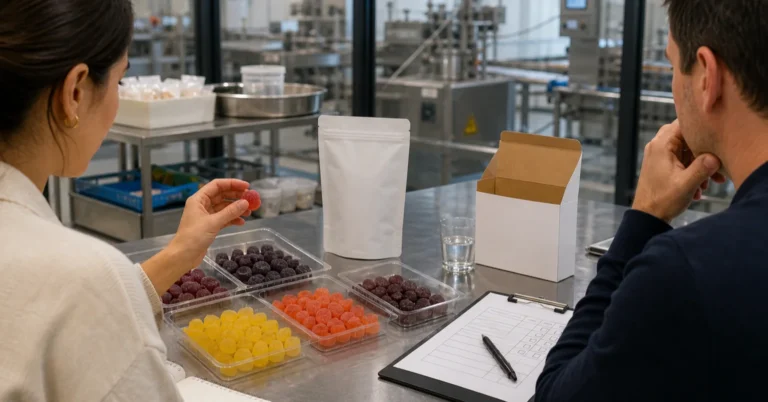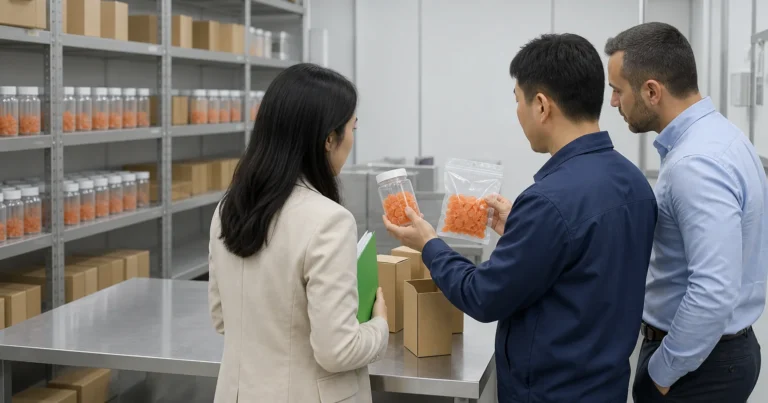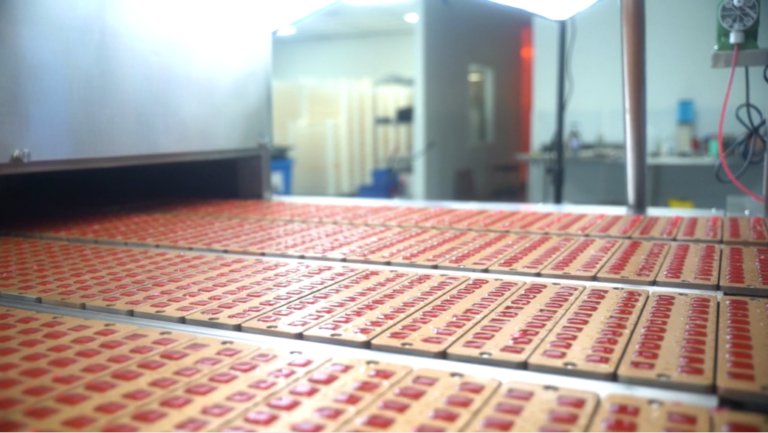


Vegan collagen gummies sound like a simple beauty product. The risk starts when the label suggests collagen, but the formula only supports collagen production.
Vegan collagen gummies are usually collagen booster gummies, not animal collagen peptide gummies. For supplement brands, the safer route is to define the claim first, then build a vegan pectin formula around nutrients, texture, testing, packaging, and label support.
For supplement brands, I view this as a positioning and manufacturing decision before I view it as an ingredient trend. The ingredient stack matters, but the first question is what the brand can say with confidence across formulation, label wording, and gummy product development.
What Are Vegan Collagen Gummies?
The phrase vegan collagen can create confusion fast. If that confusion reaches the label, the formula brief may start from the wrong place.
Vegan collagen gummies are normally plant based collagen support gummies. They do not usually contain animal collagen peptides, so brands should position them as collagen booster, beauty support, or collagen support formulas.
Vegan Collagen vs Collagen Booster
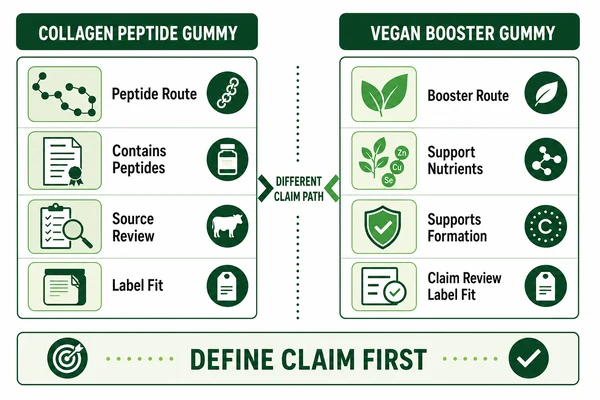
In manufacturing discussions, I usually separate vegan collagen and collagen booster early because they are not the same product idea. A conventional collagen gummy often uses collagen peptides from bovine, marine, or other animal sources.[^1] A vegan collagen booster gummy usually uses nutrients and plant based ingredients that support normal collagen-related nutrition.
This is also why phrases such as collagen gummies vegan, collagen vegan gummies, or vegan collagen boosting gummies should be translated carefully before they reach the label. They can describe market demand, but the technical brief still has to say whether the product is a booster, a support formula, or a documented vegan collagen alternative.
That difference changes the whole commercial brief. If a brand asks for vegan collagen gummies but expects the same claim strength as collagen peptide gummies, the project needs a claim review before sampling. The formula may still be a strong beauty gummy, but the wording has to match what the formula actually contains.
| Product idea | Typical formula direction | Brand risk |
|---|---|---|
| Animal collagen gummy | Collagen peptides plus support nutrients | Source, taste, dose, texture, and allergen review |
| Vegan collagen booster gummy | Vitamin C, biotin, zinc, silica, amino acids, hyaluronic acid, and plant extracts | Overstating the presence of collagen |
| Vegan beauty gummy | Broader skin, hair, nail, or beauty support formula | Losing collagen-support clarity |
| Vegan collagen alternative or fermentation-derived route | Specialized ingredient route when available and documented | Higher sourcing, cost, claim, and documentation review |
For most supplement brands, "collagen booster" is the cleaner commercial route. It lets the product explain what it supports without pretending to be an animal collagen peptide product.
Why This Claim Boundary Matters
The claim boundary matters because it controls the formula, label, testing plan, packaging brief, and product page language. A shopper may read "vegan collagen" and assume the gummy contains collagen. A brand team may use the phrase because the market uses it. A manufacturer then receives a brief that is commercially attractive but technically unclear.
The safer sequence starts from the label and works backward. First define the front-panel wording. Then define the ingredient support for that wording. Then decide which ingredients belong in the gummy. This order protects the product from becoming a beauty gummy with a risky name.
A practical claim path may use wording such as "collagen booster," "collagen support," or "supports normal collagen formation," depending on the target market and formula. The final wording still needs market-specific review. But the manufacturing team needs the direction early, because claim language affects active selection, dose targets, finished-product testing, and documentation.
Why Product Pages Can Mislead Buyers
Many buyers first meet this category through product labels, product pages, and short marketing claims. They may see the phrase vegan collagen before they see a clear explanation of what the formula contains. Some products use "vegan collagen" as a short market phrase. Others use "collagen boosting" more carefully. This wording gap is where buyer confusion begins.
For B2B brands, that confusion is useful but risky. It shows demand, but it also shows that the product cannot be built from benefits language alone. A brand needs to turn consumer interest into a claim-safe, manufacturable gummy brief.
Product page wording should be checked after the label direction is clear. The page should not promise a collagen peptide effect if the formula only contains support nutrients. It should explain the ingredient logic in plain language, then connect that logic to a reasonable beauty support position.
What Ingredients Usually Support a Vegan Collagen Gummy?
Ingredient lists can look impressive and still fail in production. A vegan beauty gummy needs a stack that supports the claim and survives the gummy format.
A vegan collagen gummy usually uses a support stack such as vitamin C, zinc, biotin, silica, bamboo extract, amino acids, hyaluronic acid, and plant extracts in a vegan pectin base.
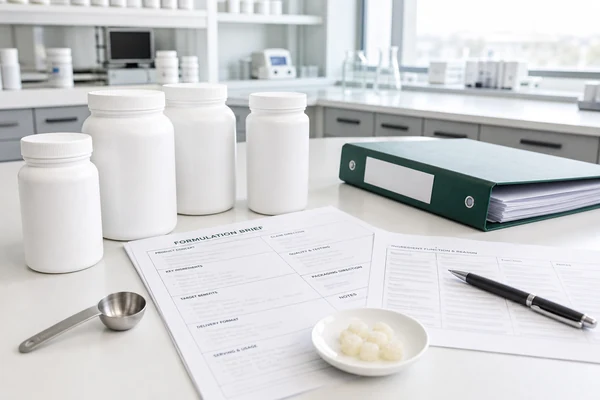
Vitamin C, Zinc, and Biotin
Vitamin C is often the strongest foundation ingredient in this category because it gives the brand a clearer collagen support angle.[^2] It also fits consumer understanding of beauty and skin support. In a gummy, however, vitamin C is not just a label ingredient. It affects acidity, taste, active stability, and the overall acid system, so it belongs in the broader vitamin C gummy formulation review.
Zinc and biotin are common companions. Zinc can support beauty and wellness positioning, but it can bring metallic notes that need flavor masking. Biotin is used at lower levels, so the main production concern is accurate distribution and label review rather than taste.[^3]
| Ingredient | Why brands use it | Manufacturing check |
|---|---|---|
| Vitamin C | Collagen support positioning | Acid balance, taste, active stability, and label claim support |
| Zinc | Beauty and wellness support | Metallic notes, serving level, and uniform mixing |
| Biotin | Hair, skin, and nails positioning | Low-dose accuracy and market-specific label review |
The formula should not start by adding every popular beauty nutrient. More ingredients can make the label look stronger, but they also add taste, color, solubility, cost, dose, and stability pressure. A cleaner formula can be easier to explain and easier to manufacture.
Silica, Bamboo, and Plant Extracts
Silica and bamboo extract often appear in vegan collagen booster formulas because they give the product a plant based beauty-support identity. Bamboo extract can also help the product feel more different from a standard vitamin gummy. The brand should still confirm the ingredient specification, active marker, origin, allergen statement, and documentation.
Plant extracts add story value, but they are not free from manufacturing cost. Some bring bitterness. Some affect color. Some are insoluble and can create visible speckling. Some require more careful sourcing documents. In a gummy, a plant extract should be judged by its behavior in the matrix, not only by its marketing story.
For a custom formula, the brand should rank ingredients by claim importance. If bamboo extract is central to the story, it should stay. If it is only added because similar products use it, the formula team should question whether it creates enough value for the taste, cost, and stability load.
Amino Acids and Hyaluronic Acid
Amino acids can fit a collagen booster concept because collagen itself is built from amino acids. But the label has to stay careful. Adding amino acids does not turn a vegan gummy into a collagen peptide product. It only gives the formula another support layer.
Hyaluronic acid is common in beauty-from-within concepts because consumers already connect it with skin hydration.[^4] In gummies, it still needs practical review. The team should check dosage target, ingredient grade, taste impact, moisture behavior, and finished-product specification.
Hyaluronic acid can influence moisture behavior because it attracts water. That does not make it unsuitable. It means the packaging and stability plan need to match the ingredient profile. A formula that includes amino acids, plant extracts, vitamin C, and hyaluronic acid should be reviewed as a full system, not as isolated ingredients.
The best ingredient stack is not the longest stack. It is the stack that supports the intended wording, fits the serving format, tastes acceptable, and gives the quality team a realistic testing plan.
Can Vegan Collagen Gummies Actually Work?
When I review a vegan collagen gummy concept, I first define what "work" means on the label, in the formula brief, and in the buyer's expectation.
Vegan collagen gummies can be credible when they are positioned as collagen support or beauty support products. Brands should avoid promising that they replace animal collagen peptides or deliver specific visible results.

What Brands Can Say Safely
Safe wording starts with the formula. If the product includes vitamin C, a brand may have a clearer path to collagen formation support language, subject to market rules. If the formula includes biotin and zinc, it may support broader beauty or hair, skin, and nails positioning. If the formula includes plant extracts, silica, amino acids, or hyaluronic acid, the wording may need more careful review because claim support can vary.
The strongest claim language does not make the gummy do more work than the ingredients can support. I would rather see a brand use a narrower claim that matches the formula than a broader beauty promise that becomes hard to defend. A brand can usually explain that the product is a vegan collagen booster, vegan collagen support gummy, or plant based beauty gummy. It can describe the nutrient stack. It can explain that the formula is designed to support normal beauty nutrition needs.
The final claim should still be reviewed for the target market. A US label, UK label, EU label, and export label may not use the same wording. That is why the supplier brief should include the launch market early.
What Needs Evidence
Any result-style claim needs stronger support than a general product concept.[^5] Claims about firmer skin, thicker hair, stronger nails, reduced wrinkles, or visible changes after a fixed number of days can raise substantiation and compliance questions. If the brand wants this kind of message, the evidence plan must be discussed before production, not after the label is designed.
It helps to divide claims into three working levels.
| Claim level | Example direction | Practical action |
|---|---|---|
| Category education | "plant based collagen booster gummy" | Check wording and formula fit |
| Nutrient support | "supports normal collagen formation" | Match ingredient, dose, market rules, and label wording |
| Result claim | "skin appearance support" | Requires stronger review and product-level support |
The manufacturer should not be asked to solve a claim that the formula cannot support. The brand, regulatory reviewer, and production partner need the same claim direction before samples start. This is especially important for private label projects where the brand may want fast market entry but still needs defensible wording.
What Not to Promise
Brands should not promise that vegan collagen gummies contain animal-free collagen unless the ingredient is truly a documented vegan collagen material and the claim is reviewed for the market. Most products in this category are boosters, not direct collagen replacements. A collagen vegan substitute message is especially sensitive because it can sound like direct replacement; in most briefs, vegan collagen alternative or collagen support wording is easier to defend.
Brands should also avoid fixed result timelines. A gummy label should not promise visible results in a set period unless the brand has appropriate support for that exact formula and claim. Even then, wording must match the market.
The product should also avoid medical-sounding language.[^6] Beauty gummies are supplement products. They can support nutritional positioning, but they should not be written like treatment products. This boundary protects the brand and keeps the product easier to defend with retailers, distributors, and internal quality teams.
Vegan Collagen Gummies Formulation Checks Before Production
A vegan collagen booster formula can look easy on paper. In gummy manufacturing, the base system, acid load, moisture plan, and packaging often decide whether it can scale.
Before production, brands should review pectin texture, active compatibility, taste masking, acid balance, sweetener system, moisture stability, and packaging protection for the vegan collagen gummy concept.
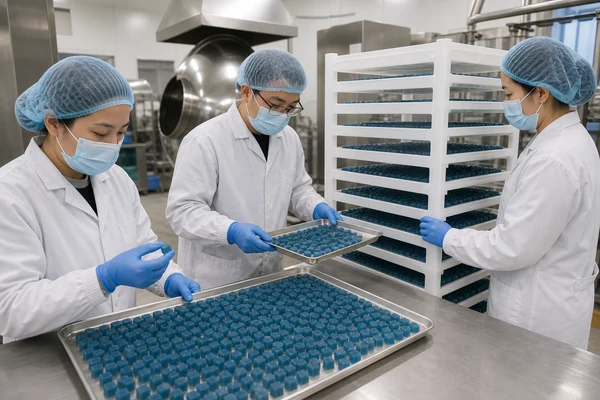
Pectin Base and Texture
A vegan gummy usually points toward a pectin base rather than gelatin. Pectin can support vegan positioning, but it behaves differently from gelatin.[^7] Texture, bite, setting behavior, acid balance, solids level, drying, and packaging protection all need attention.
The brand should not assume that a gelatin collagen gummy can be converted into a vegan booster gummy by changing only the gelling agent. Pectin systems often need their own formula design. The acid system, sweetener system, active load, and flavor profile may need adjustment together.
Pectin gummies can be sensitive to the total formula system. Acidic nutrients, plant powders, minerals, and sugar-free sweeteners can affect gel strength, mouthfeel, drying, and stickiness. A bench sample may look acceptable, but the commercial batch still needs pilot confirmation because setting time, depositing behavior, cooling, and drying can change the final texture.
| Formulation variable | Why it matters | What to review |
|---|---|---|
| Pectin route | Vegan base and texture | Bite, set behavior, demolding, and stickiness |
| Acid system | Taste and gel performance | Sourness, pH direction, active compatibility |
| Active load | Claim support and serving size | Gummy size, texture impact, uniform distribution |
| Sugar-free route | Label position and mouthfeel | Moisture behavior, texture, aftertaste, serving tolerance |
For a beauty gummy, texture also affects brand perception. A soft gummy may feel premium at first but become sticky if moisture control is weak. A firmer gummy may travel better but feel less indulgent. The right texture depends on market, packaging, active load, and shelf-life expectations.
Taste, Acid, and Sweetener System
Beauty formulas often combine acidic vitamins, mineral notes, plant extracts, and fruit flavors. This can work well, but it needs a taste plan. Vitamin C can support claim language, yet it can also push sourness. Zinc can bring metallic notes. Plant extracts can add bitterness or color changes. Amino acids can add savory or bitter notes.
Sugar-free positioning adds another layer. Sugar alcohols, fibers, or other sweetener systems can change texture, drying behavior, mouthfeel, and digestive tolerance messaging.[^8] A sugar-free vegan collagen booster gummy is possible, but it should be handled as a separate formulation route, not a simple sugar swap.
For equipment-side context, GummyGeniX has a related guide on pectin and sugar-free gummy production options that can help teams translate this formula route into line-planning questions.
The brand should define taste priority early. Does the product need a clean berry profile, a citrus beauty profile, a low-sugar profile, or a more premium botanical profile? The answer changes flavor, acid, color, sweetener, and packaging decisions.
Taste optimization should not happen after the base is locked. In pectin gummies, acid, sweetness, active ingredients, and texture are connected. Changing the acid system after the base has been approved may require another texture and stability check.
Stability, Moisture, and Packaging
Gummies live with moisture. That is why packaging should be discussed before the formula is locked. A plant based beauty gummy may need moisture control, barrier packaging, induction sealing, desiccant review, retain samples, and finished-product checks depending on the formula and market.
Stability is not only about whether the gummy melts. It also includes texture shift, stickiness, active content, color, flavor, microbial limits, and label claim support over time. The more complex the formula, the more important the testing plan becomes.
For a vegan collagen booster product, formulation and packaging should be reviewed together.
| Decision | Why it matters | What to confirm |
|---|---|---|
| Pectin base | Vegan positioning and texture | Bite, setting, acid tolerance, drying behavior |
| Sweetener route | Sugar claim and mouthfeel | Texture, moisture, taste, label wording |
| Packaging | Shelf-life protection | Barrier, seal, desiccant, storage expectations |
| Testing plan | Claim and quality support | COA items, active checks, microbial checks |
This is where Talvenda's production-first view becomes useful. A formula that looks attractive in a concept deck still needs to behave in the kettle, on the line, in the bottle, and during storage.
Label, Testing, and Supplier Brief Checklist
Many launch problems start before the first sample. The supplier brief is often too vague, so the first formula round answers the wrong question.
A strong vegan collagen gummy brief should define claim wording, ingredient priorities, allergen limits, serving format, base route, sugar requirements, testing needs, packaging direction, and launch market.
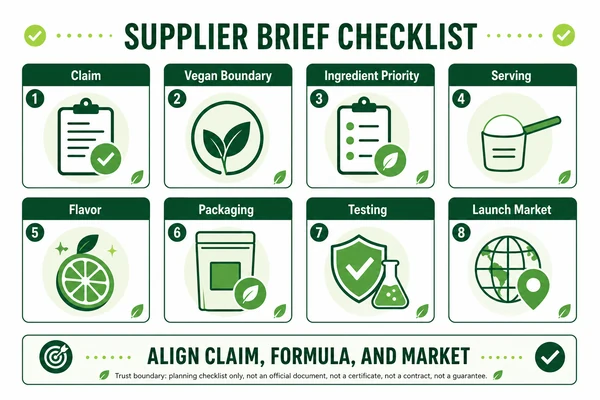
Claim and Allergen Review
The label review should start with the name of the product. If the brand uses "vegan collagen gummies," "vegan collagen support gummies," or similar wording, the back label, claims, and ingredient list should make clear whether the product contains collagen or supports collagen production. This reduces consumer confusion and gives the manufacturer a cleaner target.
Allergen review also matters.[^9] Vegan positioning can create higher expectations around animal-derived ingredients, gelatin, dairy, shellfish, and sometimes colorants or processing aids. If the product is intended for vegan buyers, the brand should tell the manufacturer which ingredient boundaries are required.
A useful claim and allergen brief should include:
- Target launch market.
- Front-panel product name and claim direction.
- Required vegan, vegetarian, gelatin-free, dairy-free, or other ingredient boundaries.
- Ingredients that are required, flexible, or optional.
- Claims that should not be used.
- Any retailer or distributor documentation requirements.
- Whether shared-line or cross-contact review is required.
The point is not to make the brand solve every compliance question alone. The point is to give the manufacturer and reviewer a clear starting point, so the first sample is built around the right commercial promise.
COA and Finished-Product Testing
A raw material COA is useful, but it is not the whole quality story. A finished gummy needs its own quality file. Depending on the product, that may include finished-product COA, active checks, microbial limits, heavy metal review, moisture or water activity checks, and retain-sample planning.
The key question is traceability. Can the brand connect the ingredient records, batch record, finished-product test, lot number, packaging record, and label claim? If yes, the product is easier to defend in buyer conversations. If no, the claim may depend too much on broad marketing language.
For vegan collagen booster gummies, testing should match the claims. If vitamin C is central, the test plan should consider that active. If zinc or biotin is central, dosage accuracy and low-level mixing control become important. If the brand uses botanical extracts, ingredient identity and specification review may need more attention.
Finished-product testing should be discussed before production.[^10] If the brand waits until after the batch is made, the test plan may not match the label claim, retailer requirement, or export file.
What to Send a Manufacturer
The best first supplier brief is specific but not overdesigned. I would not ask a brand to solve the full formula alone, but I would ask it to define the commercial target, claim boundaries, ingredient priorities, and launch constraints.
Before asking for a quote, a brand should prepare these items:
- Working product name and product concept.
- Primary claim direction and forbidden claim language.
- Required vegan, allergen, sugar-free, or clean-label boundaries.
- Ingredient priority list, ranked as must-have, flexible, or optional.
- Target serving format and gummies per serving preference.
- Flavor direction and color preference.
- Bottle count, packaging style, and label direction.
- Target market and documentation expectations.
- Testing requirements or retailer requirements if known.
- Preferred route: stock review, custom R&D, staged pilot, or full custom launch.
This is where the project becomes practical for Talvenda. Talvenda can help review whether the product idea should stay as a vegan collagen booster, shift into a broader vegan beauty gummy, or become a different collagen-related SKU with clearer claim support. The same review can translate the brief into formula feasibility, sample planning, packaging review, COA needs, and production-ready documentation.
FAQ
Are vegan collagen gummies real collagen?
Most vegan collagen gummies are not real animal collagen peptide gummies. They are usually collagen booster or collagen support gummies made with nutrients, amino acids, plant extracts, or beauty ingredients in a vegan gummy base.
Can vegan collagen gummies be sugar free?
Yes, vegan collagen gummies can be sugar free, but the sweetener system must be reviewed with texture, moisture, taste, label wording, and packaging. Sugar-free is a formulation route, not a simple ingredient swap.
Can brands combine vegan collagen boosters with biotin?
Yes, brands can combine vegan collagen booster concepts with biotin when the claim direction, dosage, taste, and label wording make sense. Biotin often fits hair, skin, and nails positioning, but the final claim still needs review.
Conclusion
Vegan collagen gummies work best as claim-safe booster formulas, not vague replacements for animal collagen peptides. Start with label wording, then review ingredients, pectin base, texture, packaging, and testing.
Talvenda can support this process before sampling or production by helping brand teams turn a vegan beauty concept into a clearer manufacturer brief. That includes formula feasibility, active compatibility, sugar-free or pectin route review, COA and testing expectations, packaging direction, and documentation planning for private label or custom gummy projects.
[^1]: "Collagen", Harvard T.H. Chan School of Public Health, https://nutritionsource.hsph.harvard.edu/collagen/. elink returned this professional third-party source for collagen category and source-context boundaries. [^2]: "Vitamin C - Health Professional Fact Sheet", NIH Office of Dietary Supplements, https://ods.od.nih.gov/factsheets/VitaminC-HealthProfessional/. elink returned this NIH ODS source for conservative vitamin C and collagen biosynthesis context. [^3]: "Biotin - Health Professional Fact Sheet", NIH Office of Dietary Supplements, https://ods.od.nih.gov/factsheets/biotin-healthprofessional/; "Zinc - Health Professional Fact Sheet", NIH Office of Dietary Supplements, https://ods.od.nih.gov/factsheets/Zinc-HealthProfessional/. elink returned these NIH ODS sources for nutrient-context support without turning the content into a claim guide. [^4]: "Oral administration of hyaluronic acid to improve skin conditions via intestinal bacteria maintenance", https://pmc.ncbi.nlm.nih.gov/articles/PMC10661223/. elink returned this PMC candidate for cautious oral hyaluronic acid beauty-from-within context. [^5]: "Health Products Compliance Guidance", Federal Trade Commission, https://www.ftc.gov/business-guidance/resources/health-products-compliance-guidance/. elink returned this FTC source for claim-substantiation boundaries around result-style messages. [^6]: "Small Entity Compliance Guide on Structure/Function Claims", U.S. Food and Drug Administration, https://www.fda.gov/regulatory-information/search-fda-guidance-documents/small-entity-compliance-guide-structurefunction-claims/. elink returned this FDA source for avoiding disease/treatment-style supplement language. [^7]: "Pectin Hydrogels: Gel-Forming Behaviors, Mechanisms, and Food Applications", https://pmc.ncbi.nlm.nih.gov/articles/PMC10530747/. elink returned this PMC source for pectin gel-system context. [^8]: "Physicochemical and Sensory Stability Evaluation of Gummy Candies", https://pmc.ncbi.nlm.nih.gov/articles/PMC10818720/; "Gastrointestinal Disturbances Associated with the Consumption of Sugar Alcohols", https://pmc.ncbi.nlm.nih.gov/articles/PMC5093271/. elink returned these PMC sources for sugar-free gummy formulation and sugar-alcohol tolerance context. [^9]: "Food Allergens and Gluten-Free Guidance & Regulatory Information", U.S. Food and Drug Administration, https://www.fda.gov/food/guidance-documents-regulatory-information-topic-food-and-dietary-supplements/food-allergensgluten-free-guidance-documents-regulatory-information/. elink returned this FDA source for allergen-review context. [^10]: "Current Good Manufacturing Practices (CGMPs) for Food and Dietary Supplements", U.S. Food and Drug Administration, https://www.fda.gov/food/guidance-regulation-food-and-dietary-supplements/current-good-manufacturing-practices-cgmps-food-and-dietary-supplements/; "21 CFR Part 111 - Current Good Manufacturing Practice in Manufacturing, Packaging, Labeling, or Holding Operations for Dietary Supplements", eCFR, https://www.ecfr.gov/current/title-21/chapter-I/subchapter-B/part-111/. elink returned these official sources for finished-product testing, specifications, and production-record context.