


Powder and gummies can both deliver collagen, but they solve different product problems.
Powder usually fits brands that need higher collagen load and lower cost per gram. Gummies fit brands that need convenience, taste, portability, and repeat use. A strong collagen gummy should not pretend to be a scoop of powder in candy form.

The mistake I see most often is positioning gummies and powder as interchangeable delivery systems. They are not. Both can use collagen peptides. Both can sit in a beauty or wellness line. But the serving math, ingredient space, packaging behavior, claim boundaries, and consumer routine are different.
Decision Snapshot
- Choose powder when collagen load, clean labels, and cost per gram are the main selling points.
- Choose gummies when convenience, taste, portability, and repeat use matter more than maximum collagen dose.
- Compare formats by serving math, ingredient space, label clarity, and real use behavior.
- Keep dosage, formulation, marine, vegan, and sugar-free questions as linked supporting topics, not the main lane.
- Before sampling a collagen gummy, align active load, texture, sweetener direction, packaging route, and claim boundaries.
What Are Collagen Gummies and Collagen Powder?
Before comparing formats, it helps to separate the collagen ingredient from the product format. The ingredient may be similar, but the product constraints are not.
Collagen powder is usually a concentrated dry collagen peptide format designed to mix into liquid. Collagen gummies are chewable supplements that combine collagen with a gummy base, sweeteners, flavors, and texture-building ingredients. Powder gives more room for collagen; gummies give less friction in daily use.

What Collagen Does in the Body
Collagen is a structural protein found in skin, joints, tendons, ligaments, bones, and other connective tissues. Many consumers associate collagen supplements with beauty, skin support, hair and nail routines, and joint wellness. Most commercial collagen supplements use hydrolyzed collagen peptides because they are easier to formulate and digest than intact collagen.
For product development, the important point is that collagen is a high-load ingredient. A meaningful collagen serving takes up physical space. Powder can usually carry that space more easily. A gummy has to reserve room for the gel system, sweeteners, flavors, acids, moisture control, and texture. That physical reality shapes the whole comparison.
What Are Collagen Gummies?
Collagen gummies are chewable supplements made with collagen peptides and a gummy matrix. The base may use gelatin, pectin, or another gelling system. The formula also needs sweeteners, flavor, acids, color, moisture control, and process stability.
The advantage is convenience. A consumer can take gummies without water, a shaker, or a mixing step. The product feels approachable and easy to repeat. The tradeoff is formula space. Collagen has to compete with everything that makes the gummy chewable and shelf-stable. That is why the full formula-space discussion belongs on collagen gummies formulation while this comparison stays focused on format choice.
What Is Collagen Powder?
Collagen powder is a dry supplement format designed to mix into water, coffee, smoothies, or food. It can be unflavored or flavored. Many powders keep a short ingredient list because the format does not need a gummy base or sweetener system.
Powder is the clearer choice when the product needs to lead on collagen amount per serving. The consumer accepts a preparation step in exchange for a larger collagen load and usually a lower cost per gram. That makes powder strong for dose-led positioning, but less strong for consumers who dislike mixing, forget powders, or want a portable routine.
For brand planning, powder source also matters. A collagen powder may be positioned around bovine, marine, grass-fed, or branded collagen peptide inputs, but the source decision should be separated from the format decision. Powder usually gives more room for a source-led, higher-load collagen story; gummies need the same source choice to work inside taste, texture, moisture, and stability limits.
Collagen Gummies vs Powder: The Core Differences
The core differences affect more than the Supplement Facts panel. They change the brand promise, product economics, packaging route, and how the consumer uses the product after the first purchase.
Powder is stronger on collagen load, cost per gram, and simple labels. Gummies are stronger on convenience, taste, portability, and daily routine fit. Neither format wins every dimension. The right choice depends on the role the SKU is meant to play.

Collagen Content per Serving
Collagen content per serving is the first serious difference. Powder can usually carry more collagen because most of the serving can be collagen peptide. Gummies have less available space because the gummy itself needs a base structure.
| Decision factor | Collagen gummies | Collagen powder |
|---|---|---|
| Collagen load | Lower and format-constrained | Higher and easier to scale |
| Serving flexibility | Fixed by gummy count | Flexible by scoop size |
| Formula space | Limited by gel matrix and taste | Much wider |
| Source/type positioning | Possible, but harder to carry at high load | Easier to lead with bovine, marine, grass-fed, or branded peptide positioning |
| Best role | Daily habit and convenience | Maximum collagen delivery |
When I review a collagen gummy concept, I look at the serving math before the claim language. If the product promise depends on powder-level collagen delivery, the gummy format is already under pressure. A better gummy concept starts with what the formula can honestly carry, then builds the label and positioning around that number.[^1] For a more detailed serving discussion, use collagen gummies dosage as the deeper internal resource instead of turning this format comparison into a dosage guide.
Ingredients, Sweeteners, and Additives
Collagen powder can often keep a short ingredient panel. An unflavored powder may be mostly collagen peptides. A flavored powder may add flavoring, sweetener, or supporting actives, but the format can still stay relatively simple.
Gummies need a longer ingredient system. The gel base, sweeteners, acids, flavors, colors, and moisture-control ingredients are not decoration. They are what make the product chewable, stable, and pleasant. This creates more label work and more consumer questions around sugar, sweeteners, and additives.
That does not make gummies a weaker format by default. It means the brand has to decide whether the target consumer values the convenience and sensory experience enough to accept a longer ingredient list. If sugar content becomes a major positioning issue, that topic should move to sugar-free collagen gummies rather than being over-expanded here.
Convenience, Taste, and Daily Routine Fit
This is where gummies have a real commercial advantage. A gummy is ready to take in seconds. It can sit on a desk, in a handbag, in a travel kit, or next to a morning skincare routine. The format turns supplementation into a small daily action instead of a preparation step.
Powder works well for consumers who already like mixing supplements into drinks. It fits smoothie routines, coffee routines, and sports nutrition habits. But the mixing step is still friction. Some consumers stop taking powders not because they dislike collagen, but because the daily behavior is too easy to skip.
This is why I would not ask whether gummies can beat powder on grams. I would ask whether gummies can help a specific consumer use the product more consistently. That is the honest commercial lane for the format.
Packaging, Portability, and Usage Occasions
Powder is usually packaged in tubs, pouches, or stick packs. Tubs and pouches work well for home use and larger serving counts. Stick packs improve portability but add packaging cost and may change the pricing strategy.
Gummies usually use bottles or stand-up pouches. They are easier to carry and easier to place into daily routines. That matters for beauty and wellness positioning, where the product is often tied to morning habits, travel, office use, or self-care routines.
Packaging also affects perceived value. A well-designed gummy bottle can feel premium even if the collagen amount per serving is lower than powder. That premium only works when the label is transparent and the product experience supports the price.
Are Collagen Gummies as Effective as Powder?
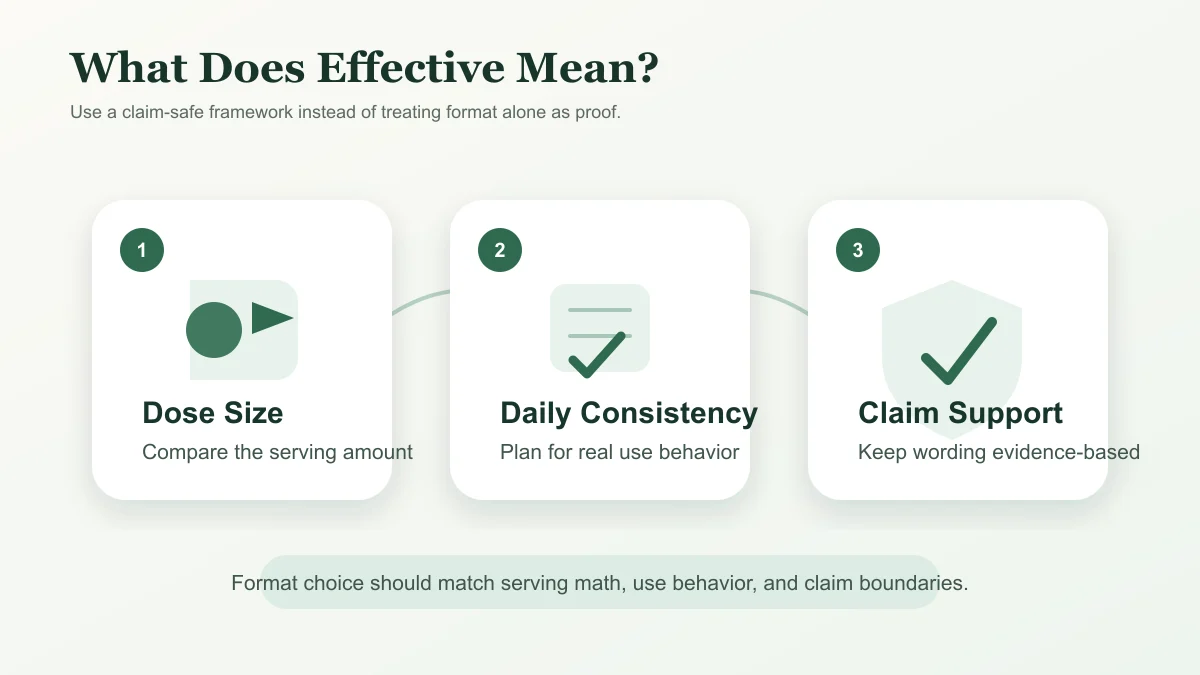
This question needs careful wording because "effective" can mean several things: active amount per serving, consistency, consumer satisfaction, or claim support.
Powder usually has the advantage if effectiveness is measured by collagen per serving. Gummies may still work well for consumers who take them more consistently. Brands should explain the difference instead of saying the two formats are automatically equal.
Why Dose Size Matters More Than Format Alone
Dose size is the first filter. A lower-load gummy serving should not be described as equivalent to a higher-load powder serving just because both use collagen peptides. If a consumer compares products by active amount, powder usually has the structural advantage.
For brands, the risk is not launching a collagen gummy. The risk is launching a gummy with powder-style expectations. If the serving size is modest, the product should be positioned around routine, taste, and convenience. If the brand wants a maximum-dose promise, powder is usually the cleaner format.
Absorption and Bioavailability: What Brands Can Reasonably Claim
Both powder and gummies can use hydrolyzed collagen peptides. The format alone is not a strong basis for claiming superior absorption. A brand should not say a gummy is more bioavailable than powder, or that powder absorbs better by default, unless the claim is backed by direct evidence for that specific product and comparison.[^2]
The safer approach is to discuss what the product actually controls: collagen content per serving, transparent source information, supporting ingredients, and realistic use expectations. Claims about visible results, timing, skin elasticity, joint outcomes, or clinical superiority should be treated as source-pass items before publication.[^3]
Why Gummies May Support Consistency for Some Users
Consistency is the main reason gummies can still be a strong product. A consumer who dislikes mixing powder may skip it often. A consumer who enjoys a gummy may take it every day. In real life, behavior matters.
I would not use consistency to hide the dose difference. I would use it to define the product role. A collagen gummy can be a convenience-led beauty SKU. It can make a routine easier to maintain. That is a valid value proposition when the label is honest and the claims do not imply powder-level collagen delivery.
Collagen Gummies vs Powder: Cost and Value Comparison
Cost comparison depends on what you are measuring. Cost per serving and cost per gram of collagen are not the same thing.
Powder usually wins on cost per gram of collagen. Gummies can still win on perceived value when the consumer is paying for convenience, taste, portability, and a product they are more likely to finish.

Cost per Serving vs Cost per Gram of Collagen
A gummy and a powder may look similar when compared by daily serving price, but powder usually delivers more collagen inside that serving. That means powder often wins on cost per gram of collagen even when the retail price looks comparable.
| Value lens | Powder usually wins | Gummies can win |
|---|---|---|
| Cost per gram of collagen | Yes | Rarely |
| Cost per daily serving | Depends on formula and pack size | Depends on formula and pack size |
| Convenience value | Moderate | High |
| Sensory value | Lower | Higher |
| Beauty/wellness routine fit | Moderate | High |
This is why brands should not sell gummies as the cheapest way to buy collagen. Gummies are usually selling a different kind of value.
Why Powder Often Wins on Collagen Load
Powder wins on load because the format is simple. It does not need to be chewable. It does not need a moist gel matrix. It does not need to balance sweetness, texture, and active load in a small piece.
That makes powder the logical choice for brands that want collagen-load leadership. The message is direct: more collagen per serving, simpler label, and stronger value per gram.
Why Gummies Can Still Win on Perceived Value
Gummies can win when the consumer values the product experience. Taste, portability, packaging, and habit formation can justify a premium if the product delivers those benefits well.
The key is transparency. A gummy should not hide behind vague wellness language. The label should make the collagen amount clear.[^4] The positioning should focus on convenience and repeat use. If the product earns that role, it can be commercially strong even when powder wins the cost-per-gram calculation.
Collagen Gummies vs Powder: Pros and Cons of Each Format
Every format has strengths and tradeoffs. The right question is not "which one is better," but "which one fits this brand promise and this buyer behavior?"
Powder is strongest for higher collagen load, clean labels, and dose-led positioning. Gummies are strongest for convenience, sensory experience, and repeat-use behavior. Pills sit between them, offering compactness but limited collagen capacity and less sensory appeal.

Collagen Powder: Strengths and Tradeoffs
Powder's strengths are collagen load, cost efficiency, and formula simplicity. It works for consumers who are willing to mix a supplement and who care about the amount of collagen they receive per serving.
The tradeoff is convenience. Powder is not as portable as gummies, and it can feel like one more task in the day. It also has less sensory appeal unless the brand invests heavily in flavor and mixability.
Collagen Gummies: Strengths and Tradeoffs
Gummies are convenient, portable, pleasant, and easy to repeat. They fit beauty and wellness routines well, especially when the consumer wants a supplement that feels simple instead of clinical.
The tradeoff is active load. Gummies also require more formulation control because texture, sweetness, moisture, active content, and shelf behavior all have to work together. If a brand wants to explore gel-system decisions, pectin vs gelatin gummies is the more appropriate internal link. If the brand is considering source-specific positioning, marine collagen gummies and vegan collagen gummies should stay as separate variant topics.
If the brand wants to highlight marine collagen, bovine collagen, grass-fed collagen peptides, or a branded peptide input, the gummy format needs an extra feasibility check. The source may support the story, but the finished gummy still has to pass active-load, taste, texture, moisture, shelf-life, and label-claim review.
Where Pills Fit in the Format Comparison
Collagen pills and capsules offer compactness without sugar or flavor. They may appeal to consumers who dislike powders but do not want gummies.
The limitation is serving burden. Collagen is bulky, and a meaningful serving may require multiple capsules. Pills also lack the sensory experience that helps gummies build a repeatable habit. They are useful in some product lines, but they should not be positioned as the same consumer promise as gummies.
Which Format Should a Supplement Brand Choose?
Format choice is a product strategy decision. The right choice depends on what the SKU is supposed to do for the brand and the consumer.
Choose powder for collagen-load leadership. Choose gummies for convenience-led beauty and wellness routines. Use pills when compactness matters more than sensory experience. Above all, make the format promise match the label reality.

Choose Powder When Maximum Collagen Load Is the Priority
Choose powder when the brand wants to lead with grams of collagen per serving, a simple ingredient list, and a value-per-gram story. This format fits consumers who already accept a mixing step and who read labels for active amount.
Powder is also stronger when the brand needs more room for supporting actives or a cleaner high-load formulation. It is usually the cleaner route for a dose-led collagen concept.
Choose Gummies When Convenience and Repeat Use Matter More
Choose gummies when the brand wants a daily beauty or wellness habit. This format fits consumers who value taste, portability, and a low-friction routine.
When I look at collagen gummies, I see a different SKU role, not a weaker powder. The opportunity is not to beat powder on maximum dose. The opportunity is to create a product people are willing to take consistently, with a label and claim level that match the serving math.
Use Format Positioning to Avoid Overpromising
The most important rule is to keep the promise inside the format's capability. A gummy should not sound like a scoop of powder. A powder should not pretend to be as effortless as a gummy.
For product planning, I would separate the roles clearly:
| Format | Best brand role | Main risk |
|---|---|---|
| Powder | Collagen-load leadership | Routine friction |
| Gummies | Convenience-led beauty habit | Overpromising dose |
| Pills/capsules | Compact practical option | High pill count and low sensory value |
This separation helps the product line make sense. It also prevents internal cannibalization when a brand offers more than one collagen format.
Frequently Asked Questions About Collagen Gummies vs Powder
Are collagen gummies as effective as powder?
Powder usually delivers more collagen per serving, so it has the advantage when effectiveness is measured by active amount. Gummies may still be useful for consumers who take them more consistently because they are easier and more pleasant to use. Brands should explain this distinction clearly instead of claiming the two formats are automatically equal.[^2]
Can you take collagen gummies and powder together?
Some consumers may use both formats, such as powder at home and gummies while traveling. From a brand strategy perspective, this can support a two-format collagen line where powder owns the dose role and gummies own the convenience role. Any consumer guidance around total intake should stay cautious and avoid medical advice.
What should buyers check on the ingredient label?
Buyers should check the collagen amount per serving first. They should also review collagen source, sweeteners, sugar content, added actives, serving size, and whether the label makes the collagen amount easy to understand.[^4] For brands, clear label math is part of product credibility.
Is marine collagen better than collagen peptides in gummies or powder?
Marine collagen describes the source, while collagen peptides or hydrolyzed collagen describe the processed ingredient form. A powder may make a source-led collagen story easier because it has more serving space. A gummy can still use marine or bovine collagen peptides, but the format has to balance source choice with taste, active load, texture, and stability.
Are there side effects or risks with collagen supplements?
Many consumers tolerate collagen supplements well, but individual responses and source-related allergies can vary. Brands should use cautious consumer education and avoid medical advice. Any specific claim about safety, results, timing, or health outcomes should be reviewed against the target market's regulatory requirements before publication.[^3]
Conclusion
The collagen gummies vs powder decision is about format role: powder for load, gummies for convenient repeat use.
Choosing collagen gummies over powder should be a format decision, not just a trend decision; the brand needs to know whether convenience and appeal can justify the serving-load tradeoff. Talvenda is an OEM/ODM gummy manufacturer that can help review low-MOQ market-tested in-stock gummies, stock formula modification, and custom gummy development before the launch becomes more custom than necessary. With sample development, packaging and label support, documentation and testing expectations, and scale-up support considered early, the brand gets a clearer view of whether the gummy route is worth sampling, modifying, or developing further. Start with the project inquiry form.
[^1]: U.S. Code of Federal Regulations, "21 CFR Part 111". Evidence role: cGMP quality, testing, and recordkeeping expectations when a finished supplement label makes serving-level statements. [^2]: U.S. Food and Drug Administration, "Small Entity Compliance Guide for Structure/Function Claims". Evidence role: structure/function claim framing and why format-comparison pages should avoid unsupported superiority language. [^3]: Federal Trade Commission, "Health Products Compliance Guidance". Evidence role: substantiation boundary for health, results, and comparative marketing claims. [^4]: U.S. Food and Drug Administration, "Dietary Supplement Labeling Guide: Chapter IV. Nutrition Labeling". Evidence role: serving size, Supplement Facts, and label-clarity boundaries for collagen amount per serving.