
A structure/function claim describes how a nutrient or dietary ingredient may affect a normal structure or function of the human body[^1]. For a U.S. dietary supplement, that classification is only the beginning, not clearance for the finished product: the responsible team must still align substantiation, disclaimer treatment, notification, product details, marketing context, and the exact artwork released for production.
Decision Snapshot
- Review the exact statement together with the product name, visuals, directions, and surrounding marketing copy.
- Separate normal-body-function language from express or implied disease meaning.
- Match the substantiation record to the actual ingredient, serving, product, audience, and intended use.
- Assign owners and checkpoints for the disclaimer, notification, artwork, and release records.
- Reopen the review when wording, formulation, ingredient source, serving, packaging, or campaign context changes.

What Is a Structure/Function Claim?
Structure/function claim classification starts the review; it does not clear the statement or the finished presentation.
A structure/function claim describes an ingredient's intended effect on normal human structure or function without stating or implying that the product diagnoses, treats, cures, mitigates, or prevents a disease.

Definition and normal-body-function scope
In dietary-supplement labeling, a structure/function claim generally concerns an ordinary physiological structure, activity, or process. It can address how a nutrient or dietary ingredient supports normal operation, helps maintain a normal condition, or contributes to general well-being. The central boundary is the meaning communicated to the customer: the statement must remain about normal function rather than position the product as an answer to disease.
That boundary cannot be decided from a single reassuring verb. Words such as “support,” “maintain,” and “promote” still communicate an expected result. Reviewers need to consider the object of the verb, the outcome suggested, the intended audience, and any condition implied by the surrounding presentation. Normal-function wording placed beside disease-oriented language can still convey disease meaning.
A useful first review asks:
- Which body structure, function, or general-well-being concept does the statement address?
- Does the message describe a normal state, or does it suggest correction of a disease or abnormal condition?
- Which product, ingredient, serving, intended user, and use occasion will carry the statement?
- What would an ordinary customer understand from the complete presentation?
Claim classification also does not establish that a statement is truthful or adequately supported. Classification asks what type of message is being made. Substantiation asks whether the evidence reasonably supports that specific message for the marketed product and intended use. These questions connect, but one cannot stand in for the other.
For a production handoff, “structure/function” is therefore a routing decision, not a clearance stamp. Once a proposed statement enters this route, the responsible team still needs to align the supporting record, required disclaimer treatment, notification responsibility, final product details, and approved artwork before commercial release.
Why the full label and marketing context matters
Customers never encounter a claim as a detached sentence in an internal spreadsheet. They encounter a product name, package hierarchy, ingredient callouts, images, directions, audience cues, testimonials, web copy, advertising, and sometimes several benefit statements at once. Those elements can combine to communicate more than any one line says literally[^2].
A statement that appears neutral in isolation may change meaning beside a condition-oriented product name, an image that points toward a disease state, symptom language, or audience targeting centered on a diagnosis. Removing one risky phrase may not remove the implication if the rest of the presentation still directs the customer toward the same conclusion.
The practical review unit is the full context:
- exact wording, punctuation, qualifiers, and prominence;
- front, side, and back label panels;
- product, line, and variant names;
- icons, diagrams, photographs, and visual emphasis;
- directions, warnings, serving information, and intended-use cues;
- marketplace, website, social, email, and sales materials that repeat or extend the message.
This full-context review should happen before individual artwork elements are locked. If a team treats naming, visuals, layout, and campaign adaptations as later design decisions, a material context issue may surface only after costs have accumulated. Claim review and artwork development should inform each other from the start.
The operational checkpoint is not “approved claim text” alone. It is an approved claim in an approved context, tied to an identifiable product and version. When label artwork and marketing creative move through separate teams, each adaptation needs a defined review point so a previously evaluated sentence is not placed into a new, unreviewed message.
Structure/Function Claims vs. Disease Claims
The disease-claim boundary depends on the total message, not on whether the wording sounds gentle.
Structure/function claims address normal structure or function, while disease claims state or imply diagnosis, treatment, cure, mitigation, or prevention of a disease or recognizable disease condition.
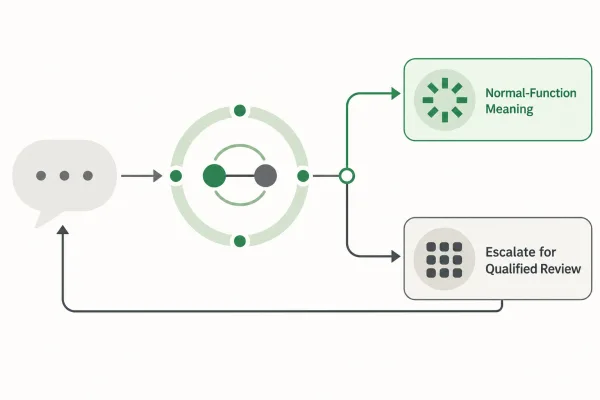
Normal function versus disease diagnosis, treatment, cure, mitigation, or prevention
The boundary turns on meaning rather than a list of universally safe words. A statement about supporting an ordinary physiological process differs from a message that presents a product as changing the course of a disease. Disease meaning can be explicit, but it can also arise by implication from the result, audience, condition, or use scenario presented.
Teams often screen first for obvious disease names. That is necessary but incomplete. A message can move toward disease territory through recognizable symptoms, abnormal states, drug-like positioning, or a suggestion that the product will replace or affect disease management. A qualifier elsewhere on the package may not neutralize a strong disease message in the main presentation.
A practical internal exercise is to record the intended message in plain language:
- What does the brand expect the customer to believe the product will do?
- Is that expected outcome about maintaining normal structure or function?
- Does the complete presentation identify, imply, or target a disease or disease state?
- Would the same meaning remain if reviewers saw only the customer-facing package and campaign?
If the intended meaning is unclear, the safer operational response is to pause. Replacing words until a sentence sounds softer is not a dependable analysis. The responsible brand team should obtain qualified review of the actual presentation and retain the resulting decision before artwork release.
Why wording, product names, visuals, and surrounding copy can change the meaning
Creative changes can alter the message even when the sentence itself remains untouched. A product name can frame every line beneath it. An image can direct attention toward a condition. A headline can become more forceful when a qualifier moves into fine print. The order and prominence of statements can produce a combined impression that the team never evaluated in the original claim list.
A claim matrix should therefore contain more than a column of phrases. For each proposed statement, it should identify where the language appears, what surrounds it, which product and serving it describes, the channels covered, and the artwork version reviewed. Digital uses deserve the same discipline: marketplace titles, search ads, social graphics, landing-page modules, and creator briefs can change the overall message.
One useful stress test is to compare the external presentation with the internal decision record. If the recorded interpretation depends on explanations a customer will never see, the customer-facing material and the internal review are not aligned.
Approval also should not be assumed to transfer across products or formats. Wording reviewed for one gummy, serving, audience, market, or package may not fit another SKU. Released language should be tied to a version-controlled design and product record rather than copied from a general phrase library.
How Structure/Function Claims Differ from Other Label Claims
Label-claim classification matters because different categories create different review paths, evidence questions, and labeling consequences.
Structure/function claims differ from health claims and nutrient-content claims[^4] in the relationship described, while supplement and conventional-food contexts also require distinct category review.

Dietary supplement claims versus conventional-food context
Everyday language can require different analysis depending on whether it appears on a dietary supplement or a conventional food. For a supplement, a structure/function statement can concern the role of a nutrient or dietary ingredient in normal human structure or function or general well-being within the applicable supplement framework.
Conventional-food context is different. The connection to the food's nutritive value matters[^1], and supplement-specific disclaimer and notification controls should not simply be copied onto a conventional-food label. Product category is a threshold fact that shapes the review route, not an administrative field to settle after artwork is complete.
The responsible team should confirm:
- how the marketed product is categorized and labeled;
- which ingredients and serving information appear in the released version;
- which claim category is being considered for that product context;
- which evidence, label treatment, record, and escalation controls follow from that route.
A manufacturing partner can help keep approved SKU specifications and packaging files aligned, but it should not infer the brand's regulatory position from dosage form, flavor, merchandising language, or a previous product in the line. The brand's qualified advisers need to establish the category and approved direction before production uses the files.
High-level distinction from health claims and nutrient-content claims
A structure/function claim concerns normal structure or function. A health claim, at a high level, concerns a relationship between a substance and reduced risk of a disease or health-related condition. A nutrient-content claim characterizes the level of a nutrient in the product through defined terms or permitted comparisons.
The categories are not interchangeable:
| Claim category | Core relationship | Routing question |
|---|---|---|
| Structure/function | Ingredient or product and normal body structure, function, or well-being | Does the total message remain within normal-function scope, and is it supported for the marketed use? |
| Health claim | Substance and disease-risk relationship | Which qualified review path and conditions apply to the specific relationship? |
| Nutrient-content claim | Product and level of a nutrient | Does the product meet the conditions for the term or comparison used? |
This table is a routing aid, not a substitute for qualified review. One package may contain more than one category, and the elements can influence one another when presented together. An ingredient statement, nutrient-level statement, and broader benefit message may each need a separate decision as well as a total-context review.
Once a category decision is approved, the record should be usable downstream. Packaging needs the exact language and placement. The evidence owner needs the message and any limits. The notification owner needs the final statement and timing trigger. Manufacturing needs the correct product specification and approved artwork version. An abstract category label is not enough to release a physical product.
What a U.S. Supplement Claim Review Must Confirm
A U.S. supplement claim review must connect the statement, evidence, label treatment, ownership, and product context to one marketed version.
Supplement claim review for the U.S. market must confirm the total message, product-linked substantiation, required disclaimer treatment, notification ownership, and the exact artwork and marketing versions approved for release.
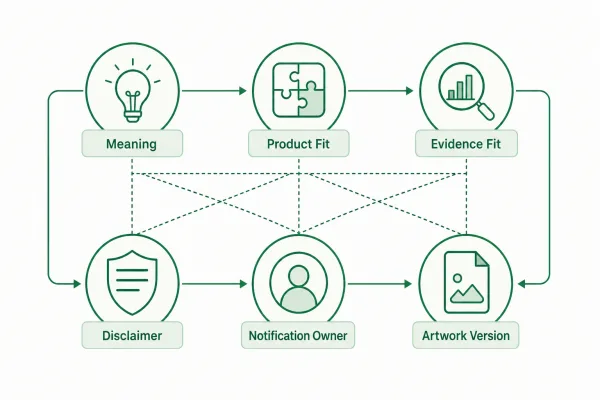
Claim meaning and product-context review
The review should begin with a frozen candidate rather than a moving collection of drafts. Record the exact text, proposed placement, product name, SKU, formula or ingredient reference, serving, intended audience, use, channels, and related visuals. Then evaluate the total impression across the package and connected marketing materials.
This prevents a common handoff failure: one team reviews a sentence while another team changes the product around it. If the evidence file describes one ingredient and serving, the label proof shows another, and the campaign expands the intended outcome, the release records no longer support one coherent decision.
A practical claim-context record can include:
- a unique claim ID and the exact approved wording;
- product, formula, SKU, serving, and market identifiers;
- label-panel and marketing placements;
- audience and intended-use description;
- associated names, images, qualifiers, and nearby copy;
- category decision, qualified owner, limits, and conditions;
- linked evidence-file and artwork-version identifiers.
The release file should answer a simple traceability question: which approved claim decision does this artwork implement? A polished label is still uncontrolled if that connection cannot be shown.
Substantiation aligned to the ingredient, serving, product, and intended use
The responsible firm needs substantiation that the statement is truthful and not misleading[^1] before use. The review should not be reduced to counting papers or attaching a general ingredient folder. It should consider the quality, relevance, and totality of the supporting record for the particular message, product, and intended use.
Alignment is the core discipline:
- Ingredient identity: Is the supported material relevant to the material used in the product?
- Amount and serving: Does the marketed serving align with the basis of support?
- Form and delivery: Could formulation or delivery differences affect relevance?
- Population and use: Does the record fit the intended audience and conditions of use?
- Outcome: Does it support the benefit actually communicated rather than a broader result?
- Finished-product context: Does the message concern an ingredient's supported role, or imply performance of the complete product?
Formulation and sourcing decisions should therefore be connected to claim review early, not handled as an unrelated production stream. An ingredient-source change, revised specification, serving change, or formulation adjustment can alter the assumptions behind the evidence-to-product match even when front-panel wording stays the same.
This is especially relevant during gummy development, where active-load constraints, serving count, matrix changes, flavor work, and scale-up can affect the commercial specification. The manufacturing team does not decide whether a change alters the regulatory conclusion. It flags the change, keeps the product record current, and routes the decision back to the qualified owner before old artwork is reused.
Substantiation records should be traceable to the release. They should identify which message and product version they support, any stated limits, the owner, and the decision date. A folder named after an ingredient is not sufficient if downstream teams cannot tell which final claim it supports.
Required disclaimer, notification timing, and ownership
Dietary-supplement structure/function statements generally require prescribed disclaimer treatment and a notification no later than 30 days after first marketing the product with the statement[^3]. These are separate controls. Having the disclaimer on the proof does not complete notification, and completing notification does not establish that the claim is supported or acceptable in context.
The project plan should assign roles before artwork release:
| Role | Checkpoint | Evidence retained |
|---|---|---|
| Qualified claim owner | Approves the claim category and total context | Claim-context decision record |
| Evidence owner | Confirms the record matches the message and product | Product-linked substantiation file |
| Label owner | Confirms required disclaimer treatment in the proof | Approved label proof |
| Notification owner | Controls timing, submission, and retained record | Notification package and status record |
| Packaging owner | Locks the approved artwork and component versions | Released files and approvals |
| Manufacturing project owner | Uses the released specification and artwork | Production-release reference |
This matrix defines checkpoints; it does not impose a universal legal allocation of responsibility. The exact division depends on the commercial relationship and the responsible firm's qualified advice. What matters operationally is that no control is left to assumption.
Each role needs more than a name. The handoff should include a trigger, due date, required record, and escalation route. It should also address what happens if the launch date moves, a statement is removed, the artwork changes, or the notification package was prepared for a version that is no longer current.
Notification Is Not FDA Pre-Approval
Structure/function claim notification is a filing step for the responsible firm, not advance clearance or endorsement[^3].
Structure/function claim notification does not pre-approve a claim; classification, substantiation, disclaimer treatment, truthful context, timing, and product-version control remain separate responsibilities.

What the 30-day notification requirement covers
For a dietary supplement first marketed with a structure/function statement, the responsible firm generally submits the required notification no later than 30 days after first marketing. The notification identifies the relevant firm, product, and statement and includes the required submission information and certification.[^3]
The timing creates a practical dependency: the team needs a reliable first-marketing date. Production release, warehouse receipt, website activation, marketplace listing, distributor shipment, and retail availability may occur at different times. The qualified notification owner should define the triggering event and maintain the supporting record rather than reconstructing the date later.
A submission record should never be treated like an approval decision. Notification does not show that the wording or supporting evidence was reviewed and accepted in advance. It also does not remove the need to reassess the package when the claim, product, or context changes.
Information and records that should be aligned before release
Before commercial release, a controlled package should connect the approved decision to the product that will actually be made and marketed. The records can remain in their appropriate systems, but the links among them must be explicit and traceable.
A compact pre-release checklist is:
- Claim: exact text, claim ID, placement, and approved context are frozen.
- Product: SKU, formula/specification revision, serving, market, and intended use match the decision.
- Evidence: the substantiation-file reference and its scope match the released product and message.
- Disclaimer: the approved proof contains the required treatment for the current version.
- Notification: owner, timing trigger, status, and retained record are defined.
- Artwork: the final file, revision, approvers, and transmitted version are identifiable.
- Production: the released specification and artwork are linked to the production order.
- Change control: wording, formulation, source, serving, packaging, and campaign changes have an escalation route.
This checklist is a release-alignment map: wording → context → evidence → disclaimer → notification → artwork → production. Each connection is a checkpoint. A missing connection creates the possibility of using a correct document with the wrong product or an approved statement in an unreviewed context.
When to escalate to qualified regulatory counsel
Escalation is appropriate whenever the team cannot confidently keep the total message within the approved structure/function route or when a commercial decision depends on an interpretation with meaningful exposure. Production coordination should pause at that boundary rather than fill the gap with an informal wording choice.
Escalation triggers include:
- express or implied disease, diagnosis, symptom, treatment, mitigation, cure, or prevention meaning;
- product names, visuals, testimonials, or audience cues that may alter the total message;
- uncertainty about the product category or the applicable claim route;
- a message that may belong to a different regulated claim category;
- evidence that does not clearly match the ingredient, serving, audience, product, or intended outcome;
- disagreement among qualified reviewers about the meaning or required label treatment;
- a material change after approval or notification preparation;
- a new market, sales channel, or campaign context not covered by the existing decision.
Qualified regulatory counsel or other appropriate professionals should evaluate the actual facts and customer-facing presentation. The goal is a documented decision for the relevant product, use, and version—not a reusable phrase that bypasses review across an entire portfolio.
A Manufacturer-Facing Release Handoff
A manufacturer-facing release handoff turns the brand's approved direction into traceable product, packaging, and production controls.
A manufacturer-facing release handoff aligns exact claim text, evidence reference, disclaimer record, notification status, approved artwork, product specification, and change triggers before commercial production.

Aligning claim text, evidence file, disclaimer, notification record, and approved artwork
The handoff should be concise enough to use and precise enough to trace. It should not ask a production team to interpret competing regulatory notes or select among several attachments labeled “final.” It should identify the released file, the product version it belongs to, the connected records, and the owners of any unresolved decisions.
A practical release index can contain:
| Release element | Controlled field |
|---|---|
| Claim | Exact text, ID, placement, approval date, context, and limits |
| Product | SKU, formula/specification revision, serving, and target market |
| Evidence | Substantiation-file ID, owner, decision date, and scope |
| Disclaimer | Approved panel treatment and proof version |
| Notification | Responsible firm, owner, timing trigger, status, and record ID |
| Artwork | Final file name, revision, integrity check, and approvers |
| Production | Work order or release reference and effective date |
[^1]: U.S. Food and Drug Administration, “Structure/Function Claims”. Scope: FDA overview of U.S. structure/function claim boundaries for dietary supplements and conventional foods. [^2]: Federal Trade Commission, “Health Products Compliance Guidance”. Scope: FTC advertising guidance on express and implied claims, net impression, and substantiation; it is not an FDA labeling-rule source. [^3]: U.S. Food and Drug Administration, “Notifications for Structure/Function and Related Claims in Dietary Supplement Labeling”. Scope: FDA’s dietary-supplement notification process, timing, and information requirements. [^4]: U.S. Food and Drug Administration, “Label Claims for Conventional Foods and Dietary Supplements”. Scope: FDA overview distinguishing health claims, nutrient-content claims, and structure/function claims. | Change control | Events that reopen the claim package |
This index is not a legal opinion. It shows that the approved direction and the manufactured presentation belong to the same controlled project. Qualified advisers own the claim decision. The brand owns its market position. The manufacturing partner supports documentation coordination, approved packaging-file use, sample-to-production validation, and mismatch escalation.
For gummy projects, that coordination can connect formulation and scale-up changes with packaging decisions. The verified gummy vitamin manufacturing service context explains the production environment, but it does not replace the brand's qualified claim review or evidence decisions.
Physical packaging consequences also belong in the handoff. A corrected digital proof may not reach a printed component already ordered. Labels, pouches, cartons, inserts, shipper cases, and marketplace images can hold different revisions. Component inventory, vendor transmissions, and lead times therefore matter to change control even though they do not decide the claim's regulatory position.
A strong handoff has a visible stop condition: production cannot select between competing “final” files. If the exact approved artwork, current specification, or responsible approval is unclear, the package returns to the brand team for resolution.
Managing changes between sample, label proof, and commercial production
Claim review should begin during sampling, but sample documentation should not automatically become the commercial release. Early samples may use temporary packaging, a developing formula, provisional serving details, or internal language never intended for the market. The project needs a deliberate transition from sample assumptions to a frozen commercial package.
Changes that should trigger review routing include:
- claim wording, qualifier, placement, size, or prominence;
- product, line, or variant name;
- ingredient identity, supplier/source specification, amount, or formula composition;
- serving size, units per serving, or directions;
- intended audience, use occasion, market, or sales channel;
- disclaimer placement or panel design;
- visuals, icons, testimonials, headlines, or surrounding copy;
- primary packaging, secondary packaging, insert, or digital listing;
- first-marketing date or notification details.
Not every change leads to the same review outcome, but production should not decide that outcome by default. The change-control record routes the item to the qualified owner, who determines whether the existing decision still applies, requires an update, or must be replaced.
Version control should remain practical. Use one source-of-truth location for released artwork, limit production use to approved files, identify obsolete revisions, and record who authorized the release. Link the artwork revision to the current product specification and production order. When a printer or packaging vendor receives files, verify the transmitted revision rather than relying on a familiar filename.
Post-launch changes should return through the same route. Documentation coordination, packaging-file control, sample-to-production checks, and scale-up handoffs can expose mismatches early; they cannot determine the brand's legal position. The operational goal is to keep the qualified decision connected to the correct formula, claim context, artwork, and production version.
Conclusion
A structure/function claim is a product-and-context decision, not merely a sentence category. Release control depends on keeping normal-function meaning, product-linked substantiation, disclaimer treatment, notification ownership, approved artwork, and change escalation aligned.