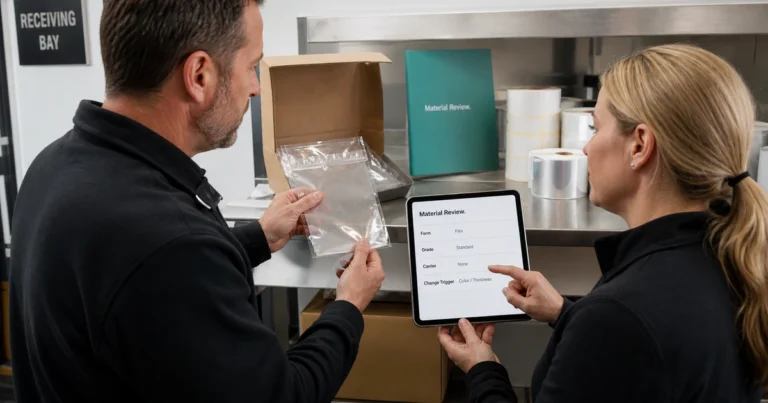


For gummy vitamins, heat stability cannot be judged by appearance or a packaging claim alone. Heat and humidity may affect texture, surface condition, package performance, and active quality differently, so shipment review should connect the exact formula, production lot, commercial pack, release results, retained samples, and documented distribution assumptions.
A shipment can be well prepared without claiming universal temperature tolerance. The practical goal is to identify mismatches before release and make the next decision visible.
Decision Snapshot
- Review physical condition and active stability as separate questions.
- Confirm that the shipped formula, lot, package, closure, and label match the reviewed configuration.
- Link release results and retain samples to the actual shipment lot.
- Compare route and storage assumptions with the stability support that is actually available.
- Escalate any material change or unresolved exception before release.
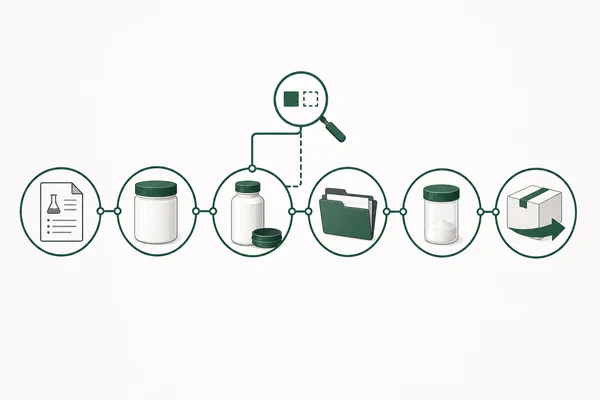
The checklist below is a release-control framework for brand, manufacturing, quality, packaging, and logistics teams. It organizes the evidence without turning a completed form into a heat-tolerance or shelf-life promise.
What Heat and Humidity Can Change in a Finished Gummy Vitamin
A finished gummy may look acceptable after production, yet later exposure can reveal physical or quality questions that a room-temperature sample did not answer.
Heat and humidity may affect a finished gummy vitamin’s texture, surface, shape, package environment, and active quality. The type and degree of change remain specific to the formula, process, pack, exposure, and review period, so physical appearance alone cannot establish nutrient stability or shipment suitability.
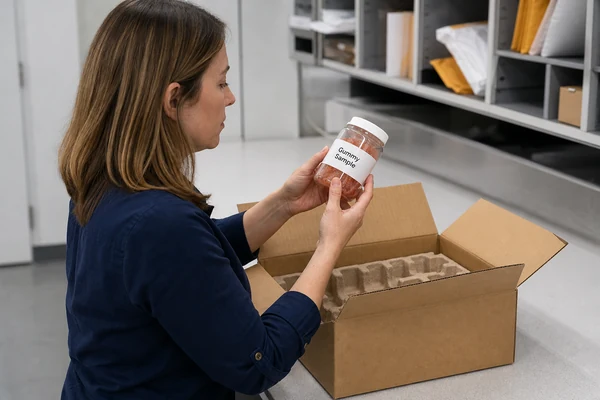
“The gummies did not melt” and “the finished product remained within its relevant requirements” are different conclusions. A useful pre-shipment review separates what can be observed from what needs controlled records, measurements, or product-specific testing.
Texture, stickiness, fusion, and appearance are product-specific risks
Heat can soften a gummy matrix, while humidity may change how its surface exchanges moisture with the surrounding environment. Possible observations include tackiness, pieces adhering to one another, coating changes, deformation, color shift, or a less clean release from the container. These signs can be useful, but they do not follow one universal sequence.
The review should begin with the actual product. Its gel system, solids balance, acid system, moisture behavior, surface treatment, piece geometry, and active blend work together. Production history matters too. A development sample may not represent the moisture profile, conditioning, coating consistency, or package loading of a commercial lot.
A visual change is therefore a signal to investigate, not a complete diagnosis. If gummies are fused or deformed, the team still needs to ask when the change was observed, whether the package showed damage, which units and lots may be affected, and what route information is available. The reverse boundary matters just as much: gummies that look normal have not automatically proved that every active-related or microbiological requirement remains acceptable.
This distinction keeps the response proportionate. Appearance may support a physical-condition decision under the applicable specification. It should not be used to infer potency, shelf life, or the cause of a change without the evidence needed for those separate questions.
Why physical change and active stability need separate verification
Physical condition may be reviewed through appearance, texture, count, odor, package integrity, and other agreed finished-product checks. Active stability concerns whether the relevant ingredients remain within the product’s defined requirements over the conditions and period being evaluated. A physical defect does not quantify active loss, and an acceptable appearance does not demonstrate active retention.
The active profile also matters. Vitamins, minerals, botanicals, and other functional ingredients do not all behave identically during processing and storage. Their relationships with moisture, oxygen, acidity, light, and the gummy matrix may differ. A broad statement about “vitamin stability” is therefore too general for a particular lot-release decision.[^1]
Keep the evidence lanes separate:
| Review area | What the team may check | What it does not establish by itself |
|---|---|---|
| Physical condition | Shape, stickiness, fusion, coating, odor, count, and visible package condition | Active potency or shelf life |
| Package condition | Closure application, liner or seal condition, leaks, damage, and label match | Protection under every possible route |
| Release documentation | Results against agreed finished-product requirements and disposition of recorded exceptions | Performance outside the reviewed lot or specification |
| Stability support | Information tied to a defined product, pack, method, conditions, and review period | Suitability after an unreviewed formula, package, market, or route change |
This separation does not make the review fragmented. It shows which evidence answers which question and prevents one passing observation from carrying more meaning than it should.
Why a “Heat-Stable” Claim Cannot Replace Final-Pack Validation
“Heat-stable” sounds decisive, but it can conceal the formula, package, exposure assumptions, method, and acceptance criteria behind the statement.
A heat-stable gummy claim cannot replace final-pack validation because gummy vitamin stability belongs to a defined product system: the released formula, commercial process, active profile, package, closure, storage assumptions, and review period. A change in one link creates a new question about whether the prior support still applies.

The useful brand-side question is not simply, “Is this gummy heat-stable?” It is, “What product and pack configuration was reviewed, and does it match what is actually being shipped?”
Formula, gel system, active profile, and moisture behavior interact
The gummy base provides structure, but structure is only one part of the finished system. Gelatin, pectin, or another gelling approach operates alongside sweeteners, acids, flavors, colors, functional ingredients, water, and process decisions. No gel system should be treated as universally better for every warm or humid market. The relevant comparison is the performance of the defined finished product against its commercial requirements.
Moisture behavior deserves its own review. Total moisture and water activity are related concepts, but they should not be used interchangeably.[^2] For release planning, a brand should work from the product’s agreed measurements, methods, specifications, and available stability support rather than copy a limit from an unrelated gummy. A number without the same product context and method can create false confidence.
Active loading may also alter the development question. An ingredient can affect taste, acidity, solids, color, or the way the matrix sets and changes over time. A multi-active blend may create different constraints from a simpler vitamin formula. The commercial lot must therefore stay connected to the formula revision and ingredient records that were actually reviewed.
A clear sequence is:
- Confirm the formula revision and serving design.
- Confirm the commercial process and finished-piece condition.
- Confirm the active profile and applicable release requirements.
- Confirm the commercial package and closure.
- Check whether the available stability support addresses that combined configuration.
This sequence does not predict a universal outcome. It exposes the point where a changed ingredient, gel approach, moisture profile, process, or package creates a fresh validation question.
The commercial package and closure must match the reviewed configuration
Packaging is part of the finished product system, not a decorative step added after formulation.[^3] The container, closure, seal or liner, headspace, fill count, and secondary packaging shape the environment around the gummies. Case packing, handling, and distribution assumptions add further context.
A barrier statement from a material supplier may help screen options, but it does not demonstrate how every finished package will perform. Material information is tied to its own test conditions. The commercial pack also includes seals, interfaces, closure application, package geometry, and filling operations. Final-pack review brings those pieces back to the product being released.
The reviewed configuration should be identifiable without relying on descriptions such as “standard bottle” or “normal pouch.” Ask:
- Which container, closure, liner, seal, or pouch construction was used?
- Which fill count and headspace were reviewed?
- Did the commercial line apply the closure and seal according to the agreed process?
- Does the shipped label match the released storage and handling language?
- Was any packaging component substituted after the review?
- Do case packing or route assumptions differ from the reviewed plan?
No single package format is the answer for every gummy vitamin. Selection needs to consider product compatibility, sealing, line handling, labeling, market requirements, cost, and moisture behavior. The defensible output is a documented fit decision for the defined product, not a universal material claim.
Talvenda, an OEM/ODM gummy manufacturing partner, publishes a gummy vitamin manufacturing process that brands can use as a broader reference for connecting formulation, production, packaging, and scale-up decisions.
Pre-Shipment Validation Checklist for Gummy Vitamins
Shipment pressure can turn small record gaps into release risk, especially when several teams assume that someone else verified the final configuration.
A pre-shipment validation checklist for gummy vitamins should connect the released formula, lot identity, commercial pack, agreed release checks, exceptions, retain samples, and distribution assumptions. If the configuration actually being shipped differs from the one supported by the records, the difference needs documented review before release.
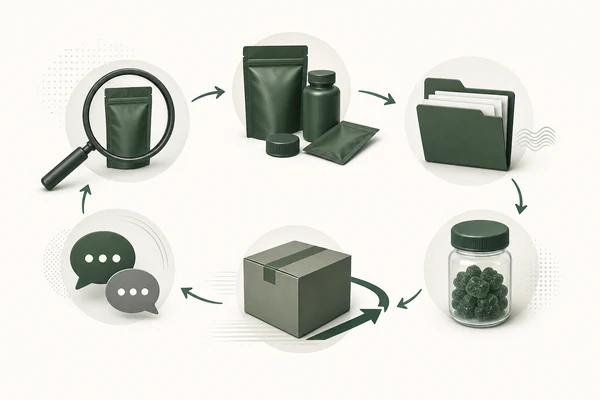
The order matters: establish identity, confirm the shipped configuration, review the evidence, and then resolve exceptions. This sequence prevents one favorable document from standing in for the complete release chain.
Confirm the released formula, ingredient records, and batch identity
Begin with the formula revision named in the production and release records. It should match the intended product, serving design, active direction, flavor or color version, and market-facing label. If more than one development sample was reviewed, the commercial record should make the selected version unambiguous.
Connect the finished lot to the applicable ingredient and batch records.[^4] This does not mean placing every supplier document in a shipment packet. It means the responsible teams can trace what was used, identify which records apply, and see whether substitutions, deviations, or rework occurred.
Use a simple identity check:
- The product name and internal code match the order.
- The formula revision matches the released version.
- The production lot and packaging lot are traceable.
- Ingredient records correspond to the material actually used.
- Any approved substitution or deviation has a recorded disposition.
- The label’s serving and ingredient information matches the released configuration.
An identity mismatch is more than a filing problem. It breaks the link between the shipment and the evidence prepared for it. Even when the pieces look correct, a different formula revision may present a different active profile, moisture behavior, texture question, or label boundary.
This is why a gummy supplement manufacturer checklist should examine traceability and release discipline alongside development and production capabilities.
Confirm the final package, closure, and label configuration
Compare the commercial pack against the configuration named in the available review. Confirm the applicable container or pouch, closure, liner or seal, fill count, label, and secondary pack by the project’s actual descriptions or component codes. If a component or step does not apply, record that rather than forcing it into a generic template.
The packaging record should show that the commercial operation produced the intended pack condition. Depending on the format and agreed requirements, checks may address closure application, seal condition, code legibility, leakage observations, or visible damage. The applicable checks should come from the product and package plan, not from a universal checklist copied across every project.
The label requires its own comparison.[^5] Confirm that its serving information, ingredient statement, and approved storage or handling language match the released product. The label should not imply stronger temperature tolerance, shelf life, or package protection than the supporting review can establish. A late label, carton, or shipper-instruction change may need to be considered in the release decision.
The tested-versus-shipped comparison should be explicit: identify the configuration addressed by the available support, identify the configuration in the shipment, and record whether they match. A verbal assurance that they are “basically the same” is not a substitute for that comparison.
Review agreed finished-product release checks and any exceptions
Use the agreed finished-product requirements for the project.[^6] Depending on the product, market, specification, and quality arrangement, the review may include identity, appearance, piece count or weight, active-related testing, microbiological requirements, moisture-related measures, package checks, or other defined attributes. This checklist does not set those requirements.
Review the results as a connected set. Confirm the correct lot, report or method reference where applicable, status, disposition, reviewer, and date. A pending, atypical, repeated, or exception-handled result should remain visible. A positive email summary should not obscure an open controlled record.
For each exception, ask:
- What differs from the approved requirement or expected condition?
- Which lots, units, packs, labels, routes, or records may be affected?
- Who is assigned to assess and disposition the issue under the project process?
- What evidence or controlled action is needed before release status can be decided?
An exception is not automatically a failure, and recording a deviation is not automatically permission to ship. The practical safeguard is a complete disposition: the issue, affected scope, evidence, owner, decision, and any follow-up action should be retrievable together.
Set aside retain samples and link them to the shipment lot
Retain samples provide a traceable reference if a later appearance, package, complaint, or investigation question arises.[^7] They are most useful when they represent the released commercial lot and relevant pack rather than an unlinked collection of development pieces.
The retain record may need to identify the product, formula revision, production lot, packaging lot where relevant, package configuration, quantity, storage location, date, and responsible owner. If multiple market labels or packs were used, the record should show which version the retains represent.
The project’s applicable quality and market requirements should determine the retain plan. This checklist does not set a universal quantity, duration, or storage condition. It asks whether the plan exists, whether the samples are linked to the shipment, and whether the record can be retrieved without rebuilding the history from memory.
Retains support an investigation; they do not establish its conclusion by themselves. The team may need to compare production records, pack information, timing, distribution details, and the observed condition before deciding what the sample means.
Match shipment and storage assumptions to available stability support
Distribution planning should describe what is known about the route, season, transit plan, warehouse steps, loading and unloading, transport mode, destination handling, and any less-controlled handoff. The purpose is not to predict every exposure. It is to identify whether the shipment plan differs materially from the assumptions addressed by the available support.
Ask the stability question in a controlled form:
- Does the support apply to the same formula revision?
- Does it address the same commercial package and closure?
- Is the review period relevant to the intended product plan?
- Are the market, route, storage, and handling assumptions reasonably aligned?
- Has a late change introduced a condition that was not previously considered?
Do not convert a study condition, ingredient statement, or package claim into a universal shipping limit. Any stated condition has meaning within its method, product, package, duration, acceptance criteria, and intended use. If the route introduces a material uncertainty, manufacturing, quality, packaging, brand, and logistics owners can decide what proportionate review or control is appropriate.
The release record should distinguish known route facts from assumptions. “The shipment uses the approved commercial pack” is a configuration fact when the record supports it. “The product will remain within all reviewed conditions throughout distribution” is an assumption unless the plan and evidence justify that conclusion.
Escalate a mismatch before release
A mismatch exists when the shipment no longer aligns with the product system or assumptions addressed by the available records. It may involve a different formula revision, substituted package component, changed closure, unresolved result, missing retain, new market label, altered route, added warehouse handoff, or storage wording that goes beyond the evidence.
Do not make the documents look consistent before identifying the underlying difference. State the change, define the potentially affected scope, assemble the relevant evidence, and route the question to the owner assigned under the project’s quality and release process. The resulting action should be proportionate to the actual issue and recorded before release status is finalized.
A compact escalation record can organize the decision:
| Field | Decision context |
|---|---|
| Mismatch | Exact difference from the released or reviewed configuration |
| Affected scope | Lots, packs, labels, routes, or shipment units involved |
| Potential impact | Physical quality, active-related requirement, package integrity, traceability, or claim boundary |
| Evidence available | Release records, retain information, pack records, stability support, and route details |
| Assigned owner | Person or function responsible under the agreed process |
| Disposition | Evidence reviewed, controlled action, release status, and follow-up responsibility |
Escalation protects the evidence chain. It prevents an unreviewed change from becoming an undocumented product or shipment promise.
What to Document Before the Shipment Leaves
A sound decision becomes difficult to defend when its supporting information is scattered across emails, supplier files, reports, and logistics messages.
Pre-shipment documentation should connect the finished gummy lot to its formula, commercial pack, release decision, exceptions, retains, and shipment assumptions in a retrievable record. The packet need not duplicate every project file, but it should show what was shipped, what was reviewed, who decided, and which assumptions applied.

The strongest packet is not necessarily the thickest. It is the smallest controlled set that lets an authorized reviewer reconstruct the release decision without guessing which version, result, or message was final.
Batch, packaging, release, retain, and shipment-condition records
Build the packet around traceability. A cover sheet or digital index can point to controlled records rather than duplicating them. The index can identify the product, lot, shipment reference, market, pack configuration, disposition date, and document owners.
A project-specific packet may reference:
- the released formula and product code;
- production and packaging lot records;
- applicable ingredient and component traceability;
- final label and packaging specifications;
- finished-product release results and disposition;
- exception, deviation, investigation, or change-control records;
- the retain-sample record;
- case, pallet, and shipment identification;
- agreed storage or handling instructions;
- route, carrier, warehouse, and handoff assumptions;
- responsible functions and decision dates.
The list is not a universal document mandate. Each item should be included, referenced, or excluded according to the project’s requirements. Where a controlled system stores the source, the index can point to its identifier and location. Draft or superseded records should not be allowed to appear as the final basis for release.
Record completeness is more than having every file name. The formula, lot, package, result, retain, and shipment references should point to the same commercial event. If one record describes a previous pack, another names a different formula revision, or the route plan changed after disposition, the packet is not complete simply because all expected document types are present.
Facts and assumptions should also be distinguishable. Naming an assumption makes it possible to challenge, support, or revise it before the shipment leaves. Commercial communication can then stay within what the controlled record actually establishes.
Questions to resolve with manufacturing and logistics partners
Manufacturing and logistics see different parts of the same risk. The production team knows the actual lot, process history, package setup, and release status. The logistics team knows the route, handoffs, timing, carrier arrangement, and expected storage environment. Bringing those views together can expose a mismatch that neither record set shows alone.
Ask the manufacturing partner:
- Does the shipment match the released formula and pack configuration?
- Are the agreed release checks complete and correctly linked to the lot?
- Are open deviations, substitutions, or exceptions visible?
- Are the relevant retain samples available and traceable?
- Does the label remain within the reviewed claim and handling boundary?
Ask the logistics partner:
- What route, mode, timing, and intermediate storage are planned?
- Where could delay or exposure occur during handoffs?
- Which handling instructions can be controlled and documented?
- How will damage, delay, or a route change be reported?
- Who receives the escalation when the plan changes?
Then define the handoff between functions. Identify who reports the event, who assesses the product question, which evidence is needed, who controls release status under the agreed process, and how the decision is communicated.
Talvenda’s role in a gummy project can include connecting formula feasibility, sample-to-production alignment, packaging review, documentation expectations, and scale-up planning. The brand retains responsibility for its market, claims, release governance, and logistics decisions. Clear role boundaries help the right question reach the right owner before shipment.
What This Checklist Does—and Does Not—Establish
A checklist can organize a release decision, but it becomes risky when a completed form is treated as proof beyond the evidence behind it.
This pre-shipment checklist establishes a disciplined review of product identity, packaging, release records, retains, and shipment assumptions. It does not establish universal heat tolerance, guaranteed shelf life, unchanged potency after exposure, regulatory acceptance, or one packaging solution for every gummy vitamin.
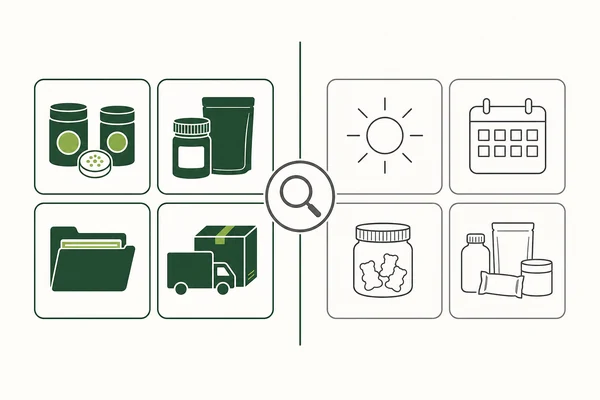
The checklist’s value is control: it shows what matches, what changed, what remains unknown, and who owns the next decision. Its limits should be recorded with equal care.
Release discipline is not a universal heat-tolerance or shelf-life promise
A completed checklist shows that defined records and assumptions were reviewed. It does not turn those assumptions into a guarantee. Heat tolerance depends on the product configuration and exposure. Shelf life depends on the finished product, package, conditions, acceptance criteria, and supporting program. Neither conclusion transfers automatically from an ingredient, material, development sample, supplier statement, or different SKU.
The same boundary applies to melted, fused, or otherwise changed gummies. A physical difference may matter under the product’s appearance or usability requirements, but it does not quantify active loss by itself. The reverse also holds: normal appearance cannot prove that every active remains within requirement. Any potency conclusion needs suitable product-specific evidence.
Use language that describes what was actually reviewed:
| Avoid | Prefer |
|---|---|
| “This gummy withstands high heat.” | “The shipment was reviewed against the product- and pack-specific support available for the stated plan.” |
| “This package prevents humidity damage.” | “The commercial package and closure matched the reviewed configuration.” |
| “The product is good for the full shelf life.” | “Shelf-life support remains tied to the defined product, package, conditions, and review period.” |
| “No melting means no potency loss.” | “Physical condition and active-related requirements were reviewed separately.” |
Careful wording is not a weaker commercial answer. It states the evidence boundary clearly and preserves a route for review if a condition, configuration, or assumption changes.
New formulas, packs, markets, or distribution assumptions need fresh review
Change control is the final safeguard. A new flavor or active blend can create different formulation, moisture, taste, color, or texture questions. A different bottle, pouch, closure, liner, label, fill count, or case configuration changes part of the commercial system. A new market or route can introduce different storage, handling, documentation, and claim considerations.
Fresh review does not automatically mean repeating every development activity. It means asking what changed, which earlier evidence still applies, what new uncertainty appeared, and what proportionate action is needed. The applicable project owner should define that scope through the relevant quality and release process.
Use four change-control questions:
- Is the shipped product still the configuration that was reviewed?
- Which records, requirements, or assumptions are affected by the change?
- What additional evidence or controlled action is needed before release?
- Who records the decision and updates downstream documents?
These questions keep validation connected to commercial reality. Formula, packaging, market, and route decisions often move in parallel workstreams. The risk appears when the final shipment record still describes an earlier product system.
The release packet should remain a living connection between development and distribution. When the formula, pack, route, or storage assumption changes, the team has a new validation question. Identifying it before release is more useful than relying on a broad heat-stability label after the shipment is already moving.
Conclusion
For gummy vitamins, heat stability is best managed through a product-specific release chain that aligns the formula, production lot, commercial pack, agreed checks, retains, and distribution assumptions while keeping uncertainty visible.
Talvenda can map three starting routes for a gummy project: an in-stock option for an early market test, a stock-formula modification when the available format needs targeted changes, or custom development when the product brief requires a distinct formula and pack. Share your target market, proposed pack, and first-order expectation through the project contact form. We can then outline which route appears practical, what sample and packaging questions should be resolved, and what documentation expectations should be clarified before a quote discussion or commercial release plan moves forward.
[^1]: Food Hydrocolloids, “Improvement of Vitamin C Stability in Vitamin Gummies by Encapsulation in Casein Gel,” https://www.sciencedirect.com/science/article/pii/S0268005X20313886. Scope note: This peer-reviewed study concerns vitamin C gummies and formulation-dependent stability; it does not set a universal limit or establish the behavior of every active. [^2]: U.S. Food and Drug Administration, “Water Activity (aw) in Foods,” https://www.fda.gov/inspections-compliance-enforcement-and-criminal-investigations/inspection-technical-guides/water-activity-aw-foods. Scope note: FDA technical guidance explains the distinct measurement concept; it does not supply a gummy-specific specification. [^3]: Electronic Code of Federal Regulations, “21 CFR § 111.70 — What specifications must you establish?,” https://www.ecfr.gov/current/title-21/chapter-I/subchapter-B/part-111/subpart-E/section-111.70. Scope note: This is U.S. dietary-supplement cGMP context for specifications, including packaging and labels; it is not universal package-performance proof. [^4]: U.S. Food and Drug Administration, “Small Entity Compliance Guide: Current Good Manufacturing Practice in Manufacturing, Packaging, Labeling, or Holding Operations for Dietary Supplements,” https://www.fda.gov/regulatory-information/search-fda-guidance-documents/small-entity-compliance-guide-current-good-manufacturing-practice-manufacturing-packaging-labeling. Scope note: This guidance supports traceable manufacturing and batch records in the U.S. dietary-supplement context; it is not legal advice or a universal document list. [^5]: U.S. Food and Drug Administration, “Dietary Supplement Labeling Guide: Chapter I — General Dietary Supplement Labeling,” https://www.fda.gov/food/dietary-supplements-guidance-documents-regulatory-information/dietary-supplement-labeling-guide-chapter-i-general-dietary-supplement-labeling. Scope note: This is U.S. labeling context; it does not establish a product’s temperature tolerance, shelf life, or package protection. [^6]: Electronic Code of Federal Regulations, “21 CFR § 111.75 — What must you do to determine whether specifications are met?,” https://www.ecfr.gov/current/title-21/chapter-I/subchapter-B/part-111/subpart-E/section-111.75. Scope note: This is U.S. dietary-supplement cGMP context for determining whether specifications are met; the article does not prescribe project specifications. [^7]: Electronic Code of Federal Regulations, “21 CFR § 111.83 — What requirements apply to reserve samples?,” https://www.ecfr.gov/current/title-21/chapter-I/subchapter-B/part-111/subpart-E/section-111.83. Scope note: This is U.S. dietary-supplement cGMP reserve-sample context; it does not set a universal retain quantity, duration, or storage condition.