


The marine collagen gummy format is simple and beauty-focused. The consumer sees convenience; a brand team should verify source, formulation, labeling, and quality decisions before sampling.
Marine collagen gummies are chewable supplements made with fish-derived collagen peptides. They are often positioned for beauty, skin, hair, and daily wellness, but brands still need source, serving-size, flavor, labeling, testing, and packaging support for the product promise.

I would not judge a marine collagen gummy only by the front label. The word "marine" can help a product feel premium and beauty-focused, but it also creates practical questions.
What fish source is being used? Can the supplier document it? Does the formula need fish allergen language? Can the flavor system control source notes? Can the gummy carry a realistic collagen serving without becoming too large, sticky, or hard to store?
Start with the consumer questions: what these gummies are, what benefits people expect, how they compare with other forms, who should be careful, how to use and store them, and what risks to check. Then turn those same questions into a brand-side development brief.
What Are Marine Collagen Gummies?
These products are collagen supplement gummies made with collagen from fish-derived sources.[^1] The format is easy for consumers to understand, but the product brief needs more precision.
A marine collagen gummy combines fish-derived collagen peptides with a gummy base, flavor system, sweetener system, packaging format, and quality checks. The finished gummy must carry both the consumer promise and the source documentation behind that promise.
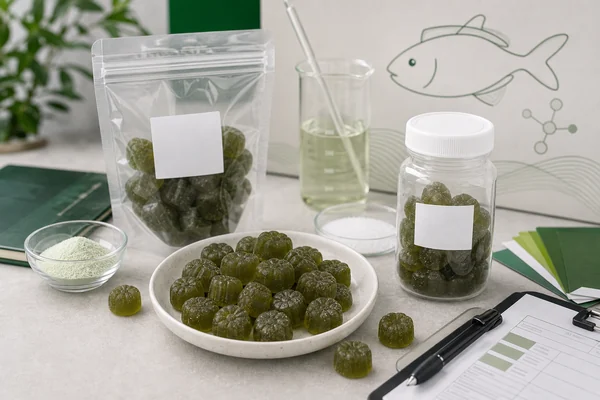
The short definition for consumers and brands
For consumers, the format is a chewable collagen supplement. It is usually positioned around beauty-from-within, skin support, hair and nail routines, or daily wellness. It may feel easier than powders because there is no measuring or mixing. It may feel more enjoyable than capsules because the format is familiar and easy to repeat.
For brands, the definition is more specific. A marine collagen gummy is a fish-source collagen peptide product delivered in a gummy matrix. That means the brand needs to define the collagen source, peptide form, target serving, gummies per serving, flavor direction, allergen statement, package format, storage expectation, and testing plan.
The consumer question is "What is it?" The brand question is "Can this exact source and marine collagen gummy format become a credible finished SKU?"
What marine collagen is usually made from
Marine collagen is generally associated with fish-derived materials, often fish skin, fish scales, or other fish processing by-products that are refined into collagen peptides. Some suppliers may describe species, origin, extraction route, or peptide characteristics in their technical documents.
For a gummy project, the key point is not only that the source is marine. The brand should know what documentation supports that source. Ingredient origin, specification, allergen statement, COA, and traceability all affect how the product can be described.
Source also affects sensory work. Some marine collagen inputs are cleaner than others, but fish-source notes still need to be considered during flavor development. Changing the collagen source after sampling is not a small change. It may require a new taste, odor, label, documentation, and stability review.
How gummy format changes the product brief
The gummy format changes the entire brief. A powder can carry more active material with fewer texture constraints. A capsule can hide taste but may require multiple capsules. A gummy has to deliver the concept while staying pleasant, stable, and easy to package.
That means the marine collagen serving must fit inside the gummy serving. The flavor system must work with sweetness and acid balance. The texture must hold up during storage. The package must protect the gummy from moisture, sticking, heat, odor shift, and consumer handling.
This is why a marine collagen gummy should connect early to broader collagen gummies formulation planning. The marine source is the focus here, but the source still lives inside a full gummy system.
What Benefits Do People Expect From Marine Collagen Gummies?
Most searchers expect marine collagen gummies to connect with beauty, skin, hair, nails, joints, or general wellness. The answer should meet that expectation without turning expected benefits into unsupported promises.
The safest way to discuss marine collagen gummy benefits is to explain the expected positioning, then separate consumer interest from the proof a brand needs for labels, product pages, and finished-product quality.
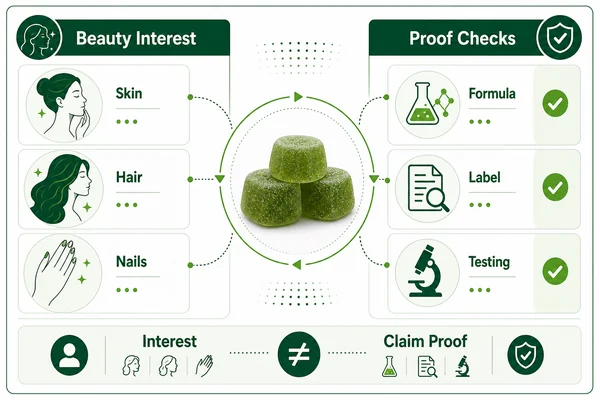
Skin hydration, elasticity, hair, and nail positioning
These gummies are often positioned around skin hydration, elasticity, hair, and nails. Those themes match why many consumers search for the product. They also fit the beauty-from-within category that many supplement brands want to enter.
For a brand, this positioning needs discipline. The product page, label, ad copy, retailer listing, and customer service language should match the ingredient evidence and the market. A finished gummy also needs a realistic serving. If the amount of collagen per serving is low, the front-label story may sound stronger than the formula can support.
I would define the claim level before sampling. Is the product a simple marine collagen gummy? Is it a marine collagen beauty gummy with vitamin C or hyaluronic acid?
If vitamin C becomes part of the primary beauty rationale, the collagen vitamin C gummy route needs its own acid, taste, stability, and claim-language review.
Is it a broader hair, skin, and nails gummy? Each route changes the formula, ingredient priority, testing plan, and wording review.
Joint and wellness claims that need careful wording
Marine collagen content online often expands into joint, bone, mobility, tissue, or general wellness language. Searchers may expect to see those topics, but brands should handle them carefully.
The issue is not whether collagen has research interest. The issue is whether the final product, serving level, wording, and target market support the exact claim.[^2] Brand content should not casually promise joint mobility, bone improvement, tissue repair, wound healing, or visible changes after a fixed number of days.
If a brand wants stronger claim language, that needs to be decided before production. Claim direction affects ingredient choice, target amount per serving, finished-product testing expectations, label review, and source-support needs.
Why benefit language should not replace ingredient proof
Benefit language can make a concept attractive. Ingredient proof protects the product. A marine collagen gummy with a polished label still needs source documents, specification review, and finished-product quality checks.
Before approving a benefit direction, I would ask:
| Question | Why it matters |
|---|---|
| Which ingredient supports the claim? | Keeps broad beauty wording from outrunning the formula |
| What serving amount is realistic? | Connects the label promise to gummy size and serving count |
| What quality file supports the source? | Helps the brand defend fish origin, identity, and documentation |
| What finished-product testing is planned? | Connects the final gummy to the label and release file |
The better brief starts with consumer expectation, then tests whether the source, dose, gummy format, and documentation can carry that expectation honestly.
Why Choose Marine Collagen Gummies Over Other Forms?
Consumers choose marine collagen gummies for convenience and routine fit. Brands should use them only when the source and format support a clear product strategy.
Fish-source collagen gummies can be a good fit when the brand wants marine positioning in a daily gummy format. The decision should still be compared with bovine collagen, powder, capsules, and drinks before sampling.
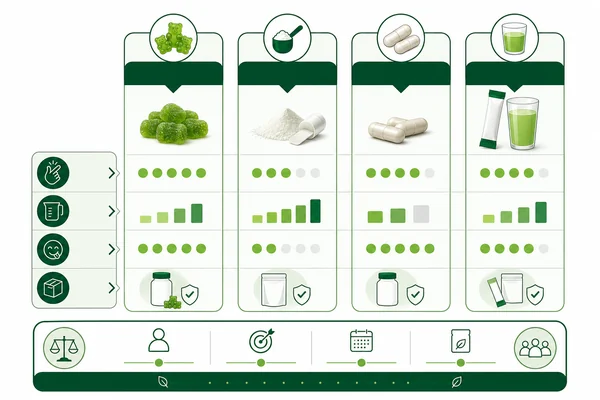
Marine collagen vs bovine collagen for beauty positioning
Marine collagen often feels more beauty-focused to shoppers. Bovine collagen may feel more familiar, cost-stable, or easier to source for some projects. Neither source is automatically better for every gummy.
The brand should compare source against product promise. Marine collagen may support a premium beauty story, but it can add fish allergen review, odor control, and source-documentation questions. Bovine collagen may fit another cost, flavor, supply, or positioning route, but it has its own animal-source and label considerations.
This is where types of collagen and source-related terms can help as support language. They should not take over the page. The focus remains the fish-derived gummy route.
| Source route | Where it may fit | Watch point |
|---|---|---|
| Marine collagen | Beauty-focused fish-source positioning | Fish allergen, odor, documentation, cost, source proof |
| Bovine collagen | Broader collagen peptide positioning | Animal-source expectations, market fit, taste, documentation |
| Vegan booster route | Plant-based beauty positioning | Not real collagen; needs claim-boundary review |
Gummies vs powder, capsules, and drinks
Gummies win on routine and sensory experience. They can feel easier than mixing powder and more enjoyable than swallowing capsules. This makes them useful for beauty, wellness, and lifestyle positioning.
The tradeoff is formula space. Powders can usually carry more collagen per serving. Capsules can avoid most flavor issues but may require multiple capsules.
Drinks have their own packaging and shelf-life constraints. Gummies must balance active load, chew, taste, sugar or sweetener system, moisture behavior, and package protection.
For a brand, the format decision should match the product promise. If the goal is a high collagen serving, a gummy may require multiple pieces per serving. If the goal is daily beauty compliance and repeat-use appeal, gummies can be a strong consumer format.
What brands should avoid saying about absorption
Some product pages talk about superior absorption or bioavailability. That language needs caution.[^3]
A brand should not claim that the gummy format itself creates superior absorption unless the claim is reviewed and supported. A safer statement is that the product provides fish-derived collagen peptides in a convenient format. If the brand wants to discuss peptide form or absorption, it should use ingredient-specific support and market-specific review.
I would write this boundary into the brief. Do not let a product page say more than the formula, evidence, and label review can support.
Who Should Be Careful With Marine Collagen Gummies?
This marine collagen gummy product type is not suitable for every consumer or every brand position. The main boundary is the fish-derived source.
Marine collagen gummies may be unsuitable for people with fish allergies and do not meet vegan or vegetarian requirements. Consumers should check the collagen source and allergen label, while brands should verify source identity, allergen documentation, and dietary-positioning claims.

Fish-source and allergen considerations
Marine collagen is fish-derived.[^4] Consumers with fish allergies should be careful, and brands should not hide the source behind vague beauty language.
For a product team, allergen review affects the label, product page, retailer documents, marketplace listings, customer support answers, and sometimes manufacturing-line questions. It can also affect markets where allergen rules, import requirements, or retailer standards are stricter.
The first supplier brief should ask for source documentation, allergen statements, and quality records. These are not final-stage paperwork details. They shape whether the product can be sold with confidence.
Dietary, religious, and market-positioning boundaries
Marine collagen may fit fish-source beauty positioning, but it is not vegan or vegetarian. It may also require review for religious dietary expectations, country-specific preferences, or customer-segment fit.
This matters because consumers may not understand the difference between marine collagen, bovine collagen, gelatin, pectin, and vegan collagen boosters. A brand should explain the product clearly.
If the gummy uses marine collagen with a pectin base, the gummy base may be plant-derived, but the collagen itself is still fish-derived. That distinction affects label review, product page wording, and consumer trust.
When a vegan collagen booster route is a better fit
If the target audience expects a vegan product, marine collagen is the wrong route. The brand should consider a vegan collagen booster concept instead, built around nutrients and plant-based support ingredients rather than fish-derived collagen peptides.
That topic belongs on the vegan collagen gummies page. The important boundary is simple: fish-derived collagen gummies and vegan collagen booster gummies are different product strategies.
This distinction protects the consumer and the brand. It also helps the manufacturer build the correct formula from the start.
How Should Brands Evaluate Marine Collagen Ingredient Quality?
This is where the topic becomes more useful than a basic consumer benefits page. Ingredient quality is not only a shopper trust signal. It is a production and documentation issue.
Brands should evaluate marine collagen ingredient quality through source, peptide form, origin, traceability, COA, specification, contaminant review, allergen statement, and finished-product testing expectations before sampling.

Source, peptide form, origin, and traceability
The first question is source clarity. What fish source is used? What form is supplied? Is it collagen peptide, hydrolyzed collagen, or another input?
Where does it come from? What documents support that story?
Traceability matters because marine collagen can become a broad marketing term if the source is not defined. A brand should know whether the supplier can provide the documents needed for the target channel and market.
For private-label or custom gummy projects, I would ask for this information before flavor work. A pleasant sample is less useful if the source documents later create label, retailer, or export problems.
COA, specification, heavy-metal, and documentation checks
Marine ingredients deserve a careful quality file. A raw material COA is a starting point, not the whole answer.[^5] The brand may need specification sheets, allergen statements, origin documents, contaminant review, and finished-product testing plans.
Heavy-metal and contaminant review is especially important for fish-derived or marine-positioned ingredients. The exact testing scope depends on market, formula, supplier, and claim direction, but the topic should not be left until after production.
The brand should also decide which finished-product checks matter. If collagen amount is part of the label promise, the test plan should reflect that. If the product uses other beauty actives, those may need their own review.
| Quality item | Brand-side question |
|---|---|
| Source statement | Can the brand explain what the marine collagen is made from? |
| COA and specification | Do documents support ingredient identity and quality expectations? |
| Allergen statement | Does label language match the fish-derived source? |
| Contaminant review | Is the marine-source risk addressed before launch? |
| Finished-product testing | Does the final gummy support the label promise? |
Certifications and quality signals that matter before sampling
Certifications can help, but they should not be used as decoration. A brand should confirm what certifications are real, current, relevant to the ingredient or facility, and usable for the target market.
The same applies to "premium," "clean," "sustainably sourced," or similar language. These claims may need support. If they are central to the product story, the brand should ask for evidence before approving the direction.
For a manufacturer conversation, the better question is not "Do you have quality?" It is "Which documents, checks, and specifications can support this exact marine collagen gummy project?"
Marine Collagen Gummy Formulation and Packaging Checks
Marine collagen source decisions become real inside the gummy formula. Taste, odor, dose, texture, moisture, and packaging all decide whether the product can move beyond a concept.
A marine collagen gummy formulation should be checked for collagen dose, gummy weight, serving count, fish-source taste notes, flavor masking, acid balance, moisture behavior, stickiness, and packaging protection before commercial production.
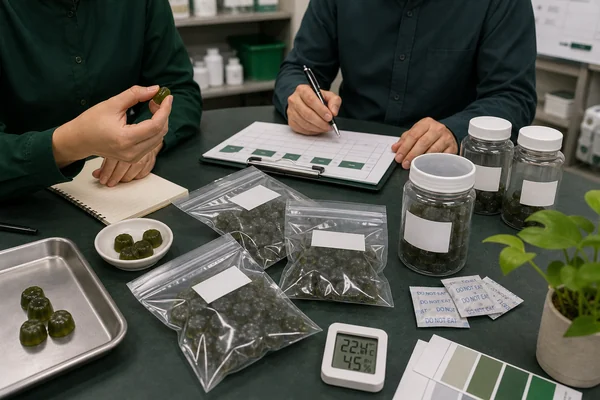
Target dose, gummy weight, and serving-size pressure
Collagen is not a tiny active. If the brand wants a meaningful collagen promise, the gummy serving may need multiple pieces or a larger gummy. This changes taste, texture, bottle count, cost, and consumer experience.
The first formulation question is not the flavor. It is the dose promise. How much marine collagen should each serving provide? How many gummies per serving are acceptable?
What gummy weight can still feel pleasant? How much room remains for base, sweetener, acid, flavor, color, coating, and other actives?
This is where collagen gummies dosage can support readers who need more detail, but this page should not become a dosage guide. Keep dosage tied to marine-source and gummy feasibility.
Taste, odor masking, acid balance, and flavor direction
Marine collagen can bring source notes. Some inputs may be mild, but flavor work should still be planned early. Fruit flavors, sweetness, acid balance, and masking systems may be needed to keep the gummy acceptable.
I would not handle taste masking as a late correction. If the source has a noticeable odor or aftertaste, the formula may need a different flavor direction, acid level, sweetener system, or serving design.
This also affects sample approval. A sample that tastes acceptable on day one may change after storage. Brands should check whether the flavor remains acceptable after the gummy sits in the intended package.
Moisture, stickiness, packaging, and storage protection
Gummies are sensitive to moisture behavior. A formula can look good when freshly made and still become sticky, hard, or clumped later. Marine collagen adds another ingredient load that must work with the gummy base.
Packaging should be discussed before the formula is locked. Bottle, pouch, closure, desiccant decision, fill count, and storage expectations can all affect the finished product.
Brands should not separate formulation and packaging. A strong sample in weak packaging is still a weak launch plan. The goal is a gummy that tastes acceptable, keeps its texture, and supports the label promise through expected storage and distribution.
| Formulation decision | What it affects | Brand-side check |
|---|---|---|
| Marine collagen level | Serving count, texture, taste | Can the serving be realistic in gummy form? |
| Flavor direction | Consumer experience and source-note masking | Does taste remain acceptable after storage? |
| Acid balance | Flavor brightness and gummy behavior | Does the acid system support the base and actives? |
| Packaging route | Moisture, sticking, odor, storage | Does the package protect the finished gummy? |
| Testing plan | Label support and release confidence | Which checks support the final product? |
How to Use and Store Marine Collagen Gummies
Consumers want simple use instructions. Brands need those instructions to match the serving design and finished-product testing plan.
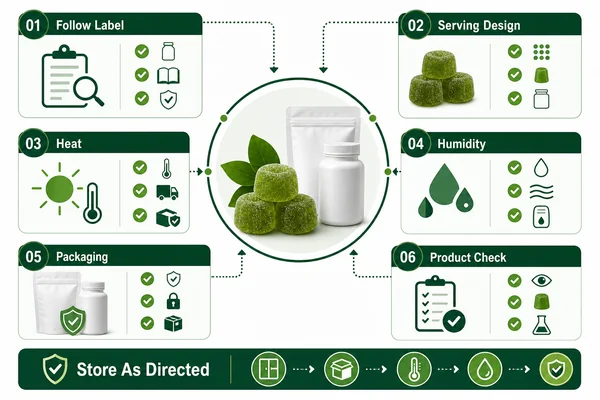
Use directions should follow the product label. Brands should also evaluate the finished gummy so serving size, storage conditions, and testing support the claim.
Daily serving guidance without overpromising results
Do not invent a universal daily dose for marine collagen gummies. Serving size depends on the formula, collagen amount, market rules, and label direction. The safest consumer guidance is to follow the product label.
For brands, serving guidance is a design decision. One gummy per day may be easier to sell, but it may not fit the desired collagen amount. Multiple gummies may fit the dose better, but they affect cost, bottle count, and consumer compliance.
This is why serving size should be decided before packaging and label artwork. It shapes the whole product.
Storage conditions that protect texture and freshness
Most gummy supplements need protection from heat, humidity, and poor storage conditions. The exact wording should match the finished product and package, but the general risk is clear: gummies can change texture, stick, lose flavor quality, or look less appealing if storage is not managed.
For a marine collagen gummy, storage also connects to sensory quality. If source notes become more noticeable over time, the brand may need to review flavor hold, packaging barrier, and shelf-life checks.
The consumer sees storage as a small instruction. The brand should handle it as part of the product design.
Why dosage claims should match finished-product testing
If the label says the product provides a certain amount of marine collagen per serving, the finished product should support that statement.[^5] Input calculations alone may not be enough for brand confidence.
The brand should discuss whether the finished gummies will have a specification, what testing is planned, and how batch documents will support release. This does not mean every consumer guide needs to explain lab methods. It means the brand should not use dosage as only a marketing number.
A credible marine collagen gummy connects label, formula, batch record, COA, and finished-product review.
Potential Risks and Side Effects of Marine Collagen Gummies
These products are usually discussed as beauty supplements, but the risk section still matters. It should serve consumers without becoming medical advice.
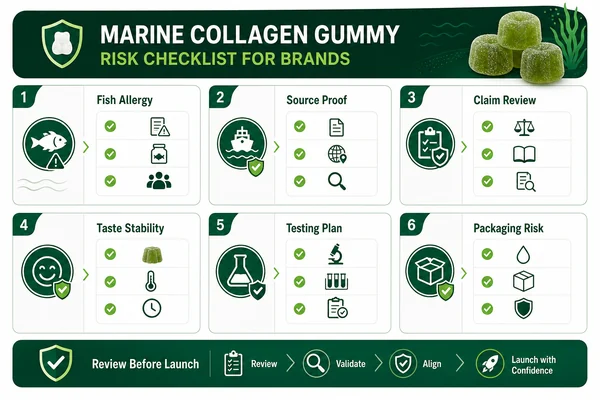
Potential concerns include fish allergy, digestive discomfort, ingredient sensitivity, claim overstatement, poor-quality sourcing, weak documentation, and products whose label promises are not supported by the finished gummy.
Common consumer cautions
Consumers should review the product label, ingredient list, allergen information, serving directions, and any personal dietary or health considerations. Anyone with a fish allergy should be especially careful because marine collagen is fish-derived.
Some users may also pay attention to sugar, sweeteners, flavors, acids, colors, or other actives in the gummy. A marine collagen gummy is rarely just collagen. The whole formula matters.
This content does not provide medical advice. If a consumer has a health condition, is pregnant, uses medication, or has allergy concerns, they should follow qualified professional guidance.
Fish allergen and label warning review
For brands, fish allergen language should be reviewed before packaging artwork is finalized. The product name, Supplement Facts panel, allergen statement, website copy, and customer support answers should all tell the same story.
If the formula is marketed as marine collagen but the fish source is not clear, consumers may misunderstand the product. That creates avoidable trust risk.
I would include allergen review in the first manufacturer brief. It belongs with source documents, not at the end of production.
Quality, testing, and supplier questions before launch
The practical risk is not only side effects. It is launching a product that cannot support its own story. Weak source documents, unclear COA expectations, no finished-product testing plan, poor flavor stability, or unsuitable packaging can all damage the SKU.
Before launch, brands should ask:
- What marine collagen source is used?
- What documentation supports origin and specification?
- How will fish allergen language be handled?
- How much collagen is intended per serving?
- Can the gummy carry that serving without poor taste or texture?
- What finished-product testing is planned?
- What packaging protects the gummy from moisture and texture change?
- What launch market and documentation expectations are known?
These questions turn a consumer beauty idea into a safer supplier conversation.
FAQ About Marine Collagen Gummies
FAQ should answer the consumer search task directly, but it can still carry the B2B bridge where useful.
Quick answers for common questions should cover what consumers care about and where brands need sourcing, storage, testing, and documentation checks before launch.
Do marine collagen gummies actually work?
They can be a convenient way to take fish-derived collagen peptides, but the answer depends on the formula, serving size, ingredient quality, product claims, and user expectations. Brands should avoid promising visible results unless the claim is properly supported.[^6]
Are marine collagen gummies better than bovine collagen gummies?
Sometimes, marine collagen fits a beauty or premium source story, while bovine collagen may suit cost, flavor, supply, or positioning needs. The better source depends on the product brief, target market, allergen review, documentation, taste, and dose feasibility.
Do marine collagen gummies taste fishy?
They should not taste strongly fishy if the ingredient and flavor system are well designed. Still, marine collagen can bring source notes, so flavor masking, acid balance, and storage checks should be part of sample review.
Can marine collagen gummies be vegan?
No. Marine collagen is fish-derived, so the marine collagen gummy format is not vegan. A brand targeting vegan consumers should consider a collagen booster or beauty gummy route instead and review vegan collagen gummies positioning separately.
What should brands ask before making marine collagen gummies?
Brands should ask about collagen source, peptide specification, fish allergen language, target amount per serving, flavor masking, gummy weight, package format, COA, finished-product testing, heavy-metal/specification review, storage expectations, MOQ planning, and scale-up route.
Conclusion
Marine collagen gummies work best when the consumer promise and the production brief match. The consumer wants a simple beauty gummy.
A marine collagen gummy brief is stronger when the brand knows whether it needs a simple beauty-format launch or a more differentiated collagen route. As a private label gummy manufacturing partner, Talvenda can help brands review low-MOQ market-tested in-stock gummies, stock formula modification, and custom gummy development before sampling becomes a heavier custom project. That route review connects sample development, packaging and label support, documentation and testing expectations, and scale-up support, so the brand can see what is practical to test first and what belongs in later product development. Start with the project inquiry form.
[^1]: U.S. Food and Drug Administration, "Food Allergies and Allergen Labeling". Evidence role: allergen-classification and fish allergen labeling boundary for ingredient/source disclosures. [^2]: U.S. Food and Drug Administration, "Label Claims". Evidence role: label-claim category boundaries and overclaim risk. [^3]: U.S. Food and Drug Administration, "Small Entity Compliance Guide for Structure/Function Claims". Evidence role: structure/function claim framing and substantiation requirements. [^4]: U.S. Food and Drug Administration, "What is a Major Food Allergen?". Evidence role: fish is a required allergen category and supports mandatory allergen communication. [^5]: U.S. Code of Federal Regulations, "21 CFR Part 111". Evidence role: quality, test, recordkeeping, and cGMP documentation expectations for dietary supplements. [^6]: Federal Trade Commission, "Health Products Compliance Guidance". Evidence role: health claim substantiation and anti-deceptive advertising boundaries.