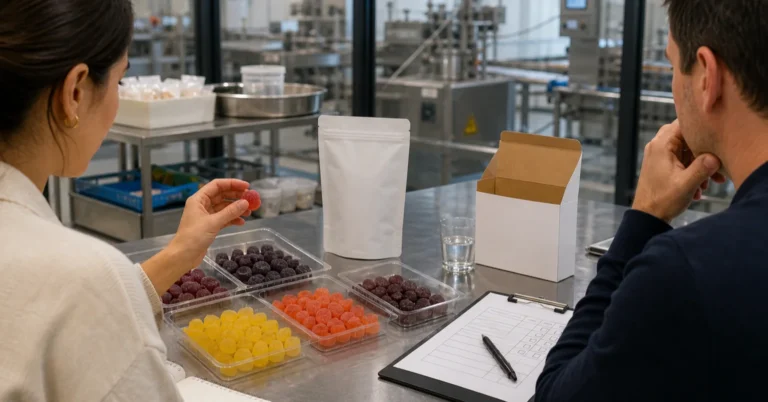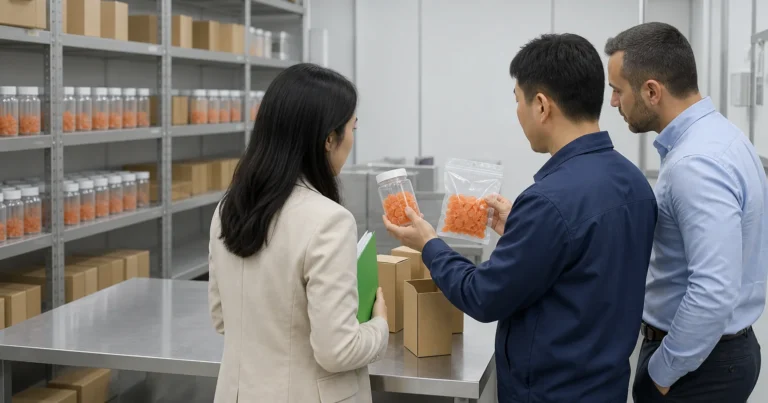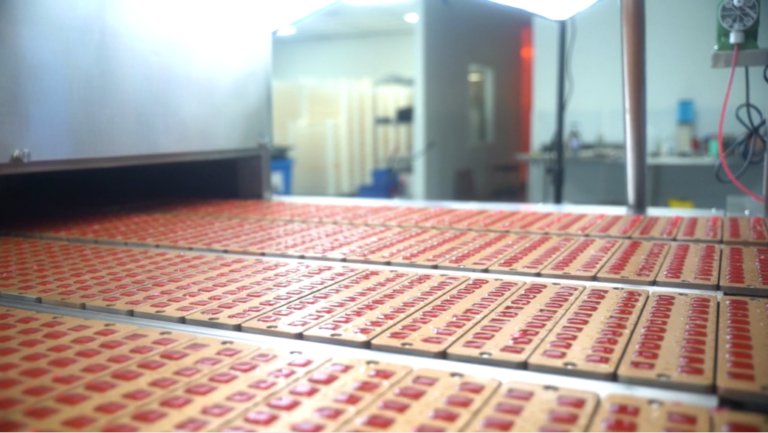
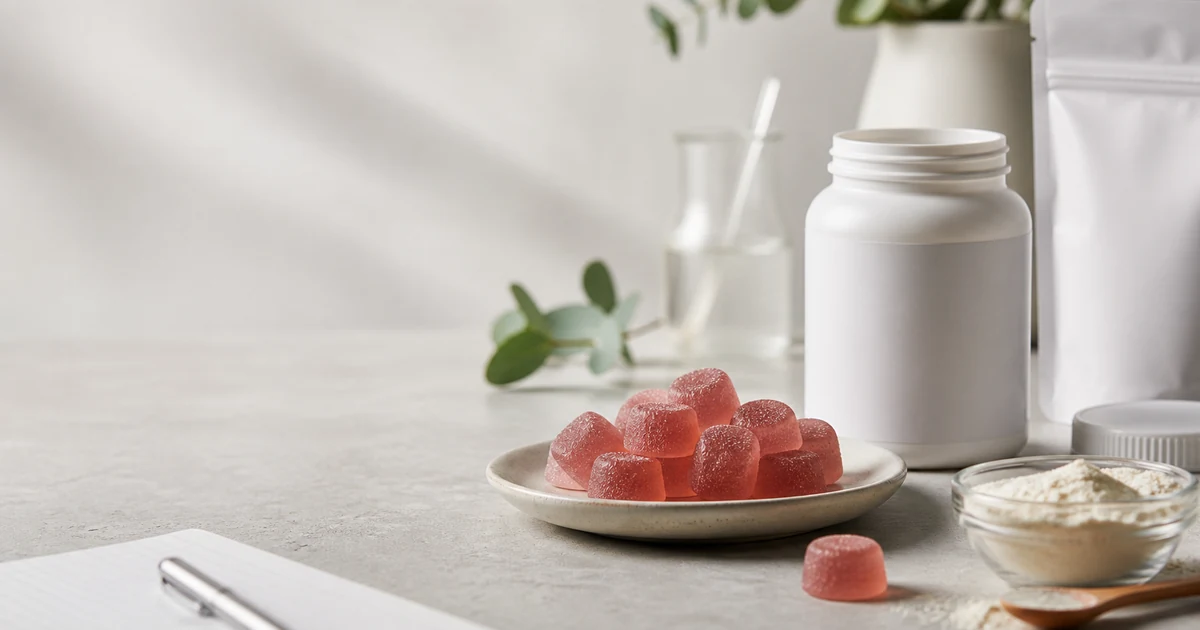

A collagen gummy can look easy on a concept sheet. The problem starts when that idea has to survive taste, texture, dose, moisture, and production.
Collagen gummies formulation is the work of turning collagen peptides, a gummy base, flavor, sweetness, acid balance, packaging, and testing into a stable product that a supplement brand can scale without weakening the label promise.
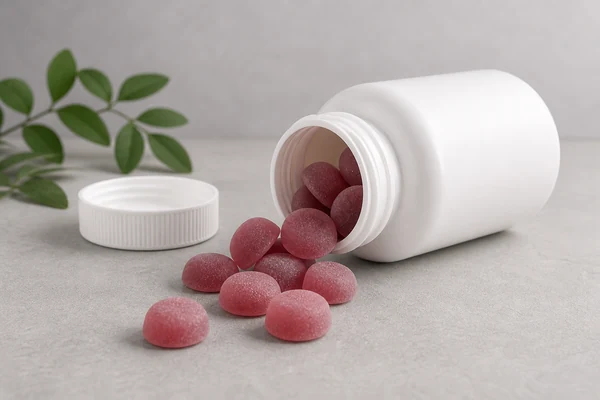
I judge a collagen gummy formula before the quote, not after the first batch. If the formula brief is vague, sampling becomes guesswork. If the constraints are clear, the sample becomes a real feasibility test.
That difference matters because collagen does not behave like a light vitamin dose in a standard gummy vitamin manufacturing system.
What Does Collagen Gummies Formulation Mean?
A formula is not just a list of ingredients. I have seen simple ingredient lists become difficult once piece weight, serving size, and shelf life enter the discussion.
Collagen gummies formulation means designing the active ingredient, gummy base, flavor system, processing route, packaging, and quality checks so the finished gummy can carry the intended claim in real production.
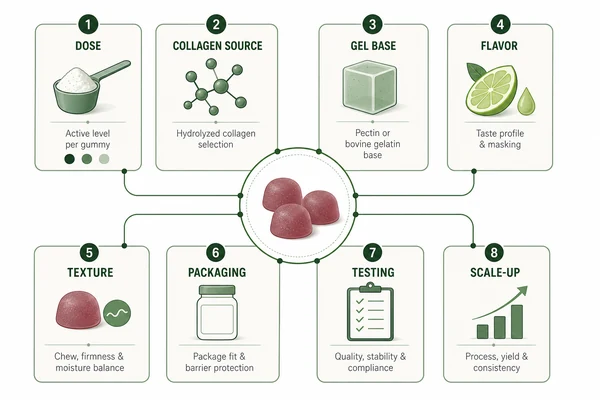
The short answer for supplement brands
For a supplement brand, collagen gummies formulation starts with one practical question: what promise can this gummy format carry without breaking the product experience? A small beauty gummy cannot hold unlimited collagen. A soft chew cannot ignore water activity.
A pleasant flavor cannot hide every source note from bovine or marine collagen. I like to separate the commercial idea from the production reality early, because that is where many launch plans become more honest.
The useful output of formulation is not only a nice sample. It is a set of decisions that can move into pilot work without constant surprise.
The brand should know the target collagen source, the serving size, the gummy weight, the base system, the flavor direction, the packaging route, and the quality checks before the first serious production conversation. If those inputs are missing, the first sample is often testing the brand's uncertainty, not the formula's feasibility.
Why formulation is more than a recipe
A recipe can make a gummy set. A commercial formula has to repeat. It needs consistent piece weight, steady texture, acceptable taste, stable packaging behavior, and documentation that supports the label.
I do not view heating, depositing, cooling, drying, coating, and packing as minor steps. Each step can change the final gummy.
The production difference is simple. A recipe asks, "Can this mixture become a gummy?" A formulation asks, "Can this product be made again, packed, shipped, stored, and still match the promise on the label?" That second question is where collagen gummies become more demanding than many brands expect.
| Formula decision | What it affects | Brand-side question |
|---|---|---|
| Collagen source | taste, odor, cost, positioning | Does the source match the product claim and target market? |
| Target mg per serving | piece size, texture, serving count | Can the dose fit without making the serving awkward? |
| Gelling system | chew, setting, label direction | Does the base match the desired bite and positioning? |
| Sweetener system | solids, mouthfeel, water behavior | Does the product need sugar, sugar-free, or reduced-sugar positioning? |
| Acid balance | flavor brightness, pH, gel behavior | Does the flavor system weaken the base or support it? |
| Packaging | stickiness, moisture, shelf planning | Can the format protect the gummy after production? |
| Testing plan | release confidence, documentation | Which checks support the label and batch release? |
Where bioavailability claims should be limited
I keep bioavailability language careful. Collagen peptides may be easier to formulate than intact collagen, but a gummy page should not promise results that belong to clinical proof, dosage evidence, or a finished-product study.
The safer and more useful point is format feasibility. The formula should protect a clear serving, a stable texture, and a credible label. That is already enough work before any brand starts making broad benefit claims.
This boundary also protects the buyer conversation. A brand can discuss collagen source, peptide form, raw material documentation, and finished-product quality checks without claiming that the gummy format itself improves absorption. If a benefit claim needs support, the support should come from the ingredient evidence and the final label review, not from a casual formulation line.[^1] I would rather make a narrower claim that holds up than a louder claim that creates risk.
Essential Ingredients in a Stable Collagen Gummy Formula
The ingredient list can look friendly to shoppers. In production, every ingredient changes solids, water, acidity, flavor release, and how the gummy sets.
A stable collagen gummy formula usually depends on collagen peptides or hydrolysates, a suitable gelling system, a balanced sweetener and acid system, flavor masking, color, and only the add-ons that the gummy can carry.
That makes collagen gummy planning part of a broader formulation and ingredients review, not a recipe exercise.
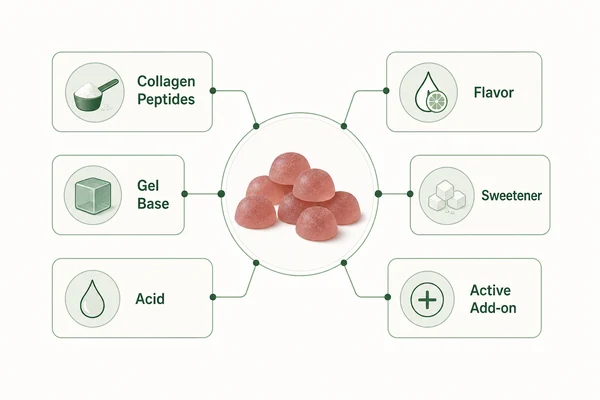
Collagen gummies ingredients list: what each part does
For a supplement brand, "collagen gummies ingredients" should not be answered as a shopper-only label list. The useful collagen gummies ingredients list has four working groups: the active ingredient, the gummy base, the taste system, and the stability support.
The active side usually starts with collagen peptides or hydrolysates, then may include supporting ingredients such as vitamin C, biotin, hyaluronic acid, zinc, or botanical extracts. In B2B review, collagen supplement ingredients should also include the collagen powder ingredients that affect source notes, dispersion, dosage pressure, and documentation. The base side includes gelatin, pectin, or another hydrocolloid system. The taste and structure side includes sweeteners, acids, flavors, and colors. The stability side includes decisions around water behavior, coating, packaging, storage expectations, and the finished-product checks needed before launch.
I would not approve an ingredient list only because it reads well on a label. I would ask what each ingredient does in the formula, what risk it adds, and whether the gummy can still keep the intended dose, chew, taste, and shelf-life behavior.
Collagen peptides and hydrolysates
I prefer to start with collagen form and dose before discussing flavor or shape. Collagen peptides and hydrolysates are common because they can disperse better than larger collagen structures.[^2] That does not mean they disappear inside the gummy system.
They still bring taste, odor, solids, and serving-size pressure. If a brand wants a gram-level collagen serving, I check whether the serving needs multiple gummies, a larger piece, or a different format.
Collagen source is also a formulation decision, not only a marketing line. Bovine collagen may fit one brand position. Marine collagen may fit another. Each route can change taste masking, allergen review, cost expectations, documentation, and the way the product is explained.
I do not handle a source change as a small substitution. A formula that works with one collagen input may need new flavor work, new hydration checks, or a different serving design when the source changes.
Gelling systems: gelatin, pectin, and alternatives
The gelling system decides more than chew. Gelatin can give a familiar elastic bite. Pectin can support a different texture and a more plant-forward positioning, but pectin does not turn collagen into a vegan ingredient. If the project is really comparing collagen pectin gummies against collagen gelatin gummies, the base-system decision belongs in a deeper pectin vs gelatin gummies review.
That distinction matters. I do not use "vegan collagen gummy" language casually, because many products are really vegan collagen booster concepts, not collagen sourced from animals. The base system should match the actual formula, label direction, and processing tolerance.
The base also affects how forgiving the formula feels during production. A gelatin route may be more familiar for many gummy teams, but high collagen load can still make the chew too firm, too soft, or too heavy. A pectin route can create a cleaner bite, but it is usually more sensitive to solids, acid, and process control.
For collagen gummies formulation, the right question is not "Which base is best?" The better question is "Which base fits the dose promise, texture target, label direction, and production route?"
I also separate the base discussion from the collagen source discussion. A brand may want marine collagen for positioning and pectin for a plant-forward gummy base. That does not make the finished product vegan.
It only means the gelling system is plant based. This sounds like a small wording point, but it affects label review, product pages, buyer trust, and how the sales team explains the product.
| Gelling route | Where it can fit | Practical watch point |
|---|---|---|
| Gelatin base | familiar elastic gummy texture | animal-source positioning and firmness control |
| Pectin base | shorter bite and plant-based base story | acid, solids, and setting window control |
| Alternative hydrocolloids | special texture or label experiments | higher development risk and more sample rounds |
| Mixed systems | custom chew or process adjustment | harder troubleshooting if the formula fails |
| Ingredient system | Main role | Formulation watch point |
|---|---|---|
| Collagen peptides | active and product promise | dose, taste, source notes, serving pressure |
| Gelatin | elastic chew and familiar gummy texture | firmness, heat behavior, animal-source positioning |
| Pectin | shorter bite and plant-based base positioning | pH, solids, setting sensitivity |
| Sweeteners | sweetness, solids, mouthfeel | sugar-free texture, crystallization, aftertaste |
| Acids | tartness and pH control | gel weakening, sourness, flavor balance |
| Flavors | taste masking and consumer experience | aftertaste, heat exposure, source-note coverage |
| Colors | appearance and product identity | heat, pH, and storage stability |
Sweeteners, acids, flavors, and colors
Collagen can bring a mild source note. Some marine collagen inputs can be more challenging than bovine inputs. Sweeteners, acids, and flavors should be chosen as a system, not as decoration.
Acid level can affect taste and setting behavior. Sugar-free routes can change mouthfeel and water behavior. Natural colors can shift under heat or acidity. I want the flavor direction defined early, because late flavor masking often hides a deeper dose or source problem.
The sweetener system is also part of the physical structure. A sugar-based gummy and a sugar-free gummy do not dry, chew, or store in the same way. If a brand wants sugar-free positioning, the formula may need more development time because bulk sweeteners, fibers, acids, and flavors all need to work together. That work becomes its own sugar-free collagen gummies lane when the label claim, texture, and sweetener system drive the brief.
This is why I ask about sugar direction before sampling. It is not a small marketing choice. It changes the gummy system.
Optional functional add-ons
Vitamin C, biotin, zinc, hyaluronic acid, or botanical ingredients can make sense in a beauty gummy. I still view each add-on as a load on the formula. Each one can affect taste, stability, claim language, and testing.
A crowded formula may look strong on the front label but perform poorly in production. For this reason, I like to ask which ingredient is the main promise and which ones are only supporting ingredients.
The safest route is to build the formula around a primary promise first. If collagen is the main promise, supporting ingredients should help the concept without forcing the gummy to carry too much technical risk. If biotin, vitamin C, marine collagen, or vegan booster positioning becomes the main story, that may deserve a separate product lane and a separate buyer brief. Trying to make one formula answer every beauty trend usually makes the sample slower, less stable, and harder to explain.
| Add-on direction | Why brands ask for it | What I would check before adding it |
|---|---|---|
| Vitamin C | beauty positioning and collagen-support story | acid balance, taste, label wording, and storage behavior |
| Biotin | hair, skin, and nails positioning | dose uniformity, claim role, and finished-product check plan |
| Hyaluronic acid | premium beauty positioning | texture load, water behavior, and mouthfeel |
| Zinc or minerals | stronger functional story | taste, solubility, color effect, and compatibility |
| Botanicals | trend or differentiation | bitterness, color change, sediment, and claim boundaries |
From Preparation Method to Commercial Process
A kitchen-style method is not enough for brand launch planning. The real question is whether the process can repeat when the batch size grows.
Commercial collagen gummy production should turn dry blending, hydration, heating, depositing, setting, sample approval, and pilot checks into controlled steps instead of one loose preparation method.
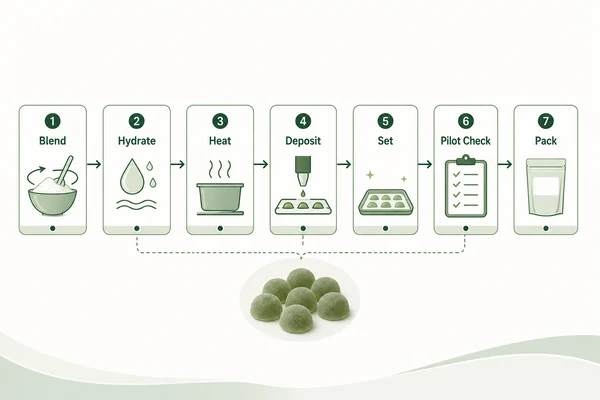
Dry blending and hydration
I start the process conversation before the cooker runs. Dry ingredients need a plan for dispersion. Collagen peptides, gelling agents, acids, colors, and sweeteners do not behave the same way.
Poor blending can create texture variation or pockets of strong taste. Hydration also matters because the gummy base needs enough water to process, but the finished gummy must not hold so much free moisture that it becomes sticky or unstable.
The order of addition matters. A brand does not need to design the factory process alone, but it should understand that dry blending, hydration time, and liquid addition can change the finished result.
If collagen clumps or disperses unevenly, the issue may show up as cloudy pieces, uneven mouthfeel, or inconsistent taste. The better development conversation is not "Can you make this sample?" It is "What process route keeps this active evenly distributed?"[^3]
Heating and process exposure
Heat is useful, but it should not be regarded as harmless. The gummy mass needs the right temperature and hold time to dissolve, mix, and deposit well. Long heat exposure can affect flavor, color, and some sensitive add-ons.
I do not make unsupported claims that heat will destroy collagen in every case. I look at the whole process instead: temperature, timing, pH, solids, and when each ingredient is added.
This is also where waiting time becomes a hidden risk. A formula can behave well in a small trial because the batch moves quickly. At larger scale, the material may sit longer, thicken faster, or lose the clean depositing window. When I review a process plan, I want to know where the active enters the mass, how long the mass stays hot, and whether the depositing window is realistic for the planned batch size.
Depositing, molding, and setting
The formula still has to move through equipment. A dense gummy mass may deposit poorly. A formula with too much active material can create fill-weight drift or a rough mouthfeel.[^3] Setting time also affects production planning.
If the gummy sets too slowly, capacity suffers. If it sets too fast, depositing and surface quality can suffer. The sample should show more than taste. It should show whether the formula can run.
Depositing is where a formula starts to reveal whether it is production-friendly. A thick mass may not fill each cavity cleanly. A thin mass may let particles settle before the gel locks.
However, a formula with the wrong surface behavior may also release poorly or need more coating than expected. These details matter to brands because they affect yield, appearance, serving accuracy, and launch timing.
For teams that also need to understand the equipment-side variables, a separate review of gummy manufacturing process factors can help frame temperature, depositing, humidity, and packaging as production controls rather than isolated formula notes.
Sample approval and pilot run checks
A sample is only a starting point. I compare it with a pilot run because scale can expose weight variation, texture drift, taste changes, surface stickiness, packaging fit, and documentation gaps.
I would not approve a collagen gummy only because the first sample tastes good. I would ask whether the formula deposits cleanly, keeps its chew after short storage, stays clean in the intended package, and matches the claim-support plan.
A sample shows whether the concept is possible. A pilot run shows whether the process is repeatable enough to plan a commercial order, before the brand commits to packaging artwork, bottle count, and launch timing.
| Process stage | Practical check | Why it matters |
|---|---|---|
| Blending | even dispersion | protects dose and mouthfeel |
| Hydration | complete wet-out and smooth mass | reduces specks, clumps, and uneven texture |
| Cooking | controlled heat exposure | protects texture, flavor, and sensitive add-ons |
| Depositing | fill-weight consistency | protects serving accuracy |
| Setting | stable chew and shape | protects product experience |
| Drying or curing | target moisture behavior | reduces later stickiness |
| Packing | moisture control | protects storage behavior |
Quality Properties That Decide Whether the Formula Works
Quality is where the formula tells the truth. A gummy can taste good on day one and still fail after packing, transit, or warm storage.
The most important quality properties for collagen gummies are texture, chew, flavor masking, mouthfeel, water activity, stickiness, shelf-life behavior, storage conditions, and packaging compatibility.

Texture, elasticity, and chew
Texture is not only a consumer preference. It is a signal of formula balance. A gummy that is too soft may carry too much moisture or have a weak gel structure. A gummy that is too firm may feel medicinal or hard to chew.
Collagen load can push texture in either direction depending on the base system and solids. I want a target chew defined before sampling, because "good texture" means different things for beauty, sports, and daily wellness products.
For brands, texture should be described in practical terms before the sample round. Is the target a soft beauty chew, a firm supplement gummy, or a cleaner pectin-style bite? Should the piece feel premium, playful, or functional?
Those words sound subjective, but they guide real formula choices. If the brand cannot describe the desired chew, the development team has to guess. Guessing is a poor way to build a repeatable product.
Flavor masking and mouthfeel
Flavor masking should not cover every formulation mistake. A strong flavor can hide a source note for a short tasting session, but it may not solve aftertaste or mouth coating. Mouthfeel is also affected by powder load, sweetener choice, acid balance, and drying.
As a result, I usually handle taste approval as a staged check. First, does the base formula work? Second, does the flavor system support the active? Third, does the product still taste acceptable after a storage period?[^4]
The last question is easy to forget. Some products taste acceptable when freshly made, then change after the formula settles in the package.
A protein note can become more obvious. A fruit flavor can fade. A surface coating can change the first bite. I prefer to connect flavor with stability, not only with sample-room approval.
Water activity and stickiness
Water behavior is one of the most practical quality checks. A collagen gummy that leaves the mold cleanly can still become sticky later. Moisture can move inside the gummy, between gummies, or between the gummy and packaging.[^4]
This is why I do not separate formula from packaging. The formula, coating, bottle, pouch, desiccant decision, and target storage condition should be discussed together.
I avoid using one universal water activity number as a promise because every formula and market plan needs validation. Still, the concept matters. Free water affects microbial risk, texture change, surface stickiness, and clumping. If a brand only asks for a good flavor sample and ignores water behavior, the first real issue may appear after the product sits in a bottle.
| Quality property | What to observe | Why it matters for launch |
|---|---|---|
| Texture | soft, firm, elastic, brittle, sticky | shapes consumer experience and repeat purchase |
| Mouthfeel | smooth, grainy, coated, drying | reveals active load and dispersion issues |
| Water behavior | tackiness, clumping, surface moisture | affects packaging and storage confidence |
| Flavor hold | taste after short storage | shows whether masking still works |
| Piece weight | variation across pieces | supports serving consistency |
| Appearance | clarity, color, surface finish | affects perceived quality and retailer confidence |
Shelf life, storage, and packaging
Shelf life should be earned through testing and documentation, not guessed from a similar product. I avoid fixed shelf-life promises unless a finished formula has data.
For planning, the brand should define the target market, packaging format, storage expectation, and label claim first. Then the development team can choose a stability plan that fits the risk. A bottle, pouch, or blister-style format may each need different moisture-control and barrier decisions.
Packaging should not be the last line item. A formula with sensitive color, flavor, or surface behavior can still struggle in the wrong package. When formula and packaging are planned together, the brand has a clearer path from sample approval to commercial release.
For a commercial brief, I make storage a design input. Warehouse holding, transit, retail storage, and consumer handling can expose moisture, heat, pressure, or light. The formula, closure, liner, desiccant, fill count, and carton plan can share that protection work.
If the project may move into bottle, pouch, or shaped-pack decisions, an early look at gummy packaging options can help the brand separate formula protection from equipment and package-format planning.
| Storage question | Why it belongs in formulation work |
|---|---|
| Will the gummies be packed in a bottle, pouch, or other format? | The package changes moisture control and clumping risk. |
| Will the product ship through warm or humid routes? | Distribution stress can expose weak water behavior. |
| Will the product use a coating? | Coating can improve handling but may change mouthfeel. |
| Will the count per container create pressure on the gummies? | Crowded containers can worsen sticking and shape damage. |
| Will the product need a premium clear appearance? | Clarity goals can limit ingredient and process choices. |
Troubleshooting Collagen Gummies Formulation Problems
Problems usually appear as texture, taste, or storage complaints. The deeper cause often sits in dose, water, gel system, process exposure, or packaging.
Troubleshooting collagen gummy formulation means tracing visible failures back to the formula and process decisions that caused them, then changing one controlled variable at a time.
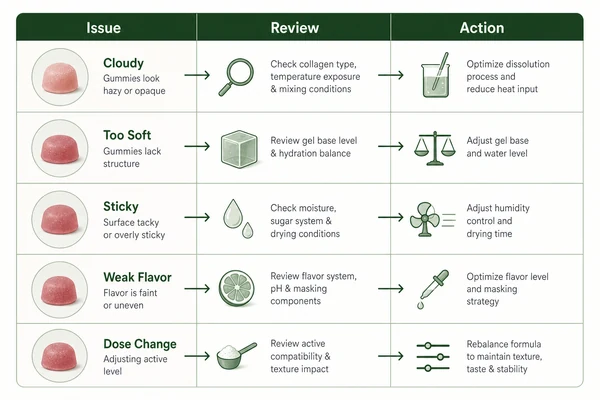
Separating or cloudy layers
Cloudiness may not be a defect. Some collagen formulas will not look perfectly clear. The question is whether the appearance matches the product promise and stays consistent.
Separation is more serious because it can point to poor dispersion, timing, pH, temperature, or solids balance. I prefer to review the mixing order before changing the whole formula. Sometimes the issue is not the ingredient itself. It is when and how the ingredient enters the gummy mass.
A cloudy gummy may be acceptable for a functional product if the appearance is stable and the brand expects a more natural look. A separated gummy is different. Separation suggests the system is not holding together.
That can affect visual quality, texture, and confidence in serving consistency. I would check hydration, viscosity at deposit, cooling behavior, and whether the active load is too high for the base.
Too soft or too rubbery
Soft gummies often need a review of solids, moisture, gelling system, setting time, and drying conditions. Rubbery gummies may need a different base balance or a lower active load per piece. I do not like solving texture problems by only adding more gel or more acid.
That can create a new problem in taste or mouthfeel. Texture work should be tied to the target serving and piece weight.
The most useful troubleshooting habit is to change one thing at a time. If the team adjusts collagen load, gelling level, acid balance, drying time, and coating all at once, the next sample may improve, but nobody knows why.
That makes scale-up harder. A clean development record is not paperwork for its own sake. It protects the brand when a formula needs to repeat.
Sticky gummies after storage
Stickiness after storage is a common warning sign. It can point to excess free moisture, a coating mismatch, or packaging that does not protect the gummy well enough. Warm or humid storage can make those weaknesses visible.
The fix depends on the cause. More drying may help one formula but make another too hard. A stronger package may solve moisture pickup but not surface migration. This is why I handle sticky gummies as a system problem, not a single defect.
Dose changes that affect texture
Dose changes are not simple edits. A higher collagen target can change viscosity, piece size, drying time, chew, aftertaste, and serving count. If the label promise changes late, the formula may need a new sample cycle. I prefer to make that clear before the brand locks artwork, packaging count, or cost targets.
For example, moving from a light collagen-support positioning to a larger gram-level serving may force a multi-piece serving or a bigger gummy. That affects bottle count, serving instructions, cost, flavor, and the consumer's daily habit. It is better to make that tradeoff visible before the brand commits to the label promise.
| Visible issue | Likely review point | First safe action |
|---|---|---|
| cloudy or uneven gummy | dispersion and process order | check mixing and hydration sequence |
| separating layers | viscosity, deposit timing, cooling | review deposit window and gel setting behavior |
| too soft | moisture, gel strength, drying | review solids and setting conditions |
| too rubbery | base balance or active load | adjust texture target and piece weight |
| sticky after storage | water activity and packaging | test coating and package protection |
| weak flavor | collagen source and masking | rebuild flavor around active load |
| gritty mouthfeel | collagen dispersion or particle behavior | review hydration and raw material form |
Manufacturer-Ready Formula Brief Checklist
A good manufacturer conversation starts before samples. I want the brand to bring constraints, not only an idea and a target launch date.
A manufacturer-ready collagen gummy brief should define the collagen source, target serving, gummy weight, base system, flavor direction, packaging format, testing needs, and scale-up expectations before sampling starts.
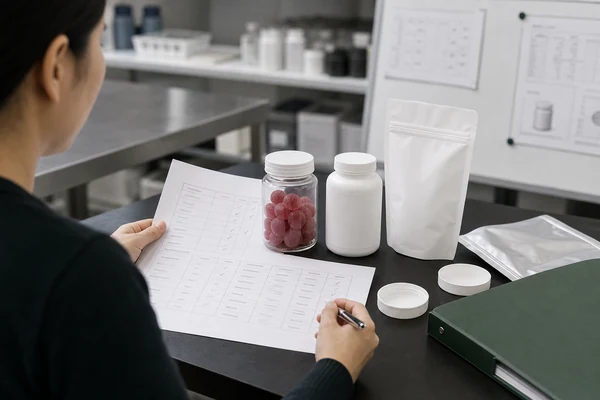
Formula inputs to prepare
I would prepare the formula inputs in plain terms. The brief should name the collagen source preference, target mg per serving, expected serving count, gummy shape, preferred base, and any sugar-free or clean-label direction. When a buyer asks for the formula of collagen gummies, the useful answer is not a generic recipe. It is a controlled collagen formulation brief that separates mandatory inputs from flexible preferences. It should also state which ingredients are mandatory and which are optional.
The strongest brief separates fixed requirements from preferences. A fixed requirement might be marine collagen, a sugar-free route, a specific market, or a two-gummy serving. A preference might be strawberry flavor, a heart shape, or a soft chew. If everything is mandatory, the project becomes rigid before feasibility is known. If everything is optional, the sample has no clear target.
Target dose and serving size
Dose and serving size should be locked early. A beauty gummy may use a modest collagen amount because the experience and daily habit matter. A higher collagen promise may need several gummies per serving or may belong in another format.
I do not see that as a failure. I see it as honest format selection. The best product is not necessarily the one with the most aggressive number on the label.
This is where I want the brand to work backward. Start with the promised serving. Then decide how many gummies the consumer can reasonably take. Then check whether each piece can carry its share without hurting texture or taste.[^5]
If the math feels uncomfortable, the solution is not to hide the problem. The solution is to adjust the serving design, the product format, or the label promise before artwork and packaging are locked.
Testing and COA questions
Testing should match the product claim and market plan. The brand should ask what documentation is available for raw materials, what finished-product checks are reasonable, and how batch records will support release.[^6]
I avoid implying that every claim is proven by one COA. A COA is part of the proof chain. It does not replace formulation judgment, stability work, third-party testing decisions, or label review.[^7]
Good testing questions are practical. What raw material documents are available? Will the finished gummy be checked for weight, appearance, water behavior, and microbiology according to the chosen release plan?
What information appears on the batch COA? What happens if the pilot sample looks good but the first larger batch needs adjustment? These questions do not make the project slower. They reduce the wrong kind of speed.
I separate a COA from a full product proof story. A COA can show useful batch information, but it does not answer every question about shelf life, flavor hold, packaging behavior, or label review. The brand should ask what each document proves and what it does not prove. That keeps the conversation practical and prevents the team from using paperwork as a substitute for product validation.
| Question to ask | What the answer should clarify |
|---|---|
| Which raw material documents are available? | identity, source, allergen review, and supplier traceability |
| What finished-product checks are planned? | piece weight, appearance, water behavior, and release quality |
| What will appear on the batch COA? | the quality data the brand can actually receive |
| How are pilot adjustments recorded? | whether scale-up learning becomes part of the project record |
| What claim language needs external review? | where formulation support ends and label review begins |
Packaging and scale-up questions
Packaging should be part of the first brief, not the last decision. A bottle count, gummy weight, coating choice, cap, liner, pouch, or desiccant can affect storage behavior and cost. Scale-up also needs a volume path. The brand should know whether it is testing market response, preparing a private label launch, or planning a larger commercial run.
The scale-up question is really a risk question. Is the brand trying to prove demand first? Is it trying to move into retail? Is it planning a premium beauty line with stricter packaging expectations?
Each path changes the right sample plan. A small market-test order can focus on speed and learning. A larger launch needs stronger documentation, packaging review, and production repeatability.
| Brief item | What to define | Why it matters |
|---|---|---|
| Collagen source | bovine, marine, or other route | affects taste, cost, positioning, and documents |
| Serving target | mg per serving and gummies per serving | protects label and user experience |
| Piece design | weight, shape, count per bottle | affects dose, chew, packaging, and cost |
| Base system | gelatin, pectin, or alternative | affects texture and process route |
| Sweetener route | sugar, reduced sugar, or sugar-free | affects solids, mouthfeel, and water behavior |
| Flavor direction | fruit, sour, mild, or masked | affects acceptance and aftertaste |
| Packaging | bottle, pouch, or other format | affects stickiness and shelf planning |
| Testing | raw material and finished-product checks | supports quality and release decisions |
| Launch path | market test, private label, or scale-up | changes speed, documentation, and cost priorities |
Collagen Gummies Formulation Variations to Keep as Separate Lanes
Variations can help a product line grow. They can also pull the project away from the main formulation question if they are not controlled.
Vitamin C, biotin, marine collagen, and vegan collagen booster gummies are useful collagen gummy variations, but each one can become its own formulation lane with different claims, sources, and production risks.
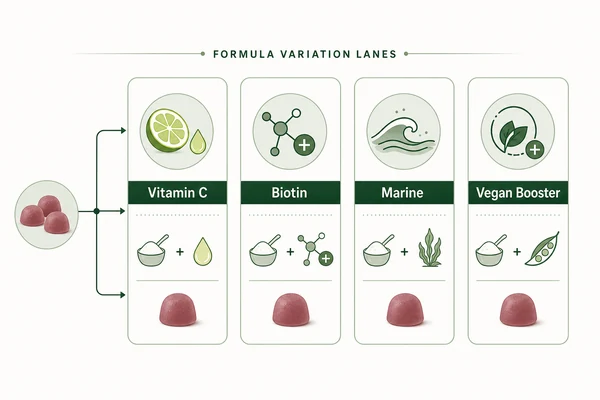
Beauty collagen with vitamin C
Vitamin C is a common beauty-positioning partner for collagen. In formulation, I still view it as an acid-sensitive and claim-sensitive choice. It can affect taste and may require careful label language.
The key is not to add vitamin C because competitors do. The key is to decide whether the product promise needs it, whether the taste system can support it, and whether the formula can stay stable.[^8] A collagen vitamin C astaxanthin gummy concept can be useful as a product-line reference, but the final dose, base, flavor, and label route still need project-specific review.
This topic can become its own product-development lane because the real question becomes how vitamin C, acid balance, flavor, and collagen positioning work together without unsupported claims. In a general collagen formulation guide, vitamin C should stay a short example of a variation, not the main lane.
Collagen with biotin
Biotin can fit a hair, skin, and nails positioning, but it changes the product from a simple collagen gummy into a combined beauty supplement. That may deserve a different search lane, while this page should stay focused on dose, texture, stability, and production control.
The practical issue with biotin is not usually bulk load. It is positioning, uniformity, and label clarity. The brand should decide whether biotin is a small support ingredient or part of the main product promise. That decision changes how the product is explained and what QA should check.
Marine collagen gummies
Marine collagen can support a premium or source-specific positioning, but it may bring taste, odor, cost, allergen, sourcing, and documentation questions. I would not handle marine collagen as a small ingredient swap. If the brand wants marine collagen as the main selling point, I would usually split it into its own brief.
These are good reasons to keep marine collagen gummies as a separate lane instead of hiding the topic inside a general formulation guide.
Vegan collagen booster gummies
Vegan collagen language needs care. Most vegan products are not true collagen products. They are usually collagen-support or collagen-booster concepts built around nutrients that support the body's own collagen-related pathways.
That distinction affects claims, ingredients, and buyer trust. I would keep vegan booster concepts separate from animal-sourced collagen gummy formulation so the label direction stays clear.
The formulation work is also different. A vegan booster gummy may use pectin and a vitamin/mineral blend instead of animal collagen peptides. That changes taste, texture, testing, and claim boundaries. It can be a strong product idea, but it is not the same formulation lane as collagen gummies formulation. For that reason, vegan-positioned projects should be planned through a separate vegan collagen gummies brief instead of being folded into an animal-collagen formula.
For Talvenda, the useful role is not to push every variation into one formula. The better role is to help a brand screen feasibility, choose a focused lane, test the sample, check stability, and prepare the product for scalable gummy production.
Conclusion
Collagen gummies formulation works best when dose, texture, taste, packaging, testing, and scale-up are planned together before the first production run.
For Talvenda, collagen gummies formulation is where formula review, sample planning, packaging discussion, quality documentation, and scale-up support belong in the same conversation. If a brand is unsure whether its collagen dose, gummy base, flavor direction, or package route can work in production, I would review those constraints before sampling starts.
[^1]: "Structure/Function Claims", https://www.fda.gov/food/nutrition-food-labeling-and-critical-foods/structurefunction-claims. elink returned this FDA source for dietary supplement claim-boundary context. Used to support cautious wording around benefit claims and label review, not to approve any specific collagen gummy claim. [^2]: "Collagen supplementation in skin and orthopedic diseases", https://pmc.ncbi.nlm.nih.gov/articles/PMC10102402/. elink returned this PMC review for collagen-supplement evidence context. Used only to support keeping collagen peptide statements evidence-bounded, not to claim a finished gummy delivers a clinical result. [^3]: "Rheological analysis in food processing: factors, applications ... - PMC", https://pmc.ncbi.nlm.nih.gov/articles/PMC12828905/. elink returned this PMC candidate for viscosity, flow behavior, and food-processing control context. Used to support process-feasibility language around dispersion, depositing, and fill behavior. [^4]: "Physicochemical and Sensory Stability Evaluation of Gummy ... - PMC", https://pmc.ncbi.nlm.nih.gov/articles/PMC10818720/. elink returned this PMC candidate for gummy water-activity, moisture, sensory, and storage-stability context. Used to support general gummy-format moisture and stability discussion, not collagen-specific shelf-life guarantees. [^5]: "Dietary Supplement Labeling Guide: Chapter IV. Nutrition Labeling", https://www.fda.gov/food/dietary-supplements-guidance-documents-regulatory-information/dietary-supplement-labeling-guide-chapter-iv-nutrition-labeling. elink returned this FDA source for serving-size and Supplement Facts context. Used to support serving-design and label-planning discussion. [^6]: "Current Good Manufacturing Practices (CGMPs) for Food and ... - FDA", https://www.fda.gov/food/guidance-regulation-food-and-dietary-supplements/current-good-manufacturing-practices-cgmps-food-and-dietary-supplements. elink returned this FDA source for dietary supplement CGMP context. Used to support documentation, batch-record, and quality-control planning language. [^7]: "Dietary Supplement and Vitamin Certification - NSF", https://www.nsf.org/consumer-resources/articles/supplement-vitamin-certification. elink returned this NSF source for third-party supplement testing and certification context. Used as a quality-signal reference only, not as a claim that any Talvenda or customer product is certified. [^8]: "Vitamin C - Health Professional Fact Sheet", https://ods.od.nih.gov/factsheets/VitaminC-HealthProfessional/. elink returned this NIH ODS source for vitamin C and collagen synthesis context. Used to support cautious vitamin C formulation positioning, not a finished-product efficacy claim.