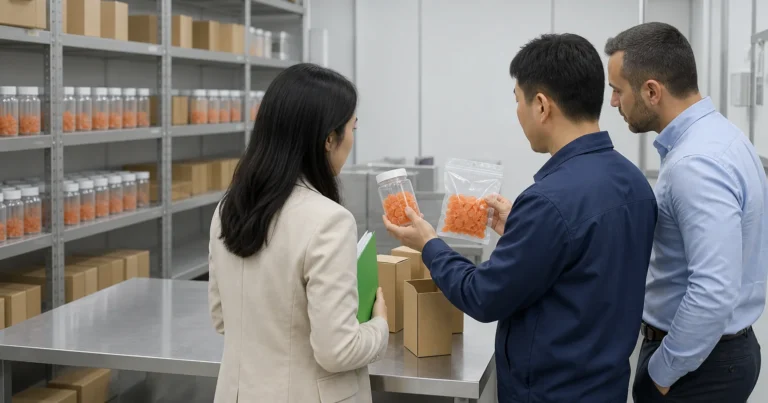

L-citrulline powder numbers look clean on paper. Putting those numbers into a gummy is where many sports nutrition product plans start to break.
An L-citrulline gummies formulation is not simply a powder dose moved into a chewable format. It is a product-development decision about active load, serving size, taste masking, gummy base, stability, label claims, and consumer experience.
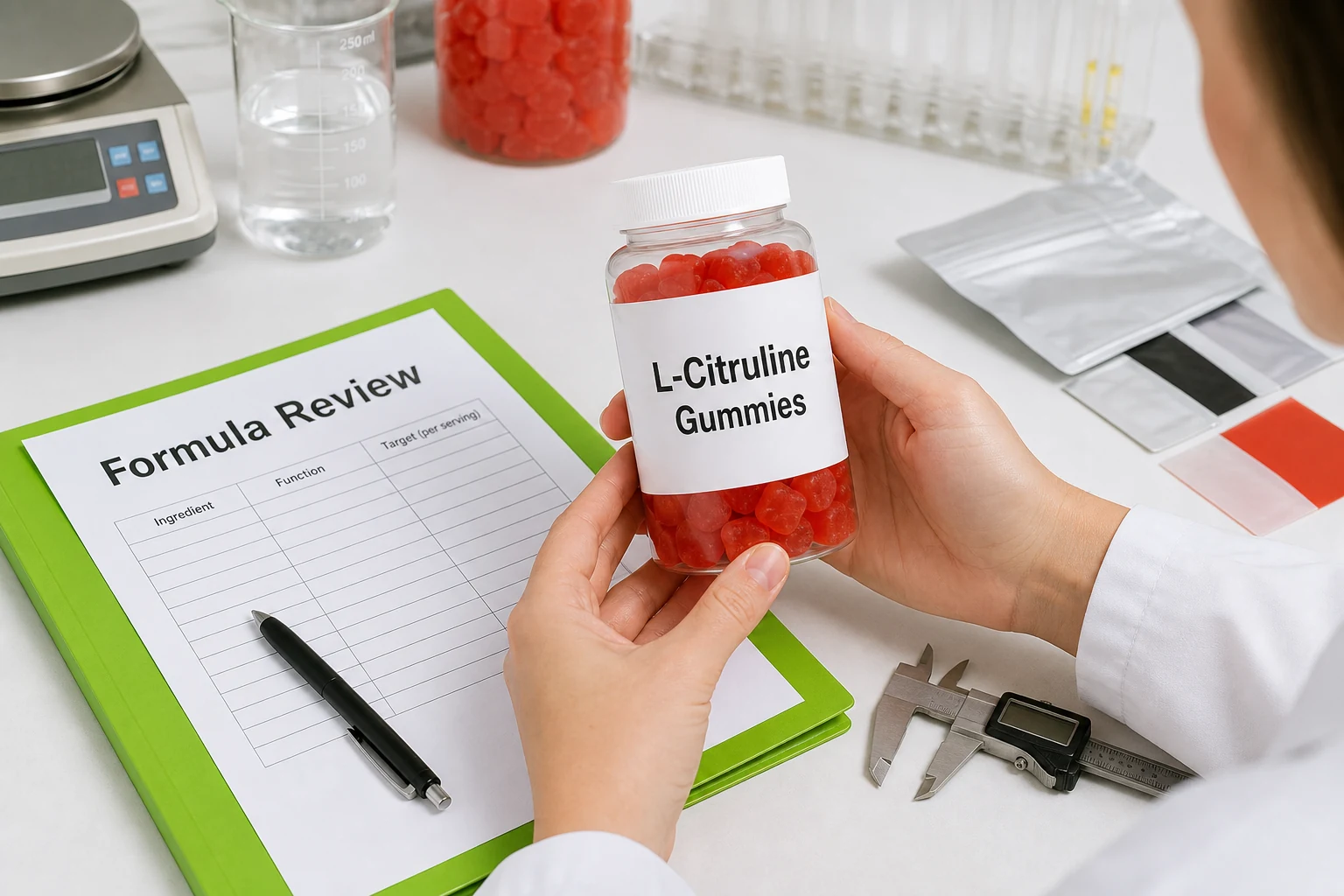
A powder can carry gram-level active doses with a scoop. A gummy has to make room for the active ingredient after the base, sweeteners, acids, flavors, moisture system, and texture requirements are already in place.
This is why the first question should not be, "Can we make L-citrulline gummies?" The better question is, "What kind of L-citrulline gummy can we responsibly formulate, label, and sell without pretending it is a powder replacement?"
For supplement brands, that distinction matters. A strong gummy concept may still be possible, but it needs to be built around dose reality rather than powder-category expectations.
What Is an L-Citrulline Gummies Formulation?
An L-citrulline gummies formulation is the technical and commercial plan for delivering L-citrulline in a stable gummy format.
An L-citrulline gummies formulation combines the active ingredient with a gummy base, sweetener and acid systems, flavor, moisture control, serving design, label direction, and testing expectations. The formula and product promise must be designed together.
The formula is only one part of the decision. The product also needs a clear role in the brand's line: a sports nutrition gummy, a daily performance-support gummy, a nitric oxide support blend, or a broader active-lifestyle supplement.
A useful formulation brief should answer several questions before sampling starts:
- How much L-citrulline should the product deliver per serving?
- How many gummies will consumers realistically take?
- Will the product be single-active or blended?
- Is the brand targeting vegan, sugar-free, low-sugar, or clean-label positioning?
- What claims can the final serving size honestly support?
- What testing and documentation will be needed before launch?
These questions are connected. A higher active load can affect taste and texture. A vegan pectin base can change stability behavior. A sugar-free direction can change mouthfeel and moisture behavior. A stronger claim direction can require a more careful evidence and label review.
Why L-Citrulline Is Used in Sports Nutrition Products
L-citrulline is an amino acid widely used in sports nutrition because it is associated with nitric oxide pathways and performance-support positioning. Consumers often recognize it from pre-workout powders, pump formulas, and active-lifestyle supplements.[^1]
That recognition creates a real commercial opportunity. A gummy format can make the ingredient more convenient for consumers who dislike powders, want a travel-friendly option, or prefer a daily routine format.
But recognition also creates expectations. Many consumers who know L-citrulline know it from powders, where serving sizes are commonly discussed in grams. That makes the gummy format harder to position if the formula cannot deliver a comparable active strategy. The product needs to be honest about what it is: a gummy-format L-citrulline product, not automatically a scoop-for-scoop powder replacement.
Why Gummies Create a Different Formulation Problem Than Powders
A powder serving can scale upward with fewer structural limits. If the product needs more active ingredient, the serving scoop can usually become larger. Flavor and sweetener systems still matter, but the format has more room to absorb the dose.
A gummy is different. Each piece has a fixed total weight and must contain more than the active ingredient. The base gives the gummy structure. Sweeteners and acids shape taste and texture. Moisture affects shelf stability. Flavors and colors create consumer acceptance. If the active ingredient takes too much of the available space, the gummy may become too sour, too bitter, too sticky, too grainy, too unstable, or too large in serving count.
That is why L-citrulline gummies should be evaluated as their own format. The first formulation question is whether the intended serving can survive the gummy system after all non-active ingredients are included. For brands still comparing formats, the broader gummies vs capsules supplement format trade-off is worth reviewing before a brief becomes locked.
Where L-Citrulline Fits in a Gummy Supplement Line
L-citrulline can fit several product directions:
| Product Direction | Best Fit | Main Formulation Question |
|---|---|---|
| Daily performance-support gummy | Active lifestyle consumers | Can the product deliver a meaningful serving without too many gummies? |
| Nitric oxide support blend | Sports and fitness consumers | Can the blend support the claim without crowding the formula? |
| Pre-workout-adjacent gummy | Gym and performance users | Can the serving strategy avoid unrealistic powder-dose expectations? |
| Men's wellness gummy | Highly sensitive claim area | Can the brand avoid medical or ED-style claim drift? |
| Broader sports gummy line | Brand portfolio expansion | Should L-citrulline be the first SKU or part of a later formula? |
For many brands, the strongest opportunity is not a high-dose powder replacement. It is a clear, convenient sports nutrition gummy with transparent positioning and realistic formulation targets.
Can Powder-Level L-Citrulline Doses Work in Gummies?
Powder-level L-citrulline doses are difficult to replicate in a standard gummy format.
Powder-level L-citrulline doses are difficult to replicate in standard gummies because higher active loads increase serving count and create pressure on taste, texture, cost, package count, and claim clarity.
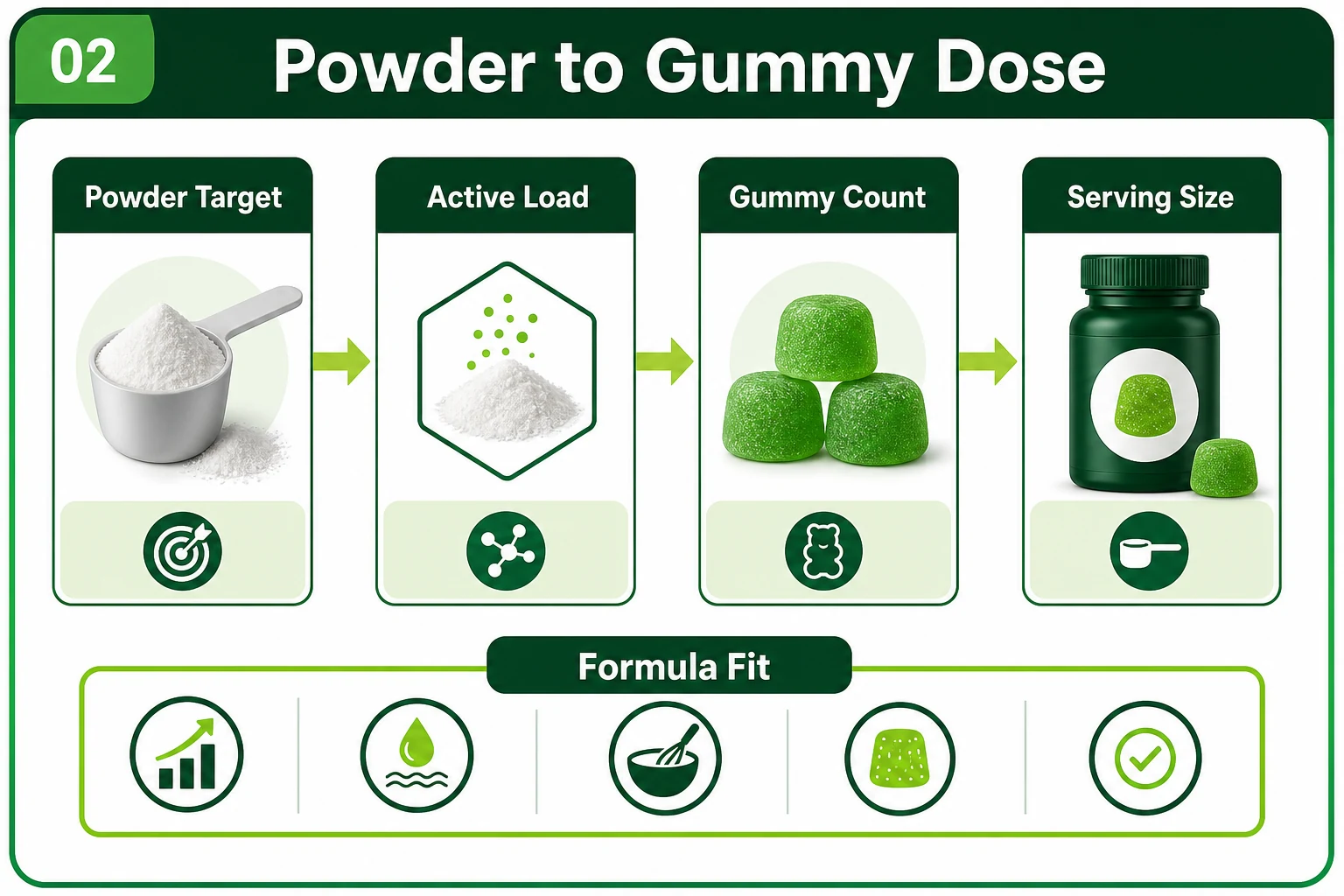
If a brand wants a gram-level serving that resembles a powder product, the formula may require multiple gummies per serving. That may still be possible, but the brand must decide whether the resulting consumer experience makes sense.
A six-gummy serving may work for some products. It may fail for others. The answer depends on price, target consumer, channel, bottle count, taste, and the claim story. In early formulation reviews, I would rather see a brand lower the dose honestly than force a gummy into a serving size consumers will not repeat.
Why Common Powder Doses Are Hard to Translate into Gummies
The powder-to-gummy conversion problem has three parts.
First, the gummy has limited physical space. A gummy is not an empty delivery capsule. It needs a working base system and enough sensory support to become a product people will actually take.
Second, L-citrulline can be difficult to mask at higher concentrations. Sour, bitter, or mineral-like notes can become more obvious as active load increases. Strong flavors may help, but flavoring cannot solve every dose problem.
Third, high active loads can influence the gummy's texture and stability. The product may become grainier, firmer, stickier, or less stable over time. These problems are easier to address before sampling than after the brand has already committed to a label claim and launch timeline.
Active Ingredient Load, Serving Size, and Gummy Count Trade-Offs
A brand should model the serving size before approving the concept. The question is not simply how much L-citrulline can fit into one gummy. The question is what the full serving looks like on the label and in daily use.
| Planning Item | Practical Meaning for Brands |
|---|---|
| Target active per serving | The amount of L-citrulline the label and product story are built around. |
| Active per gummy | The amount each gummy can carry without unacceptable taste, texture, or stability trade-offs. |
| Gummies per serving | The number consumers must take to reach the serving target. |
| Bottle count | Higher serving count increases the number of gummies needed for a 30-day supply. |
| Cost per serving | More gummies per serving usually increases cost, packaging size, and shipping weight. |
| Claim strength | Lower active servings require more conservative claim language. |
For example, a product aiming for a moderate L-citrulline serving may be feasible in two to four gummies. A product trying to match aggressive powder expectations may require a serving count that weakens the convenience advantage of gummies.
This is not a failure of the format. It is a format strategy decision.
When a Lower-Dose Gummy Concept May Still Make Commercial Sense
A lower-dose L-citrulline gummy can still be commercially useful if the positioning is honest.
It may work as:
- a daily active-lifestyle gummy;
- a convenient nitric oxide support product;
- a sports nutrition entry SKU;
- a travel-friendly companion to powders;
- a blended performance-support gummy with complementary ingredients.
It becomes risky when the product implies powder-level performance while delivering a much lighter active strategy. Consumers may accept a convenient gummy with moderate support positioning. They are less likely to accept a gummy that overpromises against the formula.
A lower dose is not automatically a weak product. It is a different product. The brand should define that difference before the label, product page, and sampling brief are written. The same logic applies to broader questions about whether gummy vitamins are as effective as pills: the answer depends on dose, stability, ingredient form, and realistic label claims, not format alone.
How Should Brands Think About L-Citrulline Gummies Dosage Conversion from Powder?
Dosage conversion from powder to gummies should be treated as a feasibility exercise, not a simple math shortcut.
The wrong starting point is, "How many gummies equal one scoop?" The better starting point is, "What serving can this format credibly deliver, and what can we honestly claim from that serving?"
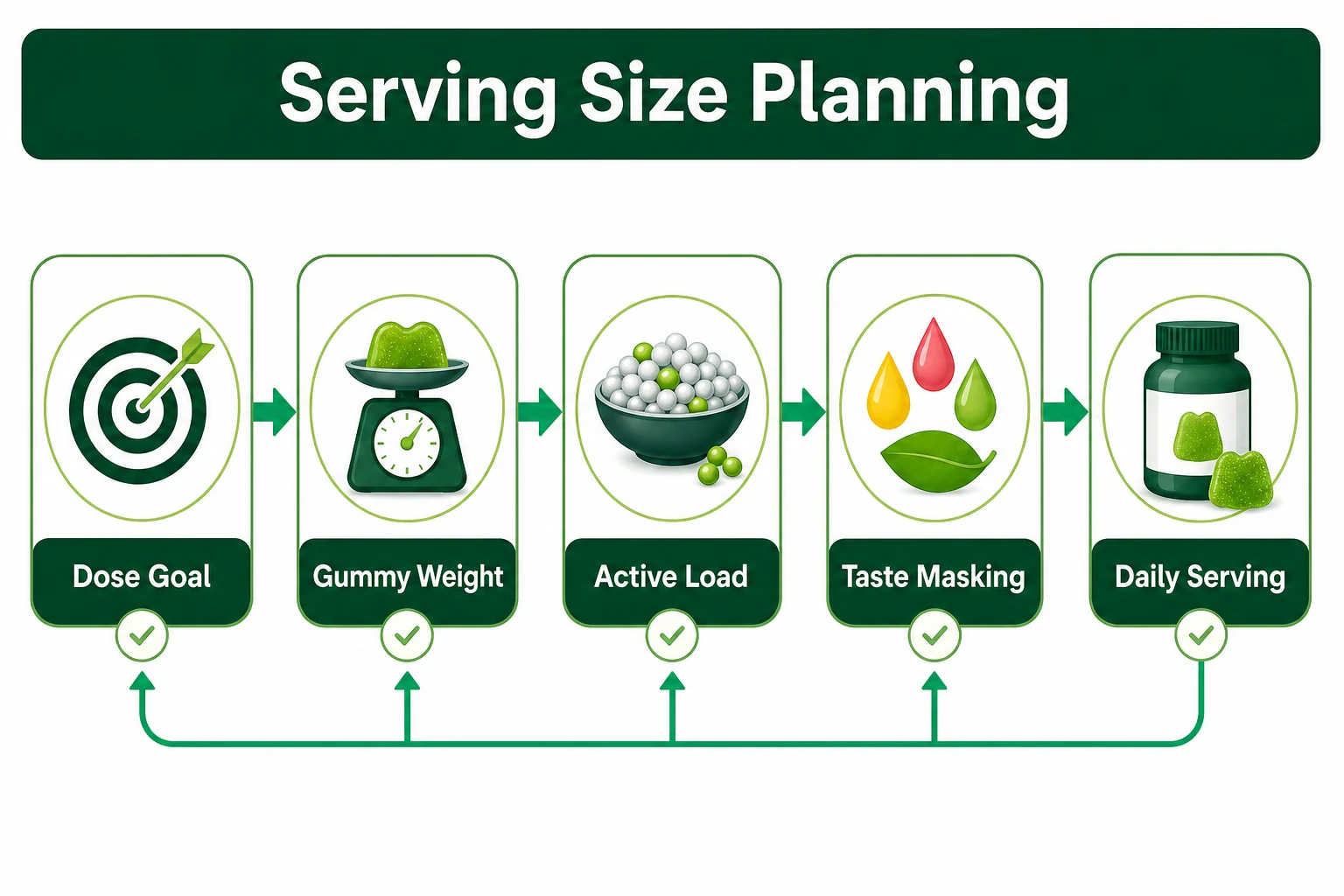
This shift matters because the final product is not judged only by active milligrams. It is judged by whether the serving is practical, the taste is acceptable, the texture holds, the label is compliant, and the product can scale.
Start with Active L-Citrulline per Serving, Not Per Gummy
The serving is the commercial unit. Consumers read the supplement facts panel by serving. Retailers evaluate value by serving. Claims should be supported by the serving.
Start with these decisions:
- target L-citrulline per serving;
- acceptable gummies per serving;
- target gummy size and format;
- single-active vs blended formula;
- consumer positioning;
- claim boundary.
Then work backward. If the target serving requires too many gummies, the brand has several options: lower the active target, change the claim, use a blend strategy, increase the serving count, or choose a different delivery format.
The worst option is to keep the powder-style claim and hope the gummy format can absorb it later.
Account for Gummy Base, Sweeteners, Acids, Flavors, and Moisture
The non-active ingredients in a gummy are not filler. They are the structure of the product.
A realistic formulation review should account for:
| Formula Component | Why It Matters |
|---|---|
| Gummy base | Creates chew, shape, and structure; pectin and gelatin behave differently. |
| Sweeteners | Affect taste, texture, solids, and consumer positioning. |
| Acids | Help flavor balance but can influence pectin behavior and sensory profile. |
| Flavors | Mask active notes and create repeat-use appeal. |
| Moisture system | Affects stickiness, softness, microbial risk, and shelf performance. |
| Active ingredient | Delivers product function but competes for space and can affect taste or texture. |
If the product is vegan, sugar-free, low-sugar, or clean label, the formulation window may narrow further. These claims may be commercially valuable, but they should be included in the brief from the start. Changing them later can require a full formula redesign.
Separate Consumer-Friendly Serving Design from Clinical Dose Claims
A gummy serving does not need to copy a research dose to be commercially valid. It needs to match the product's role, audience, and claim language.
For a brand, the practical decision is whether the gummy is meant to be:
- a high-active sports product;
- a moderate daily support gummy;
- a blended nitric oxide support concept;
- a convenience-first format for consumers who dislike powders;
- or not a gummy at all.
Each option leads to different claims. A moderate gummy should not sound like a high-dose pre-workout powder. A blended gummy should not imply that every ingredient is present at a powder-style dose. A full-dose performance product should be honest about the number of gummies required.
The claim should follow the formula. The formula should not be forced to chase a claim that the format cannot support.
What Formula Design Choices Define an L-Citrulline Gummies Formulation?
Once the serving strategy is clear, the brand can evaluate formula architecture.
The strongest formula is not the one with the longest ingredient list. It is the one where active load, serving size, gummy base, sensory system, documentation, and claims work together.
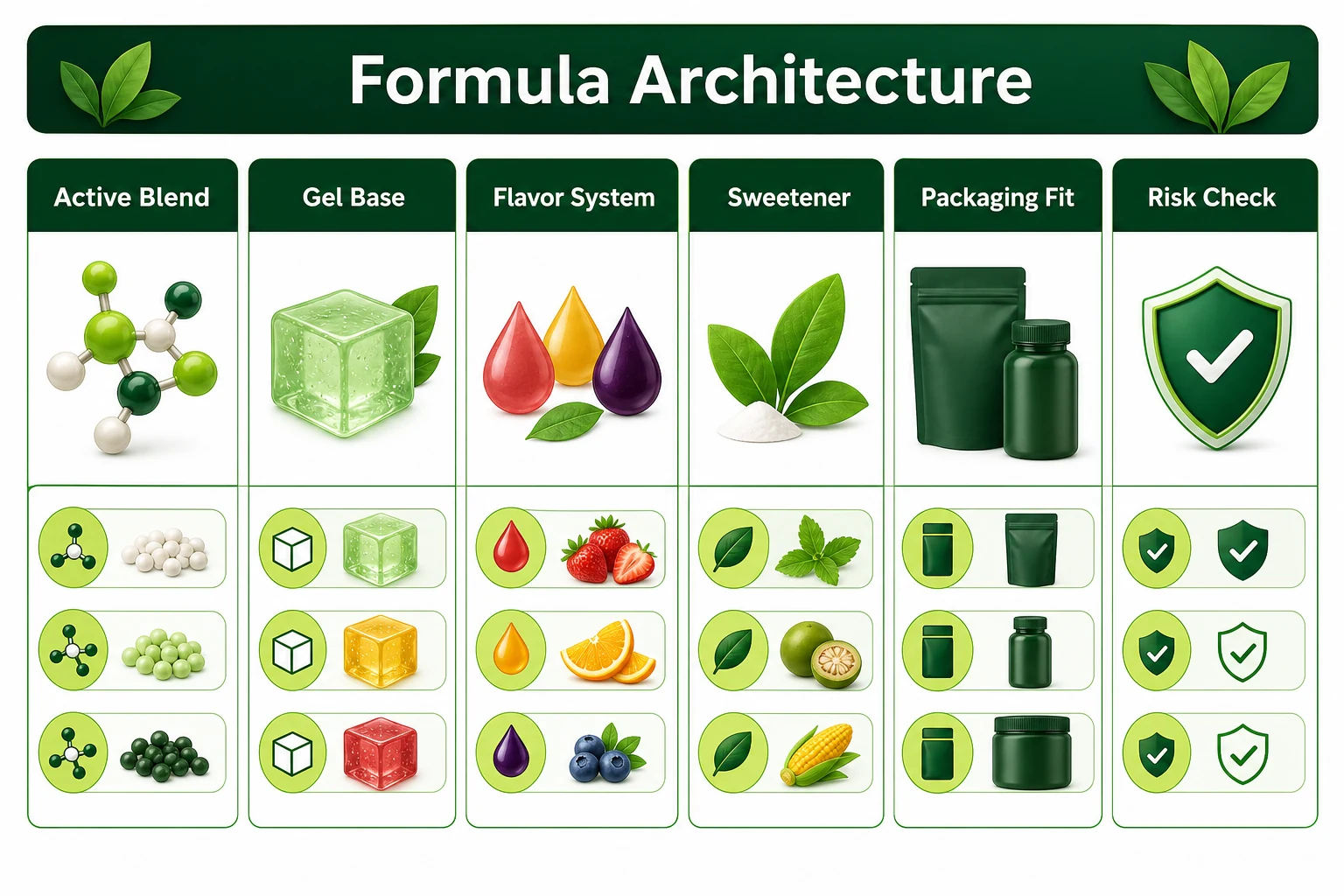
A product brief may start with L-citrulline, then add beet root, taurine, B vitamins, minerals, botanicals, sugar-free positioning, vegan requirements, natural colors, and strong claims. Each addition may make sense alone. Together, they can overload the formula.
When I review an L-citrulline gummy brief, I look for the first constraint that will break the concept: dose, taste, serving count, claim language, or documentation. If the brief tries to maximize all of them at once, the sample process usually slows down.
L-Citrulline Alone vs Blends with Beet Root, Taurine, or B Vitamins
Brands usually consider one of four directions:
| Formula Type | Advantages | Formulation Watch Points |
|---|---|---|
| L-citrulline alone | Clear label story; easier to explain; simpler quality control. | More pressure on the L-citrulline dose to justify the product. |
| L-citrulline + beet root | Strong nitric oxide support story; recognizable market pairing. | Beet root can bring earthy taste, strong color, and additional stability questions. |
| L-citrulline + taurine | Broader sports nutrition profile; useful active-lifestyle positioning. | Two actives compete for limited gummy space. |
| L-citrulline + B vitamins | Adds energy-metabolism language and familiar label elements. | Some B vitamins have strong taste or color effects even at small amounts. |
A blend can make sense when each ingredient has a clear job. It does not make sense when ingredients are added only because competitors use them.
If L-citrulline is the hero ingredient, keep the rest of the formula disciplined. If the product is a broader sports gummy, decide which ingredient carries the story and which ingredients support it.
Vegan, Sugar-Free, and Clean Label Considerations
Vegan, sugar-free, low-sugar, non-GMO, natural flavor, and clean-label requirements can all be commercially attractive. They also change formulation difficulty.
A pectin gummy behaves differently from a gelatin gummy. Sugar-free systems behave differently from sugar-based systems. Natural flavors and colors may limit masking options. Clean-label restrictions may reduce the formulator's toolset for texture, shelf stability, or taste.
For a low-active vitamin gummy, those constraints may be manageable. For a higher-active amino acid gummy, they can become a central development issue. If pectin is part of the plan, compare the pectin vs gelatin gummy formulation trade-offs before assuming the same active load will work in both bases.
Brands should rank requirements before sampling:
- Is vegan status mandatory or optional?
- Is sugar-free required, or is low-sugar acceptable?
- Is the product built for sports nutrition, men's wellness, or daily support?
- Which matters more: high active load or better sensory experience?
- Is the claim strategy built around L-citrulline alone or a blend?
Without priority ranking, every sample round becomes a negotiation between competing goals.
Taste Masking, Texture, and Stability Questions to Ask Early
Taste masking is not cosmetic for L-citrulline gummies. It affects whether the product can generate repeat purchase.
Brands should ask early:
- What off-notes appear at the proposed active load?
- Which flavor systems are most suitable for masking them?
- Does the gummy remain stable under warm or humid storage conditions?
- Does the formula become sticky, grainy, hard, or wet over time?
- Does the active ingredient interact with acids, colors, minerals, or botanical ingredients?
- Will the finished serving still feel convenient to consumers?
These questions belong in the first formulation conversation. If they are delayed until after the first sample, the team may waste time correcting a concept that was not realistic in the first place. This is also where the difference between a stock formula and custom formulation becomes important: a high-load amino acid gummy often needs more than a standard flavor swap.
What Claim and Compliance Risks Apply to L-Citrulline Gummies?
L-citrulline products often sit close to sensitive claim areas.
L-citrulline gummy claims involving nitric oxide, circulation, blood flow, vasodilation, sexual function, or cardiovascular support require substantiation and label review. Consumer demand for those outcomes does not make the wording safe to use.

Supplement brands should not copy aggressive competitor wording just because it appears in the market. The formula, serving size, claim language, and substantiation need to align.
Why Blood Pressure, ED, and Vasodilator Claims Need Careful Review
Blood pressure, erectile dysfunction, and vascular treatment claims are high-risk areas for dietary supplement marketing. Even indirect language can become risky if it implies that the product treats or improves a medical condition.[^3][^4]
For L-citrulline gummies, risk signals include:
- language implying treatment of high blood pressure;
- erectile function or male enhancement promises;
- aggressive vasodilator claims;
- before-and-after performance claims without substantiation;
- clinical-effect wording that does not match the gummy dose;
- product-page copy that suggests medical outcomes rather than healthy-user support.
A gummy with a moderate active serving should be especially careful. If the product cannot reasonably support powder-style expectations, the marketing should not imply powder-style results.[^2]
How to Position Performance Support Without Overclaiming
The safer positioning lane is performance support for healthy adults, written in proportion to the formula.
More appropriate directions may include:
- nitric oxide support for active lifestyles;
- exercise performance support;
- daily sports nutrition support;
- convenient gummy format for consumers who dislike powders;
- active-lifestyle support with a transparent serving size.
Riskier directions include:
| Riskier Claim Direction | Why It Should Be Avoided or Reviewed Closely |
|---|---|
| Blood pressure management | Can imply disease-related use. |
| ED or male enhancement | Can move toward drug-like or medical positioning. |
| Strong vasodilator promises | May exceed supportable structure/function language. |
| Clinical-dose implication | May not match the actual gummy serving. |
| Guaranteed outcomes | Creates substantiation and consumer-trust risk. |
A practical rule: if the copy sounds like it belongs on a treatment product, it probably needs legal or regulatory review before use. Advertising claims should also be checked against the level and relevance of scientific support for the specific product and claim, not only against ingredient-level popularity.[^5]
Testing, Label Review, and Documentation Brands Should Request
Documentation should be planned before launch, not collected after a problem appears. U.S. dietary supplement cGMP rules under 21 CFR Part 111 make production controls, specifications, quality-control operations, batch records, laboratory operations, packaging, labeling, holding, and recordkeeping part of the manufacturing framework.[^6]
For L-citrulline gummies, brands should request:
| Documentation / Review | Why It Matters |
|---|---|
| Raw-material identity documentation | Confirms the ingredient source and identity. |
| Finished-product active assay | Checks whether the active amount matches the label. |
| Microbiological testing | Supports safety and finished-product release. |
| Heavy-metal testing where applicable | Supports quality and market-access expectations. |
| Stability review | Checks whether potency, texture, and appearance hold over time. |
| Label and claim review | Reduces risk before labels, ads, and product pages are finalized. |
| Batch documentation | Supports traceability and buyer confidence. |
A manufacturer that can discuss these items clearly at the RFQ or sample-planning stage is more useful than one that only says the formula is possible. The product needs both formulation feasibility and documentation readiness. For a related example of how testing language can be handled cautiously, see the discussion of third-party tested creatine gummies.
L-Citrulline vs Taurine Gummies: Which Ingredient Should a Brand Explore First?
L-citrulline and taurine both belong in sports nutrition conversations, but they are not interchangeable.
The right first SKU depends on product positioning, formulation difficulty, claim risk, and the brand's roadmap. The decision is not which ingredient is universally better; it is which ingredient fits the first product job.
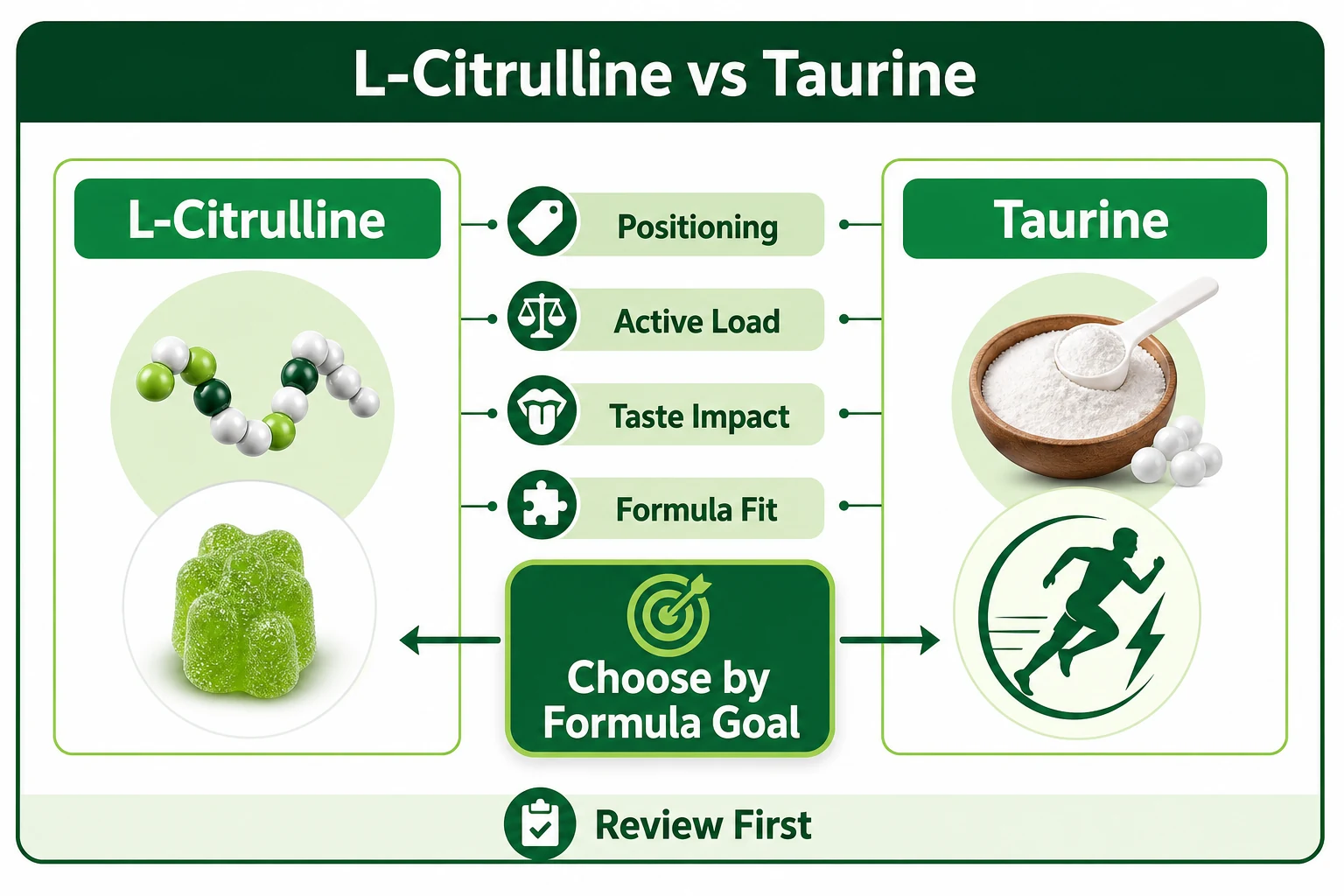
The best choice gives the brand the strongest combination of market fit, formulation feasibility, and launch discipline.
When L-Citrulline Is the Better Fit
L-citrulline is a better fit when the brand wants a focused sports nutrition product with a nitric oxide or performance-support story. It works especially well for consumers who already understand pre-workout ingredients and want a more convenient format.
It may be the right choice when:
- the target audience is active in gym, endurance, or sports categories;
- the brand wants a recognizable amino acid as the hero ingredient;
- the product can support a transparent serving strategy;
- the claim language can stay within conservative performance-support boundaries;
- the brand is comfortable with more formulation work around taste and active load.
L-citrulline is less attractive when the brand wants a tiny serving, very low cost, broad wellness positioning, or aggressive health claims.
When Taurine or a Blended Sports Gummy May Be Easier to Position
Taurine may be easier when the brand wants energy, focus, hydration, or general active-lifestyle positioning. It can also be a lower-friction first SKU for brands still learning the gummy category.
A blended sports gummy can work when one ingredient is clearly the hero and the others support the formula story. For example, L-citrulline can anchor nitric oxide positioning while taurine or B vitamins support a broader active-lifestyle concept. But the blend should not become an excuse to overcrowd the gummy.
| Decision Factor | L-Citrulline First | Taurine First | Blended Concept |
|---|---|---|---|
| Positioning | Nitric oxide, pump, sports performance support. | Energy, focus, active lifestyle, recovery support. | Broader sports nutrition story. |
| Formulation difficulty | Higher because of active load and taste. | Often easier at moderate servings. | Depends on total active load. |
| Claim risk | Higher if copy drifts toward blood pressure or ED. | Usually more flexible, but still needs review. | Depends on claims and hero ingredient. |
| Consumer recognition | Strong in sports nutrition. | Broad recognition across energy and wellness. | Depends on clarity of formula story. |
| First-SKU suitability | Best for sports-focused brands. | Best for lower-risk category entry. | Best when the brand already has clear positioning. |
How to Decide Whether This Should Be One SKU or a Broader Sports Nutrition Line
A brand planning a sports nutrition gummy line should not force every idea into the first SKU. The first product should prove the format, confirm consumer response, and build useful production knowledge.
Use these questions:
- Does the first SKU need to be high-active, or can it be a moderate daily-support product?
- Is the target consumer already educated about L-citrulline?
- Will the serving size still feel convenient?
- Does the claim story stay clear without medical drift?
- Would taurine, beet root, or B vitamins make the concept stronger, or only more crowded?
- Is the brand building one product or a line architecture?
One well-defined SKU is usually more valuable than a crowded first formula that tries to prove every claim at once.
What Should Brands Ask a Gummy Manufacturer Before Developing L-Citrulline Gummies?
Most L-citrulline gummy problems are visible before sampling if the brand asks specific questions.
An L-citrulline gummy development brief should define active load, serving size, gummy base, flavor constraints, claim direction, testing expectations, and documentation needs. A vague request for "L-citrulline gummies" does not provide enough information for feasibility review.
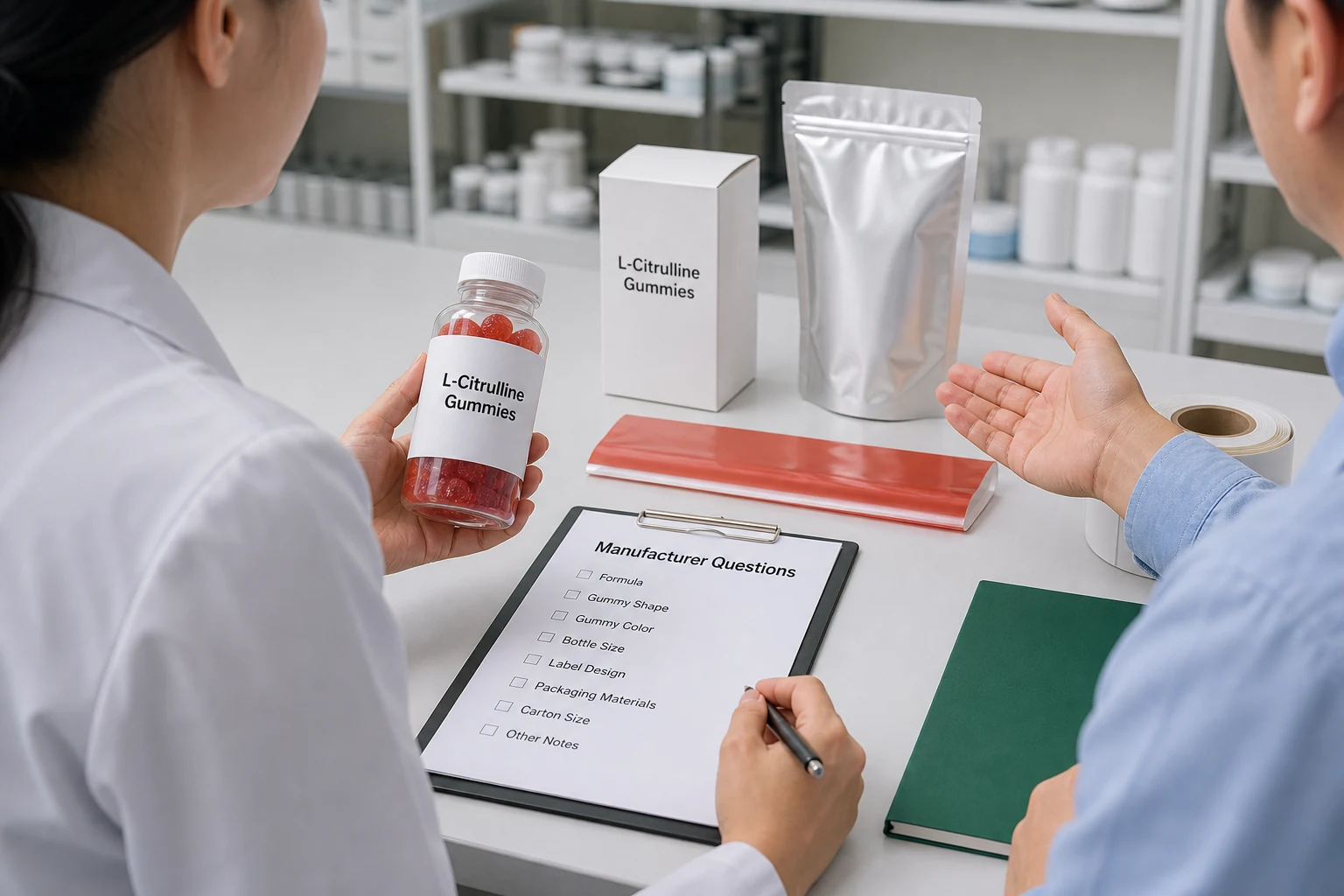
The goal is not to get a quick yes. The goal is to understand what version of the product can be made responsibly.
What Active Load Can the Formula Realistically Support?
Ask the manufacturer to discuss active load in practical terms:
- What active range is realistic for the proposed gummy size?
- What happens to taste and texture as the active load increases?
- How many gummies would the proposed serving require?
- Does the formula need pectin, gelatin, sugar-free, or vegan constraints?
- Has the manufacturer worked with amino acid gummies or similar high-load actives?
- At what point would the manufacturer recommend changing the dose, serving count, or delivery format?
- What sample brief, pilot run, MOQ, and scale-up assumptions should be confirmed before commercial production?
A useful answer should mention more than milligrams. It should also discuss taste masking, texture, stability, serving size, and sample expectations.
If a manufacturer can only say yes, the brand has not learned enough.
What Testing and Stability Checks Are Needed?
Ask for a testing plan before the first commercial batch.
At minimum, the discussion should include:
- raw-material identity review;
- finished-product active testing;
- microbiological testing;
- stability review for potency, texture, appearance, and storage conditions;
- moisture or water-activity considerations where relevant;
- batch documentation and COA expectations;
- packaging compatibility when the formula is sticky, soft, or moisture-sensitive.
The purpose is not to make the brief complicated. The purpose is to avoid discovering quality gaps after the product is already packaged or listed.
What Claims, Label Copy, and Market Positioning Should Be Reviewed Before Launch?
The manufacturer conversation should include the intended product positioning, not only the ingredient list.
Bring the team a draft of the label direction, target market, product page angle, and claims you want to use. Then ask:
- Does the serving size support this positioning?
- Are any claims too close to blood pressure, ED, or medical territory?
- Does the product need a more conservative wording strategy?
- What documentation will support the finished label?
- Should the formula, dose, or product concept change before sampling?
Claim review should not happen after the label is designed. For L-citrulline gummies, it is part of formulation strategy.
Conclusion
L-citrulline gummies can be a strong sports nutrition concept, but they should not be evaluated like a smaller version of L-citrulline powder.
Talvenda's practical role is helping brand teams pressure-test the L-citrulline gummies formulation before sampling: active load, gummy count, base type, flavor masking, claim boundary, testing expectations, and packaging assumptions.
If a brand copies powder-level dose expectations into gummies, it may end up with too many gummies per serving, taste or texture problems, higher cost, or claims that are difficult to support. A better path is to decide first whether the product is a full-dose sports product, a lighter daily performance-support gummy, or a blended nitric oxide concept.
An L-citrulline gummy should be route-checked before full customization, because active load, bitterness, serving count, and sports-nutrition positioning can quickly make the first launch heavier than needed. As a contract gummy supplement manufacturer, Talvenda can help brands review low-MOQ market-tested in-stock gummies, stock formula modification, and custom gummy development against the level of differentiation they actually need. That gives the brand a clearer path from sample development to documentation and testing expectations, quality-controlled production, and GMP-certified and FDA-registered manufacturing facilities before committing budget to a custom route. Start with the project inquiry form.
[^1]: Gonzalez AM, Townsend JR, Pinzone AG, Hoffman JR. "Supplementation with Nitric Oxide Precursors for Strength Performance: A Review of the Current Literature". Nutrients. 2023;15(3):660. doi: 10.3390/nu15030660. [^2]: Gough LA, Sparks SA, McNaughton LR, Higgins MF, Newbury JW, Trexler E, Faghy MA, Bridge CA. "A critical review of citrulline malate supplementation and exercise performance". European Journal of Applied Physiology. 2021;121(12):3283-3295. doi: 10.1007/s00421-021-04774-6. [^3]: Allerton TD, Proctor DN, Stephens JM, Dugas TR, Spielmann G, Irving BA. "l-Citrulline Supplementation: Impact on Cardiometabolic Health". Nutrients. 2018;10(7):921. doi: 10.3390/nu10070921. [^4]: U.S. Food & Drug Administration, "Structure/Function Claims". [^5]: Federal Trade Commission, "Health Products Compliance Guidance". [^6]: Electronic Code of Federal Regulations, "21 CFR Part 111 -- Current Good Manufacturing Practice in Manufacturing, Packaging, Labeling, or Holding Operations for Dietary Supplements".