


Collagen gummy dosage looks simple until the serving claim has to survive formulation, label review, packaging, and commercial-scale production.
Collagen gummies dosage should be planned per serving, not only per gummy. Supplement brands need to confirm the collagen amount, serving count, gummy weight, formula load, testing plan, and packaging route before committing to a label claim.
For consumers, the starting point is the Supplement Facts panel.[^1] For brands, the starting point is earlier: can the intended dose fit inside a gummy format that tastes acceptable, holds texture, stays clear on the label, and can be checked at scale?
Collagen Gummies Dosage: Quick Answer
Most dosage confusion starts when a brand treats the front-label number as if it automatically describes one gummy.
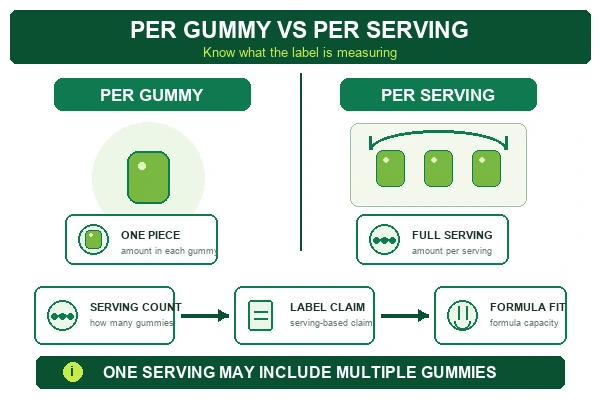
Read collagen gummies dosage per serving. One serving may be one gummy, two gummies, or more. A credible product brief should define collagen per serving, gummies per serving, and finished gummy weight before sampling.
How many collagen gummies per day?
There is no universal number of collagen gummies per day. The number depends on the serving size stated on the label, the collagen amount per serving, and the formula design behind each gummy.
A brand may choose one gummy per day for a lower-dose, convenience-led product. It may choose two gummies per serving when it wants a clearer balance between dosage and user experience. It may need three or more gummies if the brand wants a higher collagen claim while keeping each piece at a manageable size.
The key is to make the serving count intentional. A high front-panel number that quietly depends on a large serving count can create consumer confusion. A transparent label should make it easy to understand what one gummy contains and what one full serving contains.
Typical collagen amount per serving
Collagen powders and liquids often frame dosage in gram-level servings.[^2] Gummies work under tighter physical limits because the gummy base, sweetener system, water or solids balance, acid, flavor, color, coating, and other ingredients all share the same finished piece.
Because of that, collagen gummies may deliver less collagen per serving than powders. That does not make them a poor format. It means they need a different serving strategy. Gummies often win on convenience, taste, routine building, and retail appeal rather than maximum collagen volume.
| Planning item | What to define | Why it matters |
|---|---|---|
| Collagen per serving | The amount consumers receive in the labeled serving | This becomes the claim that must be supported |
| Gummies per serving | The number of pieces required to deliver that amount | This affects user experience, bottle count, and cost per serving |
| Gummy weight per piece | The approximate finished weight of each gummy | This shows whether the collagen load is realistic inside the format |
The exact amount should be set through formulation, label, and compliance review. General dosage context should not be treated as personal medical advice.
Per gummy vs per serving
Per-gummy and per-serving language is one of the easiest places for a collagen gummy label to become unclear. If a label says "1,000 mg collagen per serving" and the serving size is two gummies, each gummy carries about half of that serving amount.
For production, the distinction is even more important. A per-serving claim has to be supported by ingredient input, finished-piece weight, batch controls, finished-product checks, and stability planning. If one serving is two gummies, then the quality plan has to support the collagen content across two finished pieces, not just one theoretical formula calculation.
Before a brand approves artwork or marketplace copy, the team should be able to answer a simple question: what does one gummy contain, and what does one full serving contain?
How Much Collagen Can a Gummy Realistically Deliver?
A gummy is not an empty carrier, so pushing more collagen into the same piece creates real production pressure.[^3]
A collagen gummy can only deliver a credible dose when the collagen load fits the finished gummy weight, texture target, flavor system, moisture behavior, and serving count. High-dose claims may require multiple gummies or another format.

Dose promise vs gummy weight
Every gummy has a total finished weight. Inside that weight, the formula needs room for gelling agents, sweeteners or sugar-free bulking systems, water or solids balance, acid, flavor, color, coating, and active ingredients. Collagen competes with all of those.
One useful early check is the ratio between collagen amount and total gummy weight. If the collagen makes up a very large share of the finished piece, the remaining formula space may be too small to support a good chew, clean flavor, stable surface, and repeatable manufacturing process.
I would not use any active-load percentage as universal. The realistic limit depends on collagen grade, gummy size, base system, flavor, moisture target, and packaging. But if a brand wants a large collagen number in a small gummy, the formula team should slow down and test the math before the commercial team promises the claim.
One gummy vs multiple gummies per serving
A one-gummy serving is simple and attractive, but it limits the collagen amount to what one piece can carry. A multi-gummy serving gives the formula more room, which can help with chew, taste, ingredient distribution, and consumer experience.
The tradeoff is commercial. More gummies per serving means fewer servings per bottle at the same count, a larger daily habit, a higher cost per serving, and more pressure on packaging communication. A two-gummy serving may feel normal for consumers. A four- or five-gummy serving needs stronger justification.
For brands already familiar with gummy vitamin manufacturing, this is a familiar product-development decision. Serving size is not a label detail added at the end. It is part of the formula, package, price, and user experience.
When high-dose claims need another format
Some high-dose collagen goals may fit better in a powder, liquid, stick pack, or other format. Gummies can be excellent for convenience and routine building, but they are not necessarily the strongest format for maximum collagen volume.
That does not mean collagen gummies should be positioned as weak. It means the product promise should match the format. A gummy can be a convenient daily collagen routine, a beauty-support product, or a combination formula with vitamin C, hyaluronic acid, astaxanthin, or other supporting nutrients.
My usual recommendation is to decide whether the brand is selling maximum collagen volume or a convenient, enjoyable collagen habit. Those are different product strategies.
What Changes Collagen Gummies Serving Size?
Serving size can shift quickly when the brand changes collagen source, add-ons, gummy base, or claim language.
Collagen gummies serving size depends on collagen type, peptide form, active load, add-on ingredients, allergen planning, and label positioning. Brands should settle these variables before locking the serving claim.
Collagen type and source
Bovine collagen, marine collagen, Type I/III collagen, Type II collagen, hydrolyzed collagen peptides, and collagen booster concepts can all lead to different product decisions. They may affect taste, allergen communication, documentation, cost, market positioning, and claim boundaries.
Marine collagen can be attractive for beauty positioning, but it may require more attention to flavor masking and fish-allergen communication.[^4] Bovine collagen may fit a different cost and sourcing profile. Type II collagen is often discussed in a different joint-support context from Type I/III beauty formulas, so the dose conversation may not be the same.
A credible collagen gummy brief should not view every collagen source as interchangeable. The serving size should match the source, target market, label language, and documentation the brand can support.
Hydrolyzed peptides and active loading
Hydrolyzed collagen peptides are commonly used in supplement formats because they can be easier to disperse and formulate than less processed collagen materials.[^5] Even then, hydrolyzed peptide form does not remove the active-load challenge.
As the collagen level rises, it may affect viscosity during processing, distribution in the gummy mass, finished chew, taste, surface quality, and moisture behavior. A collagen grade that works well at a modest inclusion may behave differently when the brand pushes the dose higher.
This is why pilot review matters. A specification sheet can describe the collagen material, but it cannot fully answer how that material will behave in the target gummy base, flavor system, serving count, and package.
Why beauty, joint, and skin claims need careful wording
Collagen gummies are often marketed around beauty, skin, hair, nails, joints, or general wellness. Those themes are common, but the wording has to stay careful. A supplement brand should not turn a dosage claim into a medical treatment promise.[^6]
The dose does not automatically validate the claim. A higher collagen amount does not make a label statement more supportable by itself. The claim language, ingredient documentation, target market rules, and evidence position all need review.
For manufacturing planning, claim language matters because it influences ingredient choice, serving target, finished-product checks, and documentation expectations. A beauty-positioned gummy with collagen gummies with vitamin C may need a different formula story from a general collagen routine.
Vitamin C, biotin, and other add-ons
Vitamin C, biotin, zinc, hyaluronic acid, astaxanthin, and other add-ons can support a collagen gummy concept. They can also make the dosage conversation tighter.
Every additional ingredient uses formula space. Some ingredients affect acidity, taste, color, texture, or stability. A gummy that needs to carry collagen plus several beauty nutrients may need a larger piece, multiple gummies per serving, or a more careful formula base.
For example, collagen hyaluronic acid gummies may be commercially attractive because they combine familiar beauty ingredients. The brand still has to define the collagen amount per serving and make sure the added ingredients do not hide an unclear collagen dose.
Dosage Tradeoffs in Gummy Manufacturing
Higher collagen dosage can make a promising sample harder to scale than the first brief suggests.
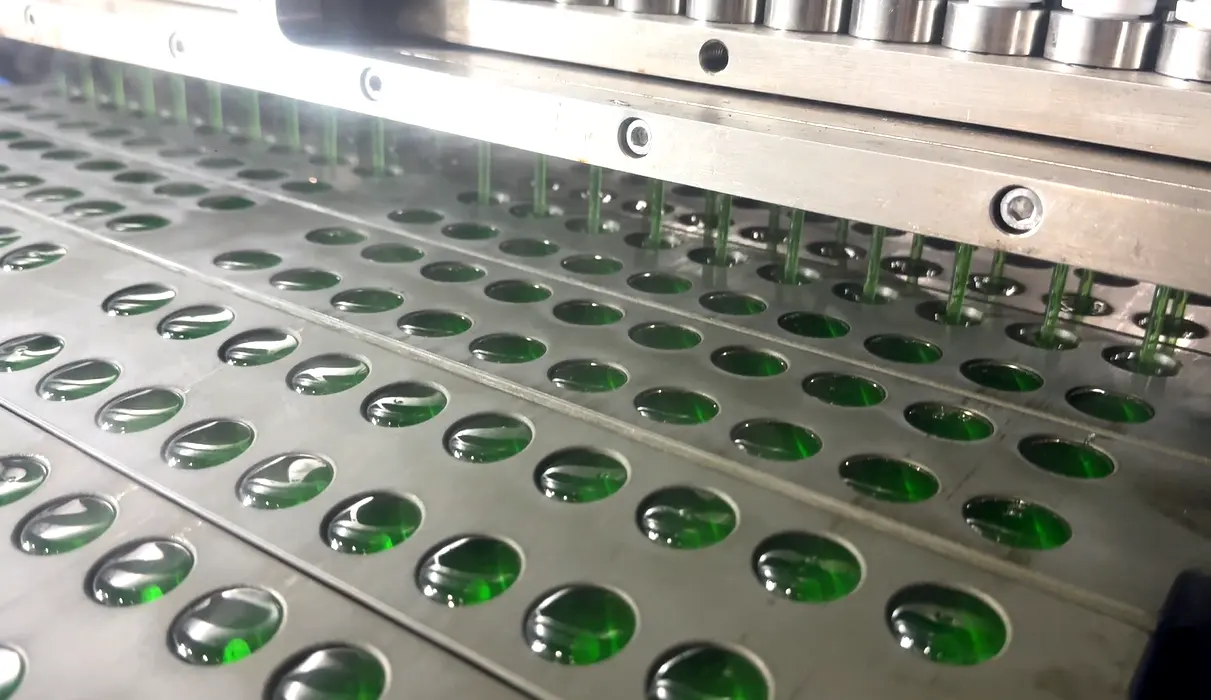
Collagen dosage affects gummy texture, taste masking, sugar-free feasibility, moisture behavior, packaging, and shelf-life review. A credible dose target should be tested with the intended formula and package, not treated as a label-only decision.
Texture and chew
A gummy has to feel like a gummy. If the collagen load pushes too high, the chew may become dense, tough, soft, gritty, sticky, or less pleasant. The brand may then need to reduce the collagen amount, increase the number of gummies per serving, increase the piece size, adjust the base system, or change the product format.
Texture also affects repeat use. A consumer may tolerate an awkward chew once, but a daily supplement has to be pleasant enough to repeat. If the target dose creates a poor eating experience, the label number may not help the brand.
When I review a collagen gummy sample, I do not only ask whether the collagen can be included. I ask whether the finished chew still matches the brand's positioning after the collagen is included at the intended dose.
Taste masking
Collagen can bring taste and odor challenges, depending on source, grade, and formula context. Marine collagen, bovine collagen, sweetener systems, acids, and flavors may interact differently. A formula that tastes acceptable at a lower collagen level may need more work at a higher level.
Taste masking can require stronger flavors, different acid balance, different sweetener choices, or a different collagen grade. Those adjustments can affect cost and product character. If the only way to hide the collagen note is to create a flavor profile that no longer matches the brand, the dosage target should be reconsidered.
Sugar-free and low-sugar systems
Sugar-free and low-sugar collagen gummies can be appealing, especially in beauty and wellness markets. They also add another layer of formulation complexity. Sweetener systems, bulking agents, texture, water activity, aftertaste, and digestive tolerance considerations may all matter.[^7]
High collagen loading and sugar reduction should not be treated as separate promises. They need to be evaluated together during sampling. A dose that is manageable in a traditional sugar-based gummy may behave differently in a low-sugar or sugar-free system.
This does not make sugar-free collagen gummies a poor idea. It means the product brief should be honest about the combined challenge.
Moisture, stickiness, and shelf life
Moisture behavior is one of the practical reasons dosage should be reviewed with packaging.[^8] A sample can feel acceptable on the bench but become sticky, soft, hard, or misshapen when it sits in the intended bottle, pouch, or shipping environment.
Collagen load, gummy base, sweetener system, acidity, drying behavior, coating, bottle or pouch format, desiccant strategy, and storage expectations can all affect the finished product. For equipment-side context, GummyGeniX has a related guide on gummy manufacturing process factors that can help teams translate formula stress into line-planning questions. A dosage claim is credible only if the formula and packaging plan can support it through the intended shelf-life review.
Talvenda's role in this type of project is not to promise a universal collagen number. It is to help a brand connect the dosage target with formulation trials, sensory review, packaging checks, documentation, and scale-up planning.
How to Check Whether a Collagen Gummy Dosage Claim Is Credible
A dosage claim can look strong on the front panel while staying weak behind the label.
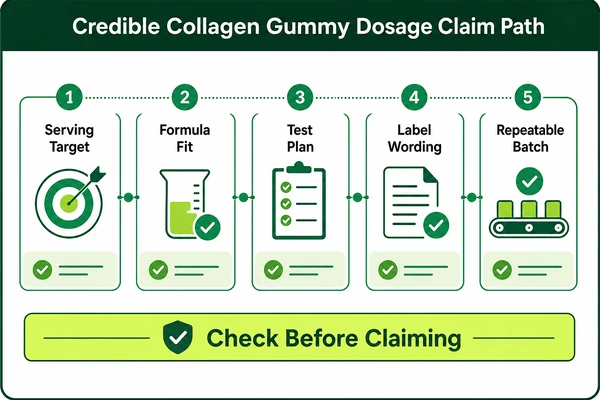
A credible collagen gummy dosage claim should connect the Supplement Facts serving size, collagen amount, total gummy weight, finished-product testing, certificate-of-analysis expectations, and shelf-life support. If those pieces do not align, the brand should slow down.
Serving size on the Supplement Facts panel
The Supplement Facts panel should define the serving size and show the amount of collagen per serving. If one serving is two gummies, the label should make that clear. If the front panel promotes a collagen number, that number should match the serving logic.
For B2B planning, the Supplement Facts panel is not just label text. It is a production target. The formula, piece weight, batch records, finished-product checks, and shelf-life plan all need to support what the label says.
Brands should also watch for blend language. If the label lists a blend weight that combines collagen with other ingredients, it may be harder to understand how much collagen is actually present. That may be acceptable in some product strategies, but it should not be confused with a clear collagen-per-serving claim.
Collagen amount vs total gummy weight
A useful internal check is to compare the collagen amount with the total gummy weight per serving. If collagen takes up too much of that serving, the brand should ask a second question. Is there still enough formula space for the gelling system, sweetener, flavor, acid balance, moisture control, and other ingredients?
This is also where collagen gummies formulation becomes important. The same collagen target can behave differently depending on collagen source, peptide grade, gummy base, sweetener choice, flavor, acid balance, and package format.
Brands do not need to publish all of this math to consumers. But they should understand it before approving the claim, sample, purchase order, or label artwork.
Testing, certificate-of-analysis, and shelf-life support
A collagen gummy dosage claim should be backed by a realistic testing and documentation plan.[^9] Brand teams should ask how the finished-product collagen amount will be checked, what certificate-of-analysis information will be available, and how the product will be reviewed over its intended shelf life.
Input calculations are not the same as finished-product support. A formula may include a target collagen amount at the mixing stage, but the brand still needs a practical plan for finished pieces, batch documentation, and retained quality over time.
The right test method and documentation scope depend on the formula, market, claim language, and brand requirements. The important point is to avoid treating testing as an afterthought. If dosage is part of the product promise, testing and documentation should be part of the early brief.
Safety and Claim Boundaries for Collagen Gummies Dosage
The dosage discussion can drift into medical language if the brand tries to make the number prove the benefit.
Collagen gummies dosage should be framed around serving size, label clarity, ingredient source, allergen communication, and claim support. Brands should avoid medical dosage advice, disease-treatment framing, and guaranteed outcome language.
Practical safety considerations without medical advice
Collagen gummy dosage content should stay away from personal medical advice. Consumers should follow the product label and speak with a qualified healthcare professional when they have health conditions, pregnancy concerns, medication questions, allergies, or special dietary needs.
A brand can discuss practical safety considerations without acting like a clinic. The product should make serving instructions clear, disclose relevant ingredients, communicate allergens, avoid oversized or confusing serving patterns, and keep benefit language within supplement-appropriate boundaries.
Brands should also avoid implying that more collagen is automatically better. A higher number can create a stronger marketing impression, but it may not create a better gummy. It may increase formula difficulty, cost, serving count, sugar or sweetener exposure, and packaging complexity.
When brands should avoid medical framing
Brands should avoid wording that frames collagen gummies as disease-related products.[^10] They should also avoid implying certain changes in skin, joint, hair, nail, or bone outcomes.
Even softer beauty or joint-support language should be reviewed for the target market. A dosage number does not make a claim safe by itself. The label claim, substantiation, ingredient documentation, and consumer communication need to fit together.
The better frame is product support, not medical promise: collagen amount per serving, serving size clarity, ingredient source, quality checks, and a formulation plan that can support the label.
Allergen and market-label considerations
Collagen source can affect allergen and market-label planning. Marine collagen may raise fish-allergen questions. Bovine collagen may affect dietary, religious, or sourcing expectations. A gelatin-based gummy system can create different positioning issues from a pectin-based system.
Brands should align collagen source, gummy base, allergen statements, market requirements, and documentation before production. If the dosage claim is approved before these details are settled, the team may have to revise the formula, label, or package later.
Collagen Gummies vs Powders, Capsules, and Liquids
Brands sometimes choose gummies for convenience, then try to force them to behave like powder.
Collagen gummies are usually stronger for convenience, taste, and daily routine than for maximum collagen volume. Powders, liquids, capsules, and stick formats may be better when the main product promise is a larger collagen serving.
When gummies make sense
Gummies make sense when the brand values convenience, taste, routine building, and a friendly supplement experience. They can be especially useful for beauty and wellness positioning, combination formulas, or consumers who dislike powders and capsules.
Gummies can also help a brand create a more approachable product line. The format is easy to sample, easy to merchandise, and familiar to consumers. But those benefits should not hide the dosage limits of the format.
The strongest gummy positioning is often not "we deliver the largest collagen dose." It is "we make collagen easier to take consistently."
When another format may be stronger
Another format may be stronger when the main selling point is a high collagen amount. Powders can often carry larger servings more naturally than gummies. Liquids and stick formats may support different premium or convenience strategies. Capsules can help with precision for some ingredients, though collagen volume can still be a limitation.
If a desired collagen claim forces the gummy into poor taste, oversized pieces, a confusing serving count, or weak shelf-life confidence, the format may be wrong for the promise. In that case, changing the format can protect the product experience better than forcing the gummy. For a deeper format decision, the dedicated collagen gummies vs powder guide explains when a brand should prioritize dose volume, convenience, taste, or routine fit.
How to position the tradeoff honestly
The honest tradeoff is simple: gummies can be easier to take, but they may deliver less collagen per serving than powder-style formats. That does not make the gummy inferior. It makes the positioning different.
| Format | Stronger fit when the brand needs | Dosage watchout |
|---|---|---|
| Gummies | Convenience, taste, routine building, retail appeal | The serving claim must fit gummy weight, texture, and serving count |
| Powders or liquids | Larger collagen servings and more flexible dose positioning | The product may be less convenient for some daily routines |
| Capsules or stick formats | Portability, portion control, or a different premium story | Collagen volume can still limit the format or change the serving count |
A credible brand can position collagen gummies around convenience, taste, and daily routine, while keeping the serving claim transparent. The dose supports the label. The format supports the habit. When those two ideas work together, the product feels more trustworthy.
Manufacturer-Ready Dosage Brief Checklist
The fastest way to waste sampling time is to ask for a collagen gummy quote without a dosage brief.
Before requesting samples, brands should define target collagen per serving, gummies per serving, collagen source, formula constraints, packaging route, testing expectations, certificate-of-analysis needs, and claim boundaries. This turns dosage into a production-ready brief.
Target mg per serving
Start with the target collagen amount per serving. Define whether that amount is a firm requirement, a preferred range, or an early concept that can change after sampling.
Also define the collagen source or positioning if known. Bovine, marine, Type I/III, Type II, hydrolyzed peptides, and collagen booster concepts can lead to different formula and label questions.
| Brief item | What the brand should provide |
|---|---|
| Target collagen per serving | Desired amount and whether it is fixed or flexible |
| Collagen source | Bovine, marine, Type I/III, Type II, peptide grade, or open to recommendation |
| Positioning | Beauty, general wellness, joint support, combination formula, or private label concept |
| Claim boundary | What the label wants to say and what should be avoided |
| Market | Target region or sales channel for label and documentation planning |
Number of gummies per serving
Define the expected number of gummies per serving. If the target is one gummy per day, say that early. If two gummies per day is acceptable, the formula team has more room to work. If a higher serving count is acceptable, the commercial team should confirm that consumers will still understand and repeat the routine.
Serving count affects bottle count, daily cost, user experience, packaging size, and label language. It should be treated as a commercial decision as well as a formulation decision.
Formula and packaging constraints
List the constraints that matter before sampling. These may include sugar-free or low-sugar targets, pectin or gelatin preference, flavor direction, color preferences, allergen limits, bottle or pouch format, desiccant expectations, target market, documentation needs, and price positioning.
The more constraints the brand adds, the more carefully the dosage target should be reviewed. A high collagen dose, sugar-free base, small gummy size, delicate flavor, strict allergen position, and compact package may not all fit together smoothly.
Good briefs also state what can change. If the collagen amount is flexible but the gummy count is fixed, that leads to one development path. If the collagen amount is fixed but the serving count can change, that leads to another.
Testing questions to ask before production
Before production, brand teams should ask practical testing and documentation questions:
- How will the collagen amount be checked in the finished product?
- What certificate-of-analysis information can be provided for the ingredient and finished production run?
- What stability or shelf-life review is appropriate for this formula and package?
- How will serving size and piece weight be controlled?
- What documentation is needed for the target market?
- What changes between lab sample, pilot batch, and commercial batch should be watched?
- How will the brand handle formula changes if the target dose creates poor texture or taste?
These questions do not replace regulatory, legal, or medical advice. They help the brand make the dosage claim part of the manufacturing plan instead of a late-stage label decision.
FAQ About Collagen Gummies Dosage
Are collagen gummies usually high dose?
Collagen gummies are not necessarily high dose compared with powder or liquid formats. A gummy has limited space because it also needs a base system, sweetener, flavor, acid balance, moisture control, and packaging stability.
Some brands use multiple gummies per serving to increase the total collagen amount. Others position collagen gummies as a convenient daily collagen format rather than a maximum-dose collagen product. Both approaches can work when the label is clear and the formula supports the serving claim.
Is collagen amount listed per gummy or per serving?
The collagen amount should be read from the Supplement Facts panel. It may be listed per serving, and one serving may include more than one gummy.
For brands, this is a critical label-planning point. If the front panel promotes a collagen number, the serving size and finished-product checks should support that number clearly. A brand should be able to explain both the per-gummy amount and the per-serving amount before approving packaging.
What does collagen gummies intake mean for a brand?
Collagen gummies intake usually points back to daily use, serving count, and label clarity. For a brand, the safer way to handle intake language is to translate it into a label-ready serving plan: collagen amount per serving, gummies per day, directions for use, and any caution language needed for the target market.
Do not use intake wording to promise a result or give personal medical dosage advice. Keep the article focused on serving design, Supplement Facts clarity, finished-product support, and whether the gummy format can realistically carry the intended collagen amount.
Can collagen gummies replace collagen powder?
Collagen gummies may replace collagen powder for consumers who want convenience, taste, portability, and a simple daily routine. They may not replace powder when the main goal is a larger collagen serving.
For a brand, the better question is not whether gummies are better than powder. It is whether the gummy format matches the product promise, target customer, label claim, price point, and launch channel.
What should brands confirm before choosing a collagen gummy dosage?
Brands should confirm the target collagen amount per serving, number of gummies per serving, collagen source, gummy base, flavor direction, sugar or sugar-free system, and package format. They should also define testing expectations, certificate-of-analysis needs, shelf-life review plan, and claim boundaries.
Before a brand commits to a collagen gummy dosage claim, I would check the serving target, gummy weight, formula load, sensory quality, packaging route, testing plan, and scale-up path together. That is where dosage becomes a production decision, not just a label number.
At that point, the question is not only how much collagen sounds marketable. It is whether the dose can be produced, documented, packaged, and explained clearly.
Conclusion
Serving size, formula load, packaging, testing, and claim wording must align before a collagen gummies dosage becomes credible.
Talvenda can review formula load, taste, packaging, testing, pilot-run planning, MOQ fit, and scale-up before your team requests samples or confirms a label claim.
[^1]: "Dietary Supplement Labeling Guide", https://www.fda.gov/food/dietary-supplements-guidance-documents-regulatory-information/dietary-supplement-labeling-guide. elink returned this FDA candidate for Supplement Facts and serving-size labeling context. Used to support label-reading context, not to provide legal advice. [^2]: "The effects of collagen peptide supplementation on body composition, collagen synthesis, and recovery from joint injury and exercise: a systematic review", https://pmc.ncbi.nlm.nih.gov/articles/PMC8521576/. elink returned this PMC candidate for general collagen peptide dosage context. Used only to support that collagen literature often discusses gram-level servings, not to recommend a personal daily dose. [^3]: "Current Innovations in the Development of Functional Gummy Candies", https://pmc.ncbi.nlm.nih.gov/articles/PMC10778822/. elink returned this PMC candidate for functional gummy formulation context. Used to support active-load, texture, and delivery-format constraints, not a collagen-specific maximum. [^4]: "Food Allergies", https://www.fda.gov/food/nutrition-food-labeling-and-critical-foods/food-allergies. elink returned this FDA candidate for major allergen context. Used to support fish-allergen review when marine collagen is considered. [^5]: "Evaluation of the Efficacy of a Hydrolyzed Collagen Supplement for Improving Skin Moisturization, Smoothness, and Wrinkles", https://pmc.ncbi.nlm.nih.gov/articles/PMC8944283/. elink returned this PMC candidate for hydrolyzed collagen supplement context. Used only to support ingredient-form context, not to promise beauty outcomes. [^6]: "Health Products Compliance Guidance", https://www.ftc.gov/business-guidance/resources/health-products-compliance-guidance. elink returned this FTC candidate for health-product claim substantiation. Used to support cautious claim-boundary language. [^7]: "Gastrointestinal Disturbances Associated with the Consumption of Sugar Alcohols with Special Consideration of Xylitol", https://pmc.ncbi.nlm.nih.gov/articles/PMC5093271/. elink returned this PMC candidate for polyol tolerance context. Used to support sugar-free formulation and tolerance review, not a product-specific warning. [^8]: "Physicochemical and Sensory Stability Evaluation of Gummy Confections Fortified with an Extract from Psidium guajava Leaf", https://pmc.ncbi.nlm.nih.gov/articles/PMC10818720/. elink returned this PMC candidate for gummy stability context. Used to support moisture, texture, and shelf-life review language, not to imply this collagen formula uses the same extract. [^9]: "Small Entity Compliance Guide: Current Good Manufacturing Practice in Manufacturing, Packaging, Labeling, or Holding Operations for Dietary Supplements", https://www.fda.gov/regulatory-information/search-fda-guidance-documents/small-entity-compliance-guide-current-good-manufacturing-practice-manufacturing-packaging-labeling. elink returned this FDA candidate for dietary supplement cGMP context. Used to support specifications, production-control, and documentation planning. [^10]: "Structure/Function and Related Claims in Dietary Supplement Labeling", https://www.fda.gov/food/information-industry-dietary-supplements/notifications-structurefunction-and-related-claims-dietary-supplement-labeling. elink returned this FDA candidate for dietary supplement claim boundaries. Used to support disease-claim caution and supplement-appropriate wording.