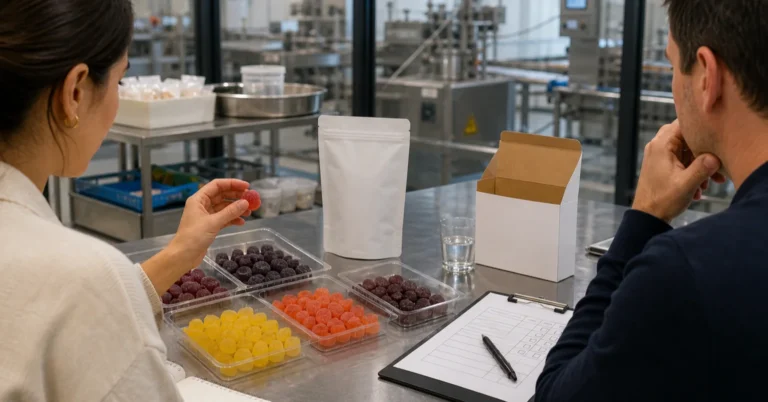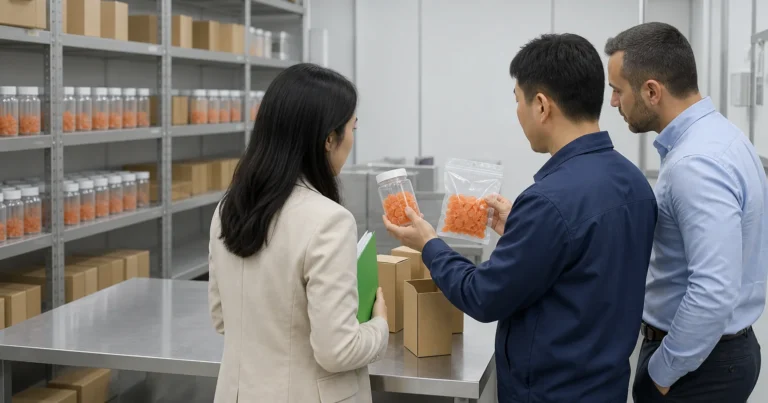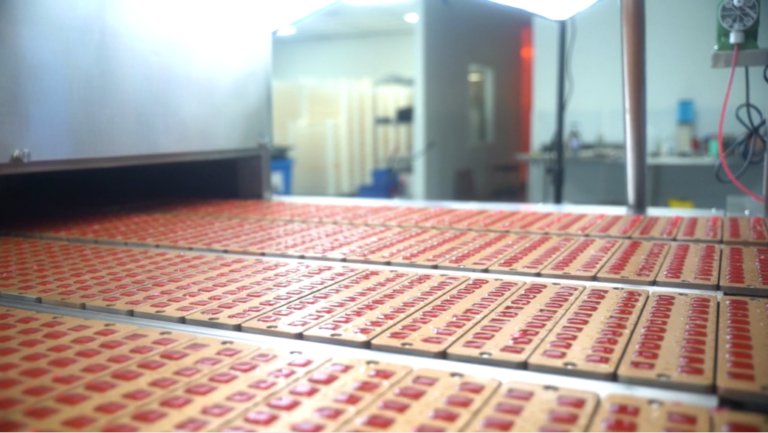

Sugar free collagen gummies are simple for consumers and complex for supplement brands. In manufacturing, sugar is not only a sweetener: it changes body, chew, moisture behavior, and release profile.
Sugar free collagen gummies can work, but they need to be developed as a complete formulation system. Sweetener choice, collagen dose, gummy base, flavor masking, label claim, packaging, and shelf-life expectations all have to fit together.
That is the difference between a marketable idea and a production-ready product. A brand may want a low-sugar beauty gummy because consumers ask for it. A manufacturer has to check whether the formula can still carry a useful collagen serving, taste pleasant, avoid aftertaste, keep a stable chew, and support the label language printed on the bottle.
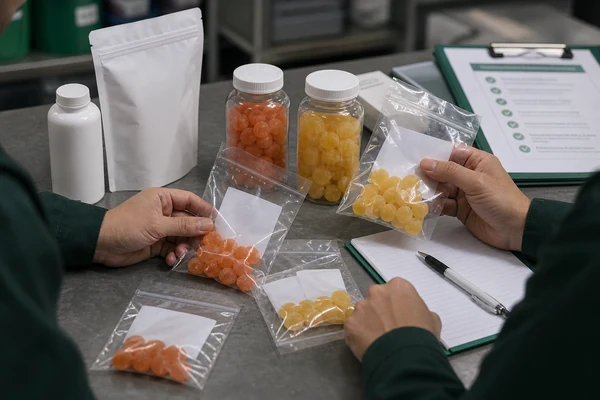
What Are Sugar-Free Collagen Gummies?
The first question for buyers is whether the format is right for the problem, not just whether it sounds more modern than regular gummies.
Sugar-free concepts need feasibility signals across taste, texture, dose, and label requirements before production planning.
Sugar free collagen gummies are chewable supplements designed to deliver collagen peptides or collagen-related beauty support ingredients while reducing or removing traditional sugar from the gummy matrix. Consumers usually find them through beauty, wellness, low sugar, keto, diabetic-friendly, or calorie-conscious searches. Brands evaluate them because sugar reduction can make a collagen gummy feel more modern, more label-conscious, and more differentiated.
Why Consumers Search for Sugar-Free Collagen Gummies
Consumers often search for sugar free collagen gummies because they want the perceived beauty support of collagen without the sugar content associated with ordinary gummies. They may be comparing collagen powders, capsules, and gummies, or looking for a format that feels easier to take every day.
That consumer expectation matters, but it should not control the whole product strategy. If the page becomes only a list of skin, hair, nail, and joint benefits, it misses the launch question that matters to a brand: can the product be manufactured credibly?
For a supplement brand, the consumer search is the entrance. The deeper task is to determine whether the concept can become a stable, quote-ready, production-ready gummy with a realistic serving format.
What "Sugar-Free" Usually Means in a Gummy Supplement
In gummy manufacturing, sugar free does not simply mean "no sweet taste." It usually means the formula avoids or limits common sugar sources and uses an alternative sweetening system, such as sugar alcohols, high-intensity sweeteners, fibers, or blended sweetener systems.
Each route changes the formula. Some sweeteners bring bulk and chew, while others bring sweetness with very little body. Some can create cooling effects or digestive tolerance concerns[^1].
Other sweeteners work better with acid and flavor systems. A formula may meet one sugar target but still fail taste, texture, or stability expectations.
This is why the claim should be checked early. "Sugar free," "low sugar," "no added sugar," "keto-friendly," and "diabetic-friendly" are not interchangeable. A brand should confirm the label basis and target-market expectations before locking packaging or marketing language.
Where Brands Need to Shift From Consumer Claims to Formula Feasibility
The shift from consumer interest to formula feasibility should happen before sampling. Instead of asking only, "Can we make this sugar free?", a brand should ask, "Can this formula still carry the collagen dose, texture, flavor, stability, and label claim we want?"
A useful manufacturer should review the formula as a system. Collagen peptides, gelling base, acids, sweeteners, flavors, colors, coatings, moisture targets, packaging, and shelf-life expectations all affect one another[^2]. If the formula is judged one ingredient at a time, problems often appear later during sampling or scale-up.
Why Sugar-Free Collagen Gummies Are Harder to Formulate Than Regular Gummies
Sugar replacement changes the technical target, so the formula has to rebuild sweetness and structure with process discipline.
The harder a sweetener change is, the more every ingredient decision affects texture, taste, and launch stability.
Sugar free collagen gummies are harder to formulate because sugar normally does more than make a gummy sweet. It helps create solids, body, chew, and a familiar sensory profile. When sugar is removed or reduced, the formula has to rebuild that experience through other ingredients.
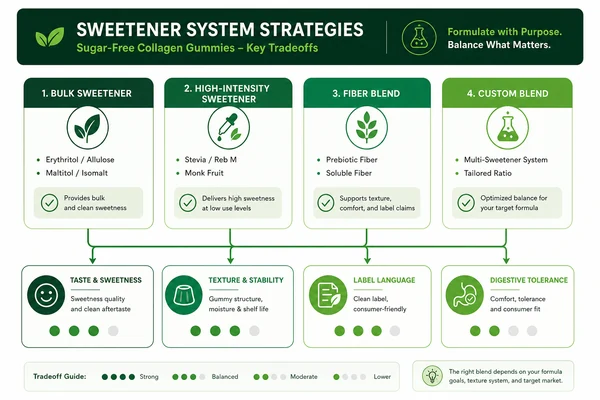
Sweetener System: Maltitol, Erythritol, Stevia, and Taste Balance
The sweetener system is one of the biggest decisions. A bulk sweetener can help replace some of the body that sugar would normally provide. A high-intensity sweetener can increase sweetness, but it may not provide the same texture or mouthfeel.[^3] A blended approach often works better than a single sweetener because taste, solids, cost, tolerance, and process behavior all need to be balanced.
| Sweetener route | Why brands consider it | Manufacturing question to check |
|---|---|---|
| Bulk sugar alcohol route | Helps rebuild sweetness and body | Does it create tolerance, cooling, stickiness, or claim issues at the serving size? |
| High-intensity sweetener route | Adds sweetness with little formula load | Does the gummy still have enough body and a clean aftertaste? |
| Fiber or blended route | Can support low-sugar positioning and mouthfeel | Does it interact well with acid, collagen, moisture, and gelling system? |
| Custom blend | Balances sweetness, body, and label target | Is the blend stable and repeatable at pilot and production scale? |
For collagen gummies, sweetness is not the only issue. Collagen peptides can bring their own taste and mouthfeel challenges. The sweetener system must work with acid, flavor, and collagen masking, not just replace sugar on a nutrition panel.
Texture Risk: Why Sugar Replacement Can Change Bite, Chew, and Stickiness
Texture is where many sugar free gummy ideas become less simple. Regular gummy formulas rely on a balance of syrup solids, gel structure, moisture, and processing conditions. If the sugar system changes, the chew can become too soft, too firm, sticky, grainy, or less elastic.
A sugar free collagen gummy also has active-loading pressure. Collagen peptides take up formula space and can influence bite and mouthfeel. If the formula pushes for a higher collagen dose, the gummy may need a larger piece size, multiple gummies per serving, or a more careful texture system.
Brands should not judge texture only on the first sample day. Some formulas feel acceptable after production but change during storage. Stickiness, sweating, surface tack, crystallization, and flavor shift can appear later. That is why pilot review and packaging review belong in the development process.
Aftertaste, Acidity, and Flavor Masking for Collagen Peptides
Aftertaste is another important risk. Sugar can soften sharp flavors and round out the sensory profile. When sugar is reduced, the formula may expose more of the collagen note, sweetener aftertaste, acidity, or bitterness from other beauty actives.
Flavor masking should be designed around the full formula. A fruit flavor that works in a regular sugar gummy may not perform the same way in a sugar free collagen gummy. Acids can help brightness, but too much acidity can create a harsher taste and may affect the gel system[^4] or active comfort.
A practical sensory review should cover sweetness onset, aftertaste, chew, aroma, and finish. A consumer may accept a small difference from regular gummies, but a beauty gummy still has to feel enjoyable enough for daily use.
Can Sugar-Free Collagen Gummies Deliver a Practical Collagen Dose?
The dose question determines whether a product stays a concept or becomes a reliable launch format.
Dose design must be tested as a system choice, because loading pressure changes texture, mouthfeel, and batching consistency.
A sugar free collagen gummy is only commercially useful if the collagen serving makes sense. The challenge is that collagen peptides usually require meaningful loading, while gummies have limited piece weight and formula space.
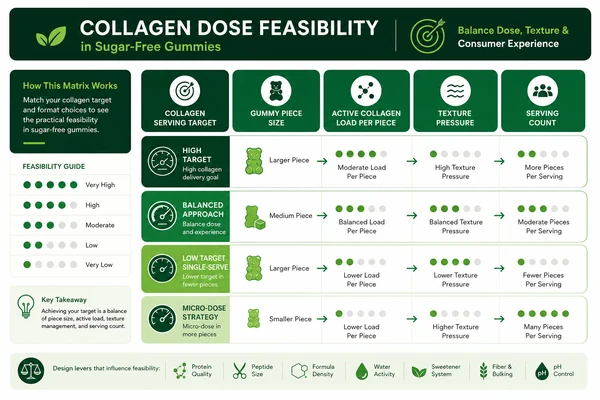
Collagen Peptide Loading vs. Gummy Piece Weight
The first dose question is simple: how much collagen should the product claim per serving, and how many gummies will that serving require? A high per-serving claim may be attractive on the label, but it can force the brand into a large gummy, multiple gummies per serving, or a texture compromise.
The second question is whether the collagen load fits with the sweetener system. Sugar replacement already changes body and chew.[^5] Adding a meaningful amount of collagen can increase formula pressure further. If the finished gummy becomes too dense, gritty, sticky, or hard to flavor, the claim may look good on paper but fail in consumer experience.
For a brand, the best path is to set the desired serving direction early, then test whether the target can be delivered in a realistic piece size and serving format.
Marine Collagen, Bovine Collagen, and Ingredient Compatibility
Marine collagen and bovine collagen can both appear in beauty supplement concepts, but they may differ in sourcing story, sensory profile, cost, and buyer expectation. The right choice depends on brand position, target consumer, claim direction, and supply chain plan.
Ingredient compatibility also matters. A collagen gummy may include vitamin C, hyaluronic acid, biotin, or other beauty-positioned ingredients. These ingredients can support the product story, but they also compete for formula space and may affect taste, acidity, color, or stability.
A stronger development process checks the full active system instead of adding ingredients one by one. If the formula tries to do too much, the gummy can become harder to manufacture and harder to explain clearly on the label.
Why Hyaluronic Acid, Vitamin C, and Beauty Actives Affect Formula Space
Beauty actives are often added because they improve market positioning. Vitamin C is common in collagen-related products because consumers associate it with collagen support.[^6] Hyaluronic acid can strengthen a beauty-from-within concept. Biotin may appear in hair, skin, and nail positioning.
If biotin becomes a co-primary active instead of a small optional addition, review collagen biotin gummies as its own formula and claim route.
However, every active ingredient uses formula space. Some bring taste, acidity, solubility, color, or stability considerations. In a sugar free gummy, the formula is already balancing sweetener behavior and texture. Extra actives should be selected for a clear product reason, not simply because competitors list them.
For supplement brands, a focused formula often performs better than an overloaded one. A manufacturer should help the brand decide which actives are essential, which are optional, and which may create unnecessary complexity.
Label Claims: Sugar-Free, Low Sugar, Keto-Friendly, and Diabetic-Friendly
Label terms are part of the sales story, but they are only safe if the formula and documentation can support them.
Sugar-free, low-sugar, and keto-friendly collagen gummy claims should be treated as verification outputs, not default marketing phrases; diabetic-friendly wording needs separate substantiation and regulatory review.
Sugar free collagen gummies are closely tied to label language. The claim may be part of the product's core appeal, but it also creates compliance and formulation responsibility.
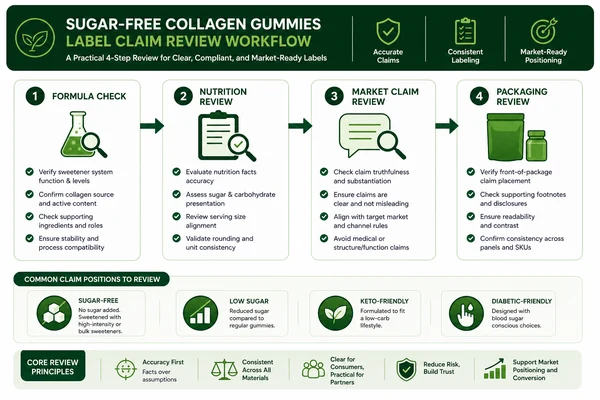
Why "Sugar-Free" Is Not Just a Marketing Phrase
"Sugar-free" should be treated as a claim that needs verification. A brand should confirm the applicable definition, serving basis, nutrition facts, ingredient contribution, and claim wording[^7] before packaging is finalized.
The same care applies to adjacent claims. "No added sugar" may not mean the same thing as "sugar free."[^8] "Low sugar" may allow a different formulation route. "Keto-friendly" and "diabetic-friendly" can create additional expectations and should be handled cautiously.
From a manufacturing perspective, the claim and formula must match. If the sweetener system is chosen only for taste and cost, the label claim may become difficult later. If the claim is chosen first without testing texture and stability, the product may become difficult to manufacture.
How Sweetener Choice Affects Label, Taste, and Digestive Tolerance
Sweetener choice affects more than sweetness. It can influence nutrition facts, ingredient declaration, mouthfeel, cooling effect, digestive tolerance, and consumer perception. A high serving size can make digestive tolerance more important, especially if sugar alcohols are involved.
Brands should ask for a clear explanation of why a sweetener system is being recommended. The answer should include taste, texture, claim fit, cost, process behavior, and serving-size implications. A vague answer such as "we can make it sugar free" is not enough for a serious launch.
The best sweetener system is usually the one that supports the intended claim while still producing a gummy people want to eat repeatedly.
What Brands Should Confirm Before Using Keto or Diabetic-Friendly Language
Keto-friendly and diabetic-friendly wording can be attractive, but these phrases should be reviewed carefully. They are not only formulation decisions; they are also marketing and compliance decisions.
Before using them, a brand should confirm the nutrition profile, serving size, carbohydrate contribution, sweetener type, and any target-market claim expectations. The manufacturer can support formulation and documentation, but the brand should also involve qualified regulatory review for final label language.
Those phrases should stay framed as claims to review. The content should not promise that a formula is appropriate for a medical condition or a specific diet.
Pectin, Gelatin, and Vegan Boundaries for Sugar-Free Collagen Gummies
Some readers need a brief boundary check here, but this page keeps focus on sugar-free feasibility.
Pectin/gelatin and vegan considerations should be included only where they change manufacturing, texture, and risk outcomes.
Sugar free collagen gummies often overlap with pectin, gelatin, and vegan search questions. Brands need the boundary, but they do not need a full vegan collagen or pectin-vs-gelatin guide inside this page.
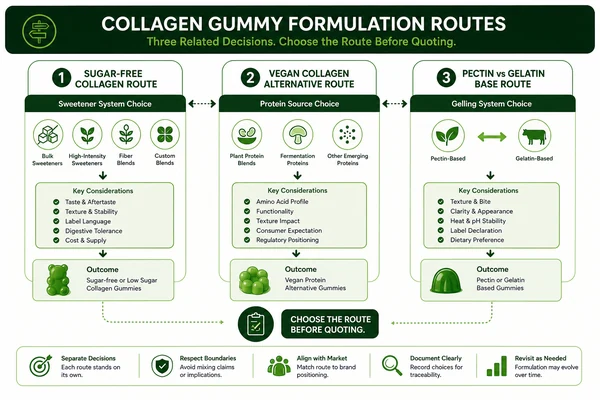
Why Most Collagen Gummies Are Not Vegan
Most collagen gummies are not vegan because collagen is typically animal-derived. A gummy can use pectin as the gelling system and still contain animal-derived collagen.[^9] This is a common point of confusion for consumers and brands.
If a product is positioned as vegan collagen, it is usually not delivering animal collagen peptides. It may instead use ingredients positioned as collagen support, collagen booster, or beauty support. That is a different product concept and should be handled under a separate vegan collagen gummy strategy.
The main point is simple: sugar free and vegan are different claims. Do not mix them casually.
When Pectin Helps a Sugar-Free Beauty Gummy Concept
Pectin can be useful in some beauty gummy concepts, especially when a brand wants a plant-based gelling system or a cleaner label perception. It can also fit certain fruit-flavor profiles and consumer expectations.
But pectin does not solve every sugar free issue by itself. The sweetener system, solids, acidity, water activity, and processing conditions still need review. A pectin-based sugar free collagen gummy may be possible, but it should be tested as a full system.
The decision should be based on formula performance, claim direction, texture target, and consumer positioning rather than a simple "pectin is better" message.
When to Link to Vegan Collagen or Pectin-vs-Gelatin Topics Instead of Expanding Here
Vegan and pectin boundaries matter only where they affect sugar free collagen feasibility. If the reader needs a full discussion of vegan collagen alternatives, that belongs on the vegan collagen gummies page. If the reader needs a full gelling-system comparison, that belongs on the pectin vs gelatin gummies page.
This keeps the page focused. The core topic is not every collagen gummy formulation choice. It is the specific challenge of making sugar free collagen gummies credible in taste, texture, dose, label, and production.
Manufacturing Checks Before Launching Sugar-Free Collagen Gummies
Production readiness should go beyond one sample review and include pre-scale controls.
A sugar-free collagen gummy launch needs pilot criteria, stability expectations, packaging assumptions, and revision limits defined before the brand commits to production.
Before launching sugar free collagen gummies, brands should ask for more than a sample that tastes acceptable once. They should ask how the formula will behave through pilot testing, packaging, storage, and scale-up.
Pilot Batch Texture Review
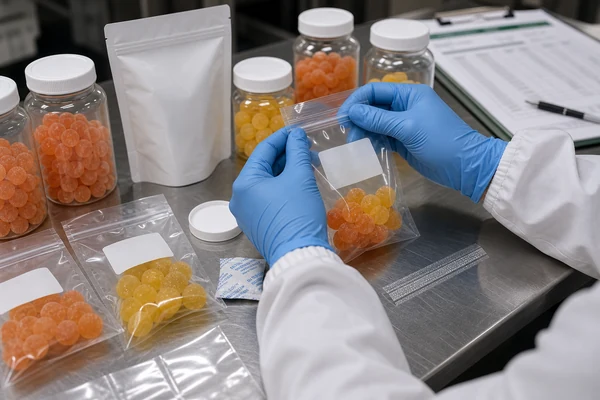
A pilot batch should confirm whether the formula can be produced consistently. Texture should be reviewed for bite, chew, elasticity, surface tack, grittiness, and piece-to-piece consistency. The sample should also be checked after a short storage period, not only on the first day.
For sugar free collagen gummies, the pilot batch is especially important because the formula has less room for error. Collagen load, sweetener behavior, and moisture balance can all change the final eating experience.
Brands should ask what the manufacturer is watching during the pilot stage. A useful answer should include texture, taste, moisture behavior, piece weight, coating, packaging fit, and any expected adjustment steps.
Before moving beyond a pilot sample, check four simple signals:
- The gummy keeps a clean bite after short storage.
- The surface does not become unusually sticky or wet.
- The collagen serving still matches the planned serving format.
- The flavor system masks collagen and sweetener aftertaste together.
Water Activity, Stickiness, and Shelf-Life Planning
Water activity and moisture behavior are central to gummy stability. Sugar replacement can affect how the gummy holds moisture and how the surface behaves in packaging. If the formula becomes sticky, sweaty, or unstable, the product may look less premium and may create distribution risk.
Shelf-life planning should begin before final production. Brands should ask how the formula will be checked under relevant storage conditions, what packaging is recommended, and whether the product needs coating, desiccant support, or a different package format.
No manufacturer should promise shelf life casually. Shelf-life expectations should be supported by testing plans and product-specific review.
Packaging, Coating, and Heat/Humidity Risk
Packaging can make or break a sugar free gummy launch. A formula that looks stable in open sampling may behave differently in a bottle, pouch, or blister format. Heat and humidity exposure can intensify stickiness and texture change.
Coating may help reduce surface tack, but it also affects mouthfeel and ingredient declaration. Bottle size, headspace, desiccant use, closure selection, and shipping lane can all matter.
Brands should review packaging and formula together. Choosing packaging after the formula is finished can create avoidable problems.
Testing, COA, and Finished-Product Specification Review
Finished-product testing should support the claims and quality expectations. Brands should discuss what will be checked, how finished-product specifications are defined, and what documentation will be available.
For a collagen gummy, this may include identity or assay expectations for relevant actives, microbiological checks, heavy metal considerations where applicable, and basic finished-product quality attributes. The exact plan depends on the market, formula, and brand requirements.
The key point is that documentation should not be an afterthought. If a brand wants a credible sugar free collagen gummy, it should ask about testing and specification review before production starts.
How Supplement Brands Should Choose a Sugar-Free Collagen Gummy Manufacturer
The supplier selection should start with feasibility criteria, not just sample acceptance.
A capable manufacturer should help brands de-risk the formula before MOQ and scale-up decisions.
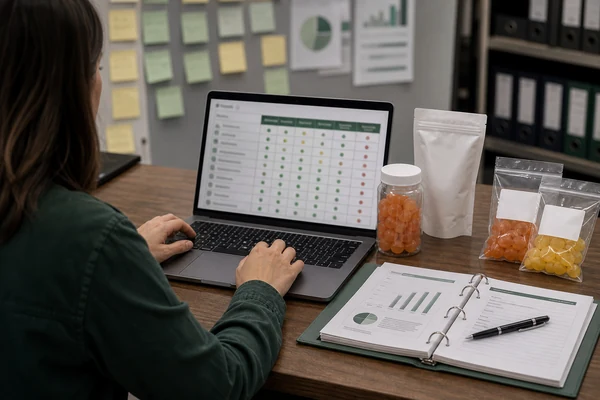
The right manufacturer should help the brand evaluate feasibility, not simply say yes to the concept. Sugar free collagen gummies require practical review of sweetener systems, active loading, label language, packaging, and production risk.
Questions to Ask About Sweetener Systems and Collagen Loading
Brands should ask which sweetener system is recommended and why. They should also ask how the sweetener choice affects texture, aftertaste, digestive tolerance, label language, and cost.
For collagen loading, the key questions are: how much collagen can fit per gummy, how many gummies make a serving, what happens to texture at the desired dose, and whether flavor masking remains acceptable. These questions should be answered before packaging and marketing promises are finalized.
Questions to Ask About MOQ, Custom Formula, and Ready Formula Options
Some brands may start from a ready formula and adjust flavor, color, packaging, or claim positioning. Others may need a custom formula to reach a specific sugar-free, low-sugar, active-loading, or label target.
MOQ should be discussed in relation to development route. A custom formula may require more sampling and validation than a ready formula.[^10] A ready formula may be faster, but it may not match the brand's exact collagen dose or claim language.
The practical question is not only "what is the MOQ?" It is "which route gives the brand the right balance of speed, differentiation, feasibility, and risk?"
Questions to Ask About Documentation, Stability, and Label Review
A serious supplier conversation should include documentation, stability planning, and label review boundaries. Brands should ask what documents are available, what finished-product checks are typical, what claim support is needed, and what the manufacturer can and cannot confirm.
Use this short checklist before moving from sample interest to production planning:
| Checkpoint | What the brand should clarify |
|---|---|
| Sweetener route | Which system supports taste, body, claim language, and serving size? |
| Collagen serving | Is the intended dose realistic for piece weight and texture? |
| Gummy base | Does gelatin or pectin fit the formula, claim, and sensory target? |
| Label claims | Are sugar free, low sugar, keto-friendly, or diabetic-friendly claims supportable? |
| Stability plan | How will stickiness, water activity, packaging, and storage be reviewed?[^11] |
| Documentation | What quality documentation, specification, and finished-product checks are expected? |
| Scale-up | What changes might appear between lab sample, pilot run, and production? |
The manufacturer can help with formulation and production documentation, but the brand still needs final label and compliance review for its target market. This is especially important for sugar free, low sugar, keto-friendly, and diabetic-friendly language.
Good supplier selection is less about choosing the cheapest sample and more about choosing a partner who can explain the tradeoffs before they become production problems. A broader collagen gummy formulation review and a collagen gummy dosage check can also help the brand decide whether the sugar free concept is ready for quoting.
Frequently Asked Questions About Sugar-Free Collagen Gummies
FAQs should clarify feasibility, not promise outcomes.
Answer the practical questions brands need before moving to formulation planning and supplier selection.
Are sugar-free collagen gummies effective?
They can be a practical delivery format when the formula contains a meaningful collagen serving, uses suitable ingredients, and is manufactured with consistent quality. The gummy format itself does not automatically create measurable outcomes. Dose, product quality, routine use, and claim boundaries matter.
Can sugar-free collagen gummies be vegan?
Usually, collagen gummies are not vegan because collagen is commonly animal-derived. A pectin gummy can still contain animal-derived collagen. Vegan collagen-style products are usually collagen booster or beauty support formulas, not true animal collagen peptide gummies.
What sweeteners are used in sugar-free collagen gummies?
Possible systems may include sugar alcohols, high-intensity sweeteners, fibers, or blended sweetener systems. The best choice depends on taste, texture, label target, digestive tolerance, cost, and processing behavior.
Do sugar-free collagen gummies have aftertaste?
They can have aftertaste if the sweetener system, acids, flavors, and collagen masking are not balanced. Aftertaste should be reviewed during sampling and after short storage, not only in the first tasting.
How much collagen can a sugar-free gummy contain?
The practical amount depends on piece weight, serving size, sweetener system, gummy base, texture target, and other active ingredients. A higher collagen dose may require multiple gummies per serving or a larger piece size.
Are sugar-free collagen gummies harder to manufacture?
Yes. They are usually harder than regular sugar gummies because sugar replacement affects sweetness, body, texture, stickiness, water activity, aftertaste, label language, and stability[^12]. The formula should be tested as a full system before production.
Conclusion
Sugar free collagen gummies are viable only when sweetener system, dose, texture, label claims, and production controls are designed as one formulation system.
For sugar-free collagen gummies, the risk is treating "sugar-free" as a label feature instead of a full formulation and production decision. Talvenda can support brands as a contract gummy supplement manufacturer, helping them decide whether to begin with low-MOQ market-tested in-stock gummies, adapt through stock formula modification, or move into custom gummy development. That gives your team a clearer view of sample feasibility, packaging and label support, documentation and testing expectations, and production through GMP-certified and FDA-registered manufacturing facilities before investing in a heavier custom route. Discuss the project through the project inquiry form.
[^1]: "A Systematic Review of the Effects of Polyols on Gastrointestinal ...", https://pmc.ncbi.nlm.nih.gov/articles/PMC5508768/. Scientific reviews and public-health sources describe that polyols can produce a cooling sensation because of their negative heat of solution and may cause gastrointestinal symptoms at higher intakes due to incomplete absorption and fermentation. Evidence role: mechanism; source type: paper. Supports: Some alternative sweeteners used in sugar-free gummies can create cooling effects or digestive tolerance concerns.. Scope note: The effect depends on the specific polyol, dose, serving size, and individual tolerance, so the source would provide contextual support rather than prove a problem in every sugar-free gummy. [^2]: "Physicochemical and Sensory Stability Evaluation of Gummy ... - PMC", https://pmc.ncbi.nlm.nih.gov/articles/PMC10818720/. Food-science sources on gummy confectionery and hydrocolloid gels describe how gel-forming agents, acids, sweeteners, water activity, moisture control, and packaging influence texture, stability, and shelf life, supporting the need to evaluate gummy formulas as interacting systems. Evidence role: mechanism; source type: paper. Supports: Gummy formulation variables such as collagen peptides, gelling base, acids, sweeteners, flavors, colors, coatings, moisture targets, packaging, and shelf-life expectations interact rather than functioning independently.. Scope note: Most sources address gummy or confectionery systems generally and may not test collagen-peptide gummies specifically. [^3]: "Aspartame and Other Sweeteners in Food - FDA", https://www.fda.gov/food/food-additives-petitions/aspartame-and-other-sweeteners-food. Regulatory and food-science sources characterize high-intensity sweeteners as providing sweetness at very low use levels, which means they generally do not supply the bulk, solids, or mouthfeel contributed by nutritive sweeteners. Evidence role: definition; source type: government. Supports: High-intensity sweeteners add sweetness but usually do not replace sugar’s texture or mouthfeel functions.. Scope note: This supports the formulation principle broadly and does not evaluate any specific sweetener blend in this product context. [^4]: "Hydrocolloids as thickening and gelling agents in food - PMC - NIH", https://pmc.ncbi.nlm.nih.gov/articles/PMC3551143/. Hydrocolloid studies show that pH and acidulant conditions can influence gelatin or pectin gelation, gel strength, and network stability, providing a basis for considering acidity when formulating gummies. Evidence role: mechanism; source type: paper. Supports: Excess acidity may affect the gummy gel system.. Scope note: The specific pH tolerance depends on the gelling system, acid type, solids content, and processing conditions used in the final product. [^5]: "Developing Low-Calorie Marshmallow Products Using Polyols and ...", https://pmc.ncbi.nlm.nih.gov/articles/PMC12509025/. Food-science literature on sugar-reduced confectionery and hydrocolloid gels reports that replacing sucrose with polyols or other sweetener systems can alter water activity, solids content, hardness, elasticity, and chewiness, supporting the formulation concern that sugar-free gummies may differ texturally from conventional gummies. Evidence role: mechanism; source type: paper. Supports: Replacing sugar in gummies can change the product’s body and chew.. Scope note: The magnitude and direction of the texture change depend on the specific sweetener blend, gelling agent, and processing conditions. [^6]: "Vitamin C - Health Professional Fact Sheet - NIH ODS", https://ods.od.nih.gov/factsheets/VitaminC-HealthProfessional/. Authoritative nutrition references identify vitamin C as a required cofactor for enzymes involved in collagen biosynthesis, supporting the biological rationale for pairing vitamin C with collagen-oriented products. Evidence role: mechanism; source type: government. Supports: Vitamin C is associated with collagen support because it has a recognized role in collagen biosynthesis.. Scope note: This supports the collagen-related rationale for vitamin C but does not by itself prove consumer perception or market frequency. [^7]: "21 CFR 101.60 -- Nutrient content claims for the calorie ... - eCFR", https://www.ecfr.gov/current/title-21/chapter-I/subchapter-B/part-101/subpart-D/section-101.60. FDA nutrient-content-claim regulations specify conditions for using “sugar free,” including quantitative sugar thresholds, serving-reference bases, ingredient considerations, and required accompanying statements in some circumstances. Evidence role: definition; source type: government. Supports: A brand should verify the regulatory definition, serving basis, nutrition facts, ingredient contribution, and wording before using a “sugar-free” claim.. [^8]: "21 CFR 101.60 -- Nutrient content claims for the calorie ... - eCFR", https://www.ecfr.gov/current/title-21/chapter-I/subchapter-B/part-101/subpart-D/section-101.60. FDA regulations distinguish “no added sugar” claims from “sugar free” claims; “no added sugar” concerns whether sugars or sugar-containing ingredients were added, while “sugar free” is tied to a quantitative sugar threshold per serving/reference amount. Evidence role: definition; source type: government. Supports: “No added sugar” is not equivalent to “sugar free.”. Scope note: This support is specific to U.S. FDA food-labeling rules and may differ in other jurisdictions. [^9]: "Hydrocolloids as thickening and gelling agents in food - PMC - NIH", https://pmc.ncbi.nlm.nih.gov/articles/PMC3551143/. Sources describing pectin as a plant-derived gelling hydrocolloid and collagen as an animal-derived protein support the distinction between the gummy’s gelling agent and its active protein ingredient. Evidence role: mechanism; source type: paper. Supports: A gummy can be pectin-based while still containing animal-derived collagen.. Scope note: The support is compositional and contextual; it does not document a specific pectin gummy product containing collagen. [^10]: "Small Entity Compliance Guide: Current Good Manufacturing ... - FDA", https://www.fda.gov/regulatory-information/search-fda-guidance-documents/small-entity-compliance-guide-current-good-manufacturing-practice-manufacturing-packaging-labeling. Product development and scale-up guidance for foods and dietary supplements describes iterative formulation, pilot testing, specifications, and validation as common steps before commercial production, supporting the claim that custom formulas generally require more development work than pre-existing formulas. Evidence role: general_support; source type: institution. Supports: Custom supplement or gummy formulas may require more sampling and validation than ready formulas.. Scope note: This supports the development-process logic rather than proving that every custom gummy formula requires more sampling than every ready formula. [^11]: "Water Activity (aw) in Foods - FDA", https://www.fda.gov/inspections-compliance-enforcement-and-criminal-investigations/inspection-technical-guides/water-activity-aw-foods. Food preservation literature identifies water activity and packaging/storage conditions as major determinants of microbial stability, moisture migration, texture, and shelf life, supporting their inclusion in a gummy stability plan. Evidence role: mechanism; source type: education. Supports: A stability plan for gummies should review stickiness, water activity, packaging, and storage conditions.. Scope note: The evidence is general to foods and confectionery systems and does not by itself establish the shelf life of a particular collagen gummy. [^12]: "Sugar reduction methods and their application in confections: a review", https://pmc.ncbi.nlm.nih.gov/articles/PMC8994798/. Food-science literature on sugar replacement in confectionery explains that sucrose contributes not only sweetness but also bulk, texture, water activity, crystallization behavior, and shelf stability; this supports the formulation rationale, although it is contextual rather than specific to collagen gummies. Evidence role: mechanism; source type: paper. Supports: Sugar-free collagen gummies are usually harder to manufacture because replacing sugar changes multiple functional properties of the gummy system.. Scope note: Evidence is likely to address sugar-free confectionery or gummy systems broadly, not collagen gummy manufacturing specifically.