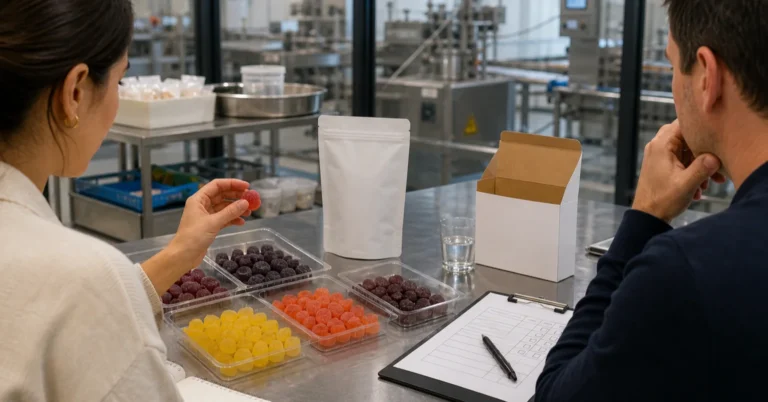


Fiber gummies can be comparable to powder, but the formats are not automatically equivalent.
Fiber gummies and powder should be compared by fiber type, grams per serving, label support, and intended use. Powder usually offers more serving flexibility, so the better fit depends on the product and routine.

I usually separate the format question from the proof question. A gummy is not weak because it is a gummy. A powder is not strong just because it is a powder. The real question is whether the finished serving can still deliver the promised fiber amount after processing, packaging, and storage.
For a quick answer: gummies can be a credible alternative when the product is designed around a realistic serving, clear directions, and finished-batch proof. Powder is usually the safer format when the brand wants a higher fiber load, adjustable dosing, or a dose-forward value story.
For supplement brands, that question affects more than marketing copy. It shapes the fiber type, serving count, Supplement Facts panel, sample review, finished-batch testing plan, packaging route, and scale-up conversation. The right format is the one that can carry the product promise honestly.
Are Fiber Gummies as Effective as Powder?
Many buyers ask this as a consumer question, but the answer belongs in formulation and finished-product proof.
Fiber gummies can be as effective as powder for certain use cases when the fiber type, grams per serving, serving count, and label support make sense. Powder is usually easier for higher or flexible dosing, but gummies can support consistency when the serving is realistic.

Short answer: it depends on fiber type, grams per serving, and label support
When I review a fiber gummy concept, I do not start by asking whether gummies are good or bad. I start by asking what the brand wants the product to prove.
If the goal is a moderate daily fiber support product with strong taste and easy use, gummies may fit well. If the goal is a higher-gram serving or adjustable dose, powder often gives the formulation team more room. So, are fiber gummies as effective as powder? They can be for the right serving goal, but they should not be presented as equal to a higher-dose powder unless the finished product can prove the same delivered fiber amount.
The most useful proof chain is simple:
| Proof point | What the brand needs to confirm |
|---|---|
| Fiber type | The chosen fiber must work with the target format, texture, and mouthfeel. |
| Delivered serving | The serving must provide a meaningful amount without asking the customer to take an awkward number of pieces or scoops. |
| Label support | The Supplement Facts panel and front-label language must match the finished product. |
| Finished-batch check | The final batch should support the declared amount after real production. |
| Stability and packaging | The product should keep texture and claim support through its intended shelf-life plan. |
This is why I avoid broad claims like "gummies are weaker" or "powder automatically wins." Format alone does not decide effectiveness. The finished serving does.
Why the same "fiber supplement" claim can mean different delivered doses
The phrase "fiber supplement" can hide very different products. One product may be a convenient daily support gummy. Another may be a scoopable powder designed for a larger serving. Both can sit in the same consumer category, but they do not carry the same dose promise.
That difference matters for brands. A gummy serving may require multiple pieces. A powder serving may require mixing with water. A gummy must balance fiber load with gel structure, sweetness, moisture, flavor, and chew. A powder must manage solubility, mouthfeel, clumping, and scoop accuracy.
So the better product brief does not ask, "Which format is better?" It asks:
| Product brief question | Why it matters |
|---|---|
| What claim do we want to support? | The claim decides the target serving. |
| What fiber type fits that claim? | Different fiber sources behave differently in gummies and powders. |
| What serving will consumers accept? | A technically possible product can still fail if daily use feels awkward. |
| What proof will we keep on file? | Label credibility depends on documentation, not only formula math. |
Fiber Gummies vs Powder: The Main Differences
Brands often compare taste first, but the larger differences show up in dose capacity, serving behavior, packaging, and value.
The main difference between fiber gummies and powder is format capacity. Powder usually handles higher or more flexible fiber amounts. Gummies can be stronger for convenience, taste, and routine use when the finished serving is honest and stable.
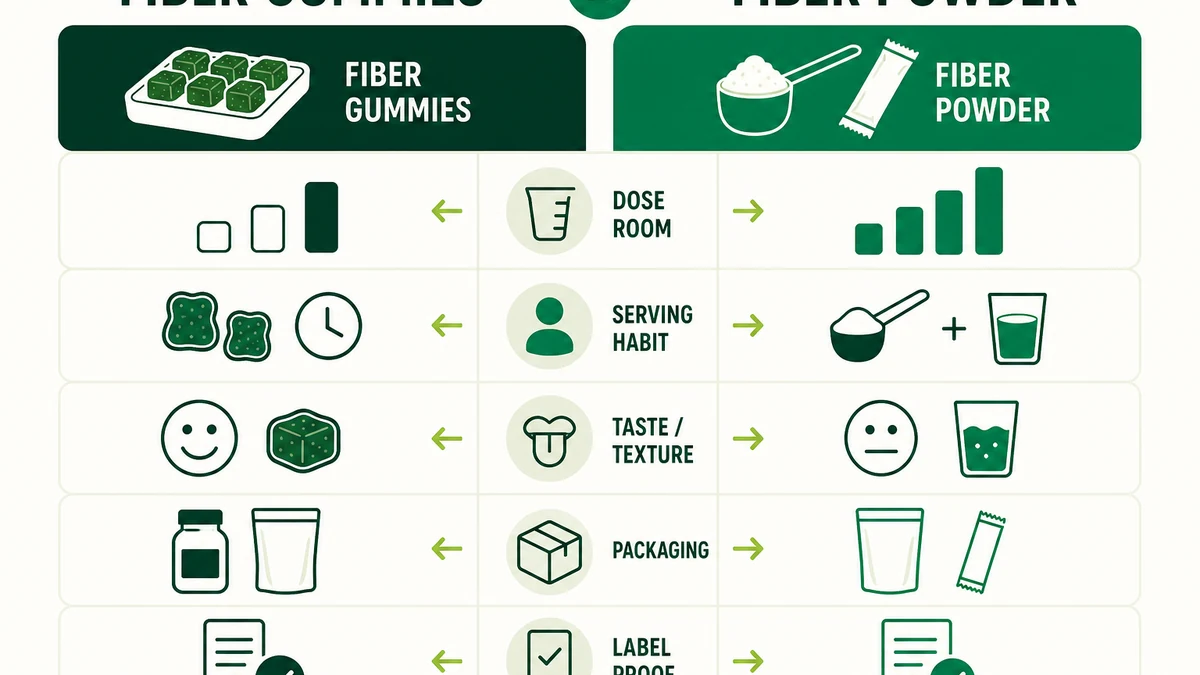
Fiber concentration per serving
Fiber concentration is usually the first practical limit. Powder has more physical room because a scoop or stick pack can carry more material. A gummy has to hold fiber alongside gelling agents, sweeteners, flavors, acids, color, moisture, and the structure needed for a stable chew.
This does not make gummies a poor format. It means the brand must define the product promise carefully. A gummy may be a strong choice for a moderate daily routine product. Powder may be stronger when the buyer expects a larger amount or flexible serving.
| Difference | Powder implication | Gummy implication |
|---|---|---|
| Active load | More room for higher or adjustable servings. | Tighter space for fiber and texture system together. |
| Serving design | Scoop size can be adjusted more easily. | Piece count must stay practical. |
| Claim pressure | Dose-forward claims may be easier to support. | Claims should match realistic finished-serving delivery. |
| Consumer habit | Requires mixing and preparation. | Easier to take as part of a daily routine. |
The mistake is to force a powder-style promise into a gummy format without checking whether the finished gummy can carry it. The same format-discipline applies to other supplement comparisons, which is why broader format questions such as gummy vitamins vs pills should also be answered through delivered dose, serving design, and proof rather than format assumptions.
Serving size and daily-use convenience
Serving size is where product design becomes commercial. Powder may deliver more fiber per serving, but it asks the user to mix, drink, and clean up. A gummy asks the user to chew a set number of pieces. That smaller habit barrier can matter.
For brands, repeat purchase often depends on whether the customer uses the product every day. A higher-dose powder that sits unused may look strong on a label but weak in the market. A gummy with a realistic dose and a pleasant routine may perform better for a convenience-led audience.
I like to review dose and use behavior together. The brand should ask how much fiber can fit, but also how many units the customer will accept, how clear the directions are, and whether the serving instructions match the Supplement Facts panel.
Texture, taste, and consumer compliance
Texture and taste are not cosmetic in gummy development. They affect whether consumers keep using the product. Fiber can change chew, moisture behavior, sweetness balance, and mouthfeel. Some fiber sources can make a gummy thicker, stickier, softer, or harder to flavor.
Powder has its own issues. Some powders become gritty, thicken quickly, clump, or feel unpleasant in water. The format gives more dosing room, but the user experience still needs real development work.
This is where gummies can earn their place. A well-built gummy can make a daily fiber routine easier and more enjoyable. The brand still needs to avoid overpromising. The winning angle is not "gummies are better." It is "this gummy format delivers a realistic fiber serving in a form customers can use consistently."
Cost, packaging, and long-term value
Cost should not be judged only by ingredient cost per gram. Powder may look efficient when the focus is fiber amount. Gummies often require more work around flavor, texture, molding, drying, packaging, and stability.
Packaging also changes the value equation. Powder needs moisture control, scoop or sachet accuracy, and clear mixing directions. Gummies need moisture control, anti-stick planning, texture protection, and packaging that protects the finished chew.
Long-term value depends on the business model. Powder may fit high-dose or value-per-serving positioning. Gummies may fit premium convenience, flavor-led wellness, private label line extension, or customers who dislike powders. A good brand brief compares these models before sample work starts.
Why Fiber Powder Often Delivers More Flexible Dosing
Powder has one clear advantage: the serving can be larger without asking the product to hold a gummy structure.
Fiber powder often delivers more flexible dosing because the formula can use a scoop-based serving. This gives brands more room for higher fiber amounts, blended fibers, and serving adjustment, although taste, texture, mixing, and packaging still need careful work.

Psyllium, inulin, wheat dextrin, and other fiber types
Different fiber types behave differently. This matters in both powder and gummy development.
Some fibers create viscosity or strong mouthfeel. Some dissolve more easily. Some are easier to flavor. Some fit better in powder than in a gummy base. The brand should not view all fiber sources as interchangeable.
In powder, the development team usually has more room to work with these differences. The product can be built around scoop size, flavor system, blend behavior, and mixing instructions. In a gummy, the same fiber choice must also fit into a chewy matrix with moisture, gel structure, sweetness, and process conditions.
| Fiber choice question | Why it matters |
|---|---|
| Does the fiber affect viscosity? | Thickening can change powder mixing and gummy texture. |
| Does the fiber affect taste? | Flavor masking may be needed in either format. |
| Does it fit the target serving? | The serving must remain practical for the consumer. |
| Does it fit the process? | A fiber that works in powder may not behave the same way in a gummy. |
Why powder can make higher-gram servings easier
Powder can make higher-gram servings easier because the serving format has more physical capacity. A scoop can hold more material than a small chewable piece. The consumer may accept that larger serving if the powder mixes well and tastes acceptable.
This is the strongest reason powder often wins in a direct dose comparison. If a brand wants a larger fiber amount per serving, powder normally gives the formulation team more freedom. It may also support blend flexibility if the brand wants to combine fiber types or adjust directions.
Powder still has limits. A large serving can become thick, gritty, too sweet, or hard to drink. More dosing room does not remove the need for product development discipline.
Where powder is less convenient for daily use
Powder asks the customer to take an extra step. They need water or another liquid. They need a cup or shaker. They need to mix it correctly. Some users dislike the mouthfeel or forget to use it outside the home.
That is where gummies can compete. A gummy serving is portable, easy to understand, and familiar. It may fit better into a daily vitamin routine.
For a brand team, this creates a strategic choice. If the product promise depends on higher grams and flexible serving, powder may be the stronger format. If the product promise depends on taste, routine, and easy daily use, gummies may deserve serious development. The right answer should come from the intended claim, target customer, price point, and production feasibility.
Where Fiber Gummies Can Work Well
Fiber gummies work best when the brand respects the format instead of forcing it to behave like powder.
Fiber gummies can work well when the product promise fits the serving size, the fiber load is realistic, and the formula can maintain taste, texture, and label support through production and storage. They are especially useful when convenience and routine matter.

When convenience and taste improve consistency
One reason brands like gummies is simple: consumers understand them. They are easy to take, easy to carry, and easier to make enjoyable than many powder formats. For a daily-use product, that matters.
In a fiber product, convenience can support consistency. If a consumer avoids powder because they dislike mixing it, a gummy may help the brand reach a different use case. This does not mean the gummy must claim the same dose as a powder. It means the gummy needs a clear and credible promise.
I would position a fiber gummy around the strength of the format: enjoyable routine, easy serving, and practical daily support. Then I would make sure the fiber amount, serving count, label language, and finished-batch documents match what the product can deliver.
Do fiber gummies work as well as powder for daily-use products?
Fiber gummies can work as well as powder for daily-use products when the serving is designed honestly and the comparison is made against the same product promise. That means the brand should define the fiber type, target grams per serving, number of gummies per serving, Supplement Facts wording, and finished-batch proof before the product is treated as launch-ready.
For product planning, this also means "fiber gummies dosage" and "fiber gummies ingredients" should not be treated as separate afterthoughts. Dosage, ingredient choice, texture, and label wording should be aligned in the same development brief.
The question is not only "do fiber gummies work?" It is whether this specific fiber gummy works for the claim the brand wants to make. A low-friction gummy routine can help consumers use the product consistently, but convenience does not replace the need for a meaningful serving and a stable formula.
For brands, the safer answer is practical: fiber gummies work best when the dosage, directions, texture, moisture control, and label support all point in the same direction. If the serving requires too many pieces or the fiber load damages texture, the product promise should be adjusted before production.
When the gummy serving still delivers a meaningful fiber amount
The phrase "meaningful fiber amount" should be decided before sample work begins. The brand should define the target serving, serving count, and label-claim route before asking the formulation team to make the gummy taste good.
If the serving requires too many gummies, the product may feel awkward. If the active load hurts texture or taste, the product may fail the consumer test. If the label claim depends on a fiber amount that cannot be maintained through storage, the product may create documentation risk.
This is also where "how many fiber gummies should I take a day" becomes a formulation and label question, not casual advice. The finished product should make the daily serving clear on the label, and that serving should be realistic for the target consumer to follow.
| Development item | What to confirm |
|---|---|
| Target fiber per serving | The amount the finished serving must deliver. |
| Serving count | The number of gummies consumers must take. |
| Fiber type | The source and its effect on texture and mouthfeel. |
| Claim language | The exact promise the label can support. |
| Finished-batch check | Whether the final product matches the Supplement Facts panel. |
These are development questions, not marketing questions. A realistic gummy brief protects the brand before the product reaches scale-up.
Common formulation checks: sweetness, texture, moisture, and active load
Fiber gummies need careful balance. The formula must taste good, hold texture, carry the active load, and remain stable. Those targets can pull against each other.
Sweetness and flavor help mask fiber notes, but they also affect consumer positioning. Texture must be firm enough for packaging and pleasant enough to chew. Moisture control matters because gummies can become sticky, dry, or unstable when packaging and storage are not aligned.
| Formulation check | What to review before scale-up |
|---|---|
| Sweetness balance | Whether fiber changes flavor perception or requires masking. |
| Texture firmness | Whether the gummy stays chewable and holds shape. |
| Moisture control | Whether the product resists stickiness, drying, or texture drift. |
| Active load | Whether the fiber amount fits the gummy without damaging quality. |
| Process behavior | Whether cooking, depositing, drying, and packaging still produce repeatable results. |
This is where production-side review becomes useful. Before moving from sample work to commercial production, the brand team and production team should align on formula feasibility, dosage accuracy, texture stability, packaging needs, and testing plans. Talvenda supports this kind of gummy vitamin manufacturing work by connecting formulation planning with finished-batch thinking, not only sample taste. Brands that are still choosing a production partner can also use a gummy supplement manufacturer checklist to compare sample review, documentation, MOQ, packaging, and scale-up support.
What Supplement Brands Must Prove Before Launching Fiber Gummies
A fiber gummy launch should be built around proof, not around the assumption that a tasty gummy will carry the claim.
Before launching fiber gummies, brands should prove the delivered fiber per serving, Supplement Facts logic, finished-batch consistency, stability, texture control, and packaging fit. The best fiber gummy concepts connect consumer convenience with manufacturing evidence.

Fiber grams per serving and realistic serving count
The first proof point is the serving. How much fiber does one serving deliver? How many gummies make that serving? Will the customer understand and follow the directions?
A serving that requires too many pieces can feel inconvenient. A serving that delivers too little fiber may not support the product promise. A serving that looks good in a formula sheet but fails after processing is not ready for launch.
I would review the serving in three layers:
| Layer | Question |
|---|---|
| Target amount | What fiber amount does the brand want to claim? |
| Serving format | How many gummies or how much powder makes one serving? |
| Finished-batch result | Does the produced product support the declared amount? |
If those layers do not align, the brand should adjust the claim, serving size, fiber type, or format before moving forward.
Supplement Facts and label-claim support
The Supplement Facts panel is not just a label task at the end. It should guide the product from the beginning. The brand needs to know what amount of fiber will be declared, how the serving size will be shown, and what claim language can be supported.
This is especially important for fiber gummies because the format can tempt brands to lead with taste and convenience. Those are real strengths, but they do not replace label discipline. The finished product must support the declared amount and the customer promise.
A practical label review should connect the formula, serving instructions, batch documents, and packaging plan. The safer path is to describe the product by delivered fiber, daily routine, format convenience, and manufacturing proof.
Finished-batch testing, stability, and shelf-life checks
Finished-batch testing matters because the product that leaves production is the product the consumer receives. A formula target is only the start. The brand needs to confirm that production, curing, packaging, and storage do not weaken the product promise.
For fiber gummies, stability is not only about fiber amount. It is also about texture, moisture, appearance, taste, and serving quality over time. A product that becomes sticky, hard, or inconsistent can damage trust even if the launch concept was strong.
I would not promise shelf-life results before real testing. I would plan the testing path. That path may include sample review, pilot or trial batch review, finished-batch documentation, packaging checks, and stability discussion. The exact scope depends on the product, market, formula, and claim.
| Proof step | What it should show |
|---|---|
| Formula feasibility review | The fiber type and serving target fit the format. |
| Sample review | Taste, texture, and serving count feel realistic. |
| Finished-batch check | The produced batch supports the declared fiber amount. |
| Stability review | Texture, moisture, and claim support remain acceptable in the chosen packaging plan. |
| Packaging check | The pack supports moisture and texture control. |
Packaging choices that protect texture and moisture control
Packaging is part of the formula system. Fiber gummies can be sensitive to moisture and texture changes, so bottle choice, closure, desiccant planning, film or pouch selection, and storage expectations can affect the final product.
Powder packaging also needs moisture control, especially when the formula can clump or thicken. Gummies have a different texture risk. They must stay pleasant to chew and easy to separate.
For brands, the packaging decision should happen before scale-up, not after the label is designed. The product team should confirm how the gummy behaves in the chosen pack, whether the count per bottle makes sense, and whether the packaging supports the serving plan. A fiber gummy with a credible claim still needs packaging that protects the finished serving.
Explore sugar-free dietary fiber gummies as a product-format option for serving design, texture, packaging, and private label planning.
Fiber Gummies vs Powder: How to Choose the Right Format
The right format is the one that matches the dose, claim, customer habit, and production reality.
Choose gummies when format appeal and daily-use consistency matter most. Choose powder when higher or flexible dosing is the priority. For brands, the best decision comes from a feasibility review that compares dose, texture, testing, packaging, and label support.

Choose gummies when compliance and format appeal matter most
Gummies are often a good fit when the product strategy depends on routine, taste, and ease of use. They can work well for brands targeting consumers who already take vitamins or prefer chewable formats. They can also help a brand create a more approachable fiber product.
The brand should still keep the serving honest. If the fiber target is modest and realistic, gummies can make sense. If the claim requires a much larger amount, the gummy format may need careful testing or a different promise.
Choose gummies when these conditions are true:
| Gummy decision point | Good sign |
|---|---|
| Fiber target | Fits within a realistic gummy serving. |
| Consumer habit | Convenience and taste support repeat use. |
| Texture | The formula stays chewable and stable. |
| Label claim | The declared fiber amount can be supported. |
| Packaging | Moisture and sticking risks are controlled. |
Choose powder when higher or flexible dosing is the priority
Powder is often the better route when the main value is a larger fiber amount, adjustable serving, or blend flexibility. A scoop format gives more room to deliver fiber without forcing the active load into a small chew.
This can be important for brands that want a more dose-forward product. It can also help when the brand wants to combine different fiber types or build a formula around mixing instructions. Powder gives the development team more flexibility, especially when the consumer is willing to accept preparation steps.
The tradeoff is daily friction. Some consumers do not like mixing powders. Some dislike thick texture or flavor. A powder product still needs strong taste work, clear directions, scoop consistency, and packaging control.
If the brand is comparing several delivery formats rather than only gummies and powder, the related gummies vs capsules supplements decision can help separate dose capacity, convenience, sensory appeal, and label-space tradeoffs without pulling this fiber article into a new keyword lane.
Ask your manufacturer for a dose, texture, and testing feasibility review
Before choosing a format, a brand should bring the product brief into a feasibility review. The review should compare target fiber amount, serving design, fiber type, texture, taste, label claims, packaging, and finished-batch testing.
This is the point where I would slow the decision down. A brand can lose time when it selects a format based only on trend, taste, or competitor examples. It can save time when it tests the real proof chain early.
This is also where the team can decide whether a pilot run, MOQ planning, or a staged sample path is needed before the product moves into commercial commitments.
A useful feasibility brief can include:
| Brief item | Why it matters |
|---|---|
| Target customer | Defines whether convenience or dose strength matters more. |
| Target fiber amount | Shows whether gummy or powder has enough room. |
| Fiber type preference | Affects texture, solubility, taste, and label language. |
| Serving expectation | Decides gummies per serving or scoop size. |
| Claim direction | Keeps the label promise realistic. |
| Packaging format | Protects texture, moisture, and user experience. |
| Testing plan | Confirms finished-batch support before launch. |
This review does not need to make the product more complicated. It makes the decision cleaner. Once the brand understands the dose and proof limits, it can decide whether to launch a gummy, a powder, or both.
FAQ: Fiber Gummies vs Powder
These FAQ answers summarize the format-choice questions supplement brands usually ask before sample work.
Fiber gummies vs powder decisions should stay tied to serving size, fiber type, label support, consumer routine, and production feasibility.
Are fiber gummies as effective as powder?
Fiber gummies can be effective when the finished serving delivers a meaningful fiber amount and supports the label claim. Powder often allows higher or more flexible dosing, so the better choice depends on intended serving, fiber type, and product promise.
Do fiber gummies work as well as powder?
Fiber gummies can work as well as powder when both products deliver a comparable fiber amount and the gummy remains stable through production, packaging, and storage. If the powder delivers a much higher or more flexible dose, it is not an equal comparison. Brands should compare finished serving, label support, testing, and real use behavior before making an effectiveness claim.
When are fiber gummies a good fit?
Fiber gummies are a good fit when convenience, taste, portability, and daily-use consistency matter. They work best when the fiber amount fits a realistic gummy serving and the formula can maintain texture, moisture control, and label support.
What should supplement brands check before choosing fiber gummies?
Brands should check fiber grams per serving, serving count, fiber type, texture, sweetness, active load, Supplement Facts logic, finished-batch testing, stability plan, and packaging fit. These checks show whether the gummy can support the product claim honestly.
How can a fiber gummy support a credible label claim?
A fiber gummy can support a credible label claim when the declared fiber amount matches the finished serving, the serving instructions are clear, and batch documents, stability checks, and packaging choices support the product through its intended shelf-life plan.
Are fiber gummies good for you?
Fiber gummies can be a useful daily-format option when the product has a clear fiber source, realistic serving size, and label-compliant directions. For brands, the stronger question is whether the formula, dosage, ingredients, and finished-batch proof support the promise without overstating health benefits.
Do fiber gummies work?
Fiber gummies can work when they deliver a meaningful fiber serving and the user can take that serving consistently. From a brand perspective, the answer depends on fiber type, gummy count per serving, label support, and whether finished batches keep the intended texture and claim through storage.
How many fiber gummies should someone take a day?
The daily amount should follow the product's Supplement Facts panel and directions, not a general rule. For brands, this means the serving count should be designed early, tested in samples, and written clearly so consumers do not need to guess how many fiber gummies make one serving.
What is the best time to take fiber gummies?
The best time is usually the routine the consumer can follow consistently, as long as the product directions allow it. Brands should avoid making timing sound like a medical claim and should focus on clear serving instructions, daily-use habit, and label-compliant wording.
Conclusion
The best fiber supplement format is not decided by trend. It is decided by the serving, claim, and finished-product proof.
As a gummy manufacturing partner, Talvenda’s view is that fiber gummies can be credible when they deliver a realistic fiber serving, keep texture stable, and support the label claim. Powder usually gives more dosing room. Brands should choose the format that best matches the product promise and proof plan.
Fiber gummies can be credible, but the proof is in the finished serving
Fiber gummies vs powder should not be framed as gummies losing and powder winning. That is too simple. Powder often gives more dosing flexibility, but gummies can be a strong commercial format when the serving is honest and the product is built for real daily use.
My usual recommendation is to start with the finished serving. Confirm the fiber type, grams per serving, serving count, Supplement Facts logic, texture target, packaging route, and testing plan. Then choose the format.
A fiber gummy has to justify itself against powder by making convenience, serving reality, texture, and repeat-use expectations work together. Talvenda works as a contract gummy supplement manufacturer that can help brands review low-MOQ market-tested in-stock gummies, stock formula modification, and custom gummy development before spending budget on a route that may be too heavy for the first launch. With sample development, packaging and label support, quality-controlled production, and scale-up support connected early, the brand gets a clearer view of whether a gummy format is practical enough to sample and quote. Start with the project inquiry form.