


Collagen vitamin C gummies look simple on a label. For a supplement brand, the harder question is whether the formula can carry dose, stability, taste, and review-ready claims.
Collagen vitamin C gummies combine collagen peptides with vitamin C in a chewable supplement format. The practical brand decision is whether active dose, gummy weight, acid balance, flavor, packaging, testing, and claim wording can work together before production starts.

Decision snapshot for brands
| Pre-sampling decision | Why it matters |
|---|---|
| Collagen mg per serving | Drives active load, piece weight, texture, taste masking, and serving count |
| Vitamin C form and dose | Affects claim rationale, sourness, pH, flavor balance, and stability planning |
| Gelatin or pectin base | Shapes texture, label positioning, heat tolerance, and acid sensitivity |
| Sugar or sugar-free direction | Changes sweetness, mouthfeel, moisture behavior, and cost |
| Packaging format | Protects against moisture, heat, oxygen, and vitamin C potency loss |
| Claim language | Keeps the beauty story credible without drifting into disease or assured-result claims |
Shoppers may enter through skin, hair, nails, collagen support, and supplement-choice questions. A brand can answer that entrance quickly, then move into manufacturing reality. The stronger work is formula feasibility, sample approval, finished-product testing, and the brief sent to a gummy manufacturer.
What Are Collagen Vitamin C Gummies?
Collagen vitamin C gummies combine collagen peptides with vitamin C in one serving format. The pairing is familiar because vitamin C supports normal collagen formation[^1].
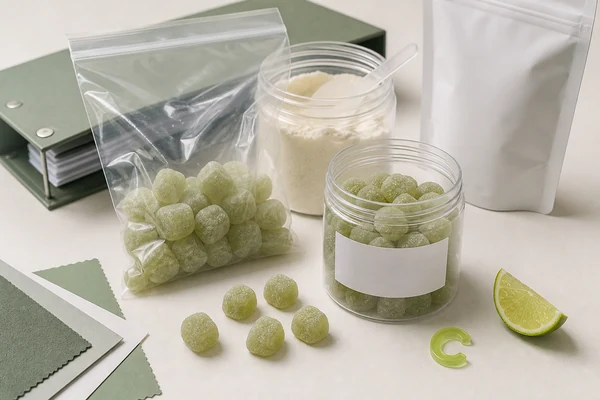
For brands, collagen vitamin C gummies are a formulation project before they are a marketing project. The formula has to carry collagen, manage vitamin C acidity, hold texture, protect potency, and use label language that does not overpromise.
The short answer for supplement brands
A brand should plan this SKU as a beauty gummy with two active responsibilities. Collagen drives formula weight. Vitamin C supports the rationale and changes the acid profile.
The brief should not start with a vague request such as "make a collagen vitamin C gummy for skin." It should start with commercial constraints. Define the target collagen mg per serving, vitamin C level and form, gummies per serving, collagen source, base system, sugar direction, flavor, packaging, market, and claim language.
That brief gives the manufacturer enough information to judge whether a stock formula is suitable, whether a custom sample is needed, and which tradeoffs are likely to appear during development.
Why collagen and vitamin C are paired in beauty gummies
Collagen is the main beauty-positioning ingredient. Vitamin C supports the formula story because it has a recognized role in normal collagen formation. Together, the pairing gives brands a clear message without requiring a complex multi-active beauty stack.
The pairing also works commercially because vitamin C is familiar to shoppers. It can make the formula feel more complete than a collagen-only gummy, especially when the brand wants a simple beauty-from-within SKU.
The risk is that marketing can move faster than the formula. A brand can easily write "collagen + vitamin C for glowing skin" before the formula is ready. The harder work is checking dose fit, sourness, and whether the claim language works in the target market.
Why this page is about formula feasibility, not generic skin benefits
Most consumer guides explain what collagen does, why vitamin C matters, and how often to take gummies. That is not the highest-value angle for Talvenda.
For a supplement brand, the more useful question is whether the product can be produced credibly. A formula that reads well on a label can still fail in sampling. Collagen may make the gummy dense, vitamin C may push the pH too low, flavor may fail to mask active notes, or packaging may not protect the finished product.
This guide focuses on the manufacturer conversation: what to decide before quotation, what to test during sampling, what claims to keep cautious, and what evidence a brand should expect before launch.
What Role Does Vitamin C Play in a Collagen Gummy Formula?
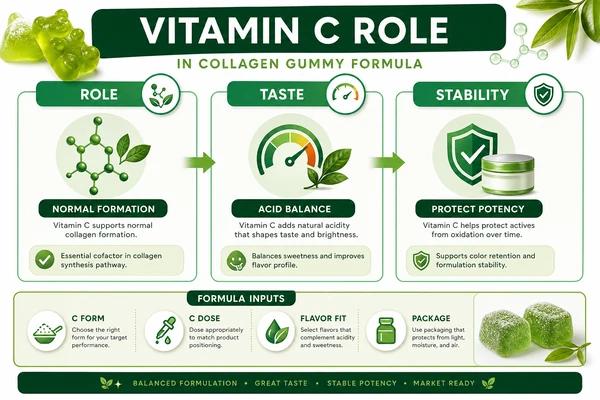
Vitamin C has two jobs here. It supports the beauty rationale, and it also affects the gummy's acid, taste, and stability profile.
Vitamin C is not just a label add-on in collagen vitamin C gummies. It changes the formula environment. The brand needs to choose the vitamin C form, dose, flavor direction, and claim language before a manufacturer can build a realistic sample.
Vitamin C and normal collagen formation
The most defensible reason to include vitamin C is its role in normal collagen formation. This gives the formula a logical pairing rather than a random active blend. It also gives the writer and label team a safer starting point than broad beauty promises.
The phrase "normal collagen formation" matters because it keeps the claim tied to a nutrient function. It does not say the product will reverse aging, remove wrinkles, address skin conditions, or promise visible results. Those stronger claims need separate substantiation and regulatory review.
For a brand brief, the manufacturer does not need a long biology lesson. The manufacturer needs the target vitamin C amount, the intended claim language, and the market where the product will be sold. Those details affect ingredient form, overage planning, testing expectations, and label review.
How to use this rationale without overclaiming
The safest claim path is to say that vitamin C supports or contributes to normal collagen formation, then bridge immediately into the product-development question. Avoid turning the product promise into an assurance that the finished gummy will create better skin outcomes for every user.
A cautious brand page can explain the formula logic: collagen peptides are included as the core beauty ingredient, and vitamin C is included to support the body's normal collagen formation process. That is enough for a credible SKU rationale.
The page should not promise anti-aging, wrinkle reduction, immune protection, disease outcomes, or assured hair, skin, and nail outcomes. A manufacturer can help with formula feasibility and documentation, but the brand owns its label claims and regulatory review.
Vitamin C as an active ingredient and as an acid/taste factor
Vitamin C is often supplied as ascorbic acid, which brings sourness. That can be useful in citrus or berry gummies, but it also makes flavor balancing harder. If the dose is too high for the flavor system, the gummy can taste sharp, medicinal, or unstable over time.
Some formulas may use buffered or alternative vitamin C forms to reduce sourness or manage pH. That decision affects cost, label wording, and testing. It should be made before sampling, not after the first batch tastes too acidic.
| Vitamin C input | Formula implication | Brand question before sampling |
|---|---|---|
| Ascorbic acid | Stronger tartness and pH impact | Is the flavor direction built around sourness? |
| Sodium ascorbate | Milder acid profile | Does the label allow this form and dosage? |
| Coated or buffered form | May improve taste or process tolerance | Is the extra cost justified by the target claim and stability plan? |
The practical manufacturer question is simple: what vitamin C form and mg per serving will fit the target taste, base, and label claim? Once that is clear, the manufacturer can decide how to balance acids, sweeteners, flavors, and process exposure.
Collagen Dose, Serving Size, and Gummy Weight
Collagen is usually the heavy part of the formula. It often determines whether the gummy can hold the active load and still chew well.
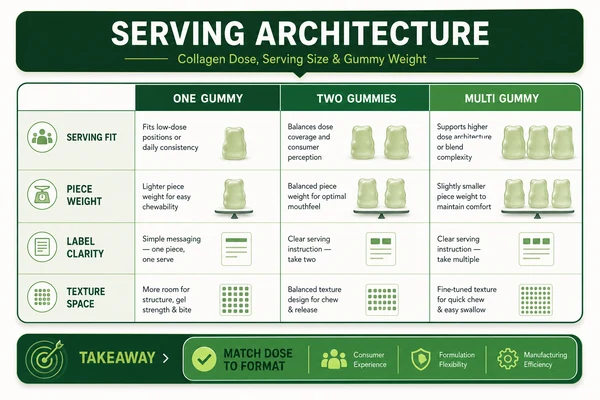
The collagen dose sets the serving architecture. A brand has to decide whether the target mg fits one gummy, needs multiple gummies, or creates a piece weight that weakens texture, packaging, or consumer expectations.
Why collagen mg per serving drives the product brief
A collagen gummy formula can become crowded quickly. Every gummy needs active ingredients, gelling system, sweetener, water, acid, flavor, color, and process tolerance. If collagen takes up too much of the piece weight, the manufacturer has less room to manage texture and taste.
This is why the target collagen mg per serving should be the first number in the brief. It determines whether the product can be a one-gummy serving, a two-gummy serving, or a larger serving count. It also affects the bottle count, Supplement Facts panel, cost per serving, and retail positioning.
If the brand wants a high collagen number, the manufacturer may recommend multiple gummies per serving, a larger piece, or a different product format. It is a feasibility decision that prevents the label promise from damaging the eating experience.
One gummy vs multiple gummies per serving
One-gummy serving formats are convenient, but they limit active load. Multiple-gummy serving formats give the manufacturer more room to distribute collagen and vitamin C while keeping each piece chewable.
The tradeoff is consumer clarity. A two-gummy or three-gummy serving must be easy to understand on the label. If the bottle contains 60 gummies but the serving is two gummies, the consumer receives 30 servings. That affects pricing, subscription planning, and perceived value.
| Serving design input | Manufacturing impact | Commercial impact |
|---|---|---|
| One gummy per serving | Lower active capacity per piece | Simple label, but lower collagen ceiling |
| Two gummies per serving | Better balance of dose and chew | Common beauty SKU format |
| Three or more gummies per serving | More active capacity | Higher cost per serving and clearer label education needed |
For brand planning, serving count should be decided alongside dose. A product that looks strong on the Supplement Facts panel but feels expensive per serving may underperform commercially. A product that is affordable but too low in collagen may not support the beauty positioning. The right answer depends on the market lane.
Hydrolyzed collagen, source choice, and documentation
Hydrolyzed collagen peptides are the common form for gummy supplements because they are easier to disperse than larger collagen proteins. The source may be bovine, marine, porcine, or another approved collagen source depending on the brand's target audience and documentation requirements.
If the source decision is the main uncertainty, review marine collagen gummies for fish-source, allergen, traceability, and sensory checks before locking the formula route.
Each source changes the conversation. Marine collagen can support a premium beauty angle, but it may raise allergen and cost questions. Bovine collagen is common and commercially familiar, but brands may need documentation around source, market access, and religious or dietary positioning. Porcine collagen may be technically usable but unsuitable for some audiences.
The manufacturer brief should specify source preference or ask the manufacturer for available options. The brand should also request raw-material documentation, specification expectations, and any source declarations needed for the launch market.
Acid, Taste, Sweetness, and Texture Challenges
Taste is where many collagen vitamin C gummy concepts become real or fail. The formula must mask collagen notes, balance sourness, and keep texture intentional.
The sensory challenge is a three-way balance. Collagen can add body and aftertaste, vitamin C can add sourness and pH pressure, and the gummy base has to hold both without becoming sticky, hard, soft, or medicinal.
How vitamin C affects sourness and flavor direction
Ascorbic acid naturally pushes the formula toward a tart profile. That can be helpful if the brand chooses orange, lemon, mixed berry, raspberry, or tropical flavors. It can be harder if the brand wants a creamy, mild, or low-acid flavor.
The flavor direction should work with vitamin C, not fight it. A citrus profile can make the acid feel intentional. A berry profile can cover some collagen notes. A tropical profile may help if the formula has both sourness and a slight protein aftertaste.
Sampling should include at least one version that uses vitamin C acidity as part of the flavor and one version that masks it more aggressively. Brands often discover that a slightly sharper flavor is more acceptable than a formula that tastes overly sweet but still carries active notes.
Balancing acid, sweetener, and flavor masking
Sugar-based gummies usually give the manufacturer more flexibility in taste and texture. Sugar contributes bulk, mouthfeel, and sweetness. Sugar-free formulas are possible, but the sweetener system can create cooling, bitterness, or texture changes that become more obvious when collagen and vitamin C are present. For the deeper sweetener-system route, review sugar-free collagen gummies before treating sugar reduction as a late label decision.
The brand should not decide "sugar-free" only because it sounds cleaner. It should decide whether the target audience expects sugar-free, whether the formula can carry the active load, and whether the final taste is good enough to support repeat use.
Flavor masking should be managed as a development task, not a final polish step. Collagen source, vitamin C form, sweetener choice, acidulant system, and flavor dosage all interact. If the first sample tastes off, the correction may require more than adding flavor.
Gelatin vs pectin base considerations
Gelatin gives a familiar elastic chew. It is often forgiving in gummy development and can handle active-loaded formulas well when the process is controlled. The tradeoff is that gelatin is animal-derived, which may not fit vegan or some religious positioning.
Pectin supports plant-based or vegan-style positioning, but this page should not turn into a vegan collagen booster guide. If the product uses real collagen peptides, the formula is not vegan even if the gummy base is pectin. That distinction has to be clear in the brief and on the label.
Pectin systems are also more sensitive to acid balance and process conditions. A collagen vitamin C formula using pectin may require tighter pH control, careful drying, and more sampling rounds. The manufacturer should confirm whether the desired dose and taste profile are realistic in that base.
Sampling questions before approving taste and chew
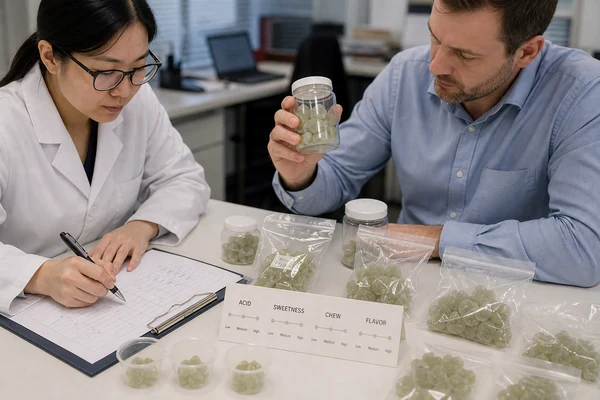
The first sample should not be approved only because the ingredient list is correct. It should be checked against the intended consumer experience and production target.
Useful sampling questions include: does the gummy taste too sour after chewing? Does collagen create a protein note? Is the piece too firm or too sticky? Does the flavor fade after storage? Does the sweetness feel balanced? Does the color change under light or heat? Does the serving count feel reasonable?
A strong sample approval process includes feedback on taste, texture, aftertaste, piece weight, appearance, coating, packaging fit, and label serving. The brand should document these decisions before pilot or commercial production.
Stability, Packaging, and Finished-Product Testing
A good first sample is not enough. Collagen vitamin C gummies need to hold their appearance, texture, microbial quality, and active levels through the target shelf life.
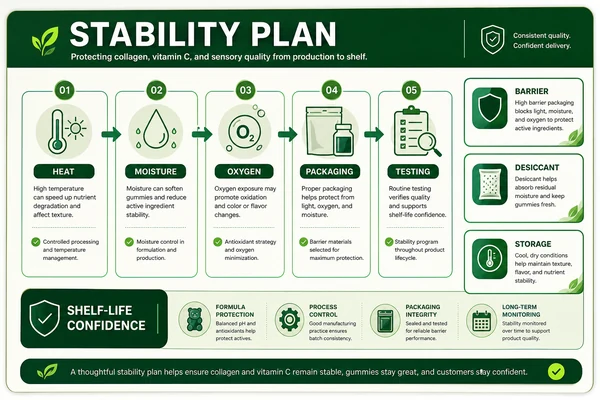
Stability planning protects the label promise. Vitamin C can be sensitive to heat, moisture, oxygen, and light, while gummies themselves can become sticky, hard, wet, or misshapen if packaging and storage conditions are not planned around the formula.
Heat, moisture, and storage considerations
Gummies are moisture-sensitive products. If they absorb too much moisture, they can become sticky, clump together, or create microbial risk. If they lose too much moisture, they can become hard or unpleasant to chew. Active-loaded gummies can make this balance more complicated because water activity is tied to available moisture and microbial growth risk[^2].
Vitamin C adds another stability concern because ascorbic acid stability can be affected by oxygen, heat, and storage conditions[^3]. The manufacturer may need to account for overage, ingredient form, process exposure, and packaging barrier. The brand should not assume the label amount will remain stable without testing.
Storage instructions should match the formula and packaging. "Store in a cool, dry place" may be standard, but the actual package and shelf-life claim should be supported by testing data.
Packaging choices that affect shelf-life confidence
Packaging is part of the formula system. Bottles, pouches, blister packs, stick packs, induction seals, desiccants, and high-barrier films all affect moisture and oxygen exposure.
A bottle may work well for a standard gummy formula, especially with a proper seal and desiccant. A high-barrier pouch may be better for certain climates or direct-to-consumer shipping. A blister or stick pack can protect individual servings but may raise cost and change the product's retail feel.
The brand should ask the manufacturer which package has been tested with similar active-loaded gummies. If the target market is hot or humid, packaging should be discussed early. A formula that performs well in a temperate warehouse may behave differently during summer shipping or in tropical markets.
Active testing and finished-product documentation
The brand should request documentation at both raw-material and finished-product levels. Raw-material specification files confirm identity and specifications for collagen and vitamin C inputs. Finished-product testing confirms whether the manufactured gummy meets the label expectations.
Finished-product checks may include appearance, weight, active content, microbiology, heavy metals where relevant, and other market-specific requirements. The exact testing plan depends on target market, brand standards, and manufacturer capabilities. For U.S. dietary supplements, 21 CFR Part 111 covers current good manufacturing practice requirements for manufacturing, packaging, labeling, or holding operations[^4].
The most important point is that testing should be part of the launch plan, not an afterthought. If a brand wants to make a serious beauty supplement claim, it needs documentation that the finished product matches the approved formula and label.
Claim Boundary for Collagen + Vitamin C Gummies
The page should support a commercial claim path without writing risky marketing copy. The safest claim strategy is narrow, factual, and review-ready.
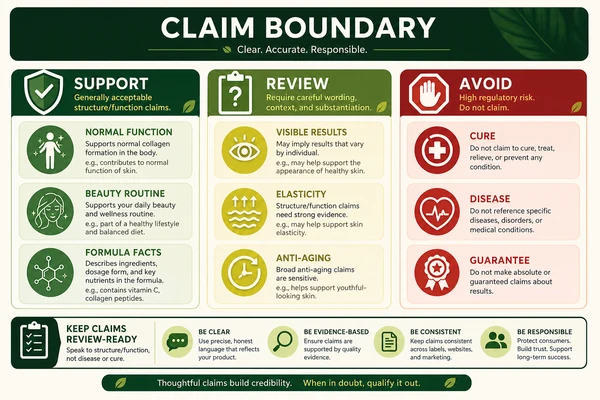
A collagen + vitamin C gummy can usually be positioned around beauty support and normal collagen formation. It should not promise anti-aging outcomes, disease outcomes, skin repair, immune protection, or assured visible results without substantiation and legal review.
What brands can usually position as structure/function support
A cautious structure/function approach focuses on normal body functions. Vitamin C can be connected to normal collagen formation. Collagen peptides can be described as collagen peptides or hydrolyzed collagen in the formula. The product can be positioned as part of a beauty supplement routine. In the U.S., FDA explains that structure/function claims may describe the role of a nutrient or dietary ingredient in normal body structure or function[^5].
The wording should avoid implying a drug-like effect. "Supports normal collagen formation" is different from "rebuilds collagen." "Formulated with collagen peptides and vitamin C" is different from "restores youthful skin."
The exact wording still needs market-specific review. What is acceptable in one market may require different language, disclaimers, or substantiation in another.
Claims that need legal and regulatory review
Claims about skin elasticity, wrinkle appearance, hair growth, joint comfort, bone support, immunity, or anti-aging should not be assumed automatic. Some may be possible with the right substantiation, but they require review. FTC guidance for health-related products also emphasizes that marketers need appropriate substantiation for health claims.[^6]
Certifications and quality claims also need care. Do not add GMP, kosher, non-GMO, gluten-free, vegan, or clinically tested wording unless the product, facility, raw materials, and documentation support that exact statement.
A manufacturer can supply documents and process information, but the brand should own claim review. The safest workflow is to draft label claims, confirm formula support, collect documentation, then review claims before printing packaging or launching product pages.
Why to avoid immune, disease, or assured-result claims
Vitamin C is widely associated with immune support in consumer content. That does not mean this page should become an immune health article. The target keyword and Talvenda lane are collagen vitamin C gummies for beauty formula development, not vitamin C immune gummies.
Disease and assured-result language creates unnecessary risk. A gummy supplement should not be positioned around skin-condition, reverse-aging, joint-condition, or illness-prevention language. This page helps the brand avoid those traps.
This boundary also protects search intent. A buyer looking for collagen vitamin C gummies may need a quick benefit entrance, but Talvenda's value is helping the brand decide whether the SKU can be manufactured and documented responsibly.
Manufacturer Brief Checklist for Collagen Vitamin C Gummies
A clear manufacturer brief shortens the path from idea to sample. It also prevents the manufacturer from guessing at core decisions that the brand should own.
The best manufacturer brief for collagen vitamin C gummies gives the factory enough information to judge feasibility. Include active dose, ingredient form, serving count, base, flavor, sweetener, package, target market, claim language, testing expectations, and order planning.

Formula inputs to send before quotation
At minimum, the brand should provide the target collagen mg per serving, collagen source preference, vitamin C mg per serving, and vitamin C form if known. Also include gummies per serving, desired gummy weight, and optional supporting actives.
If the brand is unsure, it should ask for feasible ranges rather than asking for a final quote immediately. A manufacturer can often explain which dose ranges are realistic in a standard gummy and which require custom development.
| Manufacturer brief input | Why it belongs before quotation |
|---|---|
| Collagen target | Sets formula load, serving design, and raw-material sourcing |
| Vitamin C target and form | Sets claim rationale, acid profile, taste work, and stability plan |
| Base system | Determines texture, vegan/animal-source boundary, and pH sensitivity |
| Sweetener direction | Changes taste, texture, moisture behavior, and label positioning |
| Flavor direction | Guides acid masking and collagen aftertaste control |
| Packaging format | Affects shelf-life confidence, label space, and unit economics |
| Target market | Determines claim review, documentation, and label requirements |
| Testing expectations | Defines documentation, active testing, microbiology, and stability discussion |
The brief should also include ingredient restrictions. Examples include no gelatin, no artificial color, sugar-free, low sugar, allergen-free, halal-oriented, kosher-oriented, or market-specific limitations. Each restriction affects formula options.
Target dose, serving count, base system, flavor, and packaging
Dose and serving count should be considered together. If the brand wants a higher collagen amount, it may need two or more gummies per serving. If it wants one gummy per serving, it may need to accept a lower collagen amount or larger piece.
The base system should match positioning. Gelatin may fit a classic gummy texture. Pectin may fit plant-based base preferences, but it does not make a real collagen formula vegan. Sugar-based formulas may taste better and be easier to develop. Sugar-free formulas may fit a wellness audience but require more taste work.
Packaging should be part of the same conversation. A collagen vitamin C gummy with stability-sensitive actives should not have packaging chosen only by design preference. The package needs to protect the product and support the shelf-life target.
MOQ, lead time, sample approval, and scale-up questions
Brands should ask about MOQ, but they should not make MOQ the only selection criterion. A low MOQ does not help if the sample is unstable, the documentation is weak, or the manufacturer cannot scale repeat production.
Useful questions include: how many sampling rounds are included? What is the typical lead time after sample approval? What testing is included in the quote? What raw-material documents are available? What packaging options have been used for similar formulas? What happens if stability results fail? What changes when moving from pilot to commercial batch?
The goal is to understand process reliability, not only unit price. A beauty gummy that launches late, tastes poor, or loses potency can cost more than a slightly higher manufacturing quote.
When to choose stock formula vs custom formulation
A stock formula can make sense when the brand needs speed, accepts the manufacturer's existing dose and flavor, and wants to test market demand with lower development complexity. It is often the best route for early validation.
Custom formulation makes sense when the brand has a specific collagen dose, vitamin C form, sugar-free requirement, flavor target, packaging plan, or claim strategy that stock formulas cannot support. It takes longer, but it gives the brand more control.
The right question is not "stock or custom?" The right question is whether the stock formula matches the brand's commercial promise. If it does, use it. If it does not, custom development is the safer path.
FAQ
Are collagen and vitamin C gummies different from regular collagen gummies?
Yes. Regular collagen gummies may contain collagen peptides only, while collagen vitamin C gummies add vitamin C as part of the formula rationale. That addition can support normal collagen formation language, but it also changes acid, taste, and stability planning.
For broader collagen gummy formula basics, the better internal reference is collagen gummies formulation. This page should stay focused on vitamin C's role in the formula.
How much vitamin C should be in collagen gummies?
There is no universal answer. The right amount depends on target market, label claim, serving count, vitamin C form, taste profile, and stability plan. A brand should define the target mg per serving with its regulatory and formulation team, then ask the manufacturer whether that level is practical in the gummy system.
The dose should be high enough to support the intended positioning, but not so high that it creates avoidable sourness, pH, or stability problems.
Can collagen vitamin C gummies be sugar-free?
Yes, but sugar-free development needs extra attention. Sugar-free sweetener systems can change mouthfeel, cooling effect, sweetness curve, and texture. When collagen and vitamin C are also present, the formula may need more sampling work to balance sourness, active aftertaste, and chew.
Sugar-free can be a valid positioning choice, but it should be decided before sampling because it changes the formula system.
Can brands add biotin or zinc to collagen vitamin C gummies?
Yes, but biotin or zinc should not be added casually. Each active changes the formula story, label review, taste, and testing plan. Biotin can support hair, skin, and nail positioning, while zinc can add mineral taste and claim considerations.
If biotin becomes a co-primary ingredient, the topic belongs closer to a dedicated collagen biotin gummy brief. If zinc is included, the brand should confirm dose, taste masking, and claim support before sampling.
Conclusion
Collagen vitamin c gummies work best when dose, claim, base, flavor, package, testing plan, and launch market are decided before sampling.
For collagen vitamin C gummies, the stronger project starts by matching the collagen source, vitamin C choice, acidity, flavor, packaging, and claim boundary before sample work begins. Talvenda can support this as a contract gummy supplement manufacturer, offering brands a way to choose between low-MOQ market-tested in-stock gummies, stock formula modification, and custom gummy development. That route-based review connects sample development, documentation and testing expectations, quality-controlled production, and GMP-certified and FDA-registered manufacturing facilities, so your team can see what is realistic before moving into custom development. Contact Talvenda through the project inquiry form.
[^1]: NIH Office of Dietary Supplements, "Vitamin C - Health Professional Fact Sheet." Evidence role: nutrient-function rationale. Scope note: supports the cautious statement that vitamin C is connected with normal collagen formation; it does not prove finished-product beauty outcomes for a gummy SKU. [^2]: U.S. FDA, "Water Activity (aw) in Foods." Evidence role: moisture-stability rationale. Scope note: supports using water activity as a stability and microbial-risk concept; it is not specific to this exact gummy formula. [^3]: A.E. van Bree et al., "Chemical Stability of Ascorbic Acid Integrated into Commercial Products: A Review on Bioactivity and Delivery Technology," available through PubMed Central. Evidence role: stability rationale. Scope note: supports considering oxygen, heat, storage, and formulation context when planning vitamin C potency. [^4]: Electronic Code of Federal Regulations, "21 CFR Part 111 - Current Good Manufacturing Practice in Manufacturing, Packaging, Labeling, or Holding Operations for Dietary Supplements." Evidence role: manufacturing and documentation context. Scope note: U.S.-specific regulation; other markets may require different review. [^5]: U.S. FDA, "Structure/Function Claims." Evidence role: claim-boundary rationale. Scope note: supports the difference between normal structure/function language and stronger health or disease claims. [^6]: Federal Trade Commission, "Health Products Compliance Guidance." Evidence role: advertising-claim substantiation boundary. Scope note: supports the caution that visible-result, anti-aging, and other health-related claims require appropriate substantiation and review.