
Sugar-free gummy supplement manufacturing is not a simple sweetener swap. Removing sugar changes body, chew, solids, flavor rounding, moisture behavior, packaging fit, and label wording. Before a brand approves a sugar-free gummy supplement sample, it should review the sweetener system, gummy base, active load, stability plan, and exact claim language together.
For supplement brands, the practical decision is whether the concept should be sugar-free, low-sugar, no-added-sugar, or a standard gummy with a better sugar story. Each route changes formula feasibility, taste masking, label review, cost, and sample approval.
Decision Snapshot
- Start with what sugar was doing in the gummy system before choosing replacements.
- Review sugar-free, low-sugar, and no-added-sugar as different manufacturing and label routes.
- Check sweetener blend, gelling base, active load, acidity, texture, and aftertaste before quoting.
- Review creatine, collagen, probiotic, fiber, beetroot, ACV, multivitamin, and energy gummies as different feasibility cases.
- Confirm packaging, moisture control, stability checks, finished-product specifications, and label-claim boundaries before locking artwork.
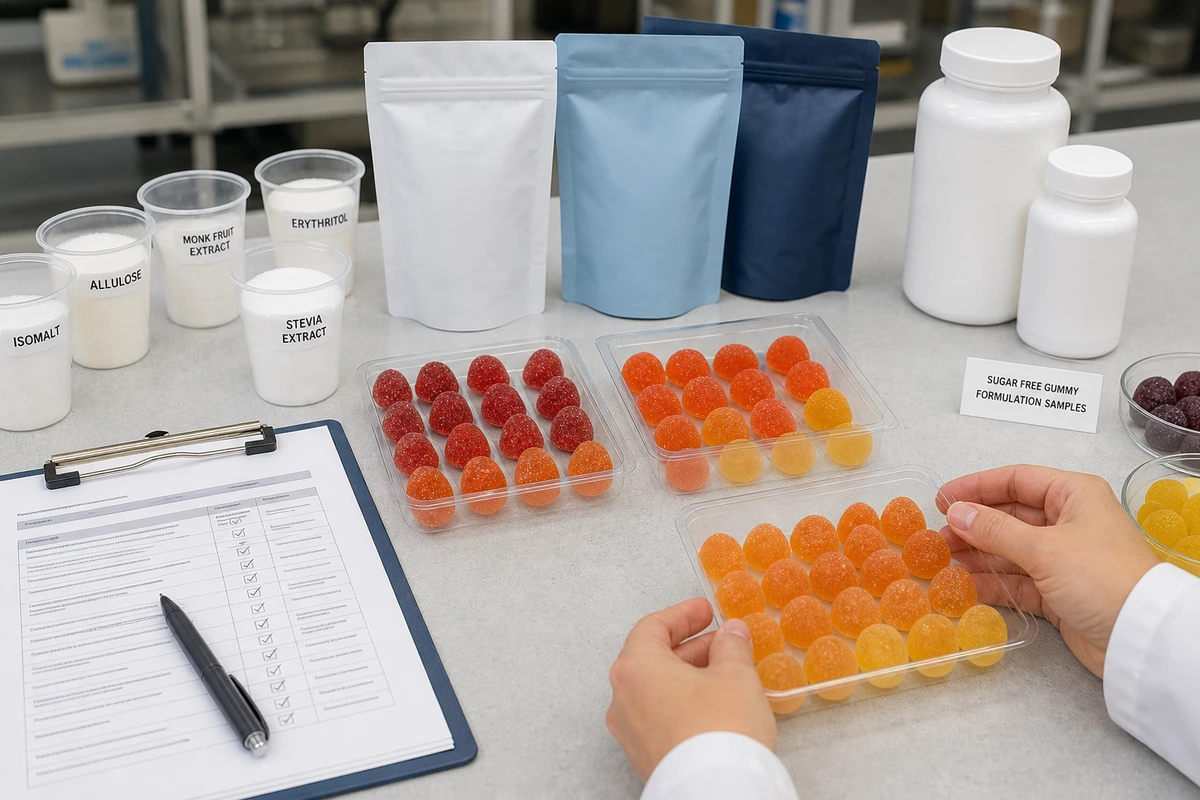
What Sugar Free Gummy Supplement Manufacturing Really Changes
Sugar-free gummy manufacturing changes the whole product system, not only the sweetness level.
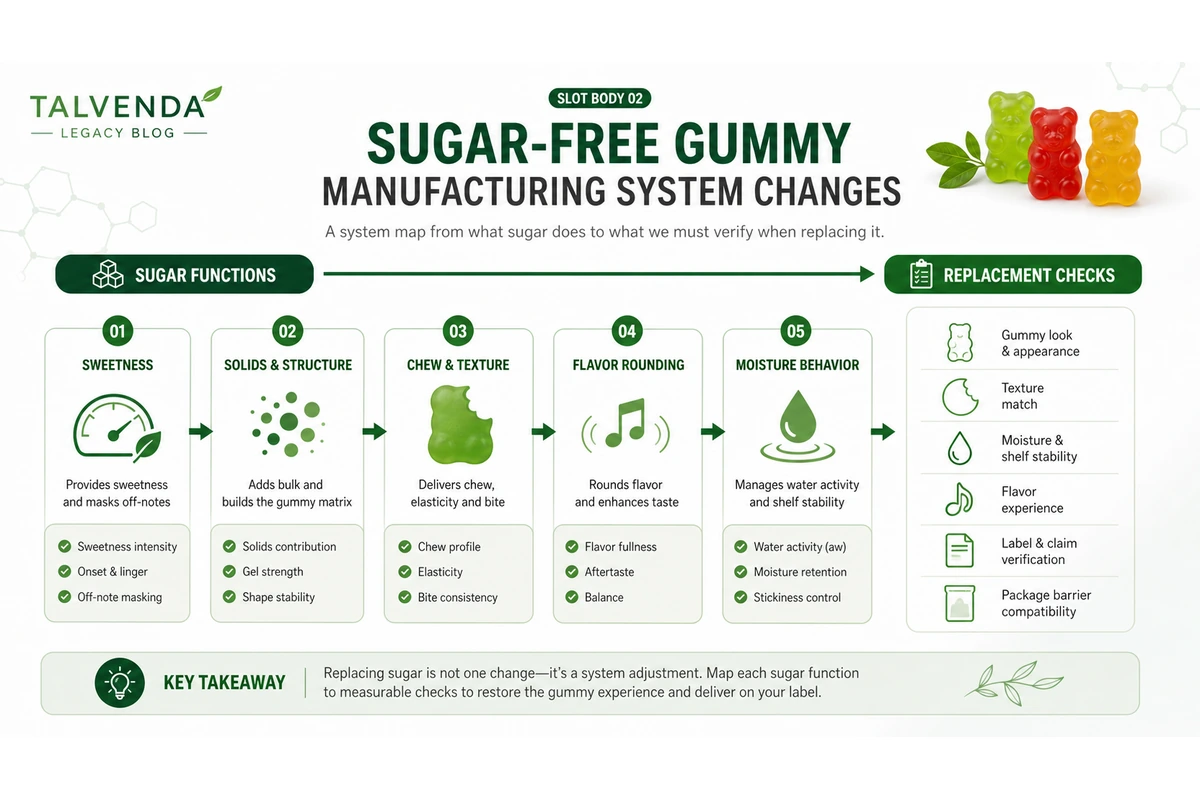
In sugar-free gummy supplement manufacturing, the first question is what sugar was doing for texture, solids, flavor, moisture, and label positioning before the brand removes it.
Why Brands Are Asking for Sugar-Free Gummies
Sugar-free and low-sugar gummies are attractive because many supplement buyers still want the convenience and taste of gummies without a high-sugar positioning problem. Brand teams see demand across daily wellness, beauty, sports nutrition, digestive health, and family-oriented products. They may also want to make a gummy format feel less candy-like while keeping the convenience that made gummies popular.
For a brand working with Talvenda as a gummy supplement manufacturing partner, that demand becomes a production question. A product manager may ask for private label sugar free gummies because the category is moving that way, because retailers are asking for lower sugar, or because the brand already sells a powder, capsule, or standard gummy and wants a broader SKU ladder. Those are valid commercial reasons, but they do not decide the formula route by themselves.
The manufacturing review should start with the actual product promise. A sugar free probiotic gummy has different pressure points than a sugar free creatine gummy, a beetroot gummy, a fiber gummy, or a biotin gummy. Each active changes taste, solids, color, serving count, pH, moisture behavior, and documentation needs. The demand signal matters, but the product still has to work as a stable gummy.
Why Sugar-Free Is Not Sweetener-Free
Sugar-free does not mean the product has no sweetness system. It means the product needs a different sweetness and solids strategy that can support the intended label claim. Sugar often contributes bulk, chew, flavor balance, and moisture behavior. When it is reduced or removed, the replacement system has to help the gummy eat like a real product, not like a compromised sample.
This is why a sugar-free gummy manufacturer should be able to discuss more than one sweetener name. The conversation may include bulk sweeteners, fibers, high-intensity sweeteners, acid balance, flavor masking, and coating or anti-stick strategy. It should also include what the brand can and cannot say on the front label.
Brands should be cautious with casual language. "Sugar-free," "low sugar," "reduced sugar," and "no added sugar" are not interchangeable claims. The product route, nutrition panel, ingredient deck, target market, and regulatory review all matter. A manufacturer can support the technical route, but the brand should still review final label language with the appropriate regulatory process before printing.
When Low-Sugar May Fit Better Than Sugar-Free
Low-sugar may be the better route when the brand wants better taste, texture, or active-load flexibility without forcing a strict sugar-free claim. This can be especially important when the formula already carries bitter, acidic, mineral, botanical, or bulky active ingredients. A strict sugar-free route can make those sensory problems more visible.
| Route | Best Fit | Manufacturing Tradeoff | Label Review Need |
|---|---|---|---|
| Sugar-free | Brands that need a hard front-label sugar claim | Highest pressure on sweetener system, texture, coating, and moisture control | Confirm definition and finished-product support before artwork |
| No-added-sugar | Brands avoiding added sugars while accepting naturally occurring sugars where applicable | More flexible than sugar-free but still needs ingredient-deck review | Confirm ingredient sources and claim wording |
| Low-sugar | Brands prioritizing taste, texture, and active-load flexibility | Often easier to balance than strict sugar-free | Confirm allowed wording in target market |
The right choice should come from sample testing and label review, not from a slogan. A serious RFQ should ask whether the proposed route can support the desired active amount, acceptable mouthfeel, packaging format, shelf-life plan, and label wording. If the answer is uncertain, the brand should review sugar-free and low-sugar prototypes side by side before committing.
Sugar Free Gummy Supplement Manufacturing: Sweetener System and Texture Feasibility
The sweetener system and gummy base decide whether the sugar-free concept can become a real SKU.
A good sugar-free gummy supplement sample should be judged by chew, aftertaste, active masking, moisture behavior, and label fit, not only first-bite sweetness.
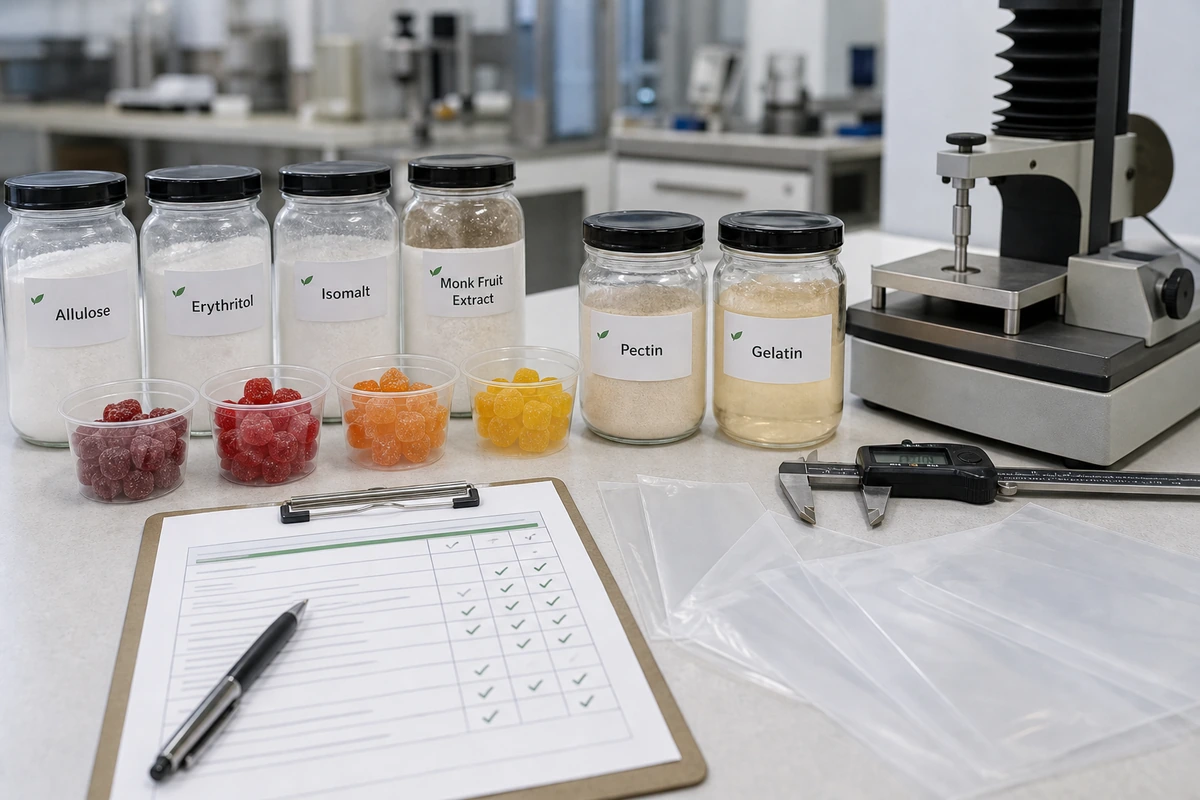
Bulk Sweeteners, High-Intensity Sweeteners, and Fibers
Sugar-free gummy development usually needs a layered sweetness strategy. Bulk sweeteners can help with body and solids. High-intensity sweeteners can lift sweetness but may need careful balancing to avoid sharpness or lingering aftertaste. Fibers may support texture and label positioning, but they can also affect digestive-tolerance language, processing behavior, and mouthfeel.
| Component | What It Helps Replace | What Brands Should Check |
|---|---|---|
| Bulk sweetener | Body, solids, sweetness, chew support | Cooling effect, crystallization risk, digestive-tolerance language, cost |
| High-intensity sweetener | Sweetness intensity | Aftertaste, flavor interaction, market acceptance, label preference |
| Soluble fiber or bulking fiber | Solids, mouthfeel, possible positioning | Texture shift, moisture behavior, serving size pressure |
| Acids and flavors | Flavor brightness and masking | Pectin interaction, active stability, sourness, lingering notes |
The right blend depends on the active system. A mild multivitamin gummy has different masking needs than apple cider vinegar, beetroot, creatine, minerals, botanicals, or caffeine. If the active is bitter, sour, earthy, salty, or aromatic, the sweetener system has to support flavor balance without making the product taste artificial or overly acidic.
This is also where cost and supply-chain questions enter. A formula that tastes good at bench scale still needs ingredients that are commercially available, documentable, and stable enough for repeat production. During quote review, brand teams should ask which sweetener components are stock options, which require custom sourcing, and which may affect MOQ or lead time.
Pectin, Gelatin, and Vegan-Base Route Decisions
The gelling base shapes texture, consumer positioning, and production behavior. Gelatin can offer a familiar elastic chew, while pectin is often used when the brand wants vegan or plant-based positioning. The right decision depends on target market, texture expectations, active ingredients, acidity, and manufacturing route.
Pectin-based sugar-free gummies may support vegan positioning, but they still need a clean texture plan. Acidity, solids, and active load can affect gel quality. Gelatin-based routes may fit some texture targets, but they will not support vegan claims. A brand comparing these routes should also review whether the chosen base works with the desired flavor system and package format.
Brand teams that are still comparing base systems can use pectin vs gelatin gummies, what gummies are made of, and vegan gummy vitamin supplements as decision references before briefing a sugar-free project. For the current SKU, the operating point is the same: review the sugar claim and base choice together before sample approval.
Aftertaste, Acidity, and Active Masking
Sugar-free gummies often expose aftertaste because the formula has less sugar to round off difficult notes. High-intensity sweeteners, sugar alcohols, fibers, acids, flavors, and actives can all create lingering sensory effects. A sample may taste acceptable at first bite but become less acceptable after a full serving or short storage period.
Acidity is one of the most useful and risky levers. It can brighten fruit flavors and help mask certain actives, but it can also create sourness, interact with texture, and affect active stability. ACV, probiotic, vitamin, mineral, and botanical gummies each need their own flavor and acid review.
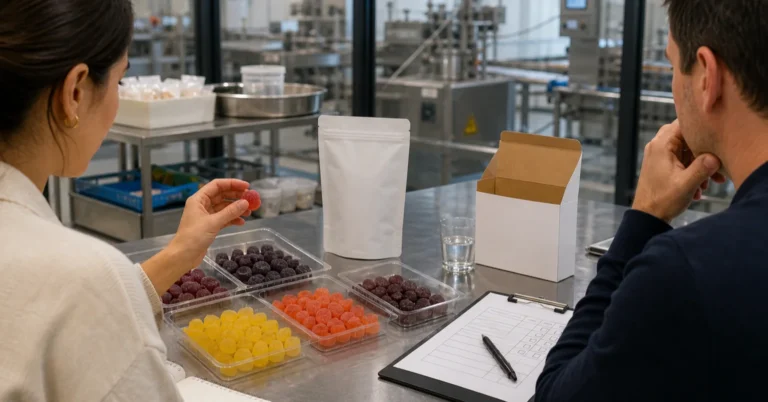
The sample approval process should include more than "does it taste sweet?" Brand teams should check first bite, full serving, aftertaste, chew, stickiness, odor, color, and how the gummy behaves after being held in the intended package. If the product needs heavy masking to hide the active, the team should revisit the active load or claim ambition before moving to production.
Active Load and Category Fit for Sugar-Free Gummies
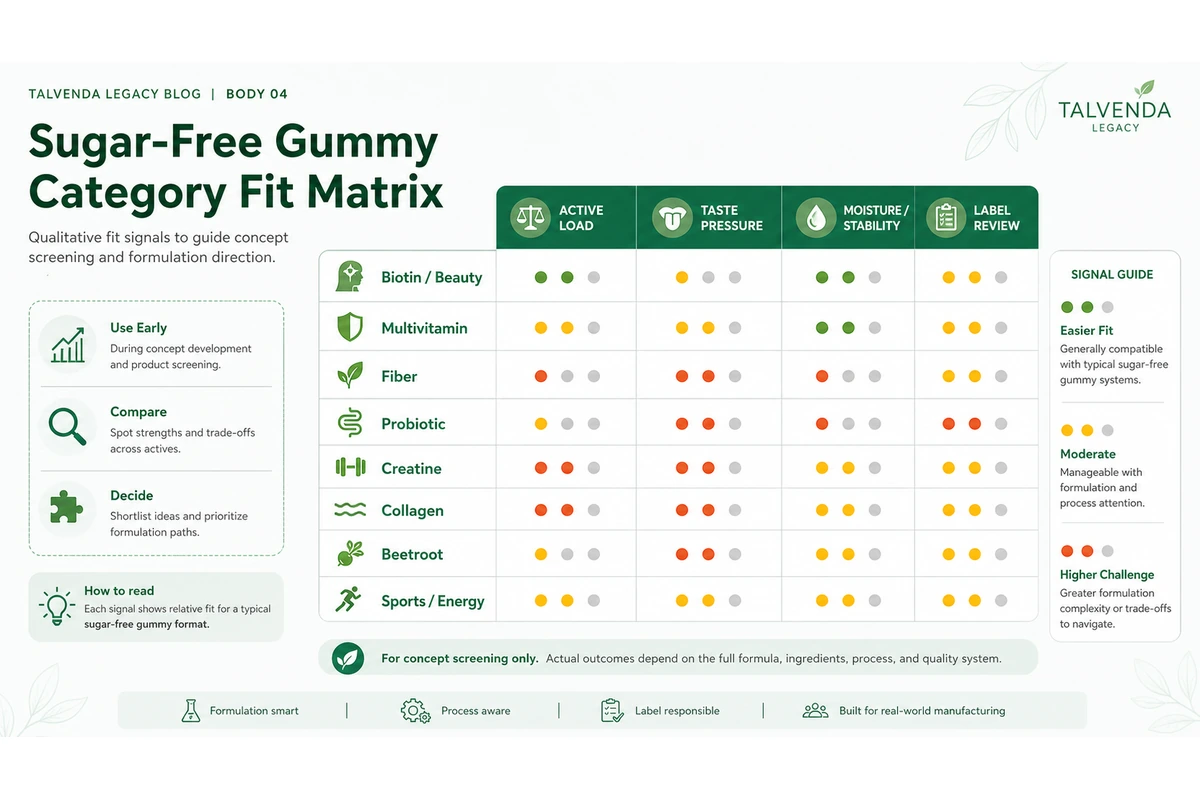
Every sugar-free gummy category has a different active-load and stability burden.
A sugar-free gummy supplement formula that works for a biotin gummy may not work for creatine, collagen, fiber, probiotic, beetroot, or energy positioning.
Multivitamins, Fiber, Probiotics, and Daily Wellness
Multivitamin and daily wellness gummies often look like natural sugar-free candidates because consumers already expect gummies in those categories. The manufacturing review still matters. Vitamins and minerals can affect taste, color, odor, and stability. Some minerals create stronger flavor and texture challenges than brand teams expect.
Fiber gummies can fit a sugar-conscious positioning, but fiber also changes solids, chew, serving size, and label review. A higher fiber story may sound attractive, yet it needs a careful texture and digestive-tolerance framing. Brands should avoid promising broad wellness outcomes and instead focus the manufacturing brief on active amount, sensory quality, and documentation.
Probiotic gummies add another layer. The brand should review whether the chosen organism, process route, packaging, storage expectation, and finished-product testing plan can support the intended claim. A sugar-free probiotic gummy should not be approved only because the sample tastes good; the viability and documentation plan need early review.
| Category | Relative Fit for Sugar-Free Gummies | Main Manufacturing Question |
|---|---|---|
| Biotin / low-load beauty | Often strong | Can the sweetener and base deliver clean taste and label fit? |
| Multivitamin | Moderate to strong | Do minerals, colors, and odors affect flavor or stability? |
| Fiber | Moderate | Does the fiber load compete with texture and serving size? |
| Probiotic | Case-specific | Can viability, moisture, package, and storage expectations be supported? |
Creatine, Collagen, Beetroot, and Sports Formulas
Creatine, collagen, beetroot, and sports formulas show why sugar-free gummy manufacturing can become a load-management project. These categories often involve stronger consumer expectations, larger serving targets, challenging taste, or visible color and texture issues. Removing sugar can reduce the formula's ability to hide those issues.
Creatine gummies are a good example. The brand may want a familiar sports nutrition promise, but the gummy must still manage active load, serving count, texture, and label clarity. A sugar-free route can be possible in the right project, but it should be evaluated against the product's actual commercial role. A convenience SKU has a different job than a full powder replacement. More detail belongs on a dedicated page such as sugar-free creatine gummies.
Collagen and beetroot create different questions. Collagen can pressure serving size and texture. Beetroot can affect color, earthy notes, and positioning. Sports energy chews may involve caffeine, electrolytes, amino acids, or other actives that require careful warning and label review. These categories should not be forced into one generic sugar-free formula logic.
| Higher-Pressure Category | Common Pressure Point | Better Early Question |
|---|---|---|
| Creatine | Active load, mouthfeel, serving count | Is this a convenience SKU or a full-format replacement? |
| Collagen | Serving size and chew quality | Can the intended collagen story fit a pleasant gummy serving? |
| Beetroot | Color, earthy taste, acidity | Does the color/flavor system stay acceptable in the chosen package? |
| Sports / energy | Warning language, stimulant or electrolyte mix | Can the formula and label stay focused without becoming a mini powder? |
Claim-Risk Categories to Handle Carefully
Some sugar-free gummy concepts carry higher claim risk because the category itself invites strong language. Sleep, calm, energy, GLP-1 support, weight management, immunity, blood sugar, digestive health, and sports performance all need careful wording. A manufacturer can help review formula feasibility, but it should not be treated as legal or medical claim approval.
Brands should separate formula claims, structure/function claims, sugar claims, ingredient claims, certification claims, and marketing language. A sugar-free front label does not make the rest of the product story easier. In some cases, it adds a second claim layer that must be reviewed alongside the active benefit language.
The practical rule is to avoid locking claims before the formula route is clear. If the active load changes during sampling, the claim may need to change. If the sweetener system changes, the sugar claim may need review. If the packaging changes, stability or storage language may need review. Claim review should run with product development, not after it.
Sugar Free Gummy Supplement Manufacturing Checks From Sample to Production
Sample approval should prove the sugar-free route can survive production and packaging decisions.
A sugar-free gummy supplement prototype is only useful when the brand knows what must be confirmed before scale-up, labeling, and first purchase order.
Formula Brief and Feasibility Review
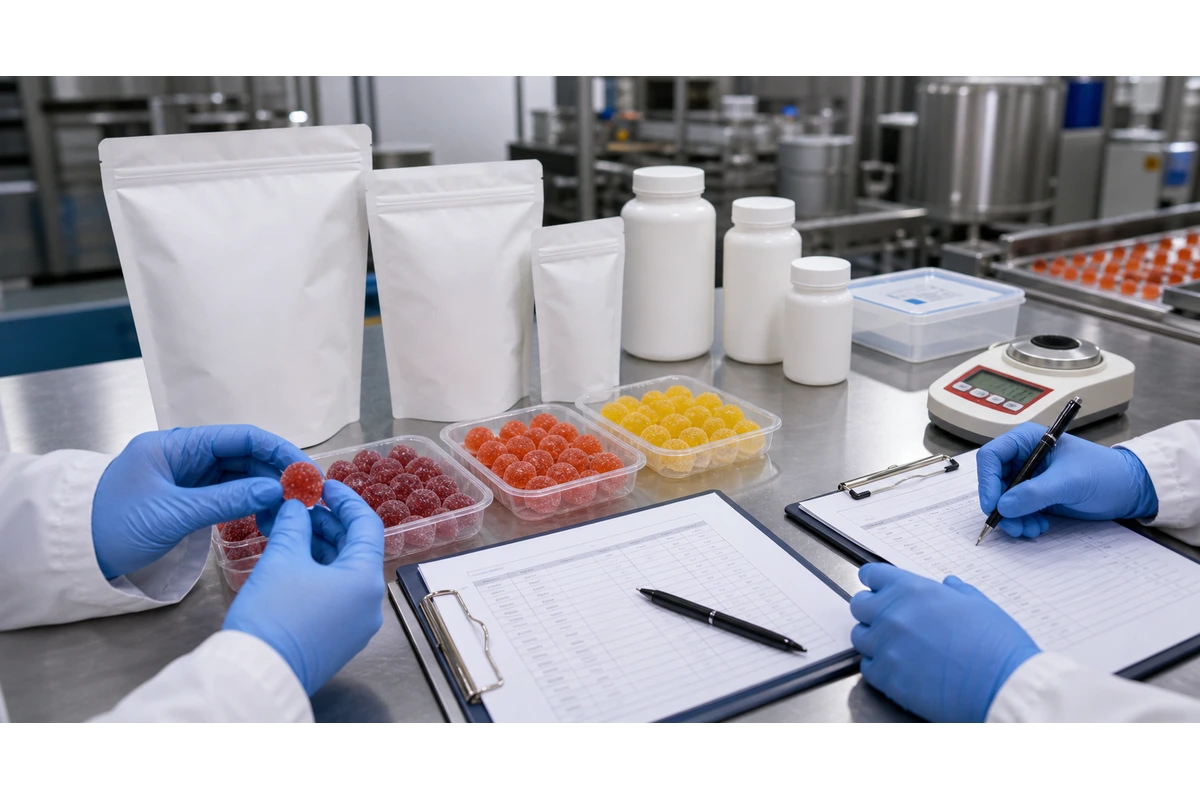
The formula brief should define the product promise before the manufacturer starts solving sweetness. It should state the target category, desired active ingredients, serving concept, sugar claim, base preference, flavor direction, target market, packaging idea, allergen or vegan expectations, and documentation needs.
The feasibility review then asks whether those requirements can live together. A sugar-free vegan pectin gummy with a high active load, strong botanical taste, organic positioning, and custom packaging is a different project from a stock low-sugar daily wellness gummy. The more constraints a brand adds, the more important it is to review tradeoffs early.
Talvenda can use this stage to help brands decide whether the project should follow a stock private label route, semi-custom adjustment, or custom formulation path. For broader manufacturing context, brand teams can also compare gummy vitamin manufacturing and supplement contract manufacturing resources.
Pilot Batch, Depositing, Cooling, and Texture Review
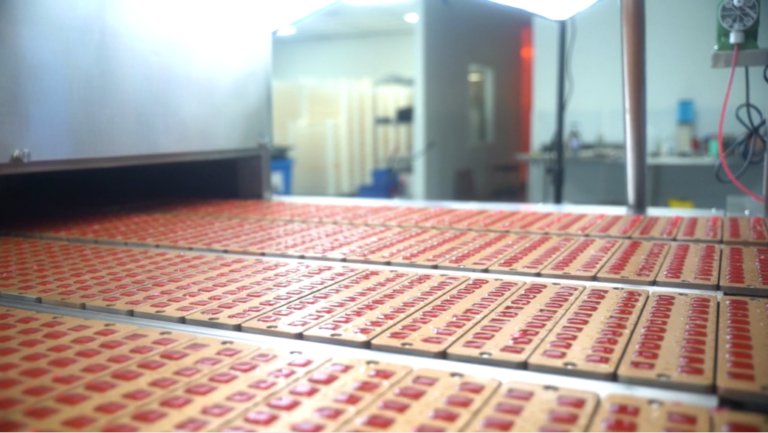
Pilot review should confirm that the formula behaves consistently enough to move toward production. The brand does not need exact production settings, but it does need to know whether the gummy deposits cleanly, cools into the intended texture, releases acceptably, and holds its shape and chew without obvious defects.
Sugar-free and low-sugar systems can behave differently from conventional gummies. The formula may need review for stickiness, sweating, firmness, graininess, surface tack, or uneven distribution. These issues can affect packaging, shelf presentation, and consumer experience.
The review should also include the full serving, not just one piece. If a serving requires multiple gummies, the sweetness, aftertaste, acidity, and chew burden become more important. A sample that works as a single tasting piece may not work as a daily supplement serving.
Coating, Moisture Control, Packaging, and Shelf-Life Planning
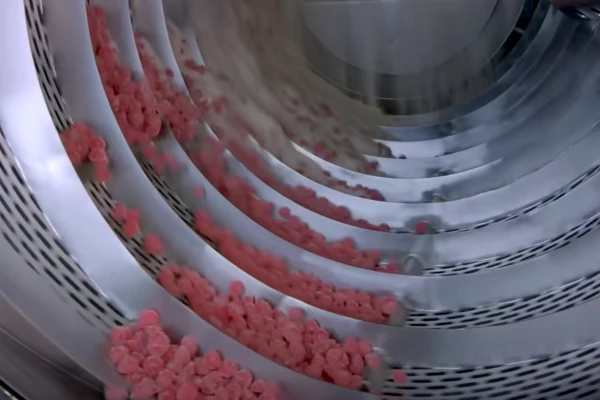
Coating and anti-stick strategy can be especially important for sugar-free gummies. The product may need a surface approach that supports handling, bottle or pouch packaging, and consumer experience without undermining the claim or ingredient-positioning goals. Coating decisions should be reviewed with the ingredient deck and label language.
Moisture control is also central. Gummies are sensitive to water activity, packaging barrier, storage conditions, and ingredient interactions. Sugar-free systems can create different moisture behavior than standard gummies, so the package should not be chosen only for branding. Bottle, pouch, desiccant strategy, count size, and closure choice can all affect product quality.
Shelf-life planning should be handled as a validation path, not a casual promise. Brands should ask what stability checks are appropriate, what finished-product specifications will be used, and what packaging format is being tested. The manufacturer can support this plan, but the brand should avoid printing shelf-life or storage language before the review is complete.
Testing, Documentation, and Label-Claim Boundaries
Sugar-free gummy projects need documentation that matches the formula and label promise.
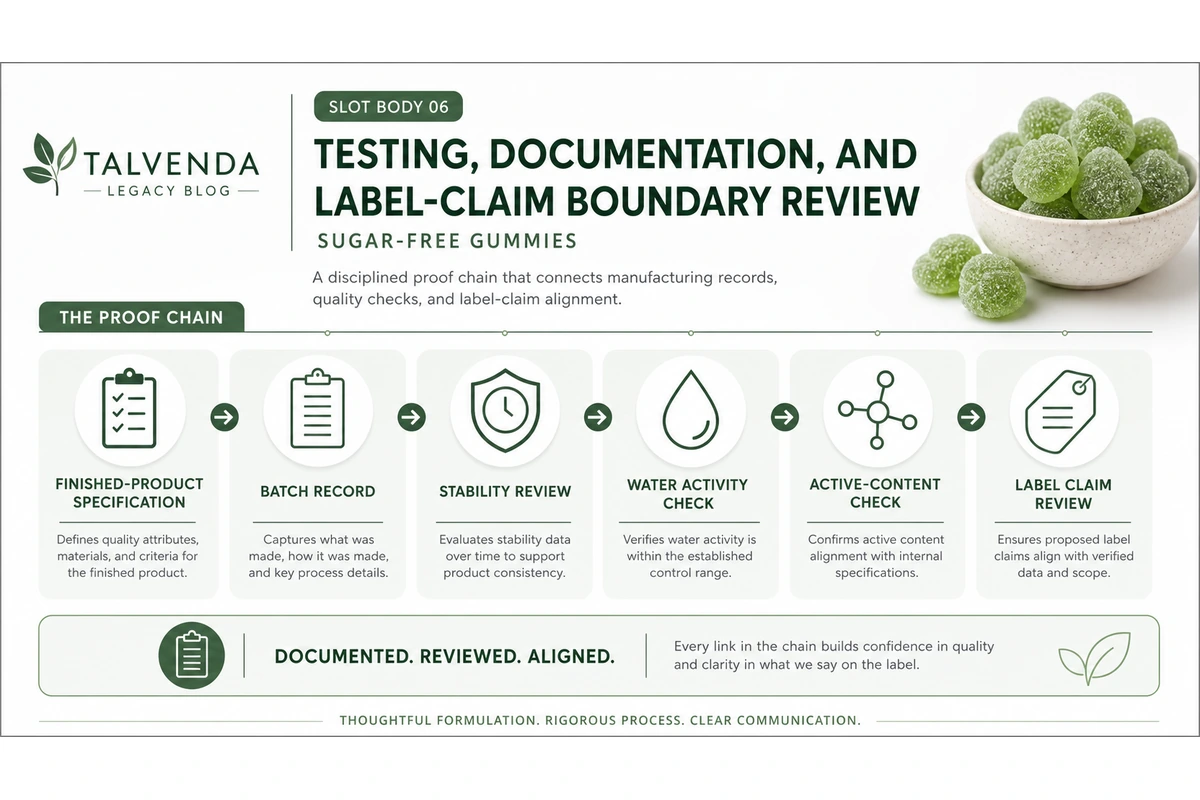
A sugar-free gummy supplement label claim should be supported by finished-product specifications, batch records, stability planning, and a clear review boundary before artwork is locked.
Finished-Product Specifications and Batch Records
Finished-product specifications define what the manufacturer is trying to control. For a sugar-free gummy, that can include appearance, texture, flavor, active-content expectations, microbiological requirements, packaging condition, and other release criteria appropriate for the project. The exact specification depends on formula and market needs.
Batch records and COA-related documentation help the brand understand what was made and how it was checked. They are especially important when the product has a strong front-label claim or a sensitive active system. A sugar-free claim should not distract from the rest of the quality file.
Before production, brand teams should ask what documents will be available, when they will be available, and what they do and do not prove. This keeps the conversation practical. Documentation supports trust, but it does not replace regulatory review, retailer review, or finished-product testing where those are required.
Stability, Water Activity, and Active-Content Checks
Stability review should connect the formula to the package. Sugar-free gummies may need close attention to texture changes, moisture movement, surface tack, flavor shift, color change, odor, and active-content behavior over time. The brand should not judge the product only from a fresh sample.
Water activity and moisture behavior are useful manufacturing checkpoints because they affect texture, microbial control strategy, and packaging fit. Brand teams do not need universal target numbers because those depend on the formula and process. Instead, the brand should ask how the manufacturer reviews moisture behavior and what stability plan is appropriate for the SKU.
Active-content checks are category-specific. A multivitamin gummy, probiotic gummy, creatine gummy, collagen gummy, and caffeine or energy gummy will not all use the same verification logic. The brand should define the intended active promise early so the manufacturer can advise what testing and specification approach should be discussed.
Sugar-Free, No Added Sugar, Allergen, Organic, and Certification Claims
Sugar-free and no-added-sugar claims should be treated as label claims, not design decorations. The ingredient deck, nutrition facts, sweetener system, target market, and local regulatory framework all matter. A manufacturer can help the brand understand the formula route, but final label responsibility should go through the right review process.
| Claim Target | Manufacturing Review | Brand Review |
|---|---|---|
| Sugar-free | Sweetener system, finished-product sugar support, batch consistency | Claim definition and label wording in each target market |
| No added sugar | Ingredient source review and formula route | Naturally occurring sugar disclosure and claim wording |
| Vegan | Gelling base, coating, processing aids, cross-contact controls | Final vegan claim and documentation expectations |
| Allergen-related claims | Ingredient sourcing and line-control records | Exact allergen categories and market requirements |
| Organic / certification claims | Ingredient availability and document trail | Certification body requirements before artwork |
Allergen-free, vegan, organic, non-GMO, gluten-free, and certification language need the same discipline. A pectin gummy may support vegan positioning, but that does not automatically prove every related claim. An organic request may affect ingredient availability, MOQ, cost, flavor, and documentation. A certification request may require supplier records or facility-level review.
The safest path is to review claims before artwork. If the brand waits until the label is finished, a small formula change can become a packaging delay. Claim-boundary review should be part of the first commercial discussion, not a final administrative step.
Private Label and Custom Manufacturing Route
The right route depends on how much control the sugar-free SKU needs.
A stock private label sugar-free gummy route can shorten launch planning, while custom development gives more control over actives, claims, flavor, base, and packaging.
Stock Formula vs. Custom Development
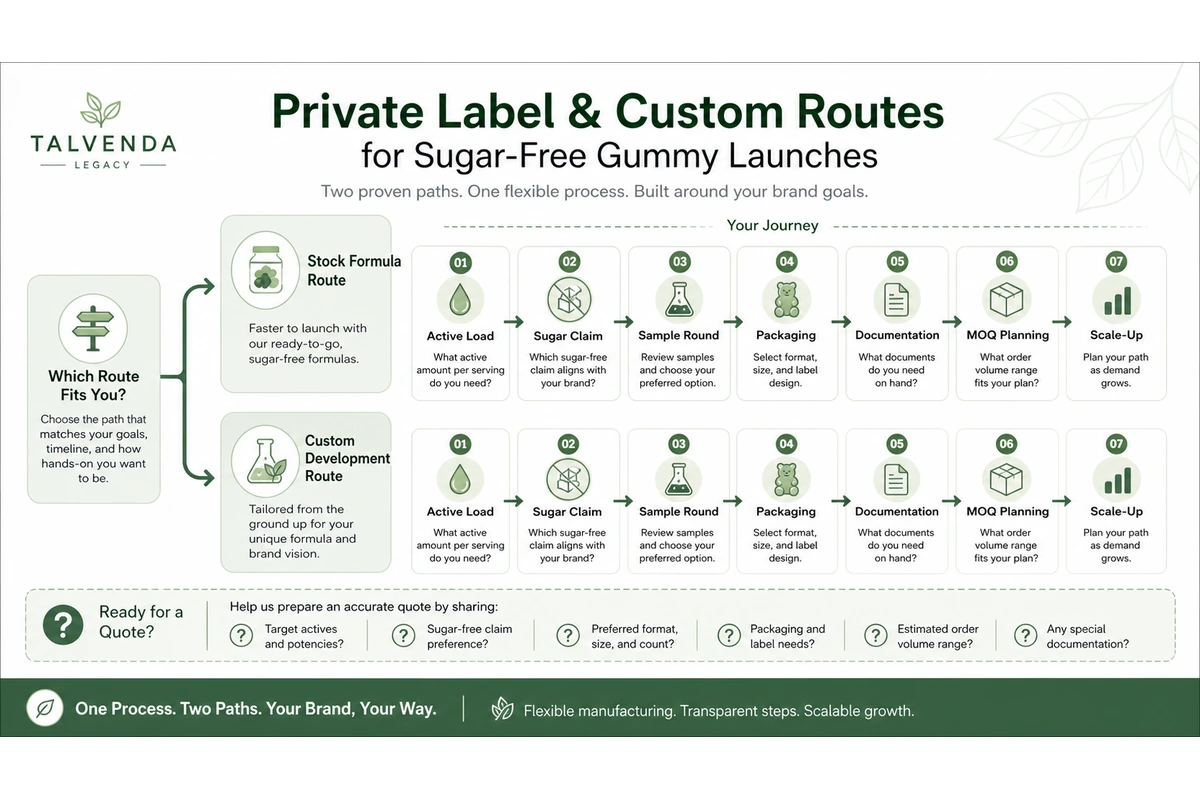
Stock private label sugar free gummies can work when the brand wants a faster path, a known formula route, and a controlled first order. This route may be useful for market testing or adding a companion SKU to an existing line. It usually offers less control over active level, flavor, shape, base system, and claim architecture.
Custom development fits when the brand needs a specific active system, sugar claim, vegan base, flavor profile, packaging concept, or stronger differentiation. It also fits when the formula has active-load or taste-masking challenges that a stock route cannot solve. The tradeoff is that custom work usually needs more sampling, review, and coordination.
The decision should follow the product promise. If the brand mainly needs a sugar-conscious daily wellness SKU, stock or semi-custom may be enough. If it needs a sugar-free creatine, collagen, probiotic, beetroot, or sports formula with specific positioning, custom review is more likely.
MOQ, Sample Rounds, and Launch Timeline
MOQ depends on formula route, ingredient availability, packaging, customization level, and production planning. A brand should avoid treating the lowest MOQ as the best answer. The better question is what the MOQ includes and whether that route supports the product promise.
Sample rounds should be planned around decision criteria. The brand should evaluate sweetness, aftertaste, chew, active amount, texture after short storage, surface condition, packaging behavior, and label fit. If each sample round changes the claim, active load, or base route, the launch timeline can stretch quickly.
For first-order planning, brands can use a low-MOQ private label route when the product promise allows it. Talvenda's low MOQ private label gummy supplements guide is a better place to review first-order risk, stock formula tradeoffs, and reorder planning in more depth.
Packaging Formats and Export Readiness
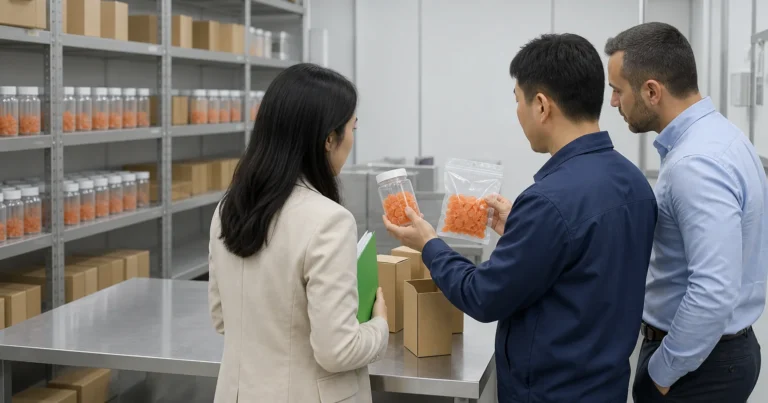
Packaging should be selected for product performance as well as brand presentation. Bottles, pouches, jars, blister-style concepts, and count-size decisions each create different moisture, handling, cost, and logistics questions. Sugar-free gummies may be more sensitive to surface and texture changes, so packaging fit deserves early review.
Export readiness adds another layer. Ingredient names, nutrition format, language, label claims, documentation, and market-specific requirements should be reviewed before the brand commits to a packaging system. A formula that works for one channel may need adjustment for another market.
Private label buyers should ask whether the manufacturer can support packaging discussion, label review coordination, export documentation planning, and carton or shipping requirements. The goal is not only to make a gummy; it is to make a gummy that can move through the intended commercial channel.
Questions to Ask Before Requesting a Quote
A strong quote request should give the manufacturer enough information to judge feasibility. The brand should share the target active ingredients, desired claim route, sugar-free or low-sugar preference, base preference, flavor direction, package format, order quantity expectation, target market, and documentation needs.
Useful RFQ questions include:
- Is the target route sugar-free, no-added-sugar, low-sugar, or still open for review?
- Which active ingredients and serving concept should the manufacturer evaluate first?
- Is pectin, gelatin, or another base route preferred for market positioning?
- Which sweetener-system tradeoffs should the brand expect?
- What sample criteria should be used before approval?
- Which packaging format best supports moisture and texture control?
- What finished-product specifications and batch documents can be provided?
- Which claims need separate label or certification review before artwork?
- What customization choices affect MOQ, sampling, or lead time?
- What would make the manufacturer recommend a different format or claim route?
This is where Talvenda's role is practical. A project can move faster when the first discussion covers formula route, sample plan, packaging fit, and claim boundary together. A vague RFQ often creates more rounds of revision than a careful one.
FAQ About Sugar-Free Gummy Supplement Manufacturing
What Is the MOQ for Custom Sugar-Free Gummies?
MOQ depends on formula route, ingredient sourcing, sweetener system, packaging format, customization level, and production schedule. A stock or semi-custom route may support a lower first order than a fully custom sugar-free formula. Ask what the MOQ includes, what can be customized, and what changes would move the project into a different production route.
How Do Manufacturers Mask Active-Ingredient Taste?
Manufacturers may use a combination of flavor design, acid balance, sweetener blending, base selection, coating or surface strategy, and active-load adjustment. Taste masking is not unlimited. If an active is bitter, sour, metallic, earthy, or bulky, the brand may need to revise the active amount, serving count, or claim promise.
Can Sugar-Free Gummies Be Vegan, Allergen-Free, or Organic?
They can be developed toward those positions only when the formula, ingredient sourcing, production route, documentation, and label review support the claim. Vegan often points toward a pectin route, but vegan, allergen-free, organic, non-GMO, and certification claims should be confirmed before artwork and purchase order approval.
Are Sugar-Free Gummies Harder to Manufacture?
They are often more complex than standard gummies because sugar affects sweetness, solids, chew, flavor rounding, and moisture behavior. Removing or reducing sugar can increase the burden on sweetener selection, texture design, active masking, packaging, and stability review. The difficulty depends on the active ingredients and claim ambition.
Conclusion
Sugar-free gummy supplement manufacturing works only when sweetener system, texture, active load, moisture control, packaging, and label expectations are planned as one system.
A sugar-free gummy project should be routed around sweetener system, texture, active load, moisture control, packaging, and label expectations together. As an OEM/ODM gummy manufacturer, Talvenda can help brands decide whether to start with low-MOQ market-tested in-stock gummies, adjust through stock formula modification, or move into custom gummy development. The review can include sample development, packaging and label support, documentation and testing expectations, and quality-controlled production, so the RFQ is more focused before your team commits to the launch plan. Contact Talvenda through the project inquiry form.