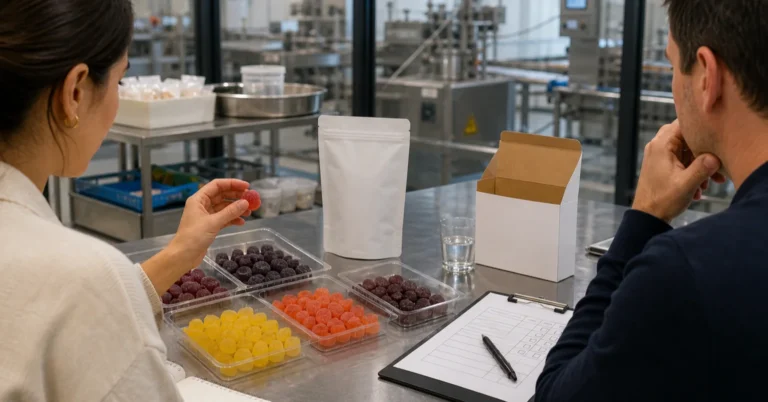


Probiotic gummies stability means more than keeping a gummy pleasant on the shelf. It means protecting live cultures through production, packaging, storage, and the full period covered by the label, so the finished product can support the CFU promise a brand plans to sell.[^1]
Key takeaways:
- Probiotic gummies stability should be judged by viable CFU through the intended shelf life, not only by raw-material paperwork.
- Heat, moisture, oxygen, pH, flavors, and active interactions can reduce probiotic survival in a gummy matrix.
- Packaging is part of the stability system, especially when moisture and oxygen exposure can affect both the gummy and the live culture.
- A private label brand should ask for finished-product testing, stability logic, COA scope, and claim-boundary review before sampling or production.
| Launch Decision | Why It Matters | Proof To Discuss Before Sampling |
|---|---|---|
| Strain and format fit | Not every probiotic behaves the same in a gummy matrix | Strain identity, supplier data, and process-tolerance discussion |
| CFU target | The label number can mean manufacture count or shelf-life count | Clear target timing and test method |
| Overage | Expected loss must be planned without guessing | Overage logic tied to process, packaging, and stability assumptions |
| Packaging | Moisture and oxygen exposure can change viability | Barrier choice, desiccant logic, and storage assumptions |
| Finished-product testing | Raw-material COA does not prove the finished gummy | Finished-product probiotic test and stability plan |
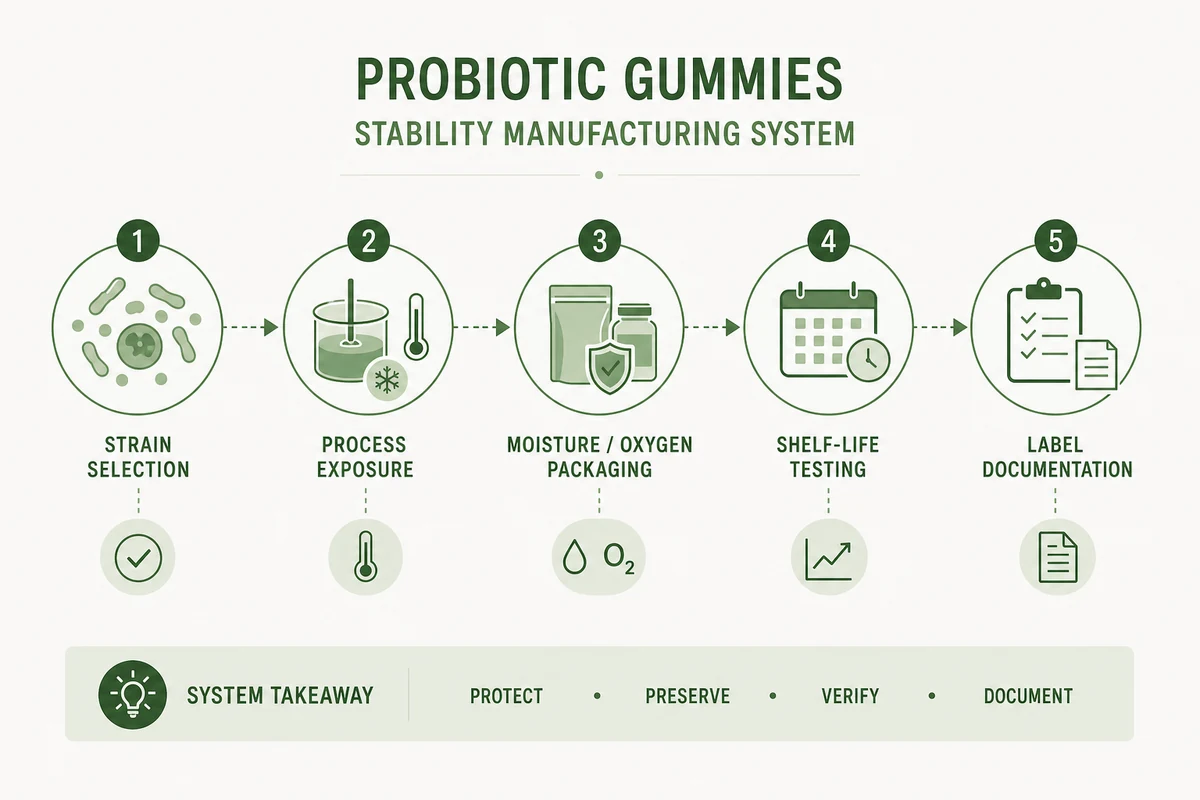
For Talvenda, the practical question is not whether probiotic gummies are popular. The question is whether the product can be built with a proof chain that supports the brand's label, packaging route, and launch plan. A probiotic gummy is a live-culture survival problem first, and a marketing choice second.
Why Probiotic Gummies Create a Stability Challenge for Private Label Brands
A probiotic gummy looks easy until the active ingredient is alive.
Probiotic gummies create a stability challenge because live cultures must survive the gummy matrix, production exposure, packaging environment, storage conditions, and the full period behind the brand's CFU claim.
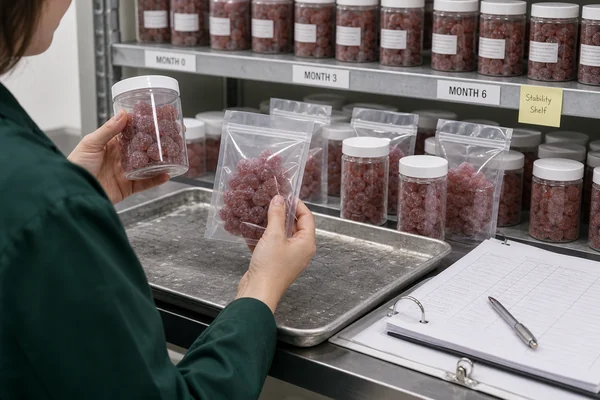
Live cultures are sensitive to heat, moisture, oxygen, pH, and ingredient interactions
Most supplement ingredients are reviewed for identity, potency, taste, and compatibility. Probiotics add another layer because the active needs to remain viable. A probiotic strain may look strong on a supplier document, but the gummy environment can still create stress.
The main pressure points are practical. Heat can reduce viability during processing. Moisture can support unwanted change over time. Oxygen can be a problem for sensitive strains. Acidic flavor systems can create pH stress. Other actives, minerals, sweeteners, acids, and flavors can change the microenvironment around the culture.
These risks also compound. A gummy formula is not a dry carrier. It is a moist, flavored, acidic, chewable matrix. If a brand only asks whether a probiotic ingredient is available, it misses the more important question: can the complete matrix protect the live culture long enough to support the intended label?
Why a gummy matrix is different from capsules, powders, or tablets
Capsules, powders, and tablets can still be difficult, but they do not behave like gummies. A gummy contains water, sweeteners, acids, gelling agents, flavors, colors, coatings, and sometimes several functional ingredients. It also needs to taste good, hold shape, release from molds, resist sticking, and remain acceptable in packaging.
That makes the survival problem different. The probiotic is not sitting in a dry capsule shell only. It is surrounded by formula components that can affect viability. The product may also face heat, mixing, holding, depositing, conditioning, coating, and packaging exposure before it reaches the bottle, blister, or pouch.
For a brand, this means a probiotic gummy cannot be evaluated only by ingredient sourcing. The whole gummy system matters: strain, carrier, dose, base formula, water activity, acidity, processing route, packaging, storage assumptions, and testing plan. A nice sample is useful, but it does not prove commercial stability by itself.
What "stable" should mean: viable CFU through the intended shelf life
"Stable" is often used too loosely. A gummy can be physically stable but fail the probiotic claim. It can hold shape, taste acceptable, and still lose viable CFU faster than the label assumes.
For a probiotic gummy, stability should mean the product can support the intended viable CFU through the shelf-life period under the storage conditions used for the product.[^2] A raw-material COA may show what arrived before production. It does not automatically prove the finished gummy after processing, packaging, shipping, and storage.
This is where private label brands need to separate concept approval from launch proof. A sample can show taste, texture, and first feasibility. A finished-product file needs a different level of evidence. It should connect strain identity, target CFU, production exposure, packaging, overage logic, and stability testing.
Manufacturing Constraints That Can Reduce Probiotic Viability
The biggest risks often appear before the gummy reaches the bottle.
Manufacturing constraints can reduce probiotic viability when live cultures face heat, water activity, acidity, mechanical handling, flavor systems, active interactions, or scale-up conditions that were not proven during sampling.
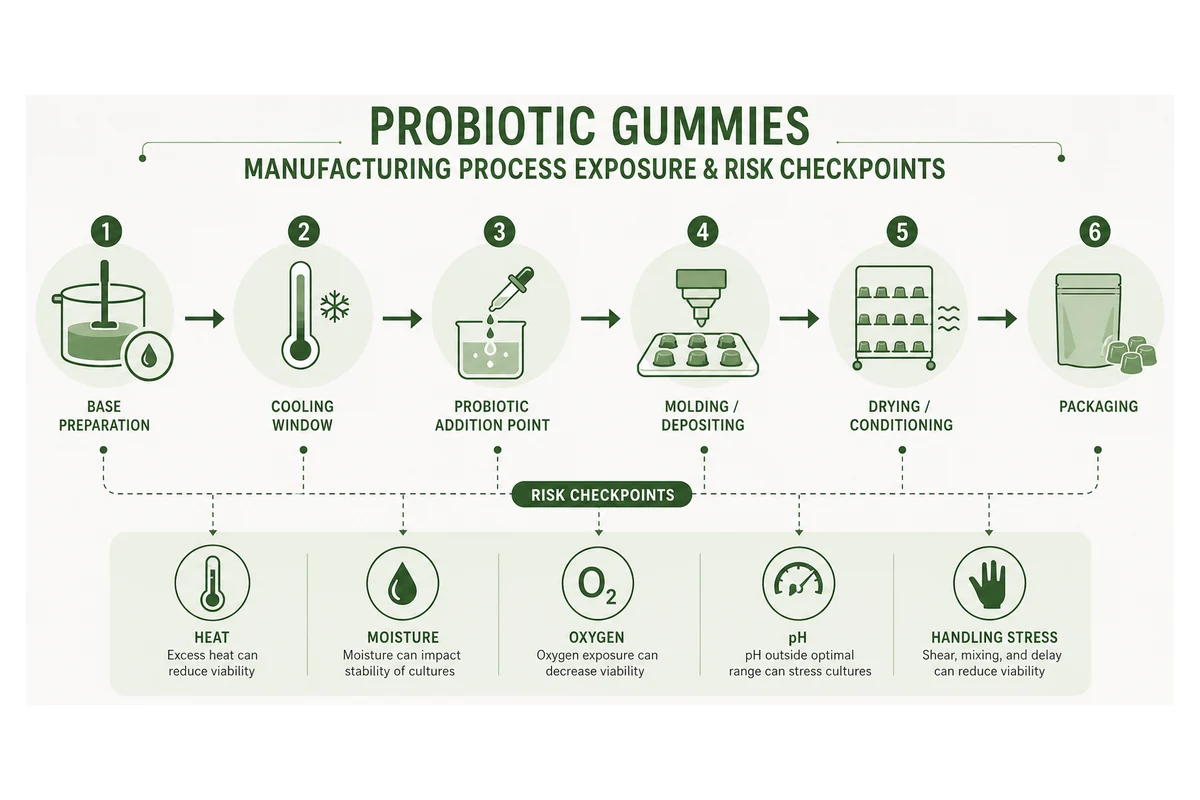
Heat exposure during gummy base preparation and ingredient addition
Gummy production usually involves heating or hydrating the base before depositing and setting. That heat step is important for texture and process control, but it can be a problem for live cultures. The exact risk depends on the process, the strain, and any protective system used, so I would avoid turning this into one universal temperature rule.
The practical manufacturing question is where the probiotic is introduced and how much process exposure it receives. If the culture is added too early, heat can create survival loss. If it is added too late, mixing, uniformity, viscosity, and production repeatability can become harder. A manufacturer needs to explain the process logic without giving the brand false confidence.
Brands should also ask whether the sample route matches the intended production route. A small hand-prepared sample may reduce exposure in a way that commercial production cannot repeat. If the sampling process and production process are not aligned, the brand may approve a product that cannot be scaled with the same probiotic recovery.
Water activity, acidity, flavors, and functional-ingredient interactions
Water activity matters because gummies are not dry capsules. The product holds moisture, and that moisture affects texture, microbial control, and active stability. Probiotics can be sensitive to this environment, especially when the package allows moisture or oxygen movement over time.
Acidity is another constraint. Many gummies use acids to build bright fruit flavors and support the gelling system. That can make the product more appealing, but it can also create stress for certain live cultures. Flavor oils, botanical extracts, minerals, prebiotic fibers, and other functional ingredients may also interact with the probiotic or change the final matrix.
| Risk Factor | Where It Comes From | Brand-Side Review Question |
|---|---|---|
| Heat exposure | Base preparation, holding, mixing, depositing sequence | Where is the probiotic introduced, and how is exposure controlled? |
| Moisture behavior | Gummy base, sweetener system, package barrier | Does the finished matrix support the intended shelf life? |
| Acid balance | Fruit flavors, acids, pectin systems, co-actives | Is the strain compatible with the formula environment? |
| Oxygen exposure | Headspace, package material, repeated opening | Does the package protect sensitive cultures enough? |
| Co-ingredient interaction | Vitamins, minerals, botanicals, prebiotics | Has the complete formula been reviewed, not only the probiotic? |
I would not review these variables one by one as if they are independent. In a gummy, the system matters. A change in sweetener can affect water behavior. A change in acid can affect gel strength and strain survival. A change in packaging can change storage conditions. The brand needs a manufacturer who can connect these decisions, not only quote the active.
Why pilot samples do not automatically prove production-scale stability
Pilot samples are useful, but they are not the same as production proof. A sample can show that a concept is possible. It can also hide scale-up risk. Commercial production may use different mixing time, holding time, transfer steps, cooling behavior, conditioning, coating, and packaging speed.
For probiotic gummies, those changes can matter. Longer exposure, different humidity, or a slower packaging route can reduce viable counts. A sample jar stored in a controlled office does not prove how a product behaves during bulk production, warehouse storage, retail distribution, or warm shipping lanes.
This is why I would ask for a clear sample-to-production plan. What will be checked after the pilot run? What will be tested in the finished product? What packaging will be used for stability review? What acceptance criteria matter before the brand moves to a larger order? These questions help keep sampling from becoming a sales step only.
Strain, CFU Target, and Overage Decisions Before Production
The CFU number on a concept sheet can create cost and proof pressure later.
Before production, brands should review strain identity, realistic CFU target, end-of-shelf-life expectation, and overage logic because each decision affects formulation cost, manufacturing risk, packaging needs, and label support.
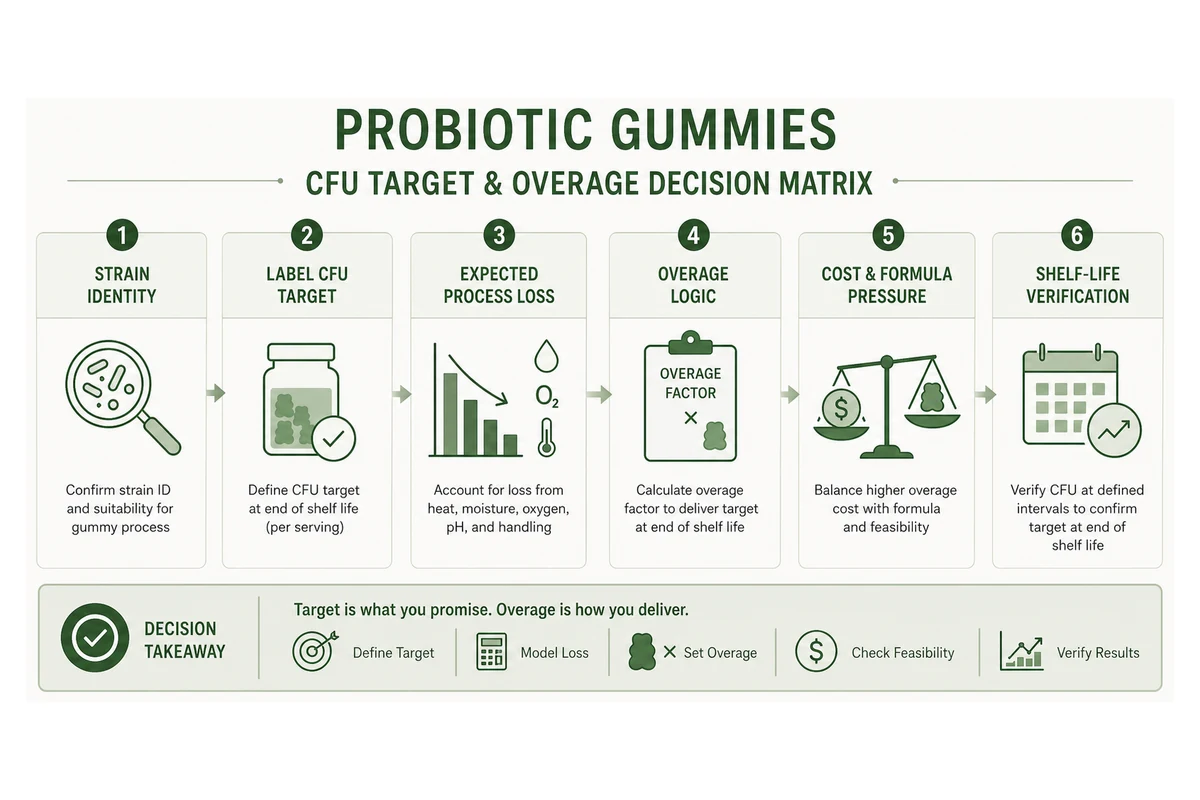
Strain identity and processing resilience should be reviewed before quoting
A probiotic label is not complete if it only says "probiotics." The strain or organism choice affects technical feasibility, claim review, supply cost, testing method, and stability risk. Some strains may be more tolerant of processing and storage conditions than others. Some may require extra protection or a different product route.
This does not mean a manufacturer should casually swap strains to make production easier. A strain choice can affect the product's positioning and the evidence behind the claim. If a brand requested a specific strain, the manufacturer should discuss whether that strain fits the gummy process and what proof is needed to support it.
Before quoting, I would ask what strain is being considered, what CFU target is expected, whether the target is at manufacture or end of shelf life, and what test method will be used. Those answers shape cost and feasibility more than many brands expect.
CFU at manufacture vs. CFU at end of shelf life
The most important CFU question is timing. A product can contain a certain CFU level at manufacture and a different level months later. If the label or marketing implies a viable amount through the product's life, the brand needs proof that connects to that timing.
| CFU Evidence Point | What It Helps Show | What It Does Not Prove Alone |
|---|---|---|
| Raw-material COA | Incoming culture information before production | Finished-gummy survival after processing |
| Finished-product release test | CFU in the actual product after manufacturing | Full shelf-life performance |
| Accelerated stability data | Early directional stress behavior | Complete real-time shelf-life proof |
| Real-time stability data | Viability trend under defined storage conditions | Future batch performance without controls |
"At time of manufacture" and "through shelf life" do not mean the same thing. A buyer should not assume one supports the other. The manufacturing file should make clear which number is being targeted, which number is being tested, and which storage conditions are assumed.
How overage can support label targets while increasing cost and formulation pressure
Overage means adding more probiotic than the final target to account for expected loss. It can be useful, but it is not free. It can increase ingredient cost, create formulation pressure, and make production planning more complex. It also does not replace stability testing.
The overage question should be tied to data and assumptions. How much loss is expected during processing? How much loss is expected during storage? What package is being used? What shelf life is planned? What market temperature and humidity assumptions are reasonable? Without those answers, overage can become guesswork.
| Decision | Why It Matters | Brand-Side Question |
|---|---|---|
| Strain identity | Affects survival, test method, and claim boundary | Which strain is being used, and why does it fit a gummy? |
| CFU target | Drives dose, cost, and label support | Is the target at manufacture or through shelf life? |
| Overage | Accounts for expected loss but raises cost | What data supports the overage assumption? |
| Serving size | Controls how much active can fit | Is the target realistic in one gummy or multiple gummies? |
Brands should be careful with a supplier who presents overage as the only answer. More input does not automatically mean better proof. The stronger path is to combine a realistic CFU target, suitable strain choice, controlled process exposure, packaging review, and finished-product stability work.
Packaging Choices for Probiotic Gummy Stability
Packaging is not the last design decision for this product type.
Packaging choices affect probiotic gummies stability because moisture, oxygen, temperature exposure, headspace, desiccant strategy, and unit protection can change both gummy quality and viable CFU through shelf life.
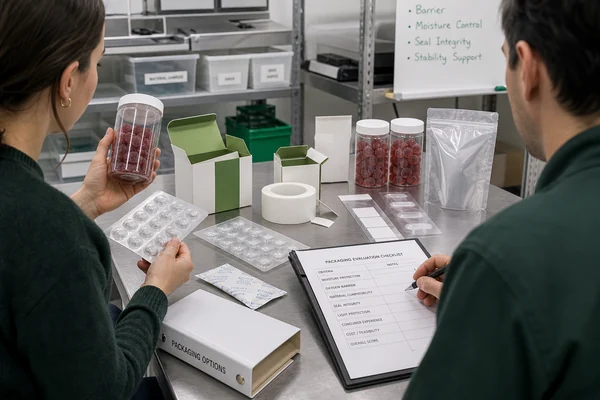
Moisture and oxygen barrier requirements
Probiotic gummies need packaging that protects the finished product, not only packaging that looks good on shelf. Moisture exposure can change gummy texture, sticking, and microbial risk. It can also affect the environment around the probiotic. Oxygen exposure can be a concern for sensitive strains and for some formula components.
The right barrier level depends on the formula, strain, storage route, market, and shelf-life target. A standard bottle may be enough for one product and weak for another. A package that works in a cool, dry warehouse may not be enough for a humid or warm distribution route.
This is why packaging should be part of the stability plan.[^3] I would not wait until the formula is approved to ask packaging questions. The brand should know whether the manufacturer recommends a bottle, blister, pouch, desiccant, oxygen control, or another protective approach before finalizing cost and label assumptions.
Bottles, desiccants, blister packs, and unit-dose formats
Each package type creates a different protection profile. Bottles are common and convenient, but the product may face repeated opening and headspace exposure. Desiccants can help manage moisture, but they must fit the product and market plan. Blister packs can protect individual servings, but they can change cost, format, and production logistics.
Unit-dose formats may support stronger separation and better exposure control. They may also raise packaging cost and affect sustainability or channel fit. A premium probiotic gummy may justify that discussion. A low-cost mass-market product may need a different balance.
| Packaging Direction | Potential Advantage | Review Before Choosing |
|---|---|---|
| Bottle with moisture-control support | Familiar format and easier retail fit | Desiccant need, opening frequency, and headspace exposure |
| Blister pack | Stronger unit-level protection | Cost, tooling, line fit, and consumer experience |
| Foil pouch or sachet | Good barrier potential | Serving format, filling route, and channel fit |
| Refrigerated route | Can reduce stress for some formulas | Cold-chain cost, retailer acceptance, and label instructions |
For private label brands, the important point is not that one package is best for every project. The point is that packaging should match the stability risk. If the product depends on live cultures, the package is part of the formula's performance system.
Storage assumptions, shipping exposure, and shelf-life expectations
Shelf life is not only a number printed on a label. It depends on assumptions about storage, transport, and market conditions. A probiotic gummy can behave differently in a cool warehouse, a warm delivery lane, a humid retail shelf, or a consumer's kitchen cabinet.
Brands should ask what storage conditions support the shelf-life plan. They should also ask whether the packaging will be tested under conditions that match the intended market. If refrigeration is required, the commercial route changes. If the product is positioned as shelf stable, the stability proof needs to support that claim.
This is also where date coding and expiration logic matter. Talvenda's guide to MFG date vs expiration date for supplements is useful supporting context, but probiotic gummies need the extra CFU layer. The date should connect to viable-count expectations, not only physical appearance.
Testing, COA, and Documentation Brands Should Request
Paperwork can look complete while the finished product remains unproven.
Brands should request documentation that separates raw-material COA, finished-product probiotic testing, stability data, packaging assumptions, and claim review because each document answers a different launch-risk question.
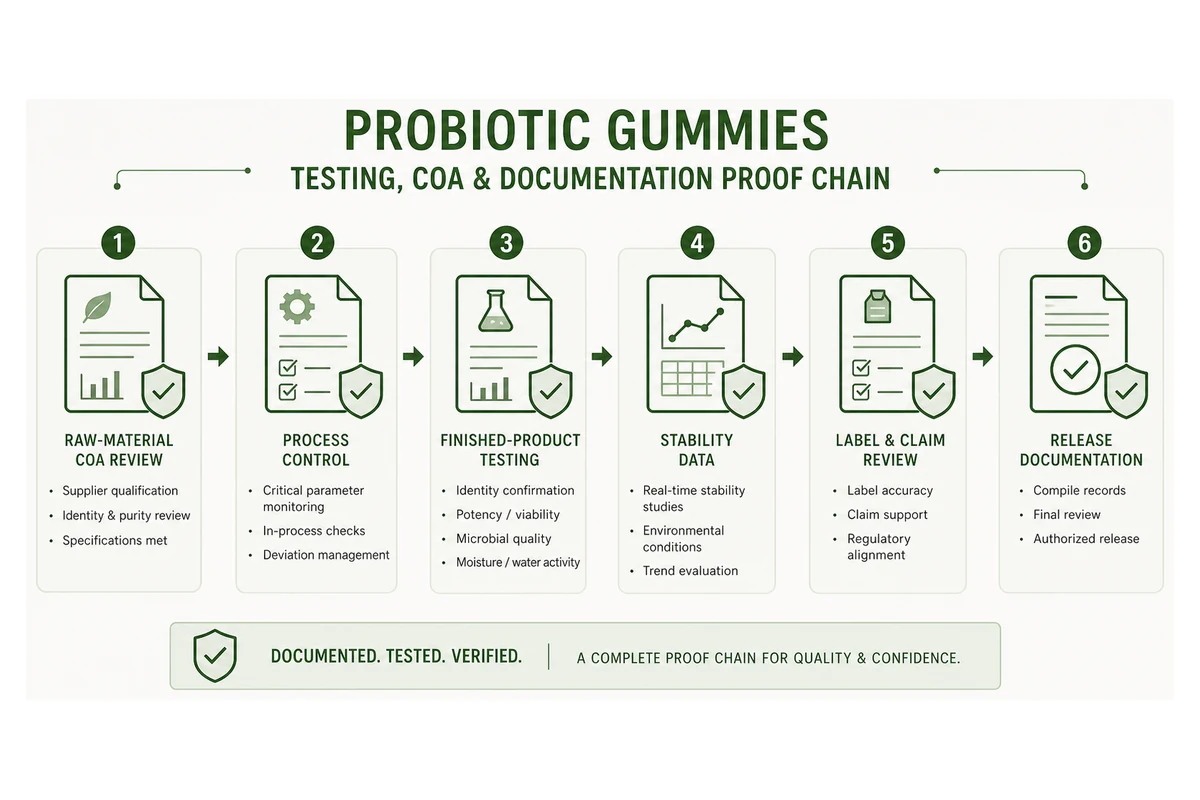
Raw-material COA vs. finished-product probiotic testing
A raw-material COA can support ingredient identity or supplier quality before production. It is useful, but it is not the same as finished-product proof. It does not automatically show what survived processing or what remains viable after packaging and storage.
Finished-product probiotic testing is closer to the product a consumer receives.[^4] It can help confirm whether the finished gummy meets the specification at release. Stability testing then helps show whether the product can support the intended shelf-life expectation.
| Document | Useful For | Common Misuse |
|---|---|---|
| Raw-material COA | Reviewing incoming probiotic material | Treating it as proof of finished-gummy CFU |
| Finished-product COA | Batch release and product-level review | Treating day-zero data as full shelf-life proof |
| Stability protocol | Defining how shelf-life evidence will be collected | Treating a protocol as completed data |
| Stability report | Supporting shelf-life and storage assumptions | Applying one formula's data to a different strain or package |
| Label review notes | Aligning wording with available proof | Turning manufacturing documents into medical claims |
This is a common source of confusion in private label projects. A brand asks for a COA, receives a document, and assumes the claim is supported. The better question is: which product, which batch, which organism, which CFU number, which method, and which timing does this document cover?
Accelerated and real-time stability data
Stability work helps connect the product to shelf-life expectations. Accelerated stability can provide early directional evidence, while real-time stability gives stronger confirmation over the actual period. The exact plan should match the product risk, market requirements, and launch timeline.
For probiotic gummies, stability should consider both the gummy and the culture. The gummy should hold acceptable texture, appearance, taste, and package behavior. The probiotic should support the viable-count expectation. If one side fails, the product has a launch problem.
Brands should ask what stability data is available for the formula family, strain, package, and storage conditions. Previous experience may help, but it should not be stretched too far. A different strain, sweetener system, acid profile, or package can change the answer. For broader proof-chain thinking, Talvenda's article on supplement quality assurance is a useful internal link.
Label claim and structure/function claim boundaries
Probiotic content can tempt brands into broad claims. That is where discipline matters. A manufacturing partner can help the brand understand what the product file can support, but it should not promise treatment outcomes or strain-specific benefits without proper substantiation.
The safer frame is to connect claims to product facts.[^5] What organism is present? What CFU level is targeted? Is the count stated at manufacture or through shelf life? What storage condition is assumed? What finished-product and stability data support the statement? What wording stays within the brand's regulatory review path?
For probiotic gummies, the same quality-assurance principle becomes more specific: a finished-batch COA and stability plan need to address viable cultures, not only ordinary supplement release checks.
Questions to Ask a Probiotic Gummies Manufacturer Before Sampling
The sampling stage should not hide the hard questions.
Before sampling, brands should ask a probiotic gummies manufacturer about strain fit, CFU target, process stage, overage logic, packaging barrier, stability evidence, finished-product testing, and claim boundaries.
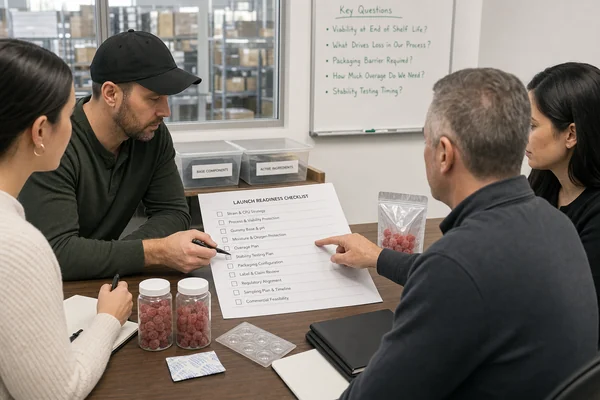
What strain and CFU target is realistic for this gummy format?
Start with the active goal. Which strain or organism is being used? What CFU target is expected? Is the target stated at manufacture or through shelf life? Does the manufacturer see the target as realistic for the gummy base, serving size, flavor system, and package?
This is a feasibility question, not only a sourcing question. A probiotic ingredient can be available and still be difficult to protect in a gummy. If the desired target creates too much overage, cost, or stability pressure, the brand should know before paying for full development.
I would also ask what alternatives exist if the target is not realistic. The answer might involve a different strain, a different serving size, a different package, or a different claim route. The manufacturer should explain tradeoffs clearly rather than pushing one answer as universally correct.
Where are probiotics introduced in the process?
The stage of addition matters because it affects heat exposure, mixing, uniformity, and production repeatability. A brand does not need proprietary machine settings, but it should understand the process logic. The answer should show that the manufacturer has thought through culture survival and batch consistency.
If the probiotic is added late, the brand should ask how uniform distribution is controlled. If it is added earlier, the brand should ask how process exposure is managed. If the manufacturer cannot explain the tradeoff, the brand may be looking at a generic gummy supplier rather than a probiotic gummy development partner.
This question also helps compare manufacturers. A probiotic gummies manufacturer discussion should not stop at flavor, shape, and MOQ. It should include the point where the active enters the process and how the finished product is verified.
What packaging and storage assumptions support the shelf-life target?
Packaging should be discussed before the brand signs off on shelf life. Ask whether the product will use bottles, blisters, desiccants, oxygen-control features, or other protective choices. Ask which storage conditions are assumed. Ask whether the same package will be used in stability work.
This question also affects cost and market route. A package that protects better may cost more. A package that looks more attractive may protect less. A product that needs refrigeration may be harder to sell through some channels. These tradeoffs belong in the early commercial conversation.
Brands should also connect packaging to claim wording. If the label depends on storage conditions, those conditions need to be clear. If the product is positioned as shelf stable, the proof should match that promise.
What documentation can support the finished product specification?
The last question is about proof. What raw-material documents exist? What finished-product probiotic testing is available? What stability data supports the shelf-life target? What COA will the brand receive? What parts of the label claim need separate review?
| Quote-Prep Item | Why It Helps The Manufacturer Respond |
|---|---|
| Strain name or organism target | Lets the manufacturer evaluate processing and testing fit |
| Target CFU per serving | Drives cost, overage, and label-support review |
| Serving size and piece count | Shows whether the concept can fit the format |
| Shelf-life target | Connects formula and package to stability expectations |
| Target market and channel | Helps review storage, shipping, and packaging assumptions |
| Sugar or sugar-free preference | Affects water activity, texture, and taste-masking review |
| Claim direction | Helps define documentation and claim-boundary questions |
This is where a strong manufacturer becomes easier to identify. The best answer is not always a thick document folder. It is a clear explanation of which document supports which decision. Ingredient approval, process control, batch release, stability review, packaging choice, and claim wording are related, but each one needs its own support.
FAQ About Probiotic Gummies Stability
Can probiotic gummies stay shelf stable?
Some probiotic gummies can be designed for shelf stability, but the answer depends on the strain, formula, process exposure, packaging, storage conditions, and stability data. A brand should not assume shelf stability from the ingredient name alone. It should ask whether viable CFU is supported through the intended shelf life.
Do probiotic gummies need refrigeration?
Not always. Some products are positioned for room-temperature storage, while others may need stricter storage conditions. The decision should come from the product's stability data, packaging, and label plan. If refrigeration is needed, the brand should consider distribution cost, channel fit, and consumer instructions.
Is a high CFU count always better?
Not in every case. A high CFU count can sound attractive, but it may create formulation cost, overage, serving-size, and stability pressure. The more useful question is whether the selected CFU target is realistic, testable, and supported through shelf life for the chosen gummy format.
Can pectin gummies carry probiotics?
Pectin gummies can carry probiotics, but they need careful review because the matrix, pH, moisture, and process route can affect viability. The brand should ask whether the strain, process, and package have been evaluated for that specific pectin gummy system. For broader gelling-system context, see Talvenda's prebiotic vs probiotic gummies guide.
Should probiotic gummies include prebiotics?
Prebiotics can fit some probiotic gummy concepts, but they also change formula behavior. Fibers can affect texture, water activity, sweetness, serving size, and tolerance positioning. A brand should review the synbiotic concept for manufacturability and claim boundaries before presenting it as a simple value-add.
Conclusion
Probiotic gummy stability is a finished-product proof problem; CFU target, packaging route, storage assumptions, testing, and documentation must be planned before production.
For probiotic gummies, stability should shape the production route from the start, not appear only after the sample looks acceptable. Talvenda can support brands as a private label gummy manufacturing partner by reviewing whether low-MOQ market-tested in-stock gummies, stock formula modification, or custom gummy development fits the CFU target, packaging route, and shelf-life expectation. That planning connects sample development, documentation and testing expectations, packaging and label support, and production through GMP-certified and FDA-registered manufacturing facilities before the project moves toward scale. Contact Talvenda through the project inquiry form.
[^1]: International Scientific Association for Probiotics and Prebiotics (ISAPP), "Probiotics," https://isappscience.org/topic/probiotics/ [^2]: NIH Office of Dietary Supplements, "Probiotics: Fact Sheet for Health Professionals," https://ods.od.nih.gov/factsheets/Probiotics-HealthProfessional/ [^3]: eCFR, "21 CFR 111.70 - What specifications must you establish?," https://www.ecfr.gov/current/title-21/chapter-I/subchapter-B/part-111/subpart-E/section-111.70 [^4]: eCFR, "21 CFR 111.75 - What must you do to determine whether specifications are met?," https://www.ecfr.gov/current/title-21/chapter-I/subchapter-B/part-111/subpart-E/section-111.75 [^5]: FDA, "Structure/Function Claims," https://www.fda.gov/food/nutrition-food-labeling-and-critical-foods/structurefunction-claims