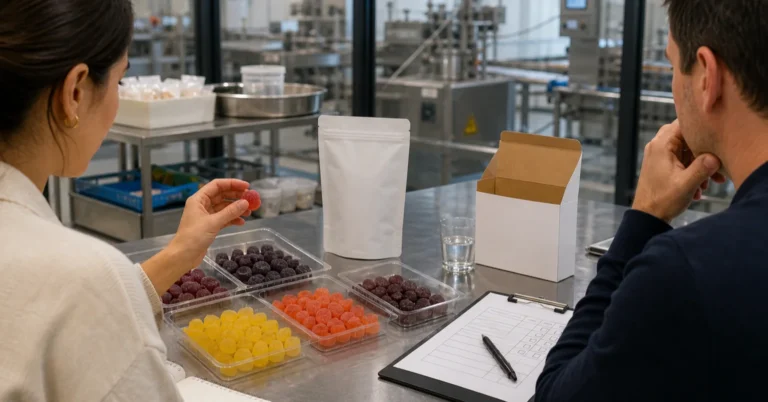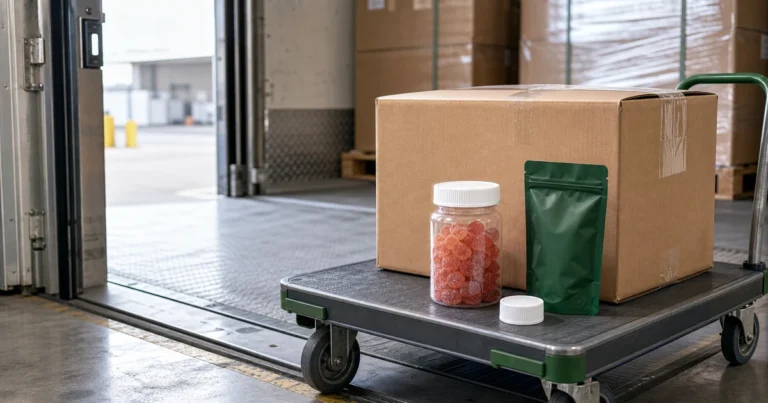


Private label weight loss supplements can move quickly from idea to sample, but the claim boundary should be set before formula selection.
Private label weight-management supplement launches should align the product role, ingredients, serving size, finished-batch proof, packaging, label copy, website language, marketplace listing, and influencer brief around one limited, substantiated message without disease-treatment or guaranteed weight-loss claims.
Decision Snapshot
- Use "weight management" as the planning frame unless stronger language has been reviewed.
- Keep appetite, fat-burning, metabolism, carb-blocking, blood sugar, and GLP-1-adjacent wording restricted until reviewed.
- Match claims to the finished product, not only to supplier claims or ingredient popularity.
- Review formula, label, batch documents, packaging, and channel copy before commercial production.
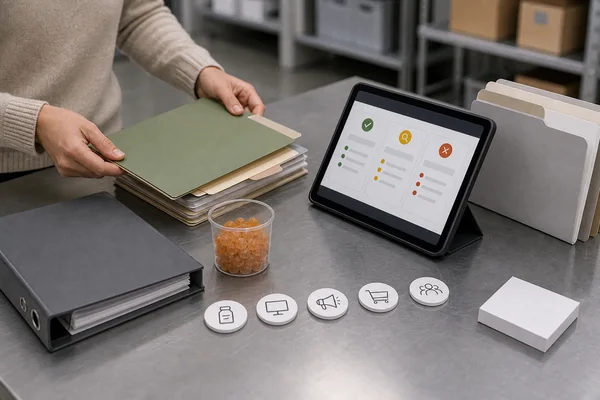
I would not begin this project by asking which ingredient sounds strongest on a sales page. I would begin by asking what the finished product can safely say, what documents can support that message, and whether every sales channel can stay inside the same boundary.
What Are Private Label Weight Loss Supplements?
The category looks commercially simple until the claim language starts shaping the product.
Private label weight loss supplements are ready-to-brand or custom-developed products positioned for weight-control support, but the claim must stay within a documented supplement boundary.
Private Label vs. Custom Development
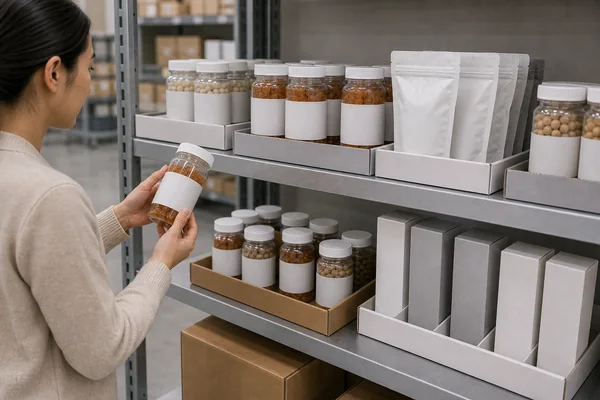
Private label usually starts with an existing formula, stock base, or manufacturer-supported concept. The brand applies its own label, packaging, market positioning, and sales channel. Custom development goes deeper. The brand may change the ingredient blend, serving size, gummy base, flavor system, packaging, or claim direction.
For private label weight loss supplements, the difference matters because speed does not remove responsibility. A stock formula may shorten sampling and quoting, but the brand still owns the label, website copy, ad language, marketplace listing, and influencer brief. A custom formula may create better differentiation, but it also creates a larger review surface because the claim, ingredient amount, finished-batch proof, and packaging plan must be checked together.
| Review Factor | Stock Private Label | Custom Development |
|---|---|---|
| Formula starting point | Existing product or base formula | Built around brand requirements |
| Speed | Faster sampling and launch path | Longer development and review path |
| Claim flexibility | Narrower, because the formula is mostly fixed | Wider, but requires more evidence and documentation |
| Differentiation | Packaging, positioning, flavor, channel strategy | Ingredient blend, serving logic, format, product story |
| Review burden | Still belongs to the brand | Still belongs to the brand, with more variables |
Why Weight Management Claims Need Extra Review
Weight management is not a neutral category. The words that attract consumer attention often sit close to higher-risk claim territory. Appetite, fat-burning, metabolism, carb blocking, blood sugar, rapid results, and GLP-1-adjacent language can all create stronger implied claims than a brand intends.
The review should cover express claims and implied claims. A label may say "supports healthy weight management," while a marketplace image, paid ad, or influencer script suggests a faster result. The product's total claim profile is shaped by the strongest message consumers see, not only by the most cautious line on the bottle.[^1]
This is why I separate ingredient selection from claim selection. Botanicals, fibers, caffeine sources, minerals, and other support ingredients may be common in the market. That does not mean every brand can use the same language. The finished serving, delivery format, evidence package, label wording, and marketing context all matter.
Where Commercial Opportunity Creates Compliance Risk
The opportunity is clear. Weight management is easy for shoppers to understand, and private label programs can help brands test demand faster than building every product from zero. That same demand also pulls brands toward stronger claims.
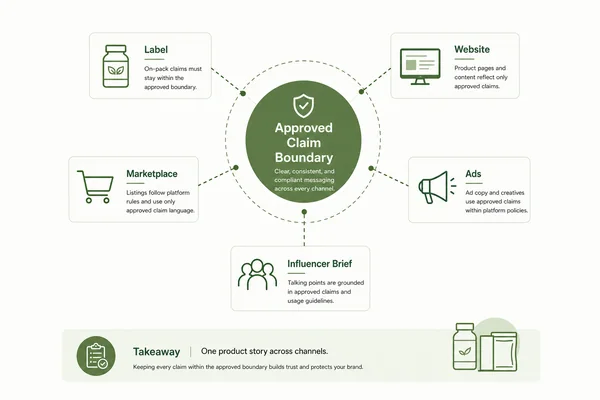
A common failure is channel mismatch. The label uses limited support language. The website promises stronger results. The marketplace bullets use before-and-after style phrasing. The influencer brief adds appetite, cravings, or drug-comparison language outside the approved label boundary.
The practical question is whether the whole product system tells one limited story. If the formula says one thing, the label implies another, and the campaign promises a stronger outcome, the product is not ready for production review.
Claim Boundaries Brands Should Set Before Choosing a Formula
A formula should not be selected before the brand knows what it can safely say.
Before choosing a formula, brands should classify allowed, review-only, and excluded claim language across the label, website, ads, marketplace content, and influencer briefs.
Weight Management vs. Weight Loss Claims
"Weight management" and "weight loss" are not the same product message. Weight management can support a narrower role, such as helping a consumer build a routine, support satiety, manage energy, or choose a convenient supplement format. Weight loss can imply a direct measurable result.
That distinction affects the evidence file. A mild structure/function-style message may be reviewed against ingredient context, serving size, and finished-product documentation. A stronger result claim needs a much higher level of substantiation and may not fit a dietary supplement launch at all.[^2]
| Claim Wording | Practical Meaning | Risk Level |
|---|---|---|
| Supports healthy weight management | General support frame | Lower |
| Supports a healthy routine | Lifestyle-support frame | Lower |
| Supports normal metabolism | Needs careful context | Medium |
| Appetite control / satiety support | Stronger implied effect | High |
| Fat burning / thermogenic | Result-adjacent wording | Very high |
| GLP-1, blood sugar control, drug-alternative language | Medical-adjacent positioning | Exclude unless separately reviewed by qualified advisers |
Appetite, Fat-Burning, and Metabolism Language
Appetite, fat-burning, and metabolism language should be handled as claim categories, not decorative marketing words. Each phrase changes what the product appears to do.
"Appetite support" may sound softer than "appetite suppression," but both still require review. The brand should ask what the product actually supports: fiber intake, meal-routine consistency, energy, or a stronger hunger-control promise. Those are different messages.
"Fat burning" is more difficult. A caffeine-containing formula may support energy positioning, but "burns fat" or "fat burner" can create a much stronger implied result. "Metabolism support" is also sensitive because surrounding copy can turn a support statement into a weight-loss promise.
GLP-1, Blood Sugar, and Medical-Adjacent Terms
GLP-1 wording should stay out of consumer-facing supplement copy unless the brand has completed a qualified claim review and has a clear reason to use it. A dietary supplement should not imply that it works like, replaces, imitates, activates, or supports a prescription drug pathway.[^3]
Blood sugar language also needs caution in a weight management context. Terms around glucose, insulin, cravings, metabolic health, and blood sugar can quickly move from wellness language into medical-adjacent territory. The risk grows when the product is positioned near weight reduction or drug alternatives.
My practical recommendation is simple: use GLP-1 and blood sugar terms as internal risk-review terms, not as easy sales hooks. If a phrase would make the product sound like a drug alternative, remove it from label copy, ad copy, and influencer instructions.
Label, Website, Ad, and Influencer Copy Alignment
Claim review cannot stop at the label. A conservative bottle can still become risky when the website, marketplace listing, social captions, paid ads, and influencer scripts escalate the message.
Brands should build a claim-control table before production:
| Copy Surface | What To Check | Risk If Misaligned |
|---|---|---|
| Supplement Facts panel | Serving size, ingredients, and amounts match the product | Label cannot support the marketing promise |
| Product label | Claims stay within approved wording | Packaging must be reworked |
| Website page | Claims do not exceed the label | Stronger implied product promise |
| Marketplace listing | Bullets, images, and titles match approved copy | Channel rejection or claim review |
| Influencer brief | No result claims, drug comparisons, or before/after language | Uncontrolled public claims |
| Social captions | Each caption stays inside the same boundary | Accumulated claim risk across channels |
This is one of the easiest checks to skip and one of the most expensive to fix later. Printed labels, product photography, ads, and marketplace content all move quickly once a launch date is set.
Ingredient and Format Choices That Affect Claim Risk
Ingredient choice is also a claim decision.
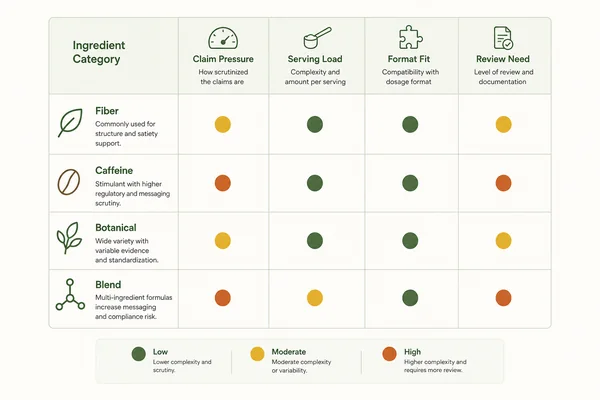
Ingredients, active load, serving size, delivery format, taste, texture, and consumer expectations all affect what a weight management product can responsibly claim.
Botanicals, Fibers, Caffeine, and Support Ingredients
Weight management formulas often use botanicals, fibers, caffeine sources, minerals, amino acids, fruit acids, or other support ingredients. Each route creates a different proof and manufacturing burden.
Fiber may support satiety or routine language when the serving and product format make sense. It also affects texture, water behavior, taste, and serving size. Caffeine may support energy positioning, but it can pull copy toward stimulant, thermogenic, or rapid-result language. Botanicals can carry strong consumer associations, but the brand needs identity, standardization, supplier documents, taste review, and claim review.
The useful question is not whether the ingredient is popular. The useful question is whether the finished product can support the message. A raw material COA, supplier description, or ingredient study does not automatically support the final gummy, capsule, powder, tablet, or softgel.
| Ingredient Route | Claim Pressure | Manufacturing Check |
|---|---|---|
| Fiber ingredients | Satiety and routine language can be tempting | Serving load, texture, water behavior, finished serving |
| Caffeine sources | Energy can drift into fat-burning language | Total caffeine, label cautions, bitterness, channel copy |
| Botanicals | Consumer recognition can exceed evidence quality | Identity, plant part, extract ratio, standardization, taste |
| Minerals and vitamins | Lower claim pressure when kept general | Amount per serving, stability, label role |
| Multi-ingredient blends | Broad positioning can become vague | Interaction risk, testing complexity, claim clarity |
Gummies, Capsules, Tablets, Powders, and Softgels
Formats change what the product can carry and what the consumer expects. Capsules and tablets can often hold more active material in less sensory space. Powders allow larger servings and more flexible blends. Softgels may fit certain oil-based ingredients. Gummies offer strong consumer appeal, but they compress the available dose space.
That dose-space issue is central for weight management gummies. A gummy has to balance active load, sweetener system, flavor, acid, moisture, texture, coating, and packaging. A claim borrowed from a capsule or powder context may not fit if the gummy cannot carry a comparable finished serving.
This is where a gummy supplement manufacturer checklist should go beyond shape and flavor. The checklist should ask whether the format can support the active-load expectation, the product role, and the claim boundary.
Stock Formula vs. Custom Formula Review
Stock formulas can be useful when the brand wants speed, conservative claims, and market testing. They can shorten sampling and simplify early packaging decisions. But stock does not mean claim-ready.
Custom development can give the brand more control over ingredient choice, format, serving logic, and positioning. It also increases the number of variables that need review. If the brand changes a botanical, adds caffeine, switches to sugar-free gummies, or adjusts serving count, the claim boundary should be reviewed again.
I would classify stock, semi-custom, and custom as different risk profiles. Stock can be faster. Semi-custom can be practical. Custom can be strategically stronger. None of them should bypass formula, label, and finished-batch review.
Serving Size, Taste, Texture, and Consumer Expectations
Serving size is not only a nutrition-panel detail. It shapes consumer expectation and determines whether the claim can be connected to the actual product.
A one-gummy serving suggests simplicity. A multi-gummy serving can change cost, usage behavior, packaging count, and consumer perception. A powder scoop can carry more material, but it may not fit the same convenience promise. A capsule may be easier to dose but less differentiated on the shelf.
Taste and texture also affect trust. If a gummy tastes overly bitter, feels sticky, changes texture during storage, or requires heavy masking, the consumer experience may conflict with the brand promise. The safer path is to define an honest product role, then choose a format that can carry it.
Manufacturing Checks Before Production
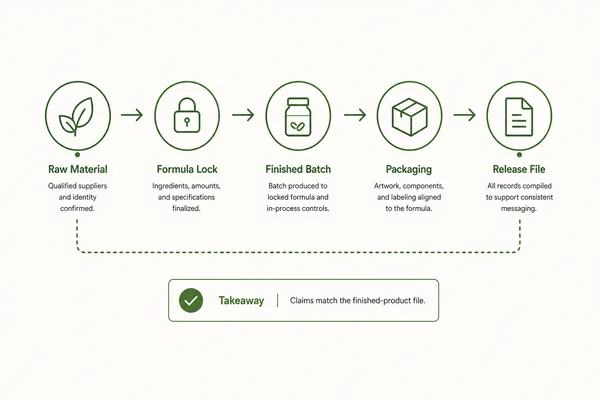
The claim boundary has to be supported by the production file.
Before production, brands should review raw material specs, supplier documents, finished-batch testing, COA matching, stability, packaging, batch records, and release documentation together.
Raw Material Specifications and Supplier Documents
Raw material review should begin with identity, specification, supplier documentation, allergen status, contaminant limits, microbiological expectations, storage conditions, and any assay or marker information tied to the ingredient.
For botanicals, plant part, extract ratio, carrier material, standardization, and storage conditions may matter. For caffeine, fiber, minerals, or specialty ingredients, the brand should understand what the specification controls and what it does not control.
A COA can confirm that a supplied material meets selected parameters. It does not automatically prove the finished-product claim. When I review this kind of project, I connect each raw material document to the label story: what the product says, what the serving provides, and what the finished batch can verify.[^4]
Finished-Batch Testing and COA Matching
Finished-batch testing closes the loop between formula design and the label. A raw material may look acceptable before production, but the finished product has gone through blending, heating, forming, drying, coating, bottling, and storage conditions.
The brand should ask what finished-product checks are planned and how those results relate to the product claim. This may include identity where appropriate, assay or marker testing where feasible, microbiology, heavy metals, moisture-related checks, and product-specific release criteria.
For gummy formats, I would be especially cautious about borrowing proof from powders or capsules. A study, supplier document, or ingredient claim may not translate cleanly into a gummy matrix. The finished gummy has its own serving size, moisture, texture, stability, and packaging behavior.
| Proof Item | Question Before Production |
|---|---|
| Raw material COA | Does it identify the actual material used? |
| Finished-batch COA | Does it confirm the selected finished-product checks? |
| Serving calculation | Does the finished serving match the label promise? |
| Stability plan | Is the shelf-life expectation supported by a defined plan? |
| Packaging record | Does the bottle, pouch, closure, or desiccant plan protect the product? |
| Channel copy | Does public copy stay within the same claim boundary? |
Stability, Packaging, and Shelf-Life Conditions
Packaging is part of the proof chain. A formula can pass early sampling and still struggle if moisture, heat, oxygen, light, or storage conditions are not managed.
Gummies are especially sensitive because water activity, coating, bottle fill, desiccant use, closure choice, and storage instructions can affect texture and quality. If the formula contains hygroscopic fiber, sensitive botanicals, strong flavors, or caffeine-containing blends, packaging should be reviewed with the formula.
The brand should also separate projected shelf life from completed evidence. A projected shelf life may guide planning. It should not be turned into a stronger public claim before the support exists.
Batch Records and Release Documentation
Batch records show how the product was made, what materials were used, what checks were performed, and whether deviations occurred. Release documentation helps the brand understand whether the batch is ready for sale under the approved specification.
For private label programs, the brand should know what it will receive and when. This can include master manufacturing records, batch production records, raw material COAs, finished-product COAs, packaging records, lot coding, deviation records, and release review. The exact package depends on the manufacturer and product, but the expectation should be clear before production.
The practical test is whether the documentation supports the same limited claim used in the market. If the campaign says more than the batch file can support, the launch needs another review.
How to Review a Private Label Weight Loss Supplement Manufacturer
A manufacturer should help narrow risk, not encourage the strongest claim.
A private label weight loss supplement manufacturer should explain formula feasibility, documentation, label review, packaging, sampling, scale-up, and claim-risk limits before production.

Quality System and cGMP Questions
A brand does not need to act like a factory auditor, but it should ask practical quality-system questions. How are raw materials qualified? How are batch records controlled? How are deviations handled? How are finished batches released? How are allergen, sanitation, and traceability questions managed?
cGMP systems can support documented production, but they do not approve marketing claims. A manufacturer can help organize formula and batch documentation. The brand still needs qualified review for final claim language.[^1][^4]
For weight management products, I would also ask how the manufacturer handles claim-sensitive categories. A useful partner should flag wording that exceeds the formula, serving size, or documentation plan.
Formula, Label, and Packaging Review Support
Formula, label, and packaging review should happen together. The formula affects the claim. The claim affects label space and warnings. The label affects packaging layout. Packaging affects stability, storage, and channel readiness.
For example, a weight management gummy may need room for Supplement Facts, serving directions, cautions, storage language, barcode, lot code, and limited brand copy. If the bottle is small, the label may become crowded. If the formula needs moisture protection, the package may need a desiccant or different closure.
Brands preparing their first supplement launch can use a broader guide like how to start a supplement brand for business setup, but this category needs an extra claim-control layer before packaging is finalized.
MOQ, Sampling, Scale-Up, and Channel Readiness
MOQ and sampling matter because many weight management lines need market testing before a larger commitment. A startup brand may want a lower-risk test run. A larger brand may need a repeatable path from sample approval to commercial production.
The manufacturer discussion should include sample rounds, formula lock timing, packaging lead time, testing timeline, batch release timing, and scale-up expectations. For gummies, the team should also discuss active-load feasibility, texture, moisture control, flavor masking, and stability planning.
Channel readiness belongs in the same conversation. Amazon, retail, practitioner channels, social commerce, and direct-to-consumer sites can create different copy-review and documentation needs. A product that fits one channel may need more review for another.
Red Flags in Overpromised Weight-Loss Programs
The clearest red flag is a partner who promises weight-loss outcomes before reviewing formula, serving, claim language, testing, and marketing context. Another red flag is a program that sells GLP-1-style supplement positioning without a careful boundary review.
| Red Flag | Why It Matters | Safer Response |
|---|---|---|
| Guaranteed weight-loss outcome | Supplements should not promise biological results | Remove the promise or reject the program |
| "Fat burner" label language without evidence review | Implies a stronger result than support language | Reframe or exclude the term |
| GLP-1 or drug-alternative positioning | Creates medical-adjacent risk | Keep it out of consumer-facing copy |
| COA only after order placement | Prevents pre-production review | Request document review before commitment |
| No stability or packaging discussion | Product may not hold quality through shelf life | Review packaging and storage plan |
| Same claim for every formula | Ignores ingredient, dose, and format differences | Require formula-specific claim review |
In my view, a good manufacturer will sometimes slow the project down. That can be frustrating during launch planning, but it is better than discovering claim, label, or documentation problems after packaging has been printed.
Launch Checklist for a Safer Weight Management Supplement Line
The launch should not begin with a claim the product cannot carry.
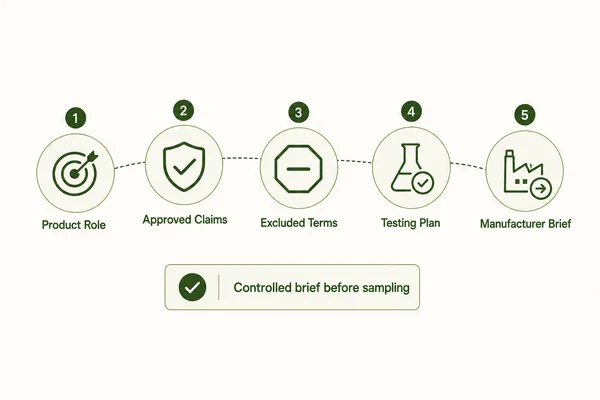
A safer launch starts by defining the product role, matching claims to evidence, excluding risky terms, and preparing a manufacturer-ready brief.
Define the Product Role Before the Claim
Start with the product role. Is the product meant to support daily fiber intake, energy, meal routine, active lifestyle, digestive regularity, hydration, or general wellness? That role should be narrower than "make people lose weight."
Once the role is clear, the team can choose ingredients and format. A fiber gummy has a different claim path from a caffeine capsule. A powder has different serving logic from a gummy. A botanical blend has different specification and sensory questions from a mineral product.
This approach also prevents the project from drifting into narrower ingredient education. Apple cider vinegar, fiber, caffeine, or sugar-free formats may each need their own review path. This page is about the claim and manufacturing system behind weight management positioning.
Match Claims to Evidence and Finished Product Proof
The claim should be matched to evidence at the finished-product level wherever possible. If the brand relies on ingredient evidence, the team should understand the gap between ingredient context and final product context.
I use a simple three-part check. First, the ingredient should have a reason to be in the formula. Second, the finished serving should match the intended claim boundary. Third, the batch file and packaging plan should support what the brand says publicly.
| Launch Review Item | What It Prevents |
|---|---|
| Product role statement | Broad weight-loss positioning |
| Approved claim list | Ad copy exceeding label copy |
| Excluded terms list | GLP-1, fat-burning, drug-comparison, or result claims |
| Ingredient specifications | Unknown raw material identity or quality |
| Finished-batch COA plan | Unsupported finished-product statements |
| Stability and packaging plan | Shelf-life and texture surprises |
| Channel-copy review | Marketplace or influencer claim drift |
Keep Risky Terms Out of Sales Copy
Some words should be restricted until reviewed. This includes fat-burning, appetite suppression, carb blocking, GLP-1, rapid weight loss, clinical-result weight-loss language, blood sugar control, and any promise tied to a measurable body outcome.[^2][^3]
The brand may still discuss these words internally. A team may need to review competitor language or consumer search behavior. That does not make the terms approved sales copy.
Safer copy is often less dramatic. It may focus on routine support, convenience, ingredient transparency, finished-batch documentation, and a limited structure/function-style statement after qualified review. Less dramatic copy can still sell when the product experience and trust signals are strong.
Prepare the Manufacturer Brief
Before asking for samples or pricing, the brand should prepare a clear brief. It should include target market, product format, ingredient direction, serving goal, approved claims, excluded claims, preferred packaging, launch channel, target timeline, testing expectations, and label-copy draft.
For gummies, add flavor direction, sweetener preference, dietary restrictions, texture expectation, bottle or pouch preference, serving count, and openness to stock or semi-custom routes. A low MOQ private label gummy supplement route may help with market testing, but the same claim boundary still applies.
Talvenda can support brands by reviewing gummy feasibility, active-load pressure, sample planning, packaging needs, documentation expectations, and scale-up logic before a weight management line moves into production. The strongest brief is not the one with the boldest claim. It is the one that lets the product team, production team, and marketing team build the same controlled product story.
Conclusion
Weight management supplement launches are safer when claims, formula choices, proof documents, packaging, and channel copy stay aligned.
As a gummy supplement OEM/ODM manufacturing partner, Talvenda can help brands review gummy feasibility, private label development options, finished-batch documentation, packaging needs, and sample-to-production risks before commercial production. Share your product brief through Talvenda's sample and feasibility review channel when you are ready to check the claim boundary before sampling.
[^1]: Federal Trade Commission, Health Products Compliance Guidance, guidance on express and implied advertising claims and the need for adequate substantiation. [^2]: U.S. Food and Drug Administration, Structure/Function Claims, overview of dietary supplement structure/function claims, disclaimer requirements, and disease-claim boundaries. [^3]: U.S. Food and Drug Administration, Questions and Answers on Dietary Supplements, consumer-facing FDA background on dietary supplement regulation and boundaries. [^4]: Electronic Code of Federal Regulations, 21 CFR Part 111 - Current Good Manufacturing Practice in Manufacturing, Packaging, Labeling, or Holding Operations for Dietary Supplements, regulatory requirements for dietary supplement manufacturing, quality control, packaging, labeling, and records.