

Powdered vitamins and gummies both look simple until a brand tries to turn the concept into a stable, good-tasting product.
Powdered vitamins vs gummies is not a universal winner question. Powders usually fit higher nutrient loads and flexible drink routines. Gummies usually fit lower-dose daily wellness formulas where taste, texture, portability, and routine consistency matter more than maximum active loading.
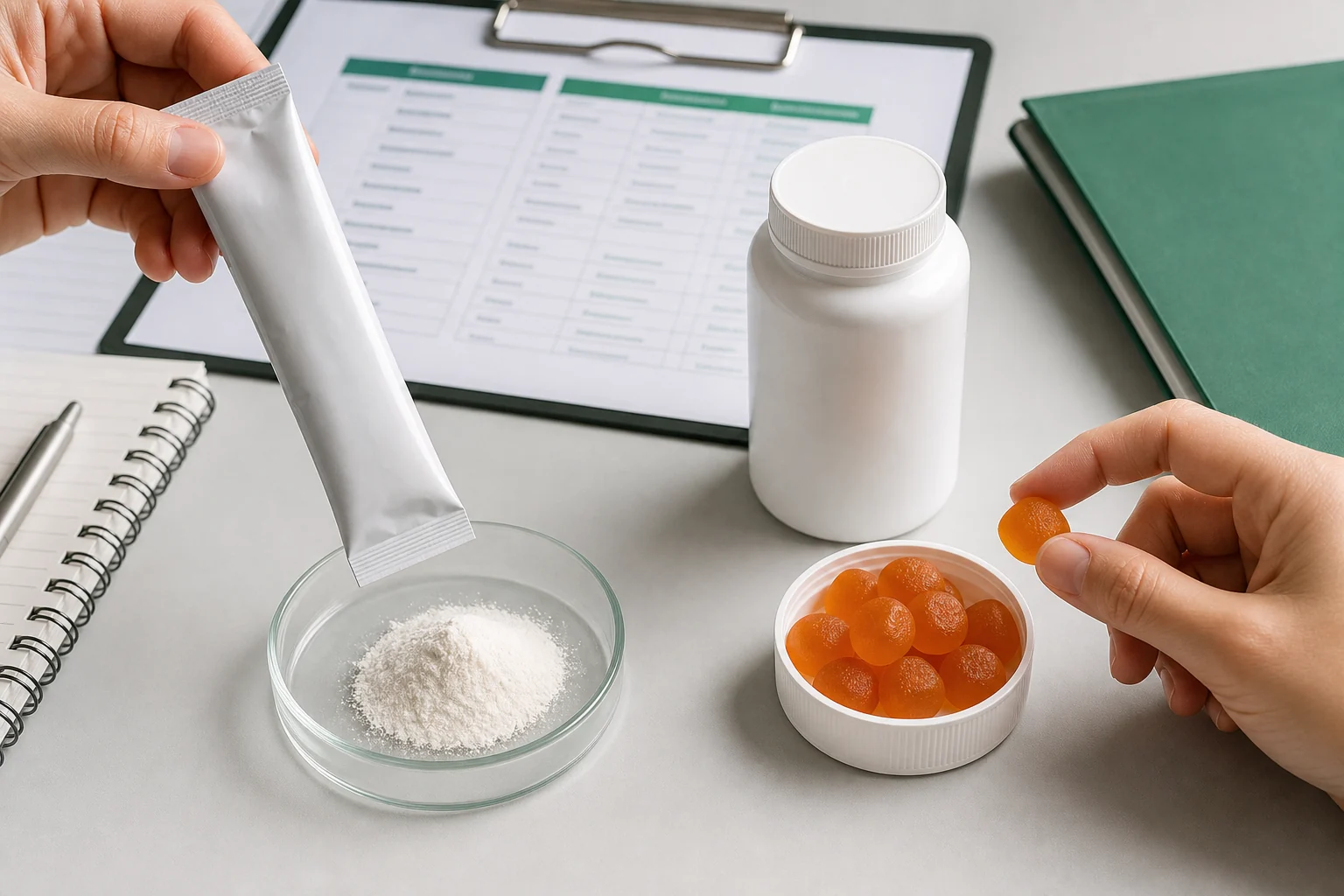
For supplement brands, the stronger question is not "Which format is better?" It is "Which format can carry this formula, taste acceptable, remain stable, support the label, and match the customer's daily use?" That answer depends on the nutrient load, ingredient sensitivity, sweetener system, packaging, serving size, and claim boundaries behind the product concept.
Decision Snapshot
- Choose powdered vitamins when the formula needs higher active loads, flexible serving sizes, electrolyte-style positioning, or a drink-mix routine.
- Choose gummy vitamins when the product is a lower-dose daily wellness concept where taste, texture, portability, and routine consistency are central to the offer.
- Treat absorption claims carefully. The nutrient form, dose, meal context, and formula quality matter more than the delivery format alone.
- Test flavor, stability, serving size, and label expectations before locking the format.
- Do not let a format trend decide the product. Let the formula decide what the format can realistically support.
Powdered Vitamins vs Gummies: What the Format Decision Really Means
Format choice looks like a marketing decision. In practice, it is a formula, packaging, and quality decision first.
Powdered vitamins and gummies create different development paths. Powders usually offer more loading flexibility. Gummies usually offer a stronger daily-use experience. The right format is the one that can carry the intended dose, survive storage, taste acceptable, and support responsible label claims.
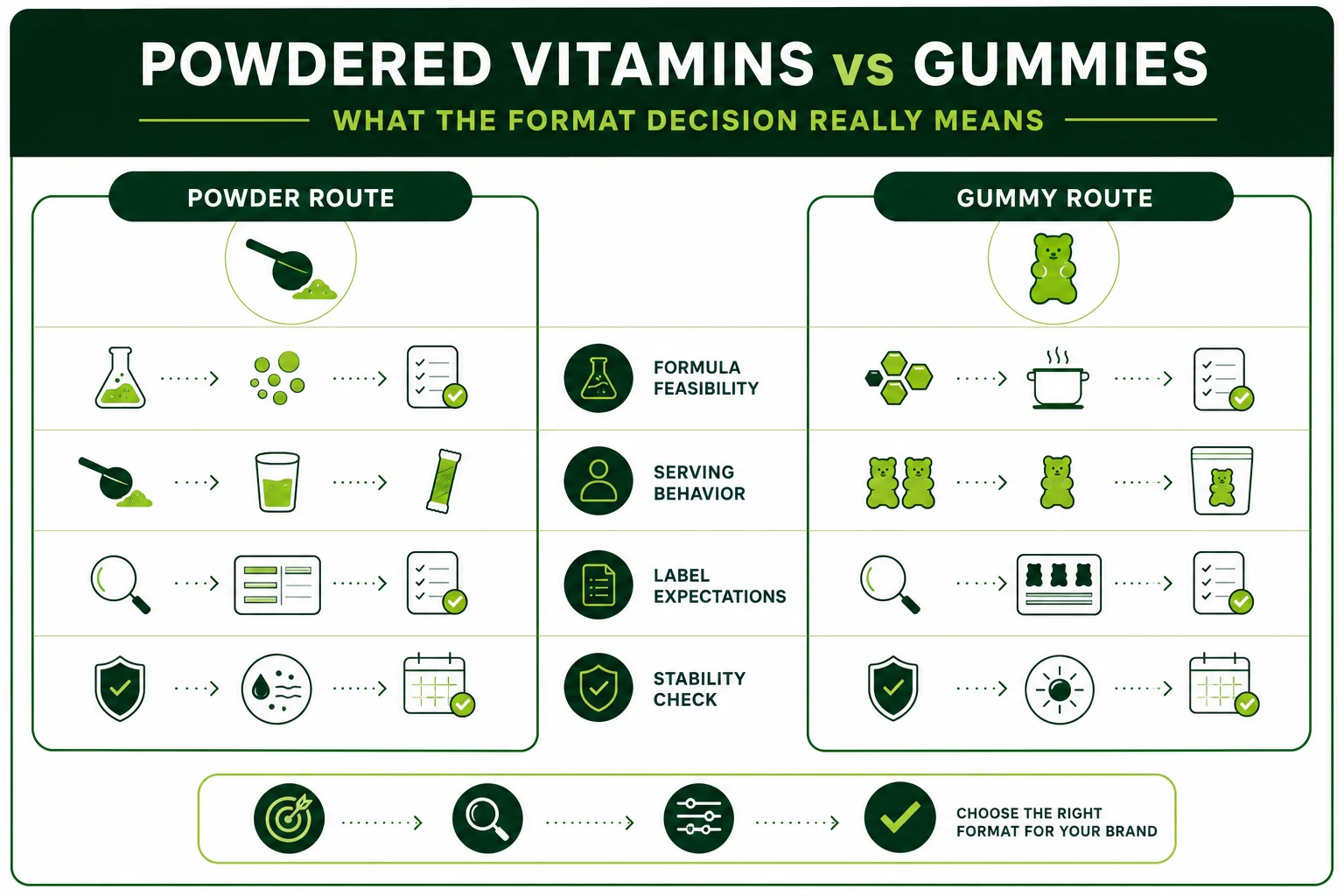
Powdered vitamins and gummy vitamins sit in the same supplement category, but they create very different product-development paths. A powder is usually mixed into water or another beverage. A gummy is chewed as a finished confectionery-style supplement. That difference affects almost every decision behind a launch: ingredient loading, flavor masking, sweetener use, packaging, shelf-life expectations, label wording, and how consumers build the product into a routine.
For a consumer, the format question often starts with convenience. One person may prefer a scoop or sachet because it feels flexible and easy to mix into a drink. Another may prefer a gummy because it is portable, familiar, and easier to remember. For a supplement brand, the decision has to go deeper. The format must support the formula before it can support the marketing story.
The best format is not the one that looks strongest in a competitor trend report. It is the one that can carry the intended active ingredients, survive real storage and use conditions, taste acceptable, and support claims that the brand can responsibly make.
What Are Powdered Vitamins?
Powdered vitamins are dietary supplement formulas supplied as loose powder, stick packs, sachets, tubs, or effervescent-style servings that the user mixes before taking.[^1] The format can support multivitamins, vitamin C powders, hydration blends, mineral blends, amino acids, greens concepts, and other daily wellness products.
Powders often give formulators more room to work with. A serving can be much larger than a gummy serving, which means the format can carry vitamins, minerals, acids, flavors, sweeteners, colors, and functional supporting ingredients with more flexibility. This does not automatically make powders more effective, but it can make them more practical for formulas that are too large, too strong-tasting, or too flexible for a small chewable format.
The tradeoff is behavior. A powder asks the customer to add water, mix, tolerate the taste, and finish the drink. If the product clumps, tastes harsh, leaves residue, or requires too much preparation, the higher dose capacity may not translate into better daily use.
What Are Gummy Vitamins?
Gummy vitamins are chewable dietary supplements built on a gelling system, flavor base, sweetener system, active ingredients, and packaging plan.[^1] They are often used for daily wellness concepts where taste and repeat use are important: multivitamins, vitamin C, vitamin D, beauty formulas, sleep support, hair-skin-nails concepts, immune support, and similar consumer-friendly products.
The strength of a gummy is experience. A well-designed gummy reduces the friction of taking a supplement. It does not need water, it is easy to carry, and it can feel more approachable than capsules, tablets, or powders. For brands, this can support product differentiation and repeat-use behavior.
The constraint is space and stability. A gummy has limited room for active ingredients because the base must still set, chew, taste good, and remain consistent over shelf life. Heat, moisture, pH, active ingredient compatibility, and texture drift all matter. A gummy that looks attractive on a label can fail in development if the active load, taste, or stability target is unrealistic.
Why Supplement Format Matters for Brands
Format is not a cosmetic choice. It affects the entire commercial path of the product. The same vitamin concept can look easy in a powder and difficult in a gummy, or simple in a gummy and unnecessarily complex in a powder.
Brands should think about format early because it changes sampling expectations, supplier communication, packaging costs, flavor work, label review, and quality documentation. A formula that is viable in a drink mix may require a reduced serving size, a different ingredient form, or a narrower claim approach in gummies. A formula that feels ordinary as a powder may become a stronger consumer product if it is built as a pleasant daily gummy.
The right format is the one that keeps the product promise realistic.
Powders vs Gummies: The Core Tradeoffs
Most format mistakes happen because brands compare preference instead of feasibility. The technical tradeoffs decide what can actually launch.
Powders vs gummies differ most in dose capacity, sensory design, stability, serving behavior, and label expectations. Powders usually give more formula space. Gummies usually give a simpler daily routine. A good brand decision weighs both sides before sampling.
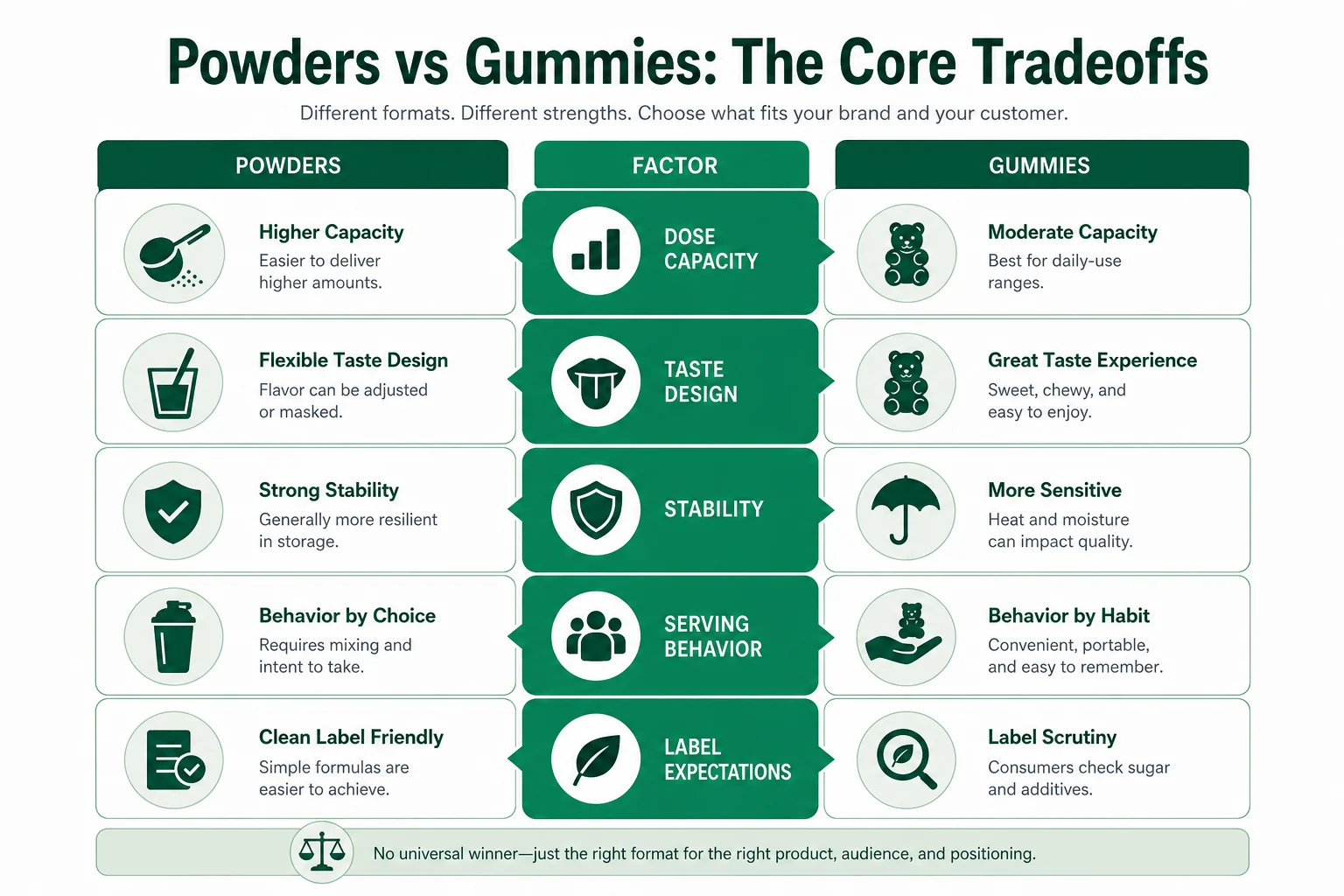
The clearest way to compare powders and gummies is not to ask which one is healthier. A better comparison is operational: how much active material must the product carry, what will it taste like, how will the user take it, and what must stay stable until the end of shelf life?
| Format Factor | Why It Matters for Brands | Powder Tendency | Gummy Tendency |
|---|---|---|---|
| Dose capacity | Determines whether the target formula is physically practical | Higher flexibility | More limited |
| Taste design | Shapes masking strategy and consumer acceptance | Drink flavor and aftertaste matter | Chew texture and flavor release matter |
| Stability | Affects shelf-life planning and packaging | Moisture and clumping are key risks | Heat, moisture, texture, and active compatibility are key risks |
| Serving behavior | Shapes routine consistency | Requires mixing or measuring | Easy unitized serving |
| Label expectations | Controls what the brand can responsibly claim | Often linked to potency or hydration concepts | Often scrutinized for sugar, sweeteners, and "candy-like" perception |
Dose Load and Nutrient Concentration
Dose load is one of the biggest differences. Powders can usually carry more material per serving because the serving size can be larger. A stick pack, scoop, or sachet can hold grams of powder. That makes the format useful for products that combine vitamins with minerals, electrolytes, acids, amino acids, or larger supporting ingredients.
Gummies have a much tighter loading window. A gummy still needs enough base to create the intended chew, moisture level, sweetness, flavor release, and shape. If the formula asks for too much active material, the gummy may become gritty, bitter, sticky, unstable, or oversized. A brand may then need to reduce the dose, split the serving into multiple gummies, change ingredient forms, or reconsider whether the concept belongs in gummies at all.
For lower-dose vitamins and daily wellness blends, gummies can be a strong fit. For high-dose formulas, powders often have a structural advantage.
Taste, Texture, and Daily Use
Powders and gummies both need taste work, but the challenge feels different. A powder is usually consumed as a drink. The customer experiences aroma, sweetness, acidity, mouthfeel, aftertaste, solubility, and residue.
Minerals, vitamin blends, acids, botanicals, and some functional ingredients can make a powder taste metallic, sour, bitter, salty, or medicinal. The formula may need flavor masking, acid balancing, sweetener adjustment, and flow support.
A gummy is experienced as a chew. The customer notices firmness, bounce, stickiness, coating, flavor release, sweetness, and aftertaste. Some vitamins and minerals can create bitterness or off-notes that are harder to hide in a small gummy matrix. Texture also has to remain acceptable over time, not only during the first lab sample.
Daily use matters because the best formula on paper still has to be taken. Powders can work well for consumers who already have a shake, hydration, or morning drink routine. Gummies can work well for consumers who want a simple, no-water habit.
Sugar, Sweeteners, and Label Expectations
Gummies often invite more scrutiny around sugar, sweeteners, acids, colors, and "other ingredients" because the format looks and tastes like candy. This does not make gummies unsuitable, but it does mean the label story must be planned carefully.
A sugar-free gummy may sound attractive, but sugar-free development can affect texture, taste, cost, and digestive-tolerance expectations. A low-sugar gummy may require a different sweetener system and more flavor work. A traditional sugar gummy may taste better but may not fit every brand position.
Powders also have sweetener questions. A drink mix may use sugar, stevia, sucralose, monk fruit, acids, flavors, colors, or other ingredients depending on the concept. Because powders are mixed into water, sweetness intensity and aftertaste can become more obvious.
For brands, the issue is not simply "gummies have sugar and powders do not." Both formats need a clear sweetener and label strategy.
Packaging, Portability, and Serving Control
Packaging changes how a supplement is used. Powders can come in tubs, sachets, stick packs, jars, or single-serve packets. Tubs may be cost-efficient but less portable. Stick packs are convenient but add packaging cost. Powders also need protection from moisture, clumping, aroma loss, and handling issues.
Gummies are usually packed in bottles, pouches, jars, or blister-style formats depending on the market and product. They need moisture and temperature protection, and the brand must think about sticking, melting, texture drift, and serving clarity. Gummies can be very portable, but they also need responsible packaging and clear serving instructions.
Serving control is another difference. A powder can allow flexible dilution or partial serving behavior, but that also creates room for inconsistent use. Gummies are usually more unitized: one gummy, two gummies, or a defined serving. That can make routine behavior easier, but it can also limit how much active material the serving can carry.
Absorption and Effectiveness: What Brands Should Avoid Overclaiming
Absorption claims are easy to write and hard to support. Format alone rarely proves the claim a brand wants to make.
Powdered vitamins and gummies can both deliver nutrients when the formula is designed correctly. Bioavailability depends on the nutrient form, dose, stability, and use conditions. Brands should avoid claiming that one format is universally faster, healthier, or more effective.
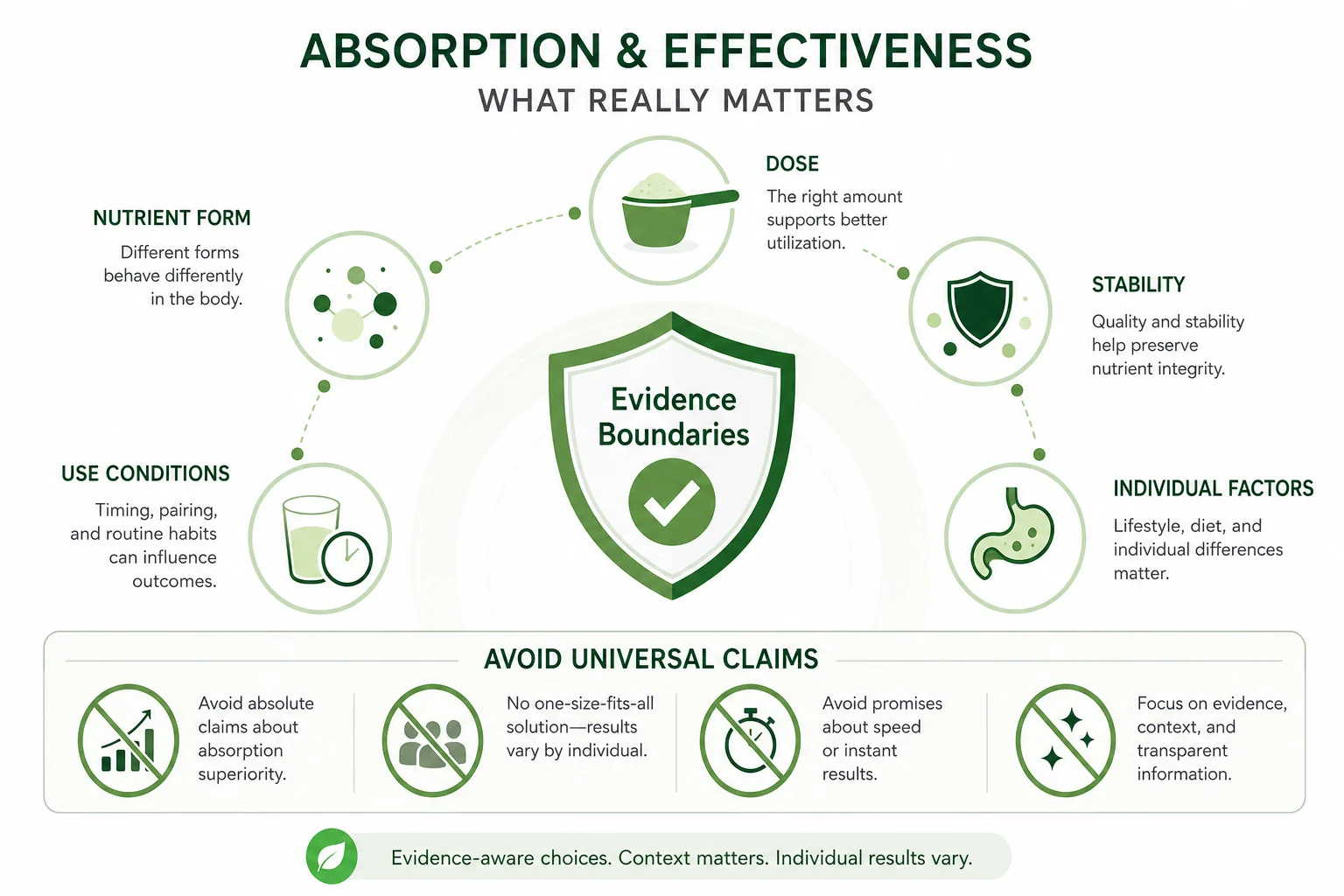
Many comparison articles ask whether powdered vitamins or gummies "work better." That question is tempting, but it can mislead both consumers and brands. Delivery format is only one part of effectiveness. The nutrient form, dose, stability, excipients, meal context, user consistency, and label compliance all influence the final product experience.
The safest brand-side message is that powders and gummies can both be effective when the formula is designed correctly, while broad effectiveness claims still need ingredient-specific support.[^2] The development question is whether the format can support the intended dose, stability, taste, and use behavior.
Bioavailability Depends on the Nutrient
Vitamins are not one single technical category. Vitamin C, vitamin D, B vitamins, vitamin A, vitamin E, vitamin K, folate, and mineral combinations all behave differently.[^3] Some nutrients are water-soluble. Some are fat-soluble. Some are sensitive to heat, moisture, light, oxygen, pH, or interactions with other ingredients.
Because of this, a broad claim like "powders absorb faster" or "gummies absorb better" is usually too simple. A powder may dissolve quickly in water, but that does not prove every nutrient in the powder is more bioavailable. A gummy may be chewed and broken down before swallowing, but that does not prove it delivers more of every nutrient.
For brands, the stronger approach is nutrient-specific. Ask what form of the nutrient is being used, what dose is needed, what the serving matrix does to stability, and what claims can be supported without overstating the evidence.
Why "Faster Absorption" Is Not Always the Right Claim
"Fast absorption" can sound attractive in marketing, especially for hydration or energy-style products. But for many vitamin products, faster is not necessarily the consumer's real need. Daily routine, dose accuracy, stability, and clear label communication may matter more.
This is especially true for broad multivitamin concepts. A consumer buying a daily wellness gummy or powder is usually not looking for an immediate effect in the same way they might with caffeine or an electrolyte drink. They are looking for an easy supplement habit that fits their lifestyle.
If a brand wants to make absorption-related claims, the claims should be reviewed carefully and tied to ingredient-specific evidence.[^3] Otherwise, the safer editorial path is to explain that effectiveness depends on the complete formula and usage pattern, not just the format.
How to Discuss Effectiveness Without Medical Overreach
Brands can discuss product design without making disease or treatment claims. The practical language is about formula suitability, serving size, ingredient compatibility, label clarity, and user adherence.
For example, a brand can compare how powders and gummies handle dose load, taste, portability, and routine behavior. It can explain why a high-load mineral blend may be easier in a powder, or why a lower-dose daily vitamin concept may work well as a gummy. It can also explain that finished products should be reviewed for composition, quality, and label accuracy.
The risk comes when the article starts promising outcomes: better absorption, better health, faster results, or universal superiority. Those claims require a much higher evidence burden and can easily drift away from the product-development question.
When Powdered Vitamins Make More Sense
Some vitamin ideas need more formula space than a gummy can comfortably provide. That is where powder usually earns attention.
Powdered vitamins make more sense when the product needs higher active loading, flexible serving sizes, hydration-style use, or a beverage format that gives flavor systems more room to work. They are often the safer first test for large multi-ingredient concepts.

Powdered vitamins are often the stronger choice when the product concept needs space, flexibility, or a beverage routine. They can be especially useful when a brand is trying to combine vitamins with minerals, electrolytes, acids, flavors, and other functional ingredients in a serving size that would be difficult to compress into a gummy.
| Powder-Fit Signal | Why It Points Toward Powder |
|---|---|
| High active load | Larger serving size gives more formulation space |
| Hydration or electrolyte positioning | The user already expects to mix the product with water |
| Flexible serving size | Scoops or sachets can support different dilution preferences |
| Strong-tasting mineral or acid blend | Beverage flavor systems may provide more room for masking |
| Multi-ingredient concept | Powders usually handle larger blends more easily than small chewables |
Higher-Dose Formulas
If the formula needs a high active load, powders usually deserve the first look. A larger powder serving can carry more material without forcing the product into an oversized chewable piece. This matters for multivitamin powders, vitamin C drink mixes, mineral blends, hydration products, and formulas where the active amount is too large for a pleasant gummy.
A gummy can still carry vitamins, but there is a physical limit to what the base can hold while maintaining texture and taste. Once the formula starts pushing that limit, the development work becomes more complex. The brand may need more gummies per serving, lower active levels, stronger masking, or a different format.
Hydration and Effervescent Concepts
Powders are a natural fit for hydration-style positioning because the user mixes the product with water. This makes it easier to build concepts around electrolytes, vitamin C, flavor, refreshment, and daily drink routines.
Effervescent or dissolving powders can also create a more active user experience. The consumer sees the product dissolve, tastes it as a beverage, and may connect it with a morning bottle, gym bag, travel packet, or office routine.
Gummies do not create that same hydration behavior. They can be convenient and enjoyable, but they do not ask the consumer to drink water with the product. If hydration is central to the concept, powder may align more naturally with the use case.
Customizable Serving Sizes
Powders can support more flexible serving behavior. Some consumers prefer a full serving in a bottle; others may use less water, more water, a smaller portion, or a different timing. This can be useful for products where taste intensity, concentration, or serving occasion varies.
That flexibility can also be a weakness. If serving size is not clear, customers may underuse or overuse the product. Scoop size, fill volume, label instructions, and packaging design all need to support consistent use.
Gummies are less flexible but easier to understand. A brand can define a serving as one or two gummies. For some products, that simplicity is worth more than customization.
Taste and Mixing Challenges
Powders can carry more, but they also expose flavor problems. Bitter vitamins, minerals, acids, botanicals, and some sweeteners may become obvious in water. Poor solubility, grit, foam, clumping, or sediment can weaken the customer experience.
This is why powder development should not be treated as just blending ingredients. The formula needs sensory work: sweetness balance, acid balance, aroma, mouthfeel, mixing performance, and aftertaste control.
If a brand cannot make the powder taste acceptable at the intended dose, the format advantage may disappear.
When Gummy Vitamins Make More Sense
Gummies are strongest when the product depends on repeat use, taste, and a simple daily habit. They still need formula discipline.
Gummy vitamins make more sense for lower-dose daily wellness formulas where consumer appeal, unitized serving, flavor, texture, and portability are central. A gummy is not a shortcut around formulation work; it is a format with tighter active-load and stability limits.
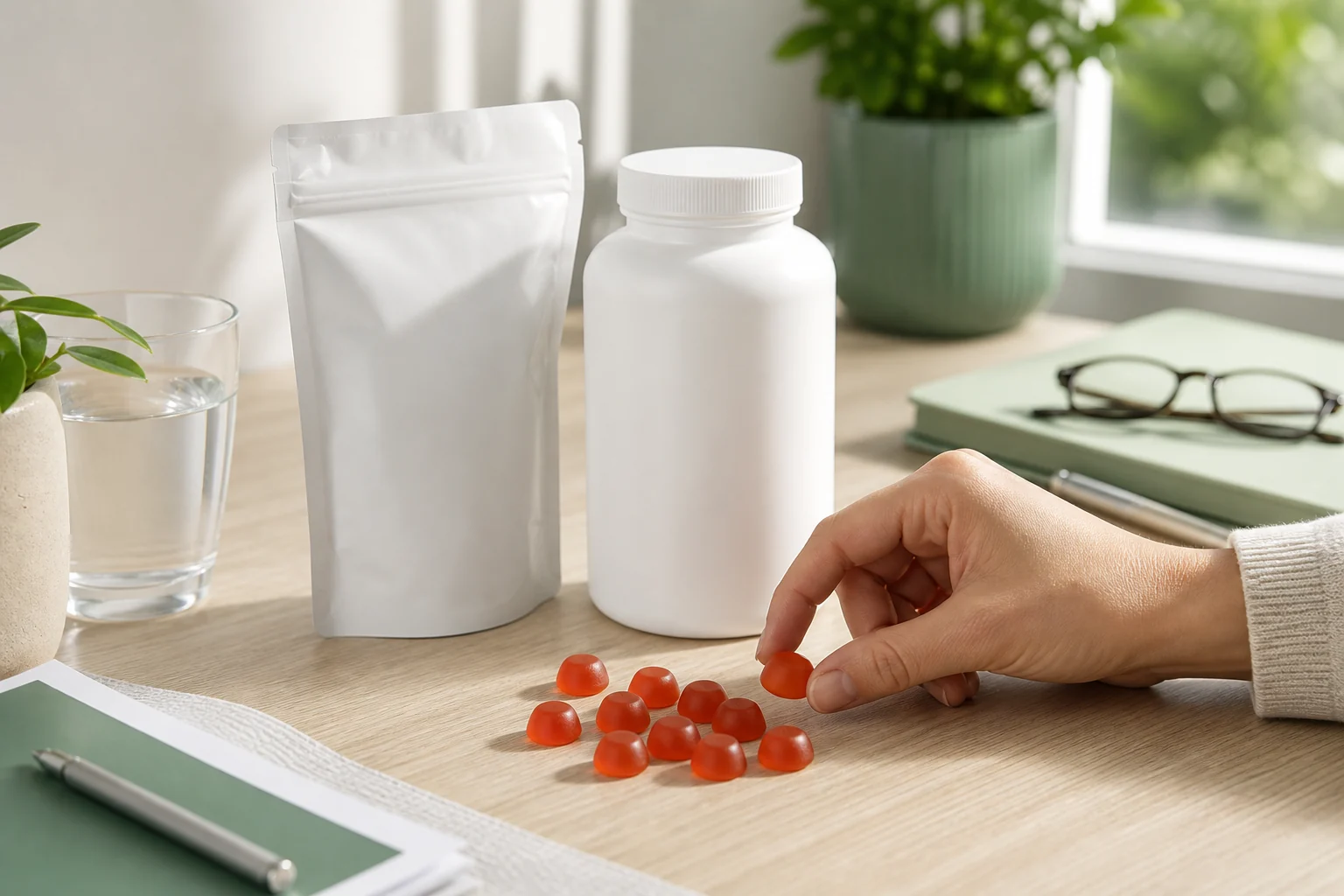
Gummy vitamins make more sense when the product promise depends on easy daily use, pleasant taste, and a low-friction routine. They are not the best format for every formula, but they can be commercially powerful when the active load and stability requirements fit the matrix.
For vitamin gummy category context, Talvenda's Multivitamins & Minerals gummy supplements page shows how stock and custom gummy concepts can be organized by active ingredients, target users, and product function.
| Gummy-Fit Signal | Why It Points Toward Gummies |
|---|---|
| Lower-dose daily wellness concept | The formula can fit the gummy matrix without excessive size or bitterness |
| Routine-based positioning | The format supports simple daily use |
| Taste-led differentiation | Flavor and texture become part of the product experience |
| No-water convenience | The consumer can use the product at home, work, or travel |
| Clear serving unit | One or two gummies can be easier to understand than scoops or partial servings |
Routine Consistency and Consumer Appeal
The biggest advantage of gummies is habit formation. A gummy can feel easier to take than a capsule, tablet, or powder. It does not require mixing, measuring, or water. It can sit on a desk, kitchen counter, or travel bag and still feel approachable.
For brands, that experience matters. A supplement that consumers remember and enjoy may have stronger repeat-use potential than a technically dense product that feels unpleasant. This is especially relevant for daily wellness categories where the consumer is not chasing an immediate sensory effect, but building a routine.
Lower-Dose Daily Wellness Formulas
Gummies are usually better suited to lower-dose formulas. Daily vitamin D, vitamin C, biotin, hair-skin-nails concepts, sleep-support blends, beauty gummies, and light wellness formulas are common examples, depending on the exact ingredient load and claim strategy.
The brand should still test the formula early. Even a low-dose active can create bitterness, color change, odor, or stability concerns, and quality checks should confirm identity, strength, composition, and labeling expectations.[^5] The question is not only whether the dose fits, but whether the finished gummy remains pleasant and consistent.
Flavor Masking and Texture Design
Gummy development is a sensory project. The base, sweetener system, acids, colors, flavors, active ingredients, coating, and packaging all work together. A good gummy should not simply hide the formula; it should create a texture and flavor profile that makes the supplement feel intentional.
This is where gummy products can stand out. A powder may taste like a functional drink. A gummy can feel like a daily treat. But if the flavor masking fails, the product can feel medicinal, bitter, sticky, or artificial.
Brands should evaluate flavor and texture before they fall in love with label claims. A claim may sell the first bottle, but taste and texture influence whether the customer finishes it.
Stability and Ingredient Compatibility Limits
Gummies can be sensitive to heat, moisture, pH, and ingredient interactions. Some ingredients may degrade, migrate, crystallize, change color, affect texture, or create off-notes. Packaging and storage conditions can also affect the finished product.
This does not mean gummies are unreliable. It means the format needs realistic development controls. A brand should discuss active compatibility, expected shelf life, packaging, production conditions, and finished-product checks before committing to a gummy concept.
If the product requires a high amount of a sensitive ingredient, powder may be easier. If the product is a lower-dose formula with strong taste potential and stable ingredient behavior, gummies can be a practical choice.
Brand Decision Framework: Powder or Gummy?
A brand should not start with "we want gummies" or "we want powder." Start with what the formula must survive.
To choose between powder and gummy formats, evaluate nutrient load first, then flavor and stability feasibility, then serving and label clarity, then packaging use case. A format that fails an early filter should not advance just because it looks more marketable.

A useful decision framework starts with the formula, not with the trend. Many brands begin by saying, "We want a gummy" or "We want a powder." A better starting point is, "Here is the nutrient dose, customer routine, flavor target, label claim, packaging plan, and launch channel. Which format can support it?"
Use the following sequence before approving the format.
| Decision Filter | Ask This First | If the Answer Is "No" |
|---|---|---|
| Nutrient load | Can the format carry the intended dose in a practical serving? | Reduce dose, change ingredient form, or choose the other format |
| Flavor feasibility | Can the active blend taste acceptable in the format? | Run flavor masking work or reconsider the concept |
| Stability fit | Can the formula stay consistent through expected shelf life? | Adjust matrix, packaging, or format |
| Label clarity | Can the serving and claims be explained clearly? | Simplify the claim or serving strategy |
| Use case | Does the format match how the consumer will take it? | Rebuild the product around a more realistic routine |
Match the Format to the Nutrient Load
Start with the intended active load. How much vitamin or mineral needs to be delivered per serving? How many actives are included? Are there bulky ingredients, strong-tasting minerals, acids, fibers, botanicals, or amino acids? Is the serving meant to be one gummy, two gummies, one sachet, one scoop, or a flexible drink mix?
If the load is high, powder may be more realistic. If the load is moderate or low and the product depends on consumer-friendly daily use, gummies may be worth developing.
This decision should happen before packaging and marketing concepts are locked.
Check Flavor and Stability Early
Flavor and stability are not late-stage polish. They are format-selection tools. A formula that looks good in a spreadsheet can fail when it tastes metallic, becomes too sour, changes color, or loses texture.
Early samples should answer practical questions:
- Does the active blend create bitterness, odor, color change, grit, or aftertaste?
- Does the serving size still feel acceptable?
- Does the gummy texture hold up under reasonable storage expectations?
- Does the powder mix cleanly and taste acceptable at the intended dilution?
- Does the formula need a different nutrient form, sweetener system, or flavor direction?
If these questions are left until the end, the brand may spend too much time developing the wrong format.
Consider Label Claims and Serving Size
Serving size is both a consumer experience and a label decision. A powder may allow a larger serving, but the label must make that serving easy to understand. A gummy may make serving simple, but the serving may need two or more pieces to reach the desired active level.
Claims also need discipline. A brand can talk about taste, convenience, format fit, and formula design more safely than it can promise faster absorption or better health outcomes. For supplement products, claims should be truthful, not misleading, and supported by appropriate evidence.[^4]
For a brand-side article, the key point is simple: do not choose a format that forces the label to overpromise.
Plan Packaging Around Real Use Cases
Packaging should match how the customer will use the product. A powder for travel may need stick packs. A powder for home use may work in a tub. A gummy for warm climates may need stronger packaging consideration. A gummy for children or family use may need clear serving communication and responsible storage expectations.
The package is not just a container. It protects the product, shapes the routine, and influences whether the supplement feels easy to use.
Common Mistakes When Comparing Powders and Gummies
Most format mistakes happen before the first commercial batch. The reason is usually a weak product brief, not a weak idea.
The common mistakes are treating all vitamins as interchangeable, ignoring heat and moisture stability, and choosing a format before taste testing. These mistakes can push a brand into reformulation after sampling, packaging planning, or label work has already started.
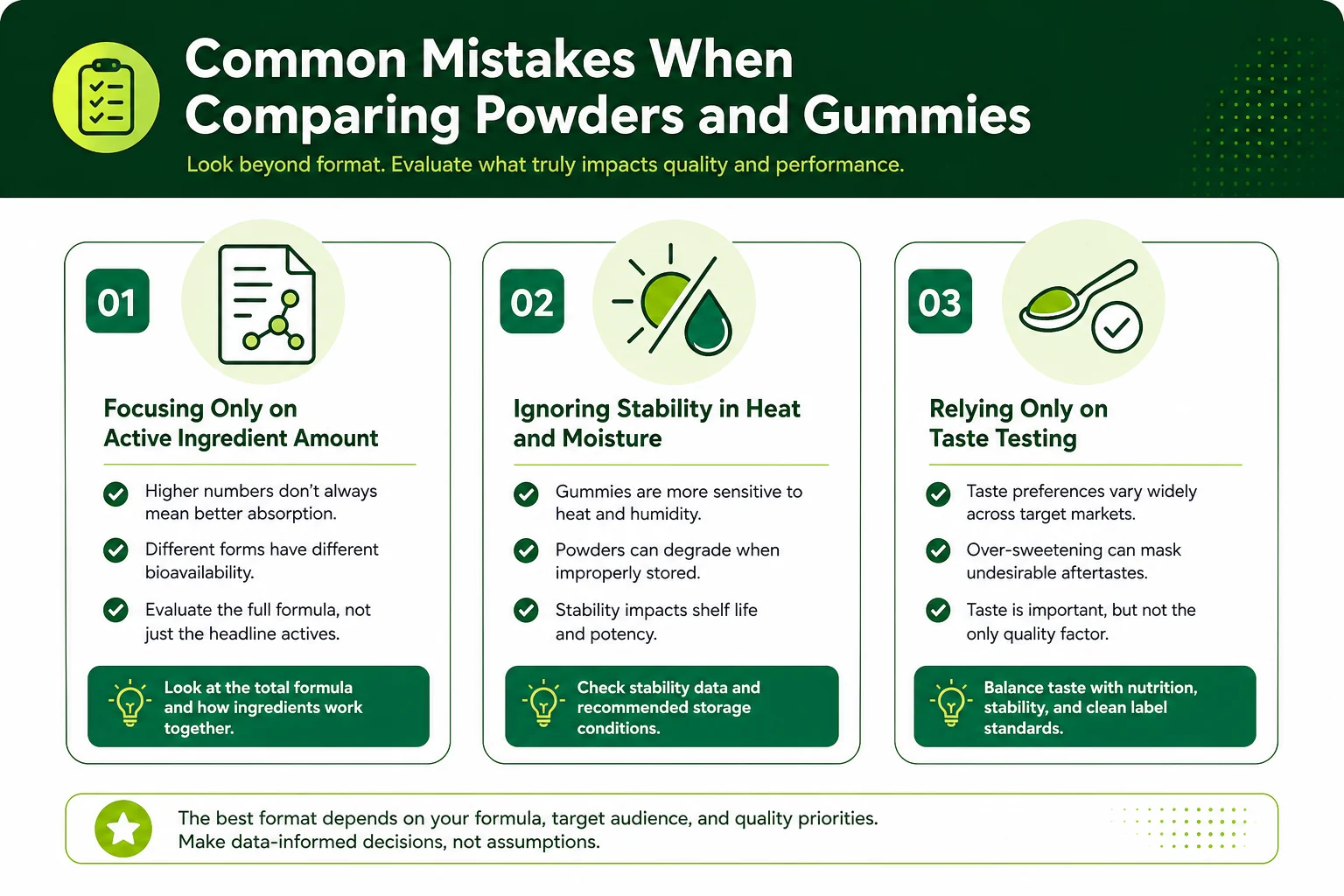
The most common mistakes come from treating format as a marketing label instead of a product-development constraint. A brand can avoid many delays by identifying these problems early.
Treating All Vitamins the Same
Vitamin products vary widely. A vitamin C powder, a vitamin D gummy, a multivitamin drink mix, and a beauty gummy are not the same technical problem. Each has different dose expectations, flavor challenges, ingredient sensitivities, and consumer routines.
Brands should avoid making format decisions based on broad category language. The more precise question is: which nutrient forms, amounts, and supporting ingredients are in this formula, and how do they behave in powder or gummy form?
Ignoring Heat, Moisture, and Shelf Life
Shelf life is where attractive concepts become real products. Powders need protection from moisture, clumping, odor changes, and flavor deterioration. Gummies need control over texture, moisture, sticking, melting, ingredient compatibility, and packaging conditions.
If a brand plans only for the first sample and not for the finished product over time, it may approve a formula that cannot hold its quality target.
Choosing a Format Before Testing Taste
Taste is not a minor issue for either format. It is central to repeat use. A powder that tastes harsh will sit in the pantry. A gummy that tastes medicinal will not become a daily habit.
Early taste testing should be practical, not emotional. The brand should compare dose, sweetness, aftertaste, texture, aroma, and serving convenience. It should also be willing to change format if the evidence points that way.
The strongest format is the one the formula can support and the customer will actually use.
FAQ: Powdered Vitamins and Gummies
Are powdered vitamins more effective than gummies?
Not automatically. Effectiveness depends on the nutrient, dose, ingredient form, stability, formulation, label accuracy, and how consistently the consumer uses the product. Powders may carry higher doses more easily, but that does not prove every powdered vitamin is more effective than every gummy.
Are gummy vitamins easier to take every day?
For many consumers, yes. Gummies can be easier because they are chewable, portable, and do not require water or mixing. That convenience is one reason brands use gummies for daily wellness products. The formula still needs to fit the gummy matrix and remain stable over shelf life.
Can high-dose vitamins be made into gummies?
Sometimes, but not always. Gummies have active-loading limits because the finished product still needs acceptable taste, texture, size, stability, and serving clarity. If the desired active load is too high, a powder may be more realistic, or the brand may need to adjust the serving size, active form, or product concept.
Should brands choose powder or gummies for a new supplement line?
Brands should choose powder when they need higher nutrient loads, flexible serving sizes, hydration-style positioning, or a drink-mix routine. They should choose gummies when the concept is lower-dose, taste-driven, and built around daily convenience. The best next step is to pressure-test the formula in both the intended dose and the intended use case before committing to production.
Conclusion
Powdered vitamins vs gummies is a format-fit decision. Choose the route that supports the formula, taste, serving size, stability, packaging, and label promise.
If a brand is comparing powdered vitamins with gummies, the decision should come down to formula fit, user experience, packaging, proof expectations, and launch economics. Talvenda can support the gummy side as an OEM/ODM gummy manufacturer, helping brands review low-MOQ market-tested in-stock gummies, stock formula modification, and custom gummy development against the original powder concept. That gives your team a clearer view of sample development, packaging and label support, documentation and testing expectations, and scale-up support before investing in the wrong format. Start with Talvenda through the project inquiry form.
Sources
[^1]: U.S. Food & Drug Administration, "Questions and Answers on Dietary Supplements." FDA notes that dietary supplements can be sold in forms including pills, tablets, capsules, gummies, softgels, liquids, and powders, and explains label requirements for dietary supplements. https://www.fda.gov/food/information-consumers-using-dietary-supplements/questions-and-answers-dietary-supplements
[^2]: NIH Office of Dietary Supplements, "Dietary Supplements: What You Need to Know." ODS explains that supplements come in forms including gummies and powders, that some supplements can help fill nutrient gaps, and that FDA does not determine supplement effectiveness before marketing. https://ods.od.nih.gov/factsheets/WYNTK-Consumer/
[^3]: NIH Office of Dietary Supplements, "Dietary Supplement Fact Sheets." Use ingredient-specific ODS fact sheets such as Vitamin C and Vitamin D when supporting nutrient behavior, intake, and safety details; do not make format-wide absorption claims from format alone. https://ods.od.nih.gov/factsheets/list-all/
[^4]: U.S. Food & Drug Administration, "Guidance for Industry: Substantiation for Dietary Supplement Claims Made Under Section 403(r)(6) of the Federal Food, Drug, and Cosmetic Act." FDA describes the amount, type, and quality of evidence it recommends manufacturers have to substantiate dietary supplement claims. https://www.fda.gov/regulatory-information/search-fda-guidance-documents/guidance-industry-substantiation-dietary-supplement-claims-made-under-section-403r-6-federal-food
[^5]: NIH Office of Dietary Supplements, "Dietary Supplements: What You Need to Know." ODS summarizes supplement quality considerations, including FDA Good Manufacturing Practices and independent quality testing seals, while noting that seals do not guarantee safety or effectiveness. https://ods.od.nih.gov/factsheets/WYNTK-Consumer/