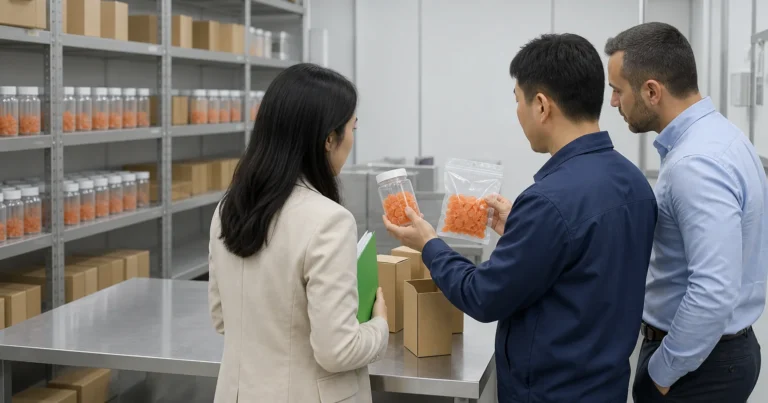
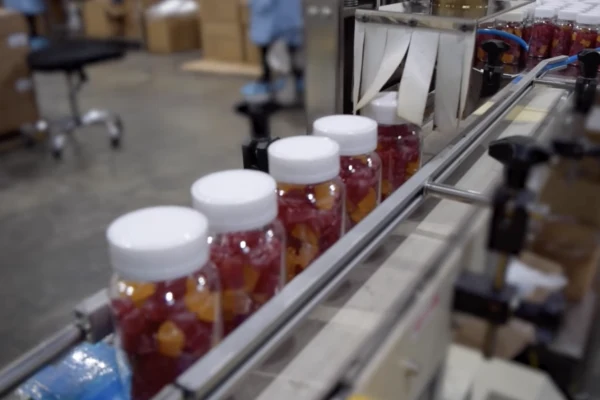

Magnesium gummies look easy to launch until dose, taste, texture, and label wording all start competing inside the same product brief.
Magnesium glycinate supplements can work in gummy format, but brands should confirm elemental magnesium[^2] target, serving size, taste masking, gel compatibility, testing documents, packaging, and claim boundaries before sampling. The format is attractive only when the product promise fits real gummy production limits.

Decision Snapshot
- Magnesium glycinate gummies are best for moderate-dose wellness positioning, not maximum-dose mineral delivery.
- The first feasibility gate is elemental magnesium per serving, not the total magnesium glycinate raw material weight.
- Sleep, stress, and relaxation language should be handled as label-review risk, not copied directly from search terms.
- A strong buyer brief should cover raw material identity, COA, heavy metals, assay, flavor masking, moisture control, packaging, and stability.
- Capsules or powders may be easier when the desired magnesium dose is high or the brand needs a simpler first launch.
Consumers search for magnesium glycinate because they want an easy daily magnesium product. Brand teams need to look one step deeper. A gummy is not just a delivery format. It is a formula system that must hold minerals, sweeteners, acids, gel structure, moisture, flavor, and label language together without creating a poor eating experience or an overpromised product.
For magnesium glycinate supplements, I would not start with the question, "Can we make this into a gummy?" I would start with a more practical question: "What amount of elemental magnesium can we deliver in a gummy serving while keeping the product pleasant, stable, and claim-safe?" That question protects the buyer brief before money is spent on samples.
That same logic should guide magnesium form comparisons. When consumers ask about magnesium glycinate, citrate, oxide, or sucrosomial magnesium, the brand-side question is not only which form sounds most attractive. It is which form can support the intended dose, gummy texture, taste profile, testing file, and label wording without forcing the product outside realistic production limits.
What Are Magnesium Glycinate Supplements, and Why Are Brands Considering Gummies?
Magnesium glycinate has strong consumer recognition, but search demand often hides the practical work needed to build a gummy SKU.
Magnesium glycinate supplements combine magnesium with glycine-based chelation. Brands consider gummies because consumers like convenient formats, but the product still needs careful dose planning, sensory control, documentation, and conservative label wording.

Magnesium Glycinate vs Bisglycinate: What the Label Usually Means
Magnesium glycinate and magnesium bisglycinate are often discussed together because both terms point to magnesium bound with glycine[^1]. In commercial supplement language, the exact wording depends on the raw material, supplier documentation, and label review. A brand should not use the two terms as interchangeable on packaging without confirming what the raw material specification actually says.
The important production point is elemental magnesium. Consumers may see a number on the front label and assume it represents the amount of useful magnesium in the product. In formulation work, the team must separate the weight of the compound from the amount of elemental magnesium provided per serving. This is where many mineral gummy briefs become unrealistic.
For a capsule, a high mineral payload may be easier to hide. For a gummy, that payload affects bite, mouthfeel, flavor, moisture behavior, and serving size. If a brand wants a magnesium glycinate gummy to compete with capsule claims, the first technical discussion should be about how much elemental magnesium can be delivered per gummy or per serving without making the product chalky, metallic, gritty, sticky, or too large.
I would ask for the raw material form, assay, heavy metal specification, allergen statement, and supplier COA before making the label name final. The label wording is not only a marketing choice. It has to follow the ingredient identity and documentation trail.
| Label or sourcing question | Why it matters before sampling |
|---|---|
| Is the material listed as glycinate, bisglycinate, buffered, or blended? | The finished label should match supplier documentation. |
| What is the elemental magnesium percentage? | This controls the raw material amount needed per serving. |
| Does the COA include heavy metals and assay[^9]? | Mineral materials need a stronger quality review than a simple sales sheet. |
| Are carriers or flow agents included? | They may affect texture, taste, allergen status, or label wording. |
| Has the material been used in gummy or chewable systems? | Capsule-friendly powders may not behave well in gummies. |
Why Consumer Demand Is Growing Around Magnesium Supplements
Magnesium has become a popular supplement category because consumers connect it with everyday wellness routines, sleep positioning, stress-related language, muscle support, and general nutritional adequacy. Those interests are visible in search behavior, product pages, and retail descriptions. Gummies add another layer because they feel easier and more enjoyable than pills for many daily users.
For brands, this demand creates an attractive product idea. A magnesium gummy can sit in wellness, relaxation, women's health, men's health, sports nutrition, or general daily supplement lines. It can also pair with other ingredients if the final formula remains realistic and claim-safe.
The risk is that consumer language can move faster than label reality. Search terms such as magnesium stress supplement or magnesium supplements for stress relief may be useful for understanding demand, but they should not be copied directly into aggressive product claims. A brand can educate around consumer interest while still keeping final label language inside a conservative review process.
In gummy manufacturing, I prefer to translate demand into a development checklist:
| Consumer signal | Brand-side translation | Why it matters for gummies |
|---|---|---|
| Easy daily magnesium | Serving size and taste target | Minerals can create sensory load. |
| Sleep or relaxation interest | Claim review and wording control | Overclaiming creates compliance risk. |
| High-absorption language | Raw material identity and documentation | Labels should match supplier evidence. |
| Men's or women's positioning | Flavor, dosage, and packaging decisions | Positioning affects the whole SKU brief. |
| Clean-label preference | Gelling system and sweetener choices | Pectin, sugar-free, and vegan claims change formulation work. |
This is where the gummy format can help a brand, but only if the brief is built around product reality instead of only search volume.
Which Magnesium Forms Fit Gummy Supplement Development?
Magnesium form selection is a production decision, not only a marketing comparison.
Magnesium glycinate, citrate, oxide, sucrosomial magnesium, and blended mineral systems can all create different dose, taste, dispersion, testing, and label-review questions in gummy development. For brands, the best form of magnesium supplement is the one that fits the intended gummy serving and documentation file without forcing unsupported claims.
Search comparisons such as sucrosomial magnesium vs magnesium glycinate, magnesium citrate vs glycinate, or the best form of magnesium supplement can be useful demand signals, but they should not become unsupported efficacy claims. For a gummy SKU, the better comparison is practical: how each raw material affects elemental magnesium load, taste masking, texture, supplier documentation, and label review.
Magnesium Glycinate vs Citrate vs Oxide: Dose Room, Taste, and Label Fit
Magnesium glycinate or bisglycinate often attracts brands because it fits familiar wellness positioning and chelated-mineral language. The formulation question is whether the raw material can deliver the target elemental magnesium amount without creating too much powder load, mineral taste, or texture pressure.
Magnesium citrate is also familiar to consumers and may appear in broader magnesium supplement comparisons. In a gummy, the development team should review acid balance, mineral note, dose target, and whether the ingredient supports the positioning the brand wants. A citrate-based direction should still be tested in the actual gummy base, not approved only because the form is recognizable.
Magnesium oxide can look attractive in some commercial briefs because many oxide materials carry a higher elemental magnesium percentage than some chelated forms. That does not make it automatically better for a gummy. The team still has to review consumer perception, mouthfeel, dispersion, grit risk, supplier documentation, and whether the final product can explain the choice without leaning on unsupported absorption or outcome language.
| Magnesium form question | Why brands ask about it | Gummy-development check |
|---|---|---|
| Magnesium glycinate or bisglycinate | Familiar wellness positioning and chelated-mineral language. | Confirm ingredient identity, elemental magnesium percentage, sensory load, and supplier COA. |
| Magnesium citrate | Familiar supplement form and broader consumer recognition. | Check acid balance, mineral note, dose target, and whether the form fits the desired positioning. |
| Magnesium oxide | Higher elemental magnesium percentage in many commercial contexts. | Review consumer perception, taste, dispersion, and whether the positioning can stay clear and claim-safe. |
| Sucrosomial magnesium vs magnesium glycinate | A more specific comparison query that may signal absorption-focused research. | Treat it as a raw-material and documentation question until supplier evidence, formula fit, and SERP intent are reviewed. |
| Magnesium blends | Can support a wider product story or cost target. | Confirm each form's contribution, label naming, assay path, and whether the blend creates avoidable claim complexity. |
Elemental Magnesium Load: Why the Best Form Is Not Only the Ingredient Name
The most important comparison is not the total amount of magnesium compound. It is the amount of elemental magnesium the finished serving can honestly deliver. Two magnesium raw materials can require very different inclusion rates to reach the same label target. In a gummy, that difference affects piece weight, drying behavior, flavor masking, packaging count, and cost per serving.
For a brand brief, I would compare forms through a feasibility screen before asking for samples:
| Selection factor | What the brand should ask before sampling |
|---|---|
| Elemental magnesium percentage | How much raw material is needed per gummy or per serving? |
| Sensory load | Does the form create bitterness, chalkiness, grit, dryness, or a mineral aftertaste? |
| Dispersion behavior | Can the ingredient stay evenly distributed through depositing, setting, and finished pieces? |
| Acid and pH fit | Does the form interact with the acid system, pectin behavior, or flavor target? |
| Finished-product assay | Can the factory verify the intended magnesium amount in the final gummy? |
| Label wording | Does supplier documentation support the exact ingredient name and any comparison wording? |
This is also how to choose magnesium supplement positioning for a gummy launch: define the real magnesium gummy benefits the brand can support, then work backward into raw material choice, serving size, flavor system, testing file, and packaging plan.
Solubility, Dispersion, and Mouthfeel Checks for Mineral Gummies
Solubility language can be useful inside a technical discussion, but it should not be used as a shortcut for better consumer outcomes. A more useful gummy-development question is whether the selected mineral form can be dispersed consistently and chewed comfortably in the finished matrix.
During sample review, the team should check whether mineral particles settle, create graininess, change the bite, weaken the gel, or leave a lingering mineral note. Those checks matter for magnesium glycinate gummies, but they also apply to citrate, oxide, blends, and specialty raw materials. A sample that tastes acceptable on day one may still fail after drying, packaging, or storage if the mineral system changes texture or moisture behavior.
Claim Boundary: Avoid Turning Form Comparisons Into Absorption or Sleep Promises
Magnesium form comparisons often drift into "best absorbed," sleep, stress, or relaxation language. For Talvenda-style product development, those phrases should be treated as claim-review triggers, not default marketing copy. A brand can explain raw material identity, elemental magnesium, finished-product testing, serving size, and format fit without promising a superior health outcome.
If a supplier provides evidence for a specific raw material, the wording still needs to match the exact ingredient, dose, finished formula, market, and label context. If the comparison cannot be supported by the documentation file, keep the claim at the formulation level: dose feasibility, taste, texture, stability, assay, packaging, and consumer-use clarity.
Can Magnesium Glycinate Work in a Gummy Format?
A magnesium gummy can work, but it should be developed as a mineral-loaded gummy, not as a normal candy base with an active added late.
Magnesium glycinate can work in gummies when the elemental dose, serving size, flavor masking, gelling system, moisture target, and packaging are aligned. The main constraint is not demand. It is how much mineral the gummy can carry while staying pleasant and stable.
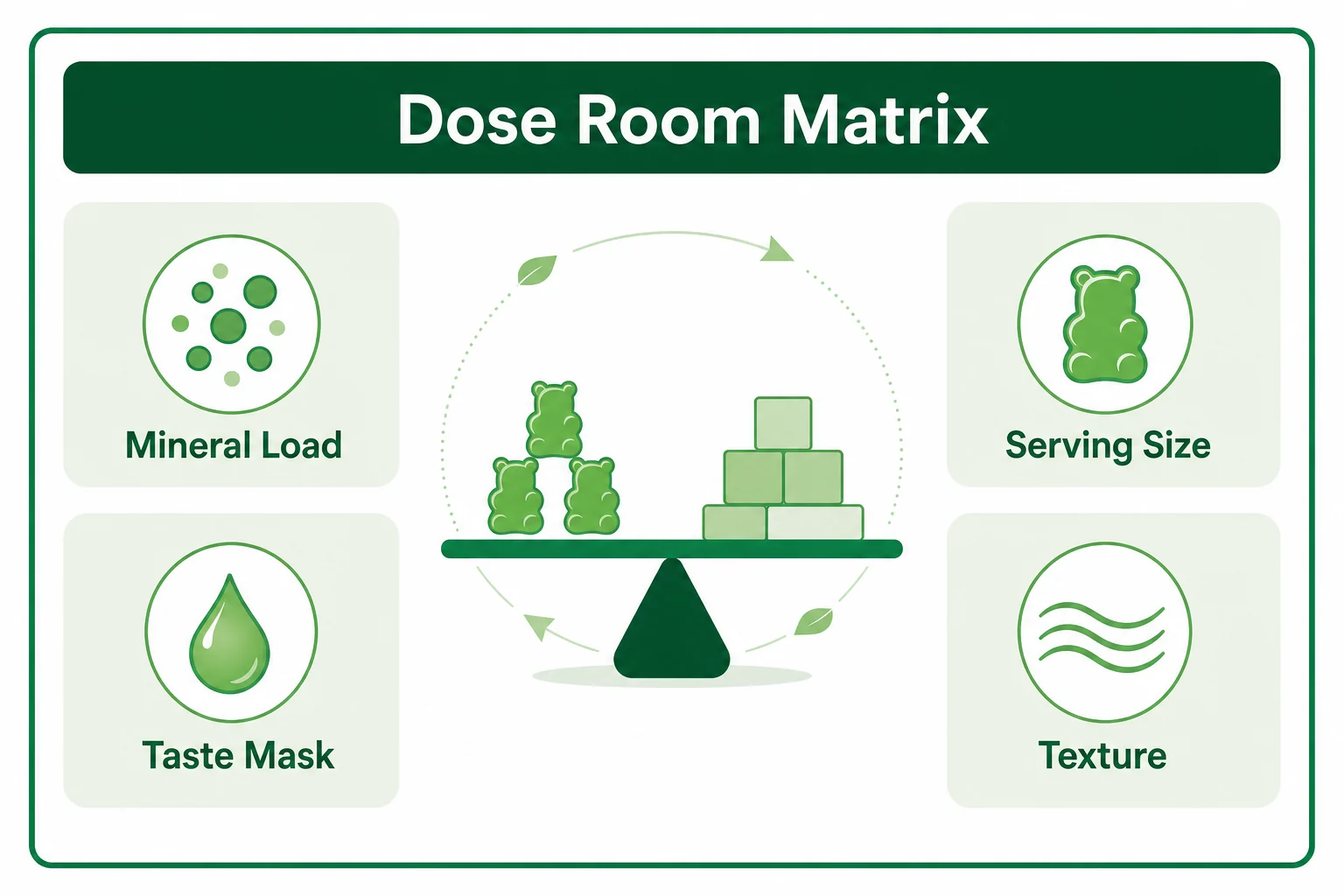
Elemental Magnesium Load and Serving Size Limits
The first feasibility gate is the elemental magnesium target. A brand may want a strong label claim, but a gummy has less room than a powder scoop and less hiding power than a capsule. If the target amount is too high, the formula may require a large gummy, multiple gummies per serving, or a compromise in taste and texture.
This is why I do not recommend starting sample work with only a front-label idea. The brief should specify the raw material, elemental magnesium target, serving count, gummy weight, taste tolerance, label path, and market requirement before the sample request is sent.
A useful way to think about dose feasibility is not "How much magnesium glycinate can we add?" It is "How much finished gummy structure remains after the mineral load is added?" A raw material with a lower elemental percentage requires more powder to reach the same label amount. The exact math must come from the supplier COA, not from a generic online number.
This is also where "best form" searches need a formulation answer. A brand comparing types of magnesium supplement should ask how much raw material is needed to reach the target elemental magnesium amount, whether that amount can be dispersed in the gummy base, and whether the final serving still tastes and feels like a product people would take daily.
| Dose planning item | What to confirm before sampling |
|---|---|
| Elemental magnesium target | Amount per gummy and amount per serving. |
| Raw material percentage | Supplier-confirmed elemental magnesium per gram. |
| Serving count | One gummy, two gummies, or more per daily serving. |
| Gummy weight | Whether the mold and piece size can carry the active load. |
| Sensory tolerance | Expected bitterness, mineral note, chalkiness, or aftertaste. |
| Commercial economics | Cost per serving, bottle count, and consumer value perception. |
A two-gummy serving may be more realistic than forcing everything into one piece. However, that decision affects cost, bottle count, serving economics, and consumer perception. If the serving size feels too high, the product may lose the convenience advantage that made the gummy attractive in the first place.
The better discussion is not only whether the formula can be made once in a lab. It is whether it can be made consistently in commercial production. Mineral dispersion, deposit consistency, drying behavior, and final moisture all matter when the active load is meaningful.
Taste, Texture, and Mineral Sensory Challenges
Minerals can create a sensory problem before they create a production problem. Magnesium materials may bring bitterness, dryness, chalkiness, or a lingering mineral note.[^6] In a gummy, that sensory load is exposed because the product is chewed and held in the mouth.
Flavor masking should be planned early. Strong fruit systems, acid balance, sweetness profile, and sometimes a layered flavor approach may help. But flavor cannot solve everything. If the mineral load is too high for the gummy matrix, the result may still taste heavy or feel gritty.
Texture is the second issue. A mineral-loaded gummy can become firmer, drier, softer, or less elastic than the brand expects depending on the raw material and gummy base. It may also behave differently during drying and storage. If the formula uses sugar-free sweeteners, vegan pectin, or a clean-label acid system, the challenge can increase because each choice changes water activity, chew, and stability.[^5]
In production, I would watch these details during sampling:
| Sensory checkpoint | Practical question |
|---|---|
| First bite | Does the gummy feel too hard, dusty, or dense? |
| Chew phase | Does the mineral note appear as the gummy breaks down? |
| Aftertaste | Does bitterness or dryness remain after swallowing? |
| Surface condition | Does the gummy sweat, stick, sand poorly, or dry unevenly? |
| Batch repeatability | Does the active remain evenly dispersed from batch to batch? |
These checks sound simple, but they help avoid a common mistake: approving a sample because the label idea is attractive, then discovering later that the eating experience cannot support repeat purchase.
Pectin vs Gelatin Considerations for Mineral Gummies
Pectin and gelatin can both be used in gummy development, but they behave differently.[^3] For a mineral gummy, the choice should not be made only from a vegan or traditional positioning angle. It should also be made from the active load, acidity, texture goal, processing window, and shelf-life expectation.
Pectin is often attractive for vegan and clean-label positioning. It can support a firmer bite and a fruit-forward profile. However, pectin systems are sensitive to pH, soluble solids, mineral interaction, and processing conditions.[^4] If your team is comparing base systems, the same decision logic also applies to broader pectin vs gelatin gummies planning. When mineral ingredients are involved, the formula team should check whether the mineral form affects gelation, texture, or stability.
Gelatin usually gives a more elastic chew and familiar gummy texture. It may be easier for some sensory targets, but it does not fit vegan positioning and may not match every clean-label or religious dietary requirement. If the magnesium product is aimed at women, men, sports, sleep, or general wellness, the gelling system should match both the market position and the technical reality.
| Decision factor | Pectin gummy | Gelatin gummy |
|---|---|---|
| Vegan positioning | Strong fit | Not suitable. |
| Texture | Shorter, firmer bite | Elastic, chewy bite. |
| Acid sensitivity | Needs careful control | Generally more forgiving. |
| Mineral interaction | Needs compatibility check | Still needs dispersion and sensory check. |
| Clean-label story | Often stronger | Depends on brand positioning. |
| Processing control | pH and solids are critical | Temperature and bloom strength are critical. |
For magnesium glycinate gummies, I would not choose pectin or gelatin in isolation. I would test the mineral load, flavor system, moisture target, and packaging together, because the format decision affects the whole product.
Where Sleep, Stress, and Relaxation Claims Become Label Risk
Search demand often points toward sleep and stress, but a supplement brand cannot turn every consumer phrase into a safe label claim.
Magnesium gummies may be positioned around general wellness or relaxation support only with careful wording and review. Brands should avoid disease-oriented, guaranteed sleep, mood-outcome, stress-outcome, or recovery-outcome claims unless the exact wording is properly substantiated and legally reviewed.
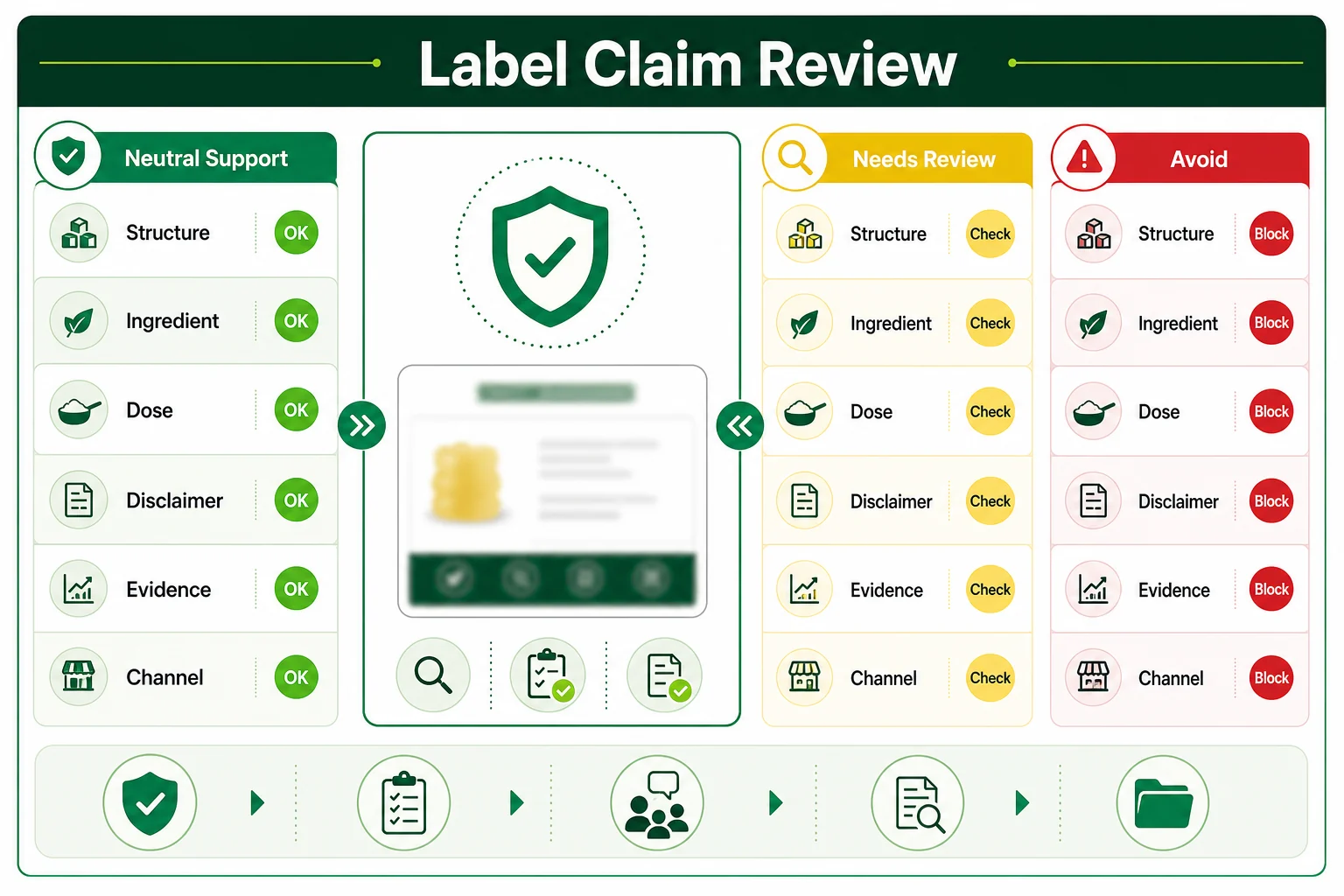
Safer Structure-Function Claim Boundaries for Supplement Brands
The commercial temptation is clear. Consumers search for magnesium stress supplement, magnesium supplements for stress relief, and similar terms. Product teams want to meet that demand. The problem is that search language is not the same as label language.
For a supplement brand, safer wording usually stays closer to normal structure-function concepts[^7], such as supporting normal muscle function, supporting a normal relaxation routine, or contributing to general wellness when the formula and substantiation support it. Even then, the exact words should be reviewed against the target market's rules.
Educational copy can explain why consumers are interested in magnesium glycinate supplements, but the brand should not imply disease-oriented outcomes, sleep-disorder resolution, deficiency correction, or guaranteed recovery outcomes. Those statements move into higher-risk territory and can create problems for advertising, marketplace approval, and regulatory review.
| Higher-risk wording direction | Safer planning question |
|---|---|
| Disease-oriented mood wording | Can the brand discuss a relaxation routine without disease language? |
| Sleep-disorder wording | Can the brand stay with general sleep-support positioning only if substantiated? |
| Guaranteed stress-outcome wording | Can the brand avoid guaranteed outcomes and keep wording conservative? |
| Deficiency-correction wording | Is the product intended for general supplementation, not diagnosis or disease-outcome language? |
| Best absorbed | Does the raw material supplier support the exact wording? |
I prefer to separate three layers during development: consumer search demand, education copy, and final label claims. They should inform each other, but they should not be handled as the same document.
What Brands Should Avoid Saying Without Strong Evidence
Brands should be especially careful with absolute language. Absolute or disease-oriented wording, guaranteed outcomes, unsupported clinical-strength phrasing, superiority language, and expert-endorsement wording can create risk if the proof does not support the exact claim. Magnesium also connects to medication interaction and intake discussions, so consumer safety language should be handled carefully.
A gummy brand should also avoid making the format itself sound medically superior. A gummy may be easier to take and more enjoyable for some users, but that does not automatically mean it is more effective than capsules, powders, or tablets. If brand copy compares formats, the comparison should focus on usability, dose feasibility, and product experience, not unsupported efficacy.
The same caution applies to demographic claims. A magnesium glycinate supplement for men or women may use positioning, flavor, packaging, or supporting nutrients to fit a target buyer, but the product should not imply that one demographic receives guaranteed outcomes unless the formula and claim support that statement.
Before final label approval, a brand should review:
| Review area | What to check |
|---|---|
| Front label | Does it avoid disease-oriented wording? |
| Supplement facts | Does elemental magnesium match the formula and serving size[^8]? |
| Structure-function claims | Are they conservative and substantiated? |
| Directions | Are serving instructions clear and not medical advice? |
| Warnings | Are market-appropriate cautions included? |
| Advertising copy | Does it avoid stronger claims than the label? |
| Marketplace listing | Does the online copy match approved claim boundaries? |
This is not only a legal step at the end. It should influence the formula brief from the beginning, because an unrealistic claim target can push the product toward an unrealistic dose target.
Formula Checks Before Sampling a Magnesium Glycinate Gummy
Sampling should not begin with flavor alone. A mineral gummy needs a complete formula brief before the first trial.
Before sampling a magnesium glycinate gummy, brands should confirm raw material identity, elemental dose, serving size, taste masking, gelling system, sweetener choice, acid balance, packaging direction, and claim boundaries. This makes the sample useful instead of merely attractive.

Raw Material Form, Purity, and Compatibility
Raw material selection is the foundation. The brand should confirm whether the ingredient is magnesium glycinate, magnesium bisglycinate, a buffered form, or a blend. The supplier documents should show assay, heavy metal limits, microbiological specifications, allergen status, country-of-origin details when needed, and any quality documents required for the target market.
Compatibility matters because a gummy is a heated, acidic, moisture-sensitive food matrix. The active ingredient must survive the process and remain evenly distributed. It also must not destabilize the gel system or create unacceptable sediment, grittiness, or taste.
A basic raw material checklist should include:
| Raw material checkpoint | Why it matters |
|---|---|
| Ingredient identity | Supports accurate label naming. |
| Elemental magnesium percentage | Determines real serving dose. |
| Assay method | Supports finished-product verification. |
| Heavy metal limits | Important for mineral ingredients. |
| Particle size or dispersion behavior | Affects mouthfeel and uniformity. |
| Heat and pH compatibility | Affects processing and stability. |
| COA availability | Supports procurement and quality review. |
| Allergen and dietary status | Supports vegan, clean-label, or market claims. |
I would also ask whether the supplier has experience with gummy or chewable applications. A raw material that works in capsules may not behave the same way in a gummy system. The best choice is not only the most marketable ingredient name. It is the ingredient that can meet label, sensory, and production requirements together.
For a form-comparison brief, the raw material file should make the magnesium story auditable:
| Form-selection file | Why it belongs in the buyer brief |
|---|---|
| Supplier specification | Confirms the exact magnesium form, carriers, flow agents, and naming limits. |
| Elemental magnesium calculation | Shows how the label amount connects to real raw material load. |
| Application history | Indicates whether the material has been used in gummies, chews, powders, tablets, or capsules. |
| Sensory notes | Helps predict bitterness, mineral note, dryness, grit, and flavor masking needs. |
| Compatibility notes | Flags pH, heat, water activity, pectin, gelatin, or coating concerns before sampling. |
| Claim support | Keeps absorption, sleep, stress, and relaxation wording inside the evidence boundary. |
Sweetener, Flavor, Acid, and Texture Balance
A magnesium gummy has to taste good enough for daily use. That means the sweetener system, flavor, acid profile, and texture must be built around the mineral load, not selected afterward.
Fruit flavors often help cover mineral notes. Citrus, berry, tropical, and mixed-fruit profiles may work depending on the raw material. However, acid level should be controlled carefully because it affects both taste and gel behavior. Too much acid can create a sharp flavor and weaken texture. Too little acid can make the gummy taste flat and fail to cover mineral notes.
Sweetener choice also affects production. Sugar-based gummies usually provide familiar texture and processing behavior. Sugar-free gummies may support a specific market position, but they can introduce different moisture, crystallization, warning, and texture considerations. A vegan pectin system adds another technical layer.
For a development brief, I would define the target like this:
| Formula area | Buyer decision |
|---|---|
| Sweetener system | Sugar, reduced sugar, sugar-free, or blended approach. |
| Flavor direction | Fruit profile strong enough to cover mineral notes. |
| Acid balance | Enough brightness without damaging texture. |
| Gelling system | Pectin, gelatin, or another system based on positioning and compatibility. |
| Coating | Sanded, oiled, or clean surface depending on stability and brand style. |
| Color | Natural or conventional color based on market requirements. |
A good sample should not only taste acceptable on day one. It should still make sense after stability checks, packaging tests, and commercial costing.
Serving Format: Single Gummy, Two-Gummy Serving, or Blend Formula
Serving format is a commercial decision as much as a technical decision. One gummy per serving sounds simple, but it may not carry enough elemental magnesium without hurting taste or texture. Two gummies may solve dose feasibility, but it changes the bottle count, cost per serving, and consumer expectation.
A blend formula can also be considered. Some brands may combine magnesium glycinate with other nutrients or botanicals for a broader wellness position. That can improve the product story, but it also uses formula space and may add more claim risk. Every added active needs compatibility, sensory, label, and documentation review.
| Format | Best fit | Main risk |
|---|---|---|
| Single gummy | Low-to-moderate mineral target and simple daily format. | May underdeliver expected magnesium amount. |
| Two-gummy serving | Better dose flexibility and taste balance. | Higher cost and larger daily serving. |
| Multi-active blend | Broader wellness positioning. | More compatibility and claim complexity. |
| Capsule or powder instead | Higher dose target or less sensory tolerance. | Less gummy-format appeal. |
For many brands, the honest answer may be that a gummy is possible, but not at the same dose expectation as a capsule or powder. That is not a failure. It is a positioning decision. A lower-dose gummy can still be useful if the brand communicates clearly and avoids overpromising.
Testing and Quality Documentation Brands Should Prepare
A mineral gummy needs documentation from raw material intake through finished product release, not only a good-tasting sample.
Brands should prepare COAs, assay expectations, heavy metal checks, finished-product testing, stability review, and packaging controls for magnesium glycinate gummies. These documents help connect the marketing promise to a product that can be produced and released consistently.
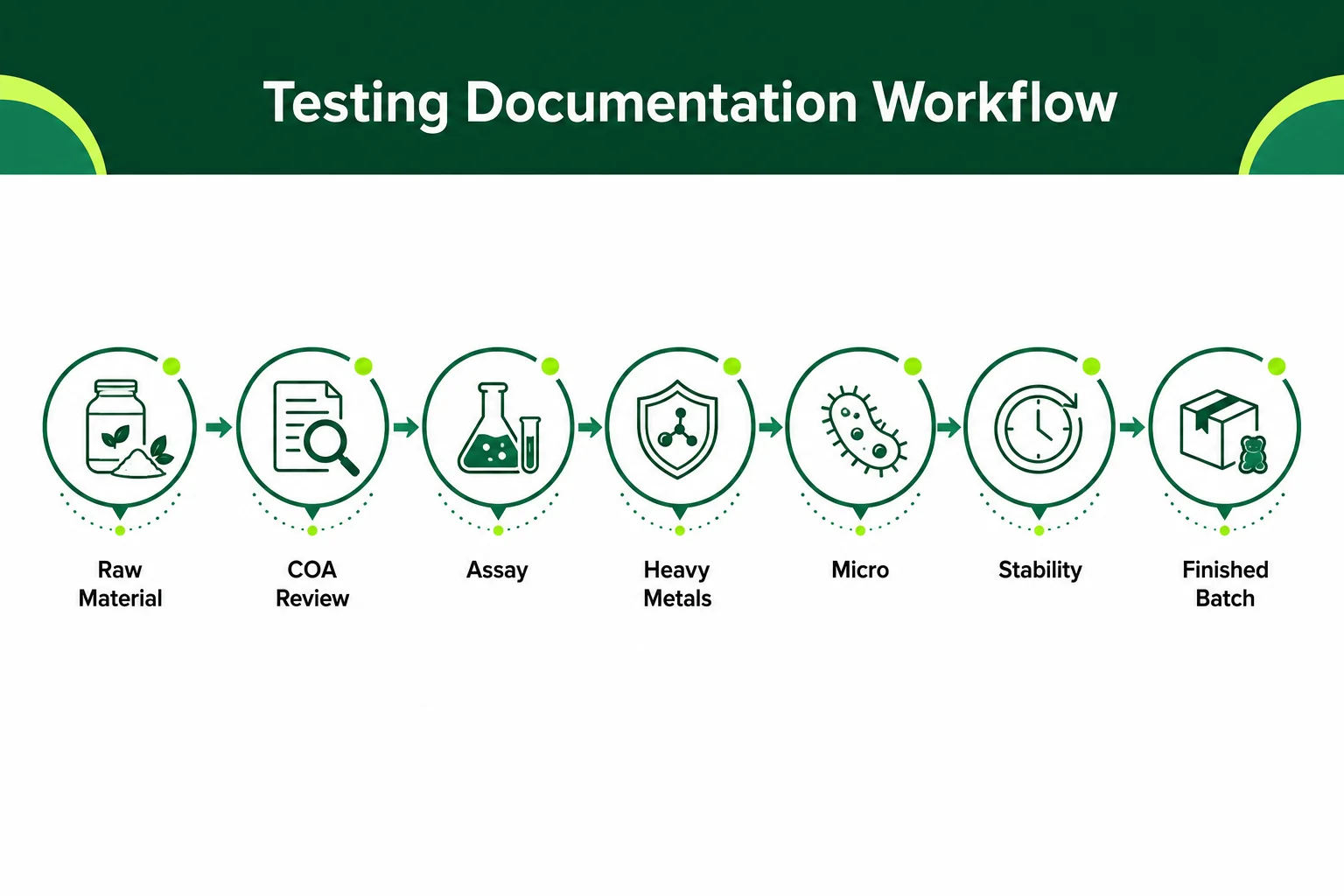
Assay, COA, Heavy Metals, and Finished-Product Testing
Mineral supplements require careful quality review because the active is measurable and the raw material may carry specific impurity concerns. A brand should not rely only on a supplier sales sheet. The documentation chain should include raw material COA, identity confirmation, assay expectations, and heavy metal limits.
Finished-product testing is also important.[^10] The brand should know whether the final gummy meets the intended elemental magnesium amount within acceptable tolerance. Because gummies are deposited pieces, uniformity matters. The production team should confirm that mineral dispersion is stable enough across the batch.
This becomes more important when the brief compares forms. If the brand changes from glycinate to citrate, oxide, a sucrosomial material, or a blend after sampling starts, the testing file may need to be reviewed again. The assay method, ingredient identity, label name, heavy-metal review, and finished-product specification should follow the actual raw material used in the batch.
A documentation package may include:
| Document or test | Purpose |
|---|---|
| Raw material COA | Confirms ingredient identity and key specifications. |
| Assay data | Supports the active amount used in formulation. |
| Heavy metal test | Especially relevant for mineral materials. |
| Microbiology test | Supports finished product safety and release. |
| Finished-product assay | Confirms magnesium content in the final gummy. |
| Batch record | Shows production steps and traceability. |
| Stability data | Supports shelf-life and packaging decisions. |
| Label review file | Aligns claims, supplement facts, and warnings. |
I would connect testing planning to the formula brief early. If the active target, serving size, or claim language changes after sampling, the documentation path may also change. That can slow down launch timing and create avoidable rework.
Stability, Moisture, and Packaging Considerations
Gummies are sensitive to moisture. A magnesium gummy adds another factor because the mineral load can affect texture, water behavior, and sensory stability. Packaging should be selected to protect the gummy, not only to match brand aesthetics.
Bottle, pouch, jar, blister, or single-pack choices each create different moisture and oxygen exposure. Desiccant use, seal quality, headspace, count per container, and storage instructions can all matter. A product that tastes good in an open sample bag may behave differently after weeks in a retail package.
Stability review should look at appearance, texture, taste, moisture, active content, and microbial condition over time. If the brand plans to sell through e-commerce, retail, or warmer shipping routes, the packaging decision should also consider transit stress.
A practical packaging review should ask:
| Packaging question | Why it matters |
|---|---|
| Will the gummy stick or sweat in the selected container? | Protects consumer experience. |
| Does the formula need a desiccant? | Supports moisture control. |
| Is the seal strong enough for the channel? | Reduces storage and shipping risk. |
| Does the package support the serving count? | Controls cost and label clarity. |
| Can the product pass stability expectations? | Supports shelf-life planning. |
| Does packaging fit the claim and market position? | Aligns premium, clean-label, or family-use positioning. |
For Talvenda-style development, this is where production-line thinking matters. The formula, active loading, drying, packaging, and documentation should be planned as one system. If they are handled separately, the product may look ready at sample stage but become unstable or hard to scale later. Brands that want an equipment-side view can also review SaintyCo's gummy making machine guide as production context before they discuss commercial scale-up.
Is Magnesium Glycinate Right for Your Gummy Supplement Line?
Magnesium glycinate gummies can be a strong concept, but only when the brand accepts the format's real limits.
Magnesium glycinate gummies make sense when the target dose, sensory profile, label claims, testing plan, and packaging can work together. If the desired magnesium dose is too high or the claim strategy is too aggressive, capsules, powders, or a different formula may be easier.
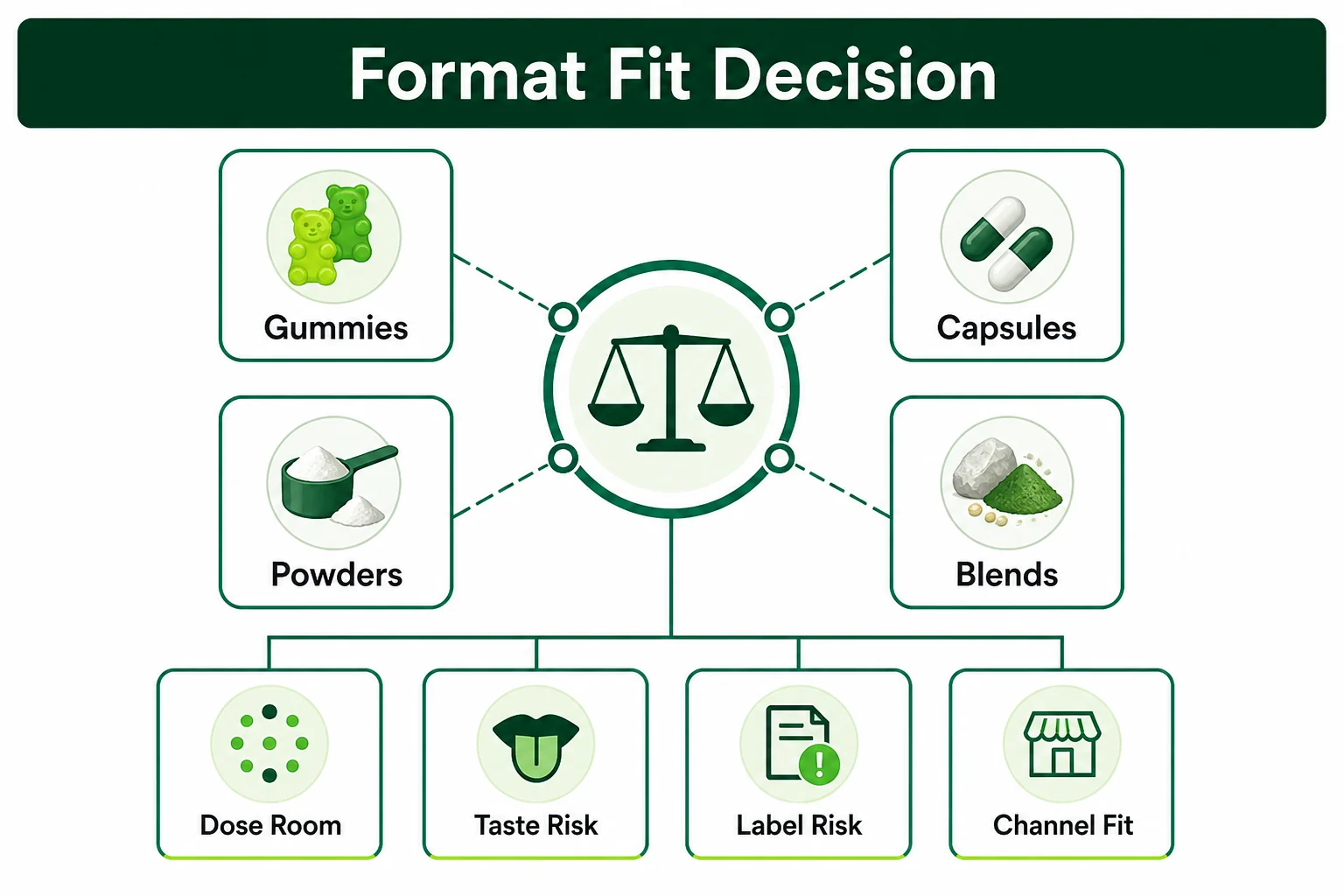
When Gummies Make Sense
Gummies make sense when the brand wants convenience, taste, daily routine appeal, and a softer consumer entry point into magnesium supplementation. They can work well for general wellness positioning, lifestyle packaging, and product lines where the consumer values experience as much as dose strength.
The format is especially reasonable when the product brief accepts a realistic elemental magnesium target, possibly a two-gummy serving, and conservative claim language. It also helps when the brand is willing to invest in flavor masking, texture testing, packaging review, and stability work instead of viewing the gummy as a quick copy of a capsule product.
A magnesium glycinate gummy is usually a better fit when:
| Brand condition | Why it supports gummies |
|---|---|
| Moderate dose target | Easier to balance taste and texture. |
| Clear wellness positioning | Avoids overclaiming medical outcomes. |
| Strong flavor direction | Helps cover mineral notes. |
| Flexible serving size | Allows two-gummy serving if needed. |
| Quality documentation plan | Supports active and heavy metal review. |
| Packaging budget | Protects moisture and shelf-life expectations. |
| Gummy-focused product line | Keeps the consumer experience consistent across SKUs. |
This is also where a contract manufacturing partner can help. Talvenda can support brands with formula review, sample planning, gummy format feasibility, flavor and texture discussion, packaging coordination, quality documentation, and scale-up planning. If the team is also comparing equipment routes, GummyGenix's gummy manufacturing equipment overview can help frame deposit, drying, and line-planning questions. The goal is not to force every idea into a gummy. The goal is to find the right path for the product and the market.
When Capsules, Powders, or Other Formats May Be Easier
Capsules, powders, tablets, or chewables may be easier when the brand wants a higher magnesium dose, a simpler supplement facts panel, lower sensory risk, or stronger format efficiency. A powder scoop can carry more material. A capsule can hide mineral taste. A tablet may support different dose economics. For a wider format comparison, brands can also review gummies vs capsules supplements before locking the route. Those formats may be less enjoyable for some consumers, but they can be more practical for certain product goals.
The brand should consider another format when the gummy brief requires too many compromises. If the dose must be high, the taste masking becomes heavy, the texture is unstable, the serving size becomes inconvenient, or the claim language depends on aggressive wellness outcomes, the product may be better positioned outside gummies or redesigned as a lower-dose gummy with clearer expectations.
My final check is simple:
| Decision question | If the answer is no |
|---|---|
| Can the elemental magnesium target fit the gummy serving? | Lower the dose, change serving size, or consider another format. |
| Can the mineral taste be controlled? | Rework flavor system or reconsider format. |
| Can the texture stay stable after packaging? | Recheck gelling system, drying, and moisture control. |
| Can the label claims stay conservative? | Rewrite claim strategy before sampling. |
| Can testing support the final product? | Build the documentation plan before launch. |
| Can the brand explain the format honestly? | Avoid forcing a gummy when capsules or powders fit better. |
Quick Buyer Questions Before Choosing a Magnesium Gummy Format
Do magnesium gummies work? They can be a viable supplement format when the formula delivers the intended magnesium amount, stays stable through shelf life, and is supported by testing and label documentation. The format itself should not be presented as proof of stronger results.
Are magnesium glycinate gummies effective? The safer commercial answer is that effectiveness depends on the elemental magnesium target, raw material quality, serving size, finished-product assay, and whether the consumer can realistically follow the serving directions. Brands should avoid promising sleep, stress, or relaxation outcomes unless the claim file supports the exact wording.
What is the best form of magnesium supplement for gummies? For gummy development, the best form is the one that fits the dose, taste, texture, documentation, packaging, and claim strategy. Magnesium glycinate may be attractive for wellness positioning, but citrate, oxide, blends, or another format may be more practical depending on the brief.
Is magnesium citrate easier to formulate than magnesium glycinate in gummies? Not automatically. Citrate may fit some positioning and acid-balance discussions, but the team still needs to test mineral note, dose target, dispersion, pH effect, texture, and finished-product assay in the actual gummy base.
Why might magnesium oxide still appear in supplement formulas? Magnesium oxide may be considered when elemental magnesium percentage, cost, or formula-space pressure matters. In gummies, brands should still review mouthfeel, consumer perception, dispersion, label wording, and whether the finished product can explain the choice without making unsupported absorption claims.
How should brands compare sucrosomial magnesium vs magnesium glycinate? Start with supplier documentation, elemental magnesium contribution, sensory behavior, formula compatibility, and label-review support. If the comparison is mainly absorption-focused, it should be verified with evidence before it appears in consumer-facing copy.
What should a brand ask a gummy manufacturer before choosing a magnesium form? Ask for a feasibility review covering elemental magnesium target, raw material load, gummy weight, taste masking, pectin or gelatin fit, moisture and packaging plan, finished-product assay, COA, heavy-metal review, and claim boundaries.
Can a magnesium gummy compare forms without making sleep or treatment claims? Yes. The comparison can stay on formulation and quality: dose room, sensory load, dispersion, stability, testing, label identity, and packaging. Sleep, stress, relaxation, or treatment-style wording should only be used when the exact claim is properly supported and reviewed.
Magnesium glycinate supplements in gummy format can be commercially useful when the brand views the gummy as a real production system. Start with dose feasibility, raw material documentation, taste masking, stability, packaging, and claim review. If your team is weighing mineral load, flavor masking, finished-product testing, and moisture-sensitive packaging, Talvenda can help review the gummy route and turn the idea into a clearer gummy manufacturing sample brief before production planning.
Conclusion
Magnesium glycinate supplements can fit gummy format when dose room, taste, texture, testing, packaging, and label boundaries are planned together before sampling.
Magnesium glycinate gummies can become difficult when mineral load, taste masking, texture, packaging, and claim language are not reviewed together. As a private label gummy manufacturing partner, Talvenda can help brands assess whether the project fits low-MOQ market-tested in-stock gummies, stock formula modification, or custom gummy development before committing to a complex brief. Your team gets a clearer sample path with sample development, packaging and label support, documentation and testing expectations, and scale-up support considered from the start. For a practical feasibility discussion, contact Talvenda through the project inquiry form.
[^1]: "Magnesium Glycinate | C4H8MgN2O4 | CID 84645 - PubChem - NIH", https://pubchem.ncbi.nlm.nih.gov/compound/Magnesium-Glycinate. A chemical reference or peer-reviewed review can substantiate that magnesium glycinate/bisglycinate refers to magnesium coordinated with glycine ligands, although commercial ingredient names may still vary by supplier specification. Evidence role: definition; source type: paper. Supports: Magnesium glycinate and magnesium bisglycinate both describe magnesium associated with glycine.. Scope note: Supports the chemical meaning of the terms, not whether any specific commercial raw material is correctly labeled. [^2]: "Magnesium - Health Professional Fact Sheet", https://ods.od.nih.gov/factsheets/Magnesium-HealthProfessional/. NIH Office of Dietary Supplements materials describe magnesium intake recommendations and supplement amounts in terms of magnesium itself, supporting the distinction between elemental magnesium and the total weight of a magnesium compound. Evidence role: definition; source type: government. Supports: Supplement formulation should distinguish total compound weight from the amount of elemental magnesium delivered.. Scope note: This supports nutritional labeling context rather than formulation feasibility in gummies. [^3]: "Hydrocolloids as thickening and gelling agents in food - PMC - NIH", https://pmc.ncbi.nlm.nih.gov/articles/PMC3551143/. Food hydrocolloid references describe pectin and gelatin as distinct gelling agents with different gelation mechanisms and textural properties, supporting the general distinction in gummy formulation. Evidence role: definition; source type: encyclopedia. Supports: Pectin and gelatin are both gummy gelling agents but have different functional behavior.. Scope note: This supports the general behavior of the hydrocolloids, not a complete comparison for all commercial gummy processes. [^4]: "Pectin Hydrogels: Gel-Forming Behaviors, Mechanisms, and Food ...", https://pmc.ncbi.nlm.nih.gov/articles/PMC10530747/. Food chemistry references on pectin gelation support that pH, soluble solids, cations, and processing conditions influence pectin gel formation and stability; the evidence may vary by pectin type such as high-methoxyl or low-methoxyl pectin. Evidence role: mechanism; source type: paper. Supports: Pectin gummy systems require control of pH, soluble solids, mineral interactions, and processing conditions.. Scope note: The degree and direction of sensitivity depend on pectin type and formulation conditions. [^5]: "Moisture and shelf life in sugar confections - PubMed", https://pubmed.ncbi.nlm.nih.gov/20112158/. Food science references on water activity and confectionery stability support that sweetener systems, acids, and hydrocolloids influence moisture behavior, texture, and shelf stability; this is broad formulation support rather than direct proof for magnesium gummies. Evidence role: mechanism; source type: education. Supports: Sweetener, gelling, and acid choices can affect water activity, texture, and stability in gummies.. Scope note: The support is general to confectionery or hydrocolloid systems and may not isolate sugar-free, pectin, and clean-label acid variables together. [^6]: "Sensory Attributes of Complex Tasting Divalent Salts Are Mediated ...", https://pmc.ncbi.nlm.nih.gov/articles/PMC6666243/. Sensory and taste-science literature on mineral salts supports that divalent mineral salts, including magnesium salts, can contribute bitter or metallic/mineral taste perceptions; it may not describe every texture descriptor such as chalkiness for each magnesium form. Evidence role: mechanism; source type: paper. Supports: Magnesium-containing mineral ingredients can create bitterness and mineral sensory notes.. Scope note: Evidence may support bitterness and mineral taste more directly than dryness or chalkiness across all magnesium ingredients. [^7]: "Structure/Function Claims - FDA", https://www.fda.gov/food/nutrition-food-labeling-and-critical-foods/structurefunction-claims. FDA guidance explains that dietary supplement structure/function claims may describe effects on normal body structure or function, while disease claims are regulated differently. Evidence role: definition; source type: government. Supports: Safer supplement wording generally stays within normal structure-function concepts rather than disease claims.. [^8]: "Dietary Supplement Labeling Guide: Chapter IV. Nutrition Labeling", https://www.fda.gov/food/dietary-supplements-guidance-documents-regulatory-information/dietary-supplement-labeling-guide-chapter-iv-nutrition-labeling. FDA dietary supplement labeling regulations require Supplement Facts panels to declare the quantitative amount of dietary ingredients per serving, and NIH materials distinguish magnesium intake amounts from the chemical forms used in supplements. Together, these sources support the need to verify elemental magnesium per serving, though they do not validate any individual formula calculation. Evidence role: general_support; source type: government. Supports: Before final label approval, a brand should check that elemental magnesium matches the formula and serving size.. Scope note: Supports the labeling principle; product-specific verification requires formula records and analytical or supplier documentation. [^9]: "General Chapter Elemental Contaminants in Dietary Supplements", https://www.uspnf.com/notices/general-chapter-elemental-contaminants-dietary-supplements. FDA and USP materials on dietary supplement quality address identity, purity, strength, composition, and contaminant controls, supporting the relevance of assay and heavy-metal review for mineral ingredients. Evidence role: expert_consensus; source type: government. Supports: Mineral supplement raw materials should be reviewed for assay and heavy-metal specifications.. Scope note: These sources establish quality-control expectations broadly and may not prescribe a unique testing package for magnesium glycinate specifically. [^10]: "21 CFR Part 111 -- Current Good Manufacturing Practice in ... - eCFR", https://www.ecfr.gov/current/title-21/chapter-I/subchapter-B/part-111. Dietary supplement GMP rules require manufacturers to establish finished-product specifications for identity, purity, strength, composition, and contaminant limits, supporting the role of finished-product testing in release decisions. Evidence role: expert_consensus; source type: government. Supports: Finished-product testing is important for dietary supplement quality assurance.. Scope note: The rule permits different verification approaches and does not require the same test panel for every finished product.