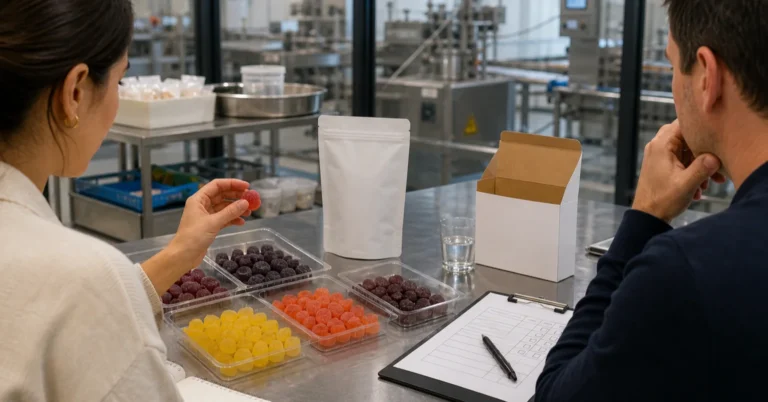


Supplement quality assurance is not one certificate, one COA, or one finished-product test.
For brand owners, supplement quality assurance means checking whether each quality document proves the right launch decision: ingredient approval, batch release, label claim, shelf life, and channel trust.
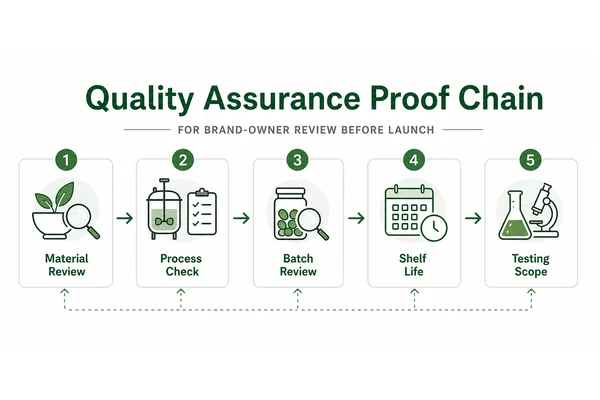
Before you approve a manufacturer, ask what each document actually proves. A facility certificate, raw-material COA, finished-batch test, and stability record all answer different questions.
What Does Supplement Quality Assurance Mean Before Launch?
Supplement quality assurance connects product safety, label accuracy, manufacturing controls, and launch readiness before your first commercial batch ships.
A useful supplement quality assurance review helps brands confirm that the product being launched matches the formula, label, batch records, and shelf-life assumptions.

Why quality proof matters for brand owners
For a supplement brand, quality assurance is a business protection system as much as a production requirement. It helps you decide whether a manufacturer can support the product you plan to sell, the claims you plan to make, and the channels you plan to enter.
The practical question is not only "What quality system applies?" A better question is: "Can they show the proof chain for this product, this formula, this serving size, this packaging, and this batch release process?"
That proof chain usually includes supplier qualification, raw-material specifications, in-process controls, finished-batch testing, stability thinking, and documentation that can be reviewed before launch. For a new brand, these records help reduce surprises after sampling, packaging design, retailer onboarding, influencer promotion, or first shipment.
Where poor quality creates label, batch, and consumer risk
Quality gaps often show up as business problems. A finished product may not match the label claim. A botanical or mineral ingredient may not be sufficiently verified. A microbial or contaminant issue may delay release. A gummy may change texture, moisture, or active level over storage.
Those risks can affect consumers, but they also affect the brand owner. They can trigger reformulation, relabeling, channel questions, refund requests, or loss of retailer confidence. The earlier the proof is requested, the easier it is to decide whether to proceed, revise the formula, adjust the claim, change packaging, or ask for additional testing.
Quality documents are only one part of launch readiness. If you are still mapping the full path from product idea to manufacturer selection, packaging, MOQ, and first batch planning, Talvenda's guide on how to start a supplement brand gives the broader launch checklist.
How GMP, 21 CFR 111, and certifications support due diligence
In the United States, dietary supplement manufacturing is governed by current good manufacturing practice requirements under 21 CFR Part 111. Those rules are not a marketing badge. They establish expectations for manufacturing controls, quality control operations, component handling, production records, packaging, labeling, and complaint records.[^1]
Certifications and audits can support due diligence, but they do not remove the need to review product-level proof. A facility may have a quality system, but your brand still needs to know how your formula is controlled, how your batch is released, and what evidence supports your label.
Talvenda's certifications page is the better place to review facility-level trust signals. The focus here is how brand owners should interpret quality proof before launch.
What Quality Documents Should a Manufacturer Provide?
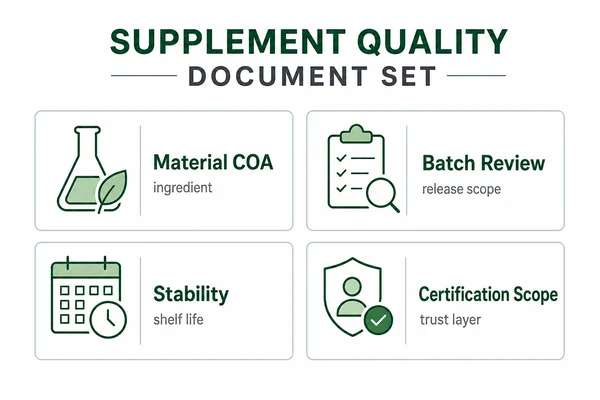
The right document set should connect raw materials, production controls, finished-product testing, and shelf-life expectations.
Manufacturer quality documents should show more than a single COA. Supplement brands should confirm whether each record covers raw ingredients, the released finished batch, packaging and label controls, or product quality through the supported shelf life.
Raw material specifications and supplier documentation
Raw-material documentation is the starting point. It helps confirm what enters production before your supplement becomes a finished product.
Useful records may include:[^2]
| Document | What it helps answer | Buyer caution |
|---|---|---|
| Material specification | What identity, purity, strength, and acceptance criteria are expected | Check that the specification matches the ingredient and dosage form you plan to use. |
| Supplier COA | What the supplier says about a material lot | A supplier COA is not the same as finished-product proof. |
| Ingredient identity review | Whether the material is what it claims to be | Botanicals, minerals, amino acids, and blends may need different verification approaches. |
| Allergen, contaminant, or microbiological information | Whether the material has relevant safety considerations | Requirements vary by ingredient, supplier, and product positioning. |
For procurement teams, the key is document traceability. The supplier, material name, lot number, specification, and intended formula should connect cleanly. If the document cannot be tied to your product, it may be poor launch evidence even if it looks official.
COA vs finished-batch testing: what each one proves
A certificate of analysis is often misunderstood. It may be issued for a raw material, a supplier lot, a bulk intermediate, or a finished product. The title "COA" alone does not tell you what was tested.
Use this distinction when reviewing a manufacturer:
| Proof type | Usually proves | Does not automatically prove |
|---|---|---|
| Raw-material COA | A supplier lot met listed criteria before production | The finished supplement still meets label claim after processing. |
| In-process record | Production followed defined checks during manufacturing | The released batch meets every finished-product specification. |
| Finished-batch test | A completed batch met selected release criteria | The product will remain within claim throughout shelf life unless stability is addressed. |
| Stability evidence | The product is expected to remain suitable over storage conditions | Every future batch will be identical without continued controls. |
| Third-party certification | Independent review against a program's criteria | Every brand claim, retail claim, or marketing statement is automatically supported. |
This is where many launch-readiness checks fail. A brand may receive a raw-material COA and assume it proves the final gummy, capsule, powder, or tablet. It does not necessarily do that.
How to check whether documents match your actual product
Before production, request documents that are specific enough to review. Match the document to the formula name, batch number, lot number, production date, ingredient identity, dosage form, package type, and label claim.
Ask these questions:
- Does the COA apply to a raw ingredient, a bulk blend, or the finished supplement?
- Does the finished-batch report cover the active ingredient listed on the label?
- Are the units, serving size, and target claim aligned with your label draft?
- Does the test date make sense for the batch and production timeline?
- Does the document identify the lab, method, specification, and result clearly?
- If the product has a shelf-life claim, what evidence supports it?
If a document cannot be matched to your actual product, use it as background information rather than launch approval evidence.
How Finished Product Testing Reduces Launch Risk
Finished product testing moves quality assurance closer to the product your customer will actually receive.
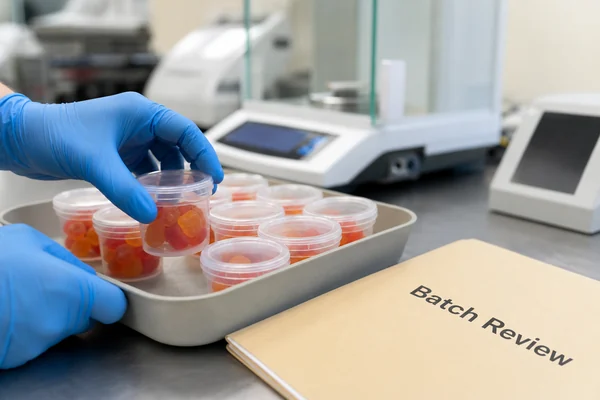
Finished-batch testing helps reduce launch risk by checking the completed product against selected specifications before release, especially for label claims and safety-sensitive attributes.
Finished batch testing and label-claim verification
Finished-batch testing is important because manufacturing can change the final product. Blending, heating, drying, coating, compression, filling, packaging, and storage conditions can all affect whether the finished product matches its intended specification.
For brand owners, the high-value question is label-claim verification. If the label says a serving provides a specific amount of an active ingredient, the release proof should support that claim within the applicable specification and tolerance approach.[^3]
This does not mean every product needs the same test package. It means the manufacturer should explain what is tested, why those tests are appropriate, and how the results support release.[^4]
Identity, potency, contaminant, and microbiological checks
Finished-product testing can include different categories depending on the formula, ingredient type, target market, and risk profile.
Common categories include:
| Test category | Buyer purpose | Example launch question |
|---|---|---|
| Identity | Confirm the product contains the intended ingredient or marker | How is ingredient identity verified for this formula? |
| Potency or assay | Support the label amount or active level | Does the finished batch support the label claim? |
| Heavy metals or contaminants | Reduce safety and channel risk | Are contaminant limits appropriate for this product and market? |
| Microbiology | Check microbial quality before release | Are results acceptable for the dosage form and packaging? |
| Physical attributes | Confirm format quality | Does texture, weight, appearance, or moisture meet the specification? |
The right mix depends on the product. A mineral gummy, sports supplement, probiotic product, and beauty supplement may require different evidence.
Why "appropriate tests" depend on formula, format, and claim type
There is no single universal testing checklist that fits every dietary supplement. Appropriate tests depend on the ingredients, dosage form, serving size, manufacturing process, packaging, shelf-life expectation, and claims.
A simple low-dose vitamin product may have a different proof need from a high-claim sports product. A botanical formula may require different identity thinking from a single-ingredient mineral product. A gummy may require more attention to heat exposure, moisture, acid balance, and texture than a capsule.
That is why brands should ask the manufacturer to explain the test rationale, not only send a certificate. The explanation often reveals whether the manufacturer understands the product risk or is only supplying generic paperwork.
Where Third-Party Certification Fits Into Supplement Quality Assurance
Third-party certification can strengthen trust, but it should sit inside a broader quality assurance review.
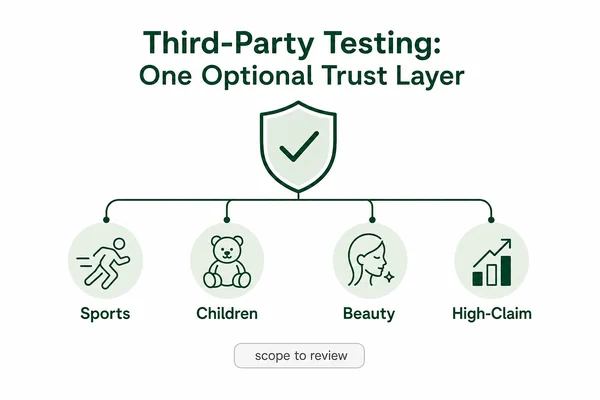
Third-party testing and certification can add credibility, especially for sensitive categories, but they do not replace product-specific document review and finished-batch evidence.
USP, NSF, Informed Choice, and other trust signals
Brand teams often see organizations such as USP, NSF, Informed Choice, FDA, NIST, and clinical or consumer education sources when they research supplement quality. That pattern matters because buyers want authority, independence, and quality proof.[^5]
For brand owners, the practical reading is this:
- USP-type verification can signal that a product or process has been reviewed against defined standards.
- NSF-type certification can support quality and consumer trust in certain categories.[^6]
- Informed Choice and similar programs are especially relevant where banned-substance risk is a concern.[^7]
- FDA information helps frame regulatory expectations, but FDA does not preapprove dietary supplement products before sale.[^8]
- Laboratory quality programs and testing resources help explain measurement reliability, but they should not turn a launch-readiness review into a lab SOP.[^5]
No one mark should be treated as required for every product. The right third-party path depends on your category, retail channel, target audience, budget, and risk tolerance.
When third-party testing matters most
Third-party testing becomes more valuable when buyers, channels, or consumers need additional confidence beyond manufacturer documentation.
It is especially relevant for:
- Sports nutrition products where athletes worry about prohibited substances.
- Children's supplements where parent trust is central.
- Beauty supplements with visible-result marketing pressure.
- High-claim products where label accuracy is heavily scrutinized.
- Retail or marketplace channels that ask for additional documentation.
- New brands that need a stronger trust story at launch.
For example, Talvenda's guide to third-party tested creatine gummies explains how third-party proof can matter for a specific sports supplement category. That is a different question from general facility certification.
Special caution for sports, children's, beauty, and high-claim supplements
Some categories create higher proof expectations even when the base manufacturing process is similar.
Sports supplements may need extra attention to banned-substance risk and athlete-facing claims. Children's products require careful label, serving, allergen, and packaging review. Beauty supplements often rely on active levels and visible-benefit language that should be handled with claim discipline. High-claim formulas may need clearer support for label amounts, test methods, and product stability.[^3]
In these cases, third-party testing can be part of the trust strategy. But the brand should still review whether the certification or test applies to the exact product, batch, claim, and launch market.
How Quality Assurance Applies to Gummy Supplement Manufacturing
Gummy supplements make quality assurance more practical and more complex because the delivery format affects active load, stability, and shelf life.
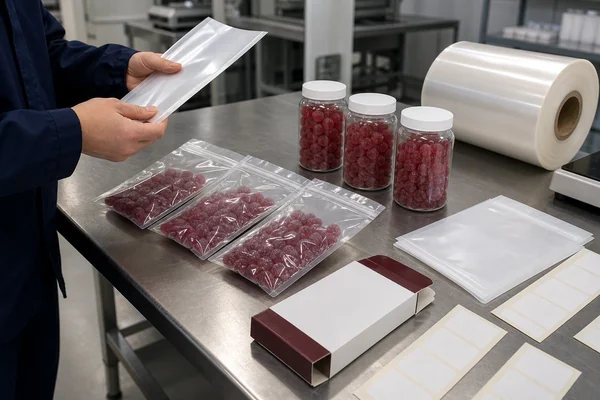
For gummy supplement manufacturing, quality assurance must connect formula feasibility, active loading, heat exposure, moisture control, packaging, and finished-product proof.
Active-load and serving-size constraints
Gummies are not empty carriers. Sweeteners, gelling systems, acids, flavors, colors, coatings, water activity, and active ingredients all compete for space and stability.
That means active loading is a quality question, not just a marketing decision. If the desired label claim is too high for the serving format, the product may face taste, texture, stability, or dosage-consistency issues. A manufacturer should be able to explain whether the requested active level is practical for the target gummy size and serving count.
If your quality review is moving from documents into production planning, Talvenda's gummy vitamin manufacturing page explains how active load, texture, packaging, batch control, and scale-up decisions connect in a real gummy project.
Stability, moisture, packaging, and shelf-life questions
Gummies are sensitive to moisture, heat, and storage conditions. A formula that looks acceptable during sampling may not behave the same way after shipping, warehousing, or months in consumer packaging.
For launch readiness, ask how the manufacturer thinks about:
- moisture migration and water activity
- texture change, sticking, or melting risk
- active degradation over time
- packaging barrier selection
- desiccant or bottle format decisions when relevant
- realistic shelf-life support
That is also why shelf-life planning should be connected to label dating early. Talvenda's guide to MFG date vs expiration date for supplements explains how production dates, expiration dates, and best-by language affect launch documentation.
Label claims, dosage tolerance, and finished-product proof
For gummies, a label claim should connect to formula feasibility and finished-product proof. If each serving claims a certain amount of vitamin, mineral, collagen, creatine, or botanical marker, the brand should understand how the manufacturer plans to support that amount at batch release and through the intended shelf life.
This does not require the brand owner to become a formulation engineer. It does require asking the right launch questions:
- Can this active level fit into the proposed gummy size and serving count?
- What finished-product test supports the active claim?
- How does the manufacturer handle dosage variation across pieces or servings?
- Does stability data support the intended shelf life?
- Does the packaging protect the product under expected storage conditions?
For smaller launches, Talvenda's low MOQ private label gummy supplements guide can help connect quality questions with practical production planning.
Manufacturer Questions to Ask Before Production
The best quality assurance conversation happens before purchase orders, label printing, and first commercial production.
Before production, ask your manufacturer which proof supports facility readiness, ingredient approval, finished-batch release, label claims, stability, packaging, and third-party trust.

Questions about GMP, certifications, and documentation scope
Start with the quality system, then move quickly to product-specific evidence.
Ask:
- What GMP system, audits, or certifications apply to the facility?
- Which certifications apply to the facility, which apply to a product, and which apply only to a program or process?
- Can you provide documentation relevant to this formula and dosage form?
- Who reviews and approves raw materials, production records, and finished-batch release?
- What documentation can be shared before sampling, before production, and after batch release?
- Are there any claim, formula, or packaging risks you see before launch?
The goal is not to collect the longest folder. The goal is to understand whether the manufacturer can explain the proof chain clearly.
Questions about COA, batch testing, and third-party labs
Next, ask how test evidence connects to the actual product.
Ask:
- Is the COA for a raw material, bulk material, or finished product?
- Does the finished-batch report test the active ingredients listed on our label?
- What methods and specifications are used for identity, potency, contaminants, and microbiology?
- Which tests are performed in-house and which are performed by an outside lab?
- Can we request third-party testing for this product or category?
- How are out-of-specification results investigated and documented?
- How will the batch number, lot number, production date, and test records connect?
These questions help separate generic paperwork from launch evidence.
Questions about stability, shelf life, and packaging readiness
Finally, ask whether the product can remain launch-ready after it leaves production.
Ask:
- What shelf life is reasonable for this formula and package?
- What evidence supports the proposed expiration date or best-by period?
- Does the product need special packaging, desiccant, barrier material, or storage conditions?
- Are there known risks for texture, color, flavor, potency, moisture, or sticking?
- What happens if stability data suggests a shorter shelf life than planned?
- How should we handle future batches if the formula, supplier, package, or active level changes?
These questions are especially important for gummies, probiotics, botanicals, sports products, and other formats where stability and claims can become launch constraints.
Conclusion
Supplement quality assurance is a launch-readiness proof chain, not a paperwork exercise.
As an OEM/ODM gummy manufacturer, Talvenda can help teams connect quality assurance with the right production route before sample approval. A clear gummy brief may fit low-MOQ market-tested in-stock gummies, stock formula modification, or custom gummy development depending on active load, packaging risk, finished-batch testing expectations, documentation scope, and scale-up support needed for quality-controlled production in GMP-certified and FDA-registered manufacturing facilities. Send the formula direction, claim position, package type, and testing expectations through the project inquiry form.
[^1]: eCFR, 21 CFR Part 111, Current Good Manufacturing Practice in Manufacturing, Packaging, Labeling, or Holding Operations for Dietary Supplements, https://www.ecfr.gov/current/title-21/chapter-I/subchapter-B/part-111/. This regulation sets the cGMP scope referenced here; it is not a Talvenda facility certification. [^2]: FDA, Current Good Manufacturing Practices (CGMPs) for Food and Dietary Supplements, https://www.fda.gov/food/guidance-regulation-food-and-dietary-supplements/current-good-manufacturing-practices-cgmps-food-and-dietary-supplements/. This FDA resource explains dietary supplement cGMP context; it is not product-specific legal advice. [^3]: FTC, Health Products Compliance Guidance, https://www.ftc.gov/business-guidance/resources/health-products-compliance-guidance. This guidance frames advertising substantiation for health-related products; it does not validate any specific supplement claim. [^4]: FDA, Dietary Supplements, https://www.fda.gov/food/dietary-supplements/. This FDA page explains dietary supplement regulation and finished-product / dietary-ingredient framing; it does not imply FDA preapproval before sale. [^5]: NIST, Dietary Supplement Laboratory Quality Assurance Program (DSQAP), https://www.nist.gov/programs-projects/dietary-supplement-laboratory-quality-assurance-program-dsqap. This program explains laboratory measurement-quality context; it is not a brand-owner SOP or product certification. [^6]: NSF, Dietary Supplement and Vitamin Certification, https://www.nsf.org/consumer-resources/articles/supplement-vitamin-certification/. This resource explains independent certification context; it does not claim Talvenda or any example product has NSF certification. [^7]: Informed Choice, Certified Dietary Supplements, https://choice.wetestyoutrust.com/. This program explains banned-substance testing context for sports supplements; it does not claim any Talvenda product is Informed Choice certified. [^8]: FDA, Structure/Function Claims, https://www.fda.gov/food/nutrition-food-labeling-and-critical-foods/structurefunction-claims/. This FDA page explains dietary supplement claim boundaries; it does not authorize disease-treatment claims.