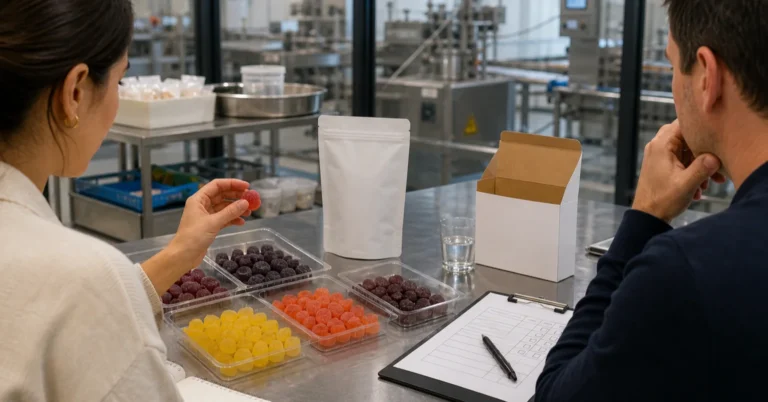


Botanical gummies look simple on a label and become technical before sampling starts.
A botanical supplement manufacturing checklist should confirm identity, extract specs, gummy feasibility, documents, testing, claims, packaging, and manufacturer readiness before pricing or production.
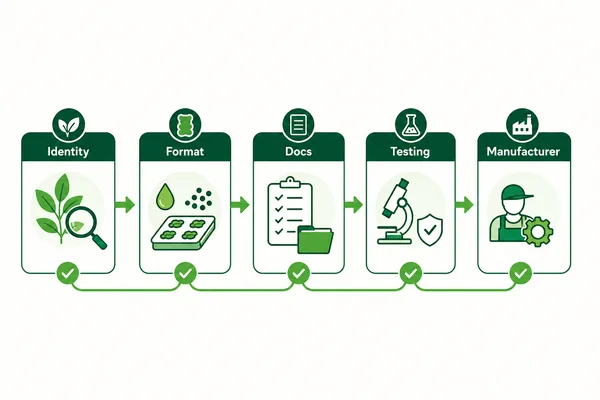
For supplement brands, the goal is not to become a formulation engineer or factory auditor. The goal is to prepare the decisions a gummy manufacturing partner needs before it can judge feasibility, quote responsibly, and move from sample to commercial production.
Why Botanical Gummies Need a Botanical Supplement Manufacturing Checklist
Botanical gummies combine plant-material variability with gummy manufacturing constraints.
The checklist needs to connect botanical quality with gummy realities: serving load, taste, moisture, heat exposure, texture, stability, packaging, testing, and claim boundaries.
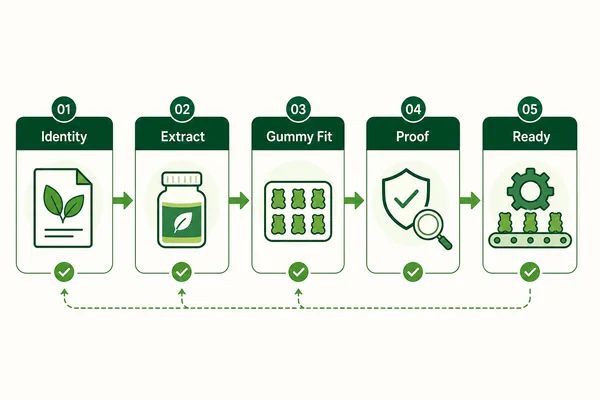
What makes botanical gummy development different from general supplement manufacturing?
General supplement manufacturing checklists often focus on GMP, records, facility controls, batch release, testing, labeling, and certifications.[^1] Those topics matter, but they do not answer the first product-development question for a botanical gummy: can this botanical ingredient work in this format?
Botanical ingredients can carry bitterness, earthy odor, dark color, particulate load, moisture sensitivity, or marker-compound testing challenges. A capsule can hide many of those issues. A gummy exposes them through taste, chew, color, serving size, water activity, acid balance, packaging, and shelf-life expectations.
That is why this page narrows the broader botanical supplement manufacturing checklist into a gummy product-development checklist. The brand needs to define the botanical source, ingredient form, target serving, extract standardization, marker expectations, claim boundary, and testing logic before asking a manufacturer for a sample or quote. For broader vendor-readiness questions, use this together with Talvenda's gummy supplement manufacturer checklist.
| Development question | Why it matters in botanical gummies |
|---|---|
| Which botanical identity and plant part? | Affects label clarity, supplier documents, testing, and claim review |
| Which ingredient form? | Changes serving load, taste, texture, cost, and testability |
| Which marker or specification? | Shapes raw-material and finished-product proof expectations |
| Can the gummy hold the load? | Determines gummy count, chew, flavor masking, and feasibility |
| What packaging is planned? | Influences moisture control, shelf-life expectations, and retail readiness |
When supplement brands should use this checklist
Use this checklist before sending an RFQ, approving a stock formula, requesting a custom sample, converting a capsule idea into a gummy, or comparing botanical gummy manufacturers.
The checklist is most useful after the brand has a botanical concept but before the first manufacturer conversation becomes too specific. At that stage, changing the extract form, gummy count, flavor system, claim language, or packaging direction is still possible.
It is also useful when the brand has selected a supplier but has not checked whether the supplier's material is suitable for gummies. A raw botanical that looks strong on a COA can still create taste, texture, stability, or finished-product testing problems.
Step 1: Define the Botanical Ingredient Before Formulation
The ingredient name alone is not enough for manufacturing.
Before formulation, define botanical identity, plant part, ingredient form, extract ratio, standardization, marker expectations, and specification documents.
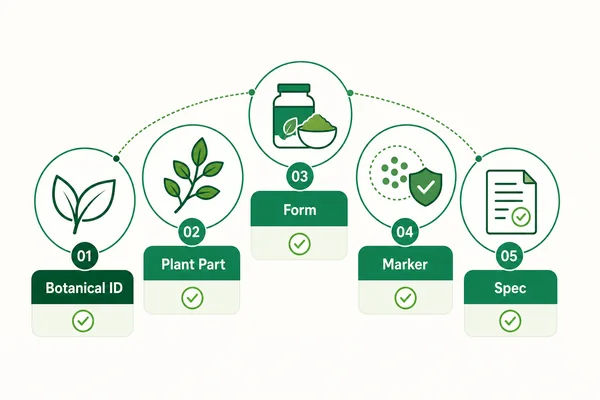
Confirm botanical identity, plant part, and ingredient form
Start with the exact material, not the marketing name. A manufacturer may need the botanical name, common name, plant part, supplier, country of origin, ingredient form, carrier material, storage condition, and supplier specification.[^2]
Plant part matters. Root, leaf, berry, bark, flower, and seed materials can have different sensory profiles, marker expectations, contaminant risks, and label implications. Two products can use the same common botanical name while relying on different plant parts or extract types.
| What to define | Example of the decision |
|---|---|
| Botanical identity | Common name plus botanical name where available |
| Plant part | Root, leaf, fruit, flower, bark, or seed |
| Ingredient form | Powder, extract, standardized extract, oil, or blend |
| Supplier documentation | Specification sheet, COA, allergen statement, storage condition |
| Intended label language | Amount per serving, botanical form, and claim boundary |
If the supplier is already selected, prepare the latest COA and specification sheet before the formulation call.[^1] If the supplier is not selected, define the target material clearly enough that the manufacturer can recommend a sourcing path.
Decide between powder, extract, and standardized extract
The ingredient form affects every downstream decision. Whole botanical powder may support a simple "whole herb" positioning, but it can create high serving load, stronger taste, visible particles, and texture pressure. A simple extract may reduce serving size but can concentrate bitterness or color. A standardized extract may support clearer specification control, but it can increase cost and documentation needs.
| Ingredient form | Practical advantage | Gummy development watchout |
|---|---|---|
| Botanical powder | Familiar, simple, sometimes lower cost | Higher load, stronger texture and flavor impact |
| Extract | More concentrated than whole powder | Carrier, color, taste, and stability need review |
| Standardized extract | Defined marker or assay expectation | Higher documentation and finished-product proof questions |
The best choice depends on the product promise. If the brand wants a recognizable botanical identity, powder may be part of the story. If the brand wants a compact serving, an extract may be more realistic. If the label or buyer expectation depends on a marker, standardization needs to be discussed early.
Identify active markers and specification expectations
For manufacturing readiness, use "active marker" carefully. The brand can identify marker compounds, assay targets, or specification parameters without making medical promises.
The practical question is what should be controlled and how it will be checked. That may include identity, assay, extract ratio, carrier material, moisture, microbiological limits, heavy metals, pesticide residues, residual solvents where relevant, and storage conditions.
A raw-material COA can support ingredient review, but it does not automatically prove the finished gummy. The brand should ask whether the target marker can be tested in the raw material, whether finished-product testing is appropriate, and whether the gummy matrix affects the method.
Step 2: Use a Botanical Supplement Manufacturing Checklist for Gummy Format Feasibility
A botanical can be acceptable on paper and difficult in a gummy.
Gummy feasibility depends on taste, odor, color, serving load, moisture behavior, heat sensitivity, texture impact, and the development route chosen.
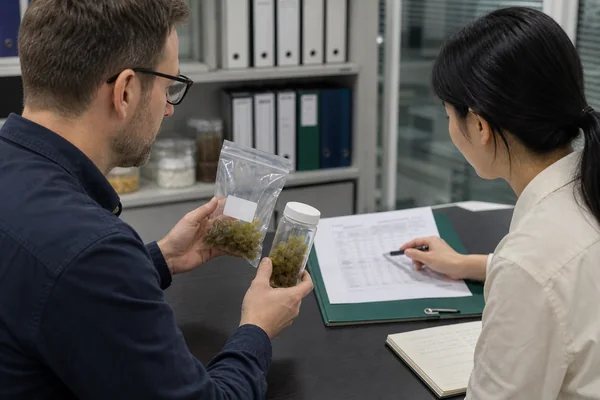
Review taste, odor, color, and serving-load pressure
Botanicals often bring sensory load. Bitter roots, earthy extracts, dark berry powders, green plant materials, and pungent botanicals can all change the finished gummy. The brand should discuss those issues before locking flavor, sweetener system, gummy count, or package size.
Serving-load pressure is one of the biggest constraints. A botanical serving that looks reasonable in a capsule or powder scoop may be hard to fit into one or two gummies without affecting chew, sweetness, cost, or texture.
Use this feasibility filter before sampling:
| Feasibility check | Brand-side question |
|---|---|
| Taste | Will this need heavy masking or a stronger flavor system? |
| Odor | Could the botanical smell affect first opening or repeat use? |
| Color | Will the ingredient make the desired color unrealistic? |
| Serving load | Can the target amount fit into the desired gummy count? |
| Texture | Could the ingredient create grit, stickiness, or chew problems? |
Consider heat, moisture, pH, and texture sensitivity
Gummies involve heat, moisture, acid balance, gel systems, cooling, coating, packaging, and storage. Botanical materials should be reviewed in that context.
Some botanicals may be sensitive to processing conditions. Others may absorb moisture, darken, change flavor, affect gelling, or behave differently after storage. The brand does not need to set process parameters, but it should ask whether the manufacturer has reviewed format risk before promising a launch timeline.
Sampling should not be treated as only a flavor approval step. It should also reveal whether the botanical can remain acceptable through production scale, packaging, and shelf-life expectations.
Decide whether stock, semi-custom, or custom development fits the project
Some botanical gummy projects can start from a stock or semi-custom base. That may work when the botanical load is modest, the sensory profile is manageable, and the brand does not need unusual positioning.
Custom development is more likely when the botanical is high-load, strongly flavored, standardized, multi-ingredient, vegan, sugar-conscious, claim-sensitive, or tied to specific packaging and retail requirements. If the project is still early, compare stock formula vs custom formulation before committing to a full custom path.
Before contacting a manufacturer, decide where the brand can be flexible:
| Decision | Flexible option | Less flexible option |
|---|---|---|
| Serving | Adjust gummy count or active target | Fixed dose in one gummy |
| Ingredient form | Change powder to extract | Locked supplier material |
| Flavor | Use stronger masking system | Fixed natural flavor profile |
| Color | Accept darker botanical color | Require bright transparent look |
| Development route | Semi-custom or custom | Stock formula only |
Step 3: Prepare Documentation Before Contacting a Manufacturer
Better inputs lead to better manufacturer feedback.
A manufacturer can evaluate a botanical gummy faster when the brand prepares positioning, ingredient documents, packaging needs, launch channel, and claim boundaries.
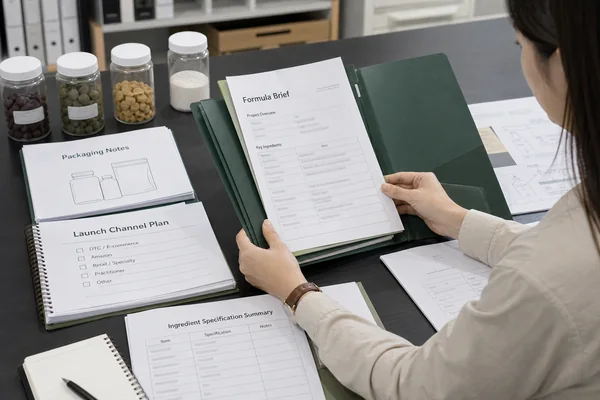
Ingredient list, target serving, claims, and product positioning
Create a short product brief before asking for a quote. It should include the working product name, target buyer, botanical ingredients, target serving, gummy count per serving, flavor direction, dietary preferences, target market, launch channel, and packaging direction.
Claims should be included early, even when they are not final. Claim language affects ingredient selection, serving expectation, finished-product testing, disclaimers, packaging copy, and regulatory-review questions.
For botanical gummies, positioning also affects sensory tradeoffs. A premium botanical product may tolerate a more herbal flavor if it feels intentional. A mainstream gummy usually needs more familiar flavor masking and a more approachable texture.
Raw material COA, allergen, contaminant, and specification records
If the botanical ingredient has already been selected, provide the latest COA and specification sheet. The COA should be reviewed for identity, assay or marker content where relevant, microbiological results, heavy metals, pesticide residues, residual solvents where applicable, moisture, and other parameters tied to the ingredient.
Allergen statements, GMO status, vegan suitability, carrier materials, and storage conditions may also matter. If an extract uses a carrier, the manufacturer needs to know whether that carrier affects label expectations, dietary claims, or formulation behavior.
Do not send only a marketing ingredient sheet. Marketing material can explain positioning, but manufacturing review needs technical records that connect the ingredient to production, quality, labeling, and finished-product proof.
Packaging, label, market, and launch-channel requirements
Packaging should be discussed before the formula is treated as final. Bottle size, pouch format, closure, desiccant use, count per container, serving size, label area, shipping conditions, and retail channel can affect the product-development plan.
Botanical gummies may need extra attention to moisture protection, color change, odor transfer, and shelf-life expectations. A sample that tastes acceptable on day one may not remain acceptable if the package does not protect it through storage and distribution.
Launch channel also matters. Amazon, retail buyers, specialty supplement channels, and international markets may ask for different documentation. Tell the manufacturer early so the documentation plan can be aligned with the intended channel.
Step 4: Ask the Right Questions When Choosing a Botanical Gummy Manufacturer
The right manufacturer questions reveal real capability.
A botanical gummy manufacturer should discuss extract handling, sample development, testing, packaging, MOQ, scale-up, and documentation without oversimplifying the project.
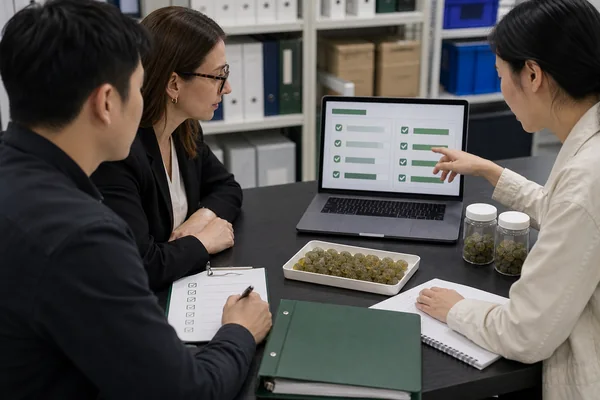
Experience with botanical extracts and functional gummies
Ask whether the manufacturer has experience with botanical extracts in gummy format, not only vitamin gummies or candy-style products. Botanical materials can create different challenges from vitamins, minerals, flavors, or simple functional blends.
Useful questions include:
- What botanical ingredient forms are easiest or hardest to work with?
- How do you evaluate bitterness, color, odor, and active-load pressure?
- Can you review supplier specifications before sampling?
- How do you handle standardized extracts?
- What happens if the target serving is not feasible in the desired gummy count?
The goal is not to make the manufacturer disclose proprietary formulation methods. The goal is to see whether the team can think through botanical gummy constraints before production.
Sample development, pilot batch, MOQ, lead time, and scale-up process
Brands should ask how the manufacturer moves from concept to sample, sample to pilot or production trial, and production trial to commercial batch. The process should be clear enough for the brand to understand which decisions are made at each stage.
Ask what information is needed before the first sample, how sample rounds are handled, what changes may trigger new samples, how MOQ is determined, what lead time applies after formula approval, and what documentation is produced before production.
Scale-up deserves specific attention. A bench sample may not behave exactly like a commercial batch. The brand should ask how taste, texture, weight, active loading, coating, packaging, and stability are checked as the product moves toward production scale.
Red flags when a manufacturer treats botanical gummies like standard candy
A red flag is a manufacturer that gives a quick price without asking about botanical form, target serving, extract specifications, flavor burden, testing, packaging, or claims. Another red flag is promising that any botanical target can fit into gummies without discussing serving size or texture.
Brands should also be cautious when the manufacturer treats a raw-material COA as complete proof for the finished gummy. Raw-material documentation is important, but it does not answer every finished-product question.
A capable manufacturer does not need to make the project sound difficult. It should make the project specific. The brand should leave the conversation understanding what is feasible, what needs testing, which decisions remain open, and what risks could affect timing or cost.
Step 5: Review GMP, Batch Control, and Quality Systems at a Brand-Owner Level
Brands need due diligence, not an internal audit manual.
The practical checklist is to ask how GMP systems, batch records, traceability, deviations, sanitation, and supplier controls support the specific botanical gummy project.
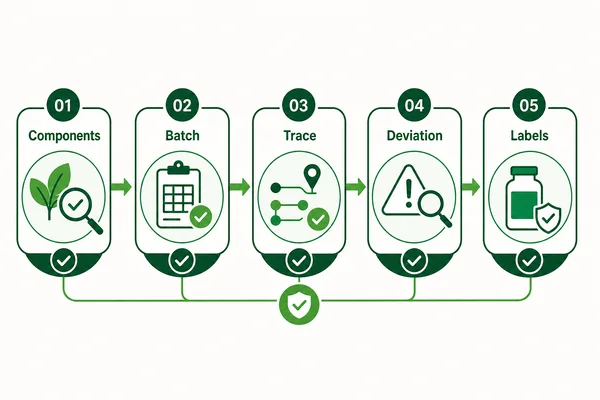
How to discuss 21 CFR Part 111 without becoming a factory auditor
Dietary supplement manufacturing in the United States is subject to current good manufacturing practice requirements, including 21 CFR Part 111.[^3] A brand should understand GMP as a baseline manufacturing expectation, while keeping final regulatory decisions with qualified support.
The useful question is how the manufacturer applies quality systems to this product. Ask about written procedures, quality responsibilities, component controls, production records, packaging and labeling controls, laboratory operations, and complaint handling at a brand-owner review level.
For botanical gummies, connect GMP questions to ingredient identity, batch traceability, finished-product release, label control, and documentation scope.
Master manufacturing records, batch records, deviations, and traceability
A master manufacturing record defines how a product should be made. A batch production record shows what happened for a specific batch. For brand owners, those documents matter because they connect formula, components, packaging, labels, and quality checks to the actual production run.
Ask what documentation the brand can review or receive, what batch information is retained, how deviations are handled, and how ingredient lots are traced into finished goods. For botanical ingredients, traceability is especially important because raw material identity and supplier records are central to product confidence.
The brand should also ask how changes are controlled. If a supplier changes, an extract specification changes, a flavor system changes, or a package changes, the manufacturer should have a process for reviewing whether the product needs new samples, testing, or documentation updates.
Cross-contamination, sanitation, and supplier qualification questions
Botanical gummies may be produced in facilities that handle many ingredients. Brands should ask how the manufacturer manages sanitation, allergen controls, material segregation, equipment cleaning, and cross-contact risk.
Supplier qualification is part of readiness. A manufacturer may source ingredients directly, accept brand-supplied ingredients, or work with approved supplier options. Each path has different documentation needs.
Brand-supplied botanicals can create extra review work because the manufacturer must confirm whether the ingredient can be accepted, stored, handled, tested, and used in production. Botanical quality and gummy feasibility should be reviewed together, not as separate tasks.
Step 6: Plan Botanical and Finished Gummy Testing
Testing should match the product, not a generic checklist.
A botanical gummy testing plan should distinguish raw-material proof from finished-product proof, then connect identity, contaminants, assay, micro, and stability to launch risk.
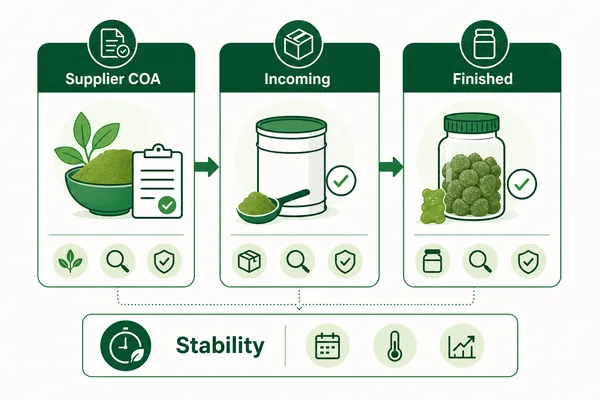
Identity, purity, strength, micro, heavy metals, and contaminants
Botanical ingredients can require identity testing and contaminant review before production. Depending on the ingredient and supplier, the review may include botanical identity, assay or marker content, microbiological results, heavy metals, pesticide residues, residual solvents, moisture, and other specification parameters.
The finished gummy may need different checks. A finished product test may evaluate microbiological status, label-related actives, weight, appearance, and other release criteria depending on the formula and claim.
| Testing layer | What it helps answer |
|---|---|
| Supplier COA | What the supplier says about the ingredient lot |
| Incoming material review | Whether the material can be accepted for production |
| In-process checks | Whether the batch is being made under defined conditions |
| Finished batch testing | Whether the finished product meets release expectations |
| Stability review | Whether product quality can remain reasonable through shelf life |
Finished product testing versus raw material testing
Raw-material testing helps confirm what enters production. Finished-product testing helps confirm what the customer will receive. Those two records should not be treated as interchangeable.
A botanical extract may arrive with a COA showing a marker level. After manufacturing, the finished gummy contains sweeteners, acids, gelling agents, flavors, colors, coatings, and packaging interactions that do not exist in the raw ingredient.
The brand should ask the manufacturer to explain the proof chain: supplier records, incoming material review, in-process checks, finished batch release, and stability expectations. That proof chain is more useful than collecting documents without knowing which launch decision each document supports.
Stability testing and shelf-life expectations for botanical gummies
Stability is where many gummy projects become more complicated. Gummies can change in texture, moisture, flavor, color, active content, and appearance over time. Botanical ingredients can add another layer of variability.
A brand should ask how shelf-life expectations are established, whether stability work is recommended, what packaging assumptions are used, and whether the label claim depends on active content over time.
The manufacturer may not be able to confirm shelf life at the concept stage. That is normal. What matters is whether the development plan identifies stability risk early enough to make packaging, serving, formula, and launch-timing decisions.
Step 7: Check Labeling, Claims, Packaging, and Retail Readiness
Launch readiness connects manufacturing proof with market presentation.
Before production, brands should review Supplement Facts, claim boundaries, packaging protection, storage conditions, and retailer documentation expectations.
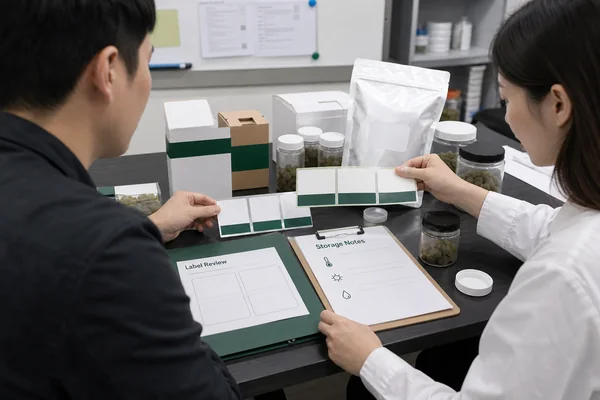
Supplement Facts, structure/function claims, and claim-boundary review
Botanical gummies should be reviewed for label accuracy before production. The Supplement Facts panel, serving size, ingredient declaration, allergen information, directions, warnings, disclaimers, and responsible-party information should align with the formula and intended market.[^4]
Claim language requires caution. Botanical products can tempt brands into disease-related or unsupported benefit language.[^5] A manufacturing partner can help flag claim-boundary questions, but the brand should use qualified regulatory review for final labeling decisions.
The practical checklist question is simple: does the planned label match the formula, serving, documentation, testing, and market channel? If not, the label may create risk before the product is produced.
Bottle, pouch, desiccant, closure, and storage considerations
Packaging is part of product development for gummies. A bottle, pouch, blister, or jar is not only a branding choice. It affects moisture protection, heat exposure, oxygen, odor, texture, clumping, color change, and consumer experience.
Botanical gummies may need packaging review because plant extracts can influence color, smell, and stability. If the brand wants a pouch, it should ask whether that format fits the gummy texture and shelf-life expectation. If the brand wants a bottle, it should discuss count, headspace, closure, desiccant use, label area, and shipping conditions.
Storage instructions should be realistic. A product that needs careful storage may need clearer label language and channel planning.
Amazon, retailer, NSF, USP, or other certification documentation
Some launch channels require additional documentation. Amazon or retail buyers may ask for product information, manufacturing details, testing records, label files, certificates, or compliance documentation. Certification programs such as NSF or USP can also influence trust, but they should not be treated as generic badges.[^6][^7]
The brand should ask what documents the manufacturer can provide and what documents are outside the manufacturer's role. It should also confirm whether a certificate applies to a facility, process, batch, finished product, or specific verification program.
Retail readiness is strongest when documentation is mapped to the channel. A folder full of unrelated files is less useful than a clear list showing what supports ingredient approval, label review, finished batch release, packaging, shelf life, and channel compliance.
Botanical Gummy Manufacturer Questions Checklist
The best checklist turns uncertainty into specific questions.
Use manufacturer questions to test whether the project is defined enough for sampling, pricing, pilot work, production, and retail launch planning.
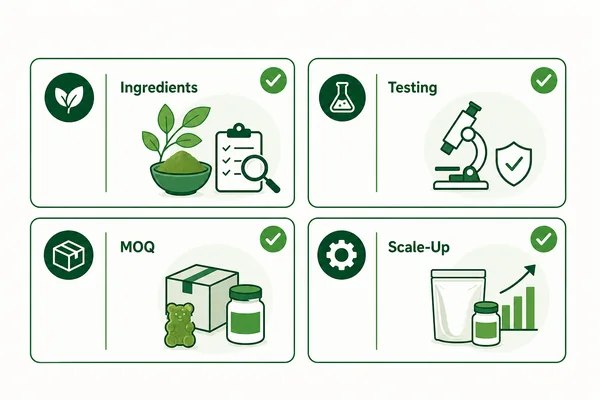
Questions about ingredients and formulation feasibility
Ask these before sampling:
- What botanical form is recommended for this gummy: powder, extract, standardized extract, or another format?
- What plant part, extract ratio, marker, carrier, or specification information do you need?
- Is the target serving realistic in the desired gummy count?
- What taste, odor, color, and texture issues should we expect?
- Will this ingredient affect moisture, pH, gelling, coating, or stability?
- Do we need a stock, semi-custom, or custom development route?
- What decisions should be made before the first sample?
These questions help the brand avoid treating the first sample as a cosmetic flavor test. For botanical gummies, the first sample should also expose feasibility issues.
Questions about testing, documentation, and compliance
Ask these before production:
- What raw-material documents do you need before accepting the botanical?
- Which COA parameters matter for this ingredient?
- What finished-product tests are recommended?
- Can the botanical marker be tested in the finished gummy?
- How are heavy metals, micro, pesticides, or residual solvents reviewed where relevant?
- What batch documents will be available?
- How are label claims reviewed against formula and documentation?
- What happens if a result or specification is out of range?
The brand should listen for clear, practical answers. A good answer may include limits, not just promises. Some tests may be unnecessary, some may be recommended, and some may be difficult depending on the matrix and claim.
Questions about MOQ, sampling, scale-up, and launch support
Ask these before committing commercial resources:
- What MOQ applies to this type of botanical gummy project?
- What sample timeline is realistic?
- How many sample rounds are included or expected?
- What changes would reset the timeline or pricing?
- Is a pilot or scale-up review recommended before commercial production?
- How do you confirm that the commercial batch matches the approved sample?
- What packaging options are compatible with the gummy and shelf-life plan?
- What documents can support Amazon, retail, or buyer review?
MOQ and lead time should be discussed with formula complexity in mind. Botanical gummies with strong flavor, high load, custom extract, special packaging, or channel-specific documentation may require more planning than a simple stock gummy.
Frequently Asked Questions
Do you need a license to sell botanical supplements?
Licensing and registration requirements depend on the market, business model, sales channel, and regulatory context. Before launch, confirm business licensing, product-category requirements, labeling responsibilities, and channel requirements with qualified support.
From a manufacturing-readiness perspective, the brand should tell the manufacturer where the product will be sold. The target market can affect label review, documentation requests, claims, packaging, and launch timeline. Startup teams can also review the broader launch steps in Talvenda's guide on how to start a supplement brand.
Is GMP required for botanical gummies?
In the United States, dietary supplement manufacturing is subject to current good manufacturing practice requirements. For brand owners, the practical step is to ask how the manufacturer applies quality systems, documentation, batch control, ingredient review, packaging control, and complaint handling to the specific botanical gummy project.
GMP is a baseline, not a complete product proof. The brand still needs to consider ingredient specifications, finished-product testing, stability expectations, label claims, and packaging fit.
What should be checked on a botanical supplement label?
Check the Supplement Facts panel, serving size, ingredient declaration, botanical name and form where appropriate, allergen information, directions, warnings, disclaimers, net quantity, responsible-party information, and storage instructions.[^4]
For botanical gummies, the label should also match the manufacturing reality. If the formula cannot support the target serving, the marker cannot be tested as expected, or the packaging does not support shelf-life assumptions, the label may need to change before production.
How do you know if a botanical gummy manufacturer is qualified?
A qualified manufacturer should ask specific questions about botanical identity, ingredient form, target serving, taste, stability, claims, testing, documentation, packaging, MOQ, and scale-up. It should not approach botanical gummies as ordinary candy or promise that any botanical target can fit into a gummy.
Look for clear process communication. The manufacturer should be able to explain what happens during sample development, scale-up review, batch documentation, finished-product testing, and packaging readiness.
How much does it cost to manufacture botanical gummies?
Cost depends on ingredient type, extract standardization, serving load, formula complexity, sweetener and gel system, flavor masking, testing, packaging, MOQ, sample rounds, certifications, and launch-channel documentation.
The better first question is what information the manufacturer needs to quote accurately. A botanical gummy concept with incomplete specifications can receive only a rough estimate; reliable pricing usually requires ingredient documents, target serving, packaging direction, testing expectations, and commercial volume assumptions.
Conclusion
Botanical gummy manufacturing works best when extract direction, active load, taste, claim boundary, documentation, packaging, and manufacturer readiness are settled early.
Botanical gummy projects need early control around extract direction, active load, taste, claim boundary, and documentation burden. As a contract gummy supplement manufacturer, Talvenda can help brands turn that checklist into a practical route: low-MOQ market-tested in-stock gummies, stock formula modification, or custom gummy development. The review can cover sample development, packaging and label support, documentation and testing expectations, and production through GMP-certified and FDA-registered manufacturing facilities, helping your team avoid spending budget on a formula path that does not fit the launch story. Contact Talvenda through the project inquiry form.
[^1]: FDA. "Small Entity Compliance Guide: Current Good Manufacturing Practice in Manufacturing, Packaging, Labeling, or Holding Operations for Dietary Supplements." https://www.fda.gov/regulatory-information/search-fda-guidance-documents/small-entity-compliance-guide-current-good-manufacturing-practice-manufacturing-packaging-labeling/ [^2]: NIH Office of Dietary Supplements. "Botanicals." https://ods.od.nih.gov/factsheets/BotanicalBackground-Consumer/ [^3]: Electronic Code of Federal Regulations. "21 CFR Part 111: Current Good Manufacturing Practice in Manufacturing, Packaging, Labeling, or Holding Operations for Dietary Supplements." https://www.ecfr.gov/current/title-21/chapter-I/subchapter-B/part-111/ [^4]: FDA. "Dietary Supplement Labeling Guide." https://www.fda.gov/food/dietary-supplements-guidance-documents-regulatory-information/dietary-supplement-labeling-guide/ [^5]: Federal Trade Commission. "Health Products Compliance Guidance." https://www.ftc.gov/business-guidance/resources/health-products-compliance-guidance/ [^6]: NSF. "Meeting Retailer Requirements: The Essential Checklist for Dietary Supplement Certification." https://www.nsf.org/knowledge-library/meeting-retailer-requirements-essential-checklist-dietary-supplement-certification/ [^7]: USP. "Dietary Supplements Verification Program." https://www.usp.org/verification-services/dietary-supplements-verification-program/