
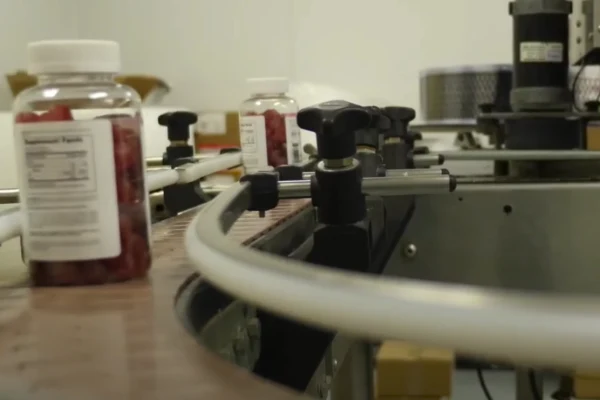

MFG date means manufacturing date—the date a product was made. It is not the expiration date and does not state how long the product remains usable. On a supplement label, the printed MFG date should match the batch record so the product can be traced to the correct production run.
For supplement brands, MFG, EXP, and LOT should connect to production records, shelf-life support, packaging assumptions, and traceable batch documentation before labels are printed.
For supplement brands, the practical question is not only "what does MFG date mean?" The better question is: does the date on the label connect to real production records, shelf-life support, and a traceable lot system? MFG is a production fact, EXP is an evidence-backed shelf-life promise, and LOT is the traceability key that connects the product on the shelf to the batch behind it.
Key Takeaways
- MFG date is not an expiration date. It tells you when the batch was produced, not how long the product will maintain quality or potency.
- EXP date needs support. An expiration date should connect to ingredient stability, packaging assumptions, storage conditions, and the product's shelf-life rationale.
- Lot number is the traceability key. It connects a bottle, pouch, or carton to batch records, quality documents, retain samples, and complaint or recall handling.
- Shelf life is not created by the label. It depends on formula sensitivity, packaging, storage, stability logic, and finished-product proof where relevant.
- Brand owners should review date codes before printing labels. MFG, EXP, best-by, and lot codes need to be readable, traceable, and aligned with the product launch plan.
What Does MFG Date Mean?
MFG date means manufacturing date. It is the date a product was made, produced, filled, or released from a defined manufacturing step, depending on how the manufacturer records the batch.
For supplement brands, the important question is which event the manufacturer uses as the MFG date and whether the same date matches batch records, lot coding, and customer-service guidance.
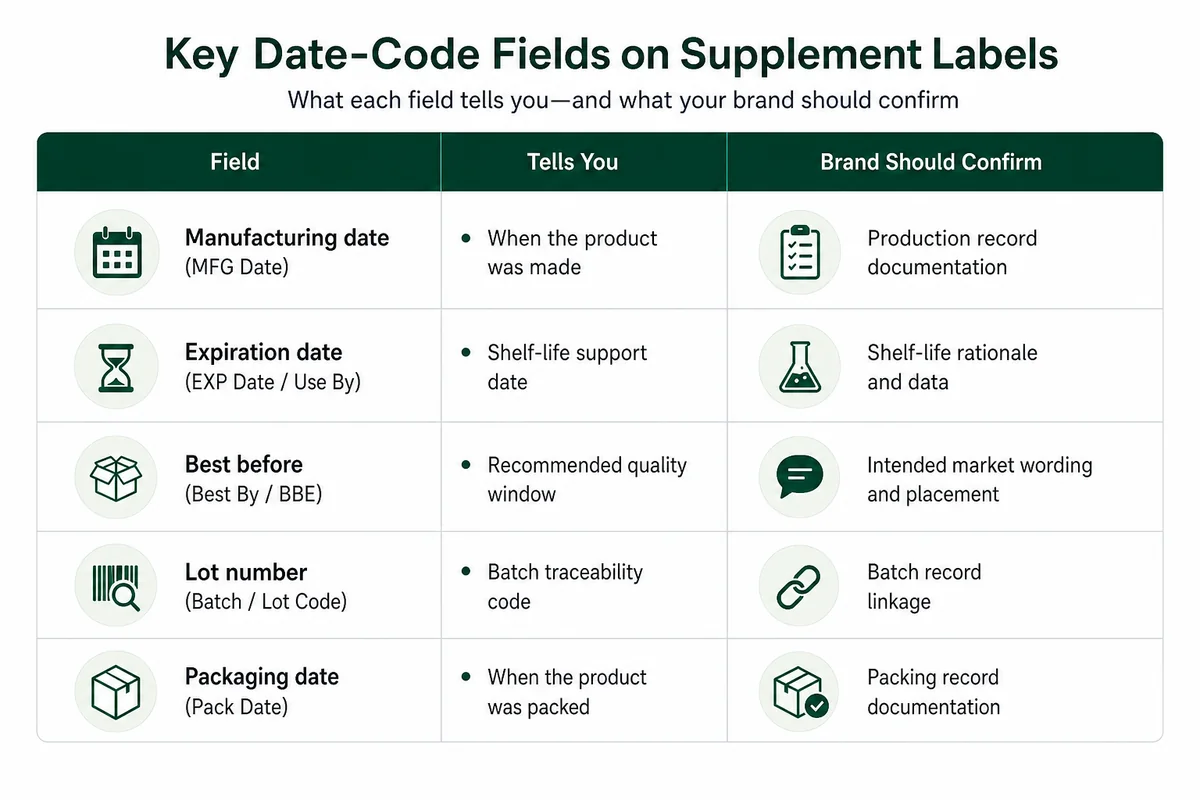
On a supplement label, the MFG date often appears near other codes such as EXP, best before, batch number, or lot number. Those codes are related, but they are not interchangeable. A manufacturing date tells you when the product was made. It does not automatically tell you when the product expires.
Definition of Manufacturing Date
A manufacturing date is the production timestamp for a product batch. For supplements, that may mean the day capsules were filled, gummies were made, powder was blended, liquid was bottled, or finished units were packaged.
For brand owners, the MFG date should match a batch record. That record usually shows the production date, raw material lots, equipment, process checks, release status, and any deviation notes that matter for that run. If the printed MFG date cannot be matched to a production record, the label may be readable to a consumer but weak for quality control.
The definition is simple. The operational meaning is deeper: the MFG date is the start point for shelf-life planning, inventory age, batch documentation, and customer-service answers.
How to Read MFG Dates on Supplement Labels
MFG dates can appear in several formats. A label may show a full date, a month and year, a short code, or a printed string that combines date, line, and lot information.
| Label marking | What it may mean | Brand-owner check |
|---|---|---|
MFG 2026-06-15 |
June 15, 2026 | Clear ISO-style format; confirm market readability |
MFG 06/15/2026 |
June 15, 2026 in U.S. format | May confuse markets that read day/month/year |
MFG 15/06/2026 |
June 15, 2026 in day/month/year format | May confuse U.S. consumers or retailers |
MFG 06/2026 |
Month and year only | Confirm whether exact production date is still in batch records |
| Short date or line code | Internal production code | Confirm customer service can decode it if asked |
The important point is consistency. If the artwork, bottle code, master carton, batch record, and quality documents all use different date formats, a simple label detail can become a documentation problem. Before launch, brands should confirm the format that consumers, retailers, distributors, and internal quality teams will all understand.
Why MFG Date Is Not the Same as Expiration Date
MFG date and expiration date answer different questions.
MFG date answers: when was this batch made?
Expiration date answers: through what date does the brand or manufacturer support the product's quality, potency, or usability under the stated storage conditions?
That difference matters because one is a production fact and the other is a product-performance commitment. If a label says only MFG 2026-06-15, the consumer knows when the product was made. The consumer does not know whether the intended shelf life is 12 months, 18 months, 24 months, or something else.
For a brand owner, that gap can become a support issue. Retailers may ask how much shelf life remains. Consumers may ask whether a product is still good. Distributors may ask for supporting documents. A clear date-code strategy prevents those questions from becoming launch friction.
MFG Date Meaning vs. Expiration Date: What Is the Difference?
The difference between MFG date and expiration date is the difference between a production event and a shelf-life commitment. A supplement brand should understand both before approving label artwork.
MFG looks backward to production; EXP looks forward to the period the brand is prepared to support under stated conditions.
| Code | What it means | What brand owners should verify |
|---|---|---|
| MFG date | Production date or manufacturing event | Which production step the date represents |
| EXP date | Date through which quality or label support is expected | Shelf-life basis, packaging assumptions, storage wording |
| Best before / best by | Quality-focused date language | What "best" means for the product and target market |
| Lot number | Batch traceability code | Whether it links to batch records, testing, retain samples, and release status |
| Packaging date | Filling or packing event | Whether it differs from the production date |
MFG Date: When the Product Was Made
The MFG date is historical. It records when the supplement was manufactured or when a defined manufacturing step was completed.
For simple products, that may feel straightforward. For gummies, liquids, probiotics, botanicals, or complex blends, production can involve multiple meaningful timestamps. A gummy batch may be cooked on one day, conditioned on another, coated later, and packaged after that. A powder may be blended before it is filled into jars. A capsule batch may be encapsulated before final packaging.
That is why the brand should confirm what the MFG date represents. Is it the date of blending, encapsulation, gummy production, filling, packaging, or final release? The answer should be documented before the code is printed.
Expiration Date (EXP or Use By): When Support Must Hold
The expiration date is forward-looking. It tells the market how long the product is expected to maintain the relevant quality or label support under stated storage conditions.
For supplement brands, that date should not be chosen casually. It should connect to the product's shelf-life support. Depending on the product, that support may involve ingredient stability knowledge, finished-product behavior, packaging barrier performance, storage conditions, stability data, or finished-product testing.
An EXP date is not just a marketing convenience. It can affect retailer acceptance, distributor confidence, inventory planning, customer-service scripts, and quality documentation. If the date is questioned, the brand should be able to explain why that period was selected.
Best Before Date (BBE or Best By): Quality vs. Usability
Best before, best by, or BBE language usually points toward quality rather than a hard safety line. In consumer language, it suggests the product is best used before a certain date for quality, freshness, texture, flavor, or other expectations.
For supplement brands, best-by language can be relevant when sensory quality matters. Gummies are a good example. A gummy may have texture, stickiness, coating, color, flavor, and mouthfeel expectations in addition to active-ingredient considerations. If the product's main visible change over time is sensory quality, best-by language may be part of the label discussion.
This still needs market and regulatory review. This guide is not legal advice. The practical takeaway is that brand owners should understand what each date communicates before choosing label language.
Packaging Date, Batch Date, and Lot Number
Packaging date, batch date, and lot number are often overlooked in consumer articles, but they matter for brands.
The packaging date may differ from the manufacturing date. A batch date may refer to a production batch or a packaged batch. A lot number may include coded information about production run, line, date, or batch sequence.
The lot number is usually the strongest operational link. If a customer reports an issue, a distributor requests documentation, or a quality team needs to review a batch, the lot number should connect the physical product to the correct records. That is why brands should not review MFG and EXP dates separately from lot-code design.[^1]
Why Supplement Brands Should Care About MFG and EXP Dates
Supplement brands should care about MFG and EXP dates because date codes shape trust, inventory handling, distributor documentation, and batch traceability.
MFG and EXP date codes reduce avoidable confusion across consumers, retailers, distributors, customer service, and quality teams when each code matches the product's records and shelf-life support.
Before production, the brand should know what codes will appear, where they will be printed, what they mean, and what records support them.

Label Trust and Consumer Confidence
Consumers often use date codes as a quick trust signal. If the label looks confusing, they may wonder whether the product is old, expired, or poorly controlled. If a bottle only has an MFG date, they may ask how long the product is good for. If the EXP date is hard to find, they may hesitate.
A clear label does not need to over-explain everything. It should make basic information easy to interpret: product identity, storage instructions, MFG or EXP date, lot number, and support path. The trust problem starts when those elements do not align. A consumer-facing FAQ may say one thing, the date code may show another, the lot number may be unreadable, and the storage instruction may be vague.
For a brand, that inconsistency becomes a support cost. The consumer question turns into customer-service tickets, returns, retailer complaints, or documentation requests.
Retailer, Distributor, and Inventory Expectations
Retailers and distributors often care about date codes for inventory management, stock rotation, returns, and channel acceptance. If a retailer expects an expiration date or minimum remaining shelf life, an MFG date alone may not answer the question.
Before launch, brand owners should ask whether the target channel accepts MFG-only coding, whether an EXP or best-by date is expected, how much remaining shelf life is required at delivery, and whether customer service can explain the code consistently. These are commercial readiness questions, not only label-design questions.
This is especially important for brands planning retail, Amazon, distributor, export, or repeat-batch programs. The date code has to work beyond the first production run.
Batch Traceability and Quality Documentation
MFG and EXP dates help with timing. Lot numbers help with traceability.
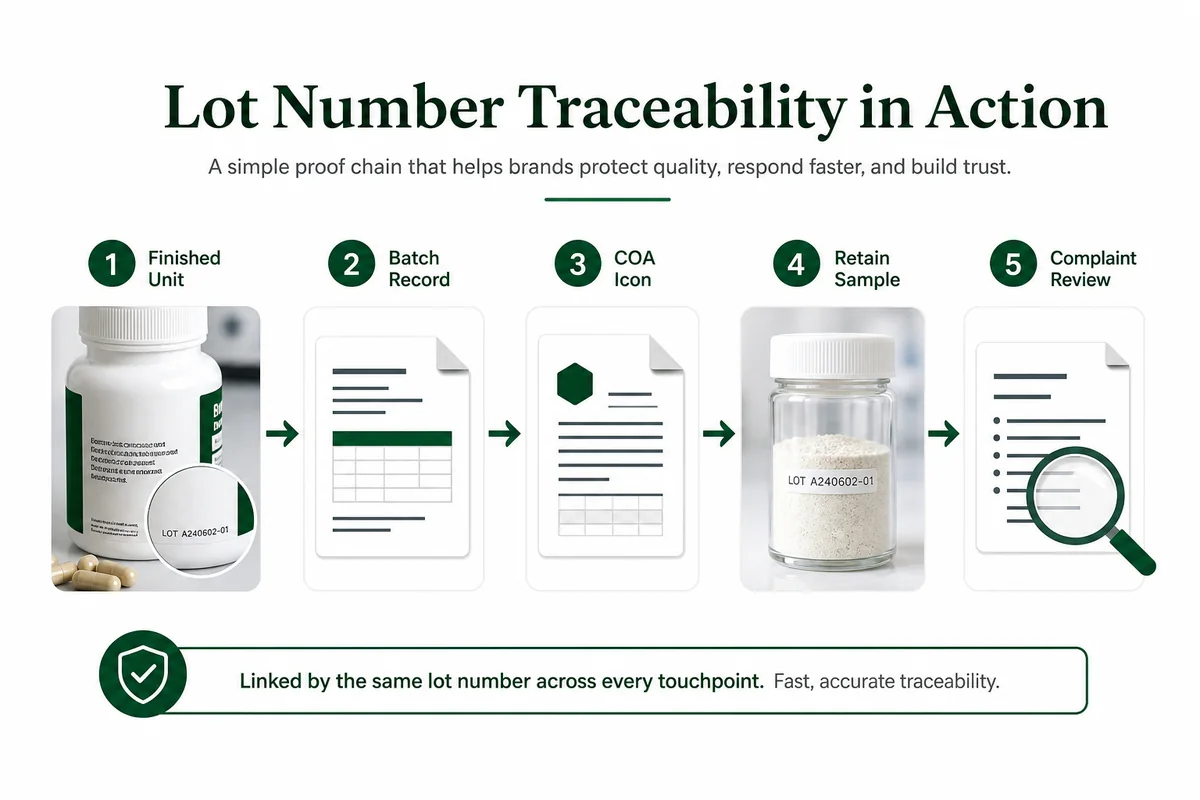
If the brand receives a complaint, quality question, distributor request, or retailer audit, the team needs to identify the exact batch. The lot number should connect the finished product to the production record, packaging record, raw material lots, batch-specific quality records where applicable, release status, retain sample, and complaint or recall review.
For deeper discussion of batch-specific testing and quality-record matching, see Talvenda's guide to lot number and COA matching in finished-batch testing. The same proof-chain logic applies beyond creatine: the sold product, lot number, label claim, and test evidence should not drift apart.
Why Do Some Supplements Use MFG Dates Instead of Expiration Dates?
Some supplements use MFG dates instead of expiration dates because MFG is easier to document. It records a completed production event. EXP requires shelf-life support.
Some supplements use an MFG date instead of an expiration date because the manufacturing event is easier to document, while an EXP date requires forward-looking shelf-life support. MFG-only labeling still leaves brands responsible for answering shelf-life and sales-channel questions.
That does not mean MFG-only labeling is automatically wrong. It means the brand should understand what the label does and does not communicate.
MFG Date as a Production Fact
MFG date is a production fact. It says the product was made on a certain date or during a certain production period.
That makes MFG date useful for traceability and customer-service questions about product age. It also helps distributors and internal teams understand batch timing. But the MFG date does not explain how long the product should hold quality, potency, flavor, texture, or other important attributes.
For brands, MFG-only labeling may be a temporary or market-specific choice. If the product is early in launch, if stability support is still developing, or if the manufacturer uses a certain coding convention, the MFG date may be the only visible date. The brand still needs a clear answer for shelf-life questions.
EXP Date Requires Shelf-Life Support
EXP date requires more support because it looks forward. It is not merely the date a product was made. It is the date through which the product is expected to hold the promised quality or label support under the stated conditions.
For a supplement brand, the support behind that date may include ingredient stability knowledge, finished-product behavior, packaging barrier assumptions, storage instructions, stability logic, finished-product checks where relevant, and release records. The exact support needed depends on the product and claim. A mineral capsule, probiotic gummy, liquid herbal product, and high-active gummy do not carry the same formulation risks.
The practical rule is simple: do not print an EXP date as a design choice. Confirm what supports it first.
Stability Testing, Packaging Assumptions, and Label Claims
Stability support is not only about time. It is about the product, package, and storage condition working together.
If a formula was reviewed in one bottle, with one closure, one desiccant approach, one storage instruction, and one target market, the conclusion may not automatically apply after packaging changes. Switching from bottle to pouch, changing desiccants, removing a seal, changing fill weight, or shipping through hotter channels can all affect shelf-life confidence.
This is why packaging and storage should be reviewed before final label approval. The label date is the visible promise. The formula and package are what make the promise more or less defensible.
Do Vitamins Expire, and What Does That Mean for Supplement Shelf Life?
Yes, vitamins and vitamin-containing supplements can expire in the practical sense that their supported potency, quality, or label claim may no longer be guaranteed after the printed date.
Vitamins can expire in the practical sense that supported potency, quality, or label claims may no longer hold after the stated date. Consumers should follow label guidance, while brands should support the date through the formula, final package, storage conditions, and quality records.
A vitamin product does not necessarily spoil like fresh food. The bigger concern is often potency drift, texture change, moisture pickup, odor change, color fading, or other quality changes that make the product harder to support. That is why brands should not use the expiration date as a label decoration. It is a promise about what the product should still represent under stated conditions.
Why Potency Can Decline Before the Product Looks Bad
Some quality changes are visible. A gummy may become sticky, wet, hard, faded, or clumped. A powder may absorb moisture. A liquid may separate. But active-ingredient decline may not be visible to the consumer.
For brand owners, this is where shelf-life planning becomes a quality question. The product brief should identify which ingredients are most sensitive, what label claims must still hold at the end of shelf life, and what finished-product checks or stability rationale will support the date.
Why Gummies, Liquids, Probiotics, and Vitamin Blends Need Tighter Review
Shelf-life risk changes by format. Gummies carry moisture, texture, coating, and packaging-barrier questions. Liquids can face pH, oxidation, separation, and preservation questions. Probiotics may involve live-count expectations. Vitamin blends may include nutrients with different sensitivity to heat, light, oxygen, or humidity.
This does not mean every product needs the same test plan. It means the brand should not copy a generic expiration period from another format. A gummy vitamin, capsule, powder, and liquid may need different packaging choices, storage wording, retain-sample logic, and customer-service answers.
What Affects Shelf Life After the MFG Date?
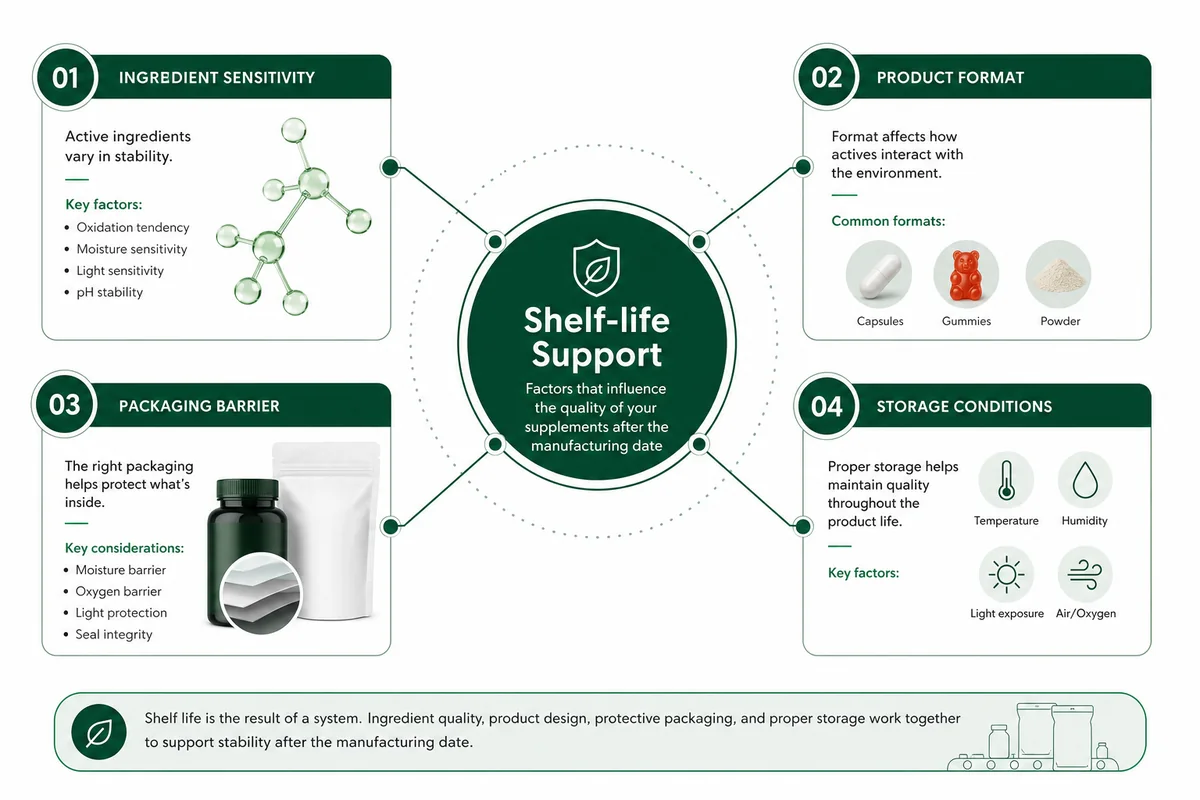
Shelf life after the MFG date depends on ingredients, format, packaging, storage, and the product's quality target. Brands should avoid using a fixed timeline for every supplement category.
Supplement shelf life after the MFG date depends on what must remain true for the specific formula, final package, storage conditions, and supported quality targets over time.
Ingredient Sensitivity: Vitamins, Botanicals, Minerals, and Probiotics
Different ingredients age differently.
Minerals are often less sensitive than some vitamins, botanicals, or live cultures, but the final product still depends on formulation and packaging. Vitamins can vary in stability. Botanicals may depend on extract type, marker compounds, and storage conditions. Probiotics are especially sensitive because the label may involve live-count expectations.
For a brand owner, the practical review is to identify the most sensitive ingredient, the expected storage conditions, the quality attributes that matter at the end of shelf life, and whether the packaging protects the weakest relevant link.
Format Differences: Gummies, Capsules, Powders, and Liquids
Supplement format changes the shelf-life question.
Gummies involve water activity, texture, coating, active distribution, color, flavor, and packaging protection. Capsules and tablets may be more stable in many cases, but moisture, oxidation, and ingredient interaction can still matter. Powders can clump or absorb moisture. Liquids can face pH, separation, oxidation, or microbial-control concerns.
| Format | Shelf-life issues brands should review |
|---|---|
| Gummies | Water activity, texture, stickiness, active distribution, packaging barrier |
| Capsules | Moisture absorption, shell behavior, fill stability |
| Tablets | Disintegration, coating, hardness, ingredient interaction |
| Powders | Moisture uptake, clumping, segregation, flavor change |
| Liquids | pH, oxidation, separation, preservation, storage condition |
| Probiotic formats | Heat, humidity, oxygen, viable count expectations |
A gummy launch should not inherit the shelf-life assumptions of a capsule launch. The brand should review the formula and package together.
Storage Conditions: Heat, Humidity, Light, and Oxygen
Storage conditions shape whether the product can maintain its quality window. Heat may accelerate degradation. Humidity can affect powders, capsules, gummies, and desiccant performance. Light can affect photosensitive ingredients. Oxygen can affect oils, botanicals, vitamins, and other oxidation-sensitive materials.[^2]
The storage instruction on the label should reflect the product's real needs. A vague instruction such as "store in a cool, dry place" may be common, but the brand should still understand what the product and package can tolerate. If a product is heat-sensitive, moisture-sensitive, or light-sensitive, the storage wording, packaging, and distribution plan should all support the same expectation.
How Packaging and Storage Support Date Claims
Packaging is not only decoration. It is part of the shelf-life system that supports the date printed on the label.
A date claim becomes more credible when the formula, package, closure, storage instruction, and distribution reality are reviewed together.
Bottles, Pouches, Closures, Desiccants, and Seals
Every packaging component can affect shelf-life confidence.
| Packaging element | Shelf-life role |
|---|---|
| Bottle material | Helps manage moisture, oxygen, and light exposure |
| Pouch film | Controls barrier level, seal integrity, and light protection |
| Closure | Affects seal quality and post-opening exposure |
| Induction seal | Adds tamper evidence and barrier support before opening |
| Desiccant | Helps control internal moisture |
| Oxygen absorber | May support oxidation-sensitive products |
| Carton or overwrap | Adds protection during storage and distribution |
The right package depends on the formula. A probiotic gummy, a vitamin C powder, a botanical capsule, and a mineral tablet may need different packaging decisions. The brand should not choose the cheapest or most attractive package without reviewing stability implications.[^3]
Why Packaging Is Part of Stability Planning
Packaging should be part of stability planning because the product is sold in the package, not in a lab beaker. If the shelf-life logic assumes one package but the final product uses another, the date claim may no longer be aligned with the actual launch product.
This is a common pre-launch mistake. A brand approves formula and label copy, then changes bottle, cap, pouch, desiccant, or seal method for cost or supply reasons. The label date stays the same, but the packaging assumptions behind it have changed.
For Talvenda-style manufacturing planning, this is where formula review, sample planning, packaging review, and launch timing need to be discussed together. For a broader supplier-screening view, see Talvenda's gummy supplement manufacturer checklist.
How Storage Instructions Protect the Label Promise
Storage instructions translate shelf-life assumptions into user behavior. If the product should avoid heat, humidity, light, or repeated exposure after opening, the label should communicate that clearly.
For brand owners, storage language is not filler copy. It is part of expectation management. It helps consumers handle the product correctly, helps customer service answer complaints, and helps retailers understand how the product should be stored. If the storage instruction is vague or mismatched with the formula, the printed EXP date becomes harder to defend in real use.
How Lot Numbers Connect MFG Dates to Batch Traceability
Lot numbers connect MFG dates to batch traceability. Date codes help with time. Lot codes help with proof.
The lot number is the operational bridge between the product in hand and the production file behind it.
Why Lot Codes Matter More Than Date Codes Alone
A date code alone may not identify the exact batch. Multiple batches can be produced on the same day, and a product may be packaged on a different day from production. A lot number gives the quality team a more precise reference point.
For brands, this matters when a customer asks about a specific bottle, a retailer requests documentation, a distributor reports a shipment issue, a complaint needs investigation, or a quality document needs to be matched to the sold product. Without a reliable lot code, the brand may have documents but no clean way to connect them to the product in hand.
How Lot Numbers Support Quality Documents, Recall, and Complaint Handling
A lot number supports several quality and service functions.
| Situation | Why lot number matters |
|---|---|
| Quality document request | Helps match the document to the correct batch |
| Complaint | Helps identify production and packaging records |
| Recall review | Helps define which units may be affected |
| Retailer question | Helps provide batch-specific documentation |
| Internal investigation | Helps trace raw materials, process records, and release status |
This is why lot number placement should be reviewed before label printing. If the code is hard to read, easy to rub off, or disconnected from the batch record system, the brand loses part of its traceability.[^4]
When to Link MFG Date Records to Batch-Specific Testing Records
MFG date records should be linked to batch-specific testing records when testing exists, when claims are sensitive, or when the sales channel expects batch-specific documentation.
If a brand makes a strong label claim, sells through channels that request documentation, or uses sensitive ingredients, it should know how the batch record, lot number, and test records align. A batch-specific quality document is more useful when it matches the batch being sold.
The full testing topic belongs in a dedicated proof-chain discussion. The same logic applies beyond creatine: the sold product, lot number, label claim, and test evidence should not drift apart.
What Brand Owners Should Confirm Before Printing Labels
Before printing labels, brand owners should confirm how MFG date, EXP date, best-by language, and lot number will work together.
A pre-print review of MFG, EXP, best-by, and lot codes should happen before artwork approval, because date-code errors become harder to fix once labels and cartons are printed.
The label is where the promise becomes visible; the records behind it are where the promise becomes defensible.
MFG Date, EXP Date, and Lot Number Placement
Start with placement. The date and lot number may appear on the bottle bottom, bottle shoulder, side label, cap, seal, pouch, carton, or shipping carton. The best placement depends on packaging format, printing method, retail visibility, and consumer usability.
A code that is technically present but hard to find can still create support issues. A code that rubs off during shipping can create a complaint issue. A code that appears only on an outer carton may not help the consumer who keeps only the bottle. The label review should include the physical package, not only the digital artwork.
Batch Record and Finished-Product Testing Alignment
At minimum, the brand should know which production batch and packaging run the code refers to, which raw material lots were used, whether finished-product testing applies, where retain samples are stored, who approved release, and how customer service can interpret the code.
If the label shows an EXP date, the brand should also know what supports that date. If the label shows only MFG, the brand should know how to answer shelf-life questions without overpromising.
Manufacturer Questions Before Product Launch
A useful manufacturer conversation should make the date-code system concrete.
Ask these questions before approving label artwork:
- What does the MFG date represent for this product: production, filling, packaging, or release?
- Will the label show MFG date, EXP date, best-by date, lot number, or a combination?
- What lot number format will be used, and can customer service interpret it?
- How does the lot number connect to batch records, quality documents, retain samples, and release status?
- What shelf-life rationale supports the EXP or best-by date?
- Were the final formula, final package, storage instruction, and target market considered together?
- What label-code changes would require a new review before the next production run?
These questions do not turn the brand owner into a regulatory expert. They help the brand avoid approving a label that the production file cannot support.
MFG and EXP Date Mistakes Supplement Brands Should Avoid
The most common mistakes happen when brands handle date codes as artwork details instead of manufacturing decisions.
The date code may look small on the package, but it can expose gaps in shelf-life support, traceability, packaging review, and launch documentation.
Printing an EXP Date Without Shelf-Life Support
The biggest mistake is printing an expiration date because it looks more reassuring than an MFG date.
An EXP date should connect to a shelf-life rationale. That rationale may be built from stability data, ingredient knowledge, packaging review, storage assumptions, or other appropriate product-specific support. The exact evidence depends on the product and market, but the date should not be a guess.
If shelf-life support is still incomplete, the brand should discuss the right label approach with the manufacturer and qualified regulatory support for the target market. Use this as a practical prompt for the right questions, not as legal advice.
Using Date Codes That Consumers or Retailers Cannot Read
A date code can be technically present and still fail.
It may be too small, smudged, hidden by a label seam, printed in an unfamiliar format, or coded in a way that customer service cannot explain. It may work on a bottle but fail on a pouch. It may be readable in a design file but illegible after printing.
Brands should review the physical sample before approving production. Check code size, contrast, placement, print durability, and format. If the product will sell across markets, confirm whether the date format creates month/day confusion.
Treating Packaging as Cosmetic Instead of Stability Support
Packaging decisions can protect or weaken the date claim.
A beautiful label on the wrong package can create shelf-life risk. A gummy that needs moisture control may not perform well in a weak barrier pouch. A light-sensitive ingredient may need opaque or UV-protective packaging. A hygroscopic powder may need better closure, seal, or desiccant planning.
This is why packaging review belongs before label approval. Once the date is printed, the brand has made a visible promise. The package should support that promise.
Frequently Asked Questions About MFG Dates
These short answers cover the common consumer-facing questions that appear after someone learns what MFG date means.
For brand owners, each FAQ also points back to the same launch principle: the label date should match the product record behind it.
What does MFG mean on a supplement label?
In supplement label context, MFG means manufacturing. In plain language, an MFG date means manufacturing date: a record of when the product batch was made, filled, packaged, or released from a defined manufacturing step. The phrase does not answer shelf life by itself; brands still need EXP, lot, packaging, and documentation support.
Can I use a supplement if it only lists an MFG date?
An MFG-only label tells you when the product was made, but it does not give a visible expiration date. For consumers, the safest answer is to follow the brand's customer-service guidance and storage instructions. For brand owners, the better action is to prepare a clear shelf-life explanation before launch so customer service does not improvise.
Is an MFG date the same as an expiration date?
No. MFG date is the manufacturing date. Expiration date is the date through which the product's quality or label support is expected under stated conditions. MFG looks backward to production. EXP looks forward to shelf-life support.
How long are supplements good after the MFG date?
There is no single answer for every supplement. It depends on ingredient sensitivity, product format, packaging, storage conditions, and the evidence behind the shelf-life claim. Vitamins, minerals, gummies, liquids, botanicals, enzymes, and probiotics can have different stability concerns. Brands should avoid giving a fixed timeline unless they have support for that product and package.
Do vitamins expire?
Yes. Vitamins can pass the date through which the brand or manufacturer supports the product's quality, potency, or label claim under stated storage conditions. For consumers, the cautious answer is to follow the label and contact the brand if the date code is unclear. For brand owners, the practical task is to make sure the date is supported by formulation, packaging, storage, and quality documentation.
Can you take expired vitamins?
Talvenda does not recommend using an expired product as a general rule. Consumers should follow the label, brand guidance, and qualified health advice, especially when a supplement is used for a specific nutrient need. Brand owners should prepare a clear customer-service answer before launch so support teams do not improvise around expired vitamins, potency, or storage history.
Is supplement shelf life counted from the MFG date or the expiration date?
The MFG date records when the product was made, filled, packaged, or released from a defined manufacturing step. Shelf life is the supported time window for the product in its final package under stated conditions. The expiration date is usually the visible end of that supported window. Brands should confirm which manufacturing event starts the clock before approving label copy.
Do supplement date labels vary by country or market?
Yes. Date formats, date language, retailer expectations, and documentation requirements can vary by market. A format that is clear in one country may confuse buyers in another. A brand planning export, marketplace sales, or retail distribution should review date-code language and format for the target market before printing.
Conclusion
MFG, EXP, and LOT codes are not just label text; they depend on traceability, shelf-life assumptions, packaging decisions, and batch records working together.
MFG, EXP, and LOT details are easier to manage when the production route already supports traceability, packaging assumptions, and batch documentation. As a private label gummy manufacturing partner, Talvenda can help brands align low-MOQ market-tested in-stock gummies, stock formula modification, or custom gummy development with packaging and label support, documentation and testing expectations, quality-controlled production, and GMP-certified and FDA-registered manufacturing facilities. That makes date coding part of the production plan, not a last-minute label detail. Contact Talvenda through the project inquiry form.
[^1]: eCFR, 21 CFR Part 111. Section 111.3 defines batch, lot, and control number concepts, and section 111.260 describes how batch production records connect finished batches and packaged or labeled lots to batch, lot, or control numbers. Evidence role: general regulatory context. Scope note: This supports the traceability principle for dietary supplement manufacturing; it does not prove Talvenda compliance or create legal advice for any specific market. [^2]: eCFR, 21 CFR Part 111. Sections 111.455 and 111.470 address holding and distribution conditions that help protect dietary supplements from mixup, contamination, and deterioration, including conditions such as temperature, humidity, and light where relevant. Evidence role: storage and distribution context. Scope note: This supports why storage instructions and distribution assumptions matter; it does not set a product-specific shelf life. [^3]: eCFR, 21 CFR Part 111. Sections 111.83 and 111.465 provide context for reserve samples and container-closure considerations in dietary supplement manufacturing records. Evidence role: packaging and sample-retention context. Scope note: This supports the idea that package and sample conditions matter for traceability and review; it does not validate any specific packaging choice. [^4]: eCFR, 21 CFR Part 111. Sections 111.560 and 111.570 provide context for reviewing and keeping complaint records, including the importance of identifying the relevant product and batch, lot, or control number when needed. Evidence role: complaint and recordkeeping context. Scope note: This supports why lot numbers matter in complaint handling; it does not imply a product defect or recall.