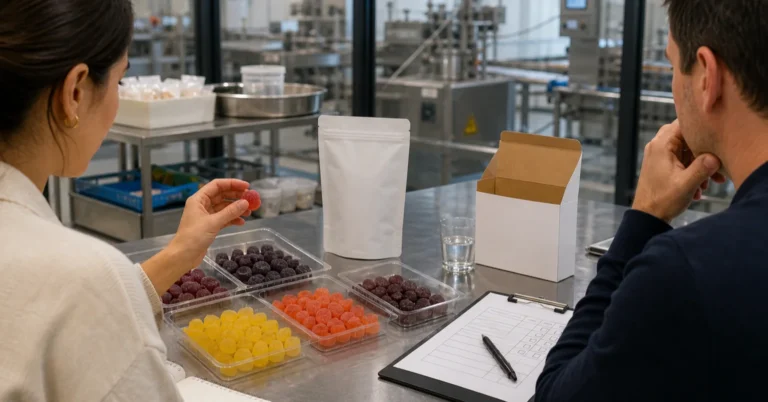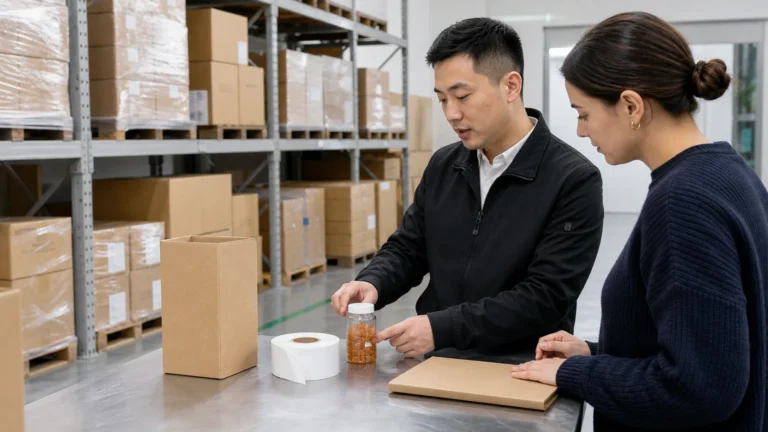

Supplement manufacturing cost depends on format, formula complexity, active load, MOQ, packaging, testing, documentation, and the completeness of your product brief.
A useful quote compares the same specifications, not just the lowest unit number.
For a supplement brand, the better question is not "what is the average price?" It is "what must we define so a manufacturer can price the same product we expect to launch?"
Decision Snapshot
- Frame cost as a quote-readiness issue, not a fixed online price.
- Separate unit cost from total project cost before comparing suppliers.
- Define format, serving target, active load, packaging, testing, MOQ, and timeline before requesting a quote.
- Use white label, private label, or custom manufacturing based on launch risk and differentiation needs.
- Keep startup-capital and legal questions separate from the manufacturing estimate.
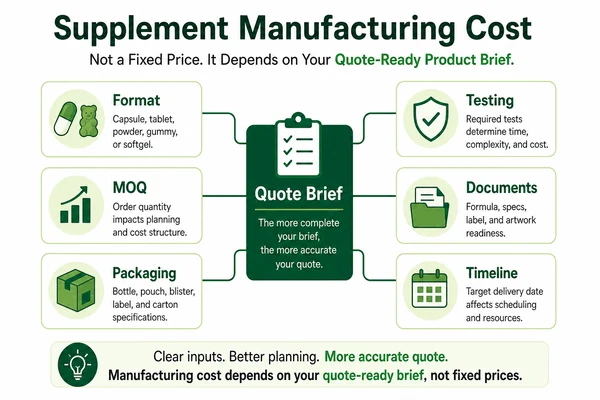
What Really Affects Supplement Manufacturing Cost?
Manufacturing cost changes when the product brief changes.
Supplement manufacturing cost depends on the defined product, production route, MOQ, packaging plan, testing expectations, and launch timeline. Without those inputs, two supplier quotes may describe materially different products.
Why fixed online prices are rarely reliable
Fixed supplement prices are easy to search for, but they rarely match the product a brand actually wants to launch. A capsule with a simple vitamin blend, a high-active gummy, a powder with several branded ingredients, and a liquid shot do not move through the same sourcing, formulation, production, packaging, or testing path.
When I review a cost question, I first look for missing specifications. If the brand has not defined serving size, active load, flavor expectations, packaging format, target market, and documentation needs, a number can only be a rough conversation starter.
That is why a cheap quote can become expensive later. The early number may exclude flavor work, packaging setup, label review, third-party testing, sample rounds, freight, or rework after the formula proves harder to manufacture than expected.
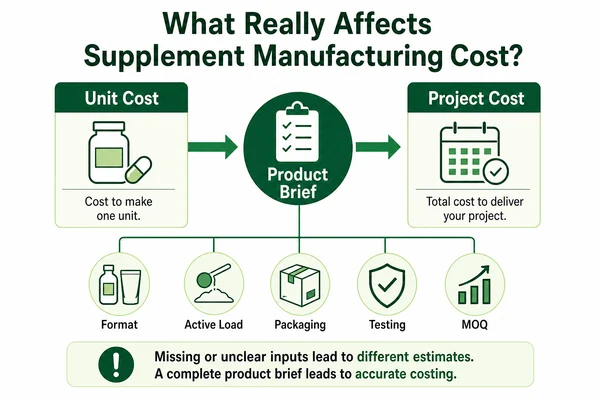
Cost per unit vs. total project cost
Unit cost matters, but it is only one part of the budget. A brand also needs to understand total project cost: formula work, samples, packaging, testing, documentation, labels, minimum order quantity, production deposits, warehousing, and reorder planning.
| Cost view | What it tells you | Why brands confuse it |
|---|---|---|
| Unit cost | Estimated cost for each finished bottle, pouch, stick pack, jar, or carton | It can look low when setup, testing, packaging, or freight are outside the quoted line |
| Project cost | Cash needed to move from brief to finished goods | It includes first-run commitments, samples, documentation, and operational items |
| Landed cost | Cost after goods are ready for sale in the target channel | It may include logistics, duties, storage, fulfillment, and channel preparation |
| Reorder cost | Cost profile after the first run and validated specifications | It may improve, but only if demand, packaging, supply, and production planning are stable |
For planning, the total project cost is often more important than a single unit estimate. It tells the brand whether the launch is realistic at the MOQ, packaging format, and testing level it wants.
What a manufacturer needs before estimating
A manufacturer cannot price a serious project from a product category alone. "We want a sleep gummy" or "we want a greens powder" does not define the active load, serving size, sensory target, packaging, testing, claim direction, or quantity.
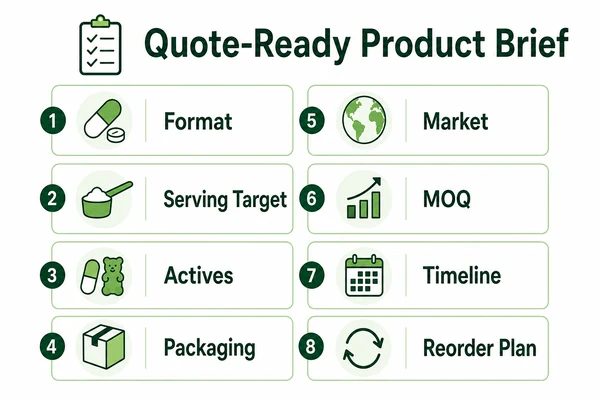
A quote-ready brief should answer at least these questions:
| Quote input | Why it affects cost |
|---|---|
| Product format | Different equipment, process controls, moisture targets, fill weights, and packaging paths |
| Serving target | Changes active amount, serving count, package size, and label math |
| Active ingredients | Impacts sourcing, solubility, flavor masking, stability, and testing |
| Ingredient grade | Changes supplier options, documentation, and lead time |
| MOQ range | Drives purchasing efficiency, setup allocation, and unit economics |
| Packaging format | Changes component cost, line setup, label area, and shipping volume |
| Testing expectations | Adds batch, identity, microbial, heavy metal, or other documentation needs depending on product and market |
| Timeline | Compressing samples, sourcing, review, and production can increase operational risk |
For brands still deciding between stock formulas and custom development, this is where route selection matters. A deeper comparison belongs in a stock formula vs custom formulation review before requesting detailed supplier pricing.
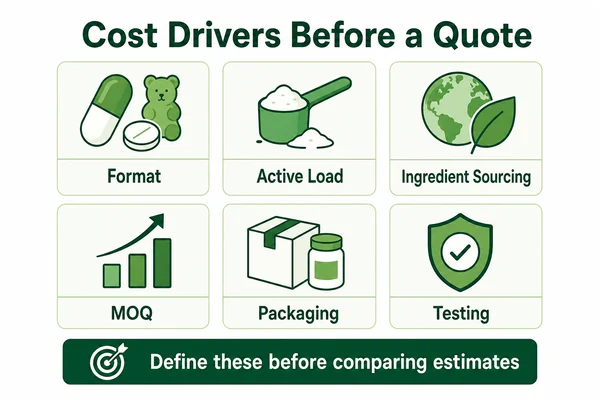
Supplement Manufacturing Cost Drivers Before You Request a Quote
Most cost differences start before production begins.
Supplement manufacturing cost is primarily shaped by product format, formula complexity, active load, ingredient sourcing, MOQ, packaging, and testing requirements. Differences in these inputs explain why two manufacturing quotes may not be directly comparable.
Product format
Format is one of the first cost drivers because it changes production method, quality checks, packaging options, and sensory work. Capsules, tablets, powders, gummies, liquids, softgels, stick packs, and sachets do not share the same constraints.
| Format | Common cost pressure | Quote-readiness question |
|---|---|---|
| Capsules | Fill weight, ingredient flow, capsule size, count per bottle | Can the formula fit the target serving without too many capsules? |
| Tablets | Compression behavior, coating, hardness, disintegration, tooling | Does the formula need special tablet development or coating? |
| Powders | Flavor system, solubility, serving scoop, dust control, pouch or tub filling | Is the serving size, flavor target, and pack size defined? |
| Gummies | Active load, flavor masking, texture, moisture, mold format, pectin or gelatin base | Can the active level fit the gummy without damaging taste or texture? |
| Liquids | Solubility, preservation, bottle type, fill volume, leak control | Is the serving volume, shelf expectation, and packaging path clear? |
| Stick packs | Film, sachet size, powder flow, count per carton | Is the per-stick fill weight and carton count confirmed? |
Brands often start with a marketing format preference. The manufacturer still needs to test whether the formula can work in that format at the desired serving and quality target.
Formula complexity and active load
Formula complexity is not just the number of ingredients. It is how the ingredients behave together during sourcing, blending, forming, filling, flavoring, packaging, and testing.
A high active load can affect cost in several ways. It may increase raw material spend, reduce available space for flavor or excipients, make gummies harder to texture, make capsules too large, or require more sample rounds before the product is acceptable.
When I see a brand ask for many actives in one serving, I usually check three things before cost: whether the serving size is realistic, whether the format can carry the active load, and whether the label direction creates extra review pressure.
| Complexity factor | Cost impact |
|---|---|
| Many active ingredients | More sourcing, more testing considerations, more label review |
| High dosage target | More material, larger serving, possible sensory or format pressure |
| Poor-tasting actives | Flavor masking, sweetener balance, or sample rounds |
| Sensitive ingredients | Storage, handling, stability, and documentation attention |
| Branded or specialty inputs | Supplier qualification, document collection, and lead time |
| International market plans | More label, claim, documentation, and ingredient checks |
Ingredient quality and sourcing
Ingredient quality affects both unit cost and quote reliability. A low material price may not be helpful if documentation is weak, lead time is unstable, or the supplier cannot support the target market.
For supplement brands, ingredient sourcing should be discussed as a practical risk-control issue. Ask whether the manufacturer can explain supplier options, specification documents, batch traceability expectations, and whether substitute grades would change the final product positioning.
Cost can change when the brand requests:
- branded ingredients or trademarked raw materials;
- organic, non-GMO, vegan, kosher, halal, or similar positioning support;
- specific country-of-origin expectations;
- allergen-related controls;
- stricter heavy metal, microbial, identity, or contaminant testing;
- documentation packages for Amazon, distributors, retailers, or import channels.
Those requirements may be valid, but they should appear in the quote brief early. Adding them after the first quote often changes the estimate.
MOQ and production scale
MOQ affects cost because setup time, procurement, packaging components, labor planning, testing, and production scheduling must be spread across the order size. A smaller first run can reduce launch risk, but it may carry a higher unit cost.
Low MOQ can be useful for a first launch, sampling market demand, or testing a new format. It should still be matched to a realistic reorder plan. A brand that sells through quickly but cannot reorder in time may face stockouts, rushed production, or packaging delays.
For gummy projects, MOQ and route selection often deserve a separate review. A brand comparing first-run risk can use a low MOQ private label gummy supplements guide before deciding whether to start with an existing formula or a more customized product.
Private Label Supplement MOQ and Startup Cost: What Changes the First-Order Budget?
Private label can reduce development work, but it does not remove the first-order budget.
A useful startup budget separates the quotable manufacturing scope from broader business costs. Talvenda can help define the production brief, but fixed startup capital, legal setup, advertising spend, and channel economics should be handled separately.
The brand still needs to plan MOQ, samples, packaging, label review, testing, documentation, deposits, logistics, and reorder timing before production starts.
Why MOQ Is Not One Fixed Number
Private label supplement MOQ depends on what the manufacturer is actually producing. A ready formula with standard packaging may support a lower first order than a semi-custom flavor, custom active level, unique package, new mold, or special testing package.
The most important question is not only "what is your MOQ?" It is "what does that MOQ include?" Brands should confirm whether the minimum applies to finished bottles, gummies, pouches, sticks, units, flavor, formula, packaging component, or SKU.
| MOQ driver | Why it changes the first order |
|---|---|
| Formula route | Stock and private label routes usually carry fewer development inputs than full custom projects |
| Active load | Higher or more complex actives can change sourcing, serving size, texture, flavor, and testing needs |
| Raw material purchasing | Some ingredients have supplier minimums or longer lead times that shape the practical batch size |
| Packaging components | Bottles, pouches, labels, cartons, molds, and closures may have their own order minimums |
| Testing and documents | Testing scope, batch document expectations, and market documents can affect both cost and schedule |
| Reorder plan | A very small first order can create stockout risk if reorder lead time is ignored |
Startup Costs Beyond the First Unit Price
Startup brands often focus on unit cost because it is easy to compare. The more useful view is the cash needed before the product can be sold responsibly.
That budget may include sample development, sample shipping, formula or sensory revisions, label artwork, Supplement Facts review, packaging setup, first PO deposit, finished-product testing, batch documents, freight, warehousing, and reorder planning. If the project is gummy-specific, the low MOQ private label gummy supplements guide can help separate first-order risk from custom-development expectations.
For the broader business launch path, use a supplement startup budget and launch plan separately. That keeps manufacturing estimates focused on production scope rather than mixing them with legal setup, advertising, marketplace fees, or working-capital assumptions.
Why "No Minimum Order" Claims Need Careful Review
"No minimum order" can mean different things. It may refer to samples, stocked finished goods, relabeling inventory, a retail resale program, or a very limited product route. It does not automatically mean a cGMP production line can manufacture any custom supplement in any quantity.
Before trusting a no-minimum claim, ask what formula is available, what customization is allowed, what documents are included, whether finished-product testing applies, and how packaging will be handled. A quote-ready manufacturer checklist helps keep those questions consistent across suppliers.
If the brand is ready for a direct estimate, the next step is not to chase the lowest headline MOQ. It is to prepare a supplement contract manufacturing quote brief with format, serving target, active ingredients, packaging, testing, MOQ range, and timeline.
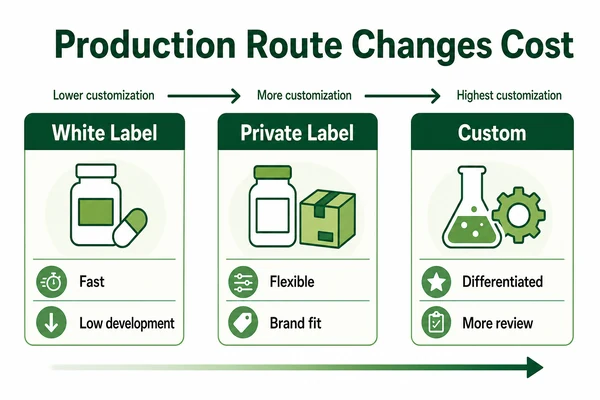
How Production Route Changes Cost
The production route sets the cost and flexibility baseline.
White label, private label, and custom contract manufacturing do not price the same problem. They trade off speed, differentiation, MOQ, development work, and control.
White label
White label is usually the fastest route because the product concept is already largely defined. The brand adds its label and enters the market with limited development work.
The cost benefit is not only the unit price. It is reduced decision complexity. The formula, format, and production route may already be known, which can simplify quote preparation and shorten the path to a first run.
The tradeoff is differentiation. If many brands can sell similar products, the brand may need to compete through positioning, packaging, channel, offer structure, or future custom development.
Private label
Private label sits between speed and flexibility. A brand may start from an existing formula or platform, then adjust flavor, packaging, serving count, label direction, or market fit.
Private label can be cost-effective when the brand wants a more controlled launch without paying for a fully custom development path. It can also help a brand learn demand before committing to larger custom work.
The quote should still clarify what is actually customizable. Changing flavor, color, active level, packaging, testing, or claim direction can move the project away from a simple private-label estimate.
Custom contract manufacturing
Custom contract manufacturing is the route for brands that need stronger differentiation, specific active combinations, unusual formats, custom sensory goals, or a product designed around a particular market position.
This route usually needs more formulation review, sample rounds, ingredient sourcing, testing discussion, packaging coordination, and timeline planning. It can be the right choice, but the cost conversation must be more specific.
For direct service intent, this guide should not replace a quote page. A brand preparing for a real estimate should build a supplement contract manufacturing quote brief with format, serving, active, packaging, testing, and timeline details before asking suppliers to price the project.
Costs Brands Often Miss After Formulation
The formula is not the whole launch budget.
Post-formulation supplement costs can include packaging, labeling, testing, documentation, certifications, additional sample rounds, and timeline changes. These items can materially change the total manufacturing budget even when the formula stays the same.
Packaging and labeling
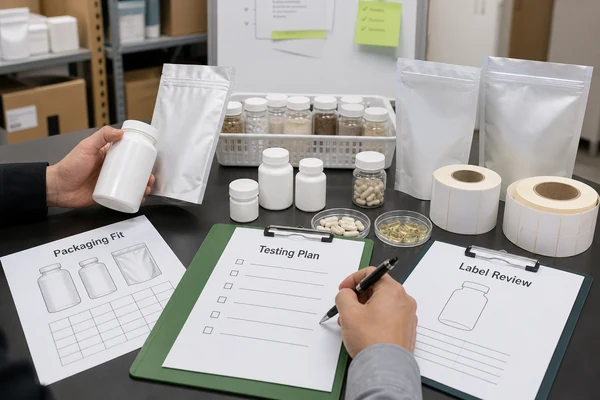
Packaging can change cost even when the formula stays the same. Bottles, caps, induction seals, scoops, pouches, stick packs, cartons, inserts, labels, shrink bands, and shipper cartons all need to be specified.
Packaging also changes production flow. A pouch filling project may need different line setup than bottles. Stick packs may require film decisions and carton counts. Gummies may need bottle size and desiccant decisions. Liquids may need leak-control and closure review.
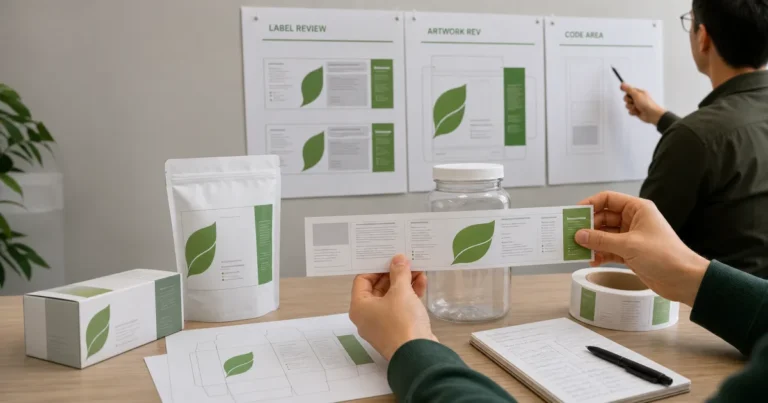
Labeling is not just artwork. The label has to match serving size, ingredient list, Supplement Facts, warnings, claims, barcode, lot/date coding area, and market-channel needs.[^1] If the label changes late, the quote and timeline can change with it.
Testing and documentation
Testing and documentation should be planned before the first serious quote. The level of testing depends on product type, ingredients, target market, claims, sales channel, and brand requirements.
Common documentation discussions may include ingredient specifications, analysis-document expectations, batch records, identity testing, microbial testing, heavy metal review, allergen statements, stability considerations, and finished-product documentation.[^2] The exact package should be confirmed with qualified manufacturing and regulatory compliance support.
| Testing or document item | Why it matters for cost planning |
|---|---|
| Raw material documents | Helps verify ingredient identity, supplier quality, and specification match |
| Batch documentation | Supports traceability and channel review needs |
| Microbial and heavy metal testing | May be expected for quality, retailer, marketplace, or product-risk reasons |
| Stability or shelf-life review | Helps align packaging, formula, and shelf expectation |
| Label and claim review | Helps reduce avoidable relabeling or launch-delay risk |
The wrong approach is to handle documentation as an afterthought. If a brand asks for extra documents after production planning, the manufacturer may need to revisit sourcing, testing, or schedule assumptions.
Certifications and claim review
Certification and claim language can affect both cost and timeline. A brand may want vegan, non-GMO, organic, kosher, halal, sports, retailer, or marketplace-related documentation. Each request should be checked against ingredient supply, production route, facility capability, documentation, and label language.
Do not assume a certification is available because a product category sounds common. Ask what proof is needed, who provides it, whether the facility or product route can support it, and whether the claim belongs on the label, website, marketplace listing, or sales material.
Claim review is also part of cost readiness. Disease claims, exaggerated performance claims, wording that implies FDA product approval, and unsupported benefit language can create rework.[^3][^4] A manufacturer can help flag practical production and documentation boundaries, but brands should use qualified legal or regulatory review for final market decisions.
Samples, revisions, and timeline
Samples are where many cost assumptions become visible. Flavor may need adjustment. A gummy may carry less active than expected. A powder may need a different sweetener system. A capsule may require a larger size or different serving count.
Sample rounds take time and may add cost. They are still cheaper than discovering after production that the product misses the intended taste, texture, serving, label, or packaging expectation.
Timeline pressure can also increase risk. If a brand compresses sourcing, sampling, packaging artwork, label review, testing, and production into an unrealistic launch date, the project may become more expensive or less stable.
How to Prepare a Quote-Ready Product Brief
A quote-ready brief makes supplier estimates comparable.
The brief should define the product enough for a manufacturer to assess format feasibility, sourcing, MOQ, packaging, testing, timeline, and documentation needs.
Product format and serving target
Start with the format and serving goal. The manufacturer needs to know whether the product is a capsule, tablet, gummy, powder, liquid, stick pack, sachet, or another format. Then define serving size, servings per container, target count, fill weight, and any sensory expectations.
If the format is not final, state the options being considered. A manufacturer can often explain why one route may be easier, cheaper, faster, or more realistic than another.
| Brief field | Example of what to define |
|---|---|
| Format | Capsule, gummy, powder, liquid, tablet, stick pack, pouch, bottle |
| Serving | Amount per serving, serving count, daily serving assumption |
| Sensory target | Flavor, sweetness, color, mouthfeel, aftertaste limit |
| Package | Bottle count, pouch size, stick count, carton, label area |
| First-run goal | Test launch, channel launch, wholesale order, reorder cycle |
Active ingredients and dosage goals
List active ingredients, target amounts, preferred grades, and any ingredients that are mandatory for positioning. Also mark what is flexible. This helps the manufacturer separate must-have inputs from items that can be adjusted for feasibility.
If the dosage goal is based on a competitor product, give that reference carefully. The goal is not to copy a formula. The goal is to show the intended serving structure, active level, and market expectation so the manufacturer can identify practical constraints.
I would also separate "brand wish list" from "launch requirement." That makes the cost conversation more useful because the manufacturer can show which choices increase cost, complexity, lead time, or sample risk.
Packaging, market, and testing requirements
Packaging and market requirements belong in the brief early. A brand selling through Amazon, DTC, distributors, retailers, or international channels may need different documentation, label details, carton structures, or testing expectations.
Include planned claims, target market, sales channel, label language, packaging preferences, and any certification or documentation requirements. If those items are uncertain, mark them as uncertain instead of leaving them out.
For manufacturer evaluation, the brief can be paired with a gummy supplement manufacturer checklist or a broader supplier checklist so the brand asks the same questions across vendors.
MOQ, launch timeline, and reorder plan
MOQ should be discussed with both launch risk and unit economics in mind. A brand may prefer a small first run, but the manufacturer still needs to plan purchasing, production, packaging, testing, and schedule capacity.
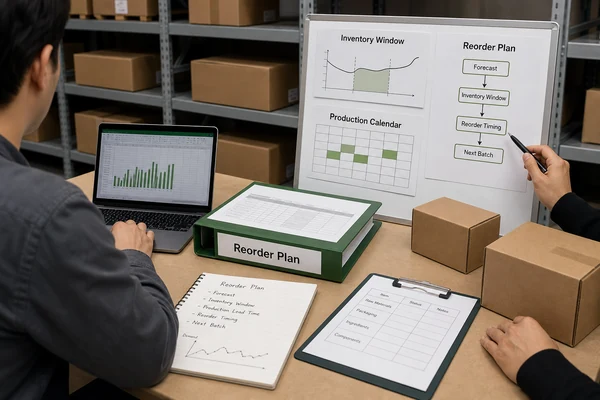
Give the manufacturer three numbers if possible: desired first-run quantity, acceptable range, and expected reorder timing. This helps the supplier explain whether the first order is a market test, a serious channel launch, or the start of a scaling plan.
| Planning question | Why it matters |
|---|---|
| What is the target first order? | Drives material purchasing, setup allocation, and cash requirement |
| What is the acceptable MOQ range? | Helps compare practical options instead of rejecting every quote |
| When is launch needed? | Affects sourcing, sampling, artwork, testing, and production schedule |
| When might the reorder happen? | Helps avoid stockouts and supports better cost planning |
| Which channel will sell first? | Changes packaging, documentation, and inventory assumptions |
For startup-level budgeting, link manufacturing decisions back to the broader launch plan. A brand can use a how to start a supplement brand guide for business setup, positioning, and startup-capital planning while keeping the manufacturing-cost discussion focused.
How Cost Can Change as You Scale
Scaling can improve unit economics, but not every cost falls automatically.
Supplement manufacturing cost per unit may fall as order volume increases and setup work is spread across more units. However, testing, packaging changes, documentation, storage, cash flow, and claim review do not automatically become cheaper at scale.
Why larger runs can reduce unit cost
Larger runs can spread setup time, labor planning, packaging setup, and some testing or documentation work across more finished units. They may also support better raw material purchasing and more efficient production scheduling.
This is why first-run pricing may not match reorder pricing. A validated product with stable packaging, confirmed suppliers, and cleaner demand forecasting is usually easier to plan than a first launch with many open decisions.
However, lower unit cost only helps if the brand can sell, store, and reorder responsibly. A large order that creates expired inventory, cash pressure, or packaging changes before sell-through is not automatically cheaper in business terms.
Where scale does not automatically save money
Some costs do not disappear just because the order is larger. Testing may still be needed by batch or lot. Packaging component changes can create new setup. Certification or documentation requests may still require review. A new claim direction may trigger label work.
Scale can also introduce new costs. Larger orders may need more warehousing, freight planning, inventory control, marketplace preparation, retailer documentation, or tighter reorder forecasting.
For custom formulas, scale-up may reveal process questions that were not visible in a small sample. The goal is not only to make more units. The goal is to make the same product consistently, with the same quality expectations, at a larger production size.
Budget planning mistakes to avoid
The most common budget mistake is comparing quotes without comparing assumptions. If one quote includes packaging, testing, and documentation while another only lists base production, the lower number may not be the lower project cost.
Other mistakes include:
- changing active load after the first quote;
- choosing packaging before checking line fit and component availability;
- assuming a low MOQ will have the same unit economics as a scale order;
- ignoring sample rounds and artwork review time;
- treating certification or claim language as a last-minute label decision;
- planning a launch date before sourcing, testing, and packaging have been confirmed;
- forgetting reorder lead time after the first batch sells.
A better budget process is simple: define the product, ask suppliers to quote the same assumptions, identify which costs are included or excluded, and separate manufacturing estimates from legal, financial, fulfillment, and channel-launch decisions.
FAQs About Supplement Manufacturing Cost
How much does supplement manufacturing cost?
It depends on format, formula, active load, MOQ, packaging, testing, documentation, production route, and timeline. A realistic quote needs a product brief before a manufacturer can estimate the project.
Is private label cheaper than custom formulation?
Private label is often simpler because the product platform may already exist. Custom formulation usually needs more development, sourcing, samples, and review, but it can support stronger differentiation.
What affects private label supplement MOQ?
Private label supplement MOQ is affected by formula route, active load, raw material purchasing, packaging components, label setup, testing needs, SKU count, and reorder timing. A lower first order may be possible when the brand uses an existing formula and standard packaging, but customization usually changes the minimum.
How much should a startup budget before supplement production?
A startup should budget for more than the quoted unit cost. The pre-production budget may include samples, revisions, artwork, label review, packaging setup, testing, documentation, deposits, freight, and reorder planning. Talvenda can support the manufacturing brief, but legal, advertising, channel, and finance planning should be handled separately.
Are private label supplements available with no minimum order?
Sometimes a supplier may advertise no minimums for samples, stocked products, resale programs, or limited relabeling options. That is different from custom manufacturing. Before relying on a no-minimum claim, confirm the formula, packaging, testing, documentation, customization limits, and whether the offer applies to finished commercial production.
Is low MOQ automatically cheaper for a new supplement brand?
No. Low MOQ can reduce first-order inventory exposure, but it may raise unit cost, limit customization, reduce packaging flexibility, or create reorder pressure. A new brand should compare total project cost, not only the smallest possible order.
Do you need FDA approval to sell supplements?
Do not frame supplement launch as a simple FDA pre-approval step.[^5] Requirements depend on product, label, claims, market, and channel. Use qualified regulatory review before launch decisions.
Is it cheaper to manufacture supplements yourself?
Usually, new brands compare contract manufacturing first because production, quality systems, equipment, testing, sourcing, and documentation require real infrastructure. Building in-house capability is a separate business decision.
Conclusion
Supplement manufacturing cost is best planned through a quote-ready product brief, not a fixed public price.
As a contract gummy supplement manufacturer, Talvenda can help teams turn cost questions into a quote-ready route decision: low-MOQ market-tested in-stock gummies for faster market testing, stock formula modification for controlled adjustments, or custom gummy development when differentiation justifies more work. The review can connect formula direction, MOQ expectation, packaging plan, documentation and testing expectations, quality-controlled production, and scale-up support, so the first conversation focuses on realistic cost drivers instead of broad supplier-price discovery. Start with the project inquiry form.
[^1]: FDA, "Dietary Supplement Labeling Guide", https://www.fda.gov/food/dietary-supplements/dietary-supplement-labeling-guide. Evidence role: labeling-context source for Supplement Facts, label elements, and review-sensitive label planning; not legal advice. [^2]: eCFR, "21 CFR Part 111 - Current Good Manufacturing Practice in Manufacturing, Packaging, Labeling, or Holding Operations for Dietary Supplements", https://www.ecfr.gov/current/title-21/chapter-I/subchapter-B/part-111. Evidence role: regulatory context for why documentation, identity, quality, packaging, labeling, and holding controls can affect planning; not a quote promise. [^3]: FDA, "Structure/Function Claims", https://www.fda.gov/food/food-labeling-nutrition/structurefunction-claims. Evidence role: claim-boundary context for avoiding disease claims and reviewing benefit language before launch; not legal advice. [^4]: FTC, "Health Products Compliance Guidance", https://www.ftc.gov/business-guidance/resources/health-products-compliance-guidance. Evidence role: advertising-substantiation context for benefit and performance wording; not legal advice. [^5]: FDA, "Questions and Answers on Dietary Supplements", https://www.fda.gov/food/information-consumers-using-dietary-supplements/questions-and-answers-dietary-supplements. Evidence role: consumer/regulatory context for dietary supplement launch boundaries and FDA oversight; not a market-entry checklist.