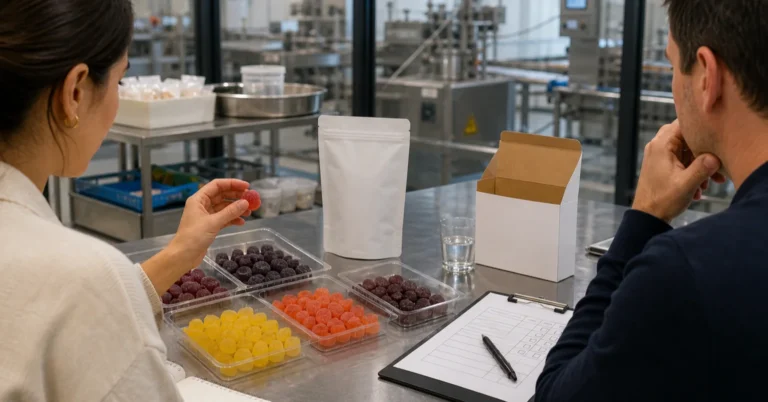

White label vs private label supplements is mainly a choice between speed and control. White label usually starts with a supplier's stock product and branded packaging, while private label may add controlled specifications, approved changes, or customization. Because suppliers use these terms differently, confirm what is fixed, what may change, and which documents govern every reorder.
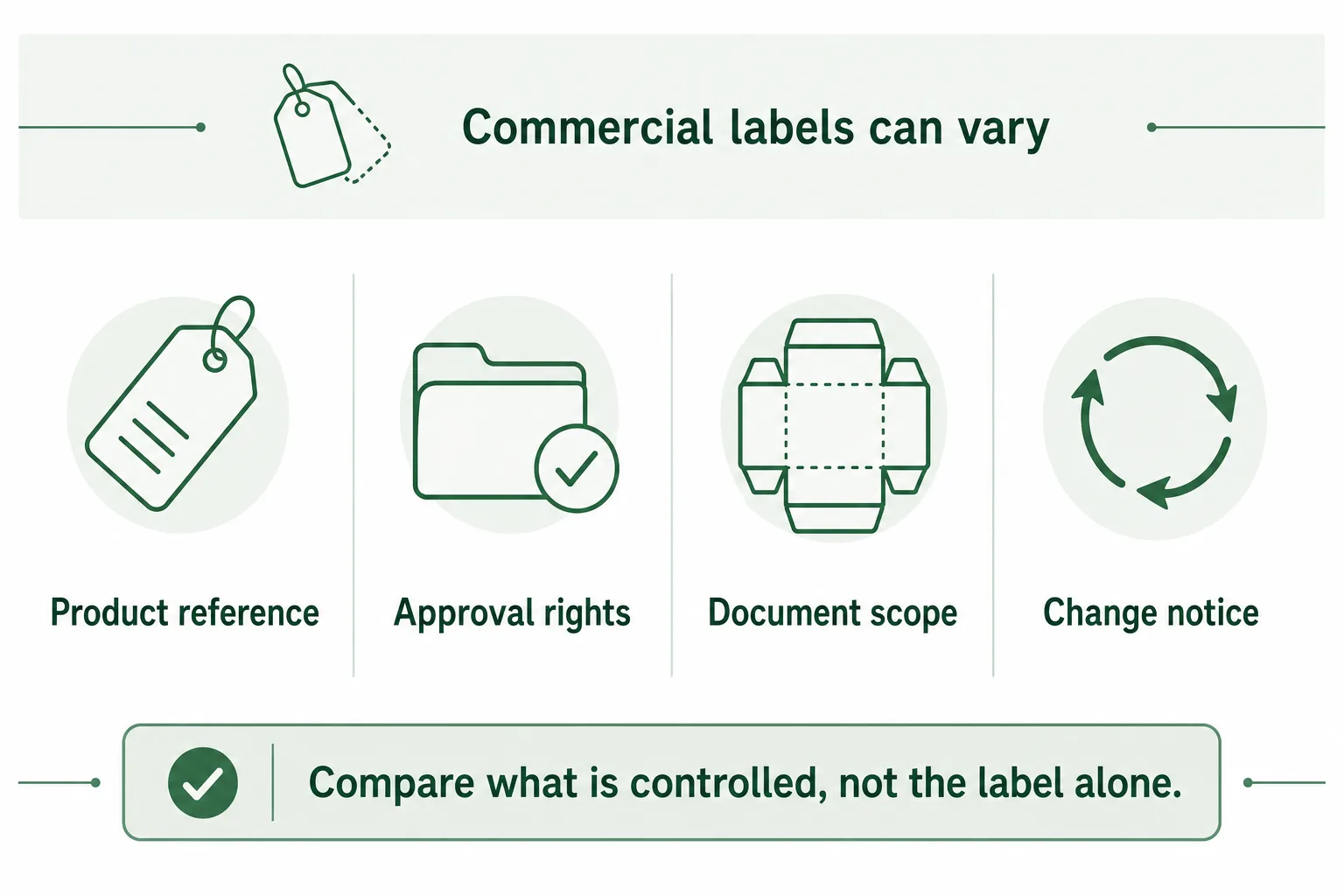
I do not approve a route from its commercial name alone. I first check whether the quote, product reference, label, packaging configuration, document expectations, and change-notification terms describe the same finished product.
Decision Snapshot
- Choose white label when speed and lower initial commitment matter more than formula differentiation.
- Choose a more controlled private-label program when your brand needs defined approval and change rights.
- Move to custom formulation only when the required product difference cannot be protected within a stock or semi-custom route.
- Treat ownership, exclusivity, testing, documentation, MOQ, and lead time as quote-specific terms, never automatic benefits of a label.

What White Label and Private Label Mean in Supplement Sourcing
The service name can sound precise while hiding different commercial arrangements. If the definition stays vague, the brand may approve a route it does not control.
White label and private label supplement programs are supplier-dependent commercial offers. White label usually uses a stock product, while private label may provide more brand control, but neither term proves formula ownership, exclusivity, testing scope, or change rights without written confirmation.
White Label: A Stock Product Route
A white-label route normally begins with a finished product concept already available in the supplier's portfolio. The base formula, dosage form, production method, and many component choices are usually established before the brand enters the project. The brand may then add its name, approved artwork, and a packaging configuration offered within the program.
The limits are equally important. A stock formula may be offered to several customers. Ingredient sources, flavors, colors, serving directions, container options, or label layouts may be restricted to an approved menu. Even when a supplier allows a minor adjustment, the product can remain fundamentally stock.
I separate branding freedom from product control at this point. A custom label does not mean a custom specification. Before accepting the speed advantage, the brand should identify the exact formula or item reference, approved packaging format, label-approval process, documents supplied with an order, and the rule for future changes.
White label is not a low-quality route by definition. It is a lower-control route when the offer leaves core product decisions with the supplier. That can be a sensible trade when the stock product fits the intended market and the limitation is understood before the first purchase order.
Private Label: A Brand-Controlled Program
Private label is used more broadly, so the name needs qualification. Some suppliers use it for the same stock-product model described as white label. Others use it for a program where the brand can approve selected formula, flavor, packaging, specification, testing, or documentation details. The useful distinction is the control written into the project, not the label used on the proposal.
A more controlled private-label program should make the product identity and approval path visible. The brand should be able to answer three questions:
- Which formula, item, or specification reference applies to this order?
- Which changes require notice, review, or written approval?
- Which label, packaging, testing, and release-document expectations apply to the order and reorder?
The answers will vary by supplier and route. They do not need to make the product fully custom. They need to remove ambiguity about what the brand is purchasing and how a future order will be matched to the approved basis.
Private label also does not automatically create ownership or exclusivity. A supplier may retain the base formula, offer the same base to other brands, or reserve the right to update components within agreed limits. A brand may own its trademarks and artwork while having limited rights over the product formula. Each right should be stated separately.
Where Custom Formulation Fits
Custom formulation sits beyond a controlled stock or semi-custom program. It becomes relevant when the brand's target cannot be reached through available stock specifications or permitted modifications. The driver may be a distinct active combination, serving target, dosage form, sensory requirement, claim boundary, packaging condition, or market-specific product brief.
The practical boundary is explained in more detail in stock formula vs custom formulation. For this comparison, the question is narrower: can the brand protect its required product difference through a documented stock or semi-custom route? If yes, full custom development may add complexity without useful market value. If no, a custom route may be justified.
I would not move a project to custom formulation because the phrase sounds more premium. I first identify the requirement that the current route cannot hold consistently. That requirement should be clear enough to guide a sample brief, a controlled specification, and later production approval.
White Label vs Private Label: The Decision Matrix
A fast quote can make two routes look similar. The gap appears later, after cash is committed and the brand asks what can change.
The white label vs private label decision should compare formula control, label rights, MOQ exposure, launch speed, documentation, change notification, and reorder consistency. The best route is the least complex option that still protects the brand's essential product and commercial requirements.
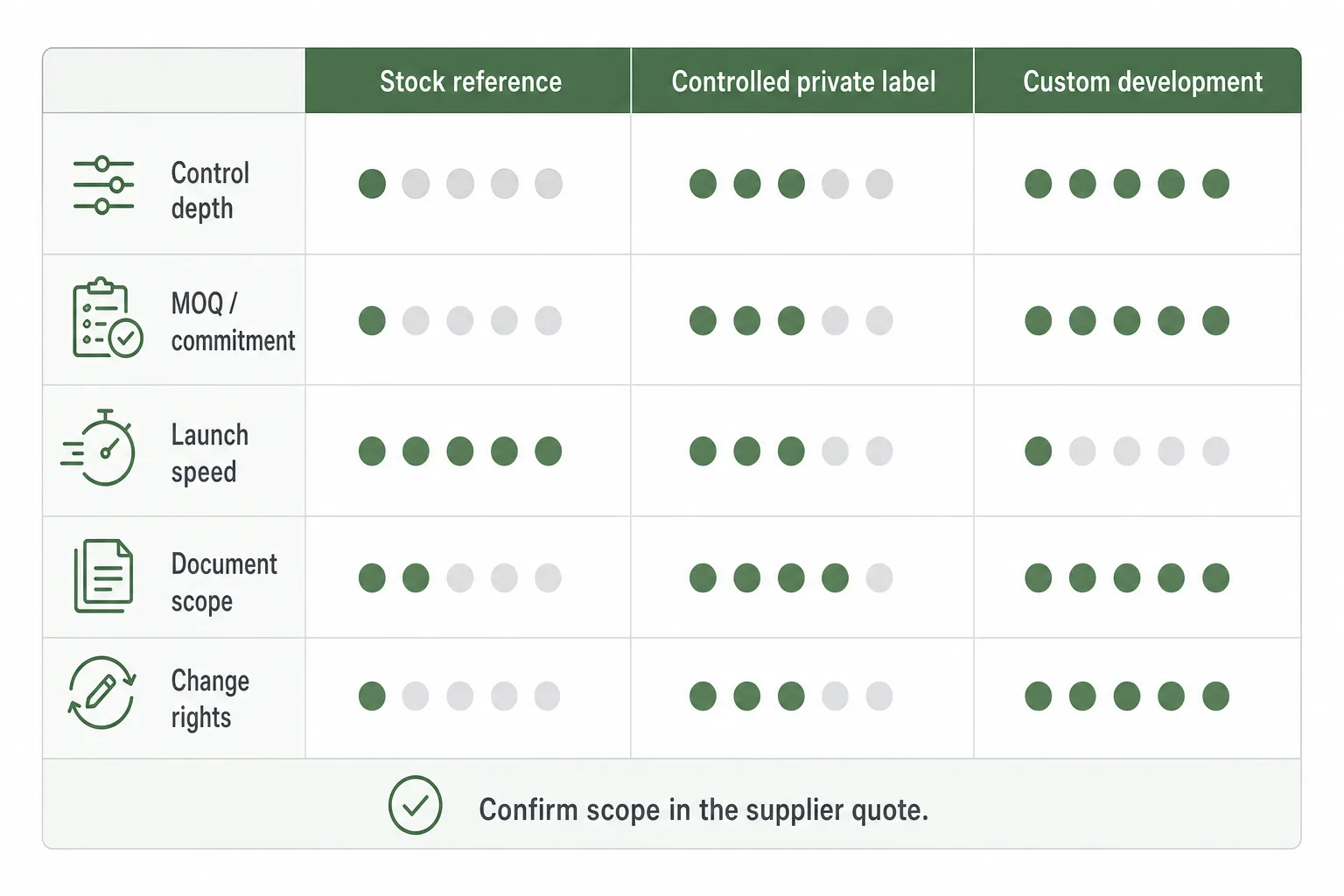
The matrix below shows common route patterns rather than guaranteed benefits. The supplier's written scope remains the controlling record.
| Decision area | Typical white-label route | More controlled private-label route | Custom formulation route |
|---|---|---|---|
| Base formula | Stock and largely fixed | Stock or semi-custom with defined options | Developed against a specific approved brief |
| Brand approval | Artwork and selected packaging | Artwork plus agreed product or specification decisions | Formula direction, sample, specification, packaging, and project-specific approvals |
| Change rights | Often supplier-led within the stock program | Defined permitted changes and notification rules | Project-specific change control should be agreed |
| Initial commitment | Usually lower than a comparable custom project | Depends on modification and packaging scope | Usually carries more development and production commitment |
| Launch path | Faster when stock and packaging are available | Moderate when approvals or modifications are added | Longer because development, sampling, and validation are required |
| Differentiation | Mostly brand, positioning, and packaging | Selected product or presentation differences | Product-level differentiation when technically and commercially feasible |
| Reorder control | Depends on the stock item and supplier policy | Stronger when a controlled reference is maintained | Depends on the final specification and change process |
| Ownership or exclusivity | Not implied | Not implied | Not implied; must be agreed separately |
Formula and Label Control
Formula control begins with identification. A quote should reference a specific formula, item, or specification version rather than a broad product name. “Multivitamin gummy,” for example, is not enough to establish ingredient amounts, sources, permitted substitutions, flavor, color, serving, or other product attributes.
Label control is a separate layer. The brand may own its artwork and still have limited authority over the formula behind it. The label also needs to remain aligned with the approved product reference. If the formula, serving, ingredient declaration, allergen information, net contents, or packaging changes, the artwork may need review before another order proceeds.[^1]
The safer procurement record links three items: the controlled product reference, the approved label version, and the approved packaging configuration. A version date or identifier helps purchasing, quality, design, and production confirm that they are discussing the same finished item.[^2]
MOQ, Cost, and Cash Exposure
MOQ should be read as a bundle of commitments, not one number. The finished product may have one minimum, while bottles, caps, labels, cartons, pouches, printed film, flavor components, or custom ingredients have separate purchasing constraints. A quote can look accessible until packaging and component commitments are included.
Cost needs the same scope discipline. The unit price may or may not include packaging components, label application, cartons, testing, documentation, freight preparation, development work, or later change requests. Comparing two prices without matching scope can direct the team toward the wrong route.
Total cash exposure is the better comparison. It can include product quantity, deposits, development or setup scope, packaging inventory, unused custom components, logistics preparation, and working capital held until the product sells. White label may reduce this exposure when the brand accepts stock choices. Private label and custom routes may increase it as controlled changes, dedicated components, or development work are added.
For gummy projects, detailed minimum-order planning belongs in the low-MOQ private label gummy supplements guide. Here, the rule is simple: compare total committed cash under the same scope, then decide whether the added control earns its cost.
Launch Speed and Change Control
Launch speed is not only the production lead time stated on a quote. It begins when the brief is complete and can include product-reference confirmation, sample work, label review, packaging approval, component availability, production scheduling, release steps, and shipping preparation. A stock route can be faster because several decisions are already constrained.
Change control protects the schedule after launch. The quote or related agreement should explain how a formula, ingredient source, packaging component, manufacturing location, specification, or document change is communicated. Not every change needs the same approval path, but the categories and responsibilities should be visible.
When I review a launch plan, I distinguish promised speed from controlled speed. Promised speed is a date. Controlled speed is a sequence with clear inputs, approvals, dependencies, and change rules. The second is more useful because it shows what can delay the project and who owns the next action.
Ownership, Exclusivity, and Reorders
Ownership can refer to different assets: the brand name, label artwork, formula, specification, tooling, packaging design, test results, or project documents. A statement that the brand “owns the product” is too broad unless those assets are separated. The same is true for exclusivity.
Reorder consistency depends less on the first sample than on the records behind it. The team should be able to reference the approved formula or product identifier, packaging configuration, label version, release-document expectation, and change history. The supplier should also explain how a superseded reference is kept out of a new order.
A sample can show whether the product direction is acceptable at one moment. It cannot, by itself, define future production. Reorder confidence comes from a controlled reference set and a change process that survives staff changes, new purchase orders, component updates, and normal production variation.
When White Label Is the Better Launch Route
Custom work is not always the best first move. It can consume cash and time before the brand has proved channel demand.
White label is the better launch route when a suitable stock supplement meets the essential product brief and the brand values speed, lower initial commitment, and market learning more than formula exclusivity or broad customization. The limits should be accepted deliberately and documented before purchase.
Testing a Market Quickly
A new brand often has more uncertainty in the market than in the formula. The team may still be testing the offer, price point, channel, message, package size, repeat-purchase behavior, and acquisition economics. Building a highly differentiated product before those questions are clearer can place too much cash into one unproved assumption.
White label can reduce that risk when the stock product is appropriate for the intended positioning. The brand can direct more attention toward packaging, customer education, channel execution, and feedback. The product is not automatically easy to launch, but the development path is narrower.
The broader sequence is covered in how to start a supplement brand. Within this route decision, keep the market test focused: confirm the stock product reference, approve the presentation, understand total commitment, and define what evidence would justify moving to a more controlled program.
Accepting Stock Formula Limits
The strongest white-label projects do not ignore stock limits. They use those limits as part of the launch strategy. The brand knows which elements are fixed and builds its market promise around what the product can support.
Acceptance may cover available flavors, serving format, color system, sweetener system, bottle or pouch options, label dimensions, testing package, document format, and substitution policy. The exact list depends on the supplier and product.
A stock route becomes risky when the sales message promises differentiation that the product reference does not create. Changing artwork, flavor names, or front-label emphasis can improve presentation, but it does not establish a proprietary formula. Claims and comparisons should remain within the approved product and support files.
I recommend setting an upgrade trigger during the first order. It might be stable demand, a channel requirement, a serving target the stock item cannot meet, a packaging need outside the current menu, or a differentiation goal with a clear commercial reason. This prevents a brand from moving into custom work too early or remaining in a restrictive route too long.
When to Move Beyond White Label
A stock route can become restrictive as the product matures. The warning sign is not growth alone; it is a requirement the current reference cannot protect.
Brands should move beyond white label when an essential formula, label, packaging, documentation, claim, or reorder requirement cannot be secured within the stock program. Private label or semi-custom work fits controlled adjustments; custom formulation fits requirements that need a distinct product specification.

Private Label and Semi-Custom Triggers
The first trigger is usually control, not novelty. A brand may need a defined ingredient source, a limited set of permitted substitutions, a selected flavor, a different serving presentation, a packaging configuration, a market-specific label review, or a clearer release-document package. If the supplier can support these within a controlled base formula, a private-label or semi-custom route may be enough.
The second trigger is coordination. Retailers, distributors, marketplaces, or internal quality teams may request documents and approvals that a basic stock program does not organize around the brand's item. A more controlled program can create a clearer link between the product reference, artwork, packaging, purchase order, batch documents, and brand approval.
The third trigger is reorder protection. As sales grow, the cost of ambiguity grows with them. A formula or packaging change can affect labels, customer expectations, inventory, and channel acceptance. The brand may need formal notification and approval rules even if the product remains close to stock.
Semi-custom work is valuable when it solves these defined problems without turning every variable into a development project. List each requested change, its commercial reason, the required approval, and its effect on MOQ, cost, timeline, documents, and reorders. If the list stays narrow, private label can offer a practical middle route.
When Custom Formulation Is Necessary
Custom formulation becomes necessary when the required product identity cannot be expressed or protected through available stock options. That may involve a distinct combination of actives, a serving goal, a dosage-form constraint, an ingredient-exclusion requirement, a sensory target, a packaging interaction, or a claim boundary that changes the formulation brief.
The need should be written as a product requirement, not a general wish to be different. “We want a premium formula” gives the production team little direction. A stronger brief states the target market, intended product role, key active direction, serving concept, dosage form, ingredient constraints, sensory expectations, packaging direction, and evidence boundaries without pretending every target is technically feasible.
Custom work also needs decision discipline. Sample approval should not stand alone. The approved direction must eventually connect to a controlled specification, label, packaging setup, testing expectations, and scale-up path. A sample that tastes good but cannot hold the required active load, texture, packaging life, or repeatable production target is not a complete commercial answer.
I treat custom formulation as justified only when the differentiation is valuable enough to carry its development burden. The requirement should improve channel fit, product positioning, claim discipline, user experience, or portfolio strategy in a way the stock route cannot. Otherwise, controlled modification may be more efficient.
What to Confirm Before You Approve a Supplier Quote
Price and lead time attract attention, but vague quote scope creates expensive surprises. Approval should lock the product, records, packaging, and change process together.
A supplier quote should define the product version, included work, approval rights, testing and document scope, packaging configuration, commercial assumptions, and change-notification process. If these items sit in separate files, the quote should reference them clearly so the first order and every reorder use one controlled basis.
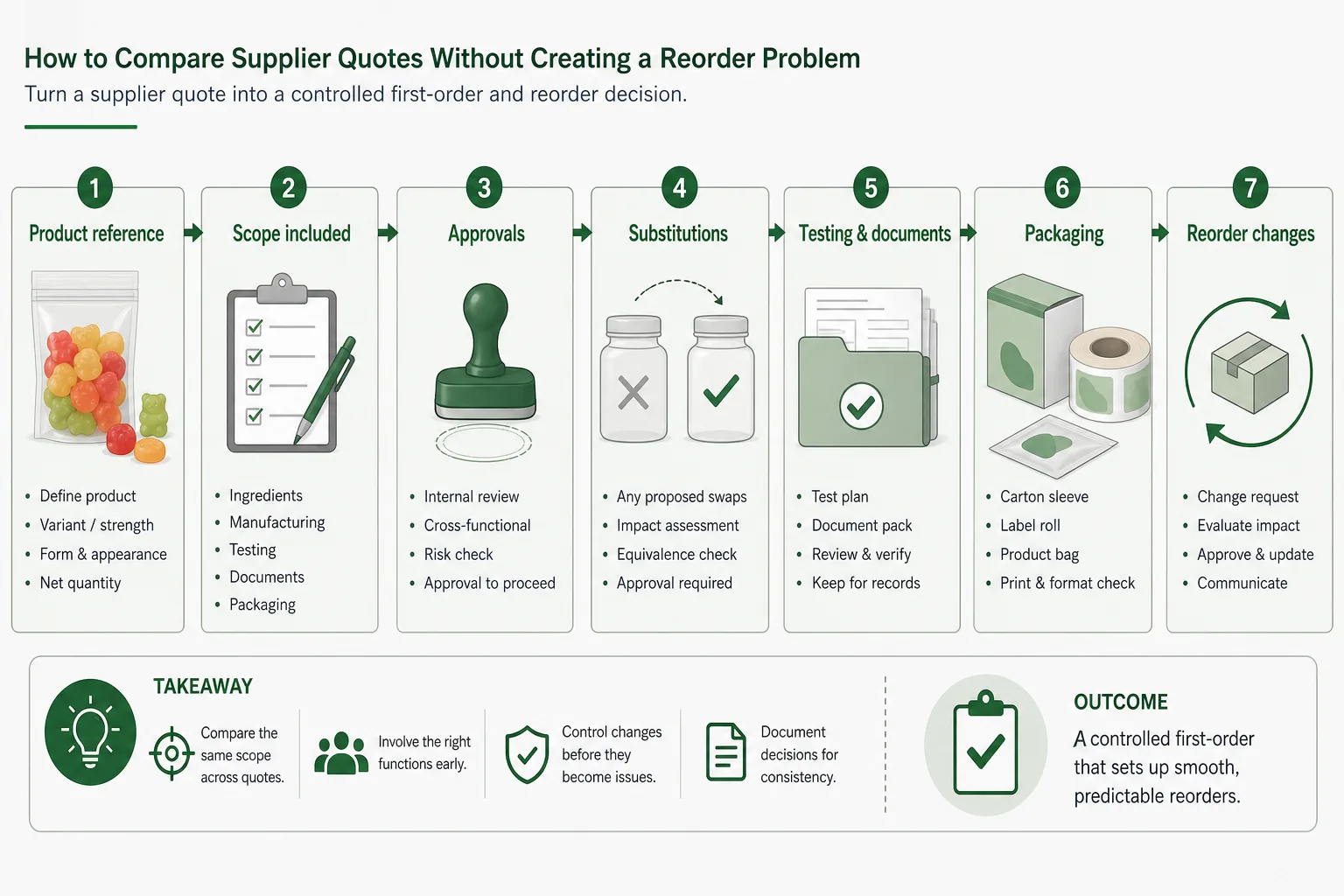
Use this checklist as a discussion and document-control tool. The exact requirements vary by product, supplier, target market, and commercial route.
| Quote confirmation | What the brand needs to see | Why it matters |
|---|---|---|
| Route definition | Stock, semi-custom/private label, or custom scope in plain language | Prevents the service name from hiding the actual work |
| Product reference | Formula, item, or specification identifier and version | Keeps purchasing and production aligned |
| Included changes | Exact formula, flavor, serving, packaging, or label options included | Prevents late scope and price surprises |
| Approval rights | What needs brand approval and who records it | Makes responsibility visible |
| Permitted substitutions | What may change, under which limits, and with what notice | Protects label and reorder consistency |
| Testing and documents | Planned testing scope and documents supplied for the order | Aligns proof expectations before production |
| Packaging configuration | Container, closure, label, carton, pouch, count, and supplied-party responsibility | Exposes component dependencies |
| Commercial scope | MOQ basis, price inclusions, deposits, component commitments, and excluded costs | Shows total cash exposure |
| Timeline basis | Required inputs, approval points, component availability, and scheduling assumptions | Turns a date into an executable sequence |
| Reorder and change process | Version control, notification, reapproval, and superseded-reference handling | Supports repeatable future orders |
Formula, Specification, and Change Rights
Start with product identity. The quote should reference the formula, product code, or specification that will govern production. If a full specification is completed later, the quote should state that production remains subject to approval of the applicable controlled document.
The specification should capture the attributes needed to identify and release the product. Its content depends on the dosage form and program. It may include ingredient and serving details, physical or sensory attributes, packaging configuration, label reference, and other agreed acceptance criteria. A procurement team does not need to design the technical file, but it does need to know which approved file controls the order.
Change rights should be separated into categories. Some changes may be prohibited without written approval. Some may require notice and review. Others may be allowed within an agreed range. The contract, quality agreement, specification, or related project documents should show where these rules live.
The brand should also confirm what follows a requested change. Does it require a revised quote, new sample, specification update, label review, testing review, packaging check, or timeline revision? A clear answer prevents a small commercial request from becoming an uncontrolled production change.
Testing, COA, and Batch Documents
Testing language should be specific to the product and order. “Tested” does not explain what is tested, at which stage, by whom, against which requirement, or which record the brand receives. The quote should identify the testing and document package included, excluded, or still subject to confirmation.
A certificate of analysis, when part of the program, should be read in context. The brand should confirm whether it relates to a raw material, an in-process check, or the finished batch, and how it matches the relevant lot or batch. A document title alone does not prove that every expected attribute was examined.[^3]
Batch documents can include different records depending on the supplier and route. The procurement discussion may need to cover the finished-product specification, COA or release record, lot identification, packaging records, label version, test reports where applicable, and change history. Not every document is automatically customer-facing, so availability and format should be agreed before the purchase order.[^4]
I check document expectations before artwork and production approval, not after goods are ready to ship. Late requests can expose a mismatch between the brand's channel needs and the quoted program. Early alignment gives quality, compliance, procurement, and production teams time to resolve scope without making unsupported claims about what a document proves.
Packaging, Labels, and Market Readiness
Packaging is part of the product route, not a decoration added at the end. The quote should state who supplies each component, which dimensions and materials are approved, how labels are applied, what quantity or component commitments apply, and what happens to unused custom packaging.
Label readiness depends on the final product and target market. The brand should obtain suitable professional review for its market and intended claims. The supplier's role, if any, should be defined as artwork coordination, technical information support, component review, label application, or another agreed service rather than assumed regulatory approval.[^5]
Market readiness also includes operational details. The team may need case configuration, date or lot coding, shipping marks, cartons, pallet requirements, marketplace preparation, or distributor documents. These points can affect component selection, cost, timeline, and production handling even when the formula does not change.
Before approval, reconcile one final reference set:
- the accepted route and quote scope;
- the controlled formula or specification version;
- the approved label artwork and packaging configuration;
- the testing and batch-document expectations;
- the MOQ, component, payment, and timeline assumptions;
- the permitted-change and notification process;
- the owner and status of each remaining approval.
When these records agree, the team can evaluate the route on its real tradeoffs. When they conflict, a low price or short headline lead time is not yet a reliable basis for purchase.
Frequently Asked Questions
Are White Label and Private Label the Same?
Not always. Some suppliers use white label and private label interchangeably, while others use white label for a stock product and private label for a more controlled or customizable program. The name is not enough; compare the formula, specification, approvals, packaging, documents, change rights, and reorder terms in writing.
What MOQ Should a New Brand Expect?
There is no universal MOQ for white label or private label supplements. The minimum depends on the product, dosage form, route, packaging, components, testing, supplier capacity, and target market. Ask for the finished-product minimum and any separate commitments for labels, bottles, cartons, film, ingredients, or other custom items.
Can a White Label Product Be Upgraded Later?
Often, but the upgrade path depends on the supplier and product. A brand may move from stock packaging to selected modifications, a controlled private-label program, or custom formulation. Confirm whether the current product can be modified, which new approvals are required, and whether old inventory, labels, documents, or specifications must be replaced.
Conclusion
For brands comparing white label vs private label supplements, the right route is the least complex option that protects the product promise through clear specifications, approval rights, total cash exposure, document scope, and a repeatable reorder process.
Before committing to development, decide whether the project needs a stock, modified, or custom path. As a gummy supplement OEM/ODM partner, Talvenda can outline low-MOQ market-tested in-stock gummies, stock formula modification, and custom gummy development so your team can choose against its timeline and control needs. We can connect sample development, packaging and label support, documentation and testing expectations, and scale-up support to a defined target market and product direction, creating a clearer basis for quote review. Share the route, market, and packaging direction through our contact page.
[^1]: FDA, Dietary Supplement Labeling Guide: General Dietary Supplement Labeling explains the required label elements and their placement for U.S. dietary supplements. [^2]: FDA, Small Entity Compliance Guide: Current Good Manufacturing Practice for Dietary Supplements describes written master manufacturing records and controls for packaging and labeling as specified in the record. [^3]: FDA cGMP compliance guide distinguishes the production and quality-control records a dietary-supplement program maintains; the article's quote-review questions remain supplier- and market-specific. [^4]: GPO, 21 CFR Part 111 sets out master manufacturing and batch production record requirements, including batch/lot and production-control information. [^5]: FDA Dietary Supplement Labeling Guide and FTC Health Products Compliance Guidance provide U.S. labeling and claim-boundary context; they do not constitute market-specific legal advice.