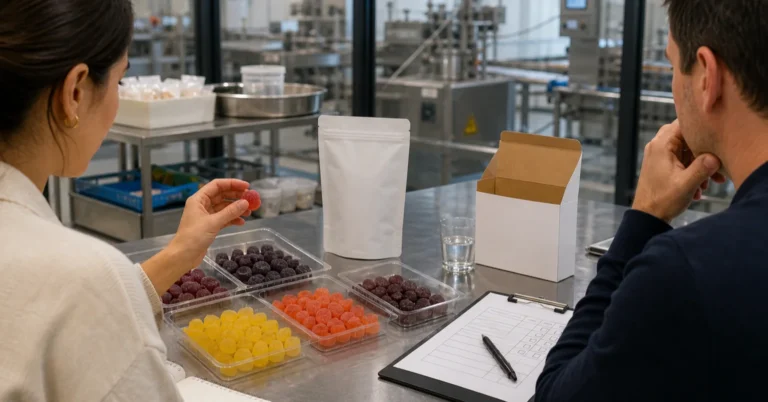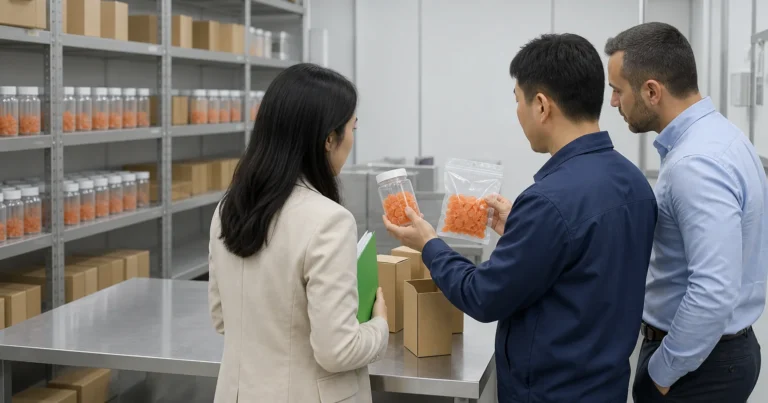


A supplement ingredient supplier provides a defined raw material and its source-level package. A contract manufacturer turns approved inputs into a finished supplement. For a gummy brand, the practical question is which party should lead first—and how source approval, formula feasibility, finished-batch proof, packaging, and change control will connect before production.
That first call depends on the decision already fixed. A named branded ingredient points toward supplier-first source coordination, followed by manufacturer confirmation of the procurement and acceptance route; an open gummy concept usually needs manufacturer feasibility first. Neither route removes the brand's responsibility to close the handoff.
Decision Snapshot
- Contact the ingredient supplier first when the concept depends on an exact source, trademark, technical package, or use condition, then confirm how the manufacturer can procure and accept it.
- Contact the gummy contract manufacturer first when active load, serving design, taste, texture, packaging, or production feasibility is still open.
- Align both parties early when a patented input, specialized carrier, supply constraint, or source-specific label position affects the finished gummy.
- Keep raw-material proof and finished-product proof separate; a supplier COA does not release a finished batch.
- Compare the cost of an approved, usable input—not raw-material price in isolation.
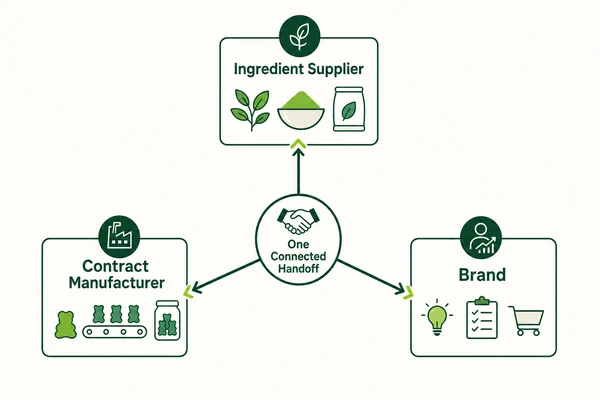
Supplement Ingredient Supplier vs Contract Manufacturer: Who Does What?
The roles overlap in conversation, but they do not own the same material, records, or decisions.
A supplement ingredient supplier supports the exact raw material; a contract manufacturer is responsible, under the agreed project scope, for the path that converts approved inputs into a controlled finished product.
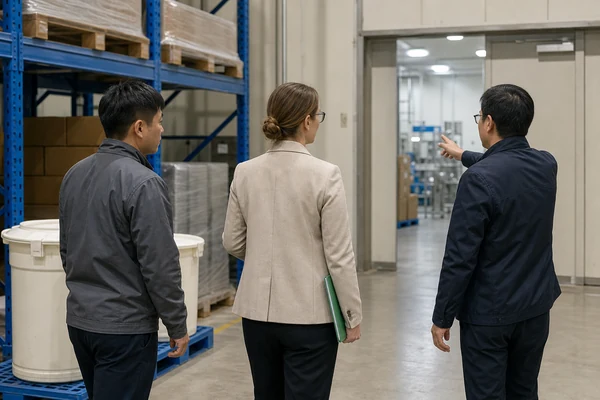
Ingredient Producers, Distributors, and Branded Ingredient Owners
“Ingredient supplier” can describe several commercial positions. A producer makes or processes the material. A distributor represents producers, holds inventory, and manages sales or logistics. A branded ingredient owner may provide or license a trademarked input and may supply technical or marketing resources; authorized channels and permissions depend on the owner's terms.[^1] One company can occupy more than one position, so the title alone is not enough.
For a brand, the useful procurement question is: what does this party control for the exact material under consideration? The answer may cover the current specification, a representative or lot-specific COA, producer identity, traceability, carrier or excipient details, allergen information, relevant contaminant limits, storage guidance, MOQ, lead time, sample availability, and change-notification terms.[^2] The exact package varies by material and commercial arrangement and should be confirmed rather than assumed.
A branded or patented input can add another layer. The owner may provide trademark or marketing rules, commercial terms, approved-claims guidance, or technical expectations that affect the label and formula direction; the exact permissions and channel conditions depend on the owner's terms.[^1] Those conditions can help define the source, but they do not approve the finished gummy. The brand still needs the manufacturing team to accept that exact input into the product plan.
Contract Manufacturers, CDMOs, and Gummy Manufacturers
A contract manufacturer produces the finished supplement to an agreed specification. A CDMO may also support development, analytical planning, or broader commercialization work. A gummy specialist brings dosage-form experience, but buyers should still confirm the actual deliverables behind any title.
For a gummy project, the manufacturing side connects the ingredient to active load, serving count, gummy size, taste masking, color, texture, pH, process exposure, stability expectations, and packaging barrier. These variables interact.[^3] More gummies per serving can ease load pressure per piece while changing unit economics and consumer use. More aggressive flavor work can improve sensory acceptance while consuming formula space and adding development complexity.
The manufacturer may source from its own approved network, review a brand-nominated source, or decline a source that does not fit its qualification or production process. A brand nomination identifies the requested source; it does not automatically authorize the brand to buy and ship that raw material to the manufacturer. Customer-supplied or consigned material is a separate route, and manufacturer policies vary. The applicable route should be confirmed before anyone treats an ingredient quote, a sample request, and a finished-gummy quote as one coherent project.
Responsibility Matrix for Supplement Brands
The brand is the decision owner joining the two sides. Outsourcing purchasing or manufacturing does not remove the need to define who approves each handoff.
| Decision or artifact | Ingredient supplier | Contract manufacturer | Brand |
|---|---|---|---|
| Exact material and commercial route | Provides source-specific offer and package | Reviews the nominated input for project acceptance | Selects or approves the commercial route |
| Raw-material specification and COA | Provides documents for the supplied material | Defines incoming review under the agreed scope | Confirms required evidence is included |
| Formula and serving design | Shares relevant source constraints | Assesses gummy feasibility and production implications | Approves positioning and commercial tradeoffs |
| BOM and source status | Confirms availability and source terms | Controls the production BOM and approved inputs | Approves source restrictions and substitution rules |
| Sampling and scale-up | Supplies technical input or sample material when applicable | Plans the development and production path | Defines acceptance questions and approves decisions |
| Finished-batch evidence | Supports source questions when needed | Coordinates agreed records, testing, and disposition | Confirms proof expectations and review authority |
| Packaging and stability | Provides ingredient-level guidance | Assesses the finished product and pack interface | Approves format, market needs, and risk level |
| Change notification | Communicates relevant source changes under agreed terms | Assesses finished-product impact and controls production changes | Decides whether reapproval or commercial action is required |
This matrix is not a substitute for a manufacturing, quality, or supply agreement. It is a way to expose assumptions before purchase orders and sampling commitments make those assumptions expensive.
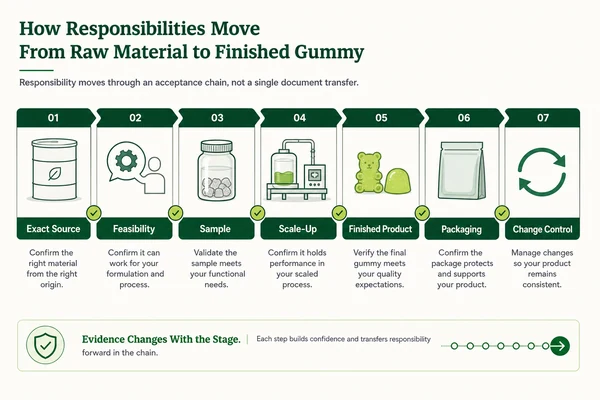
How Responsibilities Move From Raw Material to Finished Gummy
The handoff is an acceptance chain, not a single transfer of paperwork.
Ingredient responsibility becomes finished-gummy control through source review, feasibility, sampling, scale-up, finished-product evidence, packaging, and repeat-order change management.
Ingredient Specifications, COA, and Traceability
Start with the exact source rather than a generic ingredient name. Materials sold under the same common name can differ in assay or marker level, concentration, carrier, particle behavior, sensory profile, allergen status, contaminant limits, storage needs, and lead time. A generic specification may therefore describe the category without describing the material that will actually enter production.
When I review a gummy project, I do not ask only whether the ingredient has a COA. I ask whether the manufacturing team can accept that exact source into the finished-product specification. The supplier package needs to identify the commercial material clearly enough for the manufacturer to review what will be ordered, not an illustrative document from an unknown or alternative source.
A raw-material COA is important, but its scope stays at the raw-material level. It reports the supplied lot against the stated ingredient specification. It does not show that the finished gummy meets its label target, performs consistently through normal production, or remains acceptable within the finished-product stability plan.[^4]
Traceability then joins the source document to purchasing, receiving, and production records.[^5] Before sampling, the parties should know who compares the delivered lot with the approved package, who can stop a mismatch, and what happens if the supplier, carrier, grade, or specification changes.
Formula Feasibility, Sampling, and Scale-Up
Once the exact source is reviewable, the manufacturer can assess whether the intended gummy is commercially plausible. The review should connect ingredient identity, assay or marker, carrier system, allergens, relevant limits, use conditions, MOQ, and lead time with target load, serving count, taste masking, pH, process exposure, stability expectations, and packaging.
This is a joint information problem with a manufacturing decision at the end. The ingredient supplier can explain the material and any known constraints. The manufacturing team assesses how those constraints interact with its gummy system and determines what it can accept under the agreed project scope. The brand decides whether the resulting serving, sensory profile, cost, positioning, and timeline still support the product brief.
Sampling should answer defined questions. It can show whether a proposed direction produces a credible prototype and reveal load, taste, texture, appearance, or handling pressure. It does not automatically establish commercial-scale repeatability or shelf-life performance. Scale-up adds production controls, line behavior, sourcing quantities, batch documentation, packaging execution, and finished-product review.
I also check whether the sample and production quote use the same source assumption. If the sample contains one ingredient but the commercial BOM allows another, the sample may not support the final sensory, label, proof, or cost decision. Either freeze the source or document why it remains open.
Finished-Batch Testing, Packaging, and Release
Finished-product proof starts after the ingredient has entered the complete gummy system. The appropriate scope depends on the product specification, ingredients, intended market, label commitments, risk assessment, and agreements between the parties. It should be planned before production rather than reconstructed after a batch is made.[^6]
The brand and manufacturer should allocate who defines the finished-batch test scope, coordinates samples, reviews records, makes disposition decisions, and retains the relevant documents. An ingredient supplier may help an investigation with source information, but source evidence does not replace finished-product evidence.
Packaging belongs in the same chain. A gummy's moisture sensitivity, texture, serving format, count, expected storage conditions, and stability direction can influence the barrier and pack configuration. Ingredient storage guidance does not answer whether the finished gummy belongs in a particular bottle, pouch, closure, or secondary pack.[^7]
Release should connect the approved formula and BOM, production records, applicable finished-product results, packaging configuration, and authorized decision owner.[^8] Deeper testing and release detail belongs in a dedicated quality review rather than inside this role comparison.
Key Differences Brands Should Compare
The useful commercial comparison is wider than unit price and wider than who sends the fastest quote.
The key differences are source control, formula and BOM authority, MOQ exposure, timeline scope, and the coordination burden the brand chooses to retain.
Control Over Ingredients, Formula, and BOM
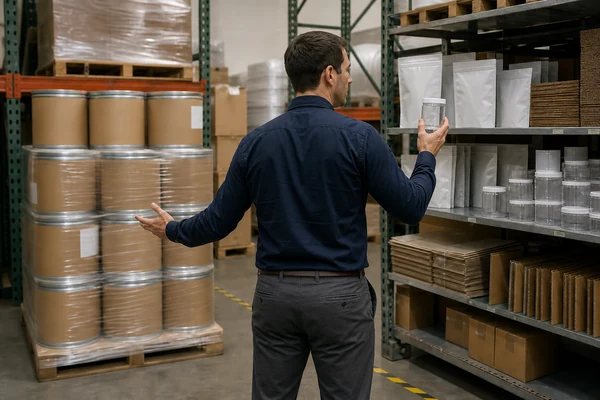
Brand-directed sourcing can follow two different routes. With a nominated source, the brand specifies the producer and material while the manufacturer may purchase it through a qualified channel after review. With customer-supplied or consigned material, the brand purchases and ships the raw material to the manufacturer. The second route requires explicit manufacturer acceptance and is not available under every contract manufacturing policy.
Either route can give the brand more influence over source identity and a branded-ingredient story, but visibility into or control over commercial terms, traceability, purchasing, and inventory depends on who procures the material and what the agreement assigns to each party. The operational burden differs. A nominated source may require supplier and channel coordination while procurement remains with the manufacturer. An accepted consignment route can add brand-side purchasing, delivery, unused-inventory, document-transfer, rejected-lot, and change-notification responsibilities.
Manufacturer-managed sourcing can consolidate those activities.[^9] The brand should still ask what the BOM means by each input. Does the quote name an exact source, permit approved equivalents, or leave the source category open? If label positioning, sensory behavior, testing expectations, or trademark permissions depend on a specific material, a generic BOM line can become a commercial and technical risk.
Formula control is separate from ingredient ownership. A brand can nominate an input without owning a production-ready gummy formula. A manufacturer can develop a formula without owning the ingredient trademark or the brand's commercial rights. A clean handoff records both interfaces instead of using “our formula” or “our ingredient” as if those phrases answer the ownership question.
MOQ, Upfront Cost, and Total Sourcing Risk
Ingredient MOQ and finished-product MOQ operate at different levels. A supplier may quote a raw-material quantity; a manufacturer may quote a batch or finished-unit quantity. The numbers rarely align perfectly. Before committing to a named source, confirm whether the manufacturer will procure it or explicitly accept customer-supplied material. Then define who pays for the material, who owns unused inventory, where it is held, what happens if development changes, and whether the same lot or source will be available for commercial production.
Where customer-supplied material is accepted, its cost can include freight, handling, testing, warehousing, inventory exposure, and coordination—not only price per kilogram. Manufacturer procurement of a nominated or standard source may place those costs and excess-inventory terms inside the finished-product quotation. Neither arrangement is automatically cheaper, and neither should be assumed available before the manufacturer's policy and quote are clear.
The lowest raw-material price is not the lowest project cost if the source later fails acceptance, changes the formula or claim direction, delays sampling, or makes repeat orders unstable. I would compare the cost of the approved, usable input within the complete gummy plan.
Production Scope, Lead Time, and Operational Burden
Supplier and manufacturer lead times describe different clocks. The supplier's clock may end at material delivery under its commercial terms. The manufacturer's clock may include source approval, formula readiness, sampling, production scheduling, packaging availability, testing, and release. Comparing the two numbers without their start and end points creates a false launch schedule.
The operational burden increases as responsibilities split. A customer-supplied route, where accepted, can require separate contracts, forecasts, shipment timing, document control, inventory decisions, investigation support, and change communication. A nominated-source route can preserve source specificity while leaving procurement with the manufacturer. The added burden may be justified when a strategic ingredient is central to the product, but the chosen route needs named owners.
Manufacturer-managed sourcing reduces the number of interfaces but does not justify a blind handoff. The brand still needs visibility into source assumptions, substitution rules, proof scope, and the decisions that can change cost or positioning. For broader service scope and quote-route questions, use Talvenda's gummy vitamin manufacturing page.
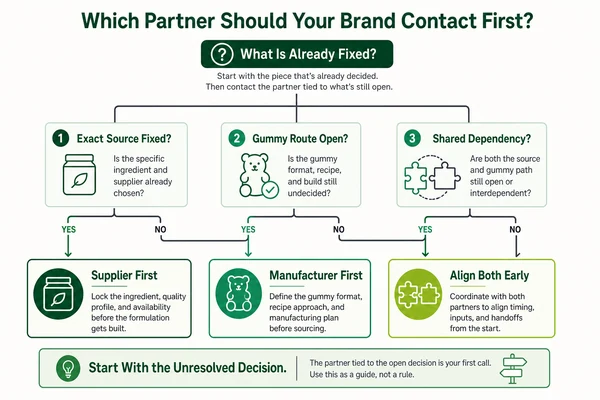
Which Partner Should Your Brand Contact First?
Start with the party controlling the most important unresolved decision, then bring in the other party before dependent promises are made.
Contact an ingredient supplier first for source-specific rights and constraints; contact a gummy contract manufacturer first for finished-format feasibility and production planning.
When to Contact an Ingredient Supplier First
Begin with the ingredient supplier or branded ingredient owner when the product concept depends on an exact commercial material. Typical triggers include a particular trademark, standardized input, documented origin, technical characteristic, authorized channel, or supplier relationship that must be known before the formula is developed.
The first discussion should establish the exact material, available specification package, authorized ordering channels, MOQ, lead time, sample access, relevant use conditions, and change-notification expectations. It should also identify what the manufacturer will need to review. Marketing literature alone is not an acceptance package, and supplier availability does not determine whether the manufacturer will procure the material or accept it as customer-supplied.
Then involve the gummy manufacturer before promising serving size, sensory outcome, label language, launch timing, or finished-unit cost. Confirmation that the ingredient is available does not establish that the proposed gummy is feasible.
When to Contact a Gummy Contract Manufacturer First
Begin with the gummy contract manufacturer when the brand has a category or positioning idea but has not fixed the exact source, active load, serving design, formula, or package. The manufacturer can frame the feasibility questions and identify which ingredient forms and source details must be reviewed before sampling.
This route also fits projects that expect the manufacturer to source standard inputs under its purchasing process. The RFQ should still distinguish a named source from an approved equivalent or open category. Ask how the source will be documented, which substitutions need approval, and whether the sample and production BOM follow the same assumption.
If the unresolved decision is mainly stock formula versus custom development, continue to the stock formula vs custom formulation guide. Here, the narrower task is deciding who nominates the ingredient and who accepts it for the gummy.
When Both Partners Need Early Alignment
Bring both parties together when one input creates technical, commercial, or documentation dependencies neither can close alone. Common triggers include a patented or branded ingredient, high active-load pressure, strong taste or color, a specialized carrier, limited availability, source-specific label positioning, or a schedule that leaves little room for rework.
A useful alignment call should end with a controlled record, not general reassurance. I would capture:
- The exact source and document version under review.
- The target load, serving count, and open gummy-feasibility questions.
- Whether the manufacturer procures the nominated source or accepts customer-supplied material, and who owns any excess inventory.
- Which substitutions or source changes require written approval.
- What the sample can demonstrate and what remains for scale-up or stability review.
- Who defines and reviews finished-product proof.
- Which dates are assumptions and which are confirmed commitments.
Without that record, all three parties can leave the same meeting believing someone else owns the critical next decision.
How Patented Ingredients Enter a Gummy Project
Patented or branded status adds rights and source conditions; it does not bypass manufacturing acceptance.
A patented ingredient enters a gummy project through linked approvals for the source, its permitted commercial use, and its feasibility in the intended finished gummy.
Documentation and Use Conditions From the Ingredient Owner
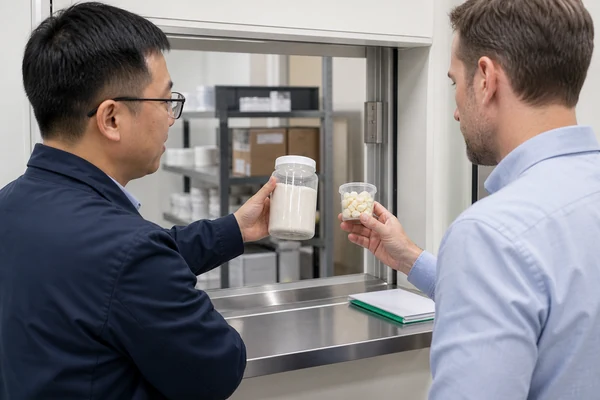
The ingredient owner or authorized supplier should identify the exact commercial material and the package relevant to the intended use. Depending on the arrangement, that may include specifications, traceability information, carrier details, storage guidance, trademark terms, approved supply channels, technical notes, or rules governing how the ingredient is referenced on the label.
Separate three questions early: Is the material available through a channel the manufacturer can approve? Can the brand use the supplier's name or mark as intended? Can the proposed finished gummy support the target serving and commercial position? The ingredient owner may answer much of the first two, but manufacturer procurement or consignment acceptance remains a separate decision. The manufacturer, brand, and appropriate reviewers must connect the third question to the actual product.
Patented status is not finished-product efficacy proof.[^10] A polished technical dossier also does not eliminate review of serving presentation, sensory pressure, process exposure, finished-product testing, stability, and packaging.
Gummy Feasibility and Finished-Product Proof
The manufacturer needs the source-specific package early enough to assess the intended input rather than a generic substitute. The review should consider target load, serving count, carrier and sensory properties, relevant process exposure, packaging implications, and the evidence the brand expects from the finished product.
If the commercial story depends on a named source or inclusion expectation, that requirement should appear consistently in the approved formula, BOM, purchasing controls, and change rules. Otherwise, a technically acceptable alternative could undermine the intended positioning even if it still produces a gummy.
The proof plan must follow the finished product. Supplier documents can support source identity and incoming review; they cannot establish the finished gummy's acceptance on their own. Define the finished-product path before using the reputation of a branded input as shorthand for product proof.
Supplier Changes and Production Change Control
Repeat-order control starts by defining meaningful changes. A supplier might alter a production site, specification, carrier, processing aid, packaging, lead time, or commercial channel. A manufacturer might propose an alternative source or change a production input within its process. The project needs one notification and approval route that joins both sets of events.
Not every change has the same impact, but the decision sequence should remain consistent: identify the change, compare it with the approved source and finished specification, assess formula and label implications, decide whether new sampling or evidence is needed, document approval, and update purchasing and production records.
This sequence protects repeat orders from silent drift. It also gives the team a controlled alternative when the original source becomes constrained instead of forcing an urgent substitution after a production slot is planned.
How to Evaluate Partners and Avoid Handoff Red Flags
Evaluate each party on role-specific evidence, then test whether the interface between them closes before commitments are made.
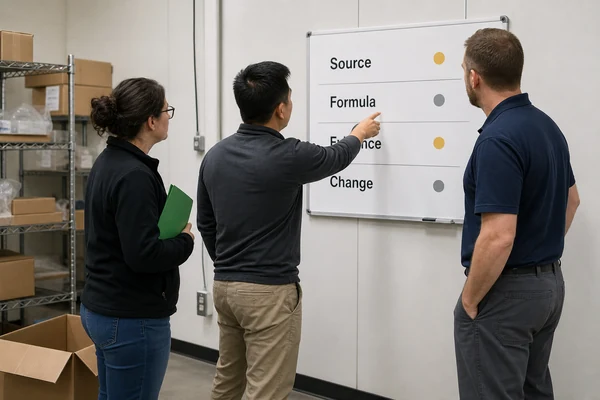
Partner evaluation should expose ownership gaps: unclear source identity, undefined substitutions, unassigned finished proof, and timelines or prices built on hidden assumptions.
Proof Each Partner Should Provide
Ask the ingredient supplier for a package tied to the exact material and commercial route. Depending on stage and material, useful items can include the current specification, representative or lot-specific COA, available traceability and producer information, carrier or excipient details, allergen statements, relevant contaminant limits, storage guidance, MOQ, lead time, sample terms, and change-notification expectations.
Ask the contract manufacturer for a clear acceptance and production path. The response should explain how a nominated source is reviewed, what is needed for feasibility, who controls the production BOM, how incoming materials are handled, what sampling and scale-up can establish, who coordinates finished-product evidence, how packaging enters the review, and how deviations or substitutions are approved.
The brand also needs internal authority. Name who can accept the source, formula tradeoffs, label direction, finished-proof plan, packaging choice, and changes. Complete vendor files do not prevent delay when no one inside the brand owns the decision.
Role Confusion, Low-Price, and Communication Red Flags
Role confusion appears when a supplier says its material “works in gummies” without reviewing the actual product context, or when a manufacturer treats any material with a COA as interchangeable. It also appears when neither party will state who owns unused inventory, source acceptance, finished-batch evidence, or change approval.
Commercial red flags include a raw-material quote with no clear producer or specification, a finished-product quote with no sourcing assumption, and a low price that depends on an unapproved alternative. A timeline can be equally misleading when it omits document review, material arrival, packaging, testing, or release.
Good communication creates controlled artifacts: named documents, decision owners, version references, open-item logs, and change notices. Phrases such as “same quality,” “equivalent material,” or “guaranteed” do not replace an agreed acceptance process. The strongest partner is not the one that says yes fastest; it is the one that makes scope and unresolved risk visible.
Where to Continue Manufacturer and Quality Due Diligence
Once the role split is clear, move deeper checks to the pages that own them. Use the gummy supplement manufacturer checklist for full partner vetting and the supplement quality assurance guide for detailed testing, records, and release questions. Botanical-specific source readiness belongs in the botanical gummy product development checklist.
That separation keeps this procurement guide focused. Its final test is whether the supplier, manufacturer, and brand can show how one exact ingredient becomes one controlled finished-gummy specification.
Before releasing an RFQ or sampling brief, verify five points:
- The exact source is approved or clearly marked as still under review.
- The procurement route is confirmed, and purchasing, excess inventory, and delivery coordination have named owners where applicable.
- The gummy-feasibility decision and unresolved sample questions are explicit.
- Finished-product evidence and packaging review are defined at the right level for the project.
- Substitutions and other relevant changes have a notification and approval route.
Frequently Asked Questions
Can a Contract Manufacturer Source Ingredients for My Brand?
Contract manufacturers may source ingredients within their service scope.[^9] Confirm whether the quote names a specific source, permits approved equivalents, or uses an open category. Also define who approves substitutions, who owns unused inventory, and which source documents the brand will receive before production.
Is a Raw-Material COA Enough for the Finished Supplement?
No. A raw-material COA addresses the supplied ingredient against its stated specification. It does not establish that the finished supplement meets its label target or finished-product acceptance criteria. Incoming review, production records, finished-batch evidence, packaging, disposition, and release responsibilities require a separate plan.
Can I Bring a Patented Ingredient to a Gummy Manufacturer?
Not automatically. You can nominate a patented or branded ingredient, but the manufacturer must confirm the source, authorized supply channel, documentation, specification fit, and gummy feasibility. Some manufacturers will procure an accepted source through their qualified supply chain; some may accept customer-supplied or consigned material under defined terms; others do not. Confirm the route before purchasing or shipping material.
How Should Documentation Responsibilities Be Divided?
The ingredient supplier should provide source-specific raw-material documents and relevant change information. The manufacturer should maintain the approved production inputs, batch records, and finished-product evidence assigned to its agreed manufacturing and quality scope. The brand should approve commercial requirements, and the agreements should identify who reviews, accepts, retains, and updates each record.[^11]
Conclusion
The first partner is determined by the unresolved decision, but success depends on one accountable chain connecting source acceptance, formula and BOM control, gummy feasibility, finished-product proof, packaging, change management, and the supplement ingredient supplier vs contract manufacturer handoff.
On Talvenda gummy manufacturing projects, we normally procure raw materials through our qualified, traceable supply chain and include procurement cost in the finished-product quotation. Clients may nominate a branded source, but we must confirm supplier and channel availability, MOQ, documentation, specification fit, lead time, excess inventory, and any repricing before acceptance. Customer-supplied raw materials are not our standard route. Share the project brief with Talvenda.
[^1]: Cognizin's formulators and manufacturers resource is a primary commercial example of a branded-ingredient owner providing technical, labeling, approved-claims, and marketing support. It does not establish universal terms for branded ingredients. [^2]: 21 CFR 111.70 distinguishes component, in-process, packaging/label, and finished-batch specifications. Commercial items such as MOQ, lead time, samples, and notification terms remain agreement-specific. [^3]: A peer-reviewed study of prototype gummy formulations evaluated multiple physicochemical and micromechanical quality attributes, including texture, moisture, weight uniformity, and pH. It supports treating gummy feasibility as multivariable, not any universal specification limit for this project. [^4]: 21 CFR 111.75 separately addresses component verification and verification of finished-batch product specifications. NSF also states that its raw-ingredient certification is not transferable to a finished product. [^5]: 21 CFR 111.155 requires unique-lot identification that permits tracing a received component to its supplier, receipt information, status, and the dietary supplement manufactured and distributed. [^6]: FDA's Dietary Supplement CGMP Small Entity Compliance Guide explains the separate component, in-process, finished-batch, packaging, and labeling specification and verification requirements. It does not prescribe a universal test panel here. [^7]: 21 CFR 111.410 requires determining whether packaging meets specifications so its condition will ensure product quality and requires batch-level packaging and label checks. [^8]: 21 CFR 111.260 identifies batch-record elements including component identifiers, test or examination results, finished-product specification documentation, packaging records, quality-control review, and release or rejection decisions. [^9]: The professional trade article Ingredient Sourcing via Contract Manufacturers describes manufacturer-managed sourcing, supplier qualification, nominated raw materials, and quality-agreement questions. It is used only for low-risk industry practice, not regulatory proof. [^10]: The USPTO's patent explanation describes a patent as an exclusionary intellectual-property right, while FDA explains that dietary supplements generally do not receive premarket product approval. Patent status is therefore not used here as finished-product efficacy evidence. [^11]: 21 CFR 111.605 sets recordkeeping requirements for records required under Part 111. Contractual allocation between brand, supplier, and manufacturer still needs to be defined in the applicable agreements.