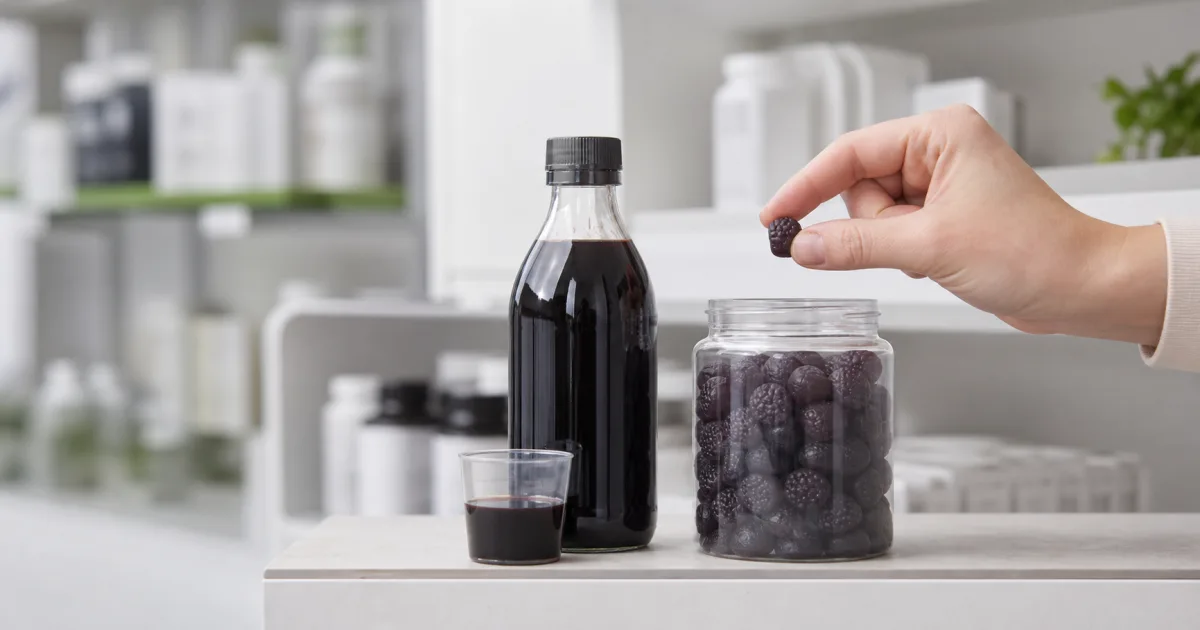

Elderberry syrup vs gummies is mainly a choice between a measured liquid and a fixed piece-count format. Carefully compare the actual elderberry source, amount per labeled serving, sweeteners, supporting ingredients, storage directions, package size, taste, and daily routine. Neither format should be assumed stronger or more effective without product-specific evidence.[^1]
The front label identifies the format. The deeper decision depends on the serving system and the finished-product evidence behind it.
Decision Snapshot
- Choose syrup when you accept measuring a liquid, bottle handling, and the product's stated storage routine.
- Choose gummies when fixed pieces, portability, and a chewable routine matter more.
- Compare added sugars and supporting ingredients on the actual labels; neither format wins automatically.
- Consider potency, quality, and effectiveness product-specific questions, not conclusions you can draw from format alone.
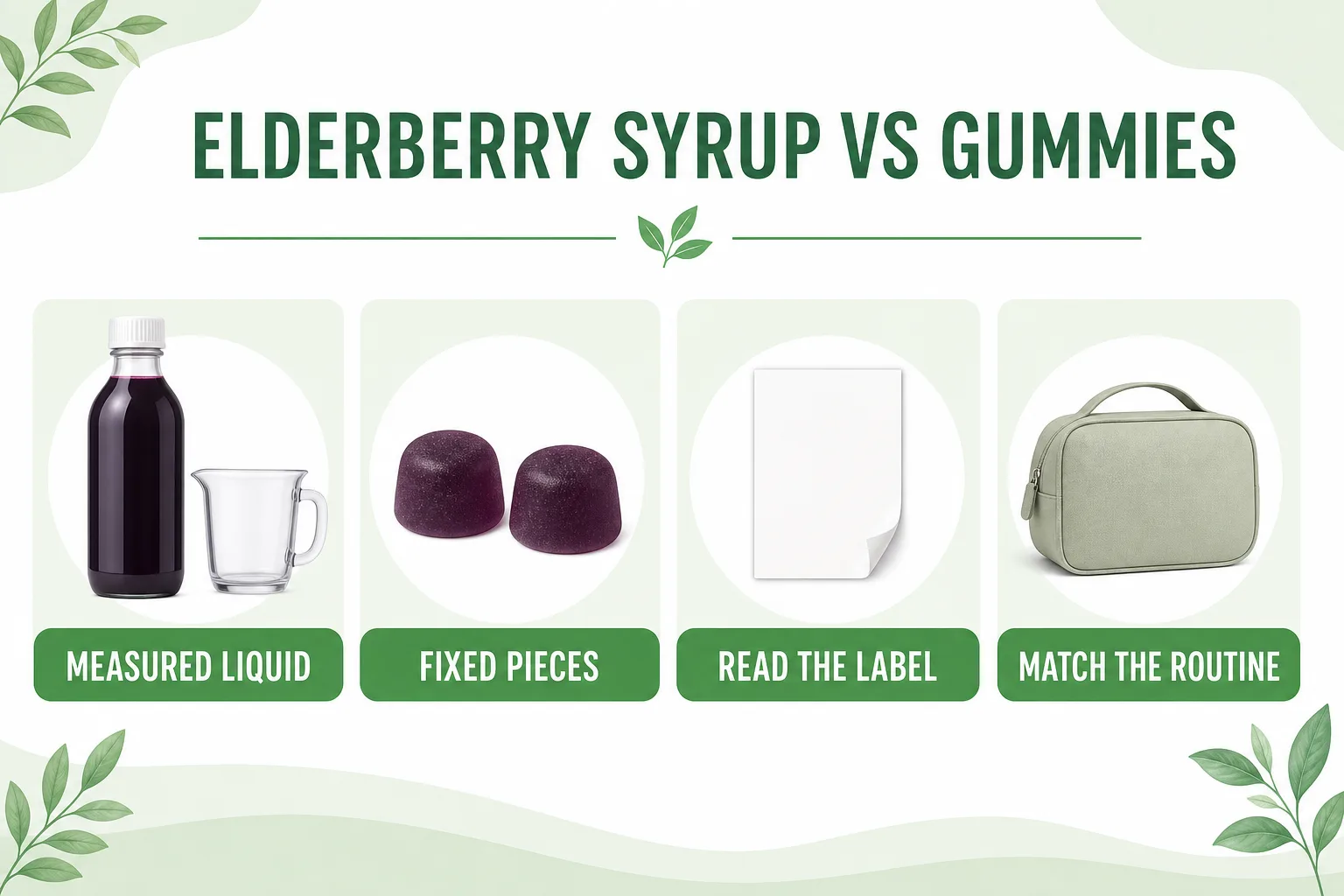
The sections below separate the visible convenience differences from the label details that can change the decision.
Elderberry Syrup vs Gummies at a Glance
Two products can feature elderberry on the front while giving you very different serving, taste, storage, and packaging experiences.
Elderberry syrup and gummies share an ingredient theme, but their delivery formats differ in measurement, texture, portability, package handling, and supporting ingredients. Compare the full label and routine rather than treating the word “elderberry” as proof that the products are equivalent.
What Both Formats Have in Common
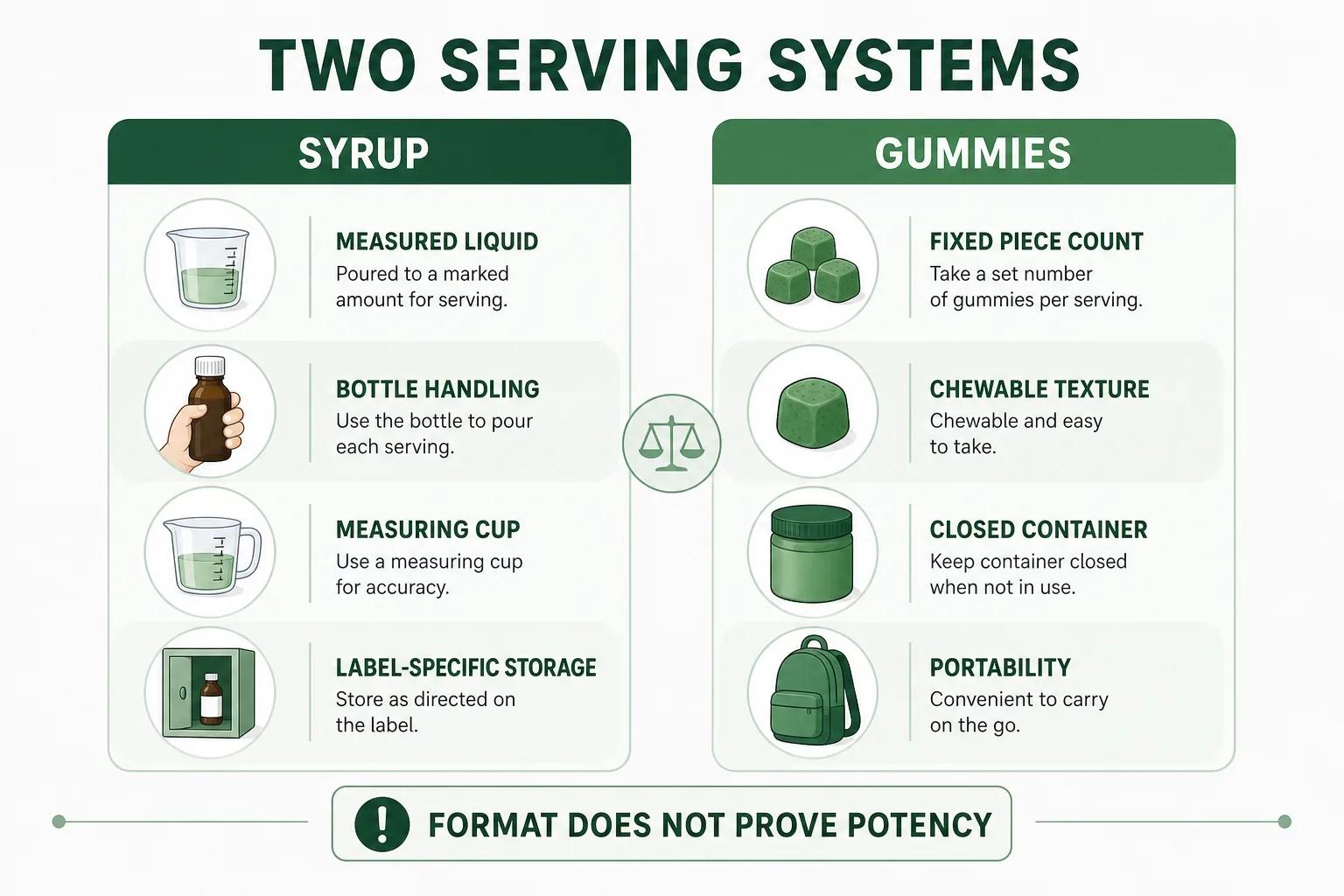
Both formats can be sold as dietary supplements that use an elderberry-derived ingredient. Both also need a defined labeled serving, an ingredient list, directions, storage information, and a package that protects the finished product. That shared structure is useful, but it does not mean two products contain the same elderberry material or the same amount.
Start with the ingredient identity. A label may describe an extract, juice, concentrate, powder, or another prepared material. Those descriptions are not automatically interchangeable. Then check whether the amount is disclosed per serving, whether the serving is expressed in milliliters or pieces, and which other ingredients are included.
Keep the product format separate from its health positioning. A syrup and a gummy may use similar marketing language, yet neither format alone proves potency, clinical effect, or suitability for a particular person. Those questions need evidence tied to the actual product, not a visual comparison of a bottle and a gummy.
Where the Formats Differ
The clearest difference is how you take and handle the product. Syrup is poured into a measuring device or otherwise taken according to its directions. Gummies are counted as pieces. That change affects convenience, the chance of inconsistent self-measurement, how the package travels, and how the product fits into a repeated routine.
| Comparison point | Syrup | Gummies |
|---|---|---|
| Labeled serving | Usually a liquid volume | Usually a piece count |
| Sensory experience | Pourable liquid, flavor spreads quickly | Chewable texture, flavor develops while chewing |
| Daily handling | Bottle opening, measuring, and cleanup may apply | Count pieces and close the package |
| Portability | Bottle leakage and measuring tools may matter | Usually easier to carry in a closed container |
| Storage | Follow the specific bottle directions | Follow the specific package directions |
| Comparison limit | Format does not prove concentration | Format does not prove equal active content |
Use this table as a starting point, not a verdict. The label can overturn a general expectation. A travel-friendly bottle may suit one routine well, while a large gummy package may be inconvenient. The actual product details remain more useful than format stereotypes.
Ingredients, Serving Labels, and Added Sugars
A familiar format can still hide important differences in elderberry material, serving size, sweeteners, and supporting ingredients.
Elderberry supplement labels should be compared line by line. Check the named elderberry source, amount per labeled serving, serving unit, sweeteners, supporting ingredients, and quality evidence because syrup does not automatically mean higher concentration and gummies do not automatically mean more sugar.
Elderberry Source and Serving
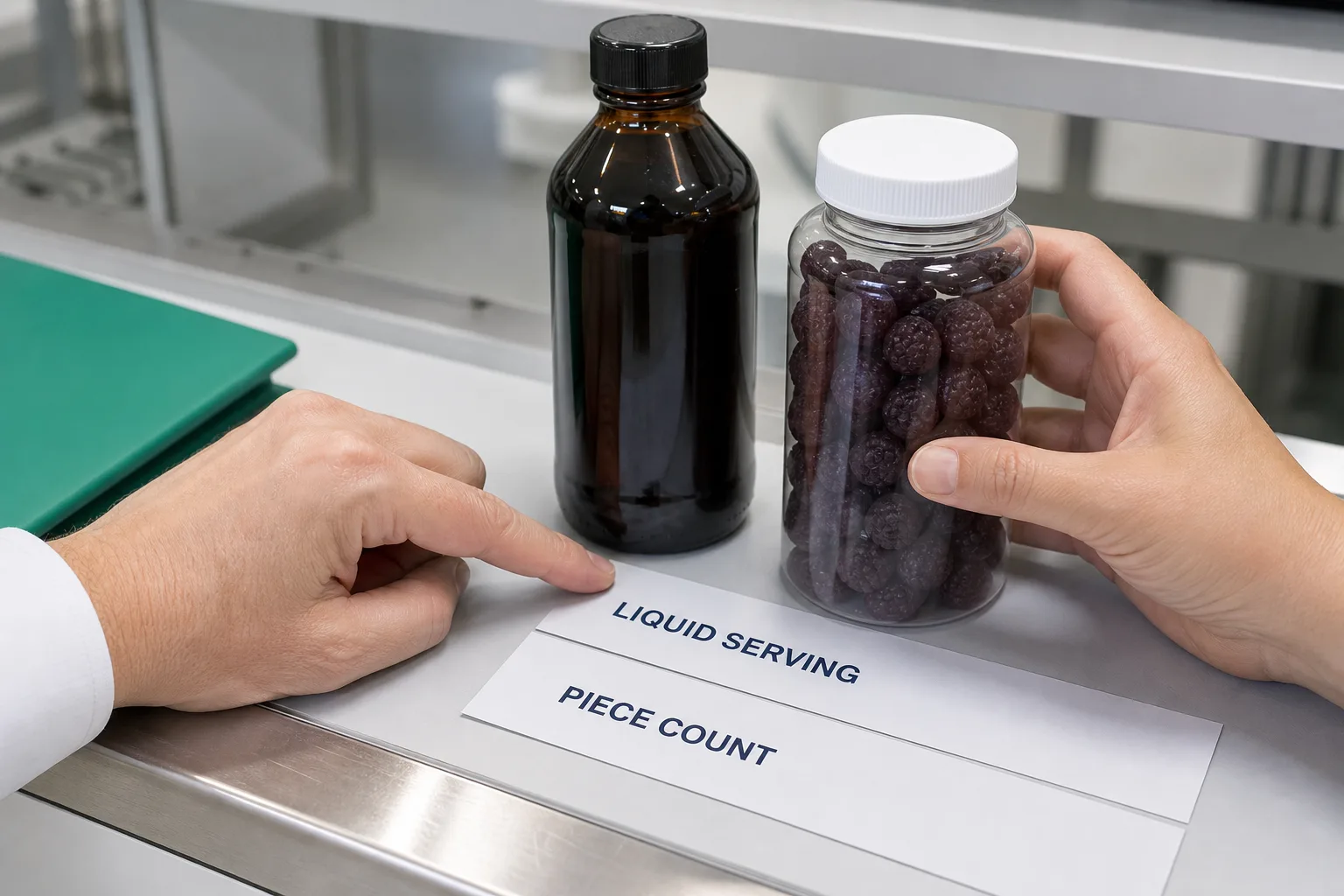
First locate the serving size and the elderberry entry in the Supplement Facts panel.[^2] For syrup, the serving will usually be a liquid measure. For gummies, it will usually be a number of pieces. Then compare the amount attached to that full serving, not to one milliliter or one gummy unless the label defines that as the serving.
Ingredient naming matters as well. A simple front-label phrase may not explain whether the product uses a powder, extract, concentrate, or blend. If two labels describe different materials, a number-only comparison can be misleading. A larger number should not be treated as better without knowing what is being measured and how the manufacturer supports that declaration.
Package count also changes how the serving feels in practice. A bottle with 60 gummies does not necessarily provide 60 servings if the serving is two gummies. A syrup bottle's total serving count depends on the stated volume per serving and the usable contents. Calculate servings per package from the label rather than from the package's most prominent number.
Sweeteners and Supporting Ingredients
Both formats may use sweeteners, flavors, acids, colors, or other supporting ingredients. Syrup needs a liquid system that stays acceptable through its intended use. Gummies need a structure that holds a stable chew and acceptable taste while carrying the formula. These are different product systems, so their ingredient lists should be expected to differ.
Added sugar deserves a direct label check.[^3] Do not assume all syrups contain more sugar because they taste sweet or that every gummy is a candy-like product.
Some products may use sugar, syrups, sugar alcohols, high-intensity sweeteners, or combinations. Each choice can affect taste and the consumer experience. The label is the proper place to identify what the product actually uses.
Supporting ingredients can also matter to personal preferences or dietary requirements. Review the complete list for allergens, animal-derived materials, color sources, and sweetener types when those points matter. A broad format comparison cannot provide individual health advice; a person with a specific medical, allergy, pregnancy, medication, or dietary concern should use appropriate professional guidance.
Claims and Quality Signals
Front-label claims can make products look easier to compare than they are. Words such as “premium,” “high strength,” or “immune” do not show whether syrup is more effective than gummies. Look for a clear serving statement, consistent ingredient naming, usable directions, responsible claim language[^4], and evidence that relates to the finished product.
An ingredient claim must also be distinguished from finished-product proof. Ingredient supplier information may help explain a raw material, but it does not automatically confirm the final product's identity, amount, stability, or performance. A serious comparison may require product-specific documentation or testing information that is not printed in full on the retail label.
Claims should stay within lawful and supportable boundaries. Neither format provides a lawful or supportable basis for promising the prevention, treatment, or reduction of a cold, flu, COVID-19, or any disease.[^5] Faster absorption, better potency, or superior clinical results also cannot be inferred from a liquid or chewable format without suitable evidence for the exact products being compared.
Taste, Texture, and Daily Routine
The best-looking label can still lead to an abandoned bottle if the taste, measurement, chew, or storage routine does not fit daily life.
Taste, texture, and daily routine often decide whether syrup or gummies feel easier to use. Compare measuring and cleanup for syrup with chew texture and piece count for gummies, then check storage and portability to decide which routine is more realistic.
Syrup Taste and Measurement
Syrup delivers flavor in a liquid form. The taste reaches the mouth quickly, and its thickness, sweetness, acidity, and aroma can shape the experience.
Some people may like that direct liquid serving. Others may dislike the flavor intensity or the feeling of a viscous product. Evaluate the specific syrup rather than assuming all elderberry syrups taste alike.
Measurement is the practical tradeoff. A user needs to follow the product directions and use the stated measuring method. A missing, hard-to-read, or sticky measuring tool can add friction. Pouring too quickly, estimating instead of measuring, or leaving residue on the bottle can make the routine less tidy and potentially less consistent.
The closure and bottle design also matter. A good liquid package should be manageable during repeated opening, pouring, wiping, and closing. This is not evidence that the supplement works better; it is evidence that the format may be easier to use as intended.
Gummy Texture and Piece Count
Gummies replace pouring with chewing and counting. That simple action can be attractive for travel or a busy routine, but texture matters. A gummy that is too sticky, too firm, too soft, or unpleasant in flavor can be just as easy to abandon as a syrup with an unwanted taste.
Piece count also needs attention. One serving may require more than one gummy. Read the directions and calculate how many days the package represents.
A fixed piece should not be treated as a fixed dose across brands. Different products can use different gummy sizes, ingredient systems, elderberry sources, and amounts per serving.
The chewable format can create a stronger food-like impression, which makes label discipline especially important. Gummies should still be treated as supplements and used according to their directions, not as unrestricted sweets. That distinction is part of responsible routine design, not a claim about pediatric suitability or individual dosing.
Storage and Portability
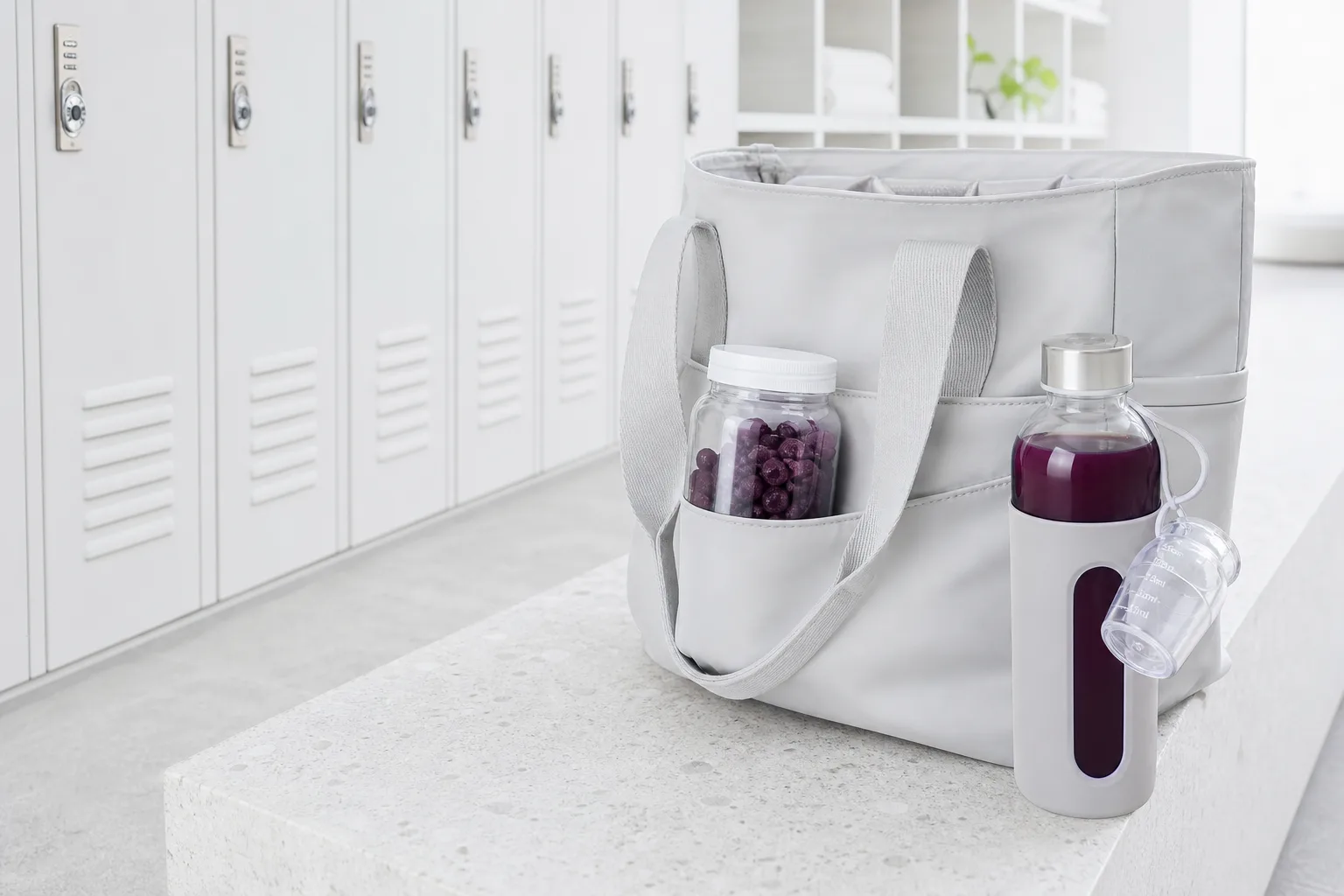
Gummies usually have an advantage when the main task is carrying a closed package without a measuring device. A bottle or pouch can be placed in a bag, and the user counts the labeled pieces. Yet heat, moisture, package closure, and physical pressure may affect a gummy's condition. Follow the storage directions instead of treating portability as unlimited durability.
Syrup can travel, but liquid handling creates extra questions: cap security, bottle material, leakage risk, total volume, and whether a measuring device is needed. Check whether the label gives special directions after opening. Do not assume every syrup requires refrigeration or every gummy can sit anywhere; those decisions are product-specific.
A practical routine check is simple:
- Where will the product normally be stored?
- Will it be used at home, at work, or while traveling?
- Is measuring a liquid acceptable every day?
- Is chewing the labeled number of gummies acceptable every day?
- Can the package be closed and protected after every use?
The answer should come from normal behavior. A theoretically convenient product is not convenient if its real handling steps are regularly skipped.
Pros and Cons of Syrup and Gummies
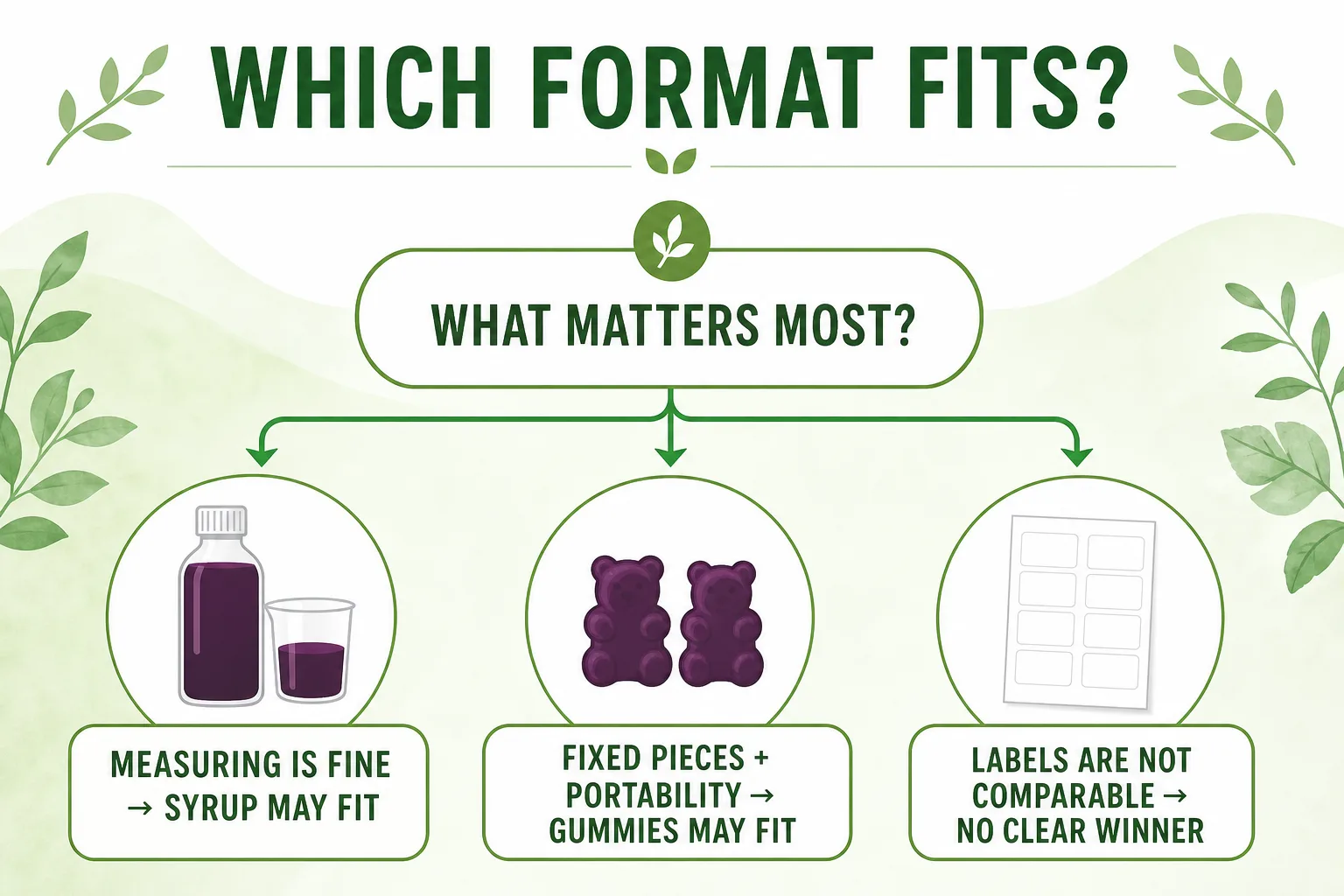
Format advantages are conditional. A feature that helps one routine can create friction in another, so simple winner-and-loser lists often overstate the choice.
Syrup fits people who accept liquid measurement and bottle handling, while gummies fit people who value fixed pieces and portability. Neither format is automatically more potent, natural, low in sugar, or effective; weigh the product label and routine together.
When Syrup Fits Better
Syrup may fit better when a person prefers a liquid sensory experience and is comfortable measuring each serving. It can also suit a home-based routine where the bottle remains in one place and travel is not a priority. The format makes the liquid serving visible, which some users may find straightforward.
The tradeoffs are equally visible. Measuring takes an extra step. The bottle may need wiping, careful closure, and storage according to its directions.
A measuring cup, spoon, or other included device can be misplaced. Flavor can also feel intense because the full serving is taken as a liquid.
Do not add “more concentrated” or “more natural” to the advantage list unless the actual label and product evidence support those statements. Syrup is a physical format, not a quality grade. A poorly explained syrup does not become a better choice because it is liquid.
When Gummies Fit Better
Gummies may fit better when the user wants a fixed piece count, a chewable experience, and easier carrying. The package can often move between home, work, and travel with fewer handling steps than a liquid bottle. A pleasant taste and texture may also support a repeatable routine.
Those benefits do not remove tradeoffs. A labeled serving can require multiple pieces. Gummies need supporting ingredients that create sweetness, flavor, and structure.
The package may be larger than expected for the number of servings. Heat and moisture exposure can also be relevant to storage and texture.[^6]
When Neither Is Clearly Better
Neither format is clearly better when the labels do not provide enough comparable information or when the routine tradeoffs are evenly matched. In that case, avoid filling the gap with assumptions. Make a short list of questions and compare the exact products again.
| Decision question | Why it matters |
|---|---|
| What elderberry material is named? | Different ingredient descriptions may not be equivalent |
| What is the amount per full labeled serving? | Per-piece and per-volume comparisons can distort the serving |
| How many servings are in the package? | Package count can differ from serving count |
| Which sweeteners and supporting ingredients are used? | Format alone does not reveal the ingredient system |
| What storage directions apply? | Liquid and gummy packages can have product-specific needs |
| What finished-product evidence is available? | Format does not prove identity, stability, potency, or efficacy |
If those answers remain unclear, “no clear winner” is the responsible result. A format decision should reduce uncertainty, not replace missing evidence with a convenient story.
How to Choose the Right Format
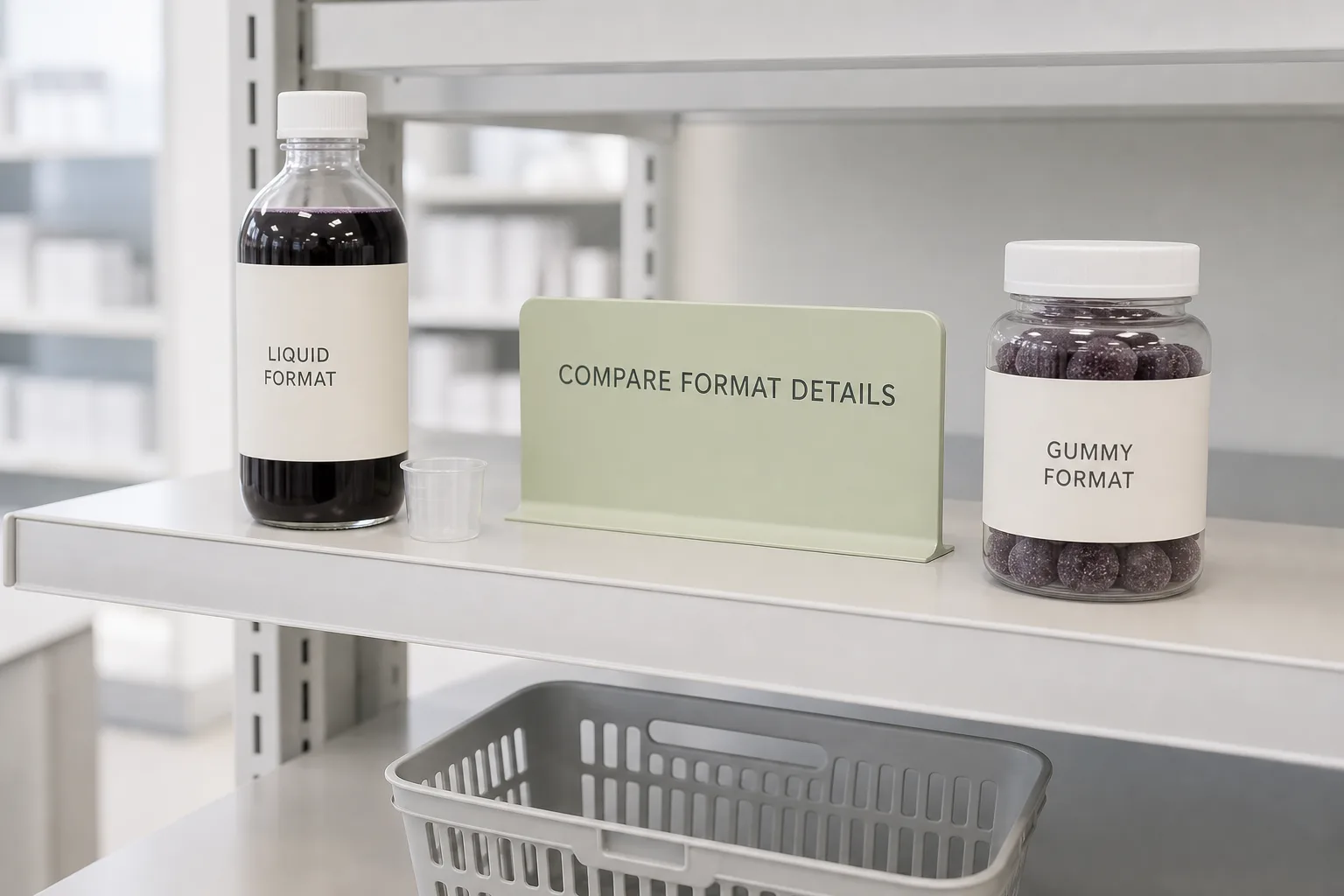
Shelf appeal can push a quick decision, but a short label-first review usually reveals which product better fits the intended routine.
Choosing between elderberry syrup and gummies starts with the label, then moves to daily handling. Compare ingredient identity, full serving, sweeteners, servings per package, storage directions, taste, measurement or piece count, and realistic portability before choosing.
Compare the Label First
Use the same sequence for both formats so presentation does not control the result:
- Read the serving size and directions.
- Identify the elderberry material as it is actually named.
- Compare the amount per full labeled serving.
- Review added sugars, sweeteners, and supporting ingredients.
- Calculate servings per package.
- Read storage and after-opening directions.
- Separate marketing claims from product-specific evidence.
This sequence prevents a common comparison error. A person may compare one gummy with one teaspoon even when neither equals the labeled serving. Another person may compare front-label milligrams without noticing that the ingredient forms are described differently. Keep the unit, material, and full serving connected.
Also look for information that is missing. A polished label does not answer every question about identity, testing, or stability. When the decision depends on those points, seek product-specific support rather than inferring an answer from the format.
Match Your Daily Routine
The right format needs to survive an ordinary week. Consider where the package will sit, when it will be opened, and which steps are likely to be repeated without frustration. If liquid measuring already feels inconvenient, syrup may not fit. If chewing several pieces feels excessive, gummies may not fit.
Taste preference matters, but it belongs in the right category. Taste can support consistency of use; it does not prove clinical effectiveness. The same is true of convenience. A format that is easy to remember may fit a routine better, but ease of use does not make its ingredient amount or evidence superior.
Also consider who controls the routine. A general format comparison cannot determine what is appropriate for children, pregnancy, medication interactions[^7], allergies, medical conditions, or individual dosing. Those questions require the product label and appropriate professional guidance.
Check Storage and Package Size
Package size affects both convenience and value. For gummies, divide the total piece count by the labeled pieces per serving. For syrup, compare the bottle's stated volume with the labeled volume per serving. This gives a more useful serving estimate than the large number on the front of the package.
Then compare the physical package with the intended setting. A large gummy bottle may be easy to use at home but awkward to pack. A compact syrup bottle may still need leak protection and a measuring device. If the product has special after-opening directions, those directions can be more important than the package's apparent size.
The final consumer-side decision is practical: choose the product whose complete label is understandable and whose serving, taste, storage, and package handling fit the actual routine. If the evidence is not comparable, keep the decision open.
What the Format Choice Means for Supplement Brands
For a brand, syrup versus gummies becomes a product-system decision that must stay coherent from the front-label promise through repeat commercial production.
Format choice for supplement brands connects serving and label design with taste, texture, packaging, testing expectations, and scale-up. The stronger commercial format is the one whose claim, routine, and finished-product evidence can be supported consistently from sample work to production.

Serving and Label Design
A brand first needs a clear serving concept. A syrup uses a liquid serving system. The project must align the stated volume, directions, measuring experience, ingredient declaration, package volume, and intended number of servings.
A gummy uses a piece-count system. The project must align gummy size, pieces per serving, active-load feasibility, package count, and label space.
In my experience, a common risk appears when the marketing promise is chosen before the serving system is tested. A desired front-label amount may look simple on a brief, yet a gummy still needs acceptable taste and texture at the intended piece count. A syrup has its own flavor, measurement, preservation, and bottle-handling demands. Neither is merely a different container for an identical idea.
The brand team and production team should align what the label will say with what the sample and finished product can support. That includes ingredient identity, declared amount, directions, supporting ingredients, and responsible claims. This comparison does not provide a formula recipe or make a product-specific regulatory determination.
For a broader project handoff, Talvenda uses the botanical gummy product development checklist instead of repeating a full development workflow here. The format decision should feed that process, not replace it.
Taste and Texture Tradeoffs
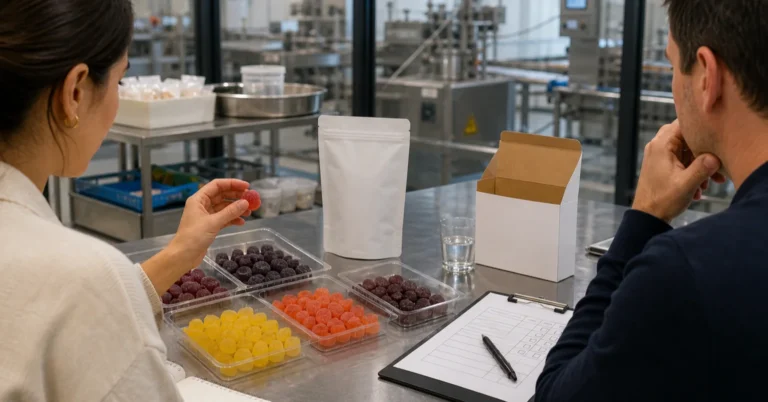
The consumer comparison shows why sensory design is commercial, not cosmetic. If a syrup's flavor is hard to accept, the measured routine may fail. If a gummy cannot hold an acceptable chew while carrying the intended ingredient system, the fixed piece-count promise may fail. The brand needs both serving logic and repeat-use logic.
When reviewing gummy feasibility, I look at active-load pressure in general terms alongside sweetness, acidity, flavor, texture, and the proposed number of pieces per serving. A change in one area can affect another. Increasing the material load, changing a supporting ingredient, or reducing sweetness may alter the sensory target and manufacturability. The proper answer comes from sample development and product-specific evaluation, not a universal recipe.
For syrup, the development team faces a different sensory and handling system. Flavor intensity, pour behavior, measuring experience, closure use, and storage directions all shape the finished routine. That system is not automatically easier simply because it avoids a gummy texture challenge.
The useful decision chain is direct: define the serving promise, build an acceptable sensory experience around it, check whether the package supports that routine, and decide what finished-product evidence will be needed. A sample that tastes good but cannot support the intended label or repeat production is not a complete commercial answer.
Packaging and Scale-Up
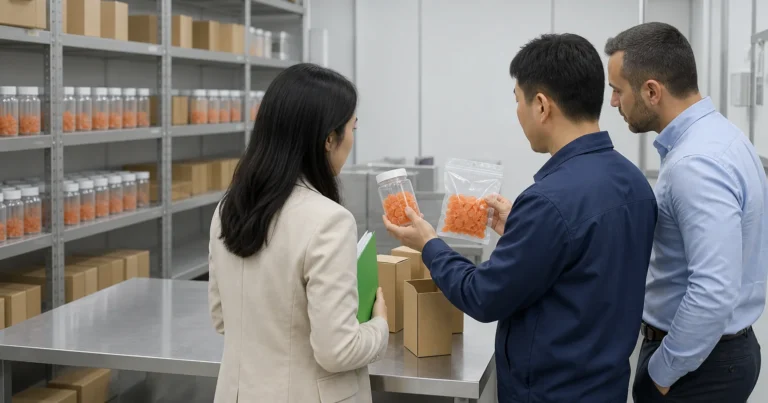
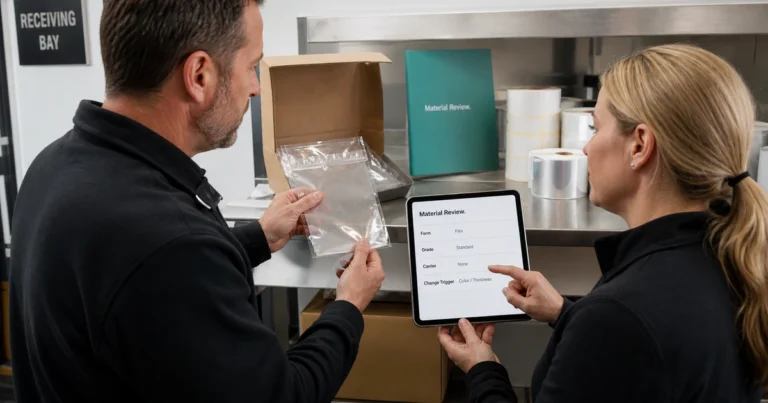
Packaging makes the format promise physical. A syrup project may need coordinated decisions about bottle size, closure, leakage control, label area, measuring components, shipping protection, and after-opening directions. A gummy project may need decisions about bottle or pouch size, closure, moisture protection, piece count, label area, and the way the gummies hold their condition through distribution.
At Talvenda, we use a four-part handoff to keep the format decision connected to production without pretending that one package or process fits every product:
| Brand decision | Syrup handoff | Gummy handoff | Evidence to align |
|---|---|---|---|
| Serving promise | Labeled liquid volume and measuring method | Pieces per serving and piece-size feasibility | Ingredient identity and amount per full serving |
| Sensory target | Pour behavior, flavor intensity, and after-opening routine | Sweetness, flavor, chew, and acceptable piece count | Approved sample criteria and finished-product specification |
| Package system | Bottle, closure, measuring component, and shipping protection | Bottle or pouch, closure, piece count, and moisture protection | Packaging specification and storage directions |
| Commercial repeatability | Filling, handling, and documentation expectations | Piece consistency, packaging, and scale-up expectations | Testing plan, label copy, and production handoff records |
This matrix is not a recipe or a regulatory decision. It is a coordination tool. The brand team can use it to identify which assumptions must be confirmed during sample work and which claims or package details should remain open until product-specific evidence is available.
Scale-up adds the consistency question. My test is whether the approved sample, production expectations, packaging specifications, label copy, documentation handoff, and testing plan all describe the same product. Finished-product checks should be tied to the actual specification and claims.[^8] Raw-material paperwork alone does not prove that every production batch will match the finished-product promise.
A brand should also discuss MOQ and production planning as project variables, not assume a fixed number from a general article. The right route depends on whether the goal is a market-tested in-stock product, a stock formula modification, or custom development. Each route changes how much formula work, packaging coordination, testing planning, and scale-up discussion is needed.
My view is that syrup and gummies are not interchangeable simply because both use “elderberry” on the front label. The better commercial format is the one whose serving claim, taste, packaging, testing plan, and repeat-use routine can be supported consistently from sample to production.
Frequently Asked Questions
Are Gummies More Effective Than Syrup?
Gummies should not be called more effective than syrup, or syrup more effective than gummies, based on format alone. Effectiveness depends on the actual ingredient, amount per labeled serving, product quality, evidence, and intended use. A liquid or chewable form does not by itself prove clinical superiority.
Do Syrup and Gummies Contain the Same Amount?
Not necessarily. Compare the elderberry material and amount per full labeled serving on each product, and check whether the labels describe the same type of ingredient. One teaspoon and one gummy are not valid comparison units unless each is the stated serving.
Which Format Is Easier to Store and Travel With?
Gummies are often easier to carry because they use a fixed piece count and do not need liquid measuring. Syrup may require more leakage protection and bottle handling. Follow each product's storage directions because heat, moisture, refrigeration, and after-opening needs can differ by product.
Conclusion
The elderberry syrup vs gummies decision should start with the complete label and the routine behind it. The best fit has clear serving, ingredient, taste, storage, and package-handling requirements without assuming clinical superiority.
For a brand, the elderberry syrup vs gummies choice is about how much product-development risk to take before launch. Talvenda supports projects as an OEM/ODM gummy manufacturing partner across low-MOQ market-tested in-stock gummies, stock formula modification, and custom gummy development. We can connect sample development, packaging and label support, documentation and testing expectations, and scale-up planning so the selected elderberry gummy route is clearer before quote discussion or sampling. Contact Talvenda to discuss the serving concept and intended launch route.
[^1]: "Elderberry: Usefulness and Safety", https://www.nccih.nih.gov/health/elderberry/. NCCIH describes the human evidence for elderberry as limited and does not establish a syrup-versus-gummy superiority conclusion. Evidence role: elderberry evidence and safety boundary; source type: official NIH/NCCIH health information. Supports: format alone should not be treated as proof that one elderberry supplement is stronger or more effective. Scope note: The source does not compare syrup and gummies and does not prove efficacy for either format. [^2]: "Dietary Supplement Labeling Guide: Chapter IV. Nutrition Labeling", https://www.fda.gov/food/dietary-supplements-guidance-documents-regulatory-information/dietary-supplement-labeling-guide-chapter-iv-nutrition-labeling/. FDA's dietary supplement labeling guide explains Supplement Facts, serving size, amount-per-serving, and dietary-ingredient declaration conventions. Evidence role: label-first serving comparison support; source type: official FDA guidance. Supports: serving size and the declared dietary ingredient should be reviewed in the Supplement Facts panel. Scope note: Nonbinding U.S. guidance; it does not determine compliance or equivalence for any specific product. [^3]: "Guidance for Industry: Nutrition and Supplement Facts Labels Questions and Answers", https://www.fda.gov/regulatory-information/search-fda-guidance-documents/guidance-industry-nutrition-and-supplement-facts-labels-questions-and-answers-related-compliance/. FDA guidance addresses added-sugars declaration and quantitative information in Nutrition and Supplement Facts labeling. Evidence role: added-sugars label review support; source type: official FDA guidance. Supports: added sugars should be checked on the actual label rather than inferred from format. Scope note: The guidance does not imply that every syrup or gummy contains added sugar or a particular sweetener. [^4]: "Health Products Compliance Guidance", https://www.ftc.gov/business-guidance/resources/health-products-compliance-guidance/. FTC guidance explains that express and implied health-product advertising claims require adequate substantiation and must be assessed in context. Evidence role: health-product advertising substantiation boundary; source type: official FTC business guidance. Supports: health-related claim language should be responsible and connected to supporting evidence. Scope note: Advertising guidance does not approve any elderberry claim and is not a complete multi-market legal review. [^5]: "Structure/Function Claims", https://www.fda.gov/food/nutrition-food-labeling-and-critical-foods/structurefunction-claims/. FDA distinguishes permissible structure/function statements from disease claims and explains the disease-claim boundary for dietary supplements. Evidence role: dietary-supplement disease-claim boundary; source type: official FDA regulatory information. Supports: supplement format does not justify disease prevention or treatment promises. Scope note: U.S.-specific educational context; no product-specific legal determination is made. [^6]: "Moisture and Shelf Life in Sugar Confections", https://pubmed.ncbi.nlm.nih.gov/20112158/. A peer-reviewed confectionery review discusses moisture, water activity, glass transition, texture, and the role of barrier packaging in shelf life. Evidence role: gummy/confectionery moisture and texture context; source type: peer-reviewed food-science review indexed in PubMed. Supports: moisture exposure and packaging can be relevant to confectionery texture and storage behavior. Scope note: No universal temperature, water-activity threshold, package barrier, or shelf life is transferred to this article. [^7]: "Mixing Medications and Dietary Supplements Can Endanger Your Health", https://www.fda.gov/consumers/consumer-updates/mixing-medications-and-dietary-supplements-can-endanger-your-health/. FDA consumer guidance warns that dietary supplements and medicines can interact and advises discussing supplement use with a health professional. Evidence role: individual medication-safety boundary; source type: official FDA consumer guidance. Supports: a general format-comparison article should not decide individual medication-interaction questions. Scope note: The source does not identify a specific elderberry interaction or provide individualized medical advice. [^8]: "21 CFR Part 111 — Current Good Manufacturing Practice for Dietary Supplements", https://www.ecfr.gov/current/title-21/chapter-I/subchapter-B/part-111/. 21 CFR Part 111 establishes a U.S. dietary-supplement CGMP framework covering specifications, production controls, packaging, labeling, records, and verification responsibilities. Evidence role: finished-product specification and control framework; source type: official eCFR regulation. Supports: finished-product checks should align with the actual specification and product claims. Scope note: The regulation does not create one universal test panel for every product or market and does not prove Talvenda capability.