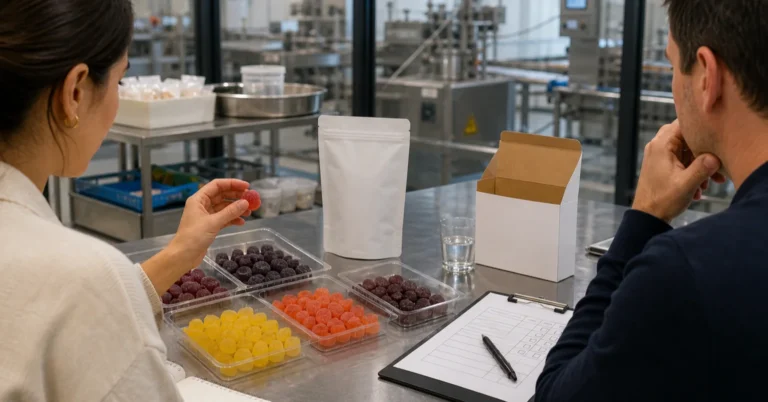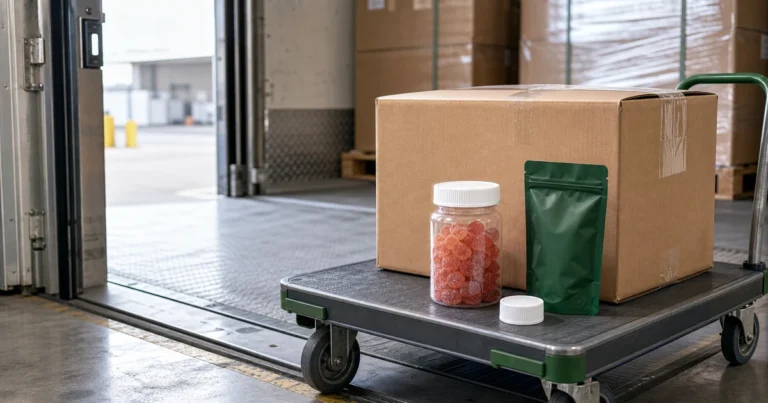


Private label mushroom gummies need a matched proof chain before launch: defined mushroom materials, supplier documents, formula feasibility, finished-batch testing, traceability, packaging fit, and controlled claims. I would judge the product as a documented commercial batch, not only as a flavorful sample or an attractive label.
A mushroom gummy can look launch-ready while its ingredient identity, test scope, label language, and production assumptions remain disconnected.
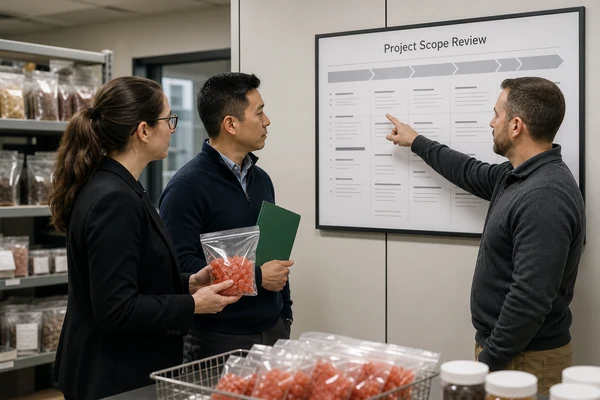
Private label can shorten development, but it does not remove the brand's responsibility to define what the product contains and what the evidence must support. Talvenda approaches that decision from the manufacturing side, where ingredient files, gummy behavior, batch records, and label expectations must remain aligned.
Decision Snapshot
- Define each mushroom by species, material type, extract details, and supplier specification before approving the formula.
- Treat the raw-material COA and the finished-batch release file as different parts of one proof chain.
- Review taste, active load, serving design, texture, moisture, and packaging together during sample work.
- Match testing and adulterant screening to the ingredients, sourcing risks, target market, and claims.
- Qualify the manufacturing route by documentation depth and scale-up control, not by sample appearance alone.
What Are Private Label Mushroom Gummies?
The phrase "private label" sounds simple, but unclear formula ownership and evidence scope can create expensive changes late in the launch.
Private label mushroom gummies are manufacturer-supported gummy supplements sold under a brand's label, usually through an existing formula, a modified stock base, or a defined custom route. I expect the commercial scope to state what can change, what evidence follows the product, and what requires new validation.
How Functional Mushroom Gummies Fit the Supplement Market
Functional mushroom gummies turn mushroom supplement materials into a familiar chewable format. For a brand, the opportunity is not simply to move a capsule concept into candy-like delivery. The product still needs a clear ingredient identity, a realistic serving design, acceptable taste, stable texture, and responsible positioning.
The consumer-facing format should remain separate from the manufacturing file. The consumer sees flavor, shape, label, and serving directions. The product team must see input specifications, carriers, the formula route, test plan, packaging conditions, and lot records. That convenience increases the need for a clear evidence file behind the commercial product.
Private Label vs. Custom Mushroom Gummy Development
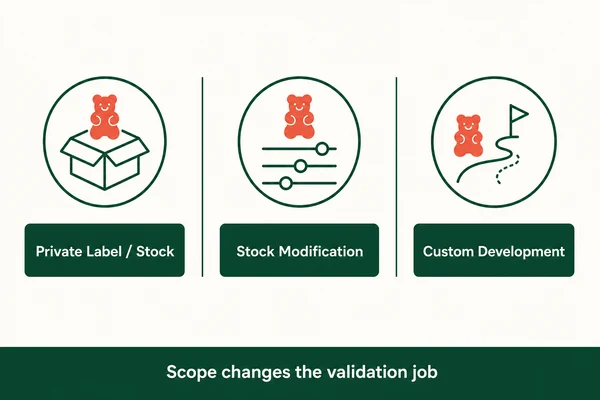
Private label often starts with an existing formula and production route. White label mushroom gummies may allow branding and packaging changes. A stock formula modification changes selected features, while custom mushroom gummies require broader formulation and validation.
The route should not be chosen by the word "custom" alone. Compare differentiation, timeline, first-order exposure, ingredient targets, serving expectations, packaging, and documentation. A stock route works when its formula and evidence fit the market. A custom route fits a brief that requires a different active system or product design.
| Route | Typical scope | Main launch check |
|---|---|---|
| White label | Existing product with brand and packaging application | Confirm the exact finished-product specification and available documents |
| Stock formula modification | Existing base with selected formula, flavor, or format changes | Identify which changes trigger new sample, test, or stability work |
| Custom development | New brief built around defined product requirements | Confirm feasibility, validation scope, cost exposure, and scale-up path |
Why Mushroom Gummies Need Stronger Documentation Than Standard Gummies
A mushroom name does not fully describe the material used in production.[^1] The file may need to distinguish species, fruiting body or mycelium, extract or powder, extraction details, carrier content, and the specification used to release the input.
That complexity continues after the material enters the gummy. Active loading, acids, heat, moisture, coating, and storage can change finished-product risk. The proof chain connects supplier qualification, input identity, contaminant limits, batch processing, finished-batch checks, and label claims. A facility certificate does not replace lot-specific evidence for the mushroom gummy.
Which Mushroom Ingredients Can Be Used in Gummies?
An ingredient list can become a marketing wish list unless every mushroom material is technically defined and suitable for the intended gummy route.
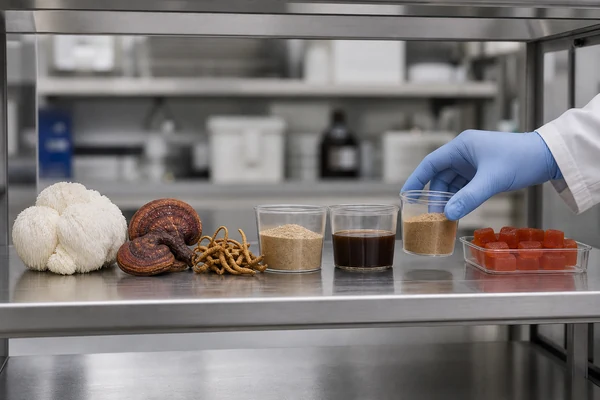
Mushroom ingredients used in gummies can include single-species materials or blends, but each input needs its species, form, extraction description, carrier profile, specification, and supplier file. I map those fields to the formula brief, COA scope, sensory notes, and label draft; a supplier or material-form change reopens approval.
Lion's Mane, Reishi, Cordyceps, Chaga, Turkey Tail, and Multi-Mushroom Blends
Lion's mane gummies, reishi gummies, and formulas using cordyceps, chaga, turkey tail, or several mushrooms can all create different sourcing and formulation questions. The species name is only the first field. The production team also needs to know the material form, concentration approach, excipients, sensory character, and planned amount per serving.
Multi-mushroom blends add another layer. A blend may simplify purchasing, but it can make each component less visible. Separate inputs provide more control but increase formula load and documentation work. That tradeoff should be explicit instead of letting "mushroom complex" hide the input structure.
Fruiting Body, Mycelium, Extract Ratio, and Supplier Documentation
Fruiting body, mycelium, whole powder, and extract are not interchangeable descriptions. Extract ratios can also be misunderstood if the basis, method, carriers, and finished specification are unclear. One number should not be treated as proof of identity or quality.[^2]
Before formula approval, the commercial name and technical identity should agree across the ingredient specification, COA, purchase record, manufacturing record, and label draft. The supplier file should also define relevant tests and acceptance limits. When the brand changes a supplier or input form, the team should assess whether taste, active load, testing, label text, and sample performance need review again.
| Material-definition field | Procurement question | Downstream decision |
|---|---|---|
| Species and material part | Does the technical file define the named mushroom and material form clearly? | Decide whether the label, specification, and purchase description match |
| Powder, extract, or blend | What processing description and composition information accompany the input? | Review load, sensory effect, and test interpretation |
| Carriers and other excipients | Are supporting materials visible in the specification and COA scope? | Check formula space, label text, and requested product attributes |
| Supplier or input change | What triggers reapproval when the source, form, or specification changes? | Revisit sample performance, documents, testing, and claims as needed |
How to Keep Function Claims Within Safe Boundaries
The formula brief should separate ingredient identity from the benefit story. The presence of a named mushroom is not automatic support for cognitive, immune, energy, adaptogenic, nootropic, or other outcome language.[^3]
Claims should be reviewed for the target market and for the exact product, not copied from broad marketplace or promotional claim language. The same discipline should apply to the label, product page, marketplace listing, advertising, and creator scripts.[^4] This is a commercial control as well as a claim control: restrained, consistent language reduces the chance that the marketing promise outruns the formula and evidence file.
Testing Risks Brands Should Review Before Launch
A long COA can create false confidence when its methods, sample identity, lot match, and finished-product relevance are not understood.
Mushroom gummy testing should cover risks attached to the named inputs and finished product. I record each risk in a test-responsibility matrix with its owner, sample point, acceptance basis, release record, and lot link. Production stops when a required decision is unassigned or evidence cannot match the commercial batch.
The testing plan is easier to control when each risk has an owner and a sample point. This compact view prevents a general promise such as "tested" from replacing a defined decision.
| Risk category | Decision owner to define | Sample point to confirm |
|---|---|---|
| Ingredient identity | Brand quality team and manufacturing quality team | Approved input and received lot |
| Contaminants | Quality team against the product and market specification | Incoming material, finished product, or both as justified |
| Relevant adulterants | Brand and manufacturing quality teams through a documented risk review | The sample point selected for the identified supply-chain risk |
| Finished-batch release | Named release owner under the agreed specification | The commercial batch linked to its packaging and lot records |
Identity Testing for Mushroom Extracts and Botanicals
Identity testing asks whether the material is what the specification says it is. That sounds basic, yet processed extracts, powders, blends, and carrier systems may require different methods and interpretation. A method useful for one input may not answer every identity question after extraction or after the material is combined in a gummy.
The brand and mushroom gummies manufacturer should agree on the identity strategy before purchase and production. That includes the test target, method source, sample point, acceptance decision, and handling of a result that does not match. For a blend, the file should state whether testing applies to the blend, its components, or both. The purpose is not to collect the longest report. The purpose is to make the named ingredient traceable to a defensible input decision.
Heavy Metals, Microbial Limits, and Contaminant Controls
Mushroom and botanical materials can bring contaminant questions that should be managed through sourcing controls, specifications, testing, and release decisions. Heavy-metal and microbial limits should fit the ingredient risk, product format, intended market, and applicable requirements.[^5] Other contaminant categories may need review depending on the source and process.
These controls should be mapped across the supply chain. Supplier qualification and raw-material testing reduce input risk. Manufacturing hygiene and process controls address what happens during production. Finished-product testing confirms selected release conditions after the full formula has been made. Each layer answers a different question, so one passing input document should not be stretched into proof of every finished-product condition.
Adulterant Screening for Psychoactive or Undisclosed Compounds
Functional mushroom supplements must remain clearly separated from psychoactive or undisclosed-ingredient products. A familiar mushroom graphic, "proprietary blend" label, or facility document does not prove that distinction. The screening plan should respond to the ingredient category, supplier history, market signals, and product claims.
The qualification discussion should identify who defines the relevant adulterant panel, which sample is tested, how the method fits the suspected compounds, and what happens if an unexpected result appears. This is not a place for vague assurances such as "all natural" or "lab tested." A documented risk assessment and an appropriate testing decision give the brand a clearer basis for deciding whether the lot can proceed to release.
COA Review and Finished-Batch Release Documents
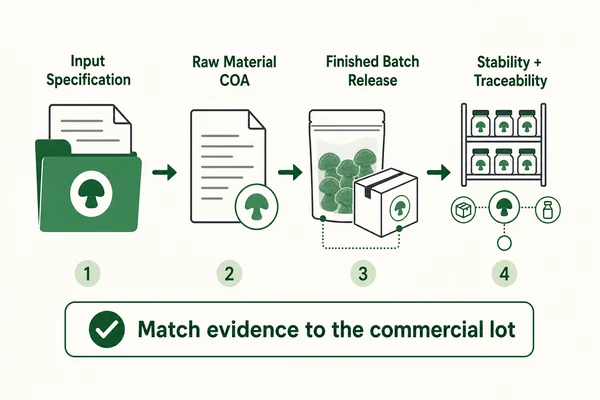
A raw-material COA belongs to the ingredient lot.[^6] A finished-batch COA or release record belongs to the manufactured gummy batch. Both records should be tied to lot identifiers, specifications, dates, and the correct product version.
| Proof-chain point | Document question | Common gap |
|---|---|---|
| Mushroom input | Does the COA match the received lot and approved specification? | A generic or unmatched report is supplied |
| Formula and batch | Does the batch record identify the approved inputs and product version? | Formula changes are not reflected across files |
| Finished product | Which release checks apply after gummy production? | The raw-material COA is treated as the final release file |
| Commercial unit | Do lot code, packaging record, and retained documents connect? | The bottle or pouch cannot be traced cleanly to the batch |
An analytical result is not the same as a release decision.[^7] A document should show what was checked and how it was judged against the approved specification. The quality team can then confirm whether the commercial lot was released.
Formulation Challenges in Mushroom Gummy Manufacturing
Good documentation cannot rescue a gummy that fails on taste, serving design, texture, moisture control, or repeat production.
Mushroom gummy manufacturing must balance earthy extracts, active load, gummy base, serving size, moisture, texture, and packaging. I treat each sample as a versioned production candidate and compare sensory notes, formula status, serving design, and packaging assumptions. A load or commercial-pack change reopens the sample decision.

Earthy Taste Masking and Flavor System Design
Mushroom extracts may introduce earthy, bitter, roasted, or lingering notes. Adding stronger flavor does not always solve the problem. Sweetness, acidity, aroma, color, coating, and the gummy base can interact with the active system, and an aggressive masking strategy can create a product that tastes artificial or loses balance over time.
Flavor belongs inside the formula-feasibility review. The question is whether the intended active direction can reach an acceptable sensory profile without creating another production problem. Sample feedback should use clear observations, not just "good" or "bad." Note the first bite, aftertaste, aroma, sweetness, acidity, chew, and any change after storage. That gives the formulation and production teams information they can act on.
Active Load, Serving Size, and Gummy Count Pressure
Active load is a space and performance constraint. More mushroom material can increase mass, flavor pressure, and texture risk. It may also force a larger gummy, more gummies per serving, or a change in how the formula is positioned. A capsule-style amount should not be moved into a gummy without reviewing the tradeoffs.
The product brief should state the intended serving, gummy count, active declaration, and acceptable sensory limits. Then the manufacturing team can review whether the route is practical. If the load creates an unwieldy serving or unstable chew, the team should resolve that conflict before label design and launch claims become fixed. This is where commercial priorities need to be ranked rather than hidden inside a crowded formula.
Pectin, Gelatin, Vegan, Organic, and Clean-Label Route Decisions
Pectin and gelatin routes have different processing, texture, and positioning implications. A vegan, organic, or clean-label direction can also affect ingredient selection, colors, flavors, coatings, processing aids, supplier files, and label review. Treat each term as a project requirement that must be defined, not as a decoration added near launch.
The brand should state which attributes are essential and which are preferences. The manufacturing team can then identify conflicts with active load, flavor, texture, supply, or documentation. A broad clean-label request is hard to execute when excluded materials or the target market remain undefined.
Stability, Moisture, Texture, and Shelf-Life Checks
Gummies continue to respond to their environment after production. Moisture movement, temperature, acids, coating, packaging barrier, and storage can affect sticking, hardening, softening, sweating, flavor, appearance, and active performance. A fresh sample is not enough to support a shelf-life promise.[^8]
The stability approach should fit the formula, container, closure, channel, and target conditions. Teams should define what attributes will be observed or tested, at which points, and how changes will be judged. Packaging belongs in this plan because the same gummy may behave differently in a high-barrier bottle and a poorly matched pouch. For a broader view of this production logic, our gummy vitamin manufacturing service connects formulation planning with packaging and commercial scale-up.
Packaging and Label Checks for Private Label Mushroom Gummies
Packaging is often selected for shelf impact first, even though barrier performance and traceability can determine whether the gummy remains saleable.
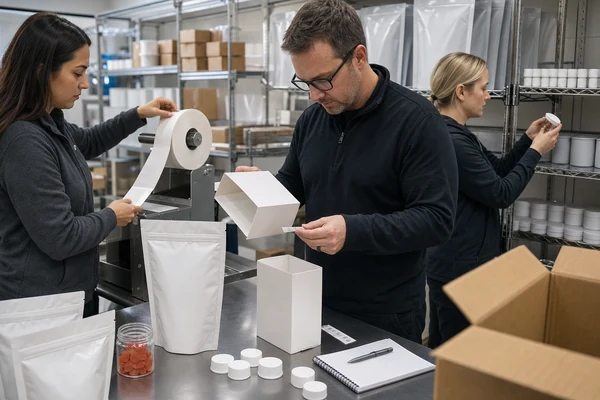
Private label mushroom gummy packaging should protect the formula, fit the sales channel, carry accurate information, and preserve lot traceability. I record the container, closure, count, coding, shipping exposure, and claim space on one packaging review sheet. Artwork stays open while barrier fit or lot-code traceability remains unresolved.
Bottles, Pouches, Bulk Packaging, and Channel Requirements
Bottles offer structure and familiar shelf presentation. Pouches reduce space and shipping weight but need barrier and seal review. Bulk packaging adds handling and repacking questions. No format is automatically best for every mushroom gummy.
Start with the formula and channel. E-commerce, retail, delivery, storage, and distributor handling create different pressures. Count, headspace, closure, moisture-control needs, label area, and case packing should be reviewed before artwork is final. The pack must also fit production, coding, and line handling.
Supplement Facts, Lot Coding, and Traceability
The label should reflect the approved formula and ingredient identity. Mushroom naming, serving size, gummy count, other ingredients, warnings, and required statements need coordinated review for the target market. The Supplement Facts panel cannot be completed independently from formulation and documentation.
Lot coding should connect each commercial unit to the finished batch and relevant packaging record.[^9] The quality file should make it possible to trace the mushroom input lots, production record, release decision, and packed goods. This chain matters when the team investigates a complaint, checks a document request, or manages a change. A code printed on a bottle has little value if the underlying records cannot follow it.
Claim Review Across Label, Website, Ads, and Influencer Copy
A cautious label can be undermined by a product page, paid ad, marketplace bullet, or influencer script that promises more than the formula file supports. Use one claim-control process across every channel, with ownership for approval and version changes.
The review should compare ingredient identity, declared amount, product description, imagery, implied use, and explicit claims. It should also flag words that blur functional mushroom gummies with psychoactive products. The goal is consistent commercial communication, not hidden qualifiers. When marketing changes after launch, the team should route new copy through the same boundary review instead of assuming the original label approval covers every new statement.
How to Choose a Mushroom Gummy Manufacturer
A polished sample and quick quotation reveal little about how the manufacturing partner controls mushroom identity, batch evidence, and repeat production.
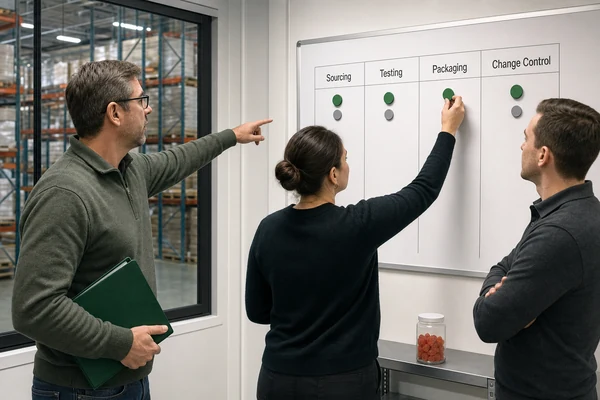
A mushroom gummies manufacturer should explain sourcing, qualification, formulation limits, test ownership, finished-batch release, packaging, change control, and scale-up. I reduce the discussion to a qualification matrix and match each answer to a document, owner, inclusion, or exclusion. If the route and project file disagree, terms remain provisional.
Questions About Extract Sourcing and Supplier Qualification
Ask how each mushroom material is described, approved, received, and linked to its COA. The answer should cover species, form, extract details, carriers, specification, supplier status, and change handling. Also confirm whether samples and commercial production use the same documented input.
Talvenda is on the cooperative production side, so our role is to help the brand team align these input questions with formula and batch planning. An ingredient substitution may affect more than purchasing. It can change taste, color, load, label language, and test interpretation. Good change control makes those consequences visible before the substituted material enters a commercial batch.
Questions About GMP, HACCP, ISO, and Testing Scope
Quality-system terms can support qualification, but they should be checked for exact scope, current status, relevant site or activity, and connection to the proposed product. An acronym is not proof that every ingredient identity, contaminant, adulterant, potency, or finished-product question is covered.
Ask who sets the product specification, who arranges each test, which laboratory or method requirements apply, who reviews results, and which records the brand receives. Review the current evidence rather than relying on a sales statement. Talvenda's certifications and quality context can support this discussion, while product-specific testing and batch release still need their own defined scope.
Questions About MOQ, Samples, Lead Time, and Scale-Up
MOQ is the result of a route, not a universal number. Formula type, active sourcing, packaging components, testing, artwork, setup, and production planning can all affect the practical order requirement. Ask for the assumptions behind the quoted MOQ instead of requesting one fixed figure without a brief.
Samples also need a defined purpose. A flavor sample, bench sample, packaging mock-up, and production-representative sample do not prove the same things. Lead time should separate formulation, ingredient procurement, packaging, testing, production, and release steps. For scale-up, confirm which sample attributes and documents become approval references, how changes are communicated, and what happens when commercial conditions produce a different result.
The qualification record should compress sales answers into comparable decisions:
| Qualification area | Ask before quote approval | Record for the project file |
|---|---|---|
| Extract sourcing | How is the named material specified, qualified, and controlled through change? | Approved specification, lot-linked document scope, and change rule |
| Quality and testing | Who defines, arranges, reviews, and releases each agreed check? | Test-responsibility matrix, sample point, acceptance basis, and document owner |
| Sample status | What does this sample represent, and which commercial inputs or checks remain open? | Sample purpose, formula version, review criteria, and provisional items |
| Commercial route | Which assumptions sit behind MOQ, timing, packaging, and included testing? | Route-specific quotation scope and exclusions |
| Scale-up | Which sample attributes and records become production references? | Approval reference, change path, and escalation owner |
Red Flags in Mushroom Gummy Suppliers
Slow the project when a supplier cannot define the mushroom input, sends generic or unmatched COAs, treats a facility certificate as product proof, or refuses to explain finished-batch release. Other warning signs include instant custom-formula promises, fixed claims without market context, unclear testing ownership, unsupported shelf-life statements, and quotations that omit packaging or required test assumptions.
Another red flag is a gap between sales answers and technical records. Confident statements do not replace a specification, change-control path, sample criteria, or lot-level document list. A credible mushroom gummy supplement contract manufacturer should define responsibilities and limits before production.
From Sample to Production: A Safer Launch Workflow
Projects often lose control when the sample, artwork, test plan, and purchase order move forward from different versions of the brief.
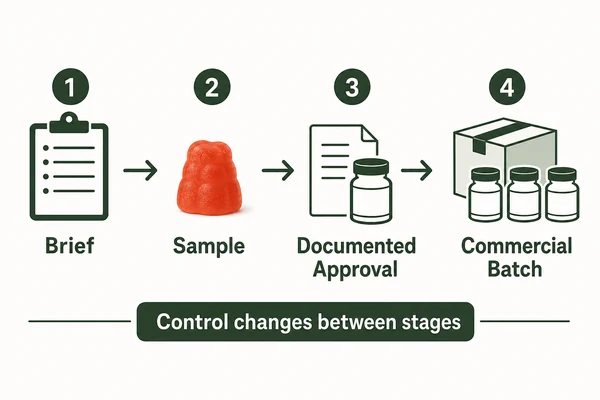
A safer mushroom gummy launch workflow freezes the product and claim brief, reviews a production candidate, confirms packaging and release requirements, and controls changes before scale-up. I tie each approval to the brief, sample version, open-item log, and release plan. A substitution, claim, or packaging change reopens approval.
Prepare the Product Brief and Claim Boundary First
The starting brief should identify the target market, product route, mushroom materials, serving concept, gummy count, base preference, flavor direction, packaging idea, channel, and claim boundary. It should also state what evidence the brand expects with ingredients and the finished batch.
Keep this document concise enough to use but specific enough to control decisions. Unknowns should be marked as unknowns. That is better than filling gaps with assumptions that later become artwork, purchase commitments, or launch copy. If the team wants a faster private label route, it can review an existing mushroom complex gummy product direction while still checking whether the actual formula, documents, packaging, and claims fit the project.
Review Samples Against Taste, Texture, Active Load, and Documentation
A sample review should use agreed criteria. The review should cover both the eating experience and the production status represented by that sample.
| Review point | What to record | Decision supported |
|---|---|---|
| Taste and aftertaste | Flavor balance, mushroom notes, sweetness, acidity, and change after storage | Whether the target active concentration can reach an acceptable sensory profile |
| Texture and appearance | Chew, sticking, coating, color, shape, and visible consistency | Whether the sample has a practical development path |
| Weight and serving | Sample weight, intended gummy count, and serving relationship | Whether the serving concept and active-load direction remain aligned |
| Formula match | Mushroom input, formula version, and any substitutions still open | Whether feedback applies to the intended commercial formula |
| Document status | Available specifications, COAs, tests, and unresolved evidence items | Whether the sample is provisional or ready for the next approval stage |
Documentation belongs in the sample decision. The product team should know whether the sample uses the intended commercial ingredients, whether substitutions remain open, and which tests or stability checks have or have not occurred. A sample can be useful while still being provisional. Recording that status prevents a pleasant prototype from being mistaken for a fully released commercial specification.
Confirm Finished-Batch Testing Before Commercial Release
Before commercial production, define the finished-product specification, test list, acceptance limits, sample ownership, document format, review responsibility, and release authority. The plan should also address relevant contaminant or adulterant questions and connect the final COA or release record to the batch and packaging lots.
These decisions should be made before the production calendar becomes the main pressure. When testing is discussed only after gummies are packed, teams may discover that the right sample was not retained, the test was not included, or the result cannot support the expected claim. A release plan protects both timing and decision quality because everyone knows what must be complete before goods move into commerce.
How Talvenda Supports Mushroom Gummy Manufacturing Readiness
Talvenda helps connect the brand's product brief with ingredient-document review, formula-route feasibility, sample planning, taste and texture feedback, packaging fit, finished-product testing expectations, batch documentation, MOQ planning, claim-boundary review, and scale-up coordination. This connection keeps commercial decisions tied to the production version.
That support does not replace the brand's legal or quality responsibilities or turn an early sample into proof. It gives the team clearer manufacturing questions before quotation and production. The formula route, evidence plan, packaging, label direction, and release expectations can then be reviewed in one project file.
Frequently Asked Questions About Private Label Mushroom Gummies
What is the MOQ for private label mushroom gummies?
MOQ depends on the stock, modified, or custom route, as well as ingredient sourcing, packaging, testing, and production setup. Request a route-specific MOQ with its assumptions instead of relying on one fixed number.
Can mushroom gummies be vegan, organic, or clean label?
They may be developed toward these requirements when the gummy base, mushroom inputs, flavors, colors, coatings, processing aids, supplier documents, and target-market rules align. Define each requested attribute before sample work because the terms are not interchangeable.
How do manufacturers mask the earthy taste of mushroom extracts?
Manufacturers can balance flavor, sweetness, acidity, aroma, color, coating, and the gummy base around the mushroom material. Judge masking at the target active concentration through structured sample review because a reduced-load flavor sample may hide the bitterness or aftertaste the commercial formula must carry.
What testing should brands request for mushroom gummies?
The plan may include input identity, heavy metals, microbial limits, relevant contaminants or adulterants, and finished-product release checks. The exact scope should match the ingredients, supplier risk, target market, claims, and commercial product specification.
Can brands customize mushroom gummy flavors, shapes, and packaging?
Yes, customization may cover flavor, color, shape, gummy base, count, container, and label presentation. Each change should be checked against formula stability, production fit, component availability, testing impact, timeline, and MOQ before approval rather than treated as a design-only choice.
Conclusion
The strongest launch plan for private label mushroom gummies is not the one with the longest benefit list. It is the one that keeps ingredient identity, formula feasibility, finished-batch evidence, packaging, traceability, and claim language connected through commercial release.
Before committing to a fully custom project, a brand should decide how much differentiation its proof file can support. As a private label gummy manufacturing partner, Talvenda can outline low-MOQ market-tested in-stock gummies, stock formula modification, and custom gummy development so the team can choose against its timeline and product direction. Sample development can expose taste and load pressure, while documentation and testing expectations, plus packaging and label support, clarify what must be resolved before scale-up. Share the target market, mushroom direction, and packaging idea through our contact page to align the private label mushroom gummies brief before sample and quote discussion.
[^1]: "Mycelium vs. Fruiting Bodies of Edible Fungi—A Comparison of Metabolites", https://pmc.ncbi.nlm.nih.gov/articles/PMC9315710/. The review reports that mycelium and fruiting bodies can differ in composition and that strain, substrate, and developmental stage affect measured constituents. Evidence role: ingredient material-definition context; source type: peer-reviewed review. Supports: a mushroom name alone does not fully define the production material. Scope note: This source compares edible fungal materials; it does not validate a specific commercial ingredient or establish that one material form is universally superior. [^2]: "Complexity of Dietary Supplement Identity and Purity Testing", https://www.usp.org/sites/default/files/usp/document/user-forums/03-complexity-of-ds-identity-and-purity-testing-james-kababick.pdf. USP analytical materials describe identity and purity testing as method- and matrix-dependent and emphasize multiple risk categories rather than a single shortcut. Evidence role: analytical-method boundary; source type: professional standards institution. Supports: one extract ratio or one test result is not a complete identity or quality decision. Scope note: The source provides analytical context, not a product-specific method requirement or approval. [^3]: "Label Claims for Food & Dietary Supplements", https://www.fda.gov/food/nutrition-food-labeling-and-critical-foods/label-claims-food-dietary-supplements/. FDA distinguishes health, nutrient-content, and structure/function claims and describes requirements that apply to dietary supplement label claims. Evidence role: label-claim boundary; source type: U.S. government. Supports: ingredient presence alone does not automatically substantiate every proposed product claim. Scope note: This is U.S. regulatory context and is not legal advice or approval of any specific claim. [^4]: "Health Products Compliance Guidance", https://www.ftc.gov/business-guidance/resources/health-products-compliance-guidance/. FTC guidance explains that health-product advertising claims, including implied claims, require appropriate substantiation and should be assessed in their full promotional context. Evidence role: cross-channel advertising substantiation; source type: U.S. government. Supports: claim control should extend beyond the label to advertising and other promotional channels. Scope note: This is U.S. advertising guidance and does not determine compliance in every target market. [^5]: "Dietary Supplements & Herbal Medicines", https://www.usp.org/dietary-supplements-herbal-medicines/. USP dietary supplement resources describe quality standards and contaminant controls across raw materials and finished products. Evidence role: risk-based contaminant context; source type: professional standards institution. Supports: contaminant review should be tied to the material and finished-product quality framework. Scope note: The source does not prescribe one universal panel or acceptance limit for every mushroom gummy. [^6]: "21 CFR 111.75 — What must you do to determine whether specifications are met?", https://www.ecfr.gov/current/title-21/chapter-I/subchapter-B/part-111/subpart-E/section-111.75. 21 CFR 111.75 addresses how manufacturers determine whether component and finished-batch specifications are met, including testing or examination and supplier qualification controls. Evidence role: specification and testing scope; source type: U.S. regulation. Supports: raw-material documentation belongs to a component/lot decision and does not replace finished-batch specification review. Scope note: The regulation does not require one universal COA format or one test panel for all products. [^7]: "21 CFR Part 111 — Current Good Manufacturing Practice for Dietary Supplements", https://www.ecfr.gov/current/title-21/chapter-I/subchapter-B/part-111/. 21 CFR Part 111 assigns quality-control review and approval responsibilities to records, operations, and batch disposition decisions. Evidence role: quality-control release boundary; source type: U.S. regulation. Supports: a test result must be judged within an approved specification and release process. Scope note: The source does not define Talvenda's internal release authority or approve a specific commercial batch. [^8]: "1ViZN LLC Warning Letter", https://www.fda.gov/inspections-compliance-enforcement-and-criminal-investigations/warning-letters/1vizn-llc-522724-08232017/. FDA dietary-supplement enforcement materials state that a voluntarily used expiration, shelf-life, or best-by date should be supported by stability data. Evidence role: shelf-life support boundary; source type: U.S. government enforcement context. Supports: a fresh sample alone is not sufficient support for a stated shelf life. Scope note: The cited warning letter illustrates FDA's U.S. position and does not prescribe a universal stability protocol. [^9]: "Small Entity Compliance Guide: Dietary Supplement Current Good Manufacturing Practice", https://www.fda.gov/regulatory-information/search-fda-guidance-documents/small-entity-compliance-guide-current-good-manufacturing-practice-manufacturing-packaging-labeling/. FDA's Dietary Supplement CGMP guide explains batch, packaging, labeling, reserve-sample, distribution, and recordkeeping controls under 21 CFR Part 111. Evidence role: packaging and traceability context; source type: U.S. government guidance. Supports: lot coding is useful only when records connect the packaged unit to the relevant batch and packaging history. Scope note: The guide does not prescribe one universal coding format or software system.