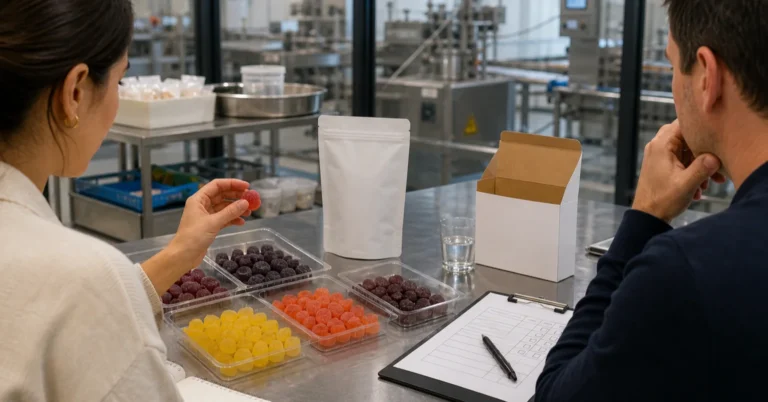

A supplement co-packer packages a supplement that is ready for filling, labeling, kitting, or retail packout.
For new brands, the key decision is whether packaging is the only bottleneck or whether formula, testing, label, documentation, and scale-up still need to be solved together.
Decision Snapshot:
| Product stage | Better route | Why it matters |
|---|---|---|
| Formula defined, bulk product released, label path clear | Supplement co-packer | The main need is packaging execution. |
| Formula, testing, packaging fit, or scale-up still open | Full contract manufacturer | Product and packaging decisions still need to be solved together. |
| Packaging capacity, labeling, kitting, or retail packout is the bottleneck | Contract supplement packaging | A focused packaging partner can add capacity without reopening formula work. |
| Label claims, batch documents, or release status are unclear | Manufacturing-led route first | Packaging too early can create holds, rework, or weak traceability. |
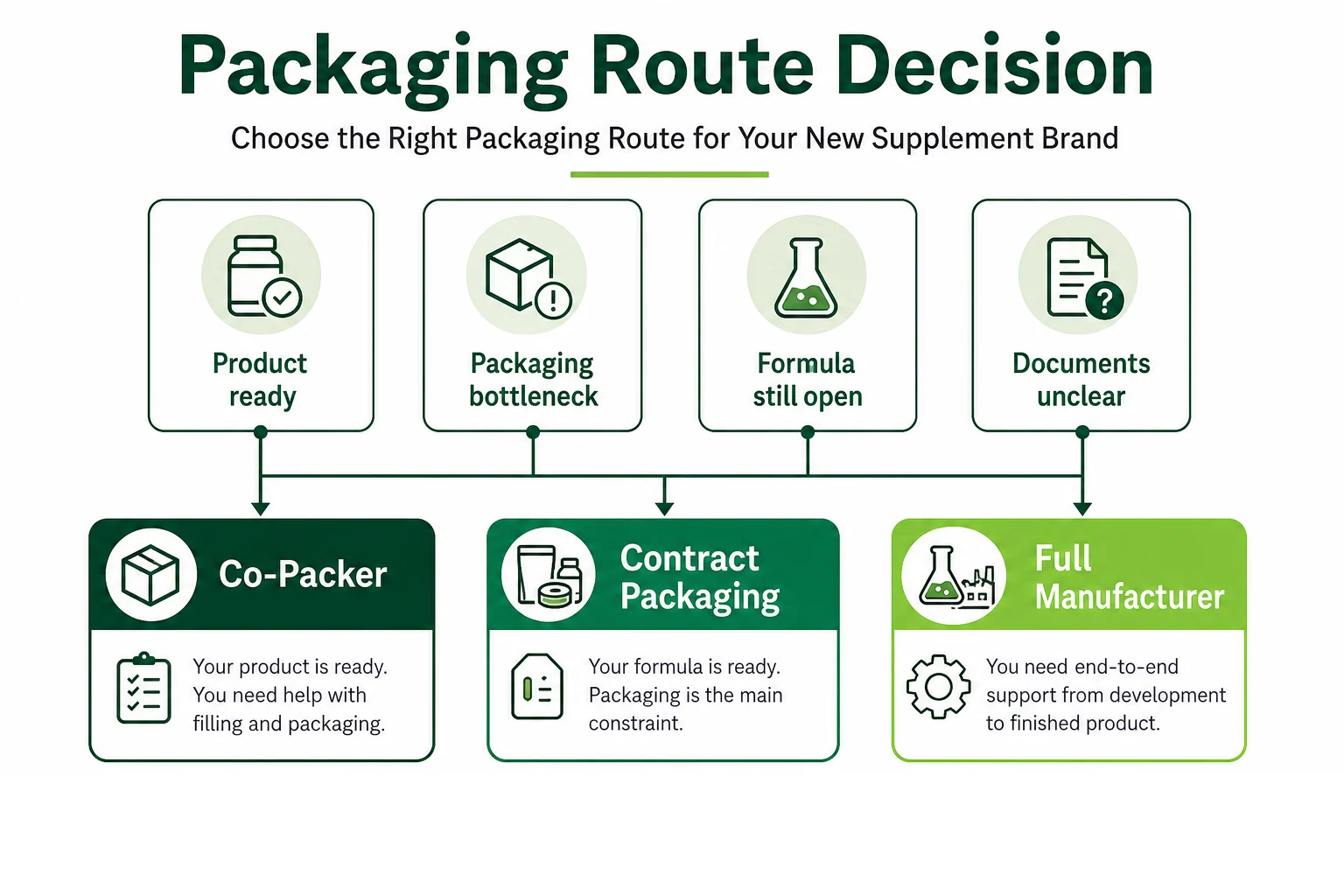
Packaging often looks like the final logistics step. In practice, it is where formula decisions, label claims, batch records, packaging protection, MOQ planning, channel requirements, and reorder planning meet. A packaging-only partner can move fast when the product is ready. The same route can create risk when the brand still needs formulation, testing, label, or production-documentation support.
I usually separate the decision this way: use a co-packer when execution is the remaining task; use a full manufacturing partner when the product route still needs to be built. For broader launch planning, see Talvenda's guide on how to start a supplement brand.
What Is a Supplement Co-Packer?
A supplement co-packer packages finished or near-finished supplement products for brands that need external packaging capacity or packaging expertise.
The practical difference is scope: a co-packer focuses on packaging execution, while a full contract manufacturer can also support production readiness, formulation, testing, scale-up, and documentation.
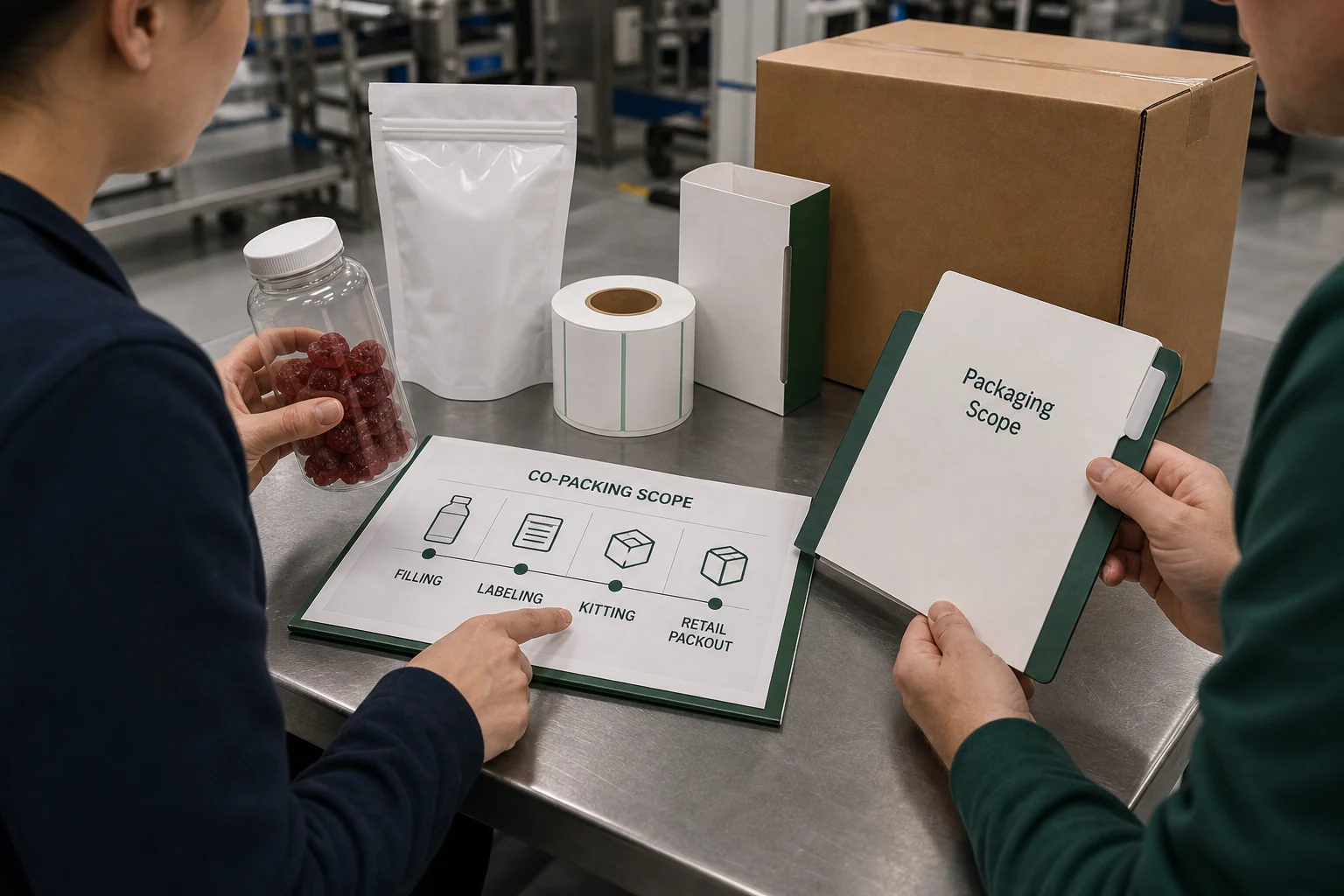
Definition of Supplement Co-Packing and Contract Packaging
Supplement co-packing is the use of a third-party partner to package a dietary supplement into its final or near-final sale format. Depending on the product, that may include counting capsules into bottles, filling powder into jars or pouches, packaging gummies into bottles, applying labels, adding lot codes, assembling cartons, preparing multi-packs, or building retail-ready displays.
Contract supplement packaging is closely related. In many buying conversations, "co-packing" and "contract packaging" are used almost interchangeably. The important point is that the supplier's main job is packaging execution. They may help source packaging components or coordinate logistics, but they are not automatically responsible for formulation, production validation, claim review, or finished-product testing unless those services are explicitly included.[^1]
This is why a brand should define the work before asking for a quote. "We need a supplement packaging company" can mean a packaging material supplier, a label printer, a contract packager, or a full manufacturer with packaging capability. A clear scope keeps the RFQ from becoming too broad and protects the brand from choosing a partner who cannot solve the real bottleneck.
Supplement Co-Packer vs Contract Manufacturer
A supplement co-packer usually receives a product that is already manufactured, released, or ready to move into packaging. A contract manufacturer may support earlier steps, including formula review, sample planning, raw material sourcing, production trials, batch manufacturing, testing coordination, documentation, and packaging coordination.
The line can be hard to separate. Some supplement manufacturers offer packaging services. Some packaging companies offer light sourcing, assembly, or fulfillment support. The buyer should not rely on job titles alone. Instead, ask what the partner actually controls: formula feasibility, bulk production, packaging components, filling equipment, label application, lot coding, quality records, release documents, storage, shipping, and post-packaging issue handling.
The most common mistake I see is approaching a co-packer while the product is still undefined. The co-packer may package exactly what arrives. But if the bulk product has moisture issues, label-claim gaps, missing documentation, or a packaging format that does not fit the product, the finished retail unit may still be hard to release or sell.
Where Co-Packing Fits in the Supplement Supply Chain
Co-packing normally sits after formula and production decisions but before finished goods reach warehouses, distributors, retailers, or e-commerce fulfillment centers. It turns a usable product into a sale-ready unit.
A typical supplement route looks like this:
- Formula and product-format development
- Raw material and component planning
- Bulk manufacturing or finished-product production
- Testing, release review, and documentation
- Packaging execution: filling, labeling, coding, kitting, or cartoning
- Finished-goods inspection and shipment
That position makes co-packing operationally important. The packager may touch bottle selection, closure fit, pouch sealing, desiccant placement, label application, date coding, carton assembly, and shipping-carton configuration. Each of these choices can affect product presentation, traceability, product protection, and downstream channel acceptance.
When Should a New Supplement Brand Use a Co-Packer?
Use a co-packer when the main problem is packaging execution, not unresolved product development.
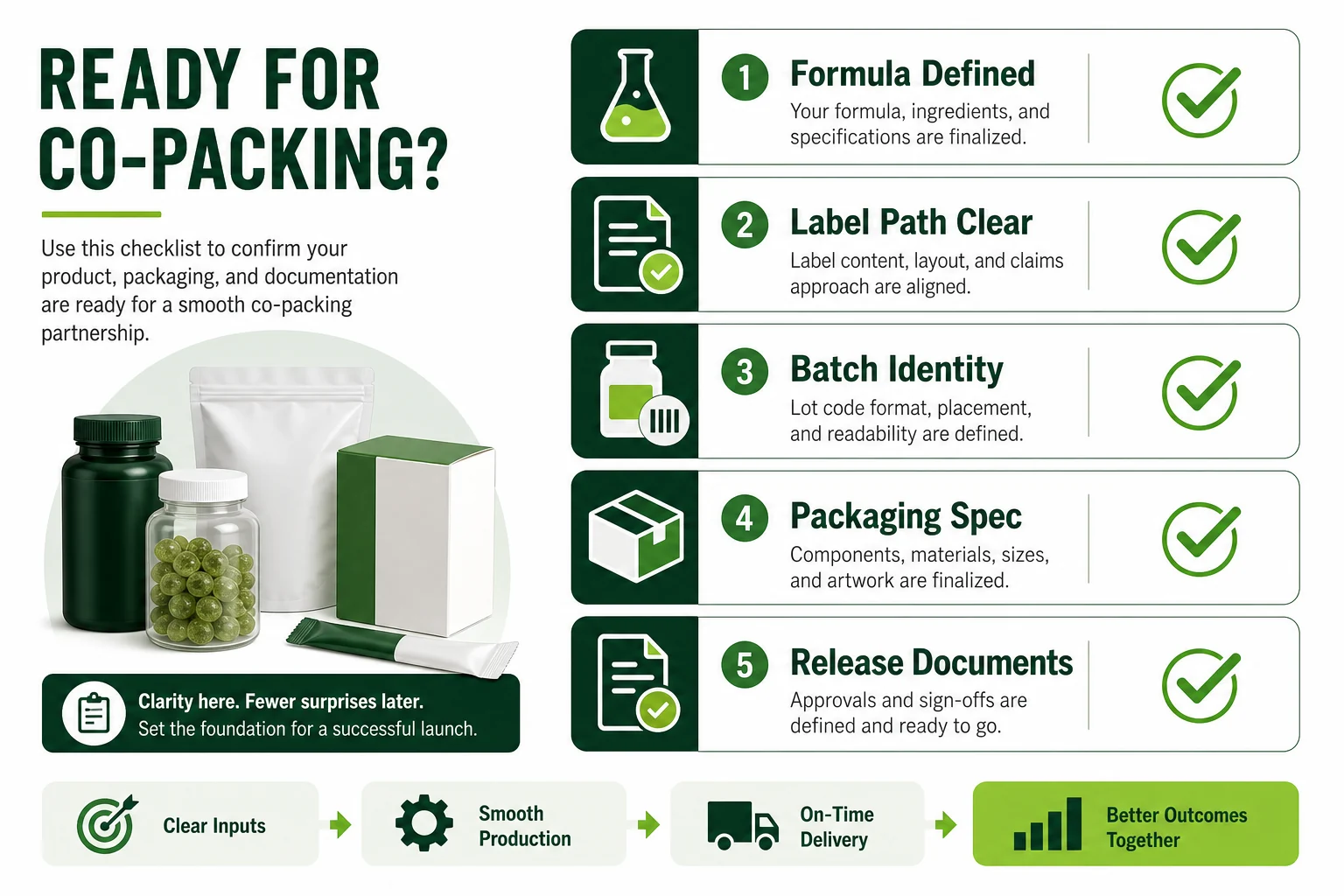
A new brand is ready for co-packing when the product, packaging format, label direction, batch identity, and documentation path are clear enough for a third party to package without redesigning the product.
When the Formula or Bulk Product Is Already Defined
The strongest case for a supplement co-packer is a product that already has a stable formula, defined serving format, review-ready label direction, and a clear packaging plan. For example, a brand may already have finished gummies, capsules, tablets, or powder and need help moving those units into retail-ready packaging.
"Defined" should not mean casual. The brand should have the product specification, packaging component list, label files, lot coding requirements, case pack requirements, and release-document expectations ready before packaging starts. If those inputs are missing, the packaging project may slow down or create preventable rework.
For gummy supplements, readiness also means the packaging route fits the product reality. Gummy size, count per bottle, moisture sensitivity, desiccant decisions, bottle headspace, pouch seal strength, label space, and carton configuration can all interact with manufacturing decisions. If those issues are still moving, the product may not be ready for packaging-only execution.
When Packaging Capacity, Labeling, or Kitting Is the Main Bottleneck
Co-packing also makes sense when the manufacturing route is clear, but packaging is limiting launch speed. This happens when a product needs multiple SKUs, retail cartons, sample packs, bundle kits, seasonal promotions, Amazon-ready preparation, distributor labeling, or a higher daily packaging volume than the brand can handle internally.
Packaging bottlenecks often show up as practical questions: Can the supplier handle several label variants? Can they apply lot codes consistently? Can they build multi-packs? Can they pack for e-commerce without damaging presentation? Can they coordinate packaging materials, inserts, and shipping cartons? Can they scale when reorder volume increases?
In this situation, the co-packing decision is mostly operational. The main questions are MOQ, lead time, line compatibility, channel-specific label requirements, and documentation output. For a deeper look at RFQ scope and cost tradeoffs, see Talvenda's guide on supplement manufacturing cost.
When Co-Packing Is the Wrong Route
Co-packing is the wrong route when the product is not ready to be packed. If the brand is still changing the formula, testing active-load feasibility, deciding serving count, choosing product format, reviewing label claims, or building the first production specification, a packaging-only project starts too late in the problem.
This is common in gummy supplements. Packaging looks simple from the outside, but gummy size, count per bottle, moisture sensitivity, stickiness, bottle fill, closure selection, desiccant use, label space, and carton configuration can all interact with manufacturing decisions. A packaging partner can package what exists, but may not be the right owner for why the product does not fit the desired commercial format.
In that situation, a full contract manufacturing route is usually safer. A manufacturer can help connect formula feasibility, sample review, production constraints, packaging fit, batch documents, and scale-up planning before the brand commits to a packaging-only path. For brands evaluating a complete route, Talvenda's page on supplement contract manufacturing is the better internal reference.
Supplement Packaging Formats That Affect the Supplier Decision
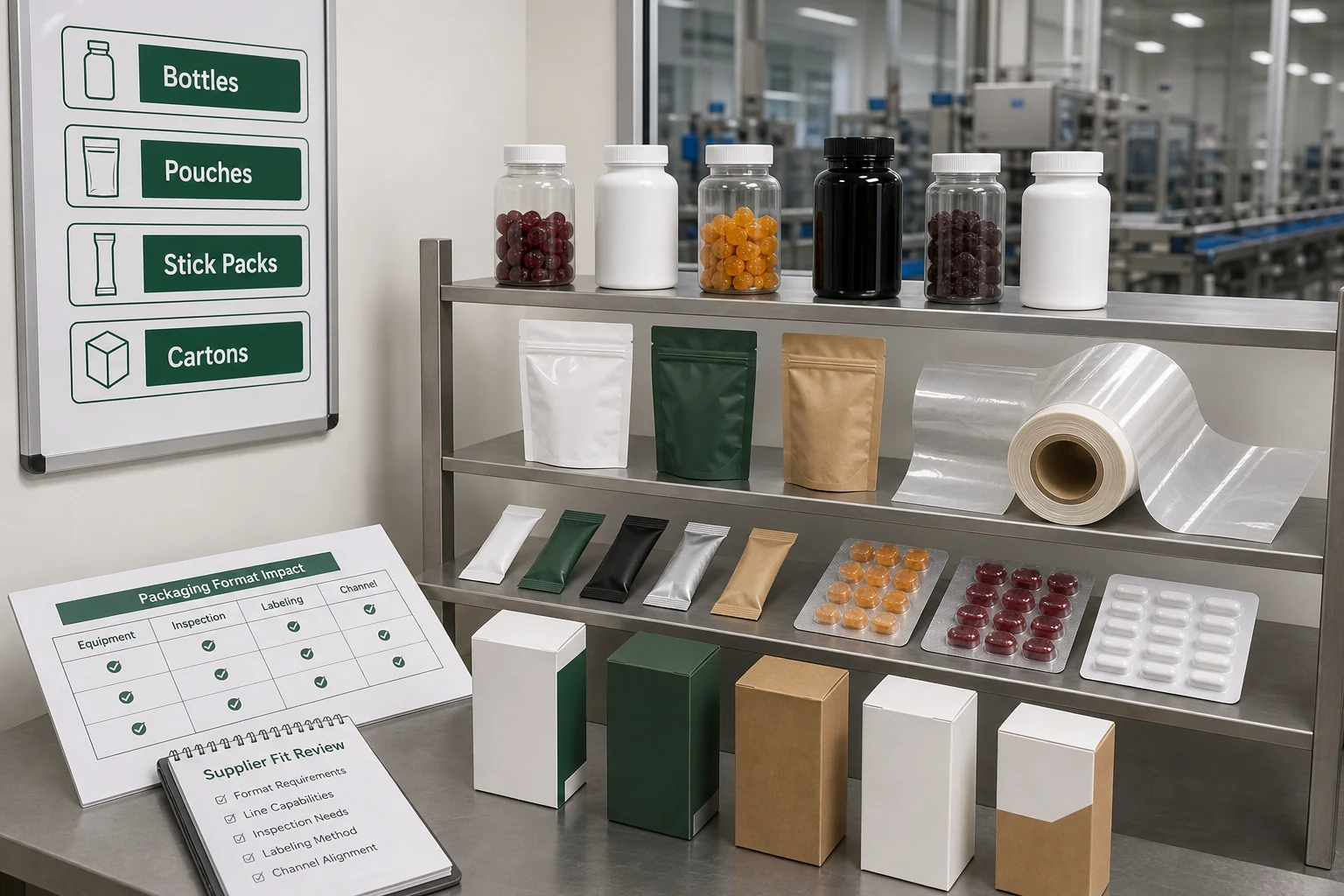
Packaging format changes the supplier decision because each format brings different equipment, handling, labeling, and quality-control needs.
A supplement packaging company may be strong in one format and weak in another, so brands should match the co-packer's equipment and controls to the product type and sales channel.
Bottles, Jars, Pouches, Stick Packs, Blisters, and Cartons
Bottles and jars are common for gummies, capsules, tablets, and powders. They require attention to fill count or fill weight, closure fit, induction sealing when applicable, label placement, lot coding, desiccant decisions, and case packing. A co-packer must have equipment and line discipline that match the product size, packaging component, and SKU complexity.
Pouches, sachets, and stick packs can be useful for powders, samples, travel packs, and single-serve formats. These formats may require different sealing equipment, film compatibility review, fill accuracy checks, and stronger attention to moisture or oxygen protection. A supplier that handles bottles well may not automatically be the right partner for flexible packaging.
Blisters and retail cartons add another layer of structure. They can improve shelf presentation and unit control, but they often require more component coordination, artwork control, and assembly steps. For retail channels, carton dimensions, barcode placement, tamper-evidence expectations, and display configuration may matter as much as the primary pack.
| Format | Common supplement use | Supplier-fit question |
|---|---|---|
| Bottles or jars | Gummies, capsules, tablets, powders | Can the line handle count, fill, closure, seal, label, and lot code consistently? |
| Pouches or sachets | Powders, samples, some gummy formats | Does the supplier understand film, seal, moisture, and fill-weight control? |
| Stick packs | Single-serve powders or liquids | Does the facility have the right fill-and-seal equipment and accuracy controls? |
| Blisters | Tablets, capsules, dose-control formats | Is tooling, cavity size, and pack inspection in scope? |
| Cartons and kits | Retail, bundles, displays | Can the partner manage secondary packaging and multi-component assembly? |
Gummies, Powders, Capsules, and Tablets Have Different Packaging Risks
Gummy supplements often need packaging choices that consider product softness, moisture, sticking risk, bottle fill, closure choice, and the consumer's first impression when opening the container. Packaging that works for hard capsules may not be appropriate for gummies.
Powders introduce different risks. Flow characteristics, dust, fill weight, scoop placement, pouch sealing, jar sealing, and headspace can affect the packaging process. A co-packer should understand whether the powder is free-flowing, hygroscopic, clumpy, dusty, or sensitive to packaging conditions.
Capsules and tablets may appear easier, but they still require attention to counting accuracy, breakage, desiccant decisions, label control, and lot traceability. If the brand sells multiple strengths or formulas, line clearance and SKU separation become important supplier-evaluation questions.
For gummy brands specifically, packaging and manufacturing are closely connected. If packaging format, desiccant specification, and seal testing are not part of the manufacturing partner's scope, they should at least be part of the co-packer brief. Talvenda's guide on supplement quality assurance explains the testing and documentation mindset behind that handoff.
E-Commerce, Amazon, Retail, and Distributor Packaging Requirements
The sales channel can change the packaging brief. E-commerce packaging must survive parcel handling and still look credible when the customer opens it. Marketplace preparation may involve barcode requirements, bundle configuration, marketplace labels, polybag or case-pack rules, and shipping-carton consistency. Retail may require shelf-ready presentation, tamper-evidence decisions, carton durability, and distributor case specifications.
Brands should give the co-packer channel requirements before quoting. Otherwise, the supplier may price only the basic packaging step and miss inserts, bundle assembly, labeling variations, case-pack rules, or carton configuration.
This is also where internal planning matters. A brand that expects retail, marketplace, and DTC sales may need packaging that supports more than one route. Choosing the cheapest packaging format for the first order can create higher rework costs when the brand adds another channel.
Quality, Label, and Documentation Checks Before Packaging
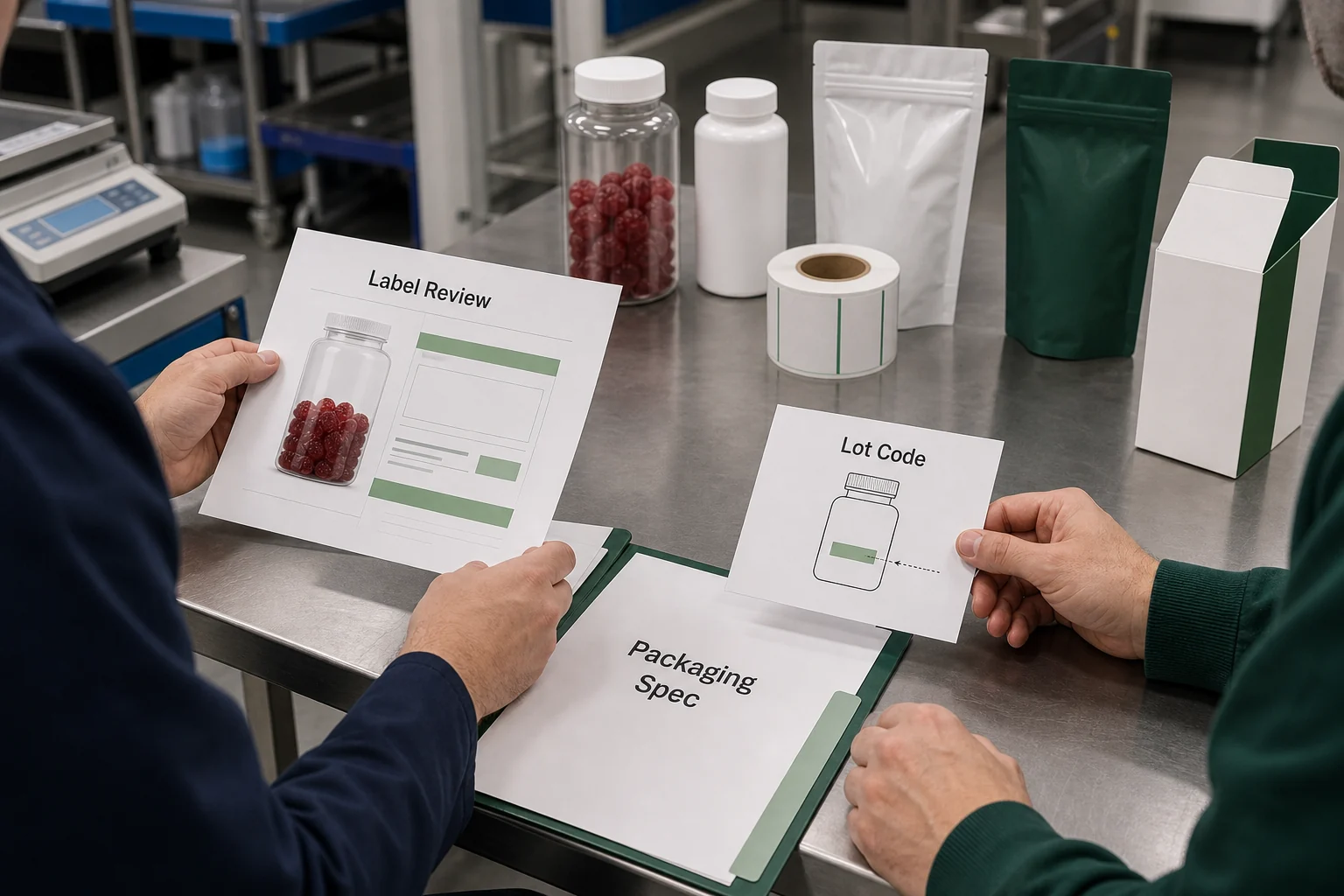
Before packaging starts, confirm the facility scope, label files, lot controls, testing expectations, and packaging specifications.
Packaging is a quality checkpoint: brands should verify what the partner documents, what the brand must supply, and how product identity, label control, and release status are protected.
cGMP, FDA Registration, and Facility Scope
Many buyers search for terms such as contract packaging services FDA certification, but the wording should be handled carefully. Dietary supplement brands should verify whether a facility is appropriately registered where required, what quality system it operates under, what product categories it handles, and what scope the facility actually covers.[^2] Brands should confirm regulatory obligations with qualified professionals instead of relying on supplier marketing language.[^3]
The practical question is not whether a phrase sounds impressive. The practical question is whether the facility's scope fits the product and packaging work. Does the partner handle dietary supplement packaging? Does it control allergens or sensitive materials where relevant? Does it have written procedures for receiving, line clearance, labeling, coding, packaging, inspection, and release? Does it provide records the brand can retain?
If a co-packer only handles secondary packaging, it may not be responsible for finished-product release. If it handles primary packaging, it may have more direct contact with the product. Brands should understand the boundary before approving the project.
Label, Supplement Facts, Lot Coding, and Traceability
Labels are not just artwork. For supplements, the label connects brand messaging, Supplement Facts, directions, warnings, barcode, net quantity, manufacturer or distributor information, and claim boundaries.[^4] A co-packer may apply the label, but the brand must confirm who reviews, approves, versions, and releases the artwork.
Lot coding and traceability also need clear ownership. The brand should define where lot and date codes appear, how codes are generated, how they connect to batch records, and what happens if packaging components are rejected or replaced. If multiple SKUs share similar packaging, line clearance and label reconciliation become especially important.
A useful RFQ should include label dimensions, application position, label roll specifications if available, code format, inspection requirements, and the expected record package after packaging. Without these inputs, even a capable co-packer may be forced to guess.
Testing, Release Documents, and Packaging Specifications
A packaging project should not start with unclear product status. The brand should know whether the bulk or finished product has been released for packaging, what testing has been completed, what batch-release documents exist, and whether any hold or quarantine status applies.
Packaging specifications are also important. A packaging specification may include bottle or pouch material, closure type, label stock, seal requirements, desiccant decisions, carton dimensions, case-pack quantity, pallet configuration, and inspection criteria. These details help the co-packer quote accurately and reduce packaging-line surprises.
Talvenda's manufacturing view is that documentation should move with the product. When packaging is treated as a separate afterthought, brands may struggle to connect production records, packaging records, and finished-goods release. When manufacturing and packaging planning are coordinated earlier, the handoff is cleaner.
How to Choose the Right Supplement Co-Packing Partner
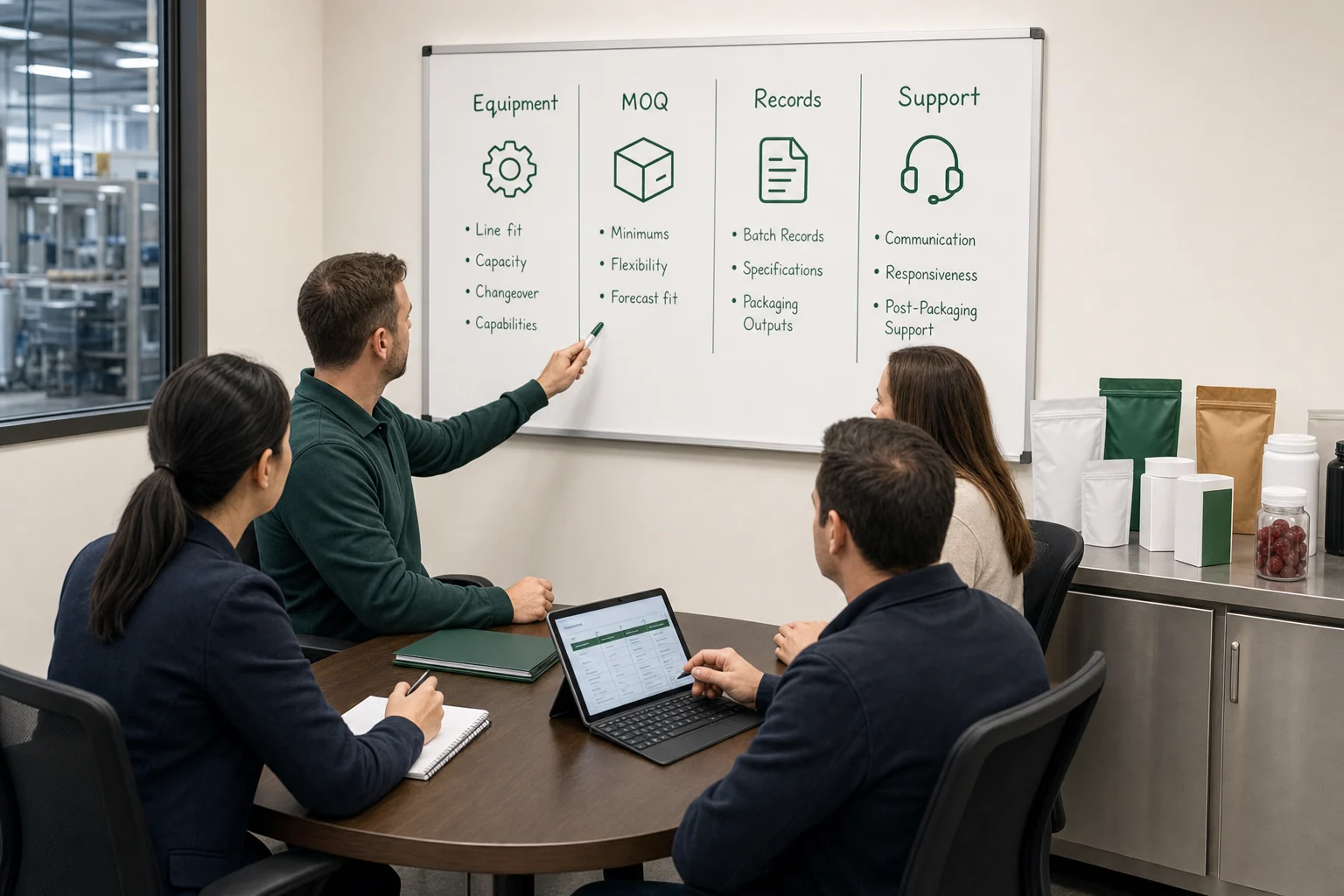
Choose a co-packer by matching their equipment, controls, communication style, and documentation output to your product and channel plan.
The right supplement co-packer is not the one with the broadest service list; it is the one whose packaging scope matches your product readiness and operational risk.
Equipment, Capacity, MOQ, and Multi-SKU Flexibility
Start with equipment fit. Ask what product formats and packaging formats the supplier handles regularly. A brand should confirm bottle sizes, pouch formats, filling method, label application type, coding method, carton assembly options, kitting capability, and inspection steps. The goal is not to collect a long equipment list, but to confirm that the line fits the product.
Capacity and minimum order quantity also matter, but they should be discussed as ranges and planning constraints, not as universal numbers. A co-packer may be efficient at larger packaging runs but less flexible for pilot orders. Another supplier may support smaller projects but become constrained when reorder volume grows.
For new brands, multi-SKU flexibility can be more important than peak volume. If a launch includes several flavors, strengths, package sizes, or label variants, ask how the partner manages line changes, label reconciliation, component staging, and documentation for each SKU. For a gummy-specific first-order view, see Talvenda's guide to low-MOQ private label gummy supplements.
Communication, Change Control, and Post-Packaging Support
Packaging projects fail when small changes are handled casually. A label revision, bottle substitution, carton change, insert update, or lot-code adjustment can affect records, pricing, timing, and channel acceptance. The co-packer should have a clear process for change approval before production starts.
Communication is also part of supplier quality. Brands should ask who owns project management, artwork proofing, component receiving, production scheduling, in-process issue escalation, record delivery, and shipping coordination. A fast quote is useful, but clear execution communication is what protects the launch.
Post-packaging support should be defined before problems happen. If a retailer flags a label issue, if a carton arrives damaged, if a marketplace rejects a barcode, or if a lot-code question appears, who investigates? The answer should not be vague.
Questions to Ask Before Sending Product or Artwork
Before sending bulk product, packaging components, or final artwork, ask practical questions:
| Evaluation area | Questions to ask |
|---|---|
| Scope | Are you handling primary packaging, secondary packaging, kitting, or all of these? |
| Product fit | What supplement formats do you package regularly? |
| Documentation | What packaging records, reconciliation records, and release documents will we receive? |
| Label control | How do you manage artwork versions, label rolls, and line clearance? |
| Components | Who sources bottles, pouches, cartons, labels, closures, inserts, and shipping cartons? |
| Change control | How are label, component, or packout changes approved? |
| Scale-up | Can the same route support reorder volume and added SKUs? |
These questions help separate a true packaging partner from a supplier that can perform only a narrow task. They also make the RFQ more accurate, because the supplier can price the real work instead of a simplified version of the project.
Co-Packer or Full Contract Manufacturer: Which Route Fits Your Brand?
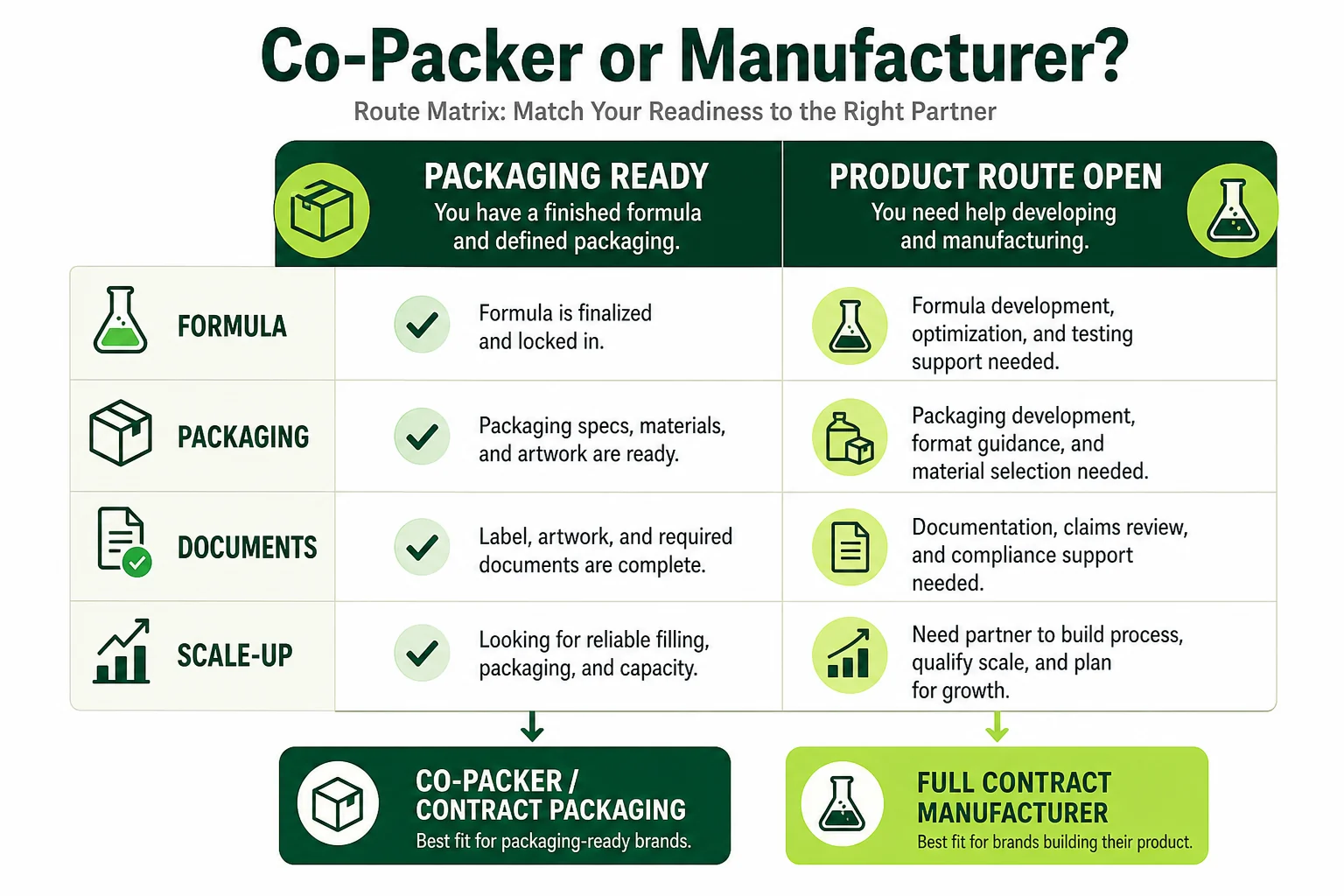
The route depends on whether the brand needs packaging execution or a connected manufacturing-to-packaging plan.
Choose a co-packer when packaging is the bottleneck; choose a contract manufacturer when product feasibility, testing, documentation, packaging fit, or scale-up are still open decisions.
Use a Co-Packer When Packaging Execution Is the Main Need
A co-packer is a good fit when the brand can clearly answer these questions: What is the product? What is the packaging format? What label is approved or ready for review? What lot coding is required? What release documents exist? What sales channel is being prepared? What shipping configuration is needed?
If these answers are clear, the co-packer can focus on execution. The brand can compare suppliers on format fit, capacity, documentation, communication, pricing, and channel support. This route is especially useful when the product has already been manufactured and the brand needs external packaging capacity or multi-SKU packout support.
The brand should still keep quality oversight. Co-packing does not remove the need to review labels, approve components, define specifications, and retain records. It simply places the packaging operation with a third-party partner.
Use a Contract Manufacturer When Formula, Testing, and Scale-Up Are Still Open
A full contract manufacturer is usually a better fit when the brand is still deciding product form, serving size, active load, flavor, texture, count per container, packaging format, test plan, or first-order size. These decisions affect each other. Treating packaging as a separate late-stage task can create rework.
For example, a gummy supplement brand may want a certain count per bottle, a specific serving direction, and a premium shelf presentation. Those requirements may influence gummy size, formula feasibility, packaging protection, label space, production yield, and MOQ planning. A packaging-only partner may not be responsible for solving that chain of decisions.
This is where a manufacturing-led route can reduce risk. A contract manufacturer can help the brand align sample development, production planning, packaging feasibility, documentation expectations, and scale-up path before the first commercial packaging run.
How Talvenda Helps Brands Connect Manufacturing, Packaging, and Documentation
Talvenda's role is not to turn every packaging question into a broad manufacturing project. The better approach is to identify the true bottleneck. If a brand already has a ready product and needs packaging execution, the project can be framed around packaging specifications, documentation handoff, and supplier-scope clarity.
If the product is still developing, Talvenda can help connect the manufacturing route with packaging decisions earlier. For gummy supplement brands, that may include reviewing product format, sample-to-production alignment, packaging fit, MOQ planning, label/spec readiness, finished-product packaging checks, and scale-up discussion.
The goal is a cleaner commercial path. Packaging should not be a disconnected final step. It should confirm that the product can move from formulation and production into a traceable, sale-ready, channel-ready finished good.
Frequently Asked Questions About Supplement Co-Packing
These questions help new supplement brands separate packaging execution from broader manufacturing support.
A co-packer can be the right partner when the product is ready, but the exact service scope should be confirmed before sending product, artwork, or purchase orders.
What is the difference between co-packing and contract packaging?
Co-packing and contract packaging are often used in similar ways. Both describe using a third-party partner to package products for a brand. In supplement projects, the exact scope matters more than the label. Confirm whether the supplier handles primary packaging, secondary packaging, labeling, kitting, retail-ready packout, component sourcing, documentation, or fulfillment coordination.
Can a co-packer help with ingredient sourcing?
Some co-packers may help with packaging components or limited supply-chain coordination, but ingredient sourcing usually belongs closer to formulation and manufacturing. If ingredient sourcing, formula feasibility, testing, and production validation are still open, a full contract manufacturing route may be more appropriate than a packaging-only route.
Does a co-packer handle supplement label compliance?
A co-packer may apply labels, manage label versions, inspect label placement, and support artwork control. That does not automatically mean the co-packer is responsible for legal or regulatory label approval. Brands should confirm who reviews Supplement Facts, claims, warnings, distributor details, barcode requirements, and channel-specific labeling rules.[^4]
What packaging formats are common for gummy supplements?
Gummy supplements are often packed in bottles, jars, pouches, cartons, sample packs, or multi-packs. The best format depends on gummy count, serving direction, product protection needs, channel requirements, brand positioning, and reorder plan. Brands should review packaging fit during manufacturing planning, not only after gummies are produced.
When should a new brand choose full contract manufacturing instead?
Choose full contract manufacturing when formula, sample approval, test plan, serving format, packaging fit, documentation, MOQ, or scale-up path is still unclear. A co-packer is useful when the product is ready to be packed. A manufacturer is more useful when the product and packaging route still need to be built together.
Conclusion
A supplement co-packer is useful when packaging execution is the remaining bottleneck, but packaging should not start until formula readiness, label direction, batch identity, release documents, and channel requirements are aligned.
As a gummy supplement development and manufacturing partner, Talvenda can help projects with a clear brief review whether co-packing is enough or whether the formula, packaging fit, MOQ, documentation, and scale-up path should be handled together first. Share the target market, product format, serving goal, packaging idea, first-order expectation, and launch channel through Talvenda's contact form so the route can be reviewed before packaging decisions lock in.
[^1]: The Electronic Code of Federal Regulations, 21 CFR Part 111, covers current good manufacturing practice for dietary supplement manufacturing, packaging, labeling, and holding operations. https://www.ecfr.gov/current/title-21/chapter-I/subchapter-B/part-111 [^2]: FDA, "Information for Industry on Dietary Supplements," lists industry resources including food facility registration and dietary supplement guidance. https://www.fda.gov/food/dietary-supplements/information-industry-dietary-supplements [^3]: FTC, "Health Products Compliance Guidance," explains that health-product advertising claims should be truthful, not misleading, and supported by competent and reliable scientific evidence. https://www.ftc.gov/business-guidance/resources/health-products-compliance-guidance [^4]: The Electronic Code of Federal Regulations, 21 CFR 101.36, sets requirements for nutrition labeling of dietary supplements, including Supplement Facts presentation. https://www.ecfr.gov/current/title-21/chapter-I/subchapter-B/part-101/subpart-C/section-101.36