
Collagen biotin gummies are easy to market, but a weak production brief can turn a beauty SKU into repeated sampling delays.
Collagen biotin gummies can work as a private-label beauty supplement when the brand defines collagen dose, biotin level, gummy base, claim language, packaging, testing, and MOQ expectations before production. The product should be planned as a manufacturing-ready formula, not only a benefits story.
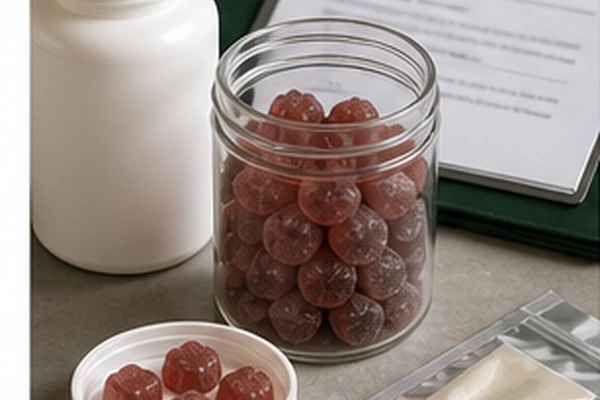
The useful first question is not whether collagen and biotin sound attractive together. The better question is whether the finished gummy can carry the beauty story with realistic dose, texture, documentation, and repeatable production.
Decision Snapshot:
- Define collagen source and mg per serving before flavor or packaging.
- Plan biotin as a small-dose active with real label and claim-review importance.
- Decide whether vitamin C, vitamin E, hyaluronic acid, zinc, or keratin are worth the added formula pressure.
- Match gummy base, piece weight, serving count, and bottle count to the active load.
- Bring a quote-ready brief before asking for price, samples, or production timing.
The Growing Market Demand for Collagen Biotin Gummies
Beauty gummies are popular because the consumer story is simple. The production story is not.
Demand for collagen biotin gummies comes from beauty-from-within, haircare, skincare, and nail-support positioning. Brands can use that demand, but the formula still needs dose logic, cautious claims, texture stability, and manufacturing proof.
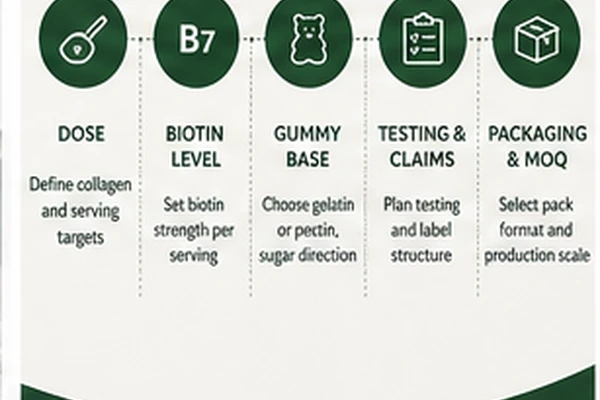
Beauty supplements in haircare and skincare
Beauty supplements have become a familiar part of wellness shelves and ecommerce routines. Gummies fit that market because they feel convenient, easy to repeat, and more approachable than powders or capsules for many consumers.
Collagen and biotin are both recognizable beauty ingredients. Collagen is often connected with skin and beauty-from-within positioning. Biotin is often connected with hair, skin, and nail supplement language. Together, they create a product story that is easy for shoppers to understand.
For brands, easy understanding is useful but not enough. A crowded category means similar labels, similar flavors, and similar benefit language appear quickly. The product has to be clear on the shelf and realistic in production. If the formula cannot support the serving size, claim language, texture, or packaging plan, market demand will not protect the launch.
Why brands choose collagen and biotin together
Brands choose collagen and biotin together because the stack creates a broad beauty supplement concept in one delivery format. Collagen carries most of the formula weight and the structural beauty story. Biotin is much lighter by weight but gives the SKU a familiar hair, skin, and nail supplement angle.
That division matters in manufacturing. Collagen can influence piece size, mouthfeel, taste masking, drying behavior, and texture. Biotin may be easy to add by weight, but it needs careful label and claim review, especially when brands want strong hair or nail language.
When I review this type of project, I usually separate consumer appeal from production burden. The consumer sees a beauty gummy. The formula team sees active loading, serving design, process behavior, finished-product testing, and packaging risk.
Where consumer benefit language needs limits
Consumer benefit language should explain the product category without promising outcomes the brand cannot support. A collagen biotin gummy can be positioned as a beauty supplement, but it should not become a hair-growth claim, anti-aging promise, or medical-style promise.[^1]
Biotin deserves special caution. Public health references note that the evidence for extra biotin benefits in people without deficiency is limited, and supplemental biotin may interfere with some laboratory tests.[^2] The product brief should still place biotin level, label warnings, and claim language into review.
The safer commercial position is simple: collagen + biotin can be an attractive beauty supplement stack, but final claims should be reviewed for the target market and supported by ingredient levels, documentation, and finished-product specifications.[^7]
Benefits of Private Label Collagen Biotin Gummy Manufacturing
Private label can move faster than custom development only when the constraints are clear.
Private label collagen biotin gummy manufacturing helps brands test the beauty market faster, reduce early SKU risk, and customize the product story. The benefit disappears when dose, base, packaging, testing, and claim expectations are vague.

Faster market testing for beauty brands
Private label can be useful when a brand wants to test collagen biotin gummies without building every formula variable from zero. A brand may begin with a stock or semi-custom route, then adjust flavor, base, collagen source, supporting actives, packaging, or label direction.
The faster route still needs a real brief. A vague request such as "collagen and biotin gummies for beauty" gives the manufacturer too many variables to guess. A useful first brief names the target consumer, target market, collagen source, collagen mg per serving, biotin level, optional actives, base direction, sugar direction, flavor, packaging, testing expectations, and first-order goal.
Market testing works best when the formula route matches the commercial goal. If the goal is a first launch, the product may not need every possible beauty active. If the goal is premium differentiation, a deeper custom stack may be worth the extra development work.
Lower-risk SKU expansion
Collagen biotin gummies are often a natural extension for beauty, wellness, haircare, skincare, or private-label supplement brands. The SKU can sit near collagen powders, hair gummies, multivitamins, or beauty capsules while giving the brand a more convenient format.
Lower risk does not mean no risk. The formula still has to survive sample review, production scale-up, label review, packaging, and reorder planning. The risk is lower only when the brand works within a realistic formula route and avoids adding complexity without a clear reason.
| Private-label decision | Lower-risk route | Higher-risk route |
|---|---|---|
| Formula starting point | Stock or semi-custom base | Fully custom active stack |
| Collagen promise | Practical serving target | High dose without serving review |
| Biotin language | Cautious supplement positioning | Strong outcome claims |
| Packaging | Common bottle with stability review | Unproven pack format |
| Launch goal | Market test first | Broad premium claims immediately |
Custom blends for niche audiences
Custom blends can help a brand speak to a more specific audience. A simple collagen + biotin formula may fit a general beauty SKU. A more targeted formula may include vitamin C, vitamin E, hyaluronic acid, zinc, keratin, fruit flavors, pectin base, sugar-free direction, or premium packaging.
Each addition should earn its place. More actives can increase taste masking needs, acid balance work, documentation requirements, and stability questions. More claims can increase label-review work. More packaging customization can increase cost and timeline.
I prefer to ask what the added ingredient changes for the buyer. If it makes the product clearer, more credible, or easier to position, it may belong. If it only lengthens the ingredient list, it may weaken the manufacturing path.
Custom Formulation Options for Collagen Biotin Gummies
The strongest collagen biotin gummy formula is rarely the longest ingredient list.
Custom formulation should start with collagen source, serving size, biotin level, optional beauty actives, base system, taste masking, and active-loading limits. Each addition should strengthen the SKU without making the sample unstable or the label difficult to defend.
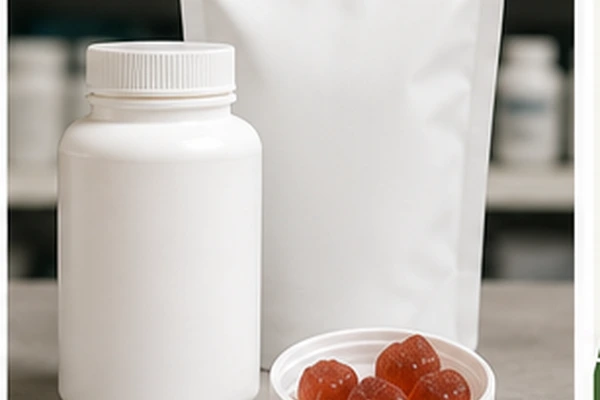
Collagen source and serving size
Collagen is usually the active that drives the physical formula. It can affect piece weight, flavor release, mouthfeel, chew, drying, and packaging behavior. The brand should decide whether the formula uses bovine, marine, or another collagen peptide route before moving too far into flavor or label design.
The serving size is the real gate. A gummy cannot carry unlimited collagen without changing texture, taste, and piece size. If the brand wants a larger collagen amount, it may need multiple gummies per serving, a larger piece, a lower promise, or a different delivery format.
This is where a manufacturer-ready brief helps. Instead of asking whether collagen can be added, the brand should ask what collagen amount is realistic for the intended gummy weight, serving count, and bottle count.
Biotin level and claim review
Biotin is much smaller by weight than collagen, so it rarely creates the same physical loading problem. Its importance is claim and label review. The brand should define the intended biotin level and the wording it wants to use before artwork or ecommerce copy is finalized.
The label should not imply assured hair growth, skin change, or nail outcomes. A safer route is to describe the product as part of a beauty supplement routine and keep final benefit language within the reviewed claim boundary.
For higher-biotin concepts, the brand should also discuss whether lab-test interference caution belongs in the label or consumer information. This is not a generic marketing point; it is a product-responsibility point.
Vitamin C, vitamin E, hyaluronic acid, zinc, and keratin
Supporting beauty actives can make the product story stronger, but they also change the formula conversation. Vitamin C can support collagen-positioning logic, vitamin E can support antioxidant-style beauty positioning, hyaluronic acid can fit hydration narratives, and zinc or keratin can support hair/nail category language.
The full vitamin C route belongs to collagen vitamin C gummies, not this page. Here, vitamin C is an optional support ingredient. The same logic applies to vegan collagen boosters, which belong to vegan collagen gummies.
| Optional active | Why brands consider it | Manufacturing question |
|---|---|---|
| Vitamin C | Collagen-support positioning | How does acidity affect flavor and gelling? |
| Vitamin E | Beauty supplement story | Does it affect taste, dispersion, or label review? |
| Hyaluronic acid | Skin hydration positioning | Does it fit the gummy matrix and serving design? |
| Zinc | Hair/nail support category | Does taste masking become harder? |
| Keratin | Hair/nail formula story | Does source, documentation, or allergen review add complexity? |
Flavor, texture, and active-loading constraints
Flavor and texture should be judged after the active stack is realistic. A low-active sample may taste good, but that does not prove the final collagen-loaded formula will behave the same way.
Collagen can bring taste, mouthfeel, and texture challenges. Optional actives may add bitterness, acidity, or aftertaste. Sugar direction and gummy base can either support or complicate the sensory profile.
The useful development sequence is active-load review first, then flavor masking, then texture, then packaging and stability checks. If those steps happen in the wrong order, the brand may approve a sample that cannot support the final label.
Gummy Base and Format Decisions
The gummy base is not a cosmetic choice; it controls the formula's behavior.
Collagen biotin gummy format decisions include gelatin or pectin, sugar direction, piece weight, serving count, and bottle count. These choices shape texture, cost, positioning, and production feasibility and should be locked before the project is quote-ready.
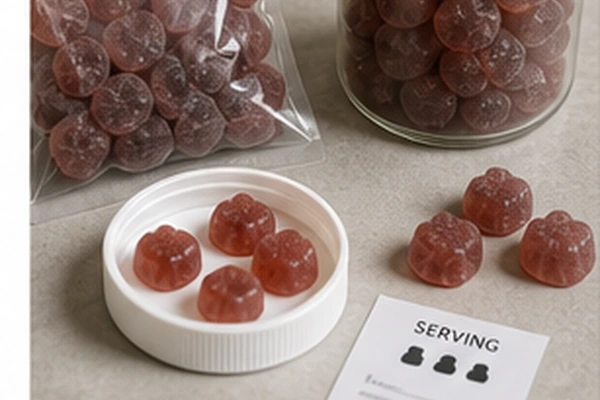
Gelatin vs pectin bases
Gelatin can give a familiar elastic chew and traditional gummy bite. Pectin can give a different texture and may support some plant-forward positioning. The right choice depends on target consumer, ingredient stack, process route, cost, and label direction.
One boundary must be clear: a pectin base does not make a collagen gummy vegan if the formula contains animal-derived collagen. If the brand wants a vegan beauty gummy, the product usually needs a collagen-booster positioning instead of a true collagen peptide positioning.
For broad base-system decisions, brands can use collagen gummies formulation or later route deeper gelling-system comparisons to the right internal topic. On this page, the base decision matters because it affects whether the collagen + biotin stack can be produced cleanly.
Sugar and sugar-free directions
Sugar affects sweetness, chew, water activity, texture, and consumer positioning. A regular sugar-based gummy may be easier to balance for taste and texture. A sugar-free or low-sugar version can be attractive, but it adds sweetener-system, aftertaste, digestive-tolerance, and label-review questions.
If the brand wants sugar-free collagen biotin gummies, that should be named in the first brief. The manufacturer may need to review sweetener route, coating, stability, texture, and finished-product labeling differently.
Brands should avoid using sugar-free as a late marketing claim. It is a formula route.
Piece weight, serving count, and bottle count
Piece weight controls how much formula space is available. Serving count controls daily use. Bottle count affects packaging size, fill count, perceived value, shipping weight, and cost.
These variables have to work together:
| Variable | Brand question | Manufacturing implication |
|---|---|---|
| Piece weight | How large can each gummy be? | Controls active space and consumer mouthfeel |
| Serving count | One, two, or more gummies per day? | Affects collagen dose feasibility |
| Bottle count | How many gummies per bottle? | Affects packaging, cost, and shelf presentation |
| Gummy base | Gelatin, pectin, or another route? | Affects texture and process behavior |
| Sugar direction | Standard, low sugar, or sugar-free? | Affects sweetness, texture, and label review |
When these choices are not aligned, the product often runs into late-stage changes. A brand may approve the concept but discover the bottle is too large, the serving count is awkward, or the formula cannot hold the intended active load.
The Collagen Biotin Gummy Manufacturing Process
The manufacturing process reveals whether the beauty concept is production-ready.
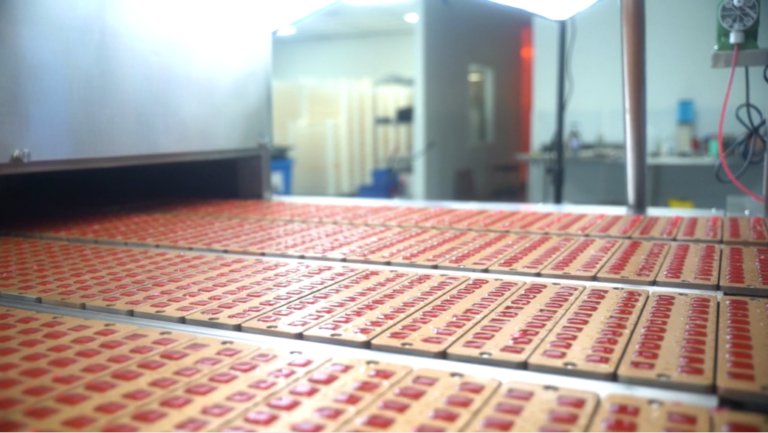
Collagen biotin gummy manufacturing should move from quote-ready brief to ingredient blending, cooking, depositing, cooling, finishing, and quality testing. Each step should confirm dose consistency, texture, moisture behavior, documentation, and packaging fit.

Custom formulation and ingredient blending
Before production starts, the formula brief should define the active stack, target dose, base system, flavor, color, sweetener route, packaging, testing expectations, and market direction. This is where many future problems are either prevented or built into the project.
Ingredient blending has two different challenges. Collagen is the high-load ingredient, so it affects bulk behavior and sensory quality. Biotin is low-dose, so distribution and measurement discipline matter. Optional actives can add their own taste, dispersion, acidity, or documentation concerns.
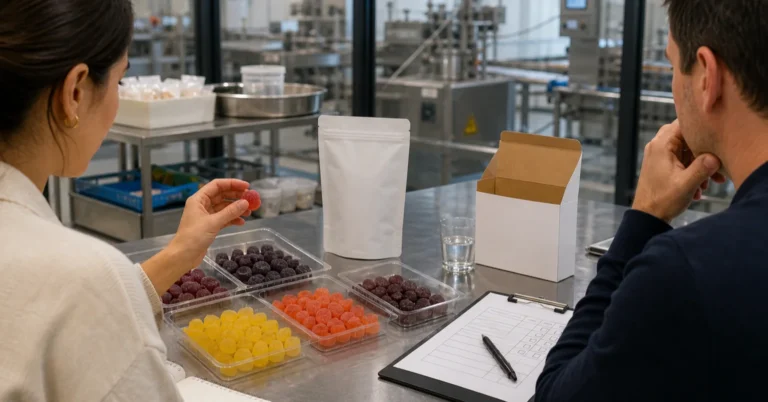
The first sample should answer more than taste. It should show whether the formula can move toward repeatable production.
Cooking and depositing the gummy slurry
Cooking and depositing depend on viscosity, solids, acidity, heat exposure, and timing. A formula that looks attractive on paper may become difficult to deposit if the active load is too high or the base system is poorly matched.
This is why the manufacturer should review active loading before the brand finalizes flavor and packaging. A small change in collagen amount or active stack can change slurry behavior, setting, and texture.
Brands do not need every production parameter in the marketing brief. They do need to know that process feasibility has been checked before production is scheduled.
Cooling, ejection, and finishing coatings
Cooling and ejection show whether the gummy holds shape and releases cleanly. Finishing coatings can reduce stickiness, improve handling, or support appearance, but they also affect mouthfeel and label review.
Collagen biotin gummies may need extra attention to surface behavior. Higher active loading, sugar-free direction, humidity exposure, or certain coatings can affect stickiness and packaging performance.
The sample should be reviewed in the form the brand expects to sell. A gummy that looks acceptable in a small bag may behave differently in the final bottle or pouch.
Quality control and analytical testing
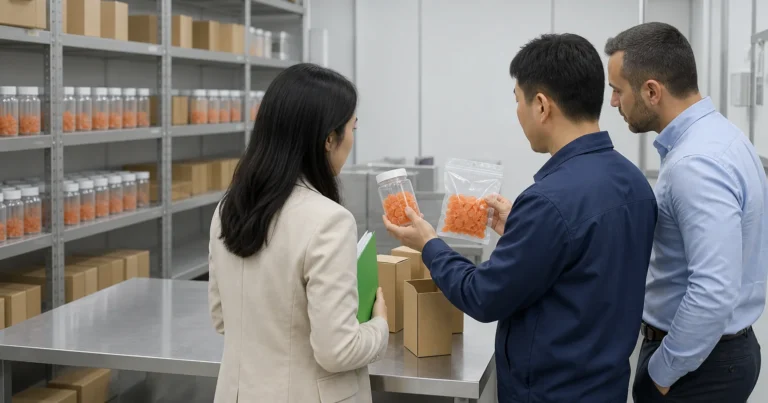
Quality control should connect the finished product back to the label and specification. For collagen biotin gummies, the quality file may include appearance, piece weight, texture, active-content expectations, microbiological testing, heavy-metal considerations, COA review, and packaging checks.
The exact plan depends on formula, market, and buyer requirements. The important point is that quality cannot be vague. If the label names collagen and biotin, the brand should know how those claims are supported and what documents will be available.
My usual recommendation is to ask for the testing and documentation plan before production approval, not after the first batch is finished.
Quality Assurance and Regulatory Compliance Checks
Quality is not a final inspection step; it is a product-development decision.
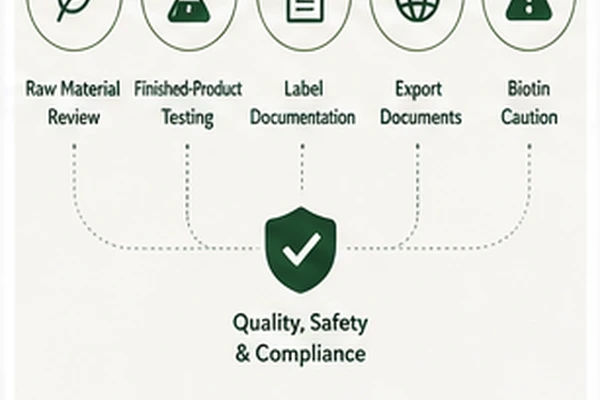
Quality assurance for collagen biotin gummy manufacturing should cover GMP expectations, potency and purity testing, heavy-metal and microbiological considerations, COA review, label documentation, export needs, and biotin-specific lab-test caution.[^4]
GMP and supplement manufacturing expectations
GMP language is common in supplement manufacturing, but brands should understand it as a system, not a badge to copy. Ask what quality controls, batch records, release checks, raw-material reviews, and finished-product specifications support the product.
If the product is sold into a specific market, market-specific regulatory review may be needed. A manufacturer can support documentation and production controls, but final compliance responsibility depends on the brand, market, label, claims, and sales channel.
The practical question is not "Can we say GMP?" It is "What process and documents support this collagen biotin gummy from raw material to finished product?"
Testing for potency, purity, and heavy metals
Testing should match the formula and risk profile.[^5] Collagen source, biotin level, optional actives, flavors, colors, base system, and packaging can all affect what a buyer wants to verify.
For many projects, brands ask about raw-material documents and finished-product testing. Raw-material COAs are useful, but they may not answer finished-gummy questions. The gummy has gone through blending, heating, depositing, drying or setting, packaging, and storage exposure.[^4]
The testing plan should be realistic and clearly scoped.[^4] Do not ask for proof the formula cannot reasonably provide, but do not launch with only vague assurances either.
COA, label, and export documentation
COA expectations should be discussed before the order is placed. The brand should know what documents are standard, what requires additional testing, what is batch-specific, and what is needed for the target market.
Label review should include serving size, ingredient names, Supplement Facts or equivalent panel requirements, allergen notes, warnings, directions, and claim wording. Export documentation may add another layer depending on destination market and channel.
Documentation should not be handled as an administrative step after production. It is part of product readiness.
Biotin-specific label and lab-test caution
Biotin has a special caution because supplemental biotin can interfere with some laboratory tests.[^2] This does not mean a collagen biotin gummy is unsuitable. It means the brand should review biotin level, warning language, and consumer information carefully.
This is especially important when marketing teams want strong hair, skin, or nail claims. A cautious formulation and label brief can still support a compelling beauty SKU without creating unnecessary claim risk.
For brands, the better approach is to make biotin part of the documentation conversation early.
Custom Packaging and Branding Solutions
Packaging protects the gummy, carries the claim, and shapes the reorder experience.
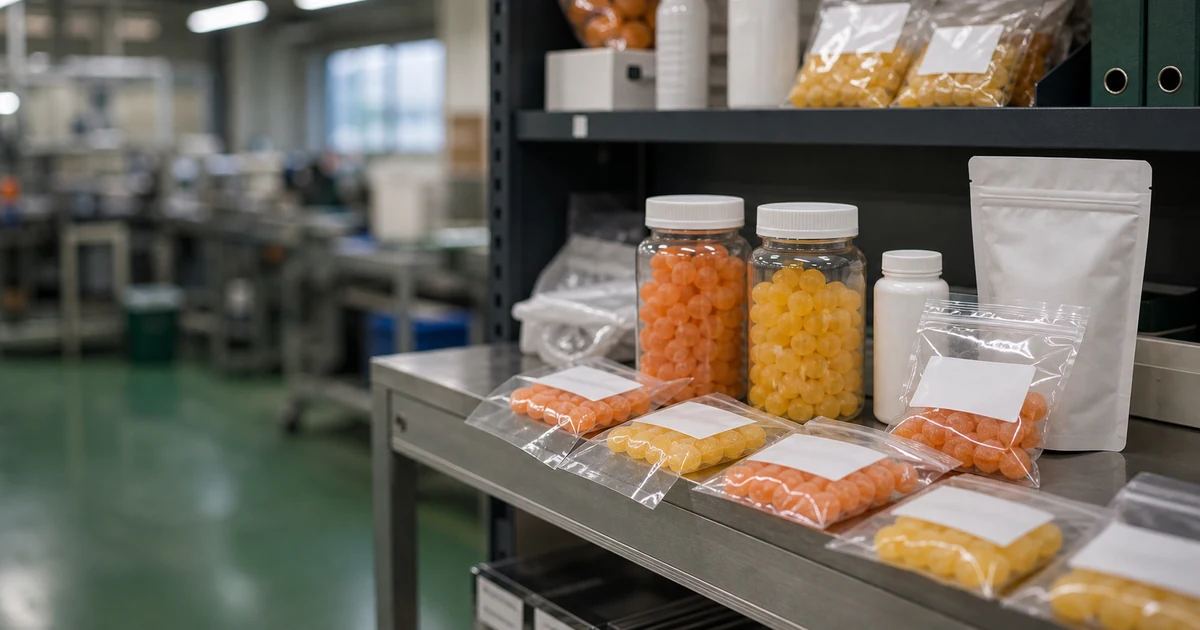
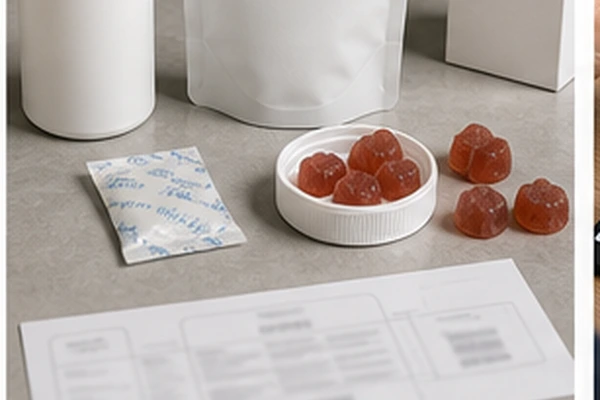
Custom packaging for collagen biotin gummies should protect against moisture, heat, stickiness, and label confusion while supporting private-label positioning. Bottle, pouch, serving count, label panel, and white-label route should be chosen together.
Bottles, pouches, labeling, and packaging options
Bottles are common for beauty gummies, but pouches and other formats may fit some channels. The best packaging route depends on serving count, fill count, moisture control, shipping conditions, display needs, and brand positioning.
Collagen biotin gummies can be sensitive to stickiness, clumping, and texture change if packaging does not fit the formula. Desiccant decisions, closure type, bottle size, pouch material, and storage expectations should be discussed with the formula in mind.
Packaging should not be approved only from a visual mockup. It has to protect the actual gummy.
Supplement Facts panel and claim alignment
The facts panel and front-label promise should tell the same story. If the serving is multiple gummies, the panel should make that clear. If the formula contains collagen, biotin, vitamin C, zinc, hyaluronic acid, or other actives, the amounts and names should be reviewed carefully.
Claim alignment also matters across ecommerce pages, marketplace listings, product inserts, and distributor materials. A cautious label can be undermined by aggressive online copy.
Brands should review the label before printing or uploading final artwork. Late claim changes can delay launch and waste packaging.
White label vs fully custom private label
White label may be useful when speed and market testing matter most. Fully custom private label may be better when the brand needs formula ownership, a specific active stack, distinctive sensory profile, or stronger long-term positioning.
For many collagen biotin gummy projects, semi-custom is the practical middle path. A brand can start from a proven base, then customize collagen source, biotin level, flavor, shape, packaging, or optional beauty actives.
The choice should match the business goal. If speed is the goal, avoid unnecessary complexity. If differentiation is the goal, define which variables truly need to be custom.
Choosing the Right Collagen Biotin Gummy Manufacturing Partner
A quote is only useful when the supplier can evaluate the right variables.
The right collagen biotin gummy manufacturing partner should help evaluate formula feasibility, sample quality, MOQ, lead time, testing, documentation, packaging, and scale-up. The best first step is a complete brief, not a vague price request.

Formulation and sampling questions
Ask how the project will evaluate collagen source, collagen amount, biotin level, optional actives, gummy base, sweetener system, flavor masking, texture target, and packaging. These answers reveal whether the supplier understands the formula as a system.
Useful questions include:
| Question | Why it matters |
|---|---|
| What collagen amount is realistic for the target serving? | Prevents a label promise that cannot fit the gummy. |
| Which collagen sources can be supported? | Affects taste, cost, documentation, allergen review, and positioning. |
| How should biotin level and label language be reviewed? | Reduces claim and consumer-information risk. |
| Which optional beauty actives are realistic? | Prevents formula overload. |
| What sample criteria should we approve? | Aligns taste, texture, appearance, stability, and documentation. |
Sampling should be handled as a feasibility test, not only a flavor approval.
MOQ, lead time, and scale-up checks
MOQ and lead time depend on formula route, ingredient sourcing, packaging, customization level, testing, and production schedule. A stock or semi-custom route may be faster than a fully custom route, but the brand should confirm instead of assuming.
Scale-up also matters. A sample batch and a production batch may behave differently. The brand should ask how the formula will be checked when moving from sample approval to production.
I would also ask what variables can still change after the first sample. If collagen dose, base system, or packaging changes later, the project may need another feasibility review.
How to request a quote with a complete brief
A complete quote brief should include target market, sales channel, collagen source, collagen mg per serving, biotin level, optional actives, gummy base, sugar direction, flavor, color, shape, serving count, bottle count, packaging format, testing expectations, documentation needs, timeline, and first-order target.
The brief should also say what is flexible. If collagen dose is fixed, say so. If flavor is flexible, say so. If MOQ is the main constraint, say so. Good manufacturing communication depends on knowing which variables matter most.
Talvenda can support this stage through formula feasibility review, sample planning, active compatibility discussion, packaging review, COA/testing expectations, documentation planning, and scale-up preparation. For a deeper supplier-evaluation lane, see the related collagen gummy manufacturer topic.
FAQ About Collagen Biotin Gummy Manufacturing
These FAQ points support pre-production decisions: what must be set before sampling, which risks need documentation, and what claim discipline launch can sustain.
These FAQ entries are intentionally compact and practical, covering the core pre-launch questions from the buyer perspective.
When a brand is comparing routes, these answers are usually turned into a production spec list for the manufacturer and a copy checklist for internal legal, marketing, and sourcing teams.
Are collagen and biotin good together in gummies?
They can work well as a beauty supplement concept, but the brand should keep benefit language cautious. Collagen drives most formula load, while biotin needs careful claim and label review.
How much collagen can fit in a gummy?
It depends on piece weight, serving count, base system, active stack, taste masking, texture target, and packaging. Higher collagen targets may require multiple gummies per serving or a different format.
Do collagen biotin gummies need vitamin C?
Not necessarily. Vitamin C can support collagen-positioning logic, but it also affects formula space, acidity, taste, and label review. Use it as optional unless the product lane is collagen + vitamin C.
Can collagen biotin gummies be vegan?
Most true collagen ingredients are animal-derived. A pectin base alone does not make a collagen gummy vegan. Vegan beauty gummies usually need collagen-booster positioning instead.
What should brands prepare before requesting a quote?
Prepare collagen source, collagen mg per serving, biotin level, optional actives, gummy base, sugar direction, flavor, packaging, serving count, bottle count, testing needs, documentation needs, MOQ target, and launch timeline.
Conclusion
Collagen biotin gummies are strongest when the beauty promise is built around realistic dose, claims, texture, testing, packaging, and quote-ready production constraints.
Collagen biotin gummies need the beauty promise to stay aligned with serving size, taste, label language, packaging, and proof. As an OEM/ODM gummy manufacturer, Talvenda can help brands shape that decision around low-MOQ market-tested in-stock gummies, stock formula modification, or custom gummy development, depending on how differentiated the product needs to be. The project gets a more quote-ready path through sample development, packaging and label support, documentation and testing expectations, and scale-up support, instead of starting with a vague beauty gummy concept. Start the discussion through the project inquiry form.
[^1]: "Dietary Supplement Labeling Guide: Chapter VI. Claims," FDA. Evidence role: claim-boundary discipline for structure/function and nutrient/health claim language in supplement labeling. [^2]: "Biotin Interference with Troponin Lab Tests," FDA. Evidence role: safety caution source for lab-test interference language, supports warning-related claim-boundary phrasing. [^4]: "eCFR 21 CFR Part 111 Subpart E-L," U.S. Electronic Code of Federal Regulations. Evidence role: quality, master manufacturing records, specifications, testing, and control-system requirements for supplement manufacturing, packaging, and labeling operations. [^5]: "21 CFR § 101.36 Nutrition Labeling of Dietary Supplements," Cornell LII. Evidence role: serving-size, servings-per-container, and format requirements for dietary supplement nutrition labels. [^7]: "Dietary Supplement Labeling Guide," FDA. Evidence role: label requirements and claims context for dietary supplement products.