
High quality collagen gummies are not the gummy version of high quality collagen powder.
For a supplement brand, a high-quality collagen gummy is a separate product design problem. Source, peptide form, active load, gummy base, taste, packaging, finished-product proof, and claim level all have to work together. A premium collagen ingredient alone does not prove the finished gummy is strong.
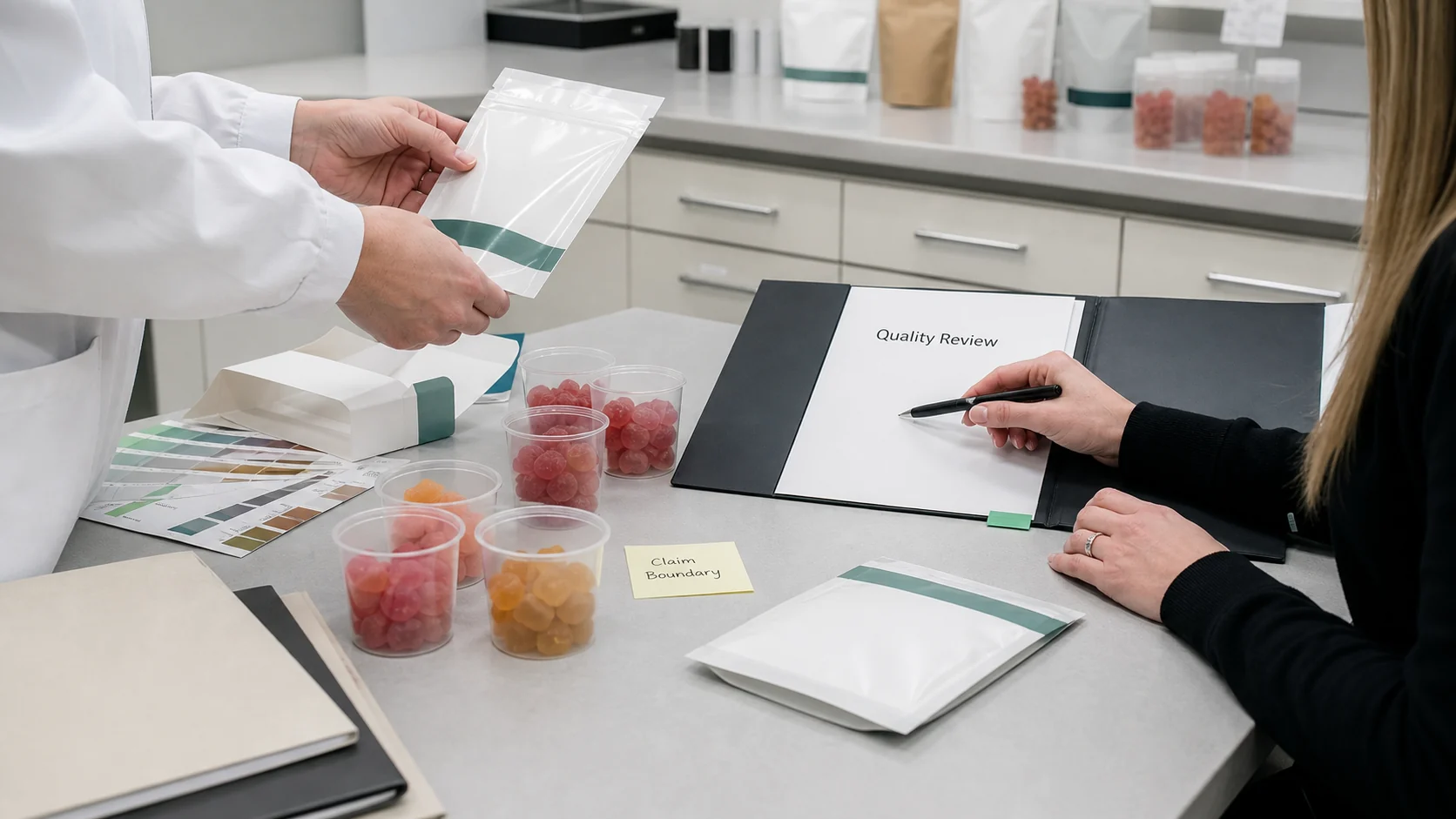
The consumer-facing market often talks about collagen gummies through benefit language: skin, hair, nails, joints, Type I and III collagen, Vitamin C, biotin, zinc, clean ingredients, and daily use. Those phrases matter because they shape buyer expectations. But for a brand preparing to source or launch a gummy, they are not enough.
The more useful question is whether the product can stay credible after formulation, sampling, testing, packaging, and shelf-life review.
Decision Snapshot
- Frame collagen quality in gummies as a format-fit question, not only an ingredient-quality question.
- Review source story, peptide form, active load, taste, gel-system compatibility, stability, and finished-product proof together.
- Do not let a lower-load gummy carry powder-style expectations or clinical-result language.
- Use raw-material COA as a starting point, then ask what proof will exist for the finished gummy.
- Separate this quality review from deeper dosage, powder comparison, formulation, and manufacturer discussions.
What Makes High Quality Collagen Gummies?
A high quality collagen gummy has to satisfy two audiences: the consumer who wants a pleasant routine and the brand that needs a defensible formula.
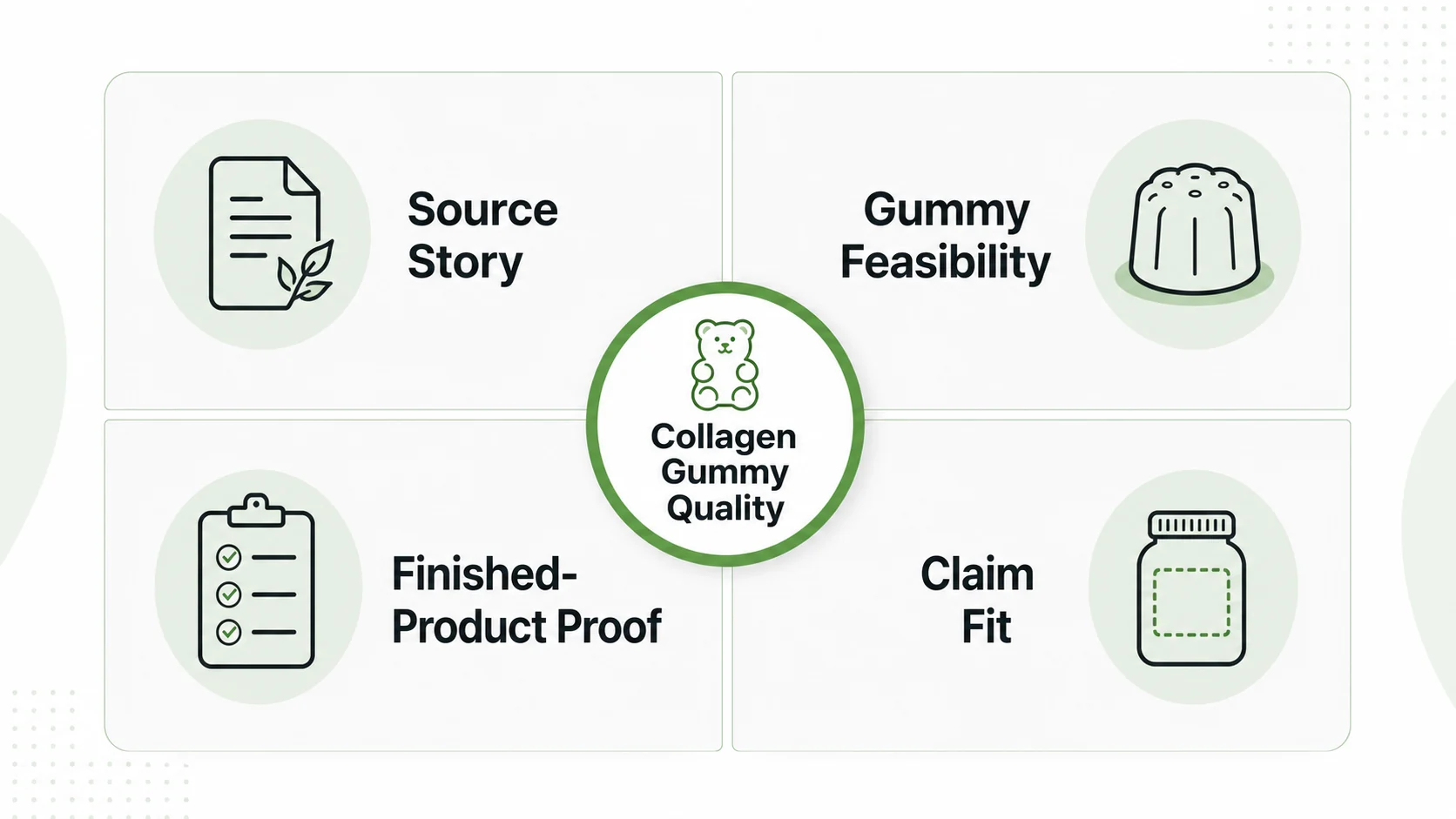
Quality comes from the connection between consumer appeal, formula feasibility, finished-product proof, and claim discipline. No single label phrase proves the gummy is strong.
That is why I would not define quality by one label phrase. "Hydrolyzed collagen," "Type I & III," "marine collagen," "grass-fed collagen," "with Vitamin C," or "clean ingredients" can all be useful positioning points. None of them proves the finished gummy is high quality by itself.
Why Quality Means More Than Adding Collagen to a Gummy
Collagen is a bulky active compared with many vitamins or botanical extracts. In powder, collagen peptides usually have room to behave like a high-load ingredient. In gummies, collagen has to share the formula with the gel system, sweeteners, acids, flavors, colors, moisture-control ingredients, and processing requirements that make the gummy chewable and shelf stable.
That changes the quality standard.
A collagen peptide input may look strong on paper, but the finished gummy still has to answer practical questions:
| Quality question | Why it matters for gummies |
|---|---|
| Can the selected peptide form work in the gummy system? | Solubility, taste, and processing behavior affect the final product. |
| Can the formula carry the intended collagen amount? | A gummy has limited formula space compared with powder. |
| Does the product still taste acceptable? | Collagen source and peptide profile can create sensory challenges. |
| Can the gummy stay stable through shelf life? | Texture, moisture, stickiness, and active content can change over time. |
| Can the claim level match the evidence? | Strong beauty or joint language needs careful claim review[^1]. |
This is the main difference between a high quality collagen supplement and a high quality collagen gummy. The gummy format adds constraints that the ingredient alone does not solve.
The Three Checks: Ingredient Source, Formula Feasibility, and Finished-Product Proof
Before a brand sees a collagen gummy as production-ready, I would separate quality into three checks.
First, check the ingredient source. What is the collagen source? Is it bovine, marine, grass-fed, or a branded peptide input? Is the collagen hydrolyzed? What documentation is available from the supplier? Does the source story fit the brand's positioning and target market?
Second, check formula feasibility. Can the selected collagen peptide work at the target load inside a gummy? Does it affect taste, texture, acidity, gel strength, or drying behavior? Does the formula still have room for Vitamin C, biotin, zinc, flavors, sweeteners, and other supporting ingredients?
Third, check finished-product proof. A raw-material document is useful, but it does not prove the final gummy delivers the declared amount after heating, depositing, drying, packaging, and storage. The finished gummy needs its own review path: assay, microbiology, heavy metals, stability[^2], texture, moisture, and label-claim review.
| Quality checkpoint | What it reviews | Why it matters before production |
|---|---|---|
| Ingredient source | Type, source, peptide form, supplier documentation | Sets the raw-material story and baseline quality expectation. |
| Formula feasibility | Active load, gel system, co-factor space, taste | Shows whether the gummy can physically carry the product promise. |
| Finished-product proof | Assay, microbes, heavy metals, stability, sensory review | Confirms the shipped gummy can support the label and brand story. |
| Claim fit | Serving math, evidence level, product role | Keeps the product from sounding stronger than the formula can support. |
If those checks do not connect, the product may still look attractive on a listing page, but it is not yet a strong product-development decision.
Where Low-Quality Collagen Gummies Usually Fail
Low-quality collagen gummies usually do not fail in a dramatic way. They fail in the gap between marketing language and product reality.
One common failure is using premium collagen language without enough serving logic. A brand may say "collagen peptides" or "Type I & III" but give little clarity on how the active amount fits the finished gummy format.
Another failure is using co-factors as decoration. Vitamin C, biotin, zinc, and similar ingredients can support the positioning, but they do not rescue a weak collagen load, poor taste, unstable texture, or unsupported claim language.
A third failure is relying only on ingredient proof. A collagen supplier COA is not the same as finished-product evidence. Brands need to know what is being checked after the gummy is made, not only what was supplied before production.
For a private label buyer, these are not small technical details. They affect product credibility, repeat purchase, claim risk, and whether the SKU can stand next to powders, capsules, and other collagen formats.
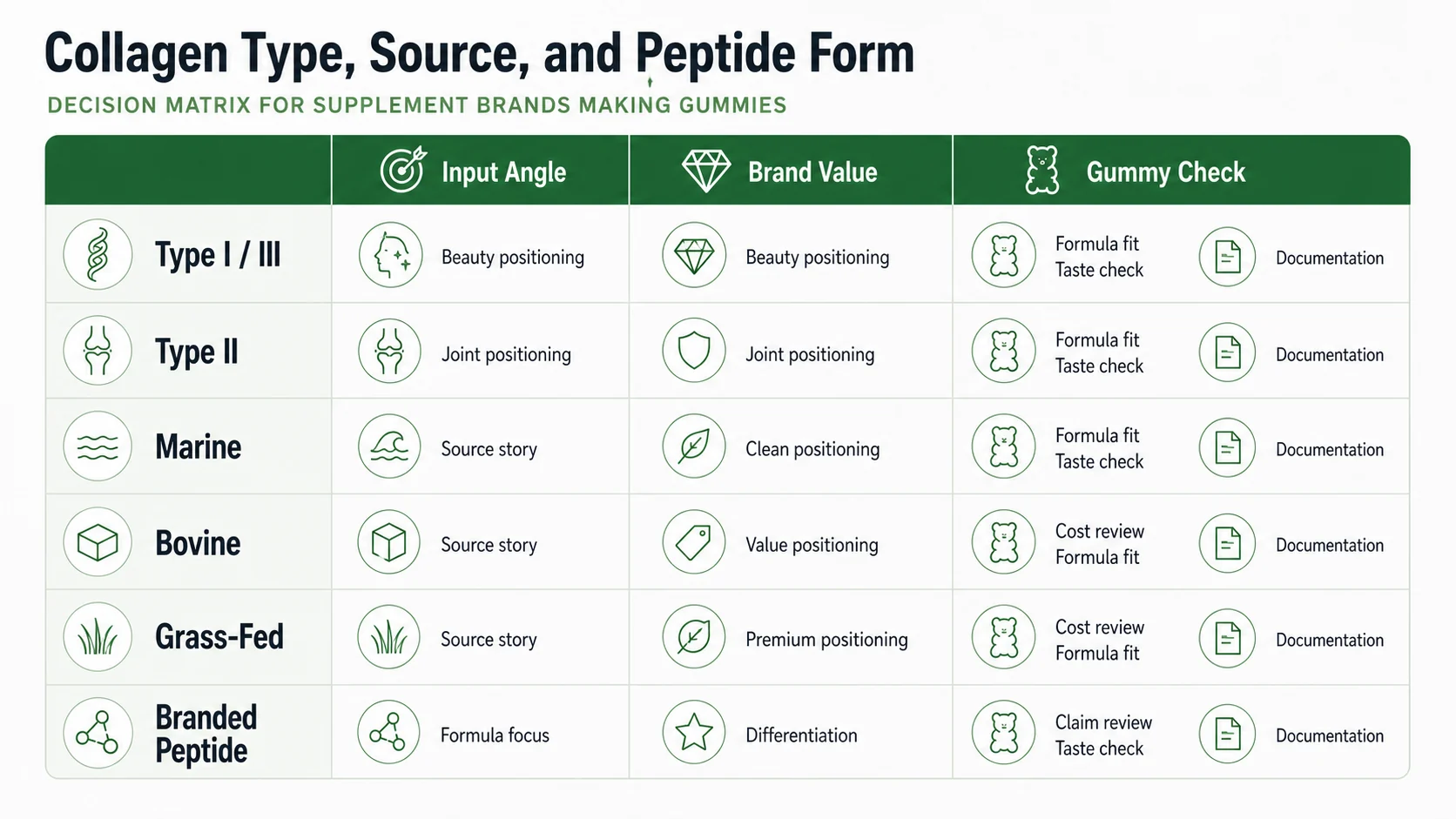
Collagen Type, Source, and Peptide Form: What Brands Should Review
Many collagen searches and product pages center on "best type of collagen" or "best form of collagen." For a supplement brand, that question needs a more practical frame.
The best collagen input is the one that fits the product promise, gummy format, documentation needs, sensory requirements, and target market.
The best collagen input is not simply the one with the strongest consumer story. It is the one that fits the product promise, gummy format, documentation needs, sensory requirements, and target market.
Type I, Type III, and Type II Collagen: What Each Usually Supports
Collagen type language can help consumers understand the product story. Type I and Type III are commonly associated with skin, hair, nails[^3], and general beauty-positioning language. Type II is more often associated with joint-positioning language. That does not mean a brand should turn the label into a medical promise.
For a gummy, the collagen type should be reviewed as part of the product's role:
| Product direction | Collagen type language to review | Brand-side caution |
|---|---|---|
| Beauty gummy | Type I / Type III language may fit consumer expectation. | Avoid overpromising visible skin or hair outcomes without claim support. |
| Joint-positioned gummy | Type II language may be considered depending on the ingredient strategy. | Do not make disease, pain, or relief claims. |
| General wellness gummy | Broad collagen peptide language may be safer. | Keep claims tied to label facts and documentation. |
The point is not to list every collagen type here. The point is to make the collagen type fit the product job. A beauty gummy, a joint-support concept, and a general wellness gummy should not all use the same quality checklist.
Hydrolyzed Collagen Peptides and Why Solubility Matters in Gummies
Most collagen gummy concepts use hydrolyzed collagen peptides[^4] because they are more practical for supplement formulation than intact collagen. For brands, "hydrolyzed" is not only a marketing phrase. It points to a form that may be easier to work with in a formula.
But even hydrolyzed collagen peptides need a gummy-specific review. The brand should ask how the peptide input behaves in the selected base, whether it creates taste issues, whether it affects the texture target, and whether the final formula can hold the desired active load.
In a powder, the consumer accepts mixing. In a gummy, the product has to be pleasant from the first chew. If the collagen input creates bitterness, off-notes, stickiness, or texture instability, the finished gummy quality suffers even if the raw material is strong.
This is why I would separate "good collagen peptide" from "good collagen peptide for this gummy." They are related, but not identical.
Marine, Bovine, Grass-Fed, and Branded Collagen Inputs
Source story can influence product positioning. Marine collagen may support a premium or beauty-focused story. Bovine collagen may fit a broader collagen supplement position. Grass-fed collagen peptides may appeal to consumers who care about source standards. Branded collagen inputs can help a product look more differentiated if the brand can use the ingredient name and evidence responsibly.
But source story has to be checked against gummy feasibility.
| Source or input angle | Potential brand value | Gummy-specific check |
|---|---|---|
| Marine collagen | Beauty-oriented positioning, source differentiation | Taste, allergen expectations, supply documentation, claim language |
| Bovine collagen | Common collagen peptide positioning | Source documentation, consumer expectations, active load |
| Grass-fed collagen peptides | Premium source story | Documentation, cost, final formula economics |
| Branded collagen input | Differentiation and evidence story | Approved use language, dose alignment, finished-product claim fit |
The strongest source story is still weak if the finished gummy cannot carry it credibly. A high quality collagen gummy needs both a source story and a formulation path.
Formula Feasibility: Active Load, Co-Factors, and Taste
Formula feasibility is where many collagen gummy concepts become real or fall apart. The manufacturer has to turn the consumer promise into a stable chewable product.
For collagen gummies, quality depends on what the formula can honestly carry while still tasting good, holding texture, and staying stable.
For collagen gummies, the key formula question is not only "What can we put on the label?" It is "What can this gummy honestly carry while still tasting good, holding texture, and staying stable?"
How Much Collagen Can a Gummy Realistically Carry?
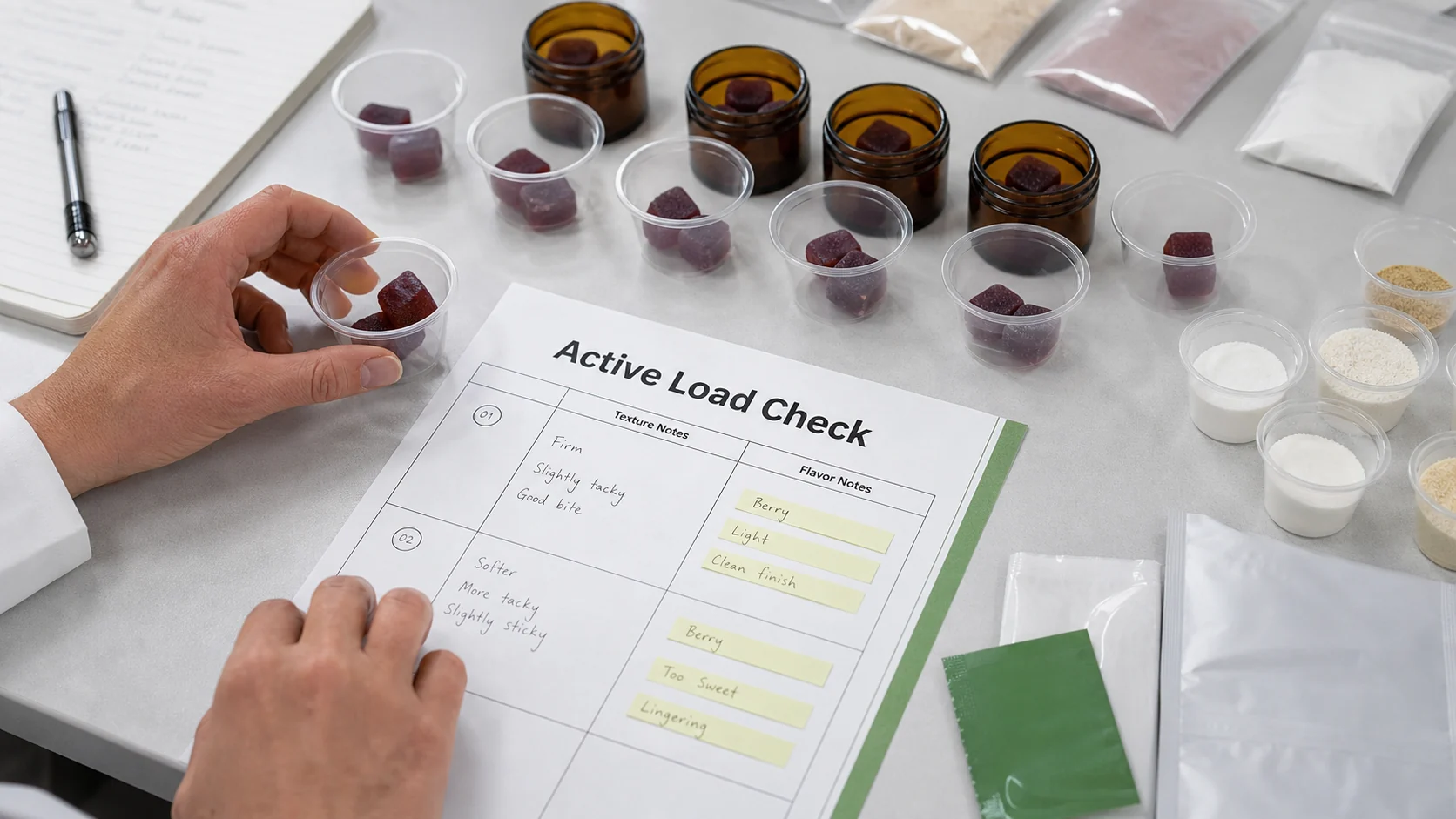
Collagen dose is one of the hardest quality questions in gummies. Powder has a natural advantage because most of the serving can be collagen peptides. A gummy has to reserve formula space for everything that makes it a gummy.
That does not mean a lower-load collagen gummy is automatically low quality. It means the product promise needs to match the format.
A convenience-led beauty gummy can still make sense if the label is honest and the claim level is controlled. It becomes weak when it carries powder-style expectations, strong clinical language, or vague premium claims that the actual serving cannot support. For deeper serving-size planning, use collagen gummies dosage instead of turning this quality review into a dosage guide.
For product review, I would ask:
- What active load is the brand expecting per serving?
- How many gummies will make up that serving?
- Does the label make the collagen amount easy to understand[^5]?
- Does the claim language fit that amount?
- Does the formula still taste and behave well at that load?
This is a quality conversation before it is a marketing conversation.
Vitamin C, Biotin, Zinc, and Other Co-Factors
Many collagen gummies include Vitamin C, biotin, zinc, or similar beauty-support nutrients. These co-factors can make sense in a consumer-facing gummy because they help the product feel complete and familiar.
For a brand, the question is how these ingredients fit the formula and claim plan.
Vitamin C can support collagen-related positioning[^6], but it may also affect acidity and taste. Biotin and zinc may support hair, skin, and nail language, but they bring their own label and claim considerations. Other supporting ingredients may compete for formula space that collagen already needs.
The quality check is not "more co-factors equals better." The better question is whether the co-factor system strengthens the product role without overcrowding the formula or pushing claims beyond support.
Sweeteners, Acids, Flavors, and Gel-System Compatibility
Collagen can create sensory and processing challenges. A high quality collagen gummy has to manage those challenges without hiding the active amount or overcomplicating the label.
Sweeteners, acids, flavors, and the gel system all shape the product experience. They affect taste, chew, moisture, stickiness, and perceived quality. They also influence how the consumer judges the product after opening the bottle or pouch.
For deeper formula mechanics, collagen gummies formulation is the better internal link. For gel-system tradeoffs, pectin vs gelatin gummies is the better next step. The key point is simple: if the formula cannot balance active load, taste, texture, and stability, it is not a high quality collagen gummy yet.
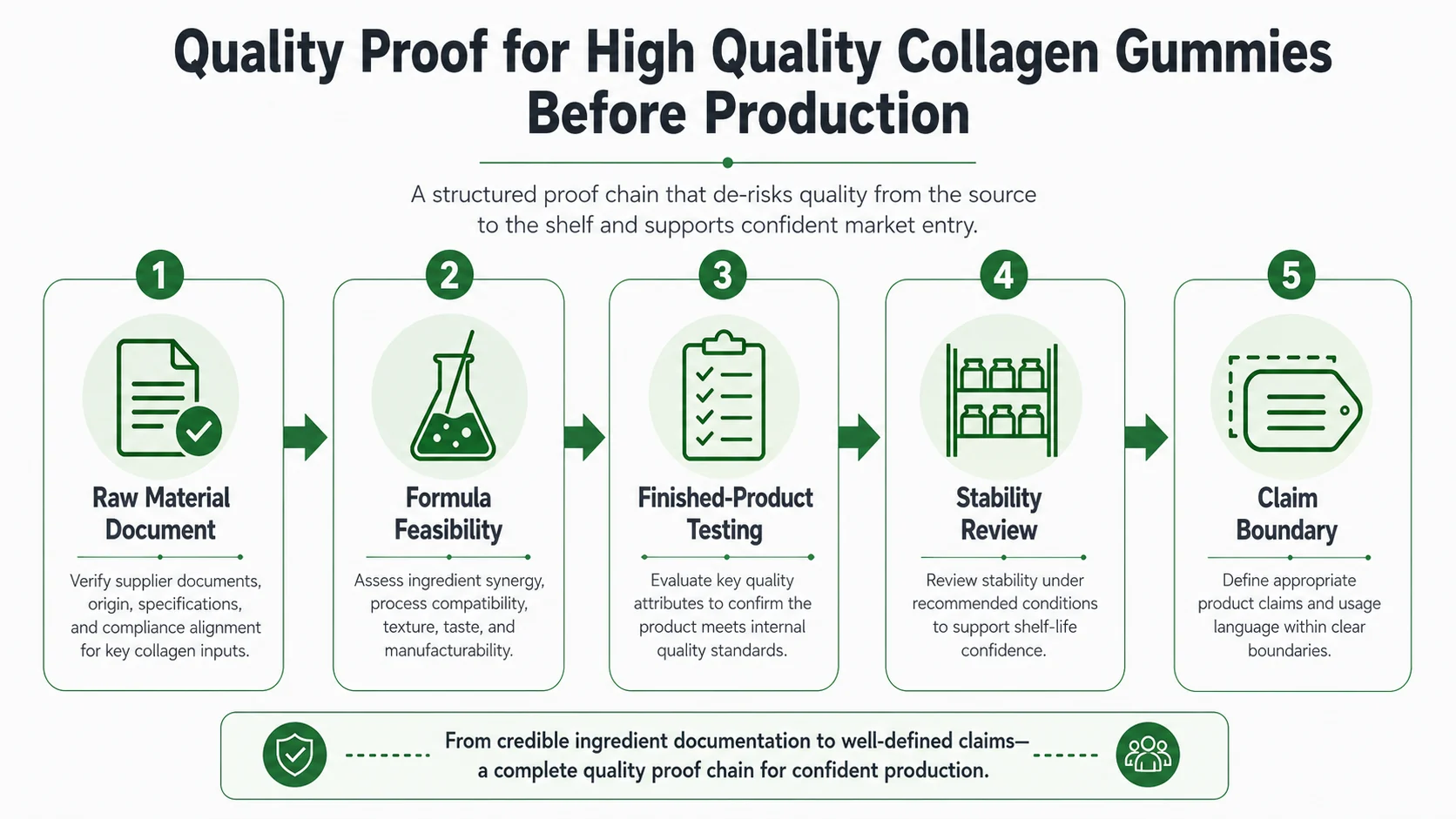
Quality Proof for High Quality Collagen Gummies Before Production
Quality proof should not stop at the raw material. In a collagen gummy project, the evidence chain should move from supplier documentation to the finished gummy.
A serious quality review connects raw-material documentation with finished-product testing, stability review, and label-claim boundaries before production.
This is especially important because the consumer sees the final gummy, not the ingredient file. The label, serving, texture, flavor, and claims all belong to the finished product.
Raw Material COA and Supplier Qualification
The raw material COA is a starting point. It can help the brand understand the collagen input, supplier documentation, and expected quality controls[^7]. It should not be handled as the entire proof package.
Before production, a brand should ask:
| Raw-material review item | Why it matters |
|---|---|
| Collagen source | Supports positioning and consumer expectations. |
| Peptide form | Affects formulation direction and label language. |
| Supplier documentation | Helps establish traceability and quality baseline. |
| Allergen and source expectations | Important for market fit and label review. |
| Approved ingredient claims | Helps avoid unsupported marketing language. |
Supplier qualification is also a practical question. Can the supplier support consistent supply, documentation, and production planning? If the source story is central to the brand, the documentation must be strong enough to support that story.
Finished-Product Testing: Assay, Microbes, Heavy Metals, and Stability
Finished-product testing is where the collagen gummy becomes more than a concept. The brand needs to know whether the final gummy supports the label and quality expectations.
The exact testing plan depends on the market, formula, and regulatory pathway, but a serious quality review may include assay, microbiology, heavy metals, stability, and sensory/texture checks. The goal is not to add technical language for its own sake. The goal is to connect the finished product to the promise being sold.
For collagen gummies, stability is especially important because the product is a chewy, moisture-sensitive format. Texture, stickiness, flavor, appearance, and active content can all affect perceived quality over time.
A product can have a good ingredient file and still disappoint if the finished gummy ages poorly. This is why raw-material proof and finished-product proof should be handled as two different layers. The first layer says the input is credible. The second layer says the product the customer will receive can support the label.
Label Claim Boundaries and Documentation Chain
The strongest quality review includes claim discipline. A brand should decide what it can safely say before the label, product page, sales material, and retail content are written.
For example, a collagen gummy may be able to talk about collagen peptides, source, co-factors, and product role. Stronger claims about visible results, skin elasticity, hair growth, joint comfort, absorption, or clinical performance need source review before publication.
The documentation chain should connect:
- ingredient source and peptide form
- target serving and label amount
- formula feasibility
- finished-product test plan
- stability and packaging review
- allowed claim language
When those pieces do not connect, the brand may still have a marketable product, but it does not have a strong quality story.
Shelf-Life, Packaging, and Sensory QA for High Quality Collagen Gummies
A collagen gummy is experienced as a physical product. The consumer judges how it looks, smells, chews, tastes, and feels after storage.
Shelf-life, packaging, and sensory QA are quality controls because they protect the gummy experience the consumer actually receives.
This is where gummy products differ from many capsules and powders. A gummy can be technically acceptable but commercially weak if it becomes sticky, dull, tough, wet, or unpleasant.

Texture, Moisture, Stickiness, and Heat Exposure
Texture is one of the first things a consumer notices. A high quality collagen gummy should have a chew that fits the brand's target experience and remains acceptable through expected storage conditions.
Moisture control matters because gummies can become sticky, weep, harden, or change surface feel[^8]. Heat exposure can make these problems more visible. A collagen gummy that looks good in the first sample review still needs shelf-life thinking before production.
For brands, sensory QA should not be handled as cosmetic. It is part of repeat purchase. A consumer may not understand assay or COA language, but they will understand a gummy that tastes off or sticks together in the bottle.
Packaging Choices That Protect the Finished Gummy
Packaging is not only a branding decision. It can help protect the finished gummy from moisture, heat, handling, and consumer-use conditions.
Bottles, pouches, desiccants, liners, serving count, fill level, and shipping expectations can all affect the final product experience. The right packaging route depends on the formula, market, cost target, and channel.
For a collagen gummy, packaging should support the quality promise. A premium source story does not help much if the gummies arrive sticky, broken, or poorly protected.
What Samples Should Prove Before Purchase Order
Samples should prove more than taste. They should help the brand judge whether the concept can move toward production without losing credibility.
Before purchase order, I would expect sample review to answer:
- Does the texture fit the target positioning?
- Does the collagen source create taste or odor issues?
- Does the serving direction feel realistic?
- Does the formula leave enough room for co-factors?
- Does the packaging route make sense for the gummy behavior?
- Are the claim and label expectations aligned with what the formula can support?
This is where Talvenda's role can become practical: not only making a sample, but helping the brand review whether the sample's active load, taste, texture, packaging route, documentation expectation, and claim level belong together.
Questions to Ask a Collagen Gummy Manufacturer
A manufacturer conversation should reveal whether the supplier understands collagen gummies as a finished-product challenge, not just as a popular ingredient trend.
The right questions show whether the manufacturer can connect source story, formula feasibility, testing, packaging, and claim discipline.
The goal is not to ask as many questions as possible. The goal is to ask the questions that expose whether the product can be credible.

Can the Formula Support the Target Collagen Load?
This is the first question because it shapes everything else. If the target collagen load is unrealistic for the gummy format, the brand should know that before building claims, packaging, or sales copy around it.
Useful follow-up questions include:
- What tradeoffs appear as collagen load increases?
- How might the target load affect taste, texture, and serving size?
- What co-factors can realistically fit around the collagen?
- Should the product be positioned as convenience-led rather than dose-led?
- Does the project need a pilot run or sample-stage review before committing to MOQ?
If the brand wants maximum collagen delivery, powder may be the better format. If the brand wants a convenient beauty routine, gummies may still be a strong choice. That distinction should be clear before production.
Which Source and Peptide Form Fit the Brand Positioning?
The manufacturer should be able to discuss source and peptide form in practical terms. Marine, bovine, grass-fed, branded peptide, and general hydrolyzed collagen inputs can all support different stories, but they also come with different documentation, cost, taste, and positioning considerations.
The brand should ask which source fits the target consumer, market channel, pricing, and claim plan. A high-quality collagen gummy should not choose source language only because it sounds premium. It should choose source language because it supports a product the formula can actually deliver.
What Testing and Stability Evidence Will Be Available?
The final question is evidence. What documentation will be available for the raw material? What finished-product checks are planned? How will the brand think about assay, microbes, heavy metals, stability, texture, packaging, and claim review?
The answer does not need to turn a buyer conversation into a laboratory manual. But it should show that the manufacturer understands the quality chain.
If the supplier can only talk about consumer benefits and popular ingredients, the brand should slow down. A high quality collagen gummy needs a stronger bridge between marketing language and production reality.
For brands ready to evaluate the commercial and supplier side in more depth, collagen gummy manufacturer is the natural next resource.
FAQ About High Quality Collagen Gummies
Are collagen gummies high quality if they contain a small collagen dose?
They can be, but only if the product is positioned honestly. A lower-load collagen gummy may still work as a convenience-led beauty or wellness routine if the label is clear and the claims stay realistic. It becomes weak when it uses powder-style expectations, clinical-result language, or premium collagen claims that the finished gummy cannot support.
For deeper serving-size planning, use collagen gummies dosage as the dedicated resource.
Are hydrolyzed collagen gummies better?
Hydrolyzed collagen peptides are commonly used because they are more practical for supplement formulation than intact collagen. In gummies, the question is not only whether the collagen is hydrolyzed. The brand also needs to review solubility, taste, active load, processing behavior, stability, and finished-product proof.
So hydrolyzed collagen may be a good starting point, but it does not automatically make the final gummy high quality.
What type of collagen is best for gummies?
There is no single best collagen type for every gummy. Type I and III language often fits beauty-oriented products, while Type II is more associated with joint-positioning language. Marine, bovine, grass-fed, and branded collagen inputs can all support different source stories.
The better question is which collagen type and source fit the brand's product role, formula constraints, target market, documentation needs, and claim boundaries.
How should brands verify collagen gummy quality?
Brands should verify collagen gummy quality through a connected review: ingredient source, hydrolyzed peptide form, active-load feasibility, taste and texture, gel-system compatibility, raw-material COA, finished-product testing, stability, packaging, and claim fit.
The most important point is to connect raw-material proof to finished-product proof. A premium collagen ingredient is useful, but the final gummy still has to carry the product promise.
A high quality collagen gummy is not a label phrase. It is the result of source story, gummy feasibility, finished-product proof, and claim discipline working together before production.
Conclusion
High quality collagen gummies should be judged as finished products, where source story, peptide form, active load, taste, packaging, testing, stability, and claim fit all matter.
A collagen gummy concept becomes stronger when collagen source, peptide form, dose room, taste, texture, and proof expectations are reviewed before sampling. As a contract gummy supplement manufacturer, Talvenda can help brands choose between low-MOQ market-tested in-stock gummies, stock formula modification, and custom gummy development. The project can then move through sample development, packaging and label support, documentation and testing expectations, and scale-up support with fewer assumptions built into the first quote or purchase order. Contact Talvenda through the project inquiry form.
[^1]: "Structure/Function Claims - FDA", https://www.fda.gov/food/nutrition-food-labeling-and-critical-foods/structurefunction-claims/. Used to support cautious label-claim boundary language for dietary supplements. Evidence role: claim boundary; source type: official regulatory. Supports: Brands should keep collagen gummy beauty or joint language within dietary supplement claim boundaries.. Scope note: Does not validate any collagen gummy efficacy claim. [^2]: "Dietary Supplement and Vitamin Certification - NSF", https://www.nsf.org/consumer-resources/articles/supplement-vitamin-certification/. Used to support third-party testing and quality-signal context. Evidence role: testing context; source type: professional third-party institution. Supports: Testing and certification language should be treated as quality signals requiring documentation.. Scope note: Does not claim this product or Talvenda has NSF certification. [^3]: "Effects of Oral Collagen for Skin Anti-Aging: A Systematic Review ...", https://pmc.ncbi.nlm.nih.gov/articles/PMC10180699/. Used to support conservative collagen-type and beauty-positioning context. Evidence role: evidence boundary; source type: peer-reviewed review. Supports: Collagen type and peptide language may support beauty-positioning context when claims remain conservative.. Scope note: Does not prove a finished gummy produces visible beauty outcomes. [^4]: "Collagen Hydrolysates for Skin Protection: Oral Administration and ...", https://pmc.ncbi.nlm.nih.gov/articles/PMC7070905/. Used to support the formulation context for hydrolyzed collagen peptide forms. Evidence role: ingredient form context; source type: peer-reviewed or technical review. Supports: Hydrolyzed collagen peptides are a common practical collagen form for supplement formulation.. Scope note: Does not prove any specific supplier input works in a gummy formula. [^5]: "Dietary Supplement Labeling Guide: Chapter IV. Nutrition Labeling", https://www.fda.gov/food/dietary-supplements-guidance-documents-regulatory-information/dietary-supplement-labeling-guide-chapter-iv-nutrition-labeling/. Used to support the importance of clear serving and Supplement Facts review. Evidence role: label context; source type: official regulatory. Supports: Serving and label clarity matter when designing a collagen gummy supplement.. Scope note: Does not prescribe the ideal collagen dose. [^6]: "Vitamin C - Health Professional Fact Sheet", https://ods.od.nih.gov/factsheets/VitaminC-HealthProfessional/. Used to support cautious vitamin C and collagen-support context. Evidence role: co-factor context; source type: official health fact sheet. Supports: Vitamin C has a relevant collagen-related nutrition role.. Scope note: Does not show that adding Vitamin C guarantees collagen gummy outcomes. [^7]: "Current Good Manufacturing Practices (CGMPs) for Food and ... - FDA", https://www.fda.gov/food/guidance-regulation-food-and-dietary-supplements/current-good-manufacturing-practices-cgmps-food-and-dietary-supplements/. Used to support documentation and quality-control planning language for dietary supplements. Evidence role: manufacturing quality context; source type: official regulatory. Supports: Supplier documentation and quality controls are part of supplement production planning.. Scope note: Does not claim Talvenda or any specific supplier holds a certification. [^8]: "Physicochemical and Sensory Stability Evaluation of Gummy ... - PMC", https://pmc.ncbi.nlm.nih.gov/articles/PMC10818720/. Used to support general gummy moisture and stability context. Evidence role: gummy stability context; source type: peer-reviewed food science. Supports: Moisture and storage behavior can affect gummy texture and perceived quality.. Scope note: Does not provide shelf-life proof for this specific collagen gummy formula.