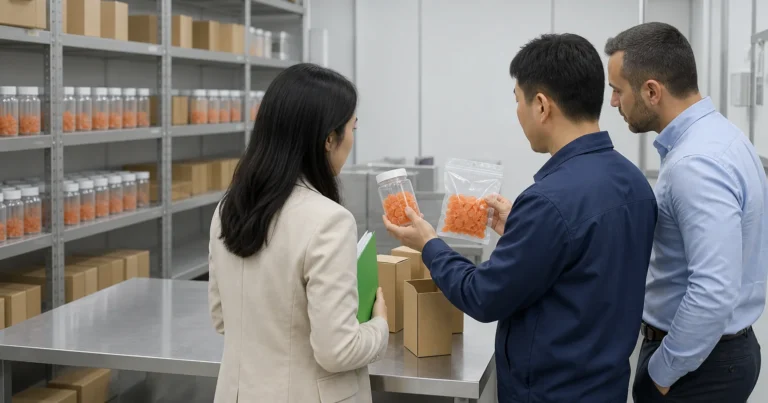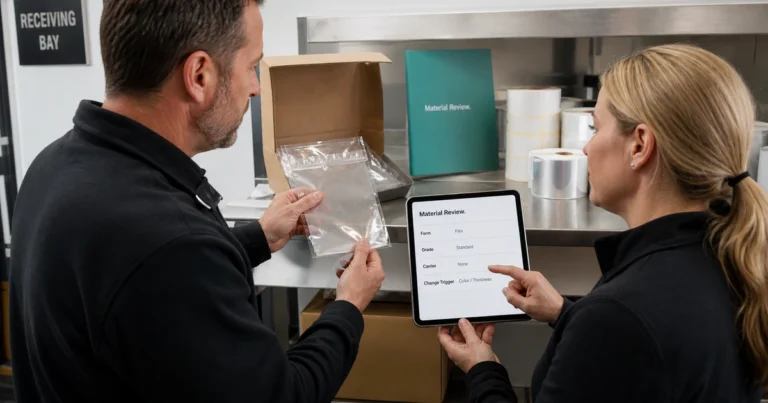
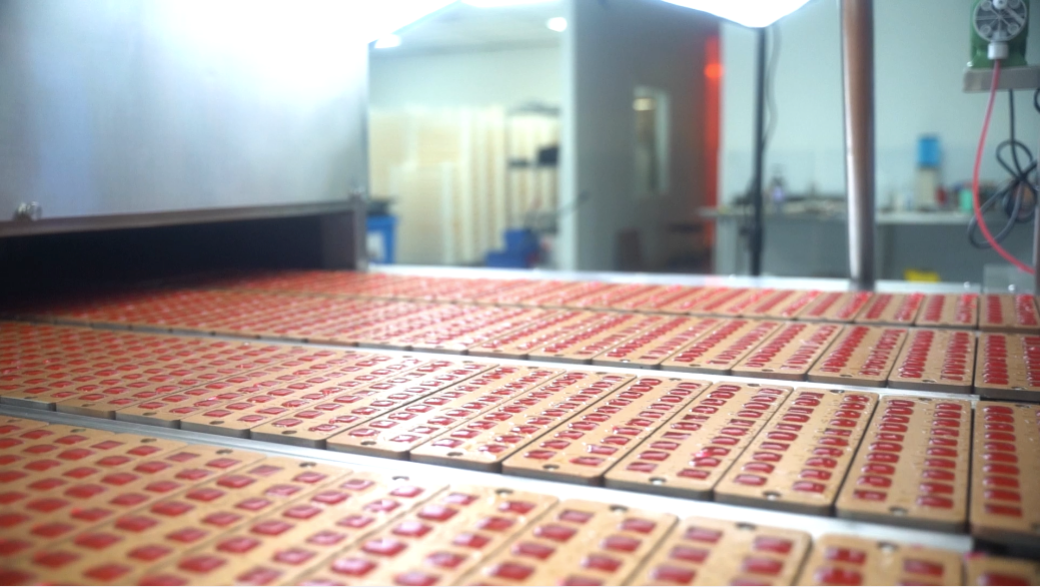

Greens powder gummies are possible, but an existing powder should not be copied directly into gummies without a feasibility review. The practical route is usually to preserve the product concept or selected hero ingredients, then redesign the serving, flavor, texture, testing plan, and packaging around what a gummy can carry consistently.
The first decision is what must remain: the complete ingredient list, the same daily serving, or the same product positioning. Those goals create very different development projects.
Decision Snapshot
- A concept-led gummy is often more practical than reproducing the complete powder formula and serving.
- Active load and acceptable daily gummy count should be reviewed before sampling.
- Insoluble greens, algae, and fiber can create grit, sediment, depositing, and cleaning challenges.
- Pectin, low-sugar, sugar-free, pleasant taste, and long shelf-life goals must be evaluated as one system.
- A successful sample is only a checkpoint; commercial readiness also requires testing, packaging, documentation, and scale-up review.
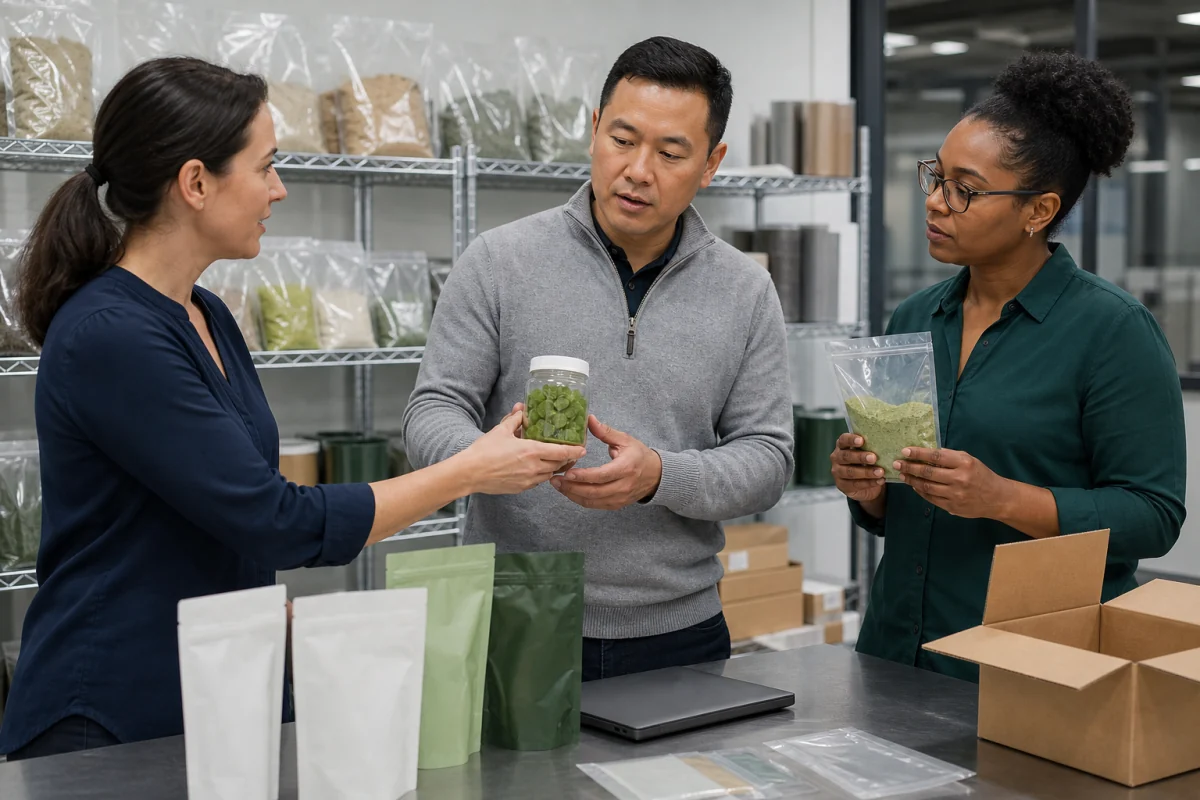
For consumers, the short answer is that greens gummies offer a chewable alternative to powders. For brands, the more important question is whether the intended formula can become a repeatable commercial gummy without losing the product's core purpose.
Can Greens Powder Be Made Into Gummies?
A green-colored sample may be easy to imagine, but a commercially practical serving is a different standard.
Greens powder can be made into gummies when the ingredient load, particle behavior, taste, color, gel system, and daily piece count remain workable together. A brand may need to prioritize selected ingredients or reposition the gummy instead of reproducing the entire powder serving.
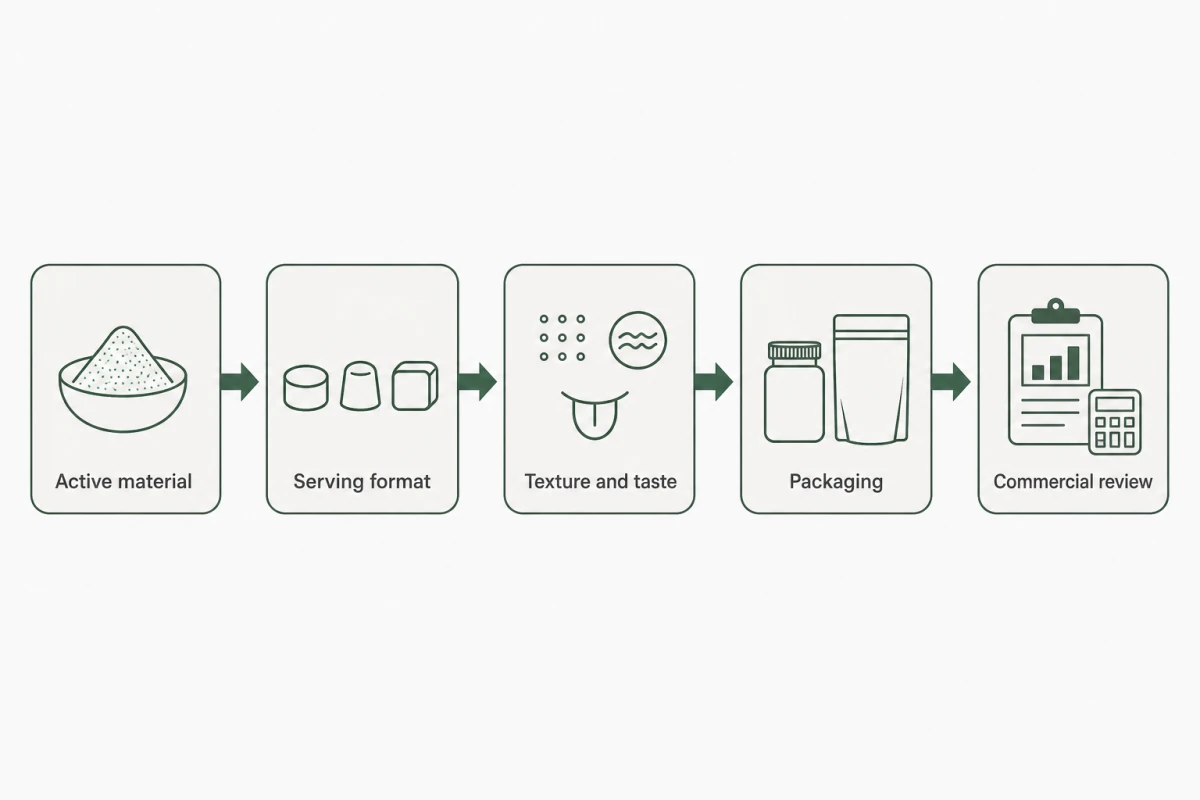
When a greens powder formula is suitable for gummy development
A formula is a stronger candidate when its product story does not depend on putting a large scoop of mixed powders into a very small serving. Selected vegetable ingredients, specified extracts, concentrated components, or a narrower group of recognizable greens may offer more formulation room than a long list dominated by bulky insoluble materials.
I separate three preservation goals before discussing samples:
| Goal to preserve | What it means for development | Likely project direction |
|---|---|---|
| Product positioning | Keep the greens or superfood concept and consumer occasion | Redesign the formula for a gummy-appropriate serving |
| Hero ingredients | Keep selected ingredients such as spirulina, chlorella, moringa, or beetroot | Build the serving and sensory direction around those priorities |
| Full formula and serving | Keep the complete ingredient list and similar daily material load | Conduct a strict capacity review; another format may remain more practical |
Screen this before requesting a sample or quote. A brand that can rank its required ingredients, preferred ingredients, and optional additions gives the development team a usable decision hierarchy. If every ingredient and feature is non-negotiable, conflicts have no clear resolution.
When active load, taste, or stability makes conversion difficult
Conversion becomes difficult when the powder contains a high proportion of vegetable solids, algae powders, fiber, minerals, or strongly flavored botanicals. These materials occupy physical space and may also affect flow, dispersion, chew, gel strength, moisture behavior, and appearance.
Requirements can also conflict. A brand may request a high greens load, two gummies per day, pectin, no added sugar, a mild fruit flavor, clean-label color, and a long shelf-life target. Each request can be reasonable alone. Together, they may leave too little flexibility to build a stable and pleasant product.
| Project signal | Lower feasibility pressure | Higher feasibility pressure |
|---|---|---|
| Ingredient strategy | Focused concept with ranked priorities | Broad formula that must remain unchanged |
| Serving expectation | Piece count can be reviewed with the formula | Very small serving is fixed before capacity review |
| Sensory target | Some plant character is acceptable | Neutral candy-like taste and texture are mandatory |
| Format requirements | Base and sugar direction can be evaluated | Multiple format claims are fixed at the start |
| Commercial plan | Packaging and scale questions enter early | Package, testing, and scale are deferred until after sampling |
The practical response is to rank the non-negotiables and decide whether the gummy will be an equivalent replacement, a concept-led line extension, or a separate portable format. This is product development, not a packaging change.
What Are Greens Powder Gummies?
The phrase sounds self-explanatory, yet products using it can represent very different ingredient and serving strategies.
Greens powder gummies are chewable supplements that use selected vegetable, algae, botanical, vitamin, mineral, or related ingredients to create a greens-positioned product. They may reflect a powder concept, but their formula and serving should be designed for a gummy rather than assumed to match a scoop.
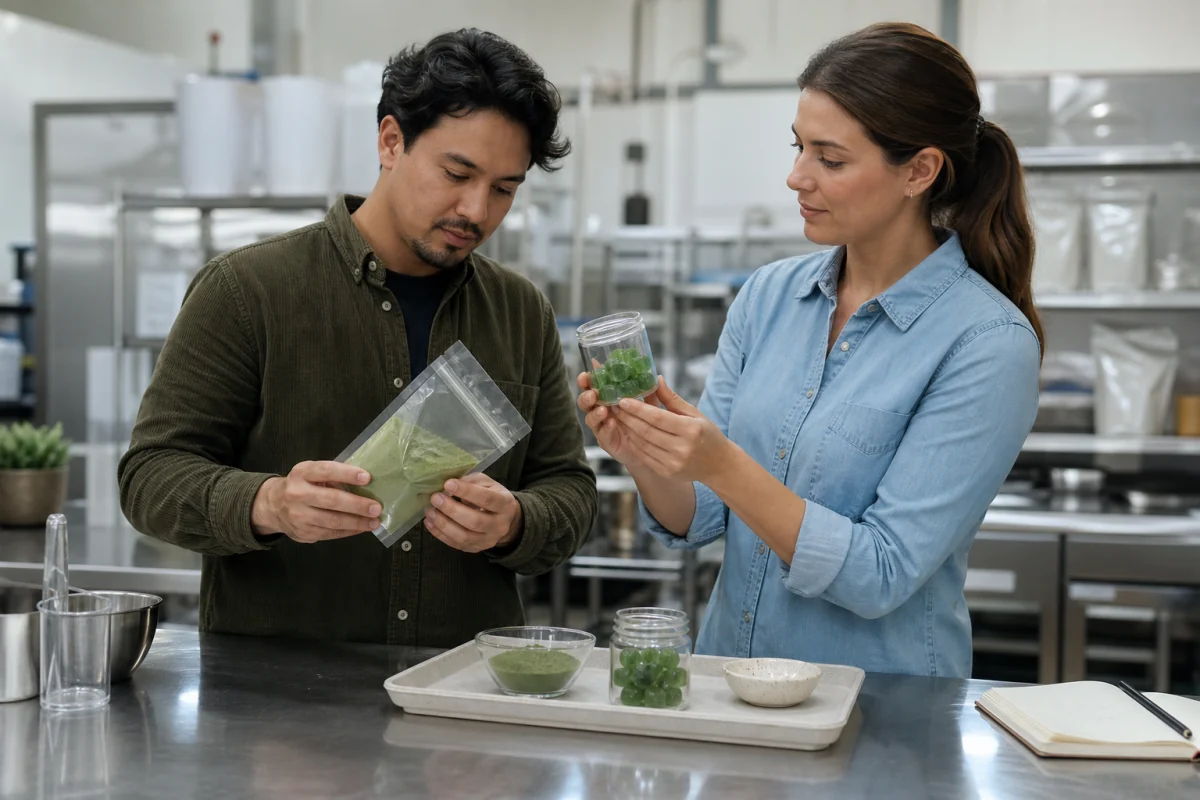
How greens gummies differ from traditional greens powders
Traditional greens powders use a scoop, sachet, or similar portion that is mixed into liquid. That format usually provides more room for a larger mass of blended ingredients. A gummy has less available space because each piece must contain not only active ingredients but also the gelling, sweetening, flavoring, acid, color, and moisture-management components needed to create a stable chew.
This means a gummy may carry the same category language without carrying the same total powder mass. Consumers should compare serving information and ingredient declarations rather than assuming that two green products are nutritionally interchangeable.
Brands can use the wider powdered vitamins versus gummies comparison to frame the format decision. The same principle applies here: a product should be judged by its finished serving and intended use, not by the dosage form alone.
Why supplement brands are exploring the gummy format
Gummies support a familiar, portable routine. They require no mixing equipment, water, or cleanup, and they can create a more approachable flavor experience for consumers who dislike drinking greens powders. The format can also give a brand another product role: a travel-friendly extension, a separate lower-load daily product, or a private label concept centered on a smaller set of ingredients.
Those advantages do not remove manufacturing limits. A high gummy count is not convenient, and a formula with persistent grit or an unstable chew is not ready for scale.
Where consumer expectations and manufacturing reality diverge
Consumers may see a compact gummy and assume it contains the equivalent of a full scoop. Manufacturing teams see limited piece capacity, a gel matrix, particles that must remain distributed, and a product that must still deposit, set, finish, package, ship, and remain acceptable through its planned life.
Clear positioning can manage this gap. Powder may remain the high-load core product while gummies serve a complementary, portable routine.
The Main Manufacturing Challenges in Greens Gummies
Greens ingredients can affect several parts of production at once, so isolated fixes often move the problem elsewhere.
The main greens gummy manufacturing challenges are limited active capacity, impractical serving counts, gritty particles, sediment, strong earthy flavors, natural-color variation, and inconsistent material behavior during production. Feasibility depends on how these factors interact, not on whether one attractive bench sample can be made.
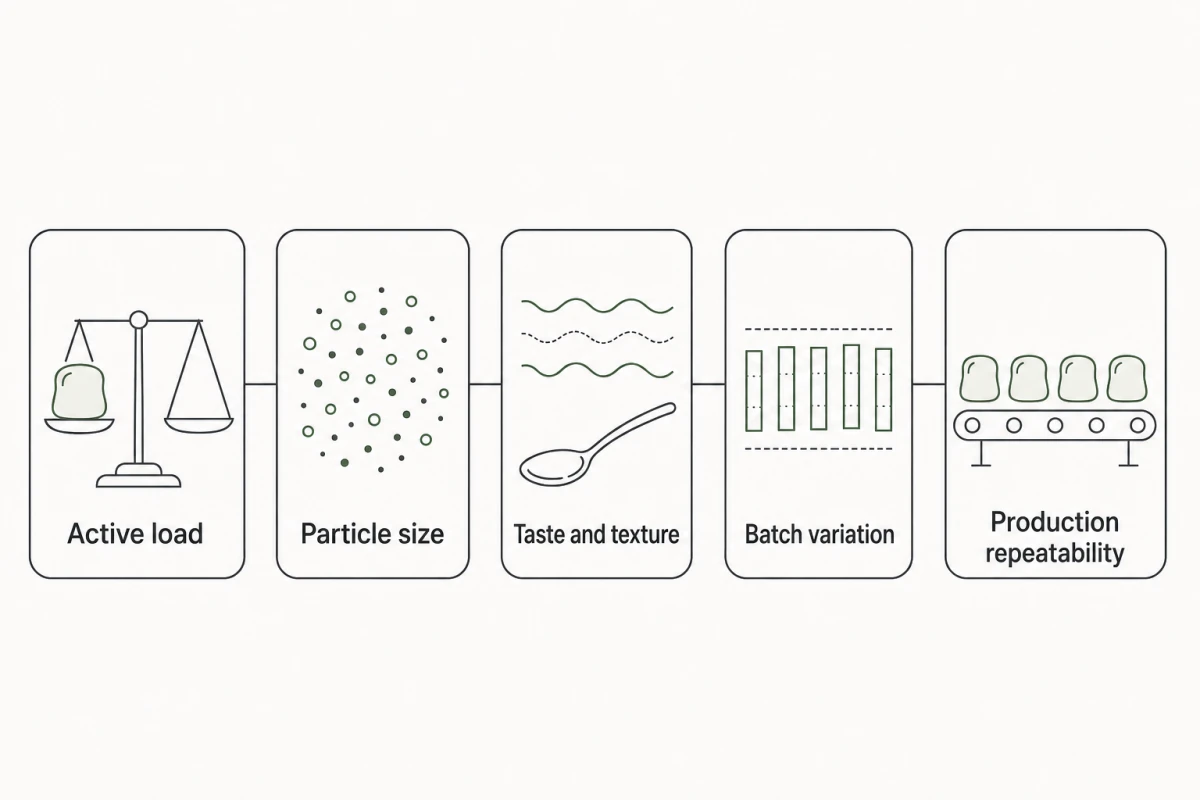
Active load, serving size, and daily gummy count
A useful review sequence is:
- Define the role and target amount of each ingredient.
- Separate hero ingredients from supporting additions.
- Check whether the load fits a practical piece and serving.
- Decide which variable can move: priority, amount, size, count, or format.
This avoids optimizing a low-load sample that does not represent the intended serving. An impractical gummy count should be addressed early, not hidden behind a demonstration formula. If no variable can move, the team should decide whether the powder should remain the primary format before further sampling costs accumulate.
Powder grittiness, sediment, and mouthfeel
Vegetable and algae powders may not dissolve into the gummy mass. Particle size, density, surface characteristics, and dispersion behavior can affect whether the finished gummy feels smooth, visibly settles, or varies from piece to piece.
Continuous production requires the mass to move, remain sufficiently uniform, and deposit repeatedly. Insoluble solids may change viscosity, contribute to interruptions, increase residue, or make cleaning more demanding. Equipment cannot make every particle-heavy concept repeatable.
This is why sample and scale are separate questions. A small sample can confirm a promising sensory direction, but it may not reproduce the hold time, material movement, repeated depositing, finishing, and cleaning demands of a longer production run. Sensory tolerance should also be defined: a slight plant-derived texture may suit one superfood concept but not a premium fruit gummy.
Masking earthy, grassy, and algae-derived flavors
Greens ingredients can bring earthy, grassy, marine, bitter, or lingering notes. Adding sweetness alone may make the gummy sweeter without removing the aftertaste. Adding more acid can brighten fruit flavor but may also alter the taste profile and interact with the gummy base.
Flavor development should use the intended active load. A low-load sample can produce false confidence because the actual commercial formula may expose much stronger notes. It is often more productive to choose a flavor direction that works with the ingredient character, then balance sweetness, acidity, aroma, and aftertaste as a system.
Any natural, sugar, or flavor restrictions belong in the brief before sampling because they can narrow masking options.
Managing natural color and batch variation
Green ingredients can vary in shade, odor, and sensory character between raw-material lots. Natural color may also change as the formula encounters acidity, heat exposure, oxygen, light[^1], moisture, and storage time. A vivid early sample does not guarantee that every batch or stored product will look identical.
The development team should agree on an acceptable appearance range, raw-material specifications, and how visible variation will be handled. Color should also be evaluated in the chosen package because clear, opaque, and light-protective formats create different presentation conditions.
Documented specifications and realistic product images help align natural variation with a repeatable commercial presentation.
Formulation Decisions That Affect Feasibility
The gummy base, sweetener system, acids, flavors, moisture targets, and package cannot be selected independently of the greens blend.
Greens gummy feasibility depends on a compatible formulation system. Pectin or gelatin, standard or reduced sugar, sweeteners, acids, flavors, moisture control, and packaging must support the active load together. Combining every premium requirement can reduce the room available for stable texture and acceptable taste.
Pectin vs. gelatin for greens gummy projects
Pectin and gelatin create different development routes.[^2] Gelatin is animal-derived and is associated with an elastic chew. Pectin can support a plant-based base and a different bite, making it relevant to vegan-positioned concepts. The choice also affects setting behavior, acidity, processing tolerance, moisture response, and the way a dense active blend is carried.
A pectin base is not automatically vegan; colors, flavors, coatings, and active sources still need review. Neither base removes active-loading or masking constraints.
For brands considering pectin greens gummies, a product example can support the early discussion, but a new formula still requires its own formulation and sample evaluation.
Low-sugar and sugar-free formulation constraints
Low-sugar, no-added-sugar, and sugar-free are not interchangeable project instructions. Each should be defined for the target market and label direction before formulation begins. Reducing or replacing sugars can affect sweetness, bulk, chew, stickiness, moisture behavior, coating, aftertaste, and storage performance.
When sugar reduction is combined with high greens loading and pectin, the formulation window may become narrow. A brand should decide whether sugar positioning is a primary product promise or a preference that can be adjusted if it prevents acceptable taste and texture.
The sugar-free beetroot gummy product route illustrates one format direction, not a universal formula for unrelated greens blends.
Sweetener, acid, and flavor-system compatibility
Sweetener, acid, and flavor decisions should be tested together because each one changes how consumers perceive the greens ingredients. A sweetener can introduce its own onset and aftertaste. Acid can sharpen fruit notes or make certain plant notes more obvious. Flavor may cover the first bite but leave a persistent finish.
The preferred flavor should remain acceptable at the intended active load and fit the positioning. Reviews should record chew, particles, sweetness, acidity, aroma, and aftertaste rather than only "like" or "dislike." If a material, base, or sugar direction changes after flavor approval, the sensory decision may need to be revisited.
Moisture, water activity, packaging, and shelf life
Moisture-related behavior connects formulation to packaging.[^3] A gummy can absorb or lose moisture, stick together, sweat, harden, soften, or change surface condition depending on its formula, finish, package, and environment. Water activity is one useful quality consideration, but it should be interpreted within the product's broader specification and microbial-control plan.
Shelf-life planning should use the final formula and commercial pack. An unfinished sample or different container does not establish performance for the product that will be sold.
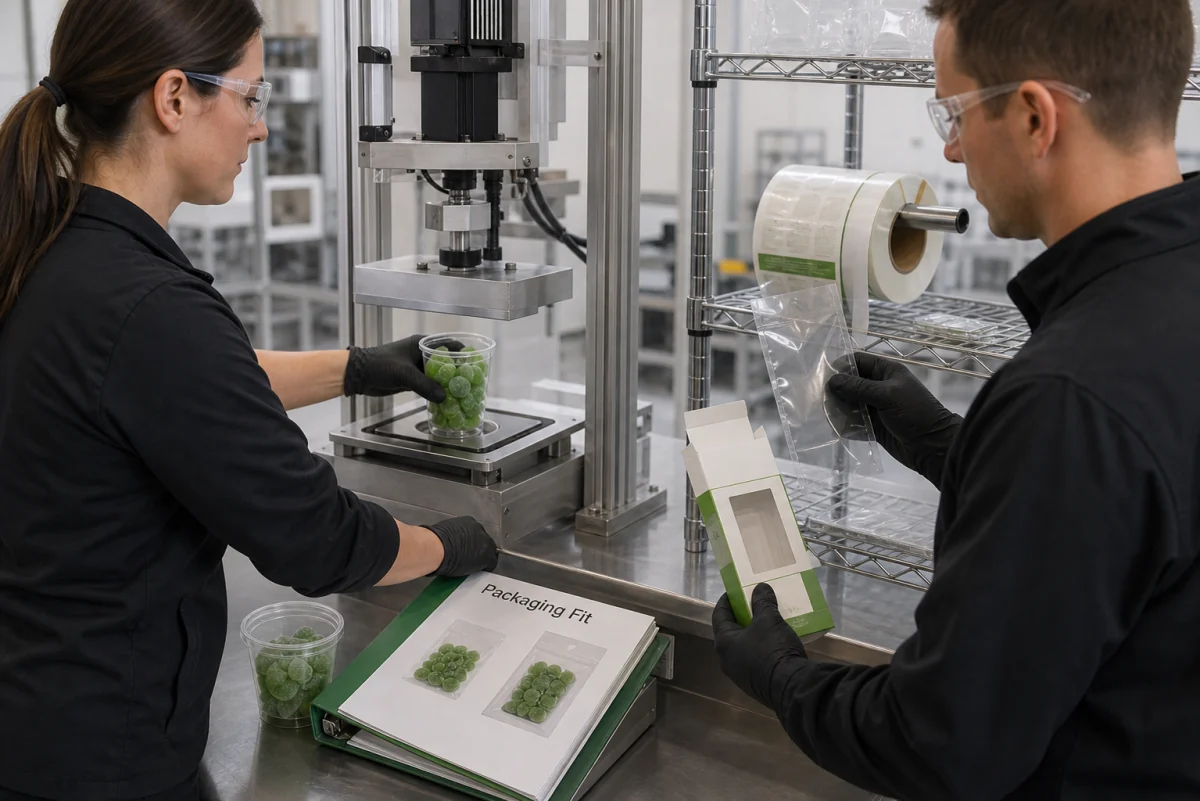
Packaging requirements should therefore be discussed while the formula direction is still being evaluated, then checked again with the intended gummy and pack. Leaving the package until after formula approval can expose an avoidable sequence problem: the chosen container or line setup may not support the product's moisture behavior, dimensions, surface condition, or distribution needs.
A fixed shelf-life claim should remain provisional until the formula, production process, commercial package, storage conditions, and supporting stability evidence align. Packaging is part of the stability route, not a late design choice.
Greens Gummies vs. Greens Powder: What Brands Should Compare
A format comparison is useful only when both products are evaluated against the same intended promise and serving.
Brands comparing greens gummies with greens powder should review delivered serving, nutrient density, convenience, preparation, sensory experience, packaging, cost structure, and claim language. Powder generally offers more loading room; gummies can offer portability and an easier routine when the serving remains credible.
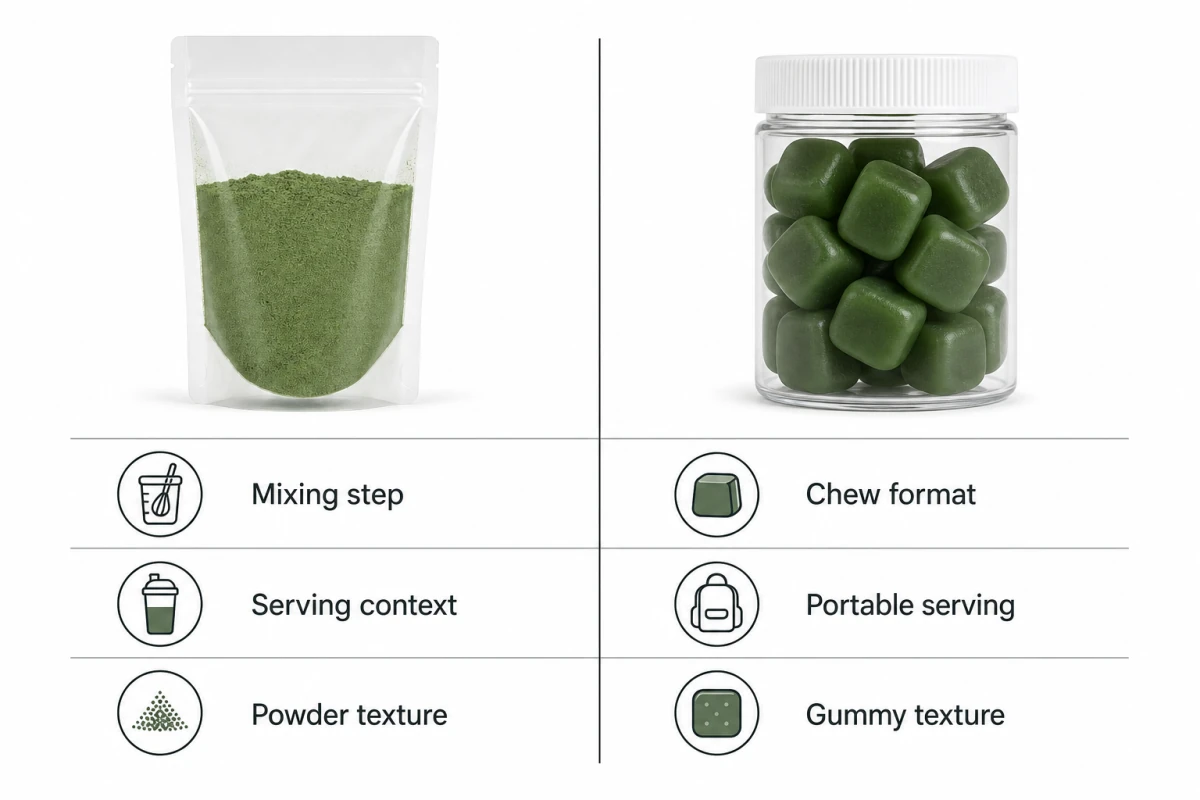
Serving size and nutrient-density trade-offs
Powder usually has a physical capacity advantage. A scoop can carry more total material than a small number of gummies. That matters when the product story depends on a broad blend or a substantial daily serving.
Gummies allocate part of every piece to structure and sensory components, so the product may need a narrower active story or different serving. The same capacity issue appears in fiber gummies versus powder, creatine gummies versus powder, and collagen gummies versus powder.
| Decision factor | Powder may fit better when... | Gummies may fit better when... |
|---|---|---|
| Product promise | The concept depends on a broad or high-load serving | A focused ingredient story supports the intended serving |
| Use occasion | Mixing is acceptable and serving flexibility matters | Portability and no-mix use are central |
| Sensory expectation | The product can be diluted before consumption | The finished chew can be acceptable as consumed |
| Line strategy | One high-load core format is the priority | A distinct complementary format has a clear role |
| Evidence and claims | Claims reflect the powder's actual serving | Claims are rewritten for the gummy's actual serving |
Convenience, portability, and format preference
Gummies require no mixing and can be carried easily. Powder can offer greater serving flexibility but needs liquid, a container, and preparation. These differences shape consumer routines and can justify separate products for separate occasions.
Some consumers value a comprehensive scoop; others prefer a compact chewable routine. Positioning should identify the intended use instead of declaring one format universally superior.
Why gummies should not automatically be positioned as more effective
Effectiveness cannot be inferred from convenience, flavor, or dosage form. It depends on the specific ingredient, delivered amount, product quality, consumer context, and the evidence supporting the exact claim[^4]. A pleasant gummy may support a simpler routine, but that does not make an underloaded or poorly supported claim accurate.
Avoid claiming automatic equivalence. Explain the actual serving, intended role, and format advantage without promising a health outcome.
Which Ingredients Can Be Used in Greens Gummies?
Many ingredients can appear in a greens gummy concept, but inclusion on a label does not prove meaningful loading or process suitability.
Greens gummies can use vegetable powders, extracts, algae, botanicals, vitamins, minerals, fiber, probiotics, and other additions when their amounts, documentation, taste, particle behavior, stability, and claims fit the gummy. Ingredient selection should begin with product purpose and manufacturability, not list length.
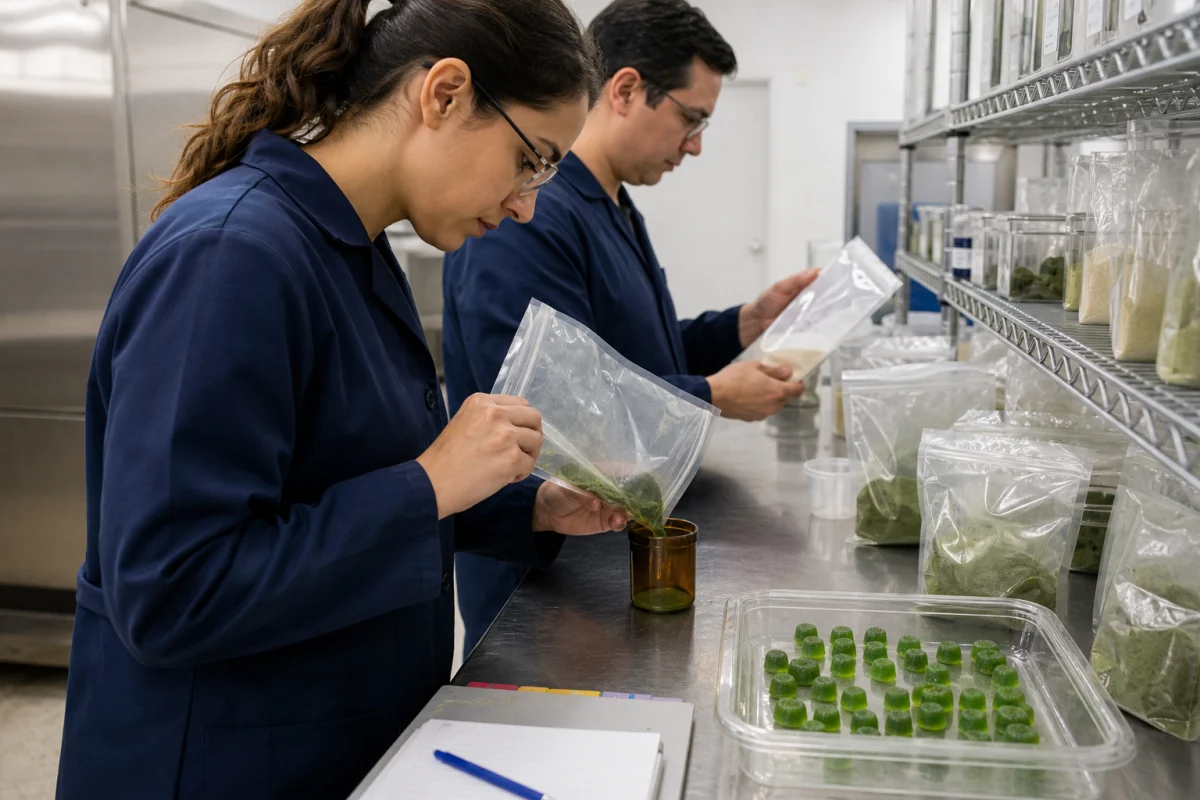
Vegetable powders, extracts, and concentrated ingredients
Whole or minimally processed powders can support a recognizable ingredient story, but they often bring more bulk and insoluble material. Extracts or concentrated ingredients may offer loading advantages, yet they are not direct substitutes unless source, ratio, specification, intended role, and label wording are aligned.
The brief should distinguish essential ingredients from label decoration. Every addition uses space and can introduce taste, color, sourcing, analytical, or stability questions. Whole powders and extracts can support different product stories; neither is automatically the correct route.
A practical ingredient record includes:
- exact material identity and supplier specification;
- intended amount per serving;
- powder, extract, concentrate, or other form;
- particle and dispersion observations;
- sensory contribution;
- documentation and contaminant expectations;
- intended label or claim role.
Spirulina, chlorella, moringa, and beetroot
Spirulina and chlorella create recognizable greens positioning but can contribute strong color, marine or algae-derived notes, and fine-particle challenges. Moringa can reinforce a botanical story while bringing its own grassy or bitter character. Beetroot can add a familiar plant ingredient and strong color, but it may move the appearance away from conventional green.
The question is whether the specific materials and intended levels fit the selected base, serving, sensory target, packaging, testing plan, and target market.
Vitamins, minerals, fiber, probiotics, and botanical additions
Additional nutrients can make a concept look more complete, but they also add technical and claim complexity. Minerals may introduce taste and interaction concerns. Fiber can increase bulk or alter texture. Probiotics can require specific viability, process, storage, and packaging consideration. Botanical additions may bring new sourcing, contaminant, identity, and claim questions.
Assign a job to each ingredient. An addition that does not strengthen the concept, support a declaration, or differentiate the product may create more risk than value.
Ingredients that require additional stability or claim review
Ingredients sensitive to heat, moisture, oxygen, light, or time may need added evaluation in the finished gummy. Others may create market-specific restrictions, warning needs, or a higher substantiation burden. A raw-material certificate alone does not establish that an ingredient remains at the intended level or supports a finished-product claim after production and storage.
Claim review should cover the product name, label, facts panel, directions, ecommerce copy, images, and advertising[^5]. Detox, immune, energy, digestive, or antioxidant language should not be added merely because consumers associate it with greens.
Testing and Quality Checks Before Commercial Production
An acceptable prototype does not show whether the formula, pack, specifications, and batch controls will hold together in commercial production.
Before commercial production, greens gummies should have a defined, risk-based review and testing plan. Depending on the formula, claims, market, process, and risk profile, that plan may include relevant identity, microbiological, contaminant, stability, finished-product, label, packaging, and scale-up checks.
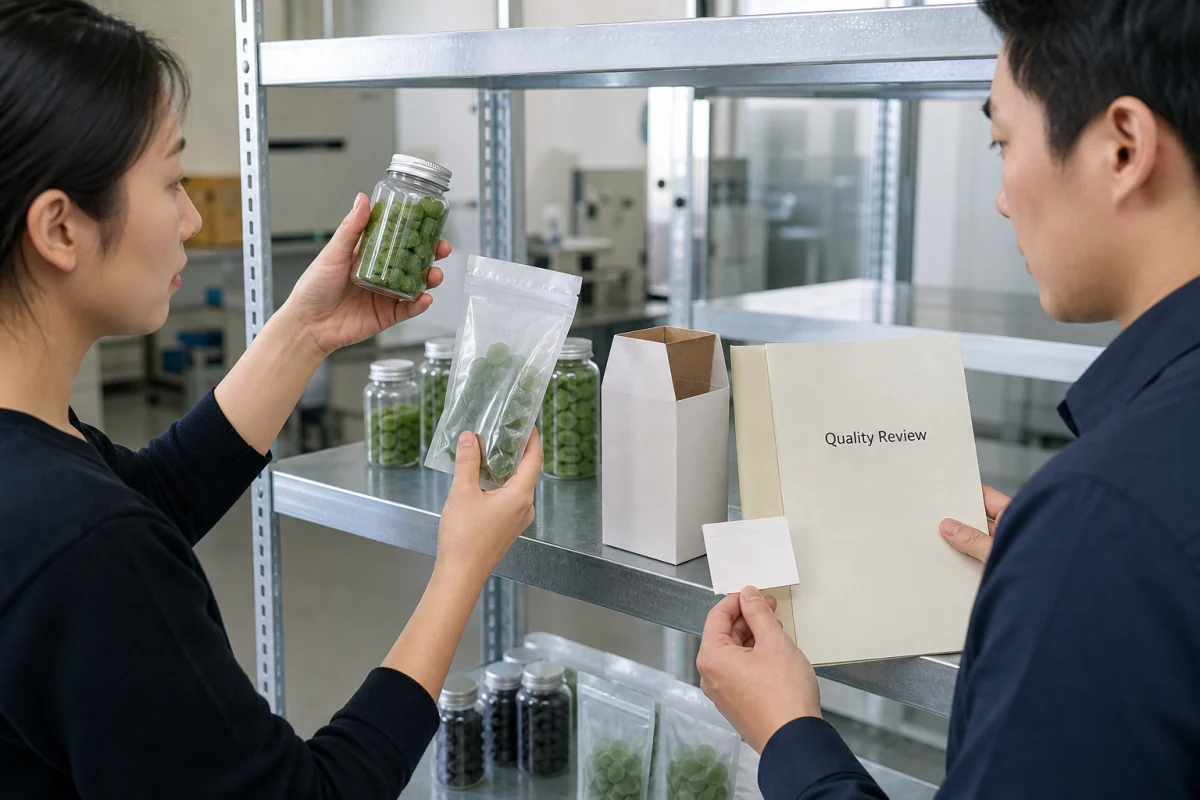
Prototype taste, texture, and visual-stability evaluation
Prototype review should be structured enough to guide decisions. Instead of approving a sample as simply "good," the brand and production teams should record the intended active load, serving count, and base. Sensory and visual notes can cover sweetness, acidity, aroma, first bite, chew, grit, aftertaste, color, surface condition, and changes over the review period.
Any temporary active, sweetener, color, coating, or packaging decisions should be recorded. Side-by-side review of labeled sample revisions is more useful than relying on memory, and it helps prevent a later sample from being approved against the wrong formula or sensory target.
Microbial, heavy-metal, and contaminant testing
Greens and botanical materials may require risk-based attention to microbiological quality and relevant contaminants. Depending on the material and market, the review may consider heavy metals, pesticides[^6], residual solvents, allergens, adulteration, or other identified risks. The appropriate scope should be defined through qualified quality and regulatory review, not copied from another product.
The finished gummy should also have an agreed release specification and testing plan. This complements rather than replaces supplier qualification and raw-material controls.
Label claims, serving specifications, and batch documentation
The formula, label, and batch record should describe the same product. Review serving size, amounts, ingredients, directions, warnings, and claims before locking artwork.
For production and release, the team should align on relevant specifications and records.[^7] Raw-material identity, lot traceability, and approved formula and artwork versions establish what is being made. Piece-weight and appearance expectations, applicable in-process and finished-product checks, packaging components, deviations, and release status document how the approved product is controlled.
Documentation is part of product design because it helps the approved intent remain repeatable and supportable.
Packaging compatibility and production scale-up
Packaging should be evaluated with the actual gummy, count, and distribution route. Shape, surface treatment, softness, stickiness, and dimensions can affect feeding and counting. The package review should separately consider headspace, closure and seal performance, barrier needs, any appropriate moisture-control component, and expected shipping exposure.
Scale-up examines whether the mass remains sufficiently uniform and depositable over a longer run. Production review can cover piece weight, visible distribution, interruptions, residue, cleaning, and finishing. Packing review can then cover counting, filling, sealing, and labeling. A sample can support a go-forward decision, but commercial production and packing still require their own review.
Commercial readiness checklist:
- [ ] Final ingredient identities and target serving are approved.
- [ ] The accepted sample represents the intended active load and base.
- [ ] Sensory and appearance acceptance criteria are recorded.
- [ ] Raw-material and finished-product test expectations are defined.
- [ ] Label, serving, claim, and warning review is complete for the target market.
- [ ] The final package has been evaluated for product and line compatibility.
- [ ] Scale-up observations, deviations, and required adjustments are documented.
How Talvenda Evaluates Greens Gummy Projects
The fastest route to a useful sample is a clear brief that exposes trade-offs before ingredients enter the gummy base.
A greens gummy project review should connect the powder concept and ingredient priorities with serving practicality, material behavior, sensory direction, packaging, quality requirements, production planning, and commercial context. The objective is a practical development route rather than an attractive prototype in isolation.
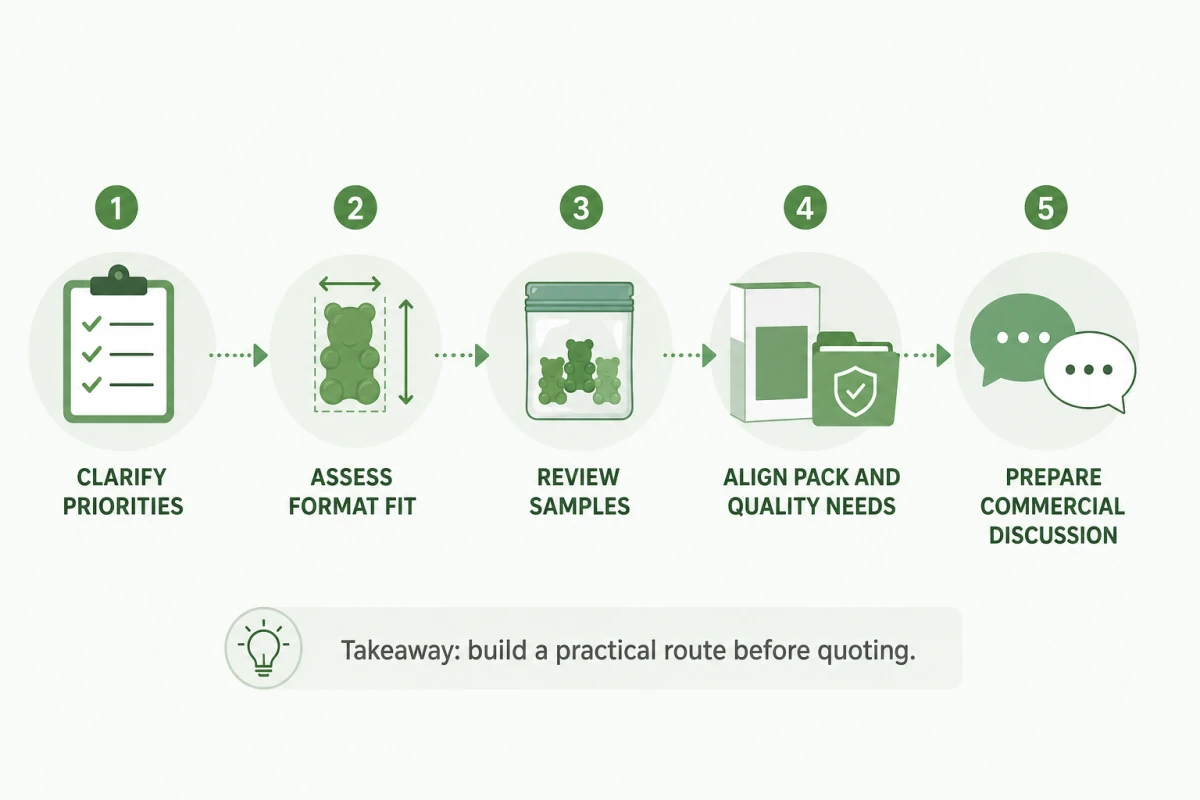
Powder-to-gummy feasibility review
The review begins by identifying what the brand wants to preserve. If the complete ingredient list and powder serving are fixed, the resulting load and serving pressure should be assessed before extensive sample work. If the concept or selected hero ingredients are the priority, there may be more room to develop a gummy-appropriate version.
Useful starting information includes ingredient specifications, intended amounts per serving, acceptable gummy count, and target market. The brief should also state the preferred base and sugar direction, sensory target, packaging concept, proposed label position, and which variables may change.
The outcome may be to proceed, revise ingredient or serving priorities, or keep powder as the high-load format while considering a complementary gummy. The first supplier conversation should therefore be treated as a project evaluation rather than a request for a formula quote.
Sample development and taste-masking evaluation
Sample development evaluates the chosen route at the intended active load. Review should cover chew and particle perception, followed by color, aroma, sweetness, acidity, and aftertaste. When trade-offs appear, the brand team should understand which variable is being adjusted and why.
The accepted sample should be identified by formula and revision. Changes to active load, base, sweetener, flavor, color, or coating can require another evaluation. Sample approval resolves a sensory and format checkpoint; it does not by itself establish packaging performance, finished-product specifications, testing outcomes, or production-scale repeatability.
Pectin, vegan, low-sugar, and sugar-free options
Pectin, vegan, low-sugar, and sugar-free directions should be evaluated within the formula's actual constraints. These options are not interchangeable badges. Pectin changes the gel route; vegan status requires source review across the full formula; sugar reduction changes the sweetener, bulk, moisture, texture, and sensory system.
These requests should be evaluated with the greens load and serving. When requirements conflict, the development review should make the manufacturing consequences clear while the brand retains the commercial decision.
MOQ, packaging, testing, and commercial scale-up
MOQ planning depends on the selected route, customization level, and production requirements. Packaging and the defined quality or testing scope can also affect commercial planning, so one fixed number should not be presented as universal for every greens gummy project. Early volume assumptions belong in the same discussion as formula and pack complexity rather than as a stand-alone buying question.
Before quote and timeline discussions, a pre-quote brief should align the decision inputs:
| Brief field | What the brand should clarify |
|---|---|
| Product core | Positioning, hero ingredients, and features that must remain |
| Serving | Intended amount, acceptable gummy count, and variables that may move |
| Format | Pectin or gelatin preference, dietary direction, and sugar direction |
| Sensory | Flavor direction, acceptable plant character, texture, and appearance range |
| Market and claims | Target market, proposed label role, warnings, and review ownership |
| Commercial plan | Packaging concept, testing expectations, launch volume context, and timing assumptions |
Together, these inputs support discussion of formula direction, sample scope, packaging fit, quality expectations, commercial context, and production planning. The route remains provisional until the ingredient specifications, serving, sample requirements, package, and applicable quality and production requirements have been reviewed together.
Frequently Asked Questions
Are greens gummies as effective as traditional greens powder?
Not automatically. Effectiveness depends on the specific ingredients, amounts per serving, finished-product quality, intended use, and evidence behind the claim. Powder often has more room for a larger blend, while gummies may offer convenience. Compare the declared serving rather than assuming the formats are equivalent.
Can greens powder gummies be made without added sugar?
Potentially, but no-added-sugar, reduced-sugar, and sugar-free routes require separate definition and formulation review. Sweetener changes can affect taste, bulk, texture, moisture behavior, coating, labeling, and packaging. The practical route also depends on the greens load and selected gel system.
Why do some greens gummies taste earthy or feel gritty?
Vegetable, algae, and botanical powders can contribute grassy, earthy, marine, bitter, or persistent notes. Insoluble particles can also remain perceptible in the chew. Material form, loading, dispersion, flavor design, and the gummy base all influence the result.
Can spirulina, chlorella, moringa, or beetroot be used in gummies?
Yes, these ingredients can be considered for gummy products, subject to the intended level, material specification, taste, color, particle behavior, stability, documentation, target market, and claim review. Their use in another product does not establish that every blend or serving will work.
What should a brand test before launching greens gummies?
A brand should define a risk-based review and testing plan for the formula and market. Depending on the ingredients, claims, process, package, and identified risks, it may include relevant identity, contaminant, microbiological, stability, finished-product, sensory, label, and packaging checks.
Talvenda is a B2B supplement and gummy contract manufacturing partner supporting OEM, ODM, and private-label projects from concept and formulation development through packaging, quality control, and production planning. Brands can contact Talvenda with a decision-ready brief to review which greens gummy priorities can move toward commercialization without overstating equivalence or outcomes.
[^1]: "Natural colorants: Pigment stability and extraction yield enhancement via utilization of appropriate pretreatment and extraction methods", https://talcottlab.tamu.edu/wp-content/uploads/sites/108/2020/03/Colors-1.pdf. The review compares major natural pigment classes and summarizes their differing sensitivity to heat, light, oxygen, and pH. Evidence role: natural-pigment stability mechanism support; source type: university-hosted academic review. Supports: natural pigment color can change with acidity or pH, heat, oxygen, and light. Scope note: Pigment classes behave differently; this source does not predict a fixed color change for every greens ingredient or formulation and no experimental range should be imported. [^2]: "Current Innovations in the Development of Functional Gummy Candies", https://pmc.ncbi.nlm.nih.gov/articles/PMC10778822/. The peer-reviewed review describes gelatin and alternative hydrocolloids, including pectin, as having different gelation, texture, and formulation behavior in functional gummies. Evidence role: qualitative gummy-base formulation support; source type: peer-reviewed review. Supports: pectin and gelatin lead to different gummy development and texture routes. Scope note: Pectin alone does not establish vegan status, and no pH, sugar, temperature, or process range should be transferred to this article. [^3]: "Sugar-Free, Vegan, Furcellaran Gummy Jellies with Plant-Based Triple-Layer Films", https://pmc.ncbi.nlm.nih.gov/articles/PMC10573701/. The study evaluates sugar-free vegan gummy formulations, moisture, water activity, texture, packaging, and changes during storage. Evidence role: formulation-moisture-packaging relationship support; source type: peer-reviewed experimental study. Supports: gummy composition, moisture behavior, water activity, texture, packaging, and storage performance are connected. Scope note: This is a formula-specific short-storage study using furcellaran and experimental films; do not import its values, storage period, package result, or shelf-life implication as universal. [^4]: "Guidance for Industry: Substantiation for Dietary Supplement Claims Made Under Section 403(r)(6) of the Federal Food, Drug, and Cosmetic Act", https://www.fda.gov/regulatory-information/search-fda-guidance-documents/guidance-industry-substantiation-dietary-supplement-claims-made-under-section-403r-6-federal-food/. FDA guidance emphasizes the relationship between evidence and the specific claim, product or ingredient, serving size, formulation, route, and conditions of use. Evidence role: dietary-supplement claim substantiation boundary; source type: official FDA guidance. Supports: evidence should directly match the exact claim and relevant product and serving conditions. Scope note: This U.S.-specific nonbinding guidance is not a clinical comparison of gummies and powders and does not prove efficacy for either format. [^5]: "Health Products Compliance Guidance", https://www.ftc.gov/business-guidance/resources/health-products-compliance-guidance/. FTC guidance requires marketers to identify and substantiate express and implied health-product claims and to consider the overall advertising message. Evidence role: health-product advertising review boundary; source type: official FTC business guidance. Supports: claim review should include online copy, visual presentation, and advertising rather than isolated wording alone. Scope note: This is U.S. advertising guidance, not a complete labeling or multi-market legal review, and it does not approve any proposed greens claim. [^6]: "Measurements and Standards for Botanical Dietary Supplements", https://www.nist.gov/programs-projects/measurements-and-standards-botanical-dietary-supplements/. NIST identifies botanical supplement measurement and standards needs in a context that includes inaccurate labeling, adulteration, and contamination with pesticides and heavy metals. Evidence role: botanical contaminant measurement context; source type: official standards-body program page. Supports: heavy metals and pesticides are legitimate risk-review categories for botanical supplement materials. Scope note: The source does not make every contaminant test mandatory for every formula or market and does not support a fixed panel or pass/fail threshold. [^7]: "Small Entity Compliance Guide: Current Good Manufacturing Practice in Manufacturing, Packaging, Labeling, or Holding Operations for Dietary Supplements", https://www.fda.gov/regulatory-information/search-fda-guidance-documents/small-entity-compliance-guide-current-good-manufacturing-practice-manufacturing-packaging-labeling/. FDA's dietary supplement CGMP guide covers specifications, quality controls, master manufacturing records, batch production records, laboratory operations, packaging and labeling controls, and recordkeeping. Evidence role: production-control and documentation framework support; source type: official FDA compliance guidance. Supports: dietary supplement production and release should align relevant specifications, controls, and records. Scope note: This is U.S. DS CGMP context; applicability depends on the operation and jurisdiction, and it does not establish a universal testing panel.