


Most people ask this question because gummies feel easier to take than pills, but they still want to know whether the format can deliver a real ashwagandha benefit.
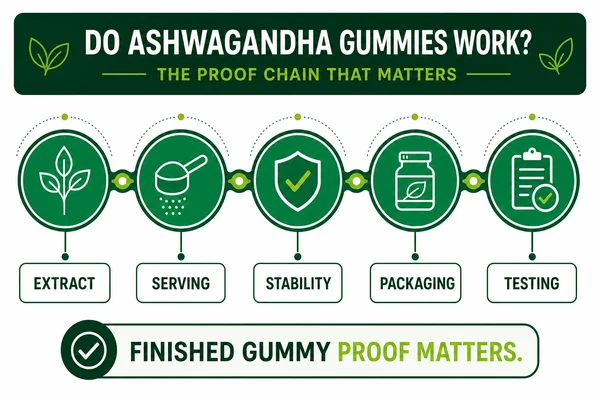
Ashwagandha gummies can work, but only when the formula proves the active chain: standardized extract, meaningful serving size, finished-gummy potency, and stability through packaging and shelf life.
The gummy form does not make ashwagandha more effective by itself. It changes the manufacturing question. A capsule mostly asks whether the ingredient and dose make sense.
A gummy asks that question, then adds taste masking, heat exposure, moisture, drying, packaging, and serving-size limits. For supplement brands, that is why a credible ashwagandha gummy should be judged by its proof chain, not by the format name.
Do Ashwagandha Gummies Work?
The honest answer is yes, but only under the right formulation conditions.
Ashwagandha gummies may be effective when they deliver a standardized ashwagandha extract at a label serving that fits the intended claim. Weak gummies usually fail because extract identity, dose, or finished-gummy potency is unclear.
The short answer
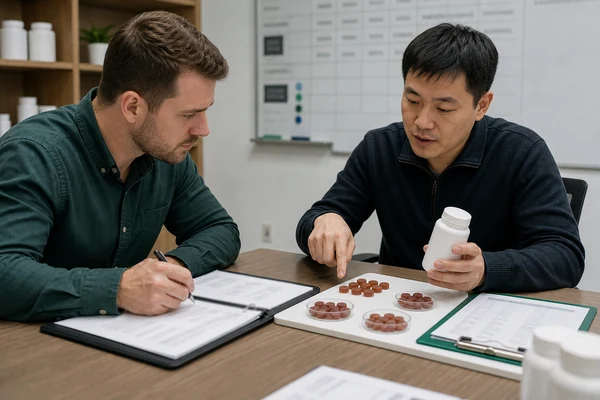
Yes, ashwagandha gummies can be a credible supplement format. They are not automatically weaker than capsules just because they are chewable. A well-formulated gummy can carry a standardized extract, fit into a daily routine, and help consumers use the product more consistently.[^1]
The caution is that "can work" is different from "will work." A gummy that uses a vague ashwagandha powder at a low dose should not borrow confidence from studies on standardized extracts. A gummy built with a defined extract, a realistic serving size, and finished-product testing is a different product.
For brand owners, this difference matters commercially. Trial may come from flavor and format, but repeat purchase depends on whether the consumer trusts the result. If the active story is thin, the product may look good at launch and still struggle after the first reorder cycle.
What "work" should mean
"Work" should not mean resolving stress, addressing anxiety, fixing insomnia, or guaranteeing a specific personal outcome. Those claims cross lines that responsible supplement copy should avoid.[^2]
For a compliant wellness gummy, "work" should mean four practical things. The product contains the stated ashwagandha preparation. The serving size delivers the intended amount. The claim language matches what the formula can support.
The finished gummy also needs to maintain that active-marker story through production, storage, and shipping.
This definition is useful because it moves the discussion away from vague consumer hope and into formulation proof. It also gives brands a pre-production checklist. Before approving the label, the team should know the extract specification, withanolide target, delivered dose per serving, and finished product verification plan.
Why the gummy format changes the question
Capsules and tablets are dry delivery systems. They have their own quality issues, but they usually handle botanical extract loading more directly. Gummies are more complicated because the active ingredient has to live inside a sweet, moist, heat-processed matrix.
Ashwagandha adds pressure to that matrix. It can taste bitter and earthy. Higher extract loads can affect texture and color.
Heat, pH, water activity, drying time, packaging, and shelf conditions can all influence whether the finished gummy still supports the label story.
That is why a brand should not simply take a capsule dose and ask a factory to put it into a gummy. The better question is whether the target extract, target serving, base, flavor system, and packaging can work together before the product moves into pilot or commercial production.
What Ashwagandha Is Usually Used For
Most ashwagandha gummy concepts begin with stress, calm, or sleep positioning.
Ashwagandha is commonly positioned for stress support, relaxation, calm routines, and sleep support. Broader claims need stronger evidence, tighter label review, and more conservative language.

Stress and calm
Consumer interest in ashwagandha often starts with stress and calm. This is why the ingredient appears in relaxation, mood-balance, unwind, and everyday wellness products. For a gummy brand, this is usually the most natural claim lane.[^3]
The safer path is to describe support rather than treatment. Phrases such as "supports a calm routine" or "helps support relaxation" are different from saying the product treats anxiety.
The first kind of language may fit normal supplement positioning when properly reviewed. The second kind moves toward medical territory.
The formula still has to justify the claim. A calm-positioned gummy needs more than a pleasant flavor. It should have a defined extract, a documented serving, and a finished-product check that connects the active input to the finished gummy.
Sleep support
Ashwagandha is also used in nighttime wellness formulas. In gummies, it may be used alone or with other sleep-support ingredients, depending on the product concept and market.
Here the claim boundary matters even more. A gummy can support a nighttime routine, relaxation before bed, or sleep quality positioning when the formula and review support that language. It should not promise to fix insomnia or replace medical care.[^4]
Sleep-positioned gummies also raise practical formula questions. The product may need careful taste masking, controlled stickiness, suitable packaging, and clear serving instructions because consumers may use it as part of a nightly habit.
Other claims need more caution
Ashwagandha is sometimes discussed around energy, hormone support, exercise, fertility, cognition, or benefits for women. These topics can attract attention, but they carry higher evidence and compliance risk.
For a narrower audience-specific discussion, review ashwagandha gummies benefits for women as a separate claim-boundary route rather than expanding this general effectiveness page.
For a gummy brand, the risk is stronger because gummies often have less dose density than capsules. A claim that might be defensible for one studied preparation at one dose may not transfer to a lower-dose gummy using a different extract.
I would avoid building an ashwagandha gummy around unsupported hormone, performance, fertility, or disease-adjacent claims. A better first product is usually a clear stress-support, calm-support, or routine-friendly wellness gummy with a documented active-marker chain.
How Do Ashwagandha Gummies Work in a Finished Formula?
The label can say ashwagandha, but the finished product has to prove delivery.
An effective ashwagandha gummy needs a standardized extract, a defined withanolide target, a realistic delivered dose, and finished-gummy potency verification. These details matter more than the format name.
Standardized extract
The first check is extract identity. A label that only says "ashwagandha" does not tell a brand enough. The team should know the botanical part used, the extract type, the concentration, and the supplier documentation.
Standardization helps because it gives the formula a measurable marker. In ashwagandha, withanolides are often used as a key marker group. The exact extract choice should match the product concept, the label claim, the serving size, and the regulatory review.[^1]
This is also where supplier qualification begins. Ingredient documentation should include batch-specific information, not just a general sales sheet. If a supplier cannot support the extract identity and marker level, the brand should not build a serious claim around that material.
Withanolide target
The withanolide target should be discussed before flavor work starts. If the target is too high for the gummy format, the formula may become bitter, oversized, expensive, or hard to stabilize. If the target is too low, the product may be easier to make but weaker as a serious ashwagandha item.
This is the point where many gummy concepts need a reality check. A brand may want a capsule-like claim in a two-gummy serving. The formula may not allow that without taste, sugar, texture, or serving-size tradeoffs.
The target also affects testing. The brand should be able to connect raw extract documentation to finished-gummy expectations. Without that bridge, the team is guessing whether the label claim survives production.
Delivered dose per serving
Consumers do not eat a formula sheet. They eat one serving. So the useful question is not just how much extract was planned, but how much extract is delivered per labeled serving.
A two-gummy serving gives more room than a one-gummy serving, but it also changes cost, calorie load, sweetener exposure, bottle count, and consumer behavior. A three-gummy serving may solve dose space on paper, but it can feel inconvenient or too sweet in real use.
This is where marketing and manufacturing need to agree early. If the brand wants a stronger claim, the formula may need more active load. If the active load damages taste or texture, the claim language may need to become more modest.
Finished-gummy potency
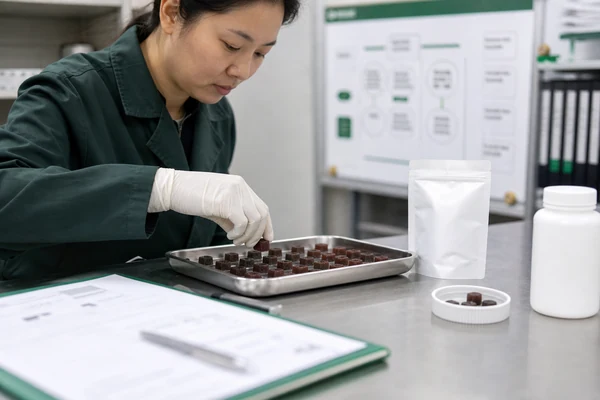
The strongest check is finished-gummy potency. The production team should know whether the active marker can still be confirmed after cooking, depositing, setting, drying, coating if used, packing, and storage.
The ingredient COA or equivalent supplier documentation matters, but it is not the whole story. A gummy can start with a credible extract and still lose label credibility if the finished product is not checked. Finished product verification is the bridge between an ingredient specification and a sellable supplement.
| Effectiveness factor | What to verify | Why it matters |
|---|---|---|
| Extract identity | Botanical part, extract type, supplier documents | Prevents vague "ashwagandha" positioning |
| Marker target | Withanolide specification or equivalent marker logic | Connects ingredient choice to claim discipline |
| Serving size | Extract amount per gummy and per serving | Keeps the product realistic for consumers |
| Finished potency | Finished product assay or verification plan | Confirms the gummy still supports the label story |
For brand owners, this table is the real answer to "do ashwagandha gummies work?" A gummy works when these proof points line up. If one point is missing, the product may still be marketable, but it is harder to defend.
Do Ashwagandha Gummies Work Better Than Pills or Capsules?
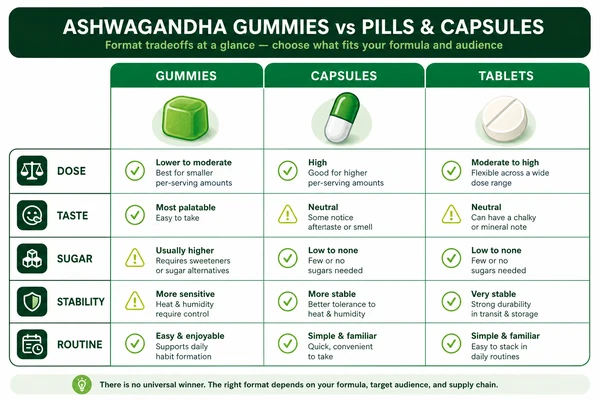
Gummies can win the routine. Capsules can win the dose.
Ashwagandha gummies are often stronger for taste and daily compliance. Pills and capsules are often stronger for dose density, simpler formulas, lower sugar, and easier stability.
Dose density
Capsules and tablets usually hold more active material in less space. This gives them an advantage when the product needs a larger extract serving or a simpler ingredient list.
Gummies have less room because the base itself takes space. Gelatin or pectin, sugars or sweeteners, acids, flavors, colors, moisture, and process needs all compete with the botanical extract. If the ashwagandha dose is high, a gummy may need more pieces per serving or a larger gummy size.
| Factor | Gummies | Capsules | Tablets |
|---|---|---|---|
| Dose density | Lower to moderate | Higher | Higher |
| Taste masking | Required | Usually not needed | Usually not needed unless chewable |
| Sugar or sweetener pressure | Common | Minimal | Minimal |
| Formula complexity | Higher | Lower | Medium |
| Heat and moisture exposure | Higher | Lower | Lower |
| Routine compliance | Often strong | Depends on consumer | Depends on consumer |
Taste masking
Ashwagandha can taste earthy and bitter. A capsule hides that taste. A gummy must manage it inside the product experience.
Good taste masking is not just adding more flavor. The production team may need to balance acids, sweeteners, flavor notes, aftertaste, texture, color, and aroma. If the flavor system is too heavy, the product may become too sweet or artificial. If it is too light, repeat use drops.
This is why sample approval should use the actual extract, not a placeholder botanical. Different extract preparations can behave differently in the same gummy base.
Sugar and sweeteners
Many consumers choose gummies because they are enjoyable. Some consumers reject them because of sugar, sweeteners, or sticky texture.
This tradeoff matters for brands. A low-sugar or sugar-free ashwagandha gummy may be attractive, but it can create texture, stability, and taste challenges.
A traditional sugar-based gummy may taste better and process more easily, but it may not fit every clean-label or wellness-positioning goal.
Reducing the active dose to make taste easier is not a clean solution. It may protect the flavor but weaken the claim. A better approach is to decide the claim level first, then test whether the gummy format can support it.
Stability and shelf life
Capsules are not risk-free, but gummies face extra moisture and heat concerns. A gummy can soften, sweat, stick, dry out, or change texture if the formula and packaging do not match the storage environment.
Ashwagandha adds another layer because the brand may want to preserve an active-marker target. The formula should be checked not only for texture stability but also for label-claim logic over shelf life.
Packaging, desiccant use, bottle or pouch choice, fill count, seals, and shipping conditions all matter. A gummy that passes a lab taste panel can still fail commercially if it cannot tolerate the real distribution route.
Consumer compliance
This is the strongest argument for gummies. Many consumers dislike swallowing pills. A gummy can make the routine easier, especially for a daily wellness product.
For brands, compliance is a commercial advantage only if the formula still has substance. A delicious gummy with a weak extract story may gain trial but lose trust. A serious gummy should use palatability to support repeat use, not to hide a thin formulation.
The practical decision is not gummies versus capsules in the abstract. It is whether the intended consumer, claim level, and supply chain fit the format.
When Gummies Are a Good Format
The best gummy projects start with the right job for the format.
Gummies are a good format when taste, routine, consumer acceptance, and moderate serving design matter. They are weaker when the product needs high dose density or very simple excipients.

For consumers who avoid pills
Some consumers will not take capsules every day. For them, a gummy may make the supplement routine more realistic. This can matter for ashwagandha because wellness products often depend on consistent use.
The brand should still avoid turning "easy to take" into "guaranteed result." The practical value is routine fit. A gummy can lower the friction of daily use, but it does not remove the need for a sound extract and label claim.
If the target consumer strongly prefers chewables, the gummy format may be worth the extra formulation work. The brand just needs to budget for that work instead of seeing gummies as an easy packaging choice.
For routine-friendly wellness products
Ashwagandha gummies can work well in calm, unwind, or nighttime routine products when the formula is built around a realistic serving. The gummy form can support a sensory ritual: flavor, chew, timing, and habit.
This is especially useful for early product-development teams that want a consumer-friendly format in the stress-support category. The product can feel approachable without becoming a medical promise. That balance is important.
The routine angle also affects packaging and serving count. A daily gummy should be easy to dose, easy to store, and stable enough to keep its quality through the full consumption period.
For lower-dose or multi-ingredient formulas
Gummies can also fit lower-dose or multi-ingredient formulas, but the brand has to watch the math. Every added ingredient competes for space.
A formula with ashwagandha, magnesium, L-theanine, botanicals, vitamins, or other actives can become crowded quickly.
In a multi-ingredient gummy, I would start by asking which ingredient owns the claim. If ashwagandha is the hero, the extract should not be buried at a token level. If it is a supporting botanical, the label and copy should make that role clear.
Brands exploring gummy vitamin manufacturing should frame ashwagandha as a format-feasibility project, not only a flavor project. The production brief should connect active loading, texture, stability, packaging, and documentation before the sample is approved.
When Capsules or Tablets May Be Better
Gummies are popular, but popularity is not a formulation argument.
Capsules or tablets may be better when the brand needs higher extract loading, fewer excipients, lower sugar, stronger shelf-life resilience, or a cleaner label structure.
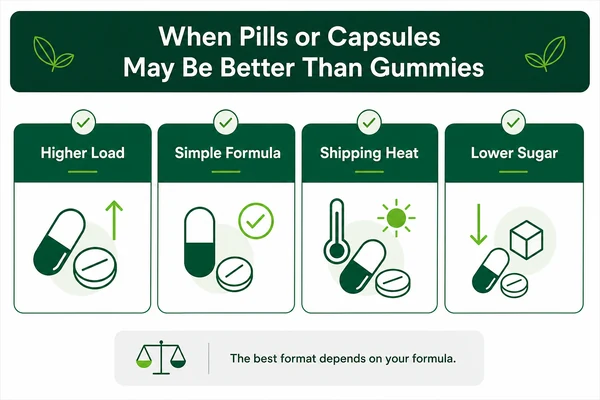
When dose matters most
If the product concept needs a larger ashwagandha extract serving, capsules may be the cleaner route. The brand can often fit more active material with fewer taste and texture compromises.
A gummy can still be possible, but the tradeoffs become visible. More gummies per serving may hurt compliance. Larger gummies may feel heavy. Stronger flavor systems may raise sugar or sweetener pressure. At some point, the format starts fighting the claim.
This does not make capsules more "effective" in every case. It means they are often easier to align with higher-dose positioning.
When clean-label simplicity matters
Capsules and tablets can be simpler from a label standpoint. A gummy usually needs a base system, sweetener system, acid system, flavor, color if used, and processing aids depending on the formula.
That does not make gummies bad. It means a clean-label gummy needs careful design. If the brand's main promise is a short ingredient list or very low sugar, capsules may support that story more easily.
For a gummy brand, the key is transparency. If the formula needs several excipients to create a stable, enjoyable chew, the brand should make sure that choice fits the target consumer's expectations.
When heat, humidity, or shipping risk is high
Gummies can be sensitive to heat and humidity. This matters for e-commerce, warm climates, long transit routes, and warehouse storage.
The production team can reduce risk with formula design and packaging, but it cannot ignore the product's physical limits.
If the product will ship through hot routes or sit in uncontrolled storage, capsules or tablets may offer a more resilient format.
If the brand still wants gummies, packaging and stability planning should happen early. Bottle choice, seal, desiccant strategy, carton protection, and shipping assumptions should be part of the formulation conversation, not a last-minute packaging decision.
What Brands Should Verify Before Launch
A finished sample can taste good and still be commercially weak.
Before launch, brands should verify extract identity, standardization, serving-size math, flavor system, gummy base, packaging logic, stability plan, and finished product checks.
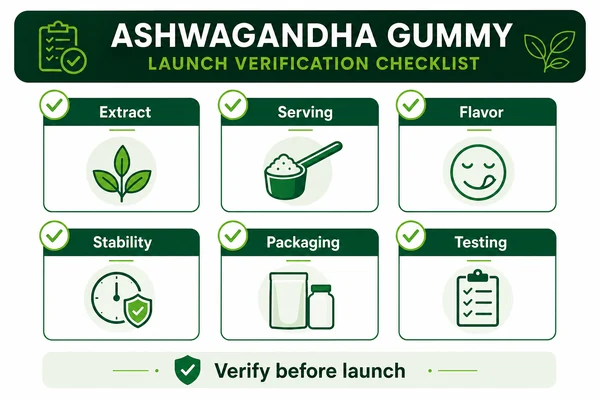
Extract identity and standardization
Start with the ingredient documents. The brand and production team should know the ashwagandha source, the extract type, the standardization marker, and whether the supplier documents support the intended label.
This is not paperwork for its own sake. It protects the formula from vague claims. It also gives the brand a better base for label review, batch consistency, and future supplier qualification.
Ask for batch-specific documentation before formula approval. If the supplier cannot document the marker profile, the formula should not carry a strong extract story.
Serving size and label claim
Serving size is where marketing and manufacturing meet. The label may look cleaner with one gummy per serving, but the formula may need two gummies to deliver a credible amount.
The brand should decide the serving logic before ordering packaging. Count per bottle, cost per serving, sugar per serving, claim wording, and repeat-purchase value all connect to this decision.
If the formula cannot deliver the planned active amount without damaging taste or texture, the claim should be adjusted before the label is approved.
Flavor system and gummy base
Ashwagandha taste masking should be tested with the actual extract, not a placeholder. Different extracts can behave differently in flavor, bitterness, color, aroma, and mouthfeel.
The gummy base matters too. Gelatin and pectin systems behave differently. Sugar-based and sugar-free systems have different stability and texture risks. Acid balance can affect taste and may also matter for active-marker retention.
This step usually needs more than one sample round. A gummy that tastes acceptable at a low extract load may not taste acceptable at the final serving target.
Stability and packaging
Stability testing should cover both physical quality and active-marker logic. The gummy should not become sticky, dry, deformed, discolored, or bitter before the intended shelf period ends.
Packaging is part of stability, not a separate design choice. Bottle or pouch material, seal quality, desiccant use, headspace, fill count, and shipping carton decisions can all affect the finished product.
Scale-up should also be considered before launch. A pilot sample may behave differently from a larger production batch because holding time, cooling rate, drying conditions, and packaging speed change at scale.
Finished product testing
Finished product testing is the final confirmation that the product delivers what the label declares. For an ashwagandha gummy making an extract or marker claim, the brand should have a plan to verify the finished gummy, not just the raw extract.[^5]
This testing protects the brand when retail buyers, e-commerce platforms, or regulated-market partners ask for documentation. It also catches production realities that ingredient paperwork cannot show.
| Launch checkpoint | What to check | Decision it supports |
|---|---|---|
| Extract documentation | Identity, plant part, standardization, supplier COA or equivalent documentation | Is the ingredient defensible? |
| Serving math | Extract per gummy, gummies per serving, claim level | Is the label realistic? |
| Flavor and base | Bitterness, texture, active load, base choice | Will consumers repeat use? |
| Packaging and stability | Moisture, heat, stickiness, shelf assumptions | Will the product survive distribution? |
| Finished product testing | Marker or potency result on finished gummies | Can the brand prove delivery? |
Safety and Claim Boundaries
Ashwagandha copy should be useful, but it should stay disciplined.
Ashwagandha gummy copy should avoid disease claims, medical-resolution claims, universal dosage advice, and unsupported hormone, fertility, performance, or medical promises.
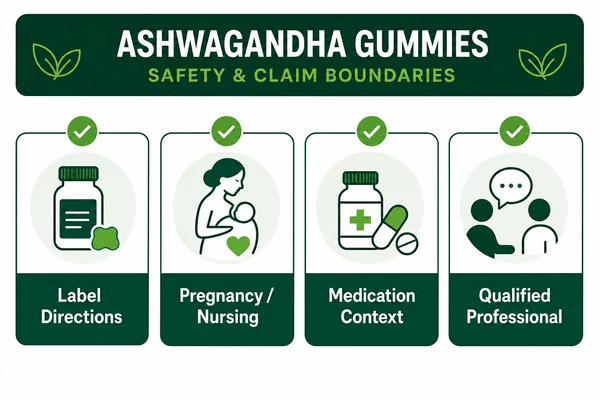
Short-term evidence only
A careful article should acknowledge that much of the public discussion around ashwagandha is tied to specific preparations, dose ranges, and study periods. That does not automatically transfer to every gummy on the market.
For a brand, this means the formula should not borrow confidence from unrelated products. If the evidence belongs to a specific extract or preparation, the gummy should be evaluated against its own extract, serving size, and finished-product proof.
Labels and marketing should also avoid implying that indefinite daily use is proven for every consumer. Usage directions and cautions should be reviewed for the target market.
Medication and health-condition cautions
Consumers who are pregnant, nursing, taking medication, managing a medical condition, or preparing for surgery should ask a qualified professional before using ashwagandha supplements.[^6]
This kind of caution belongs in responsible consumer education and label review.
Brands should also avoid writing as if every consumer is the same. The product can be positioned as a general wellness supplement, but the copy should not remove personal health context.
These cautions are not a weakness in the product story. They are part of credible supplement communication.
Structure-function claims
Structure-function claims need discipline. Stress support, relaxation support, calm support, and sleep support can be reasonable directions when the formula and review support them.
The copy should still avoid implying medical intervention, prevention, diagnosis, or guaranteed outcomes. A gummy can support a calm routine. It should not promise to erase stress. A nighttime formula can support relaxation before bed. It should not claim to fix insomnia.[^2]
| Claim direction | Safer framing | Avoid |
|---|---|---|
| Stress | Supports a calm routine | Treats anxiety |
| Sleep | Supports relaxation before bed | Cures insomnia |
| Wellness | Supports balance and daily routine | Guarantees results |
| Ingredient proof | Standardized extract and serving-size verification | Clinical-equivalent result without proof |
What not to promise
Do not promise testosterone increases, guaranteed weight loss, sexual performance, fertility outcomes, anxiety treatment, insomnia relief, or disease-related benefits. Also avoid saying that gummies work better than pills in a universal way.
The stronger message is more practical: this format may be a good fit when the formula proves extract identity, active-marker target, serving size, taste acceptance, stability, and finished product potency.
When in doubt, the label claim should be reviewed before production packaging is locked. It is easier to adjust claim language early than to rework labels, cartons, listings, and retailer materials later.
So, Should You Choose Ashwagandha Gummies?
The right answer depends on the job the format must do.
Choose ashwagandha gummies when routine, taste, and consumer acceptance matter and the proof chain is strong. Choose capsules or tablets when dose density, simplicity, or stability matters more.

For consumers
If you prefer gummies and the product has clear labeling, a recognizable extract, a sensible serving, and cautious claims, ashwagandha gummies can be a reasonable wellness format. Follow the product label. Do not use the gummy as medical care.
If you want the simplest way to compare products, look past the flavor first. Check the ashwagandha amount per serving, the extract information, the claim language, and the cautions. A good gummy should make those details easier to understand, not hide them.
The format should make the routine easier. It should not make the active story harder to verify.
For supplement brands
For brands, the decision is more commercial. A gummy may improve trial, routine fit, and category appeal.
It can also create extra work in active loading, bitterness control, sugar or sweetener balance, texture, packaging, and batch verification.
I would choose gummies when the intended serving is realistic, the claim can stay compliant, and the production team can prove the finished product. I would choose capsules or tablets when the formula needs higher active density, a shorter ingredient list, or more resilience in difficult shipping conditions.
This is a product-development decision, not a format preference contest. The right format is the one that can deliver the promise with fewer hidden compromises.
The Talvenda manufacturing lens
The Talvenda lens is simple: do not approve the format before the proof chain is clear. For ashwagandha gummies, that proof chain starts with the extract and ends with the finished gummy.
Before moving from sample work to commercial production, the brand team and production team should align on the extract documents, withanolide target, serving size, taste masking, gummy base, packaging, and finished product testing plan. This is where a gummy concept becomes a product that can be manufactured with more confidence.
Talvenda can support brands in formula feasibility review, private label development, packaging coordination, and scale-up planning for gummy products. For ashwagandha, the useful first conversation is not "can we make it sweet?" It is "can this specific formula carry the active-marker story through production and still make sense for the consumer?"
FAQ
Do ashwagandha gummies work as well as pills?
They can, but only if the gummy delivers a comparable and well-documented extract serving. Capsules often have better dose density. Gummies often have better taste and routine fit. The better format depends on the formula, label claim, and finished-product proof.
Are ashwagandha gummies effective for sleep?
Ashwagandha gummies may support a nighttime wellness routine when the formula and claim are appropriate. They should not be described as an insomnia solution or sleep disorder support product. Consumers with ongoing sleep problems should speak with a qualified professional.
How long do ashwagandha gummies take to work?
There is no universal timeline that applies to every gummy. Follow the product label and remember that evidence is tied to specific preparations and use patterns. Brands should avoid promising a fixed result time unless the claim review supports it.
What should be on an ashwagandha gummy label?
A useful label should make the serving size clear and identify the ashwagandha amount or extract information. For stronger products, brands should also consider how standardization, cautions, directions, and structure-function claims are presented.[^7]
Are ashwagandha gummies safe?
Many consumers use ashwagandha as a wellness supplement, but it is not right for everyone. Pregnant or nursing consumers, people with health conditions, and people taking medication should ask a qualified professional before use.
Conclusion
Ashwagandha gummies can work when the formula proves extract identity, delivered serving, stability, claim discipline, and finished-gummy potency.
For consumers, that means reading past the flavor and checking whether the product explains what is actually inside each serving. For supplement brands, the Talvenda lens is to frame the gummy as a formulation feasibility project before positioning it as a marketable format.
The proof chain is the product. When the extract, dose, base, packaging, and finished testing all support the label story, an ashwagandha gummy can be a credible wellness format. When they do not, the gummy is only a pleasant chew with an uncertain active promise.
For an ashwagandha gummy concept, the weak point is often not the benefit idea, but whether extract choice, taste, serving goal, and claim language can work together as a product. As an OEM/ODM gummy manufacturer, Talvenda can help turn that direction into a practical route review across low-MOQ market-tested in-stock gummies, stock formula modification, and custom gummy development. The goal is to show what can move into sample development, what needs clearer documentation and testing expectations, and what should be reserved for scale-up support, so the brand avoids overbuilding before the first version is tested. Start with the project inquiry form.
[^1]: NIH Office of Dietary Supplements, Ashwagandha Health Professional Fact Sheet. Used for botanical/extract context, withanolide discussion, and evidence-boundary framing. Scope note: supports general ingredient context only, not product-specific efficacy. [^2]: FDA, Structure/Function Claims and FDA, Label Claims for Food & Dietary Supplements. Used for claim-boundary discipline between support language and disease-treatment claims. [^3]: NCCIH, Ashwagandha: Usefulness and Safety. Used for public-use context around stress, anxiety, sleep, and safety caution. Scope note: does not validate any specific gummy formula. [^4]: Cheah KL, Norhayati MN, Husniati Yaacob L, Abdul Rahman R. Effect of Ashwagandha extract on sleep: A systematic review and meta-analysis, PLOS ONE, 2021. Used for cautious sleep-support evidence context only. [^5]: eCFR, 21 CFR Part 111 Current Good Manufacturing Practice in Manufacturing, Packaging, Labeling, or Holding Operations for Dietary Supplements. Used for specifications, production control, quality review, and finished-product documentation context. [^6]: NCCIH, Ashwagandha: Usefulness and Safety and NIH LiverTox, Ashwagandha. Used for conservative safety cautions, including medication/health-condition context and liver-related caution. [^7]: eCFR, 21 CFR 101.36 Nutrition Labeling of Dietary Supplements and FDA, Dietary Supplement Labeling Guide: Chapter VI. Claims. Used for Supplement Facts, serving-size, and claim-presentation context.