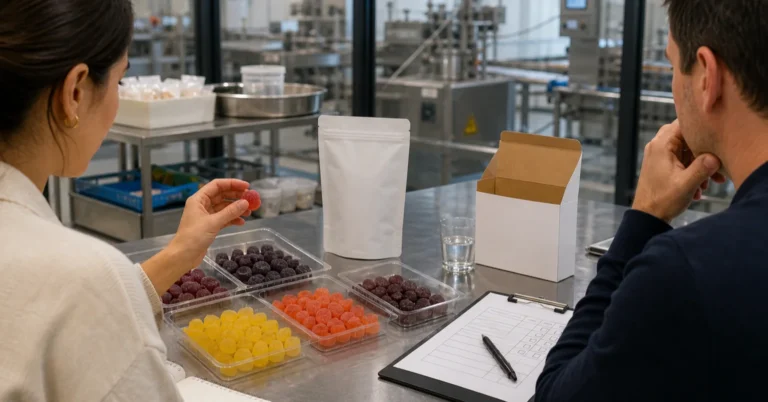


A strong vitamin D3 K2 gummies formulation can support a credible supplement launch, but it requires more than putting two vitamin names on the front label. The brand also needs a documented path from ingredient source to finished-batch release, with serving design, packaging, and claim review considered before artwork and quotation are treated as final.
Vitamin D3 K2 gummies are ready for serious product development only when the D3 and K2 sources, fat-soluble active distribution, serving design, label language, packaging, stability plan, and finished-product proof are aligned.
For a consumer, the question may be whether vitamin gummies work or whether gummies are easier to take than pills. For a supplement brand, the more useful question is whether the proposed gummy can carry its declared amounts consistently from ingredient receipt through normal storage. That is where formulation and label readiness meet.
Decision snapshot
- Confirm that the D3 and K2 source documents match the ingredient names and label story.
- Check how the fat-soluble actives will be dispersed in the gummy system and verified in finished product.
- Decide the serving count before the flavor, shape, and bottle size are locked.
- Review Supplement Facts units and proposed structure for the target market before printing artwork.
- Treat packaging, stability, batch testing, and COA alignment as part of the product brief, not as late-stage paperwork.
What Are Vitamin D3 K2 Gummies?
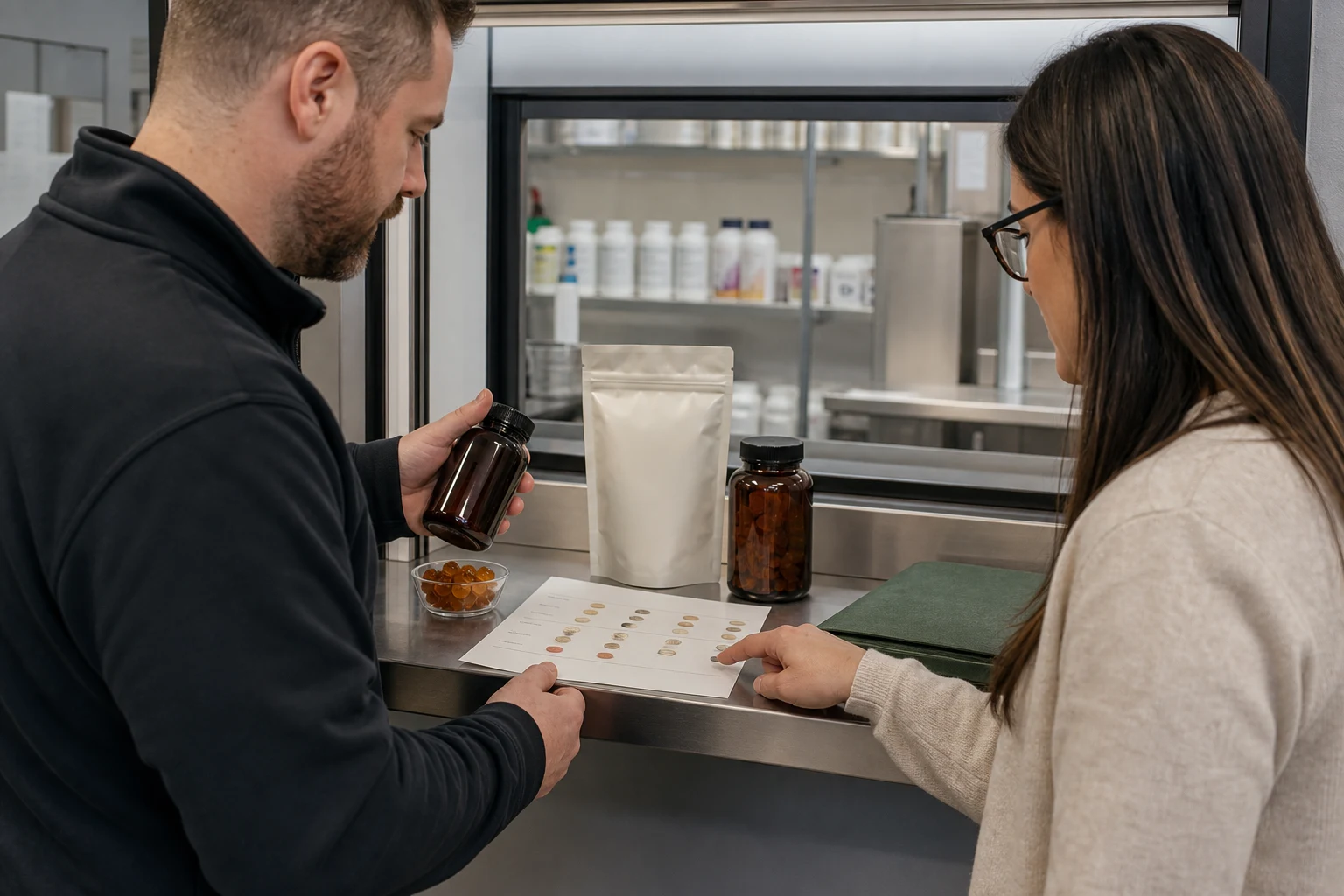
Vitamin D3 K2 gummies are chewable supplements that combine vitamin D3 and vitamin K2 in a flavored gummy base.
Vitamin D3 K2 gummies are a delivery format, not a guarantee of a particular health outcome; the product still depends on accurate actives, a workable gummy system, and a label that the finished batch can support.

D3, K2, and the label story brands want to tell
Vitamin D3 and vitamin K2 are often placed together because brands want to tell a connected story around bone, calcium, or broader wellness positioning. That story can be commercially understandable, but it is not a substitute for a documented product-development plan.
The first question is what the label actually names. A D3 ingredient may be sourced in different forms, and K2 may be specified by a particular form or source. NIH distinguishes supplemental vitamin D2 and D3 and notes that D3 can be sourced from lanolin or lichen, which is one reason a source story should be checked against the supplier specification rather than assumed from a front-label phrase.[^1] The label, supplier specification, purchasing record, and finished-product documentation should all refer to the same material. A brand should not approve artwork from a marketing description that has not been reconciled with the input specification.
The second question is how much detail the target market requires. A label may need to show the vitamin amount in a particular unit, identify the source, or use a market-specific Daily Value framework. For U.S. dietary supplements, FDA guidance describes the Supplement Facts panel as the place for serving size, servings per container, and the names and quantities of dietary ingredients.[^2] Those decisions belong in the regulatory and label-review process before the formula is treated as final.
Why gummies can fit this nutrient pair
Gummies can fit D3 and K2 because these actives are typically used at a relatively small mass compared with high-load minerals or sports-nutrition ingredients. That can leave more room for the gummy base, flavor, color, and a consumer-friendly piece count.
That does not mean the project is automatically simple. Fat-soluble actives can require careful pre-dispersion, carrier selection, and mixing control. A small active amount can still create a large quality problem if it is not distributed evenly or if the input form is incompatible with the base. A gummy that tastes good in a bench sample is not automatically a gummy that will deliver consistent finished-product results at commercial scale.
Where the consumer question becomes a formulation question
The phrase “do vitamin D gummies work?” usually asks about the active ingredient and the delivery format. A product team needs to translate that question into operational checks: Is the declared amount appropriate for the intended market? Can the gummy carry it at the proposed serving size? Can the manufacturing process distribute it consistently? Can the packaging help preserve the product through its intended storage period?
This is why I do not evaluate a D3/K2 gummy only from the front panel. I separate the project into four proof points: source-to-label match, consistent fat-soluble active distribution, a workable serving design, and finished-gummy support for the label after normal storage.
Why D3/K2 Gummies Need More Than a Simple Front Label
The front label may be simple, but the back label depends on a chain of specifications and checks.
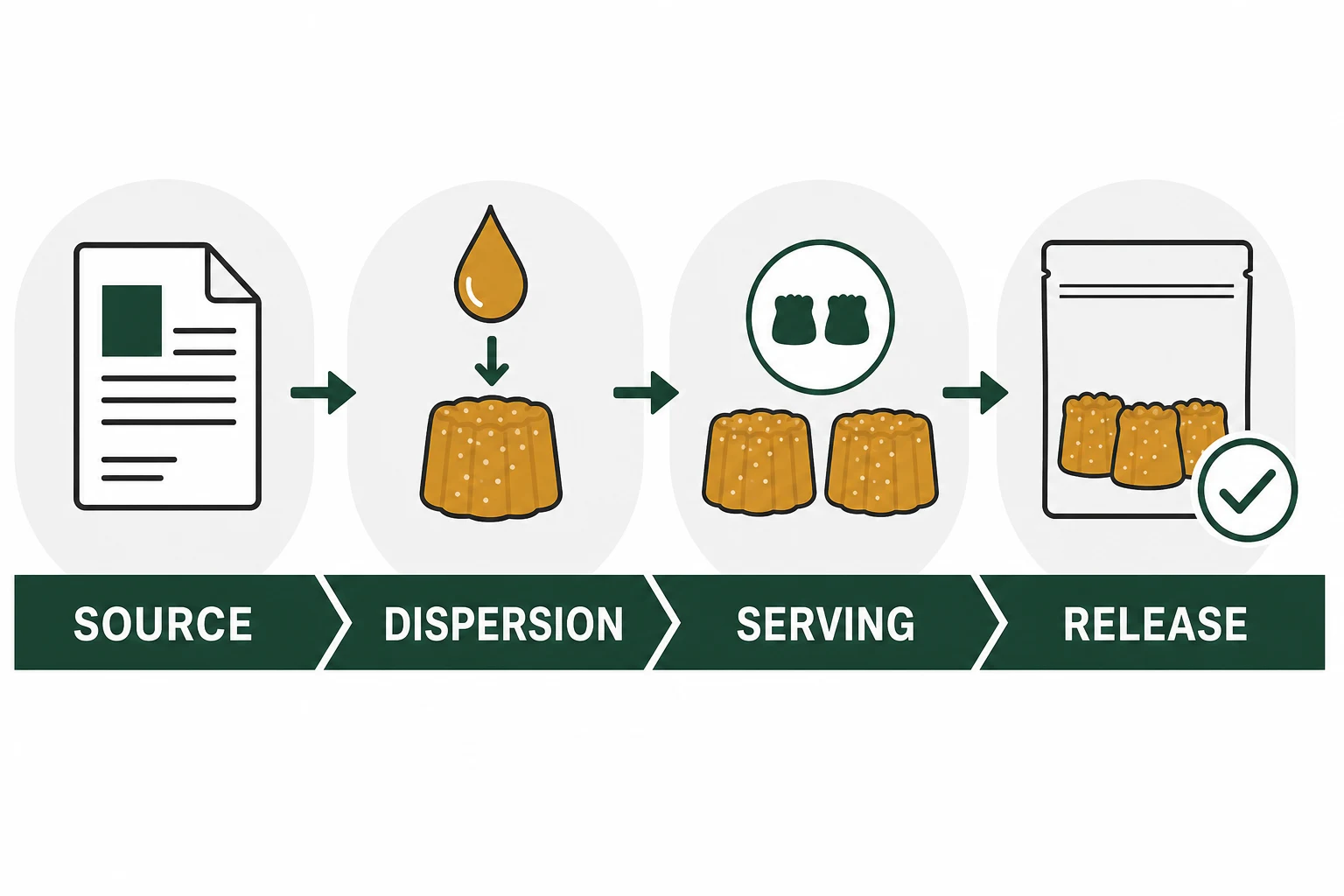
D3/K2 gummy label readiness depends on four linked controls: documented ingredient identity, even active distribution, a clear serving basis, and finished-batch verification against the declared amount.
Source documentation for D3 and K2
Source documentation should answer more than whether a supplier can provide a generic certificate of analysis. It should identify the ingredient material, the relevant form, the specification basis, storage expectations, lot traceability, and the tests covered by the document.
For D3, the source and form should match the intended label description. For K2, the brand should clarify the specified form and whether the supplier documentation supports the exact ingredient name used in the product brief. If the brand wants a vegan, fermentation-derived, or other source story, that story needs its own documentation rather than an assumption based on a supplier's marketing page.
I would create a simple source-to-label map before sampling:
| Product decision | Evidence to request | Failure mode if skipped |
|---|---|---|
| Vitamin form and source | Ingredient specification and supplier identity documents | Label language does not match the input |
| Declared amount | Lot-specific COA and finished-product test plan | Raw-material paperwork is mistaken for finished-product proof |
| Dietary positioning | Source statement and relevant allergen or processing information | Vegan or clean-label story cannot be supported |
| Storage and handling | Supplier storage guidance and packaging assumptions | Input changes before it reaches production |
The goal is not to collect paperwork for its own sake. The goal is to make every label promise traceable to an input, a process decision, or a finished-product check.
Fat-soluble active dispersion in a gummy base
D3 and K2 are fat-soluble vitamins, so a formulation team must consider how the selected forms will disperse within the gummy system. A supplier may offer a premix, carrier-based material, or other format intended to improve handling. The right route depends on the ingredient specification, the gummy base, the intended piece weight, and the process used by the manufacturer.
The key manufacturing risk is local concentration. A small active load does not automatically distribute itself evenly. Mixing order, premix preparation, batch size, temperature exposure, and the physical behavior of the ingredient can all affect uniformity. The exact process parameters are formulation and manufacturing controls that should be validated by the qualified team; they should not be copied from a generic online recipe.
During sampling, I would ask how the manufacturer will assess distribution rather than accepting “the actives were added to the batch” as the full answer. The assessment may include in-process controls, piece-weight review, finished-product sampling, and potency testing appropriate to the product. The specific test method and sampling plan should be documented before commercial production.
Serving size, gummy count, and declared amount
Serving design is one of the easiest parts of a D3/K2 gummy concept to postpone and one of the most expensive parts to change late. A brand may want one gummy per day, but that choice must fit the declared amounts, piece weight, taste, texture, and target price.
The label should make the serving basis obvious. Consumers should be able to tell whether the declared vitamin amount applies to one gummy or to a multi-piece serving. Buyers and quality teams should also be able to trace the declared amount back to the formulation worksheet and finished-batch testing plan.
For a brand, the tradeoff usually looks like this:
| Serving route | Potential advantage | Development pressure |
|---|---|---|
| One piece | Simple routine and compact front-panel story | Less room for taste, texture, and active-handling flexibility |
| Two or more pieces | More flexibility for piece weight and flavor balance | Higher daily count, larger package, and clearer serving language needed |
| High-potency positioning | Can support a specific market brief | Greater claim, label, tolerance, and regulatory-review pressure |
The final decision should be made with the target market, formula route, packaging, and label review in the same conversation. A serving count chosen only for marketing convenience can create a production problem later.
Formulation Checks Before Sampling
The sample should test whether the concept works as a product, not only whether the gummy tastes pleasant.
Before sampling, brands should evaluate active load, piece count, texture, flavor, color, dietary route, sweetener system, and stability assumptions as one connected formulation decision.

Active load and texture fit
D3 and K2 may not create the same bulk pressure as a high-dose mineral, but the selected ingredient forms and carriers still occupy space and can affect the gummy matrix. The formula team should review the total active and excipient load, not only the headline vitamin amount.
Texture is also a commercial variable. A gummy can meet a target amount on paper and still be too soft, too firm, sticky, gritty, or difficult to remove from the package. The evaluation should cover the first bite, repeated use, surface behavior, and storage changes. A sample that is attractive on day one is not enough evidence for a commercial launch.
Taste, color, and base-system compatibility
The base system needs to carry the selected actives without creating unwanted taste, odor, or color changes. Flavor and color can influence how a buyer interprets a product, but they can also mask an emerging stability or raw-material issue. For that reason, the sample review should include a record of what changed between versions.
I recommend keeping a sample decision record with at least these fields:
- Formula version and date.
- Active source and supplier lot information.
- Gummy base route, such as gelatin or pectin.
- Flavor, color, sweetener, and acid system.
- Piece weight, serving count, and packaging assumption.
- Sensory result, texture result, and open questions.
- Testing or documentation still required before approval.
This record makes the next conversation more useful. Instead of saying that one sample “felt better,” the team can discuss whether the change improved taste while creating a moisture, color, or documentation tradeoff.
Vegan, sugar-free, and clean-label tradeoffs
Vegan, sugar-free, and clean-label positioning can all be viable directions, but each one changes the formulation decision. A vegan route may require a pectin or another non-gelatin base. A sugar-free route may require a different sweetener and bulking system. A clean-label brief may restrict colors, flavors, carriers, or coating choices.
These choices should be treated as design constraints, not as badges added after the sample is finished. The team should ask whether the selected D3 and K2 forms are compatible with the dietary positioning and whether supplier documents support the language the brand wants to use. It should also confirm that the alternative base still meets the target texture, moisture behavior, piece count, and packaging plan.
The lowest-ingredient-count formula is not always the most launchable formula. A better decision is the one that satisfies the target label promise while keeping taste, texture, stability, documentation, and cost within the project's boundaries.
Label and Claim Considerations for D3/K2 Gummies
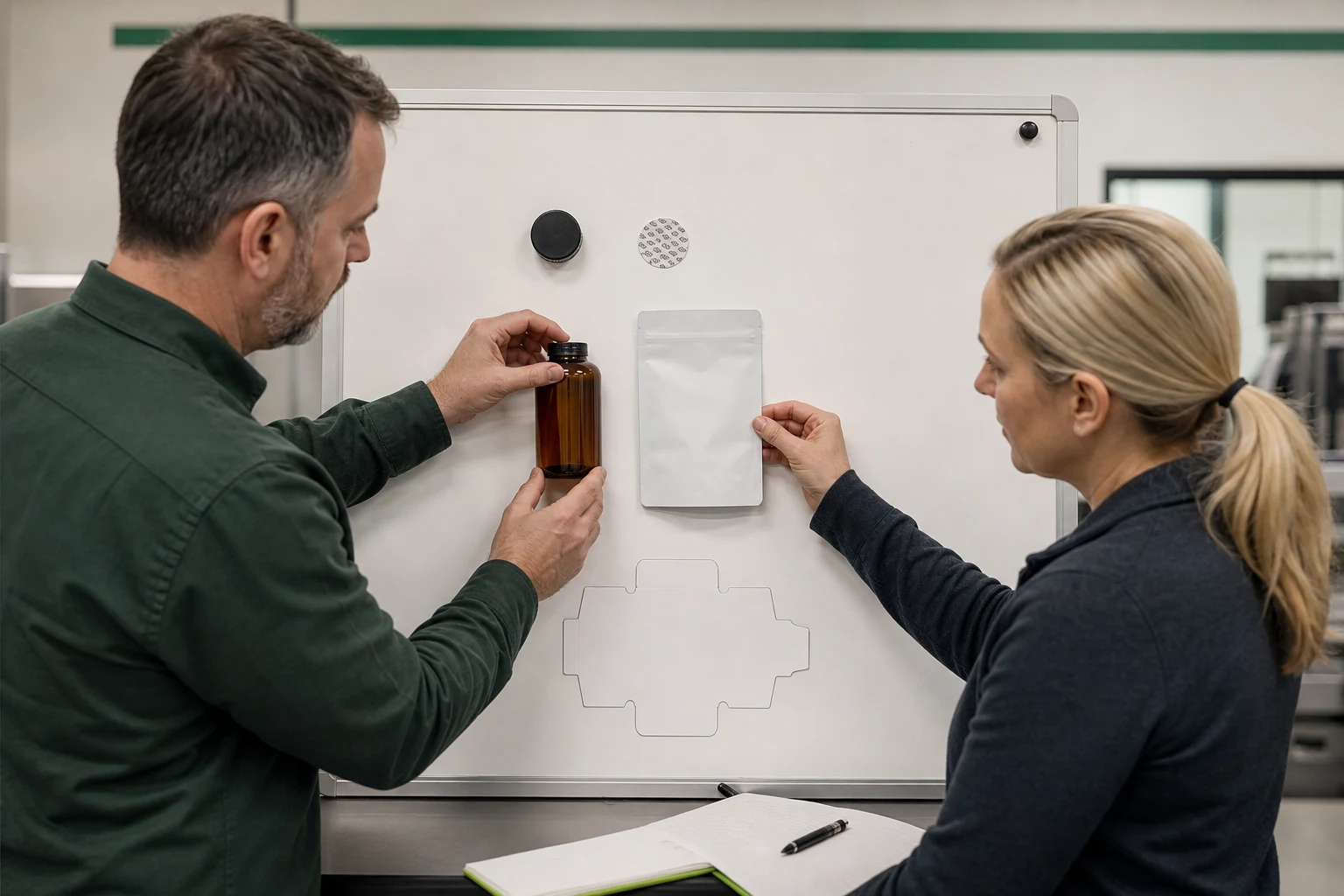
Supplement Facts and marketing claims should be reviewed together because the label establishes the product's declared identity.
D3/K2 gummy claims should be treated as a market-specific review task: the Supplement Facts panel, ingredient source, finished-batch evidence, website copy, and advertising language must tell the same defensible story.
Supplement Facts and unit clarity
The Supplement Facts panel should make the serving size, servings per container, vitamin amounts, and relevant sources clear for the target market. The unit presentation must be checked against the applicable label framework rather than copied from a competitor's product.
One practical control is to compare four versions of the same amount:
- The approved formulation worksheet.
- The supplier specification and purchasing record.
- The Supplement Facts draft.
- The finished-product test and release record.
If these records use different names, units, or serving bases, the discrepancy should be resolved before artwork approval. A small unit or serving mismatch can make a product look inconsistent even when the underlying formula has not changed.
The label team should also review source statements, allergen declarations, dietary statements, lot coding, storage language, and any required disclaimer or contact information for the target market. As a gummy manufacturing and product-development partner, Talvenda can support the manufacturing-side review, but the responsible brand and qualified regulatory reviewer must own the final legal and market-specific decision.
Bone, immune, and calcium-language boundaries
Brands often consider bone, immune, calcium, or cardiovascular language when positioning D3/K2 products. Those themes may be commercially relevant, but product content and label copy should not treat a nutrient pairing as automatic permission to make a health promise.
The safer workflow is to separate three questions. First, what nutrient function or structure-function language may be acceptable in the intended market? Second, what exact wording will appear on the label, product page, ads, and retailer content? Third, what evidence and documentation does the brand retain for that wording?
Avoid turning a general nutrient explanation into a promise that the finished product will prevent a disease, redirect calcium, improve a clinical outcome, or produce a guaranteed result. FDA's dietary-supplement claims guidance is a useful starting point for the U.S. claim boundary, but it does not replace market-specific regulatory review.[^3] A manufacturer can flag wording for review and keep the formula, label, and testing records aligned. The brand and its regulatory advisers must make the final claim decision.
Safety and interaction wording that needs review
Vitamin-related products can raise safety and interaction questions, especially when a consumer has a medical condition or uses medication. A manufacturing article should not answer those questions with individualized directions.
For label development, the useful task is to identify where review is needed. The brand should route warning language, population restrictions, and interaction statements through an appropriately qualified reviewer for the target market. The manufacturer should not improvise consumer medical advice in a product brief or sales page.
This boundary also applies to FAQ copy. “Can I take this every day?” is a consumer question, but the responsible answer depends on the actual product, serving, market, user context, and professional guidance. A launch-ready article can explain the review process without giving a universal schedule or personal recommendation.
Stability, Packaging, and Finished-Product Proof
The label is a promise made at release, while the product is expected to remain acceptable through normal storage.
A D3/K2 gummy needs a stability and packaging plan that connects active potency, moisture, texture, color, microbial control, and finished-batch testing to the intended storage conditions.
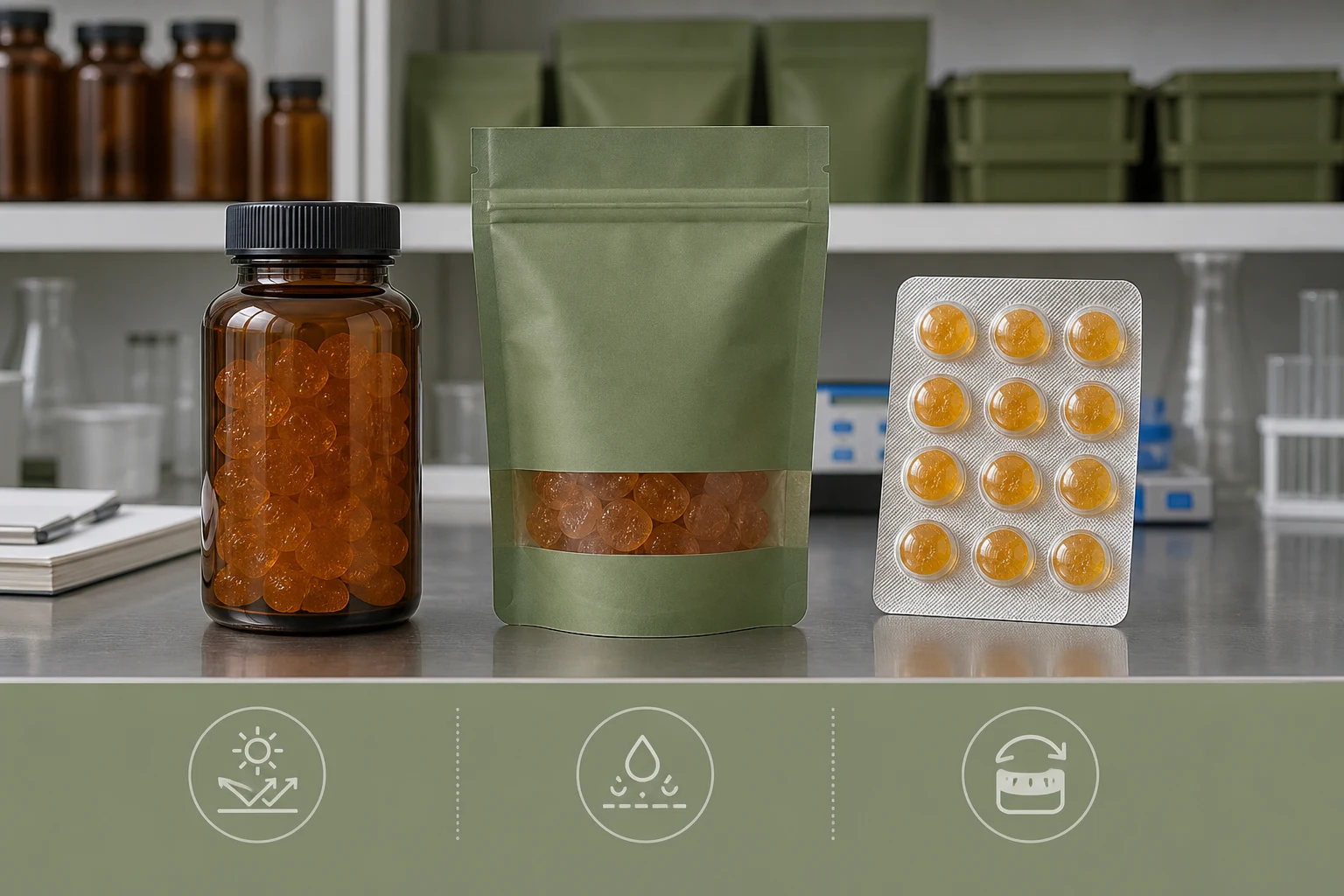
Potency through normal storage
Stability review should consider more than whether the gummy remains edible. The team should define what it needs to monitor: active potency, appearance, color, odor, texture, moisture behavior, package integrity, and relevant microbiological controls.
D3 and K2 source forms, the gummy base, acidity, heat exposure, light exposure, oxygen, and moisture can all influence the product's behavior. The specific risk profile depends on the actual formulation and package. That is why a generic “gummies are stable” statement is not enough for a label-ready brief.
The brand should ask when stability samples will be taken, what tests will be used, what storage assumptions apply, and how the results will be documented. A raw-material COA can confirm an input at receipt; it cannot replace evidence about the finished gummy after production and storage.
Packaging assumptions for gummy vitamins
Packaging should be selected with the gummy's moisture sensitivity, expected channel, serving count, and handling conditions in mind. A bottle, pouch, blister, or bulk format may create different assumptions for headspace, opening frequency, transport, and consumer use.
The packaging conversation should cover:
| Packaging question | Why it matters |
|---|---|
| How often will the package be opened? | Repeated exposure may change moisture and texture behavior |
| Is the product shipped through warm or humid conditions? | Transport assumptions can affect stability risk |
| Does the package support the serving count? | A crowded bottle can damage the user experience |
| How will lot and expiry information be shown? | Traceability must survive the commercial workflow |
| Is a desiccant, liner, seal, or other component needed? | The final package should match the formula and storage plan |
The correct package is not the most attractive container in a supplier catalog. It is the package that supports the formula, the intended channel, the label information, and the evidence plan.
Finished-batch testing and COA alignment
Finished-batch testing should be defined before production, not after a result raises a question. Depending on the product and market, the plan may include active potency, identity or verification, microbiological controls, physical checks, and other quality attributes selected by the responsible quality team.
The COA should be understood for what it covers. A supplier COA may describe a raw material. A finished-product COA may describe a released batch. A third-party certificate may describe a facility or a specific program. These are not interchangeable proof points.
I would ask for a release map that shows which document supports which decision:
- Input identity and specification.
- Batch receipt and lot traceability.
- In-process controls relevant to distribution and piece weight.
- Finished-batch potency and other release checks.
- Packaging and storage assumptions.
- Stability evidence and any follow-up action.
That map helps a buyer see whether the manufacturer can support the complete product story instead of only supplying a raw-material file.
How Brands Should Brief a Manufacturer
The quality of the first manufacturer conversation depends on the quality of the product-development brief.
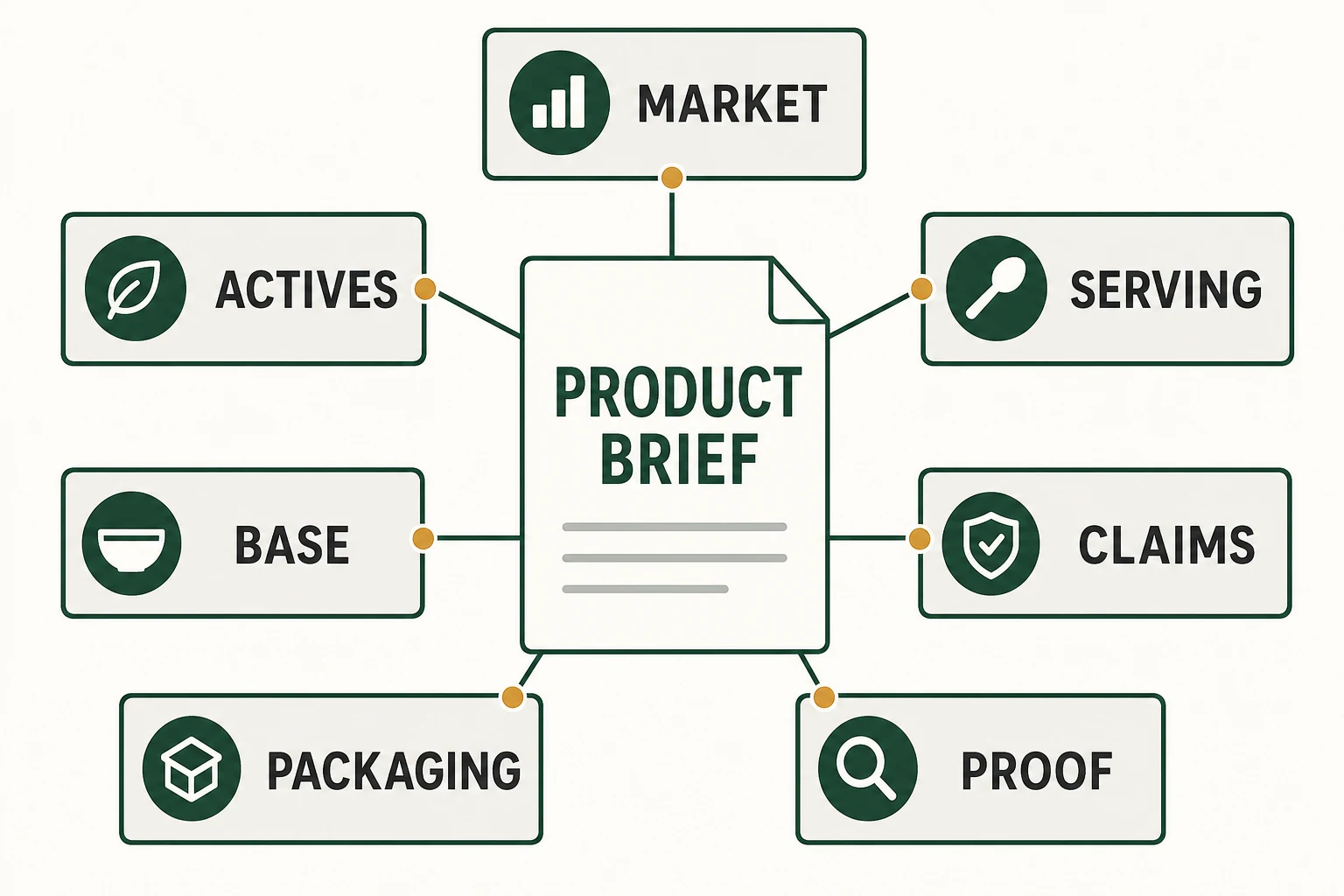
A manufacturer-ready D3/K2 gummy brief should define the market, actives, serving design, dietary route, label story, packaging, testing expectations, and scale-up questions before quotation.
What to define before quotation
Before asking for a quotation, the brand should describe the product it is actually trying to launch. “Vitamin D3 K2 gummies” is a starting point, not a complete specification.
| Brief item | Questions to define |
|---|---|
| Market | Which country or sales channel will receive the product? |
| Active concept | Which D3 and K2 forms or source stories are being considered? |
| Serving design | How many pieces should a consumer take per serving? |
| Gummy route | Gelatin, vegan, sugar-free, organic, or another constraint? |
| Sensory target | Flavor family, color, texture, shape, and coating expectations |
| Label story | Which wording is desired and which wording is still under review? |
| Packaging | Bottle, pouch, blister, bulk, count, and opening assumptions |
| Proof plan | Which input, in-process, finished-batch, and stability documents are needed? |
| Commercial target | Initial volume, MOQ questions, lead-time expectations, and scale-up path |
This information helps a manufacturer identify the real development route. It also prevents a low initial quote from hiding later changes to the serving count, package, testing scope, or label.
Scale-up should be included in the same brief. The brand does not need proprietary machine settings, but it should ask which sample attributes are provisional, which controls will be repeated at pilot or commercial scale, who owns each release decision, and what change would trigger a new sample or label review. That makes the quotation more useful than a price built around an undefined bench concept.
What to verify before approving samples
The sample approval should record both what works and what remains unproven. A good flavor does not answer whether the active distribution is consistent. A clean-looking label does not answer whether the declared amount can be supported after storage.
Before approval, ask whether the sample matches the intended active source, piece count, size, base, flavor, color, dietary route, and packaging assumption. Ask what changed from the previous version and why. Ask which tests have been completed and which will occur only at pilot or commercial scale.
| Sample decision | What can be reviewed now | What may still need later proof |
|---|---|---|
| Sensory fit | Flavor, odor, chew, surface, and appearance | Behavior after normal storage and transport |
| Formula match | Ingredient list, active sources, base route, and serving design | Commercial-batch distribution and finished potency |
| Packaging fit | Proposed count, container size, closure, and label space | Container-closure performance under intended conditions |
| Documentation status | Available specifications, COAs, and version record | Lot-specific release documents and stability follow-up |
This distinction prevents a tasting approval from being mistaken for commercial release approval. The sample can be promising while its finished-batch and storage evidence remains open.
I would also verify that the sample decision does not accidentally lock a claim. If the front label says “bone support” or “immune support,” the team should know whether the wording has completed the required market-specific review. The sample should be approved as a product-development candidate, not as a finished regulatory decision.
When to link this project to gummy vitamin manufacturing
Brands that need a broader production overview can review Talvenda's gummy vitamin manufacturing resource. This D3/K2 guide owns the formulation and label-readiness decisions, while the broader manufacturing page explains the overall path from gummy concept to production.
For brands comparing format expectations, are gummy vitamins as effective as pills addresses the consumer-facing format question. The vitamin D3 and vitamin K2 pages provide ingredient context without replacing the combined gummy-development focus here.
Talvenda's useful role is to help translate a simple product idea into a manufacturer-ready brief: source documentation, formulation route, sample review, packaging fit, testing expectations, and scale-up coordination. The final formula, label, and claims still require the brand's responsible technical and regulatory review.
FAQ About Vitamin D3 K2 Gummy Development
Can D3 and K2 be made in gummy form?
Yes, D3 and K2 can be developed in a gummy format when the selected ingredient forms, gummy base, dispersion approach, serving design, and testing plan are compatible. The answer should be confirmed through formulation and finished-product review, not assumed from a competitor's label.
Are D3/K2 gummies better than pills?
Neither format is automatically better. Gummies may improve convenience or sensory appeal for some users, while pills may offer a more compact serving and simpler formulation route. For brands, the relevant comparison is whether each format can deliver a clear, stable, accurately labeled product for the intended market.
What makes a vegan D3/K2 gummy different?
A vegan D3/K2 gummy may require a different gelling system, sweetener and flavor balance, color route, source documentation, and packaging review. The vegan claim should be supported by the full ingredient and processing chain rather than by the D3 or K2 ingredient name alone.
What proof should a brand request before launch?
At minimum, the brand should request source specifications, lot traceability, relevant raw-material COAs, a formulation and serving record, finished-batch testing, packaging and storage assumptions, stability expectations, and a claim-review record. The exact scope should be set by the target market and the responsible quality or regulatory team.
Conclusion
D3/K2 gummy development is a coordination task. A credible vitamin D3 K2 gummies formulation needs source documents, dispersion, serving design, label language, packaging, stability, and finished-batch proof to support the same product story.
Talvenda's manufacturing role is to help brands turn that story into a clear development brief, sample decision, testing plan, and scale-up conversation without replacing the brand's qualified regulatory review. Brands ready to define the project can discuss the brief with Talvenda.
[^1]: "Vitamin D - Health Professional Fact Sheet", National Institutes of Health Office of Dietary Supplements, https://ods.od.nih.gov/factsheets/VitaminD-HealthProfessional/. Used for vitamin D2/D3 and source-route context. Evidence role: ingredient identity context; source type: official health-information source. Supports: D3 source language should be reconciled with the actual supplier specification. Scope note: Does not validate a finished D3/K2 gummy formula, label, or health claim.
[^2]: "Dietary Supplement Labeling Guide: Chapter IV. Nutrition Labeling", U.S. Food and Drug Administration, https://www.fda.gov/food/dietary-supplements-guidance-documents-regulatory-information/dietary-supplement-labeling-guide-chapter-iv-nutrition-labeling. Used for U.S. Supplement Facts and serving-information context. Evidence role: regulatory label context; source type: official regulatory guidance. Supports: U.S. dietary-supplement labels require a Supplement Facts framework covering serving and dietary-ingredient information. Scope note: Does not determine compliance for any specific market or product label.
[^3]: "Dietary Supplement Labeling Guide: Chapter VI. Claims", U.S. Food and Drug Administration, https://www.fda.gov/food/dietary-supplements-guidance-documents-regulatory-information/dietary-supplement-labeling-guide-chapter-vi-claims. Used for cautious U.S. dietary-supplement claim-boundary context. Evidence role: regulatory claim context; source type: official regulatory guidance. Supports: Claim wording requires review and should not be treated as an automatic result of nutrient pairing. Scope note: Does not authorize a D3/K2 claim or replace qualified regulatory review.